"The first victory we can claim is that our hearts are free of hatred. Hence we say to those who persecute us and who try to dominate us: ‘You are my brother. I do not hate you, but you are not going to dominate me by fear. I do not wish to impose my truth, nor do I wish you to impose yours on me. We are going to seek the truth together’. THIS IS THE LIBERATION WHICH WE ARE PROCLAIMING."
Oswaldo José Payá Sardiñas (2002)
Showing posts with label Drug trafficking. Show all posts
Showing posts with label Drug trafficking. Show all posts
Some commemorating Fidel Castro's birthday, such as the Cuba Solidarity Campaign in the United Kingdom, assert that "For
more than 65 years the Cuban Revolution has been an inspiration to
people around the world for its achievements in health, education,
internationalism and more.
Hasta Siempre, Comandante." Debated one of their leaders in 2017, and exposed his totalitarian orientation when he claimed North Korea was also a democracy.
This brings up a thought-provoking exercise. What would have
happened if the 65-year old communist dictatorship in Cuba had never come to
be? If Fidel Castro had never been born? Let us look at Cuba's pre-1959 and post-1959 and imagine "what might have been?"
The economy
In 1959 in terms of per-capita GDP Cuba was second to Chile and was
doing better than Costa Rica, the Dominican Republic, and Panama. Under communism. Cuba lagged well behind the other four countries. It would be fair
to say that in economic terms, despite billions in Soviet and Venezuelan subsidies that the past six and a half decades have been a disaster for Cuba.
Death count in Cuba
Firing squad in Cuba.
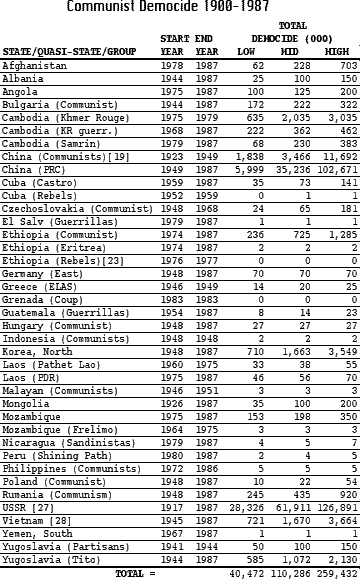
Tens of thousands of Cubans would still be alive today if Fidel Castro had never been born. In 1987, historian R. J. Rummel of the University of Hawaii reported that credible estimates of the Castro regime's death toll ran from 35,000 to 141,000, with a median of 73,000." Rummel made a career out of studying what he termed "democide," the killing of people by their own government.
Democracy restored in a post-Batista Cuba
Cuban diplomats pushed for the Universal Declaration of Human Rights in 1948
Many of the July 26th movement's leaders, who put in a lot of hard work fighting in the field and persuading Washington to impose an arms embargo on Fulgencio Batista in the spring of 1958, really desired the restoration of democracy in Cuba. Much like the vast majority of Cubans did. For this reason, Fidel Castro lied systematically throughout the 1950s and into 1960, insisting he respected democracy and civil freedoms while denying being a communist.
Fidel Castro carried out the consolidation of power and established a communist totalitarian dictatorship as he paid lip service to civil rights and imprisoned his fellow countrymen who had warned that communists were infiltrating the revolution as traitors.
The Castro
dictatorship early on began, with the assistance of the KGB, assisting
drug trafficking networks improve their ability to get more drugs into
the United States to strike at American youth. The Havana Cartel documentary provides an overview of these practices to the present day.
Havana hosted terrorists from Africa, the Americas, and Asia at the Tri-Continental Conference on January 3rd through 16th in 1966.At the Conference, Fidel “Castro insisted that ‘bullets not ballots’ was the way to achieve power.” Hemaintained “‘conditions exist[ed] for an armed revolutionary struggle.’
The Cuban dictatorship created the Organization for the Solidarity of the Peoples of Asia, Africa and Latin America (OSPAAL) to coordinate terrorist groups worldwide.
Havana then established terrorist training facilities in Algeria, Libya, and Cuba.
This had devastating effects on Europe, the Middle East, Africa, and Latin America; the United States was not immune.
Terrorists attack on U.S. soil killing Americans
The Puerto Rican terrorist group, Fuerzas Armadas de Liberación Nacional
Puertorriqueña, (FALN), from the mid-1970s through the mid-1980s,
carried out more than 130 bombings, including in the United States.
This group was started in the mid-1960s and received
advanced training in Cuba. This information is taken from Zach Dorfman’s
article “How Fidel Castro Supported Terrorism in America: ‘FALN was
started in the mid-1960’s with a nucleus . . . that received advanced
training in Cuba,’” published in The Wall Street Journal on June 8, 2017.
The FALN was responsible for the January 24, 1975 bombing of the historic Fraunces Tavern in New York City which killed
Alejandro Berger (28), James Gezork (32), Frank Connor (33), Harold H.
Sherburne (66) and wounded 63 others.
The same Puerto Rican terrorists were also responsible for a bombing spree in New York City
in August 1977 that killed Charles Steinberg, (age 26),
injured six, and forced the evacuation of 100,000 office workers; and
the purposeful targeting and maiming of four police officers, among many
other crimes.
Without Fidel Castro this terrorism international most likely would not have been brought into existence.
Installing and maintaining tyranny in Venezuela
Hugo Chavez and Fidel Castro
If Fidel Castro had never been born then Hugo Chavez would not have had a mentor and the assistance of the Cuban secret police to take over Venezuela
and turn it into the dictatorship it is today with Chavez's successor Nicolas Maduro, a Cuban mole, and tens of thousands of Cuban "advisers" torturing, jailing, and killing Venezuelans who want to live in freedom, and the ongoing crisis threatening the region.
Human rights in Cuba
If Fidel Castro had never been born then Cubans would not be going to prison for not sufficiently mourning the dictator's death in 2016, or worse yet providing a negative assessment of the regime he created. Thousands of men and women would not have spent decades in Cuban prisons for their political beliefs, and over 1,100 today.
There are also great concerns about the Cuban educational system today. First the issue of a system of education being transformed by the Castro dictatorship into a system of indoctrination and
secondly following the collapse of Soviet subsidies the material
decline of the entire system along with shortages of teachers.
Without
Fidel Castro intervention Cuba was on track to having a first class
education system without sacrificing civil liberties. Now it has neither.
Healthcare
The
Castro regime in the past failed to report Dengue (1997) and Cholera
(2012) outbreaks in Cuba. Jailing those who warned the world of the
threat. In 2017 the Cuban dictatorship failed to report thousands of Zika virus cases.
On November 29, 2018 The New York Times reported
that the Pan American Health Organization (PAHO), a division of the
World Health Organization (WHO) "made about $75 million off the work of
up to 10,000 Cuban doctors who earned substandard wages in Brazil." A
group of these Cuban medical doctors are now suing PAHO for the organization's alleged role in human trafficking.
This also raised questions on the relationship between PAHO, Cuba and reporting not only on outbreaks but the healthcare statisticsthat present the regime in a positive light.
Without
Fidel Castro, Cuba would be another normal country that would be
reporting health statistics that were accurate because there would be
both an independent press and civil society to keep the government
honest. Both were destroyed by Fidel Castro and his regime.
With apologies to Chevy Chase and Saturday Night Live
Fidel Castro's gone but when will the dictatorship he created follow him?
Five years ago the dictatorship in Cuba announced that Cuban communist
dictator Fidel Castro had died. Today one can say with full confidence
that Fidel Castro is still dead.
This blog entry will list ten reasons
why this is a good thing.
1. Lied his way into power. Fidel Castro, secretly a communist since at least 1950, lied to Cubans and the world that he would restore the 1940 Constitution and democracy
in Cuba. Castro arrived in Havana in January of 1959 and immediately
set upon consolidating power and erecting a totalitarian, communist
dictatorship. On December 2, 1961 Castro explained the reason for the lie: "If we had paused to tell the people that we were Marxist-Leninists
while we were on Pico Turquino and not yet strong, it is possible that
we would never have been able to descend to the plains." Communism and the communist party were deeply unpopular in Cuba because of its links to the Batista regime.
Matos and Chanes fought with Castro but jailed for questioning communist infiltration
2. Used terror and killed thousands to stay in power. While Fidel Castro talked democracy in 1959 the firing squads were filmed
and broadcast and the terror began to consolidate control. Those who
had fought by his side in good faith believing the Revolution was a
struggle to restore democracy became uneasy with the course of the
new regime. Some, like Huber Matos, Julio Ruiz Pitaluga, and Mario Chanes de Armas who spoke out spent decades in prison. Many returned to the hills of the Escambray to carry on the struggle for the democratic restoration. This resistance was crushed in 1966 after five years of assistance from 400 Soviet counterinsurgency advisors.
Executed by firing squad in Santiago de Cuba by the Castro regime in 1959
3. Killed tens of thousands. The Black Book of Communism states that in Cuba between 1959 thru the late 1990s between 15,000 and 17,000 Cubans were shot. Rudolph Joseph Rummel, a political science professor at the University of Hawaii and an expert in Democide (murder by government) also takes into account the Cuban boat people who have died fleeing the dictatorship and estimates 73,000 dead Cubans
between 1959 and 1987. Without opening up archives on the island and an
exhaustive search the full number of victims may never be known.
Raul Castro preparing one of his victims for execution
Andrian
A. Danilevich, a Soviet general staff officer from 1964 to ’90 and
director of the staff officers who wrote the Soviet Union’s final
reference guide on strategic and nuclear planning is quoted in the early
1980s, saying that Mr. Castro “pressed hard for a tougher Soviet line
against the U.S.
up to and including possible nuclear strikes.” The general staff,
General Danilevich continued, “had to actively disabuse him of this view
by spelling out the ecological consequences for Cuba of a Soviet strike against the U.S.”
Castro encouraged East German border guards in their deadly work
5. Celebrated border guards killing fleeing migrants. Fidel Castro visited Berlin in 1972 and addressed the border guards that policed the
Berlin Wall to prevent East Germans from escaping to the West. At Brandenburg gate on June 14, 1972 in the afternoon (pictured above) he addressed the men charged with shooting East Germans fleeing to West Germany as "the courageous and self-denying border guards of the GDR People's Army who stand guard in the front line of theentire-socialist community." Later in the evening Premier Castro addressed the Nikolay Bezarin Barracks in East Berlin:
It is very important to know that the people of the GDRhave great confidence in you, that they are truly proud of you. Thecomrades of the party and the citizens of socialist Berlin have told uswith great satisfaction about the activity of the border troops, speakingwith great admiration for you and for your services.
Fidel Castro with ally and war criminal Mengistu Haile Mariam in Ethiopia 1977
6. Backed genocide in Ethiopia. Fidel Castro on April 3, 1977 met in East Berlin with Erich Honecker about the need to help the revolution in Ethiopia and talked up Mengistu Haile Mariam, a then emerging new Marxist-Leninist leader.Fidel Castro celebrated the initiation of the Red Terror on February 3, 1977
in Ethiopia:
"Mengistu strikes me as a quiet, serious, and sincere
leader who is aware of the power of the masses. He is an intellectual
personality who showed his wisdom on February 3. […]
The prelude to this was an exuberant speech by the Ethiopian president
in favor of nationalism. Mengistu preempted this coup. He called the
meeting of the Revolutionary Council one hour early and had the rightist
leaders arrested and shot. A very consequential decision was taken on
February 3 in Ethiopia. […]Before it was only possible to support the leftist forces indirectly, now we can do so without any constraints."
7. Sent troops take part in genocide. Fidel Castro took part in mass murder in Eastern Africa in the 1970s and 1980s. Between 1977-78, a conservative estimate of over 30,000 Africans perished as a result of a Red Terror unleashed in Ethiopia by the Mengistu and his Cuban allies. Amnesty International concluded that
"this campaign resulted in several thousand to perhaps tens of
thousands of men, women, and children killed, tortured, and imprisoned."
Sweden's Save the Children Fund lodged a formal protest in early 1978 denouncing the execution of 1,000 children, many below the age of thirteen, whom the communist government had labeled "liaison agents of the counter revolutionaries."
Raul Castro and Fidel Castro with ally Mengistu Haile Mariam
Both Fidel and Raul Castro were deeply involved in sending 17,000 Cuban
troops to East Africa in assisting Mengistu in consolidating his rule
and eliminating actual and potential opposition. The last Cuban troops
did not leave Ethiopia until 1989 and were present and complicit in the
engineered famine that took place there in the 1980s. Donald R. Katz in the September 21, 1978 Rolling Stone article "Ethiopia After the Revolution: Vultures Return to the Land of Sheba" gave the following description of the wave of terror and repression unleashed by Mengistu.
"Toward the middle of last year [1977], Mengistu pulled out all the stops.
"It is an historical obligation," he said then, "to clean up vigilantly
using the revolutionary sword." He announced that the shooting was about
to start and that anyone in the middle would be caught in the cross
fire. In what came to be known as the "Red Terror," he proceeded to
round up all those who opposed the military regime. According to Amnesty
International, the Dergue killed over 10,000 people by the end of the
year. One anti-government party, mostly made up of students and
teachers, was singled out as 'the opposition.'"
Africa Watch (the precursor to Human Rights Watch’s Africa Division)
analyzed Ethiopian counter-insurgency operations in this period and
found that they followed a four-pronged approach: i) the forced
displacement of much of the civilian population into shelters and
protected villages; ii) military offensives against people and economic
assets outside the shelters; iii) the sponsoring of insurgent groups
against the WSLF and Somali government; and iv) attempts to promote the
repatriation of refugees.In December 1979, a new Ethiopian military offensive, this time
including Soviet advisors and Cuban troops, “was more specifically
directed against the population’s means of survival, including poisoning
and bombing waterholes and machine gunning herds of cattle.”
Manuel Noriega and Fidel Castro: Partners in drug trafficking
"Federal prosecutors say Noriega traveled to Havana to ask [Fidel] Castro to
mediate a potentially deadly dispute with top members of Colombia`s
Medellin cocaine cartel. They say the cartel chiefs were upset because a
major drug lab had been seized in Panama despite payment of millions of
dollars in protection money to Noriega.
According to the Noriega
indictment, Castro negotiated a peace accord between the cartel and
Noriega at the 1984 meeting. The allegation forms a cornerstone of the
racketeering and drug trafficking charges against Noriega."
Fidel Castro, Hugo Chavez of Venezuela and Raul Castro
9. Fidel Castro spent decades trying to
overthrow democracy in Venezuela before succeeding with Hugo Chavez and
then sought to consolidate a totalitarian regime in the South American
country. The Castro regime's interest in Venezuela began from the
earliest days
of the dictatorship. Venezuelans understood the threat poised by the
Cubans by 1960 when Ernesto "Che" Guevara was giving unsolicited advice
to Rómulo Betancourt, the democratically elected president of
Venezuela. Guevara called for Betancourt to use the firing squad against
his "rightist opponents." In 1963 Congressional Quarterly reported on how:
"Riots led by Communists and other pro-Castro elements in Caracas [in the
autumn of 1960] took the lives of 13 persons and injured 100. Venezuela recalled
its ambassador to Cuba, and Betancourt ordered out the army to end the
rioting, which he termed an attempt to “install a regime similar to that
in Cuba.”
Cuban Communist leader Blas Roca, told a Havana rally on January 23, 1963 that when the communists gained full control and “make themselves owners of the great
riches in oil, aluminum and everything their earth imprisons, then all
of America shall burn.” A cache of three tons of weapons was found on a Venezuelan beach in November
1963 that was to be used to disrupt the democratic elections there.
Fidel Castro would continue to agitate for revolution in Venezuela. A
well documented incident occurred on May 8, 1967 and was reported by
Francisco Toro in The Washington Post who described how:
"two small boats carrying a dozen heavily armed fighters made landfall
near Machurucuto, a tiny fishing village 100 miles east of the
Venezuelan capital, Caracas. Their plan was to march inland and recruit
Venezuelan peasants to the cause of socialist revolution." An all night
gun battle with the Venezuelan military led to nine guerrillas dead, two
captured, and one who had escaped.
The Castro regime's efforts would not begin to bear fruit until December 1994
with the arrival of Hugo Chavez in Havana to a hero's welcome following
two years in prison for a coup attempt in Venezuela. Four years later
Chavez had won the presidency of Venezuela and the Castro regime finally
had its entry to Venezuela. By 2007, Chávez had declared that Cuba and Venezuela were a single nation. “Deep down,” he said, “we are one single government.” When Hugo Chavez died in 2013 the succession to Nicolas Maduro was planned in Havana.
“He
actively participated in the actions of the burning of Standard Oil;
the bombing of Bejucal Railway Station cable, the cable from the Bus
Station, the explosion of Vento, in the action of the Tunnel and the
explosion of 120 coordinated bombings in Havana, which in a telephone
phone call on this occasion to the chief of police, he told him “Coward,
prepare your ear tonight ... we are going to explode 100 bombs under
your own noses.”
The Castro regime has practiced, trained, and even published manuals with chapters on how to engage in terrorism and to never renounce it, and on more than one occasion targeted the United States.
Plaque erected by Castro regime to honor bomber Sergio González López “El Curita”
Gerardo Jorge Schamís in his book War and terrorism in international affairs describes how in
the summer of 1975 the disappearance of “Carlos” who killed his
assistant and two members of the French secret service led to the
expulsion of three Cuban diplomats from Paris and greater surveillance of the activities of Cuban agents in Europe.According to Jorge Schamís
the terrorists had concealed their “modus operandi” since 1976 in Paris
in offices of the Revolutionary Coordination Board (JCR) which on the
surface sought to obtain solidarity from European democracies to condemn
authoritarian regimes in Latin America but in reality it was a
documentation center producing forged passports; raise money for
clandestine operations and were connected to terrorist training camps in
Cuba:
“opened in 1966 by the Dirección
General de Inteligencia (DGI) , the Cuban regime's main intelligence
agency, under the supervision of the Soviet KGB after the Tricontinental
Conference in Havana, to "organize anti-imperialist forces.”
These are ten reasons and there are many more that have been documented in this blog among them: massacres of fleeing refugees (1993, 1994); the extrajudicial killings of four members of Brothers to the Rescue in the shoot down (1996); and the extrajudicial killings of Oswaldo Payá Sardiñas and Harold Cepero(2012). Fidel Castro is dead, but the regime he built continues to cause harm, and Mr. López
Rivera is wrong the world should reject the harmful example of Fidel
Castro and his terrible legacy of lies, terror, murder and complicity in
genocide.
"The lady doth protest too much, methinks." - William Shakespeare, Hamlet, Act -III, Scene-II
Yesterday, Castro's foreign minister, Bruno Rodriguez, issued a strong denial over social media that was also carried by the dictatorship's official media, rejecting the statement reported and published by Newsweekon April 3, 2020 that a "senior Pentagon official said that the U.S. Intelligence Community 'has evidence that Maduro is trafficking drugs using naval vessels between Venezuela and Cuba.'"
Clearly, the military junta in Cuba is nervous. The United States Department of Justice announced on March 26, 2020
that Nicolás Maduro Moros and 14 current and former Venezuelan
Officials were charged with narco-terrorism, corruption, drug
trafficking and other criminal charges.
Manuel Noriega and Fidel Castro before the unpleasantness of 1989
Last time something like that happened was in 1989 when Panamanian strongman Manuel Noriega was indicted, captured, sentenced and jailed for drug trafficking, the Castro regime responded by holding a show trial and executing possible witnesses linking the Castro brothers to cocaine trafficking. High ranking officials were subjected to political show trials, were they admitted their guilt, and were then shot by firing squad.
General Arnaldo Ochoa prior to being purged and executed in 1989.
General Arnaldo Ochoa, who backed the Sandinistas in Nicaragua, and had distinguished himself in South Africa in important battles against the Apartheid regime's army, had grown too popular among the troops, and had the mistaken idea that he had the right to an opinion. Others like Tony de la Guardia were executed because they could have testified to the direct involvement of the Castro brothers in the drug trade. Bad luck for his twin brother Patricio, who ended up sentenced to 30 years in prison.
Tony and Patricio de la Guardia at their show trial in 1989
No doubt officials in the Castro regime are looking around the room during official meetings wondering if they know too much, or are too popular and will be given the Ochoa or De la Guardia treatment.
Guilt or innocence does not matter, but if you have left a bad impression with Raul Castro or if your capture would lead to testimony that endangered him, or someone else in the Castro family then a show trial or a sudden fatal illness could easily result. Not a fun time to be in the inner circle of the Castro regime. It also explains why Castro's foreign minister doth protest too much.




 Posts
Posts