Showing posts with label extrajudicial executions. Show all posts

Thursday, June 13, 2019

Justice for the Forgotten: 25 years after Cuba's July 13, 1994 "13 de Marzo" tugboat massacre

"There may be times when we are powerless to prevent injustice, but there must never be a time when we fail to protest." - Elie Wiesel, Nobel Lecture 1986
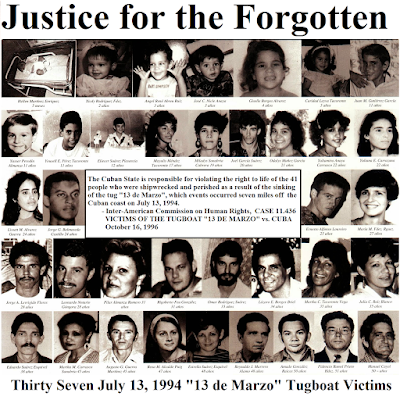
Wednesday, July 13, 1994 at three in the morning three extended Cuban families set out for a better life aboard the "13 de Marzo" tugboat from Havana, Cuba and were massacred by Cuban government agents.

The most extensive international report on the what took place is by the Inter-American Commission on Human Rights and is available on-line. Fifteen years later human rights defender Oswaldo Payá Sardiñas, national coordinator of the Christian Liberation Movement, reflected on what had happened:
Behind the Christ of Havana, about seven miles from the coast, "volunteers" of the Communist regime committed one of the most heinous crimes in the history of our city and of Cuba. In the morning, a group of seventy people in all, fled on a tugboat, led by the ship's own crew; none was kidnapped, or there against their will. They came out of the mouth of the Bay of Havana. They were pursued by other similar ships. When the runaway ship and its occupants stopped to surrender, the ships that had been chasing them started ramming to sink it. Meanwhile, on the deck, women with children in their arms begging for mercy, but the answer of their captors was to project high pressure water cannons against them. Some saw their children fall overboard under the murderous jets of water amid shrieks of horror. They behaved brutally until their perverse mission was fulfilled: Sink the fleeing ship and annihilate many of its occupants.
The man who denounced the "13 de Marzo" tugboat massacre would himself become a martyr of the same dictatorship along with Harold Cepero, a youth leader from the Christian Liberation Movement.
Oswaldo Payá Sardiñas and Harold Cepero Escalante killed 7/22/12
Seven years ago on July 22, 2012 on a stretch of road in Eastern Cuba, State Security agents rammed the car Oswaldo Payá Sardiñas and Harold Cepero Escalante were traveling in. Both bodies appeared later that same day.

One month from today will mark 25 years since 37 Cubans were killed for wanting to live in freedom. Eleven of them were children, and nine days later we will remember two men killed seven years ago for non-violently advocating for freedom in Cuba.

They must not be forgotten, and the demand for justice continued.

Sunday, August 17, 2014

Oswaldo Payá and Harold Cepero may have been extrajudicially executed


Police block Oswaldo Paya's children from attending Carromero's show trial. (AP)
 The extrajudicial killings of Oswaldo Payá Sardiñas, and Harold Cepero Escalante are both  back in the news in connection with an alleged Cuban defector Ortelio Abrahantes Bacallao, 42, who claims to be related to former MININT chief Jose Abrantes and to have information on the killings of the two Christian Liberation Movement activists. The alleged Cuban defector is being held in a migrant detention center in the Bahamas according to Juan O. Tamayo.

The machinations of Cuban state security, trained by the East German Stasi, are inscrutable. However, it is important to remember that the evidence that Oswaldo and Harold were killed by Cuban state security on July 22, 2012 does not depend on the declarations of a lone defector but two years of evidence accumulated, and the behavior of the Cuban government. For example, two years later the autopsy reports have yet to be turned over to the families of the two victims despite formal requests.

One of the survivors of the events that day, Angel Carromero, was subjected to a show trial to cover up the Cuban government's role in the killings of the two men. Oswaldo's children were barred from attending the trial of the man the Cuban government said was responsible for the crash.

SMS text messages and the initial declaration of a government official at the hospital in Bayamo pointing out that a second car was involved corroborate Angel's account of what happened.  Angel Carromero has gone on the record granting interviews, writing a book and speaking at a parallel forum in the United Nations Human Rights Council

At the same time high profile figures from around the world have called for a transparent and international investigation into these two deaths. 

There is much more hard evidence already out there that Oswaldo and Harold were murdered in a state security operation orchestrated by the Cuban government that demands an international investigation then the word of one defector. Furthermore it appears that 1) they weren't killed in the crash but 2) afterwards and not from injuries sustained in the car and 3) these two activists may have been extrajudicially executed in a premeditated manner.


Tuesday, August 12, 2014

Six Months after February 12: Venezuela Demands Justice for Robert and Bassil

"Today I was hit with a rock in the back, a helmet in my nose. I swallowed tear-gas, Carried the kid who died, and what did you do?" - Robert Redman, age 28 over twitter on February 12, 2014 shortly before he was shot and killed.

Roberto Redman (center) carrying Bassil Alejandro Da Costa on February 12
February 12, 2014 is a day that needs to be remembered, not only in Venezuela, but wherever people of goodwill are to be found. Students were gunned down in cold blood that day by state security agents of the Maduro regime for nonviolently protesting in defense of their rights.

 
Janeth Frias, the mother of Bassil Alejandro Da Costa, said her son "wanted to go out to protest for his mother who had been waiting for four months for an operation and there were no supplies for the surgery." 

Bassil Alejandro Dacosta(age 24) shot and killed on February 12, 2014

Bassil Alejandro Da Costa was shot in the head in Caracas on February 12, 2014 from shots fired by a group of police men and his killing was captured from different angles on three different cameras. He was 24 years old. 

Due to the public outrage over the killing eight government functionaries have been charged in the killing, only one of which is being held in custody awaiting trial.

Robert Redman, in the picture above carrying shooting victim, Bassil Alejandro Da Costa on February 12, 2014 tweeted: "Today I was hit with a rock in the back, a helmet in my nose. I swallowed tear-gas, Carried the kid who died, and what did you do?" He was 28 years old.

 He had carried the lifeless body of  Bassil Alejandro Da Costa Frias who had been shot by Venezuelan security. Hours after tweeting the above message, Roberto Redman was also shot in the head and extrajudicially executed by Maduro's security forces.

Six months later and the words of Robert Redman, a young man who put his life on the line for a better Venezuela, remain a powerful indictment both of a tyrannical regime and those who remain apathetic before its unjust actions. 
 
Robert Redman shot and killed on February 12, 2014

Forty one more would be killed over the next six months for peacefully exercising their rights and many shot in the head like Robert and Bassil. They must be remembered, their sacrifice honored and the call for justice  for them and their families echoed around the world.


Thursday, June 10, 2010

The Dictatorship doth protest too much

It has no credibility
Danish student Joachim Løvschall extrajudicially executed by Cuban soldier on March 29, 1997

"Cuba does not need an objective evaluation 'of the situation in the country.' Cuba seeks no endorsement. In Cuba, there has never been a single case of extrajudicial execution or forcible disappearance. Our achievements in matters of penal justice and crime prevention are well recognized. Few countries can exhibit Cuba's results in the treatment of sanctioned people and their full reinsertion into society." Statement by Cuban U.N. mission in Geneva, June 9, 2010


The above paragraph is taken from a statement released by the Cuban government's diplomatic mission in Geneva and is in response to the special rapporteur's statement earlier in the day chastising the regime for not following through on the invitation they had extended to him on January 28, 2009.

First, Cuba desperately needs an objective evaluation of the overall situation in the country not just in the area of human rights (although that is a good place to start). The dictatorship in Cuba desperately wants to avoid an objective evaluation of its human rights record, with good reason. There have been objective evaluations over the years and they are not positive especially in the areas of civil and political rights, torture, and extrajudicial executions. Human Rights Watch in 1999 and again in 2009 presents detailed overviews. The Inter-American Commission on Human Rights (IACHR) has documented numerous atrocities and closely studied the Cuban legal system.

Secondly, the statement: "In Cuba,there has never been a single case of extrajudicial execution or forcible disappearance" is painfully untrue. Human Rights Watch, Amnesty International, the IACHR, and the UN Human Rights Commission have documented cases.

One well documented case cited by the Special Rapporteur on Extrajudicial, Summary or Arbitrary Executions is the sinking of the tugboat 13 de Marzo, which took place on July 13, 1994 by government agents and led to the extrajudicial execution of 37 men, women and children. Interviews with the survivors and photos and names of the victims in the video below:


Another case is that of Joachim Løvschall, a Danish student studying Spanish at the University of Havana gunned down by an AK-47 wielding Cuban guard as he walked home. The body remained hidden for days. The shooter was never identified. Ten years after his son's extrajudicial execution, Christian Løvschall spoke at a parallel forum in Geneva Switzerland about what had happened.

Third, the claim that "Our achievements in matters of penal justice and crime prevention are well recognized" is perversely true. The Telegraph offers a succinct description: "regular beatings, humiliation and arbitrary punishment with long periods of solitary confinement in cramped cells with cement beds." International human rights organizations are barred from visiting the island and even the International Committee of the Red Cross has not had access to prisons in Cuba for over 30 years, but what has emerged is evidence of widespread torture. As the following survivor Omar Pernet Hernandez can attest to:


Others like Sebastian Arcos Bergnes were not so lucky. Systematically denied attention he died a short time after his release, but he was able to address the UN Human Rights Commission in 1996 and present the reality within Cuba's prisons from his own experience. His son, Sebastian Arcos Cazabon, outlines what happened to his father which has been described as death by medical neglect. Sebastian Arcos Bergnes was an Amnesty International prisoner of conscience.


The February 23, 2010 death of prisoner of conscience Orlando Zapata Tamayo while on a hunger strike protesting prison conditions and the subsequent efforts by the dictatorship to smear his name, intimidate, and assault members of his family indicates that Cuba not only needs an objective evaluation of the human rights situation in the country, but also solidarity with the Cubans on the island who have had their human rights systematically violated for 51 years, and especially those who are imprisoned.

"I believe that unarmed truth and unconditional love will have the final word in reality. This is why right, temporarily defeated, is stronger than evil triumphant." -Martin Luther King.
