Showing posts with label Robert Redman. Show all posts

Wednesday, February 12, 2020

Venezuela's National Youth Day on February 12, 2014 was a defining moment: Students rose up and Maduro murdered them.

"Gentlemen, he who is here will go out tomorrow to find a better future." - Bassil Alejandro Dacosta, age 24 , over Facebook on February 11, 2014. He was murdered the next day by the Maduro regime.

Robert Redman and Bassil Alejandro Dacosta murdered six years ago today
Six years ago today nonviolent student protesters Bassil Da Costa and Robert Redman were gunned down on February 12, 2014 in Venezuela, while engaged in nonviolent street protests against the government of Nicolas Maduro. Robert Redman was shot and killed hours after he had carried Bassil, who had also been shot and died earlier that same day, and tweeted about it.

"Today I was hit with a rock in the back, a helmet in my nose. I swallowed tear-gas, carried the kid who died, and what did you do?" - Robert Redman, age 28 over twitter on February 12, 2014 
On February 12, 2014 Venezuela's National Youth Day millions of young students took to the streets to nonviolently protest "the social and economic crisis caused by the illegitimate government that Venezuela has today."  

Robert Redman with other youths carrying Bassil Dacosta on February 12, 2014.
Young Venezuelans inside and outside of the country mobilized in a coherent and sustained effort to expose the anti-democratic nature of the Maduro regime. A full and brief explanation was offered by Andreina Nash at the time in the video titled: What's going on in Venezuela in a nutshell.

The violence had escalated in the days prior to February 12th. On February 11, 2014 in an update via twitter from Roderick Navarro and Guido Mercado they reported: wounded by bullets today: Jorge Monsalve 20 years old, Franco Perez 15 years old (Thorax), Pedro Alison 24 years old (Left arm), Anny Paredes 36 years old (Abdomen). 

These students continue to face a government that over the past eighteen years has been stripping Venezuela's democracy of all its constitutional and institutional democratic safeguards in order to consolidate power into the United Socialist Party of Venezuela and in the presidency. At the same time the presence of both Cuban state security and military officials in the country who have presided over the building of a totalitarian apparatus is cause for great concern. They have used technological tools to censor images over twitter. Over the past 20 years independent television press outlets have been taken over or shutdown by the government.

Six years later and across Venezuela the youth still remember the fallen and the Maduro regime's repressive forces who murdered them. They have not forgotten and it marked a before and after in the history of the South American country. Ana Karina Garcia over twitter stated in Spanish that, " February 12, 2014 marked us as a generation. Bassil Da Costa, Juancho Montoya and Robert Redman were murdered by the tyranny while they were in the streets demanding a country of opportunities. #AHeroIsNotForgotten"    

Monday, February 18, 2019

#Feb24SilentProtest: Time to say NO to illegitimate votes, NO to continued impunity, NO to dictatorship, and NO to Castro regime meddling in other countries

"There may be times when we are powerless to prevent injustice, but there must never be a time when we fail to protest." - Elie Wiesel, Nobel Lecture 1986

#YoVotoNo =  #YoNoVoto = #N1Mas = #NoMoreImpunity = #NoMoreCastros

February is a difficult month for friends of freedom in Cuba and Venezuela. 

Five years ago in February of 2014 on Venezuela's national youth day the Maduro regime gunned down students peacefully protesting in the streets of Venezuela. The killings have continued to the present day.

Robert Redman with other youths carrying Bassil Dacosta on February 12, 2014.
Nine years ago on February 23, 2010 human rights defender, and Amnesty International prisoner of conscience, Orlando Zapata Tamayo died on hunger strike after years of torture and mistreatment by Castro regime agents. Political prisoners continue to suffer in Cuban prisons today.

Orlando Zapata Tamayo 1967 - 2010
Twenty three years ago on February 24, 1996 at 3:21 pm and 3:27 pm in international airspace two civilian aircraft belonging to the humanitarian group Brothers to the Rescue were destroyed by air-to-air missiles fired by a Cuban MiG-29 killing Armando Alejandre Jr. (age 45), Carlos Alberto Costa (29), Mario Manuel de la Peña (24), and Pablo Morales (29).

Extrajudicially executed by the Castro regime on 2/24/1996
Author Matt Lawrence translated and subtitled the audio of the Cuban MiG pilots who hunted and destroyed the two planes. The planes had been engaged in a search and rescue mission for Cuban rafters in the Florida Straits. Three planes set out only one returned.

On Sunday, February 24th the Castro regime will be engaged in a sham constitutional referendum in an attempt to gain international legitimacy to perpetuate the rule of the Castro dictatorship in Cuba for another generation. The democratic resistance in Cuba has campaigned proclaiming "No" to the illegitimate process calling on Cubans not to vote and stay home or if they are going to vote to vote "No."

Let us also take this upcoming Sunday, February 24th not only to say "No" to the illegitimate referendum in Cuba, but to say "No" to dictatorship, and "No" to the continued impunity in Cuba and Venezuela. Friends of freedom around the world please join us in calling on the Castro regime to stop meddling and get out of Venezuela, Nicaragua and bring those responsible for gross and systematic human rights abuses in Cuba to justice.

#Feb24SilentProtest at 3:00pm in front of the Cuban Embassy. We will not chant or yell, but bring posters with the word "No" writ large and images of victims of the Castro regime. Between 3:21pm and 3:27pm form a human chain, and at 3:30pm go our separate ways.


Thursday, February 14, 2019

Five years after 12F: The Youth Day when Maduro's Snipers Executed Nonviolent Youth and Kept Doing It

"Gentlemen, he who is here will go out tomorrow to find a better future." - Bassil Alejandro Dacosta, age 24 , over Facebook on February 11, 2014. He was murdered the next day by the Maduro regime.

Robert Redman with other youths carrying Bassil Dacosta on February 12, 2014.
Five years ago nonviolent student protesters Bassil Da Costa and Robert Redman were gunned down on February 12, 2014 in Venezuela, while engaged in nonviolent street protests against the government of Nicolas Maduro. Robert Redman was shot and killed hours after he had carried Bassil, who had also been shot and died earlier that same day, and tweeted about it.

"Today I was hit with a rock in the back, a helmet in my nose. I swallowed tear-gas, carried the kid who died, and what did you do?" - Robert Redman, age 28 over twitter on February 12, 2014 
On February 12, 2014 Venezuela's National Youth Day millions of young students took to the streets to nonviolently protest "the social and economic crisis caused by the illegitimate government that Venezuela has today."  

Young Venezuelans inside and outside of the country mobilized in a coherent and sustained effort to expose the anti-democratic nature of the Maduro regime. A full and brief explanation was offered by Andreina Nash at the time in the video titled: What's going on in Venezuela in a nutshell.

The regime violence had escalated in the days prior to February 12th. On February 11, 2014 in an update via twitter from Roderick Navarro and Guido Mercado they reported, "wounded by bullets today: Jorge Monsalve 20 years old, Franco Perez 15 years old (Thorax), Pedro Alison 24 years old (Left arm), Anny Paredes 36 years old (Abdomen)."  On the days following February 12th the regime orchestrated violence and killings continued.


Robert Redman and Bassil Alejandro Dacosta murdered five years ago.
On May 18, 2017 The Miami Herald reported that it had a secret recording of a Venezuelan general advocating for the use of snipers against street demonstrators "in the future." The sad news is that this has been a practice long adopted by the Maduro regime in Venezuela.

Genesis Carmona is evacuated on a motorcycle after being shot.

Génesis Carmona, a local beauty queen, was just 22 years old and nonviolently expressing her desire for a better Venezuela when she was shot in the head on February 18, 2014 and died a day later. 

Génesis was marching at approximately 4:00 pm on Tuesday February 18, 2014, near Cedeño Avenue and the intersection of Carabobo, when  a group of masked gunmen on motorcycles opened fire on the demonstrators. She was shot in the head in the left occipital region. Génesis was with her sister Alejandra Carmona at the moment it happened. Alejandra in a radio interview said "I was with her, when the motorized units (of the Government) arrived, we fled running. We were stopped on a street corner, we were looking up and then suddenly she fell."   

According to VOXXI the "22-year-old was rushed in a motorcycle to the Medical Center Guerra Mendez in Valencia, where she was operated and kept in intensive care. Less than 24 hours later on 12:14 p.m., the doctors announced that she had died from her injury. 

Five years will have passed in five days and those responsible for her murder have yet to be brought to justice, and the extrajudicial killings continue in Venezuela.

Génesis Carmona: Shot in the head by a sniper on February 18, 2014
Geraldine Moreno was shot in the head with buckshot on February 19, 2014 in Tazajal, located in Naguanagua, in the state of Carabobo while taking part in a protest and in one of her last tweets on February 17th explained what motivated her to take part in the demonstrations: "No one sends me I go because I want to defend my Venezuela." She died from her injuries on Saturday, February 22, 2014. She was 23 years old.

Geraldine Moreno (age 23) shot in the head with buckshot and died

 In the evening hours of March 18, 2014 Anthony Rojas died of a gunshot wound to the face. He was a second semester student of mechanical engineering at the University of Tachira (UNET). He died in a presumed shootout near a shop in the Diamante sector of Táriba. It was learned that Rojas was in the commercial establishment buying drinks with other youth when motorized units passed by fired and into the place. He was eighteen years old. 

Anthony Rojas shot in the face and killed 3/18/14
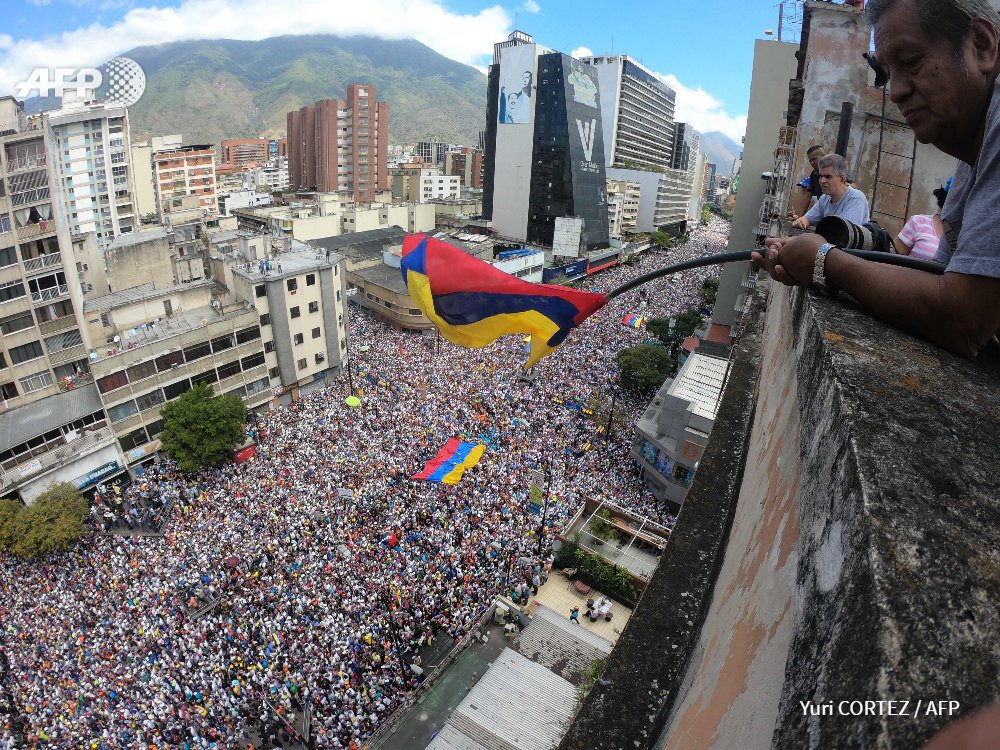
On February 12, 2019 hundreds of thousands of Venezuelans took to the streets to protest against the Maduro regime, to demand a democratic restoration, and remember those killed by the dictatorship. The theme for the mobilization of the student movement on February 12th was "The Youth Do Not Forget" and the mass nonviolent movement took to the streets.

Regime tactics have grown more deadly over the past five years.  In 2017 Nicolas Maduro ordered the formation of the FAES - "the Spanish acronym for the Bolivarian National Police’s Special Action Forces," according to Caracas Chronicles " are police Death Squads in all but name."

Maikel Jesús Cumare Ávila (age 21) murdered by Maduro's death squad on 1/8/19
Maikel Jesús Cumare Ávila was 21 years old when he was murdered by FAES officers in front of his mother, Desiré Cúmare, on January 8, 2019. At 9:00 a.m., his mom heard a knock on the door. In a flash, masked men had a gun to her face. They threatened to shoot her if she didn’t open the metal door. According to his mom, "Maikel took the keys and opened himself. They burst in, pushed him to the ground and started kicking his head against the floor. That’s how they killed him. They cracked his skull.”


The Chavez-Maduro regime was in its 20th year, before the arrival of the new and legitimate government of President Juan Guaido. Although now illegitimate and a tyranny, Maduro's regime, still continues to carry out extrajudicial killings and attempt to block humanitarian aide for Venezuelans.  

According to Amnesty International there have been more than 8,200 extrajudicial executions between 2015 and June 2017 in Venezuela.

Two question arise in the midst of the continuing repression: How many Venezuelans have been murdered by the Chavez-Maduro regime between 1999 and 2019?  and "When will this regime that sends out death squads to murders students and artists finally stop?"


Saturday, April 22, 2017

March of Silence for the Fallen: Remembering the Maduro regime's victims

Silent marches and vigils for Maduro's victims in Venezuela
"No more murders in Venezuela"
The Maduro regime is killing young Venezuelans in order to provoke a violent response for the opposition. It is a trap for the opposition as was seen in Syria. A civic movement abandoning nonviolence and fighting the regime militarily is taking the fight to ground where the dictatorship has the advantage. Rather than falling into the trap, nonviolent opposition is organizing a nonviolent silent march later today to remember those killed and demand justice.

"Silent march in honor of our fallen"


 Mobilizing millions of Venezuelans to nonviolently resist the Maduro dictatorship has a better chance of forcing a democratic transition and the ouster of the regime. The alternative would be civil war and the odds are it would lead to the permanence of the Maduro regime with the aide of Cuban soldiers and intelligence assets.

Paola Ramírez and Carlos Moreno both shot in the head on April 19, 2017 in Venezuela.
Shooting young Venezuelans in the head to terrorize demonstrators and provoke a response has been a Maduro regime tactic since at least February 2014.

Beginning on February 12, 2014 regime agents shot Bassil Alejandro Dacosta, age 24 in the head.  One of the young students who carried Bassil off  after he was shot was Robert Redman, age 28, who reported later that day over twitter: "Today I was hit with a rock in the back, a helmet in my nose. I swallowed tear-gas, Carried the kid who died, and what did you do?" That same day he was also gunned down by Maduro's colectivos, working in concert with his security forces, and murdered. The killings continued.

Some of the young Venezuelans shot in the head by Maduro's agents
 A high profile killing that shocked the world was the murder of a local beauty queen. Génesis Carmona was marching at approximately 4:00 pm on Tuesday February 18, 2014, near Cedeño Avenue and the intersection of Carabobo, when  a group of masked gunmen on motorcycles opened fire on the demonstrators. Génesis was shot in the head in the left occipital region. She was a model who had won the Miss Tourism Carabobo beauty pageant in 2013.There have been dozens more executed by Maduro regime agents in an effort to terrorize and either silence or provoke nonviolent protesters.

March of silence for the fallen on Saturday, April 22nd at 10am
Families of the victims have pursued justice and had some successes, but much remains to be done to end impunity and hold those responsible accountable. This morning beginning at 9:00am silent marches and rosaries will be held in Acarigua and Araure while an hour later marches will begin in other parts of Venezuela. Demonstrators are asked to dress in white.

March of silence in honor of the fallen. Saturday, April 22, 2017 at 10am
Those of us who advocate for nonviolence in Venezuela have an obligation to speak out and denounce the violence visited on non-violent opponents by the Maduro regime and their Cuban handlers. Those engaged in violence need to understand that sooner or later they will have to answer for their crimes in a court of law.

"They did not die. They murdered them."
Please use the hashtags and #SilentMarch along with #Venezuela and share pictures of those killed by Maduro. Tragically, there are many to choose from. They must be not be forgotten.

Vigil for the fallen in Anzoategui, Venezuela last night


Thursday, May 19, 2016

Warned UNHRC in 2014 that Venezuela would spiral out of control and that it required their attention

 "These situations in Cuba and Venezuela require the Human Rights Council´s attention before they spiral out of control." - John Suarez to the UN Human Rights Council 9/15/14 

Venezuela under Maduro's regime on May 18, 2016
What is happening now in Venezuela could be foreseen, but the world chose not to act. On September 15, 2014 at the United Nations Human Rights Council  under Item 4 on the agenda I read a statement ( 1 hour 33 minutes and 59 seconds) that made the case that the failure to address human rights issues nonviolently in Syria had ended in disaster and that this would be repeated elsewhere  where human rights are systematically violated. Two examples offered up as future regional disasters where Venezuela and Cuba. Repressive regimes attempted to disrupt the presentation with points of order, but the full statement was eventually read out and is reproduced below.  

Text taken from Directorio Archives

Item 4
United Nations Human Rights Council
September 15, 2014 

We welcome the conclusions of the Report of the independent international commission of inquiry on the Syrian Arab Republic and particularly the observation that what was a “conflict in the Syrian Arab Republic, once between the Government and a limited number of anti-Government armed groups, has morphed into multiple shifting conflicts involving countless actors and frontlines,” and we are in complete agreement with the report that “the regional conflagration, of which the commission has long warned, illustrates the fallacy of a military solution.” 
The disaster in Syria did not arise yesterday but is the long term result of the failure to have human rights respected there.

Unfortunately other areas exist that can also unexpectedly erupt into regional disasters. Years of freedom of expression and association being systematically outlawed, arbitrary detentions constant, along with politically motivated beatings, torture and extrajudicial killings lead to destabilizing responses.

The 2012 deaths of Oswaldo Paya and Harold Cepero have not been cleared up. Sonia Garro, a lady in white, remains jailed without trial since 2012 and Angel Yunier Remon Arzuaga, a musician, has been jailed for his dissenting views since March 2013. 
Bassil Dacosta, Robert Redman, Génesis Carmona and Geraldine Moreno were the first shot and killed by government agents in their country in 2014.

Since February 12, 2014 forty three youths have been killed while protesting rising insecurity and vanishing rights in their country. Over 5000 have been injured and 3,000 arbitrarily detained. Investigations are needed into the circumstances surrounding the deaths of 43 Venezuelan students and Cuba’s Oswaldo Paya and Harold Cepero.
Ms. Garro and Mr. Arzuaga should be freed.

These situations in Cuba and Venezuela require the Human Rights Council´s attention before they spiral out of control. 

Friday, February 12, 2016

Two years after #12F and no progress on murders of protesting Venezuelan students

"Today I was hit with a rock in the back, a helmet in my nose. I swallowed tear-gas, Carried the kid who died, and what did you do?" - Robert Redman, age 28 over twitter on February 12, 2014 shortly before he was shot and killed.

"Gentlemen, he who is here will go out tomorrow to find a better future." - Bassil Alejandro Da Costa, age 24 , over Facebook on February 11, 2014. Killed the following day.


Two years ago today nonviolent student protesters Bassil Da Costa and Robert Redman were gunned down on February 12, 2014, the Day of the Youth in Venezuela, while engaged in nonviolent street protests against the government of Nicolas Maduro. Robert Redman was shot and killed hours after he had carried Bassil who had also been shot and killed earlier that same day and tweeted about it.

Today the Venezuelan human rights organization Foro Penal published and distributed the above image with the names and images of young Venezuelans murdered during the 2014 anti-government protests along with their first names which states: "It is ironic to celebrate the Day of the Youth in Venezuela when her youth are in prison, exiled or in a tomb." 

Also toda, Robert Redman's dad visited his son's grave site and tweeted the following image recreating picture of his son holding up the Venezuelan flag with the following text:"Here with my son on the 2nd anniversary of his murder by hired assassins of the regime. God bless you son."


Two years later and a second Venezuelan human rights organization PROVEA reports that: "In 2015 there was no progress into the investigations of the cases of Bassil Da Costa, Juan Montoya and Robert Redman.

They and the others killed, tortured and arbitrarily detained by the Maduro regime are not forgotten and the call for freedom and justice continues. My prayers go out to them and their families.


Thursday, February 12, 2015

12 months after 12F: The Youth Day when Maduro Executed Nonviolent Youth

"Today I was hit with a rock in the back, a helmet in my nose. I swallowed tear-gas, Carried the kid who died, and what did you do?" - Robert Redman, age 28, murdered later that same day by Maduro's security forces
Student movement organizing action today in Venezuela
Started a 24 hour fast at 7:00pm on February 11, 2015 in remembrance of Venezuelan students gun down by Maduro's state security beginning on February 12, 2014 while nonviolently protesting rising insecurity in their country.  It began on that day with Bassil Alejandro Dacosta, age 24 , who over Facebook the day before on February 11, 2014 had written: "Gentlemen, he who is here will go out tomorrow to find a better future." 

Bassil Dacosta murdered by Maduro's agents on February 12, 2014
 Hours later on February 12, 2014 he had been gunned down. One of the youths who carried him away to seek medical assistance, Robert Redman, age 28, reported later that day over twitter: ""Today I was hit with a rock in the back, a helmet in my nose. I swallowed tear-gas, Carried the kid who died, and what did you do?" That same day he was also gunned down by Maduro's security forces and murdered. The known number today stands at 43.

Robert Redman murdered by Maduro's agents on February 12, 2014
 Today, February 12, 2015 facing a regime that has now approved the use of lethal force against nonviolent protesters the stakes are higher than a year ago. Students and in many cases their parents and grand parents will be taking to the street today.


Maria Corina Machado explained why they are going out tomorrow:  
"Tomorrow February 12,  I will go out for the young heroes of yesterday and today, who started the protests that unmasked the regime and changed the history of our noble country. See you in Caracas at 10 am at Plaza The Three Graces. We will march to the San Pedro Church where Mass will be held for the fallen."
"March for the Fallen"
Hard to believe that it has been one year and still the murderers of these nonviolent student protesters have not been brought to justice. 28 out of the 44 killed in the 2014 protests in Venezuela were shot. They are remembered along with the continuing demand for justice.


Monday, February 9, 2015

Fast in Remembrance of Murdered Venezuelan Students

"Today I was hit with a rock in the back, a helmet in my nose. I swallowed tear-gas, Carried the kid who died, and what did you do?" - Robert Redman, age 28 over twitter on February 12, 2014 

"Gentlemen, he who is here will go out tomorrow to find a better future." - Bassil Alejandro Dacosta, age 24 , over Facebook on February 11, 2014.
  
Robert Redman and Bassil Alejandro Dacosta


‘señores, este que está aquí sale mañana a marchar para encontrar un futuro mejor’. - See more at: http://www.larazon.net/2015/02/08/reina-la-impunidad-un-ano-de-los-asesinatos-de-bassil-dacosta-y-juan-montoya/#sthash.yU0iH8Jx.dpuf
Fast for Justice
In memory of the students murdered by the Maduro regime I will be initiating a fast beginning at 7:00pm on February 11, 2015 and ending 24 hours later. At the same time will be following events in Venezuela and praying for Bassil Alejandro Dacosta and Robert Redman both shot in the head, hours apart, by regime agents on February 12, 2014. The body count would continues to rise, along with acts of torture and arbitrary detentions by government authorities and paramilitaries in their service.


How it all began
 
One year ago today the repression was escalating against Venezuela's students. Members of Venezuelan civil society issued an SOS to the international community warning of the criminalization of nonviolent protest. They reported that in localities of Táchira and Mérida there were prisoners and wounded.

The initial incident that sparked the student protests began in Táchira on February 4, 2014 when a student at the University of Los Andes in the Botanical Garden of the University was the victim of an attempted rape. Students protested that "insecurity had taken over the campus." The protest was repressed and a number of students arrested and physically mistreated by the authorities. The news of the abuse by government officials sparked additional protestsThe underlying reason that sparked the protests, insecurity, continues to claim new victims. The Maduro regime is so out of touch with this reality that it claimed in December of 2013 that crime rates had fallen. The United Nations released a report four months later in April 2014 placing Venezuela as the country with the world's second highest murder rate in the world after Honduras and it continues to rise. 
  
Student leader Juan Requesens laid out on February 10, 2014 in a letter to the government the conditions for a dialogue with the government which focused on two areas: 1) release of students who had engaged in protests as is their constitutional rights and 2) For the government to stop accusing them of being "coup plotters" and "terrorists" for holding nonviolent demonstrations. These conditions were rejected by the Maduro regime.

On February 12, 2014 hundreds of thousands of students took to the streets across Venezuela and were met with deadly force by regime agents but despite this the protests continued. 

The freedom of expression continues to deteriorate in Venezuela and members of the nonviolent opposition, such as democratic opposition leader Leopoldo Lopez, continue to be arbitrarily detained under a judicial process that is no longer impartial.