Sunday, August 11, 2013

Cuban opposition leader Yris Tamara Pérez Aguilera denounces mistreatment in Cuba

Yris Tamara Pérez Aguilera addresses Resistance Assembly

"I come in the name of all those women who inside of this country struggle for democracy in our country. I have been a victim on countless occasions of beatings, arrests and including victim of attempts to abuse me sexually. But I come to give hope to all the women struggling for freedom in Cuba that we will continue to struggle for that freedom that belongs to us, and that those dictatorial men will have to leave our country."  - Yris Tamara Pérez Aguilera, August 10, 2013


On Saturday, August 10, 2013 at a Forum organized by the Assembly of the Cuban Resistance held at the Florida International University Law School, Yris Tamara Pérez Aguilera made a powerful presentation on the threats, harassment and violence that she and other female activists suffered for defending human rights in Cuba. She spoke of women such as Damaris Moya Portieles who was beaten and mistreated but was also threatened by state security agents with the rape of her five year old daughter.


Friday, August 9, 2013

Hunger Strike for Human Rights in the Bahamas: An Update

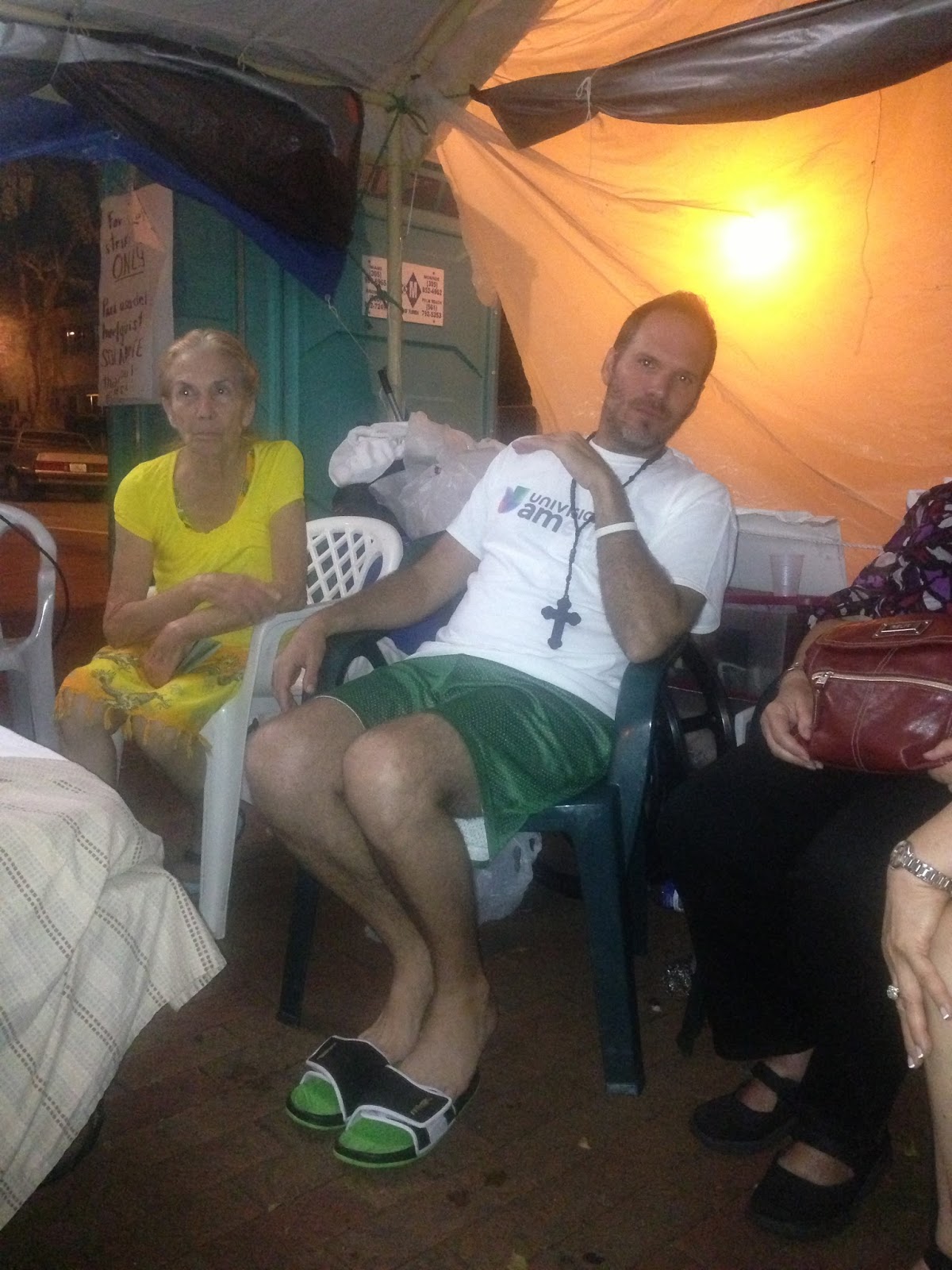
Jesus Alexis Gomez 22 days and Ramon Saul Sanchez 15 days on hunger strike protesting mistreatment of migrants in the Bahamas. 

Jesús Aléxis Gómez (Day 22 on hunger strike)

 The demands have not been met and the hunger strike continues. After 22 days Jesús Aléxis looks gaunt and his face emaciated but he remains determined to carry on his protest. Ramon Saul seems in better shape but as a diabetic undergoing a hunger strike is a precarious exercise.

Ramon Saul Sanchez (Day


Meanwhile this week the hunger strike garnered greater attention in the international media and at the same time Bahamian officials went to Cuba to meet with their Cuban counterparts.


All eyes on a small tent in Little Havana on South West 8th Street and 13th Avenue where two men are putting all on the line for the rights of undocumented migrants in the Bahamas, and if you're the praying type - please say a prayer for them.


 Listen to their demands here below.

Arturo Sandoval: Presidential Medal of Freedom Recipient

Arturo Sandoval: Presidential Medal of Freedom Recipient
 Arturo Sandoval is a jazz trumpeter and pianist. He was born in Artemisa, in Havana Province, Cuba. Sandoval, while still in Cuba, was influenced by jazz legends Charlie Parker, Clifford Brown, and Dizzy Gillespie, finally meeting Dizzy later in 1977.


Gillespie promptly became a mentor and colleague, playing with Arturo in concerts in Europe and Cuba and later featuring him in The United Nations Orchestra. Sandoval defected to the United States of America while touring with Gillespie in 1990, and became a naturalized citizen in 1999. Because of his defection, his music was banned in his homeland. Many other prominent and important Cuban musicians like Arturo, have also been banned from the airwaves in Cuba.

On February 24, 2009 Arturo Sandoval played taps for Armando Alejandre Jr., Mario De La Peña, Carlos Costa, and Pablo Morales extrajudicially executed by the Cuban government on February 24, 1996 at 3:21 pm and 3:27 pm., respectively, in international airspace. Arturo has remained a steadfast advocate for Cuban freedom and human rights. He scored the soundtrack for the documentary Oscar's Cuba, about the life of a Cuban dissident and former prisoner of conscience.

On August 8, 2013 Arturo Sandoval was named one of 16 recipients of the Presidential Medal of Freedom, the highest civilian honor of the United States for those "who have made especially meritorious contributions to the U.S. and to world peace."


Cuban dissident Antúnez speaks to The Miami Herald and El Nuevo Herald editorial boards


Cuban dissident Antúnez says women, blacks, provincial residents joining movement

 by Juan O. Tamayo
      El Nuevo Herald

Cuba’s dissident movement has been growing with the increased involvement of women, blacks and provincial residents, the opposition activist known as Antúnez said Wednesday during his first public appearance in Miami.

Jorge Luís García Pérez also said that although President Barack Obama’s decision to lift almost all restrictions on Cuban-American travel and remittances to the island was well-intentioned, his administration also “broke a tradition of solidarity” with dissidents.

Cubans separated by decades of animosity have been able to see each other again, but “that’s not helped at all” to improve political conditions on the island, García said in a lengthy interview with El Nuevo Herald and The Miami Herald.

The 48-year-old García, regarded as one of Cuba’s more combative dissidents and best known as Antúnez, spent 17 years in prison after shouting anti-government slogans during a speech by then-Defense Minister Raúl Castro in 1990.

He landed in Miami on Sunday on his first-ever trip abroad even though he has had a U.S. visitors visa for the past six or seven years. The Cuban government previously told him that he could leave the island only if he agreed to stay out, he said.

García was the latest of the many dissidents allowed to travel abroad after Havana eased its migration restrictions in January. They include Guillermo Fariñas and Antonio Rodiles, blogger Yoani Sánchez and Ladies in White leader Berta Soler.

While Cuba’s dissident groups were traditionally led by older intellectuals, García said, they have been growing in recent years with the addition of blacks like himself, women like the Ladies in White and people who live outside of Havana.

The most aggressive resistance is currently in the provinces, he added, because people there know and trust each other while residents of Havana barely know their next-door neighbors. García lives in Placetas, a municipality of 50,000 people in central Cuba.

Proof of the growing resistance is in the number of anti-government signs that appear at sunrise, he told the newspapers, the rising rate of abstentions in elections and the complaints increasingly voiced by usually ultra-loyal military officers.

Castro, who succeeded ailing brother Fidel in 2006, has replied with increased harassments, threats and detentions after which activists are usually released in isolated rural roads, García said.

Like most Cuban dissidents, García also dismissed the economic reforms pushed by Castro for the past five years as an attempt to make only the minimum changes required to ensure the survival of the island’s communist political and economic system.

Although the reforms have brought about “some slight improvements in some sectors of the population,” García added, overall “the people see no improvement at all. The people see fraud.”

“The people want bread, but also freedom,” he said, adding that the opposition movement “will not settle for little changes.”

García also declared that the hierarchy of Cuba’s Catholic Church has been insensitive to the work of the dissident groups and that Cardinal Jaime Ortega, the archbishop of Havana, “does not enjoy credibility” among Cubans.

As for the foreign journalists based in Havana, he said that dissidents regularly send them news releases, photos and videos but they seldom publish the information. Cuba has expelled several foreign journalists whose coverage they deemed too negative.

Reporters in Havana are either “insensitive to the pain” of the opposition “or in clear complicity” with the government, he added.

García, who helped found the National Movement for Civic Resistance Pedro Luis Boitel, and his wife, Yris Tamara Pérez Aguilera, an activist in the Rosa Parks Movement for Civil Rights, plan to stay outside Cuba for about two months.

They are scheduled to meet Friday in Miami with Reps. Ileana Ros-Lehtinen and Mario Diaz-Balart and former Rep. Lincoln Diaz-Balart, all Miami Republicans. It is not yet known if they will travel to Washington or other countries to speak about Cuba.

García said he had the impression that people outside the island sometimes view the allegations of human rights and other abuses reported by dissidents as likely exaggerations, although dissidents most often don’t report all they suffer.

Government agents once attacked his wife and other women dissidents with machetes, he said. And he added that a prison guard once threw a rope into his cell and said, “Look, black guy. So you can hang yourself.”

http://www.miamiherald.com/2013/08/08/3549600/cuban-dissident-antunez-says-women.html

Read more here: http://www.miamiherald.com/2013/08/08/3549600/cuban-dissident-antunez-says-women.html#.UgOW7Dm_FQQ.twitter#storylink=cpy

Tuesday, August 6, 2013

Maleconazo 2013

August 5, 1994 in Havana, Cuba during "El Maleconazo" uprising
Nineteen years ago yesterday the word "liberty" was chanted through the streets of Havana, Cuba by thousands of Cubans spontaneously gathered in protest against the dictatorship and desiring freedom.
Part of the reason that they were out there was the "13 de Marzo"tugboat massacre that had taken place less than three weeks earlier just six miles from the Malecon in Havana. Family members and survivors bravely spoke out and the news of what happened had gotten out.


Thousands of Cubans beginning in the early hours of August 5, 1994 took to the streets shouting for freedom and continued throughout the day.

Plain clothes state security aiming gun during "El Maleconazo" uprising


The response by the regime was violent repression and police shooting at unarmed civilians and beating them down with night sticks. After things were under control the dictator Fidel Castro appeared on the scene and opened the borders. Before that announcement fleeing refugees had confronted snipers and grenades.


The end result was another mass exodus of Cubans. Nineteen years later the regime, as it did in 1994, opened the gates to relieve dissatisfied Cubans and like then there is another exodus of 46,662 Cubans who migrated permanently in 2012. The report also shows that over the past five years immigrants leaving averaged over 39,000 per year. At the same time repression is on the rise and scores of Cubans have been arrested.

August 5, 1994 in Havana, Cuba during "El Maleconazo" uprising

The Cuban punk rock band Porno para Ricardo on tour through Europe recalls those days of protest and frustration in 1994 in their song "El Maleconazo". They have an official video that begins with the lead singer calling for more Maleconazos. The conditions in Cuba two decades later are ripe for another social explosion.