Sunday, June 5, 2022

#Tiananmen33: Remembering the Tank Men

"Seeking government accountability for the massacre in accordance with the law is our legitimate right. For 33 years, we have been pursuing the three demands of “truth, compensation, and accountability” in a peaceful and rational manner, calling for a dialogue with the government through the legal process to resolve the issues related to the June Fourth massacre." -  Tiananmen Mothers, June 1, 2022

Nonviolent moment: Tank Men face off in Beijing on June 5, 1989

On June 5, 1989 in Beijing, following the Chinese Communist Party's massive and bloody crackdown  on thousands of Chinese students and workers on June 3rd and 4th after six weeks of protests that began in Tiananmen Square and spread across 400 cities in China something remarkable happened in the midst of all the horror and terror. 

A man risked all to protest what had taken place. Wearing a white t-shirt, black trousers, and carrying what appeared to be a shopping bag he walked out on the north edge of Tiananmen Square, along Chang'an Avenue and faced down a column of Type-59 tanks.
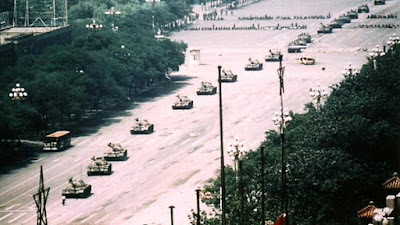
Wider perspective of the Tank Men protest with the full column of tanks

Jianli Yang, a Tiananmen Massacre survivor and former Chinese political prisoner and president of Citizen Power Initiatives for China in his important 2022 article in Newsweek provides the full significance and context of what happened.

"I was near Tiananmen Square in the early morning on June 4, just as gunfire began. At one point, I was so close to the soldiers that I shouted to them in their trucks and told them not to shoot. We even sang songs that every Chinese knows, trying to touch their hearts. But when they received the order, they just opened fire. I saw many killed, including 11 students who were chased and run over by tanks on that fateful day."

Photos appeared of what remained after a tank ran over a student, and this is what Tank Man was in danger of becoming.

Human body crushed to pieces by PLA's tanks.

In the video of the confrontation, the lead tank tried to drive around him, but the lone man repeatedly ran in front of the tank to prevent its passing. The tank driver turned off his engine and the rest of the column of tanks followed suit. 

The protester climbed on top of the tank and began to talk with him. Eventually he climbed back down and the tank driver turned the engines on but the protester once again blocked the tank column.

Jianli makes a powerful observation about this dynamic between the two men in the same OpEd in Newsweek.

"The Tank Man photo was taken the next day, on June 5, the morning after, when the massacre was still ongoing. By any measure, this image is one of heroism. But how many heroes do we see?

Nearly nine years after the picture was taken, the writer Pico Iyer said: "The heroes of the tank picture are two: the unknown figure who risked his life by standing in front of the juggernaut, and the driver who rose to the moral challenge by refusing to mow down his compatriot."

Not only did the driver refuse to kill, but he undoubtedly disobeyed orders and risked—and perhaps received—punishment in order to save a countryman's life."

We do not know the identities of either Tank Man, or what happened to them, but we do know that for one moment, in the midst of a blood bath perpetrated by the Chinese Communist Party, humanity and dignity triumphed over repression in this particular case.

For more information visit:

Standoff At Tiananmen
How Chinese Students Shocked the World with a Magnificent Movement for Democracy and Liberty that Ended in the Tragic Tiananmen Massacre in 1989
http://www.standoffattiananmen.com/

Virtual Museum of China '89
http://museums.cnd.org/China89/

http://www.cnd.org/June4th/

Screams for help at China's secret 'black jails' - 27 Apr 09 AlJazeera
https://youtu.be/NsN4-A1G5zc

Seeking Justice, Chinese Land in Secret Jails / NY Times
https://www.nytimes.com/2009/03/09/world/asia/09jails.html

A piece of red cloth by Cui Jian (music video - song sang by him in the Square)
https://youtu.be/l8UPST1ZKSw

Frontline Documentary Tankman
https://www.pbs.org/wgbh/pages/frontline/tankman/

Saturday, June 4, 2022

Lessons from Tiananmen Square

How it started, and how it ended.

On April 27, 1989 soldiers try to stop students entering Tiananmen Square.

 On April 26, 1989 the People's Daily ran an editorial with the objective of frightening students into submission that had the opposite effect enraging them instead and mobilizing many more to go and protest in Tiananmen Square.  It was a strategic blunder of the first order carried out by the highest levels of the Chinese Communist regime.

Imagine for a moment that for 51 days of demonstrations beginning on April 15, 1989 thousands of students gathered nonviolently to protest and demand reforms. Protests had taken place before in China in 1986, but had not been sustained.  This time, in part due to the regime's demonizing of the student demonstrators, the protests grew and did not dissolve. 

At the height of the student movement in China, over one million people marched in the streets of Beijing. This movement ended with the government's crackdown and the Beijing massacre of June 4. 

Below is the documentary, The Gate of Heavenly Peace, that captures the days of protest leading up to the crackdown and the massacre. 

Nonviolent resisters should learn as much as they can about this important movement. Finally, the struggle for a free China continues to the present day and needs our solidarity.

It is also important to challenge the official narrative that nothing happened, or worse that it was a "vaccination." Thousands were killed, and it was not just students, but also workers in solidarity with student protesters.

At least 10,000 killed during the Tiananmen Square massacre.

Chinese Communist Defense Minister Wei Fenghe on June 2, 2019 at a regional forum defended the Tiananmen Square massacre claiming "[t]hat incident was a political turbulence and the central government took measures to stop the turbulence, which is a correct policy." 

The official newspaper, The Global Times, doubled down claiming that the mass killings and crackdown were "[a]s a vaccination for the Chinese society, the Tiananmen incident will greatly increase China's immunity against any major political turmoil in the future." The message is clear the Communist Chinese regime in China is willing to kill large numbers of Chinese to remain in power.

Bodies at Shuili hospital mortuary. All died from bullet wounds. Credit Jian Liu

A 2017 declassified British diplomatic cable revealed that "at least 10,000 people were killed in the Chinese army's crackdown on pro-democracy protesters in Beijing's Tiananmen Square in June 1989."

The Pro-Democracy Movement that had taken to the streets in April of 1989 was violently crushed by the Chinese communist dictatorship beginning on the evening of June 3, 1989.

Between June 3 and June 5, 1989 other tank drivers ran over protester

By dawn on June 4, 1989 scores of demonstrators had been shot and killed or run over and crushed by tanks of the so-called People's Liberation Army.

On June 5, 1989 in Beijing, following the massive and bloody crackdown after six weeks of protests that began in Tiananmen Square and spread across 400 cities in China, a man risked all to protest what had taken place. 

Wearing a white t-shirt, black trouser, and carrying what appeared to be a shopping bag he walked out on the north edge of Tiananmen Square, along Chang'an Avenue and faced down a column of Type-59 tanks.

 We must also remember the courage of the late Nobel Laureate Liu Xiaobo who saved the lives of many young Chinese in Tiananmen Square in June of 1989 obtaining safe passage for them and persuaded these students to leave before the massacre unfolded.  This courageous and nonviolent human rights defender was jailed in 2008 and died on July 13, 2017.

Image of late Chinese activist Liu Xiaobo is displayed at a candlelight vigil to mark the 33rd anniversary of the 1989 Tiananmen Square Massacre, at the Victims of Communism Memorial in Washington, DC epa/ Michael Reynolds


Friday, June 3, 2022

Tiananmen Square Massacre: 33 years later still no justice or freedom.

“This is for the lost souls of June 4th.” - Liu Xiaobo, Nobel Peace Prize Lecture, 2010 
 

Thirty three years ago the Chinese Pro-Democracy Movement that had taken to the streets in April of 1989 and occupied Tiananmen Square for months was violently crushed by the Chinese communist dictatorship beginning on the evening of June 3, 1989. By dawn on June 4, 1989 scores of demonstrators were shot and killed or run over and crushed by tanks of the so-called "People's Liberation Army."

 A 2017 declassified British diplomatic cable revealed that "at least 10,000 people were killed. The Chinese Communist regime still defends committing this massacre

George Orwell wrote in "As I Please" in the Tribune on February 4, 1944 that "[t]he really frightening thing about totalitarianism is not that it commits 'atrocities' but that it attacks the concept of objective truth; it claims to control the past as well as the future."

We are witnessing this attempt to silence the victims, and rewrite the history of the 1989 Tiananmen protests and the crackdown and massacre that began on June 3, 1989 through social media.

The Czech writer Milan Kundera wrote that "[t]he struggle of man against power is the struggle of memory against forgetting."  This is the challenge presented by the Chinese Communist Party in its effort to erase the mass protests, months long occupation and crackdown in Tiananmen Square, and across China. It is also why we must remember and honor courageous Chinese dissidents such as Liu Xiaobo martyred for his commitment to nonviolence and democracy.

Last night participated in a candlelight vigil hosted by the Victims of Communism Memorial Foundation and on Saturday, June 4th starting at 11:00am in Rockville, MD free Chinese will hold a Freedom from Tyranny Rally. 

This blog will continue to do its small part by sharing the 2022 declaration by the Tiananmen Mothers, and translated by Human Rights in China.

For Fairness and Justice, We Will Persevere: On the 33rd Anniversary of the June Fourth Massacre


[Translation by Human Rights in China]

Thirty-three years ago, a brutal tragedy of unparalleled savagery occurred in China, sending shockwaves across the nation and around the world. The ruling Communist Party of China and the Chinese government, in complete disregard of the lives of the hundreds of thousands of students and common people along the ten-mile Chang’an Avenue, used the military to indiscriminately murder innocent people in the capital city of Beijing with live ammunition. The armed forces aimed their guns at them and even drove tanks to crush the crowd, killing and injuring thousands.

This government-led massacre caught Beijing residents completely off guard. At around 10 p.m. on June 3, under cover of darkness, martial law troops rode tanks and armored vehicles from all directions toward Tiananmen Square. On their way, they sprayed students and residents with gunfire and chased after those trying to escape, leaving heavy casualties in their wake. Early the next morning, on June 4, when student protestors evacuated from the square in files and walked to Liubukou in Xidan, the army unleashed poisonous tear gas with paralyzing nerve agents, causing the students and residents at the scene to collapse on the ground, unable to move due to difficulty breathing and a feeling of suffocation. A row of tanks ran over the fallen crowd, killing or seriously injuring more than ten students on the spot.

Among the 203 victims we have found so far are 61 undergraduate and graduate students from various universities, 14 elementary and middle school students, and 14 missing persons. The youngest was only 9 and the oldest 66.

In April and May 1989, millions of students and common people joined marches, petitions, and protests, exercising the rights conferred to Chinese citizens under the Constitution and the law—these were lawful acts that did not violate the Constitution whatsoever. From beginning to end, the movement upheld the principles of peace, rationality, and non-violence. Up until the military crackdown, the entire social order had been stable. This stability was conscientiously maintained by the students and other members of the public in the nation’s capital. The students and the public in the demonstrations were simply demanding an end to corruption and official malfeasance, freedom of speech, disclosure of officials' assets, and the establishment of a mechanism for civil society to monitor the integrity of government officials.  None of these demands deviated from the constitutional framework. When the two sides disagreed, the protestors did nothing more than ask the government for a reasonable resolution within the scope of the Constitution and the law: through the legal process, consultation, and dialogue.

But the ruling CPC and the Chinese government completely ignored the people’s reasonable demands and chose a course of action completely contrary to modern civilization. They abused their power to savagely and brutally kill and crush their own citizens with bullets and tanks, and subsequently launched a fascist-like nationwide probe, hurling the whole society into a state of terror and putting everyone in danger.

We cannot help but ask: Did the student movement, which merely offered suggestions to help the ruling party and government to serve the people with greater integrity, really warrant military suppression and arbitrary killing of innocent citizens? As the student protests spread from Beijing to the whole country, they became a way for the people to express their good wishes for the government. And what is your definition of “the people”? Do the people become the enemy once they put forth a recommendation? The Chinese ruling party and government then went on to absolve themselves from their murderous crime and responsibility under the guise of “quelling counter-revolutionary riots”—isn’t it too cruel?

Sending the army to slaughter students and civilians in peacetime is undeniably an atrocity against humanity. In the face of the vibrant lives shot to death in the June Fourth massacre, the unilateral, fact-denying characterization and rhetoric of China's ruling party and government are pale and devoid of humanity. They will not withstand the test of history.

Over the past 33 years, 64 members of our group of bereaved family members of June Fourth victims have passed away. This year we have had two more deaths, Yin Min and Liu Qian. Liu, the oldest member of our group, died in late April this year, at the age of 97.

Seeking government accountability for the massacre in accordance with the law is our legitimate right. For 33 years, we have been pursuing the three demands of “truth, compensation, and accountability” in a peaceful and rational manner, calling for a dialogue with the government through the legal process to resolve the issues related to the June Fourth massacre.

We appeal to your conscience on behalf of the families of those killed. For fairness and justice, we will persevere.

Signers (120)


Sunday, May 29, 2022

Freedom for Patria y Vida's Luis Manuel and Maykel: Jailed Cuban Artists face 7 and 10 years in prison for criticizing dictatorship. Trials start tomorrow.

Freedom  /ˈfrēdəm/ noun: The power or right to act, speak, or think as one wants without hindrance or restraint. Absence of subjection to foreign domination or despotic government. The state of not being imprisoned or enslaved. Similar: liberty, liberation,independence, self-government, self-determination,  democracy, individualism, emancipation

Maykel Castillo Pérez and Luis Manuel Otero Alcántara go on trial this week.

Freedom is a criminal offense in Cuba. The new penal code in Cuba explicitly punishes the right to speak, or think as one wants if it is critical of the government. The dictatorship in Cuba is a despotic government.

Thousands of Cubans were jailed during and after the nonviolent protests that demanded change in the streets of Cuba between July 11 - 13, 2021. Some protesters were shot by paramilitaries, and the police. Some of the protesters were killed by regime agents. Hundreds have been subjected to political show trials, and sentenced to prison sentences of up to 30 years.

The trials continue.

Two artists, Maykel Castillo Pérez and Luis Manuel Otero Alcántara, are set to stand trial starting on May 30, 2022.

Luis Manuel Otero Alcántara is a visual artist. He was last arrested, and detained on July 11, 2021 before he could join in the 11J protests mentioned above.

Maykel Castillo Pérez is a rap singer who is also known by his artistic name “Osorbo,”  and he has been in pre-trial detention for over a year. He was taken by the political police on May 18, 2021.

On May 17, 2022 Luis Manuel delivered a message from prison. "In an audio recording from his prison cell at Guanajay on May 17, Otero Alcántara said: 'I dream that no Cuban will be the enemy of any other Cuban. Today for these dreams I am ready to sacrifice the artist’s flesh, my artist’s flesh, and my freedom-loving spirit,'" reported PEN International. The full audio message with English subtitles is available below.

The dictatorship's prosecutor has requested that Luis Manuel be sentenced to seven and Maykel Castillo to ten years in prison" on a range of charges related to their participation in a peaceful demonstration and an artistic performance, and their criticism of President Miguel Díaz-Canel", reports Amnesty International.

People of good will are not remaining passive before this injustice. In Miami, Florida friends of Luis Manuel and Maykel plan to gather at 6:00pm at Our Lady of Charity (La Ermita de la Caridad) in a human chain to march to the American Museum of the Cuban Diaspora in a demonstration of solidarity.

The idea that art must have a political function, and subject to political considerations because "politics is everything" is a Communist concept. Unlike Marxist-Leninists, and other totalitarians I do believe art can be detached from or independent of politics. 

I also believe in freedom, in all its aspects including the arts, and have my entire life, and this encompasses criticizing all governments. This does not mean that I agree or disagree with the critique, but recognize the importance of the freedom to do so.

If you share this principle, then join the friends of Luis Manuel, and Maykel that will be marching from the Ermita to the American Museum of the Cuban Diaspora on Monday, May 30, 2022 at 6:00pm.

For Freedom.

Patria y Vida (Homeland and Life)

Wednesday, May 25, 2022

#OTD: 50 years ago today student leader Pedro Luis Boitel who fought against the Batista and Castro dictatorships died on hunger strike


Martyred student leader Pedro Luis Boitel fought by Fidel Castro's side to bring an end to the Batista dictatorship and restore Cuban democracy. However, as Castro came to impose a communist regime, the student leader became a liability.
 
Pedro Luis Boitel was born in Cuba to a family of modest means of French origin. He studied at the University of Havana while working as a radio technician. He was also a poet. Opposing the dictatorship of Fulgencio Batista, he joined the July 26 movement led by Fidel Castro. The majority of the movement's members, like Pedro Luis, were anti-communists.

Once Batista left for exile and Fidel Castro took control, the anti-communist members of the July 26 movement became an obstacle to absolute power. Following the revolution, Boitel returned to University, where his fellow students nominated him to run for the presidency of the Federation of University Students in 1960.  Fidel Castro personally intervened to remove him from the presidency. Pedro Luis Boitel refused to betray the Federation of University Students. He sought to maintain academic freedom and autonomy. This made Pedro Luis an obstacle
to the emerging communist regime. 

Pedro Luis Boitel at CMQ Radio Station

As time went on and the dictatorial nature of the Castro regime became more apparent, the student leader became an opponent of Fidel Castro. Condemned to a decade in prison in 1961, he served the cruel and unjust sentence, but as the date of his release came and went, prison officials refused to release him. 


While imprisoned, Boitel continued to challenge the repression and the impunity of regime prison officials.  He left a powerful impression on his fellow political prisoners. In 2009, Gregorio Asorio in an interview discussed how he first met Boitel while in prison for his opposition to the Castro dictatorship in the 1960s. Prison officials condemned black Cuban political prisoners for opposing Castro, thinking that they should be grateful to the dictator, and this thin man challenged the guards, declaring that Cuban blacks were part of the Cuban nation, and had helped found the Cuban nation in the struggle for independence. This man then cited Jose Marti's quote that anything that divides humanity is a sin against humanity. Gregorio introduced himself and asked his name, and learned that he was Pedro Luis Boitel.

In response to the years of cruelty, torture, and now denial of his freedom, he went on hunger strike on April 3, 1972. Pedro Luis Boitel died fifty years ago on May 25, 1972, after 53 days on hunger strike in Havana at the Castillo del Principe prison. Academic freedom and autonomy ended in 1960 and were replaced with fear, repression, and ideological litmus tests to attend university. It has still not been restored today. He was buried in an unmarked grave.

Fifteen years later, in the documentary Nobody Listened, Boitel's mother spoke on camera about her son's imprisonment and death.  

Fifty years later, the Castro dictatorship's cruelty continues unabated, as does the courage of Cubans who oppose it. 

Below is a poem by Pedro Luis written during his long years of imprisonment.


The Exile 
by Pedro Luis Boitel 
 
Distant melody that invades my room 
shadows that travel the corners of my mind 
my hands, destiny with experiences chained 
that, that is the law of the exile. 
 
Crosses of experiences etched on my skin 
hurting me like the deadly disdain of a woman 
covered with ephemeral times my heart subsists
nostalgic dependence on a child who forgot to grow up. 
 
Memories turned into ghosts 
those who besiege me while I rest 
omnipresent shadows that disturb my dreams 
while I evoke my country in my own way. 
 
Island that disappears on the horizon 
roaring station I once occupied 
today only this withered exodus picks up the wind 
petals scattered in a stream away from the sea. 
 
Exile links me to the past 
I am a slave to a concept, to an idea 
I search among the memories for the beginning of everything 
but I only find ashes, partially buried during my journey. 
 
Exile has sentenced me to live imprisoned in nostalgia, sharing his cell 
but as the years have passed I have learned to wake up, 
and now in my reality I seek my emancipation, my path.

Original Spanish text below

El destierro

por Pedro Luis Boitel

Melodía distante que invade mi habitación
sombras que transitan los rincones de mi mente
mis manos, el destino con vivencias ha encadenado
esa, esa es la ley del desterrado.

Cruces de experiencias grabadas en mi piel
lastimándome cual el mortífero desdeño de una mujer
recubierto de épocas efímeras subsiste mi corazón
dependencia nostálgica de un niño que se olvido de crecer.

Memorias transformadas en fantasmas
aquellos que me asedian mientras reposo
omnipresentes sombras que perturban mis sueños
mientras yo evoco mi país a mi modo.

Isla que desaparece en el horizonte
crepitante estación que alguna vez ocupé
hoy sólo este éxodo marchito recoge el viento
pétalos esparcidos en una corriente ausente de mar.

El destierro me vincula al pasado
soy esclavo de un concepto, de una idea
busco entre los recuerdos el principio de todo
más sólo hallo cenizas, parcialmente sepultadas durante mi trayectoria.

El destierro me ha sentenciado a vivir encarcelado a la nostalgia, compartiendo su celda
pero al transcurrir los años he aprendido a despertar,
y ahora en mi realidad busco mi emancipación, mi senda.
