Showing posts with label Tiananmen Massacre. Show all posts

Thursday, June 5, 2025

#Tiananmen36: Remembering the Tank Men

 "The heroes of the tank picture are two: the unknown figure who risked his life by standing in front of the juggernaut, and the driver who rose to the moral challenge by refusing to mow down his compatriot." - Pico Iyer

A Nonviolent moment: Tank Men face off in Beijing on June 5, 1989

On June 5, 1989 in Beijing, following the Chinese Communist Party's massive and bloody crackdown  on thousands of Chinese students and workers on June 3rd and 4th after six weeks of protests that began in Tiananmen Square and spread across 400 cities in China something remarkable happened in the midst of all the horror and terror. 

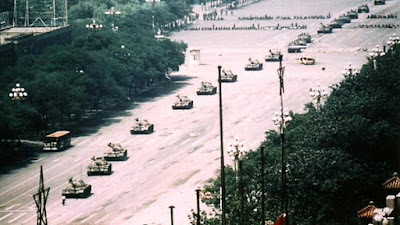
A man risked all to protest what had taken place. Wearing a white t-shirt, black trousers, and carrying what appeared to be a shopping bag he walked out on the north edge of Tiananmen Square, along Chang'an Avenue and faced down a column of Type-59 tanks.

Wider perspective of Tank Men protest with full column of tanks
 

Jianli Yang, a Tiananmen Massacre survivor and former Chinese political prisoner and president of Citizen Power Initiatives for China in his important 2022 article in Newsweek provides the full significance and context of what happened.

"I was near Tiananmen Square in the early morning on June 4, just as gunfire began. At one point, I was so close to the soldiers that I shouted to them in their trucks and told them not to shoot. We even sang songs that every Chinese knows, trying to touch their hearts. But when they received the order, they just opened fire. I saw many killed, including 11 students who were chased and run over by tanks on that fateful day."

Photos appeared of what remained after a tank ran over a student, and this is what Tank Man was in danger of becoming.

Human body crushed to pieces by PLA's tanks.

 In the video of the confrontation, the lead tank tried to drive around him, but the lone man repeatedly ran in front of the tank to prevent its passing. The tank driver turned off his engine and the rest of the column of tanks followed suit. 

The protester climbed on top of the tank and began to talk with him. Eventually he climbed back down and the tank driver turned the engines on but the protester once again blocked the tank column.

Jianli makes a powerful observation about this dynamic between the two men in the same OpEd in Newsweek.

"The Tank Man photo was taken the next day, on June 5, the morning after, when the massacre was still ongoing. By any measure, this image is one of heroism. But how many heroes do we see?

Nearly nine years after the picture was taken, the writer Pico Iyer said: "The heroes of the tank picture are two: the unknown figure who risked his life by standing in front of the juggernaut, and the driver who rose to the moral challenge by refusing to mow down his compatriot."

Not only did the driver refuse to kill, but he undoubtedly disobeyed orders and risked—and perhaps received—punishment in order to save a countryman's life."

We do not know the identities of either Tank Man, or what happened to them, but we do know that for one moment, in the midst of a blood bath perpetrated by the Chinese Communist Party, humanity and dignity triumphed over repression in this particular case.

For more information visit:

Standoff At Tiananmen
How Chinese Students Shocked the World with a Magnificent Movement for Democracy and Liberty that Ended in the Tragic Tiananmen Massacre in 1989
http://www.standoffattiananmen.com/

Virtual Museum of China '89
http://museums.cnd.org/China89/

http://www.cnd.org/June4th/

Screams for help at China's secret 'black jails' - 27 Apr 09 AlJazeera
https://youtu.be/NsN4-A1G5zc

Seeking Justice, Chinese Land in Secret Jails / NY Times
https://www.nytimes.com/2009/03/09/world/asia/09jails.html

A piece of red cloth by Cui Jian (music video - song sang by him in the Square)
https://youtu.be/l8UPST1ZKSw

Frontline Documentary Tankman
https://www.pbs.org/wgbh/pages/frontline/tankman/

Wednesday, June 5, 2024

#Tiananmen35: Remembering the Tank Men

"The heroes of the tank picture are two: the unknown figure who risked his life by standing in front of the juggernaut, and the driver who rose to the moral challenge by refusing to mow down his compatriot." - Pico Iyer

Nonviolent moment: Tank Men face off in Beijing on June 5, 1989

On June 5, 1989 in Beijing, following the Chinese Communist Party's massive and bloody crackdown  on thousands of Chinese students and workers on June 3rd and 4th after six weeks of protests that began in Tiananmen Square and spread across 400 cities in China something remarkable happened in the midst of all the horror and terror. 

A man risked all to protest what had taken place. Wearing a white t-shirt, black trousers, and carrying what appeared to be a shopping bag he walked out on the north edge of Tiananmen Square, along Chang'an Avenue and faced down a column of Type-59 tanks.

Wider perspective of the Tank Men protest with the full column of tanks

Jianli Yang, a Tiananmen Massacre survivor and former Chinese political prisoner and president of Citizen Power Initiatives for China in his important 2022 article in Newsweek provides the full significance and context of what happened.

"I was near Tiananmen Square in the early morning on June 4, just as gunfire began. At one point, I was so close to the soldiers that I shouted to them in their trucks and told them not to shoot. We even sang songs that every Chinese knows, trying to touch their hearts. But when they received the order, they just opened fire. I saw many killed, including 11 students who were chased and run over by tanks on that fateful day."

Photos appeared of what remained after a tank ran over a student, and this is what Tank Man was in danger of becoming.

Human body crushed to pieces by PLA's tanks.

 
In the video of the confrontation, the lead tank tried to drive around him, but the lone man repeatedly ran in front of the tank to prevent its passing. The tank driver turned off his engine and the rest of the column of tanks followed suit. 

The protester climbed on top of the tank and began to talk with him. Eventually he climbed back down and the tank driver turned the engines on but the protester once again blocked the tank column.

Jianli makes a powerful observation about this dynamic between the two men in the same OpEd in Newsweek.

"The Tank Man photo was taken the next day, on June 5, the morning after, when the massacre was still ongoing. By any measure, this image is one of heroism. But how many heroes do we see?

Nearly nine years after the picture was taken, the writer Pico Iyer said: "The heroes of the tank picture are two: the unknown figure who risked his life by standing in front of the juggernaut, and the driver who rose to the moral challenge by refusing to mow down his compatriot."

Not only did the driver refuse to kill, but he undoubtedly disobeyed orders and risked—and perhaps received—punishment in order to save a countryman's life."

We do not know the identities of either Tank Man, or what happened to them, but we do know that for one moment, in the midst of a blood bath perpetrated by the Chinese Communist Party, humanity and dignity triumphed over repression in this particular case.

For more information visit:

Standoff At Tiananmen
How Chinese Students Shocked the World with a Magnificent Movement for Democracy and Liberty that Ended in the Tragic Tiananmen Massacre in 1989
http://www.standoffattiananmen.com/

Virtual Museum of China '89
http://museums.cnd.org/China89/

http://www.cnd.org/June4th/

Screams for help at China's secret 'black jails' - 27 Apr 09 AlJazeera
https://youtu.be/NsN4-A1G5zc

Seeking Justice, Chinese Land in Secret Jails / NY Times
https://www.nytimes.com/2009/03/09/world/asia/09jails.html

A piece of red cloth by Cui Jian (music video - song sang by him in the Square)
https://youtu.be/l8UPST1ZKSw

Frontline Documentary Tankman
https://www.pbs.org/wgbh/pages/frontline/tankman/

Tuesday, June 4, 2024

Lessons from Tiananmen Square

 How it started, and how it ended.

Chinese students march under a banner of late Chinese reformer Hu Yaobang

When Chinese reformer Hu Yaobang died suddenly of a heart attack on April 15, 1989, students responded angrily, with the majority of them assuming that his death was related to his forced resignation. On the day of this reformer's sudden death, small, spontaneous gatherings to mourn Hu began around Tiananmen Square's Monument to the People's Heroes.   

The death of Hu gave the motivation for students to congregate in large numbers. Posters sprouted on university campuses eulogizing him and demanding for Hu's legacy to be honored. Within a few days, the majority of posters addressed bigger political themes such as corruption, democracy, and press freedom, and the protests continued.

On April 27, 1989 soldiers try to stop students entering Tiananmen Square.


On April 26, 1989, the People's Daily published an editorial aimed at scaring students into submission, but it had the opposite effect, enraging them and rallying thousands more to demonstrate in Tiananmen Square.  It was a strategic error of the first order committed by the Chinese Communist regime's highest echelons.

Imagine for a moment that for 51 days of demonstrations beginning on April 15, 1989 thousands of students gathered nonviolently to protest and demand reforms. Protests had taken place before in China in 1986, but had not been sustained.  This time, in part due to the regime's demonizing of the student demonstrators, the protests grew and did not dissolve. 

At the height of the student movement in China, over one million people marched in the streets of Beijing. This movement ended with the government's crackdown and the Beijing massacre of June 4. 

Below is the documentary, The Gate of Heavenly Peace, that captures the days of protest leading up to the crackdown and the massacre.

Nonviolent resisters should learn as much as they can about this important movement. Finally, the struggle for a free China continues to the present day and needs our solidarity.

It is also important to challenge the official narrative that nothing happened, or worse that it was a "vaccination." Thousands were killed, and it was not just students, but also workers in solidarity with student protesters.

At least 10,000 killed during the Tiananmen Square massacre.

Chinese Communist Defense Minister Wei Fenghe on June 2, 2019 at a regional forum defended the Tiananmen Square massacre claiming "[t]hat incident was a political turbulence and the central government took measures to stop the turbulence, which is a correct policy." 

The official newspaper, The Global Times, doubled down claiming that the mass killings and crackdown were "[a]s a vaccination for the Chinese society, the Tiananmen incident will greatly increase China's immunity against any major political turmoil in the future." The message is clear the Communist Chinese regime in China is willing to kill large numbers of Chinese to remain in power.

Bodies at Shuili hospital mortuary. All died from bullet wounds. Credit Jian Liu

A 2017 declassified British diplomatic cable revealed that "at least 10,000 people were killed in the Chinese army's crackdown on pro-democracy protesters in Beijing's Tiananmen Square in June 1989."

The Pro-Democracy Movement that had taken to the streets in April of 1989 was violently crushed by the Chinese communist dictatorship beginning on the evening of June 3, 1989.

Between June 3 and June 5, 1989 other tank drivers ran over protester

By dawn on June 4, 1989 scores of demonstrators had been shot and killed or run over and crushed by tanks of the so-called People's Liberation Army.

On June 5, 1989 in Beijing, following the massive and bloody crackdown after six weeks of protests that began in Tiananmen Square and spread across 400 cities in China, a man risked all to protest what had taken place. 


Wearing a white t-shirt, black trouser, and carrying what appeared to be a shopping bag he walked out on the north edge of Tiananmen Square, along Chang'an Avenue and faced down a column of Type-59 tanks.

We must also remember the courage of the late Nobel Laureate Liu Xiaobo who saved the lives of many young Chinese in Tiananmen Square in June of 1989 obtaining safe passage for them and persuaded these students to leave before the massacre unfolded.  This courageous and nonviolent human rights defender was jailed in 2008 and died on July 13, 2017.

Below is one of his last interviews prior to being unjustly imprisoned.

Monday, June 5, 2023

#Tiananmen34: Remembering the Tank Men

“We persist in our three demands as always: truth, compensation, and accountability — on the 34th anniversary of the June Fourth Massacre.” - Tiananmen Mothers, May 27, 2023

Nonviolent moment: Tank Men face off in Beijing on June 5, 1989

On June 5, 1989 in Beijing, following the Chinese Communist Party's massive and bloody crackdown  on thousands of Chinese students and workers on June 3rd and 4th after six weeks of protests that began in Tiananmen Square and spread across 400 cities in China something remarkable happened in the midst of all the horror and terror. 

A man risked all to protest what had taken place. Wearing a white t-shirt, black trousers, and carrying what appeared to be a shopping bag he walked out on the north edge of Tiananmen Square, along Chang'an Avenue and faced down a column of Type-59 tanks.

Wider perspective of the Tank Men protest with the full column of tanks

Jianli Yang, a Tiananmen Massacre survivor and former Chinese political prisoner and president of Citizen Power Initiatives for China in his important 2022 article in Newsweek provides the full significance and context of what happened.

"I was near Tiananmen Square in the early morning on June 4, just as gunfire began. At one point, I was so close to the soldiers that I shouted to them in their trucks and told them not to shoot. We even sang songs that every Chinese knows, trying to touch their hearts. But when they received the order, they just opened fire. I saw many killed, including 11 students who were chased and run over by tanks on that fateful day."

Photos appeared of what remained after a tank ran over a student, and this is what Tank Man was in danger of becoming.

Human body crushed to pieces by PLA's tanks.

In the video of the confrontation, the lead tank tried to drive around him, but the lone man repeatedly ran in front of the tank to prevent its passing. The tank driver turned off his engine and the rest of the column of tanks followed suit. 

The protester climbed on top of the tank and began to talk with him. Eventually he climbed back down and the tank driver turned the engines on but the protester once again blocked the tank column.

Jianli makes a powerful observation about this dynamic between the two men in the same OpEd in Newsweek.

"The Tank Man photo was taken the next day, on June 5, the morning after, when the massacre was still ongoing. By any measure, this image is one of heroism. But how many heroes do we see?

Nearly nine years after the picture was taken, the writer Pico Iyer said: "The heroes of the tank picture are two: the unknown figure who risked his life by standing in front of the juggernaut, and the driver who rose to the moral challenge by refusing to mow down his compatriot."

Not only did the driver refuse to kill, but he undoubtedly disobeyed orders and risked—and perhaps received—punishment in order to save a countryman's life."

We do not know the identities of either Tank Man, or what happened to them, but we do know that for one moment, in the midst of a blood bath perpetrated by the Chinese Communist Party, humanity and dignity triumphed over repression in this particular case.

For more information visit:

Standoff At Tiananmen
How Chinese Students Shocked the World with a Magnificent Movement for Democracy and Liberty that Ended in the Tragic Tiananmen Massacre in 1989
http://www.standoffattiananmen.com/

Virtual Museum of China '89
http://museums.cnd.org/China89/

http://www.cnd.org/June4th/

Screams for help at China's secret 'black jails' - 27 Apr 09 AlJazeera
https://youtu.be/NsN4-A1G5zc

Seeking Justice, Chinese Land in Secret Jails / NY Times
https://www.nytimes.com/2009/03/09/world/asia/09jails.html

A piece of red cloth by Cui Jian (music video - song sang by him in the Square)
https://youtu.be/l8UPST1ZKSw

Frontline Documentary Tankman
https://www.pbs.org/wgbh/pages/frontline/tankman/


Sunday, June 4, 2023

Lessons from Tiananmen Square

How it started, and how it ended.

Chinese students march under a banner of late Chinese reformer Hu Yaobang

When Chinese reformer Hu Yaobang died suddenly of a heart attack on April 15, 1989, students responded angrily, with the majority of them assuming that his death was related to his forced resignation. On the day of this reformer's sudden death, small, spontaneous gatherings to mourn Hu began around Tiananmen Square's Monument to the People's Heroes.   

The death of Hu gave the motivation for students to congregate in large numbers. Posters sprouted on university campuses eulogizing him and demanding for Hu's legacy to be honored. Within a few days, the majority of posters addressed bigger political themes such as corruption, democracy, and press freedom, and the protests continued.

On April 26, 1989, the People's Daily published an editorial aimed at scaring students into submission, but it had the opposite effect, enraging them and rallying thousands more to demonstrate in Tiananmen Square.  It was a strategic error of the first order committed by the Chinese Communist regime's highest echelons.

On April 27, 1989 soldiers fail to stop students entering Tiananmen Square.

Imagine for a moment that for 51 days of demonstrations beginning on April 15, 1989 thousands of students gathered nonviolently to protest and demand reforms. Protests had taken place before in China in 1986, but had not been sustained.  This time, in part due to the regime's demonizing of the student demonstrators, the protests grew and did not dissolve. 

At the height of the student movement in China, over one million people marched in the streets of Beijing. This movement ended with the government's crackdown and the Beijing massacre of June 4th.

Below is the documentary, The Gate of Heavenly Peace, that captures the days of protest leading up to the crackdown and the massacre.

Nonviolent resisters should learn as much as they can about this important movement. Finally, the struggle for a free China continues to the present day and needs our solidarity.

It is also important to challenge the official narrative that nothing happened, or worse that it was a "vaccination." Thousands were killed, and it was not just students, but also workers in solidarity with student protesters.

Chinese Communist Defense Minister Wei Fenghe on June 2, 2019 at a regional forum defended the Tiananmen Square massacre claiming "[t]hat incident was a political turbulence and the central government took measures to stop the turbulence, which is a correct policy." 

At least 10,000 killed during the Tiananmen Square massacre.

The official newspaper, The Global Times, doubled down claiming that the mass killings and crackdown were "[a]s a vaccination for the Chinese society, the Tiananmen incident will greatly increase China's immunity against any major political turmoil in the future." The message is clear the Communist Chinese regime in China is willing to kill large numbers of Chinese to remain in power.

A 2017 declassified British diplomatic cable revealed that "at least 10,000 people were killed in the Chinese army's crackdown on pro-democracy protesters in Beijing's Tiananmen Square in June 1989."

Bodies at Shuili hospital mortuary. All died from bullet wounds. Credit Jian Liu

The Pro-Democracy Movement that had taken to the streets in April of 1989 was violently crushed by the Chinese communist dictatorship beginning on the evening of June 3, 1989. 

By dawn on June 4, 1989 scores of demonstrators had been shot and killed or run over and crushed by tanks of the so-called People's Liberation Army.

Between June 3 and June 5, 1989 other tank drivers ran over protester

On June 5, 1989 in Beijing, following the massive and bloody crackdown after six weeks of protests that began in Tiananmen Square and spread across 400 cities in China, a man risked all to protest what had taken place.

Wearing a white t-shirt, black trouser, and carrying what appeared to be a shopping bag he walked out on the north edge of Tiananmen Square, along Chang'an Avenue and faced down a column of Type-59 tanks.


We must also remember the courage of the late Nobel Laureate Liu Xiaobo who saved the lives of many young Chinese in Tiananmen Square in June of 1989 obtaining safe passage for them and persuaded these students to leave before the massacre unfolded.  This courageous and nonviolent human rights defender was jailed in 2008 and died on July 13, 2017. Below is one of his last interviews prior to being unjustly imprisoned.

Friday, November 25, 2022

Handpicked communist president from Cuba visits Communist China and celebrate 60 years of diplomatic relations between the two regimes.

A long relationship that began while Cuba had normal diplomatic relations with the United States.

Diaz-Canel met with Xi Jinping earlier today.
 

Castro regime president Miguel Diaz-Canel met in Beijing on November 25, 2022 with president for life Xi Jinping.

The relationship between the two dictatorships stretches back 62 years, and began while the United States had a policy of patience and forbearance at the time believing they could maintain normal diplomatic relations with Havana. They were wrong, and the relationship between Beijing and Havana has grown closer since 1989.

President Xi, who is also general secretary of the Communist Party of China Central Committee, exchanged congratulatory messages with Raul Castro Ruz, first secretary of the Communist Party of Cuba Central Committee, and Miguel Diaz-Canel in September 2020 to celebrate the 60th anniversary of diplomatic relations between the two communist dictatorships.

In September 1960 the Cuban government diplomatically recognized the Peoples Republic of China. Between 1960 and 1964 the two regimes would collaborate closely together. 

Ernesto 'Che' Guevara and Chairman Mao Zedong dining in 1960

Ernesto "Che" Guevara with a Cuban delegation visited Mainland China and met with Mao Zedong, Zhou Enlai, and other high ranking Chinese officials in November 1960 to discuss conditions in Cuba and in Latin America, and the prospects for communist revolution in the Western Hemisphere.

This was at a time that Havana still had normal diplomatic relations with the United States. Diplomatic relations between Cuba and the United States were severed on January 3, 1961.

Relations between China and Cuba cooled in 1964 when the Castro regime sided with the Soviet Union in the Sino-Soviet  split, but warmed again in 1989 following the Tiananmen Massacre. The Castro regime was one of the few governments to support the massacre, and the Castro regime had distanced itself from the Soviet Union viewing Perestroika and Glasnost  as existential threats to their rule.

Chinese Premier Li Peng and Fidel Castro in Havana in 1995

Cuba's relationship with the Soviet Union provided Havana with expertise in biological warfare and biotech that had been denied the Chinese due to the above mentioned split. The Castro regime beginning in the late 1980s began offering that knowledge to their counterparts in Beijing and signed a  formal agreement to produce monoclonal antibodies in 2002.

The two regimes worked closely together during the COVID-19 pandemic that originated in Wuhan, China in December 2019.  Above is a video presentation given in April 2020 on this relationship.

At the United Nations Human Rights Council on July 1, 2020 the Castro regime took the lead in backing the new security law in Hong Kong that effectively ends autonomy there.

Diaz-Canel doubled down on Havana's alliance with Beijing during this visit to mainland China.


Sunday, June 5, 2022

#Tiananmen33: Remembering the Tank Men

"Seeking government accountability for the massacre in accordance with the law is our legitimate right. For 33 years, we have been pursuing the three demands of “truth, compensation, and accountability” in a peaceful and rational manner, calling for a dialogue with the government through the legal process to resolve the issues related to the June Fourth massacre." -  Tiananmen Mothers, June 1, 2022

Nonviolent moment: Tank Men face off in Beijing on June 5, 1989

On June 5, 1989 in Beijing, following the Chinese Communist Party's massive and bloody crackdown  on thousands of Chinese students and workers on June 3rd and 4th after six weeks of protests that began in Tiananmen Square and spread across 400 cities in China something remarkable happened in the midst of all the horror and terror. 

A man risked all to protest what had taken place. Wearing a white t-shirt, black trousers, and carrying what appeared to be a shopping bag he walked out on the north edge of Tiananmen Square, along Chang'an Avenue and faced down a column of Type-59 tanks.

Wider perspective of the Tank Men protest with the full column of tanks

Jianli Yang, a Tiananmen Massacre survivor and former Chinese political prisoner and president of Citizen Power Initiatives for China in his important 2022 article in Newsweek provides the full significance and context of what happened.

"I was near Tiananmen Square in the early morning on June 4, just as gunfire began. At one point, I was so close to the soldiers that I shouted to them in their trucks and told them not to shoot. We even sang songs that every Chinese knows, trying to touch their hearts. But when they received the order, they just opened fire. I saw many killed, including 11 students who were chased and run over by tanks on that fateful day."

Photos appeared of what remained after a tank ran over a student, and this is what Tank Man was in danger of becoming.

Human body crushed to pieces by PLA's tanks.

In the video of the confrontation, the lead tank tried to drive around him, but the lone man repeatedly ran in front of the tank to prevent its passing. The tank driver turned off his engine and the rest of the column of tanks followed suit. 

The protester climbed on top of the tank and began to talk with him. Eventually he climbed back down and the tank driver turned the engines on but the protester once again blocked the tank column.

Jianli makes a powerful observation about this dynamic between the two men in the same OpEd in Newsweek.

"The Tank Man photo was taken the next day, on June 5, the morning after, when the massacre was still ongoing. By any measure, this image is one of heroism. But how many heroes do we see?

Nearly nine years after the picture was taken, the writer Pico Iyer said: "The heroes of the tank picture are two: the unknown figure who risked his life by standing in front of the juggernaut, and the driver who rose to the moral challenge by refusing to mow down his compatriot."

Not only did the driver refuse to kill, but he undoubtedly disobeyed orders and risked—and perhaps received—punishment in order to save a countryman's life."

We do not know the identities of either Tank Man, or what happened to them, but we do know that for one moment, in the midst of a blood bath perpetrated by the Chinese Communist Party, humanity and dignity triumphed over repression in this particular case.

For more information visit:

Standoff At Tiananmen
How Chinese Students Shocked the World with a Magnificent Movement for Democracy and Liberty that Ended in the Tragic Tiananmen Massacre in 1989
http://www.standoffattiananmen.com/

Virtual Museum of China '89
http://museums.cnd.org/China89/

http://www.cnd.org/June4th/

Screams for help at China's secret 'black jails' - 27 Apr 09 AlJazeera
https://youtu.be/NsN4-A1G5zc

Seeking Justice, Chinese Land in Secret Jails / NY Times
https://www.nytimes.com/2009/03/09/world/asia/09jails.html

A piece of red cloth by Cui Jian (music video - song sang by him in the Square)
https://youtu.be/l8UPST1ZKSw

Frontline Documentary Tankman
https://www.pbs.org/wgbh/pages/frontline/tankman/

Saturday, June 4, 2022

Lessons from Tiananmen Square

How it started, and how it ended.

On April 27, 1989 soldiers try to stop students entering Tiananmen Square.

 On April 26, 1989 the People's Daily ran an editorial with the objective of frightening students into submission that had the opposite effect enraging them instead and mobilizing many more to go and protest in Tiananmen Square.  It was a strategic blunder of the first order carried out by the highest levels of the Chinese Communist regime.

Imagine for a moment that for 51 days of demonstrations beginning on April 15, 1989 thousands of students gathered nonviolently to protest and demand reforms. Protests had taken place before in China in 1986, but had not been sustained.  This time, in part due to the regime's demonizing of the student demonstrators, the protests grew and did not dissolve. 

At the height of the student movement in China, over one million people marched in the streets of Beijing. This movement ended with the government's crackdown and the Beijing massacre of June 4. 

Below is the documentary, The Gate of Heavenly Peace, that captures the days of protest leading up to the crackdown and the massacre. 

Nonviolent resisters should learn as much as they can about this important movement. Finally, the struggle for a free China continues to the present day and needs our solidarity.

It is also important to challenge the official narrative that nothing happened, or worse that it was a "vaccination." Thousands were killed, and it was not just students, but also workers in solidarity with student protesters.

At least 10,000 killed during the Tiananmen Square massacre.

Chinese Communist Defense Minister Wei Fenghe on June 2, 2019 at a regional forum defended the Tiananmen Square massacre claiming "[t]hat incident was a political turbulence and the central government took measures to stop the turbulence, which is a correct policy." 

The official newspaper, The Global Times, doubled down claiming that the mass killings and crackdown were "[a]s a vaccination for the Chinese society, the Tiananmen incident will greatly increase China's immunity against any major political turmoil in the future." The message is clear the Communist Chinese regime in China is willing to kill large numbers of Chinese to remain in power.

Bodies at Shuili hospital mortuary. All died from bullet wounds. Credit Jian Liu

A 2017 declassified British diplomatic cable revealed that "at least 10,000 people were killed in the Chinese army's crackdown on pro-democracy protesters in Beijing's Tiananmen Square in June 1989."

The Pro-Democracy Movement that had taken to the streets in April of 1989 was violently crushed by the Chinese communist dictatorship beginning on the evening of June 3, 1989.

Between June 3 and June 5, 1989 other tank drivers ran over protester

By dawn on June 4, 1989 scores of demonstrators had been shot and killed or run over and crushed by tanks of the so-called People's Liberation Army.

On June 5, 1989 in Beijing, following the massive and bloody crackdown after six weeks of protests that began in Tiananmen Square and spread across 400 cities in China, a man risked all to protest what had taken place. 

Wearing a white t-shirt, black trouser, and carrying what appeared to be a shopping bag he walked out on the north edge of Tiananmen Square, along Chang'an Avenue and faced down a column of Type-59 tanks.

 We must also remember the courage of the late Nobel Laureate Liu Xiaobo who saved the lives of many young Chinese in Tiananmen Square in June of 1989 obtaining safe passage for them and persuaded these students to leave before the massacre unfolded.  This courageous and nonviolent human rights defender was jailed in 2008 and died on July 13, 2017.

Image of late Chinese activist Liu Xiaobo is displayed at a candlelight vigil to mark the 33rd anniversary of the 1989 Tiananmen Square Massacre, at the Victims of Communism Memorial in Washington, DC epa/ Michael Reynolds