"The first victory we can claim is that our hearts are free of hatred. Hence we say to those who persecute us and who try to dominate us: ‘You are my brother. I do not hate you, but you are not going to dominate me by fear. I do not wish to impose my truth, nor do I wish you to impose yours on me. We are going to seek the truth together’. THIS IS THE LIBERATION WHICH WE ARE PROCLAIMING."
Oswaldo José Payá Sardiñas (2002)
Showing posts with label Tiananmen Mothers. Show all posts
Showing posts with label Tiananmen Mothers. Show all posts
“We persist in our three demands as always: truth, compensation, and accountability — on the 34th anniversary of the June Fourth Massacre.” - Tiananmen Mothers, May 27, 2023
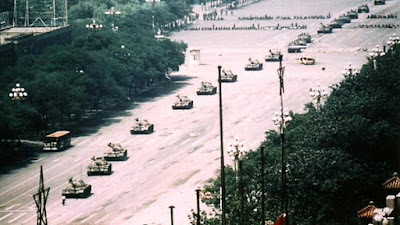
Nonviolent moment: Tank Men face off in Beijing on June 5, 1989
On
June 5, 1989 in Beijing, following the Chinese Communist Party's
massive and bloody crackdown on thousands of Chinese students and
workers on June 3rd and 4th
after six weeks of protests that began in Tiananmen Square and spread
across 400 cities in China something remarkable happened in the midst of
all the horror and terror.
A man risked all to protest what had
taken place. Wearing a white t-shirt, black trousers, and carrying
what appeared to be a shopping bag he walked out on the north edge of Tiananmen Square, along Chang'an Avenue and faced down a column of Type-59 tanks.
Wider perspective of the Tank Men protest with the full column of tanks
Jianli Yang, a Tiananmen Massacre survivor and former Chinese political prisoner and president of Citizen Power Initiatives for China in his important 2022 article in Newsweek provides the full significance and context of what happened.
"I was near Tiananmen Square in the early morning on June 4, just as
gunfire began. At one point, I was so close to the soldiers that I
shouted to them in their trucks and told them not to shoot. We even sang
songs that every Chinese knows, trying to touch their hearts. But when
they received the order, they just opened fire. I saw many killed,
including 11 students who were chased and run over by tanks on that
fateful day."
Photos appeared of what remained after a tank ran over a student, and this is what Tank Man was in danger of becoming.
In the video of the confrontation, the lead tank tried to drive around him, but the lone man repeatedly ran in
front of the tank to prevent its passing. The tank driver turned off his
engine and the rest of the column of tanks followed suit.
The protester
climbed on top of the tank and began to talk with him. Eventually he
climbed back down and the tank driver turned the engines on but the
protester once again blocked the tank column.
Jianli makes a powerful observation about this dynamic between the two men in the same OpEd in Newsweek.
"The Tank Man photo was taken the next day, on June 5, the morning
after, when the massacre was still ongoing. By any measure, this image
is one of heroism. But how many heroes do we see?
Nearly nine years after the picture was taken, the writer Pico Iyer
said: "The heroes of the tank picture are two: the unknown figure who
risked his life by standing in front of the juggernaut, and the driver
who rose to the moral challenge by refusing to mow down his compatriot."
Not
only did the driver refuse to kill, but he undoubtedly disobeyed orders
and risked—and perhaps received—punishment in order to save a
countryman's life."
We do not know the identities of
either Tank Man, or what happened to them, but we do know that for one
moment, in the midst of a blood bath perpetrated by the Chinese
Communist Party, humanity and dignity triumphed over repression in this
particular case.
For more information visit:
Standoff At Tiananmen How
Chinese Students Shocked the World with a Magnificent Movement for
Democracy and Liberty that Ended in the Tragic Tiananmen Massacre in
1989 http://www.standoffattiananmen.com/
A 2017 declassified British diplomatic cable revealed that
"at least 10,000 people were killed. The Chinese Communist regime still defends committing this massacre, and is punishing those who seek to remember and observe the date.
In Hong Kong, commemorating the Tiananmen Square Massacre with white flowers, signs, or a hunger strike lead to arrests.
It's a poignant example of eroding free speech and political rights. Charges of 'sedition' could result in lengthy imprisonment. https://t.co/tUpJR5YWKg
George Orwell wrote in "As I Please" in the Tribune on February 4, 1944 that "[t]he
really frightening thing about totalitarianism is not that it commits
'atrocities' but that it attacks the concept of objective truth; it
claims to control the past as well as the future."
We are witnessing this attempt to silence the victims, erase and rewrite the history of the 1989 Tiananmen protests and the crackdown and massacre that began on June 3, 1989 through social media and in the real world. People are being arrested for engaging in silent, nonviolent protests in remembrance of students and workers murdered by the Peoples Liberation Army (PLA) on orders of the Chinese Communist Party (CCP). Making this known is the most effective method to combat it.
The Czech writer Milan Kundera wrote that "[t]he struggle of man against power is the struggle of memory against forgetting." This is the challenge presented by the Chinese Communist Party in its effort to erase the mass protests, months long occupation and crackdown in Tiananmen Square, and across China. It is also why we must remember and honor courageous Chinese dissidents such as Liu Xiaobo martyred for his commitment to nonviolence and democracy.
My performance artist friend Sanmu just got arrested in Hong Kong, he was trying to perform on the street on June/3 to commemorate 1989 Tiananmen Square Massacre, during his arrest, he yelled “, Hongkongers have no fear! Don’t forget June 4th!” pic.twitter.com/itYnfDiSii
Last night participated in a candlelight vigil hosted by the Victims of Communism Memorial Foundation where I listened to eyewitnesses who were present in the square in 1989, and those persecuted today for holding vigils in remembrance.
HRIC Note: On the 34th anniversary of the June Fourth Massacre, the Tiananmen
Mothers have authorized Human Rights in China to publish this essay. See our website
for more information on June Fourth and the Tiananmen Mothers.
[Translation by Mi Ling Tsui]
The year 2023 marks the 34th anniversary of the June Fourth Massacre that unfolded
on the night of June 3-4, 1989, on the ten-mile-long Chang'an Avenue in Beijing, the
capital of China.
Though 34 years have passed, for us, family members of those killed, the pain of
losing our loved ones in that one night has tormented us to this day, in a nightmare
that has never let go. In a time of peace, the Chinese government flouted the world’s
condemnation and brazenly mobilized the nation’s military power against unarmed
students and ordinary people, in a massacre that shocked the world—the June Fourth
Massacre. We, families of June Fourth victims, will not relinquish our determination
to seek justice for our loved ones every single day that the authorities refuse to make
public the truth about the massacre—until justice is done.
Since the 33rd anniversary of June Fourth, in 2022, seven members of our group have
passed away (one of them died of old age and physical decline in the first half of the
year, and the other six died in the second half of the year). Every time we heard the
news of the passing of a fellow family member, we were struck with great sorrow,
especially because we could not visit the families of the deceased immediately due to
pandemic restrictions. Our hearts are heavy, with no relief.
As we commemorate our loved ones on this 34th anniversary of June Fourth, we
honor the deceased family members here—in order to restore history, bear
witness to how the victims were killed, recall the harm and suffering inflicted on
the victims’ families by the troops who perpetrated the massacre, and so that
people can know their misery and remember their desire and unwavering
determination to defend their lawful rights and seek justice for their loved ones.
Although their lives are gone, their final wishes are still with us.
"Seeking government accountability for the massacre in
accordance with the law is our legitimate right. For 33 years, we have
been pursuing the three demands of “truth, compensation, and
accountability” in a peaceful and rational manner, calling for a
dialogue with the government through the legal process to resolve the
issues related to the June Fourth massacre." - Tiananmen Mothers, June 1, 2022
Nonviolent moment: Tank Men face off in Beijing on June 5, 1989
On June 5, 1989 in Beijing, following the Chinese Communist Party's massive and bloody crackdown on thousands of Chinese students and workers on June 3rd and 4th
after six weeks of protests that began in Tiananmen Square and spread
across 400 cities in China something remarkable happened in the midst of all the horror and terror.
A man risked all to protest what had
taken place. Wearing a white t-shirt, black trousers, and carrying
what appeared to be a shopping bag he walked out on the north edge of Tiananmen Square, along Chang'an Avenue and faced down a column of Type-59 tanks.
Wider perspective of the Tank Men protest with the full column of tanks
Jianli Yang, a Tiananmen Massacre survivor and former Chinese political prisoner and president of Citizen Power Initiatives for China in his important 2022 article in Newsweek provides the full significance and context of what happened.
"I was near Tiananmen Square in the early morning on June 4, just as
gunfire began. At one point, I was so close to the soldiers that I
shouted to them in their trucks and told them not to shoot. We even sang
songs that every Chinese knows, trying to touch their hearts. But when
they received the order, they just opened fire. I saw many killed,
including 11 students who were chased and run over by tanks on that
fateful day."
Photos appeared of what remained after a tank ran over a student, and this is what Tank Man was in danger of becoming.
In the video of the confrontation, the lead tank tried to drive around him, but the lone man repeatedly ran in
front of the tank to prevent its passing. The tank driver turned off his
engine and the rest of the column of tanks followed suit.
The protester
climbed on top of the tank and began to talk with him. Eventually he
climbed back down and the tank driver turned the engines on but the
protester once again blocked the tank column.
Jianli makes a powerful observation about this dynamic between the two men in the same OpEd in Newsweek.
"The Tank Man photo was taken the next day, on June 5, the morning
after, when the massacre was still ongoing. By any measure, this image
is one of heroism. But how many heroes do we see?
Nearly nine years after the picture was taken, the writer Pico Iyer
said: "The heroes of the tank picture are two: the unknown figure who
risked his life by standing in front of the juggernaut, and the driver
who rose to the moral challenge by refusing to mow down his compatriot."
Not
only did the driver refuse to kill, but he undoubtedly disobeyed orders
and risked—and perhaps received—punishment in order to save a
countryman's life."
We do not know the identities of either Tank Man, or what happened to them, but we do know that for one moment, in the midst of a blood bath perpetrated by the Chinese Communist Party, humanity and dignity triumphed over repression in this particular case.
For more information visit:
Standoff At Tiananmen How
Chinese Students Shocked the World with a Magnificent Movement for
Democracy and Liberty that Ended in the Tragic Tiananmen Massacre in
1989 http://www.standoffattiananmen.com/
A 2017 declassified British diplomatic cable revealed that
"at least 10,000 people were killed. The Chinese Communist regime still defends committing this massacre.
George Orwell wrote in "As I Please" in the Tribune on February 4, 1944 that "[t]he really frightening thing about totalitarianism is not that it
commits 'atrocities' but that it attacks the concept of objective truth;
it claims to control the past as well as the future."
We are witnessing this attempt to silence the victims, and rewrite the history of the 1989 Tiananmen protests and the crackdown and massacre that began on June 3, 1989 through social media.
The Czech writer Milan Kundera wrote that "[t]he struggle of man against power is the struggle of memory against forgetting." This is the challenge presented by the Chinese Communist Party in its effort to erase the mass protests, months long occupation and crackdown in Tiananmen Square, and across China. It is also why we must remember and honor courageous Chinese dissidents such as Liu Xiaobo martyred for his commitment to nonviolence and democracy.
Last night participated in a candlelight vigil hosted by the Victims of Communism Memorial Foundation and on Saturday, June 4th starting at 11:00am in Rockville, MD free Chinese will hold a Freedom from Tyranny Rally.
Thirty-three years ago, a brutal tragedy of unparalleled
savagery occurred in China, sending shockwaves across the nation and
around the world. The ruling Communist Party of China and the Chinese
government, in complete disregard of the lives of the hundreds of
thousands of students and common people along the ten-mile Chang’an
Avenue, used the military to indiscriminately murder innocent people in
the capital city of Beijing with live ammunition. The armed forces aimed
their guns at them and even drove tanks to crush the crowd, killing and
injuring thousands.
This government-led massacre caught Beijing residents
completely off guard. At around 10 p.m. on June 3, under cover of
darkness, martial law troops rode tanks and armored vehicles from all
directions toward Tiananmen Square. On their way, they sprayed students
and residents with gunfire and chased after those trying to escape,
leaving heavy casualties in their wake. Early the next morning, on June
4, when student protestors evacuated from the square in files and walked
to Liubukou in Xidan, the army unleashed poisonous tear gas with
paralyzing nerve agents, causing the students and residents at the scene
to collapse on the ground, unable to move due to difficulty breathing
and a feeling of suffocation. A row of tanks ran over the fallen crowd,
killing or seriously injuring more than ten students on the spot.
Among the 203 victims we have found so far are 61
undergraduate and graduate students from various universities, 14
elementary and middle school students, and 14 missing persons. The
youngest was only 9 and the oldest 66.
In April and May 1989, millions of students and common
people joined marches, petitions, and protests, exercising the rights
conferred to Chinese citizens under the Constitution and the law—these
were lawful acts that did not violate the Constitution whatsoever. From
beginning to end, the movement upheld the principles of peace,
rationality, and non-violence. Up until the military crackdown, the
entire social order had been stable. This stability was conscientiously
maintained by the students and other members of the public in the
nation’s capital. The students and the public in the demonstrations were
simply demanding an end to corruption and official malfeasance, freedom
of speech, disclosure of officials' assets, and the establishment of a
mechanism for civil society to monitor the integrity of government
officials. None of these demands deviated from the constitutional
framework. When the two sides disagreed, the protestors did nothing more
than ask the government for a reasonable resolution within the scope of
the Constitution and the law: through the legal process, consultation,
and dialogue.
But the ruling CPC and the Chinese government completely
ignored the people’s reasonable demands and chose a course of action
completely contrary to modern civilization. They abused their power to
savagely and brutally kill and crush their own citizens with bullets and
tanks, and subsequently launched a fascist-like nationwide probe,
hurling the whole society into a state of terror and putting everyone in
danger.
We cannot help but ask: Did the student movement, which
merely offered suggestions to help the ruling party and government to
serve the people with greater integrity, really warrant military
suppression and arbitrary killing of innocent citizens? As the student
protests spread from Beijing to the whole country, they became a way for
the people to express their good wishes for the government. And what is
your definition of “the people”? Do the people become the enemy once
they put forth a recommendation? The Chinese ruling party and government
then went on to absolve themselves from their murderous crime and
responsibility under the guise of “quelling counter-revolutionary
riots”—isn’t it too cruel?
Sending the army to slaughter students and civilians in
peacetime is undeniably an atrocity against humanity. In the face of the
vibrant lives shot to death in the June Fourth massacre, the
unilateral, fact-denying characterization and rhetoric of China's ruling
party and government are pale and devoid of humanity. They will not
withstand the test of history.
Over the past 33 years, 64 members of our group of
bereaved family members of June Fourth victims have passed away. This
year we have had two more deaths, Yin Min and Liu Qian. Liu, the oldest
member of our group, died in late April this year, at the age of 97.
Seeking government accountability for the massacre in
accordance with the law is our legitimate right. For 33 years, we have
been pursuing the three demands of “truth, compensation, and
accountability” in a peaceful and rational manner, calling for a
dialogue with the government through the legal process to resolve the
issues related to the June Fourth massacre.
We appeal to your conscience on behalf of the families of those killed. For fairness and justice, we will persevere.
"We believe that the truth can be made
public by first releasing the names of the dead and then going step by
step until the true history of the killing is eventually restored."- Tiananmen Mothers, June 1, 2021
Tank men face off on June 5, 1989 on Changán Avenue in Beijing, China
Human Rights in China (HRIC) is right when it observes that "to remember is to resist." 32 years have passed and we continue to remember, despite the efforts of the Chinese Communist Party, and their allies to erase this crime against humanity.
We remember the
thousands of students and workers murdered by the People's Liberation
Army and the more than 800 imprisoned.
The Pro-Democracy Movement that had taken to the streets
in April of 1989 was violently crushed by the Chinese communist
dictatorship beginning on the evening of June 3, 1989. By dawn on June
4, 1989 scores of demonstrators had been shot and killed or run over and crushed by tanks of the so-called People's Liberation Army.
Between June 3 and June 5, 1989 other tank drivers ran over protester
On June 5, 1989 in Beijing, following the massive and bloody crackdown
after six weeks of protests that began in Tiananmen Square and spread
across 400 cities in China, a man risked all to protest what had
taken place. Wearing a white t-shirt, black trouses, and carrying
what appeared to be a shopping bag he walked out on the north edge of Tiananmen Square, along Chang'an Avenue and faced down a column of Type-59 tanks.
The lead tank tried two drive around him, but the man repeatedly ran in
front of the tank to prevent its passing. The tank driver turned off his
engine and the rest of the column of tanks followed suit. The protester
climbed on top of the tank and began to talk with them. Eventually he
climbed back down and the tank driver turned the engines on but the
protester once again blocked the tank column.
Wider perspective of the Tank Man protest with the full column of tanks
Thousands more would be rounded up, arrested and sentenced to prison in show trials. As many as a thousand received death sentences that were carried out. This time two men, dressed in blue, approach the protester and escort him off the main avenue and disappeared into the crowd.
At least seven spent over two decades behind bars, and there names are Zhu Gengsheng, Li Yujun, Jiang
Yaqun, Chang Jinqiang, Miao Deshun, Shi Xuezhi, and Yang Pu. The last to be freed, that we know about, Miao Deshun, was freed on October 15, 2016. He was jailed for 27 years. They were living ghosts.
Below we share the 2021 statement of the Tiananmen Mothers and their continuing demands for truth, memory and justice.
Some Tiananmen mothers hold up photos of their loved ones.
Our Faith and Perseverance Will Never Change: On the 32nd Anniversary of the June Fourth Massacre
On June 4, 1989, in a time of peace, the Chinese People’s Liberation
Army, under the leadership and command of the ruling authorities, sent
tanks, armored vehicles, and soldiers with live ammunition onto the
ten-mile Chang’an Avenue in Beijing. Without restraint or scruples, they
shot and crushed unarmed students and citizens, and even destroyed the
bodies to cover up their crimes. As a result, some of the victims’
families have heard nothing about their loved ones after they left home,
not knowing if they were dead or alive, as if they had vanished from
the face of the earth.
This massacre—devoid of humanity and sending shockwaves around the
world—was stupefying and unconscionable. On that sleepless night,
residents huddled in the streets and alleyways to discuss the escalating
situation. Despite hearing gunshots, those good-hearted people still
thought the army was merely shooting rubber bullets to scare the people.
The students and residents at the scene were equally naive in clutching
to their illusions about the government, until people around them
started to collapse, their bright-red blood staining the ground. Only
then did the crowds start to panic, flounder, weep, and take cover.
Still more residents risked their own lives to rescue those who had
fallen around them, using all means of transportation available to
them—such as flatbed tricycles, carts, and vans—to rush the injured to
nearby hospitals as fast as they could.
In the spirit of saving lives and healing wounds, hospital staff
poured all they had in them into rescuing those injured. Many hospitals
took in more people than they could possibly operate on and were forced
to triage the patients for surgeries. Due to the overwhelming number of
wounded people, many waited for hours without treatment. Because of the
delay, some lost their limbs in otherwise preventable amputations and
others their lives. In the face of tragedy, the selflessness and
sacrifice of the ordinary residents of Beijing who rushed to rescue
others despite their own risks was both laudable and gut-wrenching.
Preserving life is the instinct of humanity. In stark contrast was the
viciousness and brutality of the authorities who violated the
constitution and sent in the army to crack down on the unarmed students
and residents.
As to how many people were killed and injured in the end—the
government has not uttered a single word for the past 32 years. All
Chinese people have been stripped of the right to learn about the
tragedy and even forbidden to openly commemorate the dead or hold the
ruling Communist Party of China and the government responsible for the
bloodbath. The government’s immorality and use of silent contempt to
deprive each individual’s right to life have led to the blocking of all
information related to the June Fourth massacre. Having grown up in a
false sense of prosperous jubilance and enforced glorification of the
government, many young people nowadays have no idea of or refuse to
believe what happened on June 4, 1989, in the nation’s capital.
Back in 1949, Beijing, a city with a history of more than 3,000 years
and had served as the capital of three dynasties, was peacefully
liberated by the army without a single shot or cannon fired. Sadly, 40
years after the founding of the People’s Republic of China, the
passionately patriotic people of Beijing were slaughtered by the martial
law troops, who called themselves the “people’s army,” in a human
tragedy of blood and tears.
We, relatives and families of the victims, have experienced the most
painful agony in life, and our hearts have known no joy ever since. The
middle-aged bereaved parents back then are now gray-haired seniors. They
hope to see the law bring fairness and justice in their lifetime—a wish
that, once fulfilled, will console their shattered hearts and allow the
spirits of their children to rest in peace. And as for the children who
lost their fathers or mothers in June Fourth, and traumatized by
growing up in incomplete families, allowing the public to learn about
the massacre will also bring them solace. However, almost 32 years
later, we still don’t see any official attempt at unsealing and
disclosing information about the bloodshed, and the killing in June 1989
remains a taboo for the government.
This year marks the 100th anniversary of the founding of the
Communist Party of China, and a great deal of preparation and
propagandistic efforts have been put into the celebration. In mid-April,
the government also published a high-profile speech delivered on July
1, 2016 by Chinese President Xi Jinping—who also serves as the General
Secretary of the CPC Central Committee and Chairman of the Central
Military Commission—at a commemoration of the CPC’S 95th founding
anniversary. In his speech, Xi demanded that “all Party members
shall put the people in the most prominent place in their hearts and
adhere to the fundamental purpose of serving the people wholeheartedly,
effectively realizing, protecting, and developing the people’s broadest
interests. The people’s support, approval, satisfaction, and affirmation
should be regarded as the fundamental standard for the success or
failure of all of our work so that the Party may enjoy an inexhaustible
source of strength.”“Our greatest threat as the ruling
party is corruption. . . . [We must] be in fearful reverence of the
people, the Party, and the law and discipline, and use our power with
fairness, in accordance with the law, to the benefit of the people, and
with integrity, to maintain the unsullied political nature of the
incorruptible CPC members.”
In 1989, the social incident that was triggered by the student
movement in Beijing and involving the participation of people from all
walks of life in many major cities across the country—who used peaceful
and rational demonstrations to voice their opposition to bureaucratic
profiteering, embezzlement, and corruption to the government—was the
most quintessential manifestation of a healthy society. When the public
spotted embezzlement and corruption in the CPC’s powerful elite during
the Reform and Opening Up, what the government should have done was to
assess its performance based on the people’s demands and resolve social
conflicts in accordance with the law, rather than seeing protests as
turmoil and using the state’s military force to indiscriminately murder
innocent people in broad daylight on the streets of Beijing.
We believe it is the unavoidable responsibility of the CPC and the
Chinese government to resolve the June Fourth massacre, and redressing
the tragedy is the first step to governing the country by law,
respecting the people’s own agency, and ensuring their position as the
masters of the country. Doing this would let the people CPC members have
nothing to hide and seek no personal gain, and that the Party’s conduct
is also subject to the supervision of the law. We look forward to the
day when the CPC and the Chinese government can sincerely and
courageously set the record straight and take up their due
responsibility for the anti-human 1989 massacre in accordance with the
law and the facts.
We have been calling for a peaceful dialogue with the government
since the late 1990s to discuss the June Fourth tragedy and ways to
resolve it in accordance with the law. To this end, we have publicly put
forward the three demands of “truth, compensation, and accountability”
and established a dialogue group. We believe that the truth can be made
public by first releasing the names of the dead and then going step by
step until the true history of the killing is eventually restored.
Compensation should be paid to the relatives of the victims, and those
responsible for ordering the shooting should be held legally
accountable. We look forward to seeing the CPC and the Chinese
government bow down and apologize to the entire nation for this
atrocity!
Our group lost two more mothers of victims to illness in 2020, and we
have lost 62 bereaved family members thus far. As the years go by, the
parents in our group are getting older by the day, and some of the
elderly have left us forever. However, our faith and perseverance will
never change!
Standoff At Tiananmen How
Chinese Students Shocked the World with a Magnificent Movement for
Democracy and Liberty that Ended in the Tragic Tiananmen Massacre in
1989 http://www.standoffattiananmen.com/
Vigil for martyrs of the Tiananmen Square massacre in defiance of government ban.
Despite the orders from the authorities that Hong Kongers were forbidden from holding an act of remembrance for the martyrs of the Tiananmen Square massacre thousands took to the streets and held their vigil of remembrance.
A time to remember the
thousands of students and workers murdered by the People's Liberation
Army and the more than 800 imprisoned of which at least seven spent over two decades behind bars. There names are Zhu Gengsheng, Li Yujun, Jiang
Yaqun, Chang Jinqiang, Miao Deshun, Shi Xuezhi, and Yang Pu. They were living ghosts. The last to be freed, that we know about, Miao Deshun, was freed on October 15, 2016. He was jailed for 27 years.
Candlelight vigils were held across Hong Kong, and across the world in remembrance of those massacred on June 3-4, 1989 standing up for truth, freedom and life in China.
Thousands of Hong Kong protesters defied a police ban Thursday night to stage a vigil on the anniversary of June 4, 1989 — the date that Chinese tanks rolled into Beijing’s Tiananmen Square to crush a student-led democracy movement https://t.co/fpRj0oxAxApic.twitter.com/Wv1XPjlZh0
It
also continues to be the time to demand justice for the dead and to demonstrate our solidarity with brave citizens of Hong Kong and Taiwan who continue to live in freedom despite the threats from Beijing. Below is the statement of the Tiananmen Mothers in 2020 calling for the truth to be told.
Tiananmen mothers hold up photos of their loved ones.
Tell the Truth, Refuse to Forget, Lies Written in Ink Cannot Conceal
the Facts Written in Blood On the 31st Anniversary of the June Fourth
Massacre:
by the Tiananmen Mothers
June 1, 2020
[English translation by Human Rights in China]
This year, 2020, is the 31st anniversary of the June Fourth massacre
that took place in Beijing, China, in 1989. We will not forget the
tragedy. That year, in peacetime, the Chinese government mobilized our
nation’s military force—a force flaunted as "people's soldiers"—and
deployed tanks and armored vehicles on Chang'an Avenue. On their way to
Tiananmen Square, the troops opened fire randomly, ignoring crowds that
lined the streets. They fired even at the students at Liubukou in Xidan
who had retreated from Tiananmen Square. The troops first sprayed
poisonous gas containing nerve-numbing agents to render people
unconscious and then moved the tanks to crush the crowds, in bloody
scenes of unparalleled brutality and inhumanity.
In a movement that had begun in April, around the time of the death
of Hu Yaobang, the former General Secretary of the Communist Party of
China, to the bloody crackdown on June 4, the students were always
peaceful and rational in their petition for dialogue with the
government. Outside the capital, students in many provinces and cities
across the country also came forward to express their solidarity with
the students in Beijing. This was the most magnificent and unprecedented
student movement in modern Chinese history.
The students raised these demands: End to corruption and bureaucratic
turpitude, democracy and freedom, official asset transparency, the
right to speak freely, and a fair and equitable dialogue between the
people and the government. The demands found great resonance throughout
the society. Looking back, from 1979 to 1989, in the ten years of Reform
and Opening-up policies that transformed the national economy from a
planned economy to a market economy, the real beneficiaries of the
reform were the extreme few who held power in their hands. This social
injustice had caused dissatisfaction among the people. As a result,
citizens from all walks of life participated in the marches, raised
questions about people's livelihood, demanded citizens’ right to know,
and made suggestions about people's livelihood. They proposed speeding
up political reform, allowing freedom of the press and, grasping the
true meaning of government, returning governance to the people. This was
a moment of great awakening that brought forth questions and thoughts
among the people about the social problems that had accumulated in the
ten-year ravage of the Cultural Revolution.
It was unbelievable that the government completely ignored the voices
and opinions of the people: it avoided the core substance and dwelled
only on the trivial by only addressing the governance issue. It demanded
the students withdraw from Tiananmen Square unconditionally. The
government's demand was rejected by the students because they worried
that, following their unconditional withdrawal, the government would
come after them to settle scores. And the citizens of Beijing bore
witness to the entire course of the 1989 student movement and the June
Fourth massacre.
Our children and loved ones were killed in the June Fourth massacre.
For 31 years, every family of the victims has lived in the mid of this
suffering and life’s arduousness. We, as citizens of this country and
relatives of the victims, have every reason to question the Chinese
ruling party and the Chinese government. The government bears
unavoidable responsibility for the harm done to all the citizens through
the bloody tragedy that year. Legally, you owe the people
accountability, and morally, you owe the people an apology. The specific
reasons are as follows:
Reason One. The Communist Party of China established a new China in
1949, overthrowing the old system and establishing a new system. Article
5 of the Founding Program (the Common Program of the Chinese People ’s Political Consultative Conference)
stipulates that the people of the People ’s Republic of China have the
rights to freedom of thought, speech, publication, assembly,
association, communication, person, residence, migration, religious
belief, and demonstrations. Article 35 of the Constitution of the People ’s Republic of China
also clearly provides the same: Citizens of the People's Republic of
China enjoy freedom of speech, publication, assembly, association,
procession, and demonstration. If the Chinese ruling Party and the
Chinese government have not forgotten their original aspiration, they
should abide by and implement the Founding Program and Constitution
established in the early days of the founding of the country. However,
in its highly centralized rule, the CPC has long forgotten the sacred
rights conferred to citizens by the Constitution. We believe that the
student movement of that year did not exceed the scope permitted by the
law. If the government had conscientiously listened to the opinions of
the people, instead of ending the student movement in such a cruel and
barbaric manner, the process of civilizing the Chinese society would
have accelerated its pace to integrate with the civilized society of the
world, and the corruption in Chinese officialdom would not have been so
rampant.
Reason Two. The politics of "the Elders" was most vividly manifested
in their decision on the June Fourth tragedy. The government's
functional departments were in chaos. The government of a civilized
society resolves social contradictions in accordance with the law, and
resolving social contradictions is the daily responsibility of a
government. However, what we saw was the total disregard of the law by
those who were enthroned as the older generation of proletariat
revolutionaries, who ignored the lives of the people and the existence
of government functions. Even though those old revolutionaries had
already stepped down and yielded their power, they were allowed to wield
the power of life and death of the people at will, and brand citizens
as "counter-revolutionary rioters" and elements "endangering state
power" at will, according to the needs of the ruling class.
Reason Three. We have to ask the Chinese ruling party and the Chinese
government: Which civilized Chinese law expressly confers the
government the right to use state military force to kill, at will,
students and civilians in peaceful demonstrations? The Constitution
provides that state military power is exercised by authorization by the
National People’s Congress. At that time, the students repeatedly called
for a special meeting of the Standing Committee of the People’s
Congress to vote on the use of the army to carry out the crackdown. The
government ignored the students’ appeals. We want to know exactly where
and when the counterrevolutionary riots occurred? Where is the evidence?
Who commanded the riots? What is the truth?
Reason Four. To measure the robustness of a civil society, the level
of people’s happiness index, the level of civilization, and the freedom
of speech are among the most important and necessary conditions. A large
nation that allows only one voice from the authorities and not the
diverse voices of the people, and that is blind to the people's
well-intentioned criticism and supervision of the government's
inadequacies will only produce this result: the unlimited expansion of
the authority of those wielding hefty power, who lord over the people
from the top and unchecked by the law, with the so-called equality
before the law serving as decoration for them.
Over the past 31 years, we have repeatedly called for a legal
resolution to a political problem, through fair and equitable dialogues
with the government in accordance with the law. The government has
remained silent on the June Fourth massacre, without demonstrating the
slightest trace of remorse. With the passage of time, 60 people among
our group of victims’ families have passed away. Time can erase our
lives, but our group ’s resolve in the pursuit of fairness and justice
will not alter. We continue to adhere to our three demands: truth,
compensation, and accountability—in order to obtain justice from the
government for all the victims of the June Fourth tragedy. The dignity
of every single life may not be stripped away and trampled on
arbitrarily by power. They are our loved ones and your compatriots.
Standoff At Tiananmen How
Chinese Students Shocked the World with a Magnificent Movement for
Democracy and Liberty that Ended in the Tragic Tiananmen Massacre in
1989 http://www.standoffattiananmen.com/
“Any man's death diminishes me, because I am involved in mankind, and therefore never send to know for whom the bells tolls; it tolls for thee.” - John Donne, Meditation XVII
What Chinese students demanded from the Chinese regime in June 1989
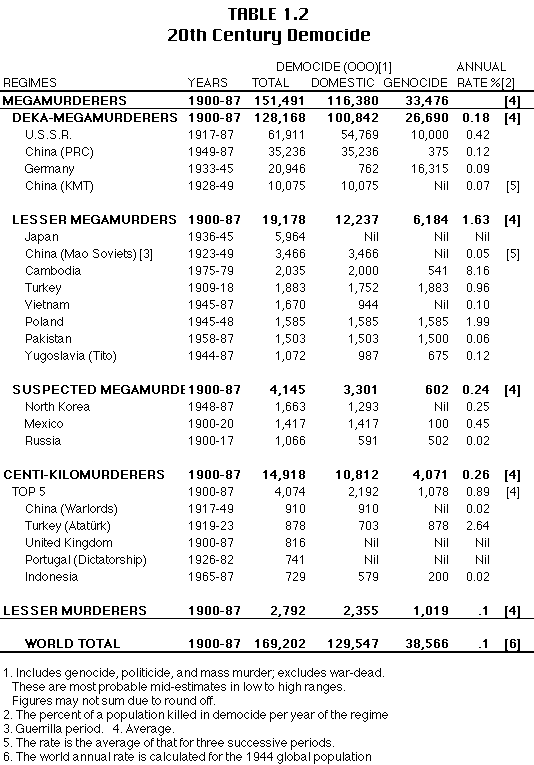
This analysis is mistaken, not because Cubans will not resist a policy that condemns them to decades more under communist tyranny, but because the Chinese have resisted and paid a high price for their desire for freedom. More than 35 million Chinese were killed under this regime between 1949 and 1987. The Chinese regime also demonstrated that the founding generation of leaders, as they neared death, initiated one last spasm of sustained mass killings in the Cultural Revolution.
On June 2, 1989 the communist party elders issued the orders to put down the "counterrevolutionary riot." The savage suppression by military forces was not just in Beijing but across China in all those cities that had participated in the protests demanding reform. Time magazine in 2015 reported on the brutality visited on protesters in Chengdu, the capital of China’s Sichuan province. On June 4, 1989 the protesters at the center of town voluntarily left but when they learned of the massacre in Beijing things changed:
"Then crowds swelled and protesters, fully aware of the danger they
were putting themselves in, took to the streets holding banners that
read: “We are not afraid of death.”Street fights erupted, and, over the course of June 4, June 5 and
June 6, turned into riots. Protesters stormed the gates and ransacked
the Jinjiang Hotel, about 1.5 km from the main square, after which “the
police rounded up about 70 protesters and began to beat them brutally in
front of guests,” Lim tells TIME. Vehicles were set on fire and
eventually a major market in the city was razed (which would later be
used by Communist propaganda to discredit the protesters). ...[C]onservative estimates from a U.S. diplomatic cable, the Los Angeles Times
and an Amnesty International report from Sept. 19, 1990, around 30
people died in the clashes. Others, including Western eyewitnesses, put
the estimate as high as 400."
Tank Man on June 5, 1989 stops a column of tanks in Beijing
In the midst of all this on June 5, 1989 one man with his shopping bags infuriated by what had happened, and was still happening, challenged and stopped a column of tanks. 27 years later the fate of that man remains unknown, as does the fate of the tank driver who refused to run him over. Thousands of people of good will from around the world are asking the Chinese government to reveal what happened to these two individuals.
Sadly, we must also remember the betrayal of the Western world that for the sake of economic interests paid lip service in support of Chinese democrats while quietly backing the Chinese communist dictatorship.
Unfortunately, as one can see in Cuba and Vietnam with the United States and other Western powers marginalizing pro-democracy activists, paying lip service on human rights, while embracing communist dictatorships for economic, or other perceived strategic objectives, as was done three decades ago in China that today in a real and tragic way "we are all Chinese."
"The cause of human rights is a single cause, just
as the people of the world are a single people. The talk today is of
globalization, but we must state that unless there is global solidarity,
not only human rights but also the right to remain human will be
jeopardized."
Erazim V. Kohák in his book Jan Patočka: philosophy and selected writings
provides an idea of what this global solidarity would look like when he refers to Patočka’s “solidarity of the shaken” as a community freed
“from the preoccupation with the pursuits of peace and prosperity that
inevitably lead to war and turn it instead to the pursuit of the Good,
the care of the soul” that is “living with a clear conscience, living in
truth, or in far older terms, seeking first the Kingdom of God.”
Therefore let us identify with our Chinese brothers and sisters, not only in our shared suffering of totalitarian regimes, in a world too often complicit with tyranny, but also in our shared struggle for freedom.






 Posts
Posts