Showing posts with label CCP. Show all posts

Sunday, July 13, 2025

Remembering Liu Xiaobo: Jailed Chinese Opposition leader and Nobel Peace Prize Laureate died on this day in 2017

The history of man is the history of crimes, and history can repeat. So information is a defense. Through this we can build, we must build, a defense against repetition. - Simon Wiesenthal 


Tragically, Chinese Nobel Peace Prize Laureate and human rights defender Liu Xiaobo died eight years ago on July 13, 2017 at the First Hospital of China Medical University, in Shenyang, China after being unjustly imprisoned from December 8, 2008 until his untimely death nearly 10 years later. 

It is likely that he died of a cancer made terminal by politically motivated neglect. July 13 marks seven years since his passing. After eight years in "unofficial detention" his widow Liu Xia was finally allowed to leave China on July 10, 2018.

Liu Xiaobo was one of the authors of Charter 08 and signed it along with more than three hundred Chinese citizens. The Charter is a manifesto that was released on December 10, 2008, the 60th anniversary of the adoption of the Universal Declaration of Human Rights. It calls for more freedom of expression, human rights, more democratic elections, the privatization of state enterprises and economic liberalization and would collect over 10,000 signatures.


Charter 08 is reminiscent of the Varela Project that was initially signed by 11,020 Cubans in May of 2002 calling on the Cuban government to respect international human rights norms and engage in the same kind of reforms. Both were inspired by Vaclav Havel and Charter 77. Lamentably, the author of the Varela Project, Oswaldo Payá Sardiñas, founding leader of the Christian Liberation Movement and a youth leader of the same movement, Harold Cepero Escalante were both extrajudicially executed twelve years ago on July 22, 2012 in a crash engineered by the Cuban dictatorship's agents.

The demand for justice remains unfulfilled in all these cases, but we must not despair.

We bear witness embracing truth and memory in defiance of the attempt to whitewash and forget. Holocaust survivor Elie Wiesel explained the importance of doing this in his 1986 Nobel Lecture on why it is important to remember:

"To forget the victims means to kill them a second time. So I couldn't prevent the first death. I surely must be capable of saving them from a second death." ... "There may be times when we are powerless to prevent injustice, but there must never be a time when we fail to protest."

In 2017, I was present at a candlelight vigil in Washington, DC on July 17th organized by the Victims of Communism Memorial Foundation to pay my respects for Liu Xiaobo and demonstrate my solidarity with Chinese human rights defenders.


Tuesday, June 3, 2025

Tiananmen Square Massacre: 36 years later still no justice or freedom.

 “This is for the lost souls of June 4th.” - Liu Xiaobo, Nobel Peace Prize Lecture, 2010


Thirty six years ago the Chinese Pro-Democracy Movement that had taken to the streets in April of 1989 and occupied Tiananmen Square for months was violently crushed by the Chinese communist dictatorship beginning on the evening of June 3, 1989. By dawn on June 4, 1989 scores of demonstrators were shot and killed or run over and crushed by tanks of the so-called "People's Liberation Army."

 A 2017 declassified British diplomatic cable revealed that "at least 10,000 people were killed. The Chinese Communist regime still defends committing this massacre, and is punishing those who seek to remember and observe the date.

George Orwell wrote in "As I Please" in the Tribune on February 4, 1944 that "[t]he really frightening thing about totalitarianism is not that it commits 'atrocities' but that it attacks the concept of objective truth; it claims to control the past as well as the future." 

We are witnessing this attempt to silence the victims, erase and rewrite the history of the 1989 Tiananmen protests and the crackdown and massacre that began on June 3, 1989 through social media and in the real world. People are being arrested for engaging in silent, nonviolent protests in remembrance of students and workers murdered by the Peoples Liberation Army (PLA) on orders of the Chinese Communist Party (CCP). 

Making this known is the most effective method to combat it by amplifying the voices of those impacted, and who continue to demand justice. Below is the 2025 declaration by the Tiananmen Mothers, translated by Human Rights in China. 

The Czech writer Milan Kundera wrote that "[t]he struggle of man against power is the struggle of memory against forgetting."  This is the challenge presented by the Chinese Communist Party in its effort to erase the mass protests, months long occupation and crackdown in Tiananmen Square, and across China. It is also why we must remember and honor courageous Chinese dissidents such as Liu Xiaobo martyred for his commitment to nonviolence and democracy.

If you are in the Washington DC area then join the Victims of Communism Memorial Foundation on June 4 at 8:00pm at the Victims of Communism Memorial located on the corner of New Jersey and Massachusetts Avenues to honor the legacy of the brave men and women who stood for freedom, and paid the ultimate price, at their annual Tiananmen Square Massacre candlelight vigil 

Please also share over social media documentary information on what happened. For example, the three hour 1995 documentary, The Gate of Heavenly Peace, provides an over view of the entire protest, and its context in Chinese history, and it is available online. The BBC in 2019 provided a more concise synopsis of the crackdown which is shared below.  

Tuesday, June 4, 2024

Lessons from Tiananmen Square

 How it started, and how it ended.

Chinese students march under a banner of late Chinese reformer Hu Yaobang

When Chinese reformer Hu Yaobang died suddenly of a heart attack on April 15, 1989, students responded angrily, with the majority of them assuming that his death was related to his forced resignation. On the day of this reformer's sudden death, small, spontaneous gatherings to mourn Hu began around Tiananmen Square's Monument to the People's Heroes.   

The death of Hu gave the motivation for students to congregate in large numbers. Posters sprouted on university campuses eulogizing him and demanding for Hu's legacy to be honored. Within a few days, the majority of posters addressed bigger political themes such as corruption, democracy, and press freedom, and the protests continued.

On April 27, 1989 soldiers try to stop students entering Tiananmen Square.


On April 26, 1989, the People's Daily published an editorial aimed at scaring students into submission, but it had the opposite effect, enraging them and rallying thousands more to demonstrate in Tiananmen Square.  It was a strategic error of the first order committed by the Chinese Communist regime's highest echelons.

Imagine for a moment that for 51 days of demonstrations beginning on April 15, 1989 thousands of students gathered nonviolently to protest and demand reforms. Protests had taken place before in China in 1986, but had not been sustained.  This time, in part due to the regime's demonizing of the student demonstrators, the protests grew and did not dissolve. 

At the height of the student movement in China, over one million people marched in the streets of Beijing. This movement ended with the government's crackdown and the Beijing massacre of June 4. 

Below is the documentary, The Gate of Heavenly Peace, that captures the days of protest leading up to the crackdown and the massacre.

Nonviolent resisters should learn as much as they can about this important movement. Finally, the struggle for a free China continues to the present day and needs our solidarity.

It is also important to challenge the official narrative that nothing happened, or worse that it was a "vaccination." Thousands were killed, and it was not just students, but also workers in solidarity with student protesters.

At least 10,000 killed during the Tiananmen Square massacre.

Chinese Communist Defense Minister Wei Fenghe on June 2, 2019 at a regional forum defended the Tiananmen Square massacre claiming "[t]hat incident was a political turbulence and the central government took measures to stop the turbulence, which is a correct policy." 

The official newspaper, The Global Times, doubled down claiming that the mass killings and crackdown were "[a]s a vaccination for the Chinese society, the Tiananmen incident will greatly increase China's immunity against any major political turmoil in the future." The message is clear the Communist Chinese regime in China is willing to kill large numbers of Chinese to remain in power.

Bodies at Shuili hospital mortuary. All died from bullet wounds. Credit Jian Liu

A 2017 declassified British diplomatic cable revealed that "at least 10,000 people were killed in the Chinese army's crackdown on pro-democracy protesters in Beijing's Tiananmen Square in June 1989."

The Pro-Democracy Movement that had taken to the streets in April of 1989 was violently crushed by the Chinese communist dictatorship beginning on the evening of June 3, 1989.

Between June 3 and June 5, 1989 other tank drivers ran over protester

By dawn on June 4, 1989 scores of demonstrators had been shot and killed or run over and crushed by tanks of the so-called People's Liberation Army.

On June 5, 1989 in Beijing, following the massive and bloody crackdown after six weeks of protests that began in Tiananmen Square and spread across 400 cities in China, a man risked all to protest what had taken place. 


Wearing a white t-shirt, black trouser, and carrying what appeared to be a shopping bag he walked out on the north edge of Tiananmen Square, along Chang'an Avenue and faced down a column of Type-59 tanks.

We must also remember the courage of the late Nobel Laureate Liu Xiaobo who saved the lives of many young Chinese in Tiananmen Square in June of 1989 obtaining safe passage for them and persuaded these students to leave before the massacre unfolded.  This courageous and nonviolent human rights defender was jailed in 2008 and died on July 13, 2017.

Below is one of his last interviews prior to being unjustly imprisoned.

Monday, June 3, 2024

Tiananmen Square Massacre: 35 years later still no justice or freedom.

  “This is for the lost souls of June 4th.” - Liu Xiaobo, Nobel Peace Prize Lecture, 2010


Thirty five years ago the Chinese Pro-Democracy Movement that had taken to the streets in April of 1989 and occupied Tiananmen Square for months was violently crushed by the Chinese communist dictatorship beginning on the evening of June 3, 1989. By dawn on June 4, 1989 scores of demonstrators were shot and killed or run over and crushed by tanks of the so-called "People's Liberation Army."

 A 2017 declassified British diplomatic cable revealed that "at least 10,000 people were killed. The Chinese Communist regime still defends committing this massacre, and is punishing those who seek to remember and observe the date.

George Orwell wrote in "As I Please" in the Tribune on February 4, 1944 that "[t]he really frightening thing about totalitarianism is not that it commits 'atrocities' but that it attacks the concept of objective truth; it claims to control the past as well as the future."

We are witnessing this attempt to silence the victims, erase and rewrite the history of the 1989 Tiananmen protests and the crackdown and massacre that began on June 3, 1989 through social media and in the real world. People are being arrested for engaging in silent, nonviolent protests in remembrance of students and workers murdered by the Peoples Liberation Army (PLA) on orders of the Chinese Communist Party (CCP). Making this known is the most effective method to combat it.

The Czech writer Milan Kundera wrote that "[t]he struggle of man against power is the struggle of memory against forgetting."  This is the challenge presented by the Chinese Communist Party in its effort to erase the mass protests, months long occupation and crackdown in Tiananmen Square, and across China. It is also why we must remember and honor courageous Chinese dissidents such as Liu Xiaobo martyred for his commitment to nonviolence and democracy.


Sunday, June 4, 2023

Lessons from Tiananmen Square

How it started, and how it ended.

Chinese students march under a banner of late Chinese reformer Hu Yaobang

When Chinese reformer Hu Yaobang died suddenly of a heart attack on April 15, 1989, students responded angrily, with the majority of them assuming that his death was related to his forced resignation. On the day of this reformer's sudden death, small, spontaneous gatherings to mourn Hu began around Tiananmen Square's Monument to the People's Heroes.   

The death of Hu gave the motivation for students to congregate in large numbers. Posters sprouted on university campuses eulogizing him and demanding for Hu's legacy to be honored. Within a few days, the majority of posters addressed bigger political themes such as corruption, democracy, and press freedom, and the protests continued.

On April 26, 1989, the People's Daily published an editorial aimed at scaring students into submission, but it had the opposite effect, enraging them and rallying thousands more to demonstrate in Tiananmen Square.  It was a strategic error of the first order committed by the Chinese Communist regime's highest echelons.

On April 27, 1989 soldiers fail to stop students entering Tiananmen Square.

Imagine for a moment that for 51 days of demonstrations beginning on April 15, 1989 thousands of students gathered nonviolently to protest and demand reforms. Protests had taken place before in China in 1986, but had not been sustained.  This time, in part due to the regime's demonizing of the student demonstrators, the protests grew and did not dissolve. 

At the height of the student movement in China, over one million people marched in the streets of Beijing. This movement ended with the government's crackdown and the Beijing massacre of June 4th.

Below is the documentary, The Gate of Heavenly Peace, that captures the days of protest leading up to the crackdown and the massacre.

Nonviolent resisters should learn as much as they can about this important movement. Finally, the struggle for a free China continues to the present day and needs our solidarity.

It is also important to challenge the official narrative that nothing happened, or worse that it was a "vaccination." Thousands were killed, and it was not just students, but also workers in solidarity with student protesters.

Chinese Communist Defense Minister Wei Fenghe on June 2, 2019 at a regional forum defended the Tiananmen Square massacre claiming "[t]hat incident was a political turbulence and the central government took measures to stop the turbulence, which is a correct policy." 

At least 10,000 killed during the Tiananmen Square massacre.

The official newspaper, The Global Times, doubled down claiming that the mass killings and crackdown were "[a]s a vaccination for the Chinese society, the Tiananmen incident will greatly increase China's immunity against any major political turmoil in the future." The message is clear the Communist Chinese regime in China is willing to kill large numbers of Chinese to remain in power.

A 2017 declassified British diplomatic cable revealed that "at least 10,000 people were killed in the Chinese army's crackdown on pro-democracy protesters in Beijing's Tiananmen Square in June 1989."

Bodies at Shuili hospital mortuary. All died from bullet wounds. Credit Jian Liu

The Pro-Democracy Movement that had taken to the streets in April of 1989 was violently crushed by the Chinese communist dictatorship beginning on the evening of June 3, 1989. 

By dawn on June 4, 1989 scores of demonstrators had been shot and killed or run over and crushed by tanks of the so-called People's Liberation Army.

Between June 3 and June 5, 1989 other tank drivers ran over protester

On June 5, 1989 in Beijing, following the massive and bloody crackdown after six weeks of protests that began in Tiananmen Square and spread across 400 cities in China, a man risked all to protest what had taken place.

Wearing a white t-shirt, black trouser, and carrying what appeared to be a shopping bag he walked out on the north edge of Tiananmen Square, along Chang'an Avenue and faced down a column of Type-59 tanks.


We must also remember the courage of the late Nobel Laureate Liu Xiaobo who saved the lives of many young Chinese in Tiananmen Square in June of 1989 obtaining safe passage for them and persuaded these students to leave before the massacre unfolded.  This courageous and nonviolent human rights defender was jailed in 2008 and died on July 13, 2017. Below is one of his last interviews prior to being unjustly imprisoned.

Saturday, June 3, 2023

Tiananmen Square Massacre: 34 years later still no justice or freedom.

 “This is for the lost souls of June 4th.” - Liu Xiaobo, Nobel Peace Prize Lecture, 2010


Thirty four years ago the Chinese Pro-Democracy Movement that had taken to the streets in April of 1989 and occupied Tiananmen Square for months was violently crushed by the Chinese communist dictatorship beginning on the evening of June 3, 1989. By dawn on June 4, 1989 scores of demonstrators were shot and killed or run over and crushed by tanks of the so-called "People's Liberation Army."

 A 2017 declassified British diplomatic cable revealed that "at least 10,000 people were killed. The Chinese Communist regime still defends committing this massacre, and is punishing those who seek to remember and observe the date.

 George Orwell wrote in "As I Please" in the Tribune on February 4, 1944 that "[t]he really frightening thing about totalitarianism is not that it commits 'atrocities' but that it attacks the concept of objective truth; it claims to control the past as well as the future."

We are witnessing this attempt to silence the victims, erase and rewrite the history of the 1989 Tiananmen protests and the crackdown and massacre that began on June 3, 1989 through social media and in the real world. People are being arrested for engaging in silent, nonviolent protests in remembrance of students and workers murdered by the Peoples Liberation Army (PLA) on orders of the Chinese Communist Party (CCP). Making this known is the most effective method to combat it.

The Czech writer Milan Kundera wrote that "[t]he struggle of man against power is the struggle of memory against forgetting."  This is the challenge presented by the Chinese Communist Party in its effort to erase the mass protests, months long occupation and crackdown in Tiananmen Square, and across China. It is also why we must remember and honor courageous Chinese dissidents such as Liu Xiaobo martyred for his commitment to nonviolence and democracy.

Last night participated in a candlelight vigil hosted by the Victims of Communism Memorial Foundation where I listened to eyewitnesses who were present in the square in 1989, and those persecuted today for holding vigils in remembrance.

This blog will continue to do its small part by sharing the 2023 declaration by the Tiananmen Mothers, and translated by Human Rights in China.

Tiananmen Mothers: “We Persist in Our Three Demands as Always: Truth, Compensation, and Accountability 
— On the 34th Anniversary of the June Fourth Massacre” (Statement)

Essay by the Tiananmen Mothers

May 27, 2023

HRIC Note: On the 34th anniversary of the June Fourth Massacre, the Tiananmen Mothers have authorized Human Rights in China to publish this essay. See our website for more information on June Fourth and the Tiananmen Mothers.

[Translation by Mi Ling Tsui]

The year 2023 marks the 34th anniversary of the June Fourth Massacre that unfolded on the night of June 3-4, 1989, on the ten-mile-long Chang'an Avenue in Beijing, the capital of China.

Though 34 years have passed, for us, family members of those killed, the pain of losing our loved ones in that one night has tormented us to this day, in a nightmare that has never let go. In a time of peace, the Chinese government flouted the world’s condemnation and brazenly mobilized the nation’s military power against unarmed students and ordinary people, in a massacre that shocked the world—the June Fourth Massacre. We, families of June Fourth victims, will not relinquish our determination to seek justice for our loved ones every single day that the authorities refuse to make public the truth about the massacre—until justice is done.

Since the 33rd anniversary of June Fourth, in 2022, seven members of our group have passed away (one of them died of old age and physical decline in the first half of the year, and the other six died in the second half of the year). Every time we heard the news of the passing of a fellow family member, we were struck with great sorrow, especially because we could not visit the families of the deceased immediately due to pandemic restrictions. Our hearts are heavy, with no relief.

As we commemorate our loved ones on this 34th anniversary of June Fourth, we honor the deceased family members here—in order to restore history, bear witness to how the victims were killed, recall the harm and suffering inflicted on the victims’ families by the troops who perpetrated the massacre, and so that people can know their misery and remember their desire and unwavering determination to defend their lawful rights and seek justice for their loved ones. Although their lives are gone, their final wishes are still with us.

[ Full document here ]

Signers (116)

Saturday, June 4, 2022

Lessons from Tiananmen Square

How it started, and how it ended.

On April 27, 1989 soldiers try to stop students entering Tiananmen Square.

 On April 26, 1989 the People's Daily ran an editorial with the objective of frightening students into submission that had the opposite effect enraging them instead and mobilizing many more to go and protest in Tiananmen Square.  It was a strategic blunder of the first order carried out by the highest levels of the Chinese Communist regime.

Imagine for a moment that for 51 days of demonstrations beginning on April 15, 1989 thousands of students gathered nonviolently to protest and demand reforms. Protests had taken place before in China in 1986, but had not been sustained.  This time, in part due to the regime's demonizing of the student demonstrators, the protests grew and did not dissolve. 

At the height of the student movement in China, over one million people marched in the streets of Beijing. This movement ended with the government's crackdown and the Beijing massacre of June 4. 

Below is the documentary, The Gate of Heavenly Peace, that captures the days of protest leading up to the crackdown and the massacre. 

Nonviolent resisters should learn as much as they can about this important movement. Finally, the struggle for a free China continues to the present day and needs our solidarity.

It is also important to challenge the official narrative that nothing happened, or worse that it was a "vaccination." Thousands were killed, and it was not just students, but also workers in solidarity with student protesters.

At least 10,000 killed during the Tiananmen Square massacre.

Chinese Communist Defense Minister Wei Fenghe on June 2, 2019 at a regional forum defended the Tiananmen Square massacre claiming "[t]hat incident was a political turbulence and the central government took measures to stop the turbulence, which is a correct policy." 

The official newspaper, The Global Times, doubled down claiming that the mass killings and crackdown were "[a]s a vaccination for the Chinese society, the Tiananmen incident will greatly increase China's immunity against any major political turmoil in the future." The message is clear the Communist Chinese regime in China is willing to kill large numbers of Chinese to remain in power.

Bodies at Shuili hospital mortuary. All died from bullet wounds. Credit Jian Liu

A 2017 declassified British diplomatic cable revealed that "at least 10,000 people were killed in the Chinese army's crackdown on pro-democracy protesters in Beijing's Tiananmen Square in June 1989."

The Pro-Democracy Movement that had taken to the streets in April of 1989 was violently crushed by the Chinese communist dictatorship beginning on the evening of June 3, 1989.

Between June 3 and June 5, 1989 other tank drivers ran over protester

By dawn on June 4, 1989 scores of demonstrators had been shot and killed or run over and crushed by tanks of the so-called People's Liberation Army.

On June 5, 1989 in Beijing, following the massive and bloody crackdown after six weeks of protests that began in Tiananmen Square and spread across 400 cities in China, a man risked all to protest what had taken place. 

Wearing a white t-shirt, black trouser, and carrying what appeared to be a shopping bag he walked out on the north edge of Tiananmen Square, along Chang'an Avenue and faced down a column of Type-59 tanks.

 We must also remember the courage of the late Nobel Laureate Liu Xiaobo who saved the lives of many young Chinese in Tiananmen Square in June of 1989 obtaining safe passage for them and persuaded these students to leave before the massacre unfolded.  This courageous and nonviolent human rights defender was jailed in 2008 and died on July 13, 2017.

Image of late Chinese activist Liu Xiaobo is displayed at a candlelight vigil to mark the 33rd anniversary of the 1989 Tiananmen Square Massacre, at the Victims of Communism Memorial in Washington, DC epa/ Michael Reynolds


Monday, February 7, 2022

Remembering Dr. Li Wenliang: the hero who warned about the COVID-19 outbreak in Wuhan, China and paid a terrible price

How the Chinese Communist Party prioritized power, punishing whistleblowers such as Dr. Li Wenliang, and plunged the world into a pandemic.

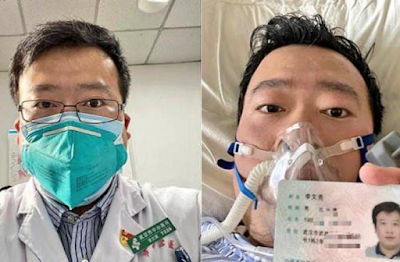
Dr. Li Wenliang warned about Covid-19
 

Today remembering Dr. Li Wenliang, the hero who warned about the initial COVID-19 outbreak in Wuhan, China. He was grabbed by secret police in the middle of the night and threatened with prosecution for making "untrue statements." 

He died two years ago today on February 7, 2020. The police state had silenced him and COVID-19 took his life, but the whistleblower is not forgotten despite the efforts of Beijing to erase him. 

On March 15, 2020 this blog warned about Communist regimes, such as the ones operating in China and Cuba, to engage in the "denial of objective reality, truth and an ability to systematically lie to achieve is sometimes effective in taking over a country and imposing a totalitarian dictatorship, but is a disaster when dealing with infectious diseases, and an outbreak such as the coronavirus."

Dr. Li Wenliang warned about intitial COVID-19 outbreak in Wuhan

Others in China, who questioned the Chinese Communist dictatorship's response to COVID-19 went missing. A high profile case was Chinese tycoon Ren Zhiqiang who "wrote in a scathing essay that China’s leader, Xi Jinping, was a power-hungry 'clown.' He said the ruling Communist Party’s strict limits on free speech had exacerbated the coronavirus epidemic," reported  Javier C. Hernández in The New York Times on March 14, 2020

Mr. Zhiqiang went missing at the time, and reappeared in September 2020 when he was found "guilty of corruption, bribery and embezzlement of public funds" in a Beijing court fined $620,000 and sentenced to 18 years in prison.

The message to the Chinese populace is clear: criticize the Chinese Communist leadership at your own peril. Transparency and the free exchange of ideas and data are non-existent in such an environment. 

This is not good in the midst of a pandemic.

Rewarding this behavior that has led to the loss of millions of lives with a Winter Olympics is an outrage. This is part of the reason why I am boycotting the Winter Olympics in Beijing this year, and encourage others to do so.

Please watch and share "The Story Of Coronavirus Whistleblower: Dr Li Wenliang" made by Brut India.

Thursday, July 1, 2021

The Communist Party in China turns 100. A century of a spreading evil that threatens to engulf the world.

100 years of an evil ideology metastasizing in the Middle Kingdom. #CCP100 #100YearsofRepression

Students wave flags of the CCP before celebrations in Beijing to mark 100th anniversary of its founding. Wang Zhao/AFP 

China's Communist Party was actually founded on July 23, 1921 "by a mixture of Chinese and foreign revolutionaries in Shanghai" according to NPR, but twenty years later hiding out in caves from the Japanese they decided to rewrite history and declare that the founding of the Party was on July 1, 1921.

This is why today the communist dictatorship in China is celebrating the 100th anniversary of the founding of the political party that has created a totalitarian one party dictatorship that has caused the deaths of tens of millions of Chinese, and whose founder, Mao Zedong, is considered the greatest killer in human history, outdoing both Josef Stalin, and Adolf Hitler in body counts.

According to historian Frank Dikötter, author of the book Mao’s Great Famine, the Chinese dictator was "responsible for the deaths of at least 45 million people between 1958 and 1962." Mao was responsible for the deaths of as many as 70 million Chinese on his watch alone. Mao died in 1976, but the Chinese Communist Party continues its killing spree to the present day.

Estimates place the number of killed by Chinese Communists at over 70 million

On September 26, 1980 The New York Times ran a UPI story reporting that "Chinese Reds Limited To a Child Per Family"  and euphemistically wrote  "China intensified its population-control drive today by ordering the 38 million Communist Party members to have only one child per family" and how the policy would use "painstaking patience and persuasion."

Time Magazine reported in 2015 that "patience and persuasion" included "forced abortions and sterilization, and a gender imbalance resulting from female infanticide." Tom Hilditch in the South China Morning Post (Hong Kong) in September of 1995 described it as a "A Holocaust of Little Girls." In 2015 reports emerged that the one-child policy was replaced with a two-child policy.

The Dying Rooms and Return to the Dying Rooms broadcast in 1995 and 1996 respectively offered a variety of sources (human rights organizations, doctors who had fled China armed with photographs) which corroborated the claims made in the documentary:

Producers/directors Brian Woods and Kate Blewett uncover the systematic neglect of abandoned babies in Chinese state-run orphanages. They find "dark rooms" where the weakest and least liked children are left to die. These are known as "The Dying Rooms."  China’s one-child policy has created a race where most families desire boys and therefore parents are forced to abandon their babies. Their unfortunate and tragic lives are left at the mercy of these orphanages where their sad fate is ultimately decided by the staff and ignored by the government.
But the most damning evidence came from official records themselves that document how many of the children in their care died, and how long it took them to and they called it a "Summary Resolution."
 
In addition to systematic processes that have impacted millions, the communists would still carry out massacres when Chinese nationals engaged in sustained public dissent. 

Thirty two years ago the Pro-Democracy Movement that had taken to the streets in April of 1989 was violently crushed by the Chinese communist dictatorship beginning on the evening of June 3, 1989. By dawn on June 4, 1989 scores of demonstrators had been shot and killed or run over and crushed by tanks of the so-called People's Liberation Army. A 2017 declassified British diplomatic cable revealed that "at least 10,000 people were killed. The Chinese Communist regime still defends committing this massacre.

Between June 3 and June 5, 1989 tank drivers ran over protesters

Think of it, the biggest mass murderer of the Chinese people is the Chinese Communist Party. 100 years of conspiracies, mass killings and repression while building the perfect totalitarian cage. There is nothing to celebrate but much to mourn, and also to continue to fight for a free China.

Despite this history, Westerners decided to go into business with the Chinese Communist Party, and betrayed a free China, with many withdrawing their diplomatic recognition from Taiwan, a free and democratic republic where human rights are respected, and a free economy lifts all boats.

Flag of Taiwan

The island of Taiwan was under Japanese colonial rule from 1895 until 1945, and during the Chinese Civil War, the forces of a free China (the Republic of China) relocated there in 1949. Over the next 72 years the Republic of China (ROC) established itself on the island and transitioned into a democratic multi-party democracy that is an example of what a free China could be on the mainland.

It is shocking that those in power did not think twice about enriching, and providing technical know how to a totalitarian dictatorship that has killed over 70 million of their own citizens, and do not respect human rights, or the rule of law. Now, with  the aid of Western investments and technology they have intercontinental ballistic missiles and where do you think they are pointing?

It is even more shocking that after the Chinese communists demonstrated their continued outlaw status with the COVID-19 pandemic that Westerners consider this regime "a good place to invest." It is disappointing to see business magnates, like Elon Musk, " celebrate the "economic prosperity" in Communist China, without looking at the costs. Meanwhile a jewel of international capitalism, Hong Kong, is being dismantled by the dictatorship he praises.

Genocide is taking place in Communist China against the Uighurs and Tibetans. The death count is no longer limited to China.

Let us remember that the lack of transparency by communist officials in China led to a global pandemic that has so far killed over 3,970,601 people around the world and infected nearly 200 million, and caused an economic downturn that has impacted hundreds of millions more. 

Westerners claimed that engaging with communist China would lead to them becoming more like us, but instead the rest of the world has become more like them, and human rights have been in decline for nearly two decades globally as a result. 

Time for people to wake up, before it is too late, that is if it is not already too late. Sorry Elon Musk, while communism reins in Mainland China, the only China that I will be visiting is a free China, and that today is Taiwan.