Showing posts with label Beijing. Show all posts

Wednesday, June 4, 2025

Many viewed the Tiananmen Square massacre as a crime, but the Cuban dictatorship saw it as an opportunity.

How the events of June 4, 1989 in China allowed Havana to rekindle relations with Beijing


A crime against the Chinese people by the Chinese Communist Party

Thirty six years ago the non-violent Chinese Pro-Democracy Movement was subjected to a military crackdown in which at least 10,000 Chinese people were killed.

The United States, Britain, France, West Germany, Italy, Spain, the Netherlands, Sweden, and Chinese students condemned the crackdown by the “People’s Liberation Army.” Chinese students around the world took to the streets and protested the bloodshed in Beijing.

People of conscience the world over were horrified. Beijing was diplomatically shunned.

Cuba’s dictatorship endorsed the Tiananmen massacre to normalize relations with Beijing

In contrast, the dictatorship in Cuba saw an opportunity to rekindle and old friendship. Together with North Korea, and East Germany expressed their support for the actions taken by Beijing.

Cuban foreign minister Isidoro Malmierca commended Chinese authorities for “defeating the counterrevolutionary acts.” Fidel Castro openly supported Beijing’s Tiananmen Square massacre in 1989, as a means to both preempt reform elements in the Cuban regime, and improve relations with Beijing.

Chinese foreign minister Qian Qichen’s visit to Latin America took place in the midst of the crackdown, and he described the contrast between Havana’s warm welcome and the disapproval of many other countries in the region.

“The crackdown in Beijing, Qian says, completely changed the atmosphere around his tour: many Latin American governments expressed their disapproval of the suppression and cancelled his visits, and even the overseas Chinese, who usually greeted visiting Chinese officials with enthusiasm, had“stern faces” and questioned the reasons for using force. Qian had planned a visit to Mexico before Cuba. The Mexican government cancelled his visit but allowed him to go to Cuba via Mexico City.”

[…]

“But Qian’s reception in Havana exceeded his expectations. He was greeted by the Cuban foreign minister at the airport and brought to a welcome dinner the next evening hosted by Fidel Castro himself. Castro had a long talk with Qian at dinner which continued in his office until midnight. Understanding Qian’s situation, Castro gave him a detailed description of what had happened in Beijing since 4 June and the international response, based on his collection of information and from his own perspective. Castro said that he “completely supported the Chinese government” and would offer “whatever occasions and facilities” Qian might need to make his government’s voice heard.”

Cuba-Sino relations: From a warm embrace in 1960 to a decades long chill in relations

Communist China and Cuba had been close in the first years of the Castro regime. Mao Zedong had already been in power in China for a decade when the Castro regime took power in Cuba in 1959.

On September 28, 1960 the Cuban dictatorship diplomatically recognized the People’s Republic of China.

Ernesto “Che” Guevara led a Cuban delegation’s visit to Mainland China and met with Mao Zedong, Zhou Enlai, and other high ranking Chinese officials in November 1960 to discuss conditions in Cuba and in Latin America, and the prospects for communist revolution in the Americas.

Subsequently, between 1960 and 1964 the two regimes collaborated closely together.

Mao's regime in 1958 had embarked on the Great Leap Forward, a campaign to reorganize the Chinese populace to improve its agricultural and industrial production along communist ideological lines. The campaign was a disaster that led to mass famine and a death toll of at least 45 million which did not end until 1962.

The visit by the Cuban delegation at the time did not go unnoticed in Mainland China. Dimon Liu was born in China and immigrated to the United States in 1965. She wrote about her early experiences growing up in the midst of the Great Leap Forward in 2017 and her first encounter with Cuba while still in China.

It was 1960, the height of famine during the years of Great Leap Forward. I was a child living in the southern city of Guangzhou in China. Meal time meant a little rice, and whatever we could scrape together. For nearly two years, we had no meat, fish or even cooking oil. We were starving.

All of a sudden, there was cane sugar from Cuba, and we school kids had to learn Cuban songs. We had been on rations even before the Great Leap Forward which began in 1958. Thirty jin (one jin is about 1.1 pound) of grains per month for an adult, and fifteen jin for a child above the age of seven. Two jin of meat and two ounces of cooking oil, also for a month. [...] People on our streets were dying of many infectious diseases, though no one dared to say anyone died of hunger.[...]

Frank Dikotter, the historian at the University of Hong Kong who wrote "Mao's Great Famine", a book about this period, said in a social media post that "the first thing the regime did in September 1960 was to procure an extra 100,000 tons of grain and ship it to Cuba," in order to help break the economic blockade imposed by Washington on the island. Dikotter added that "you can feed about 2000 people for a day with a ton of rice... Or over half a million people for a year."

Properly fed people rarely existed in China at that time, unless you belonged in the very small and exclusive club of Chinese Communist elite. For a child like me who received coupons for under 8 pounds of rice a month, you could have fed more than 2 million of us for a year; or about half a million Chinese adults for a year on a standard ration of 30 jin, or 33 pounds of rice per month for the amount of grain sent to Cuba.

Cuba was not the only place that China exported food to during those harrowing years.

In the midst of the Great Famine, while tens of millions of Chinese died of hunger, Beijing exported food to their communist ally in Cuba.

Relations between China and the Castro regime cooled, and completely deteriorated following a February 6, 1966 speech by Fidel Castro that was heavily critical of the Peoples Republic of China. Havana finally sided with Moscow in the Sino-Soviet split.

Criticizing Mao

Castro, while receiving Soviet subsidies, would continue to slam the Chinese Communists in the 1970s.

Journalist Chieu Luu, in his CNN article “Castro’s Cuba and Mao’s China: Communist regimes that never saw eye to eye” published on November 26, 2016 recalled the late Cuban dictator’s critique of Mao Zedong in 1977.

“I believe that Mao (Zedong) destroyed with his feet what he did with his head for many years. I’m convinced of that. And some day the Chinese people, the Communist party of China will have to recognize that,” Castro told American journalist Barbara Walters in May 1977. He went on to list what he said were Mao’s grave mistakes: a cult personality and abuse of great power. “I also acquired that power, but I never abused it, nor did I retain it in my hands,” Castro said. Although both Cuba and China were functioning Communist states, Castro told Walters he viewed China as a “good ally” of the US, which was a bitter enemy of Cuba.

How Moscow drove Cuba into improving relations with Beijing

Russia’s democratic spring in the mid to late 1980s under Mikhail Gorbachev led to a cooling of relations between Havana and Moscow.

Perestroika was a policy that recognized economic central planning was a failure, and pursued reforming and restructuring the Soviet economy, and Glasnost was a policy that sought “more open consultative government and wider dissemination of information.”

These policies both instituted were viewed with great dread, and rejected by the Castro brothers. This was at a time when 75% of Cuba’s commercial exchanges were with the Soviet Union, but that did not stop Havana from censoring Soviet publications, and the beginning of the Castro brothers’ outreach to Beijing in 1989.

Havana’s successful engagement with Beijing: Harming U.S. interests and security

Backing the massacre of thousands of Chinese nationals by the People’s Liberation Army (PLA) on the orders of the Chinese Communist Party (CCP) resulted in Chinese President Jiang Zemin’s high-level visit to Cuba in 1993. This was followed by Raul Castro’s first visit to China in 1997.

Prior to this, Beijing quietly began in 1992 jointly operating intelligence bases targeting the United States from Cuba, according to Chris Simmons, a former head of the U.S. Defense Intelligence Agency’s Western Hemisphere counterintelligence research section, revealed to the Miami Herald on July 4, 2024. He said that U.S. surveillance services were unaware of the arrangement until 2001, operating undetected for a period of nine years.

The Center for Strategic and International Studies (CSIS) published a report in December 2024 that identified four places in Cuba it believes are most likely to be aiding China’s intelligence activities against the United States. One of the authors of the report Ryan C. Berg, Director, Americas Program, Center for Strategic and International Studies, and Andrés Martínez-Fernández, Senior Policy Analyst, Latin America, Allison Center for National Security, testified before Congress on May 6, 2025. They point to these spy bases in Cuba being upgraded with new technology.

This restored “special friendship” between two Communist dictatorships was founded on the mass killing of Chinese civilians by the PLA in June 1989, and Havana’s public support for this crime against humanity.

Following this rapprochement, it is believed Havana began offering their biotech knowledge, gained from Moscow, to their counterparts in Beijing, and in 2002, China and Cuba signed a formal agreement to produce monoclonal antibodies.

By 2004 Cuba had joint ventures in China that included both biotech, and genetic engineering. Douglass Starr in Wired Magazine on December 1, 2004 reported on this phenomenon in the article “ The Cuban Biotech Revolution“.

What Cubans call “the Special Period” produced one notable success: pharmaceuticals. In the wake of the Soviet collapse, Cuba got so good at making knockoff drugs that a thriving industry took hold. Today the country is the largest medicine exporter in Latin America and has more than 50 nations on its client list. Cuban meds cost far less than their first-world counterparts, and Fidel Castro’s government has helped China, Malaysia, India, and Iran set up their own factories: “south-to-south technology transfer.”

In 2015, then vice-president Miguel Diaz-Canel visited Beijing and praised Havana’s collaboration with Communist China in the sphere of biotechnology. Granma, Cuba’s official national communist newspaper, reported on the Cuban vice-president’s visit to a biotech facility in China.

“Díaz-Canel emphasized the notable progress made by Cuba and China in the sphere of biotechnology over recent years while also highlighting the close collaboration that the two countries share in the sector; providing great benefits and knowledge for both peoples.”

Without Havana’s joint ventures over the past 20 years in Cuba, Beijing may not have been in a position to have the capability to run a biotech / genetic engineering lab like the one in Wuhan that caused so much tragedy during the COVID pandemic.

Modernizing big brother for the 21st century

Raúl Castro met with China’s Minister of Public Security on December 1, 2024, and Chinese companies ZTE and Huawei are providing Havana censorship tools that are used to block information, track dissidents, silence dissent, and shut down the internet during anti-government protests.

Communist China’s Foreign Ministry spokeswoman Mao Ning on June 4, 2024 described Cuban Minister of Foreign Affairs Bruno Rodríguez Parrilla as a “good old friend of China.” Rodríguez’s official visit from June 5 to 9, 2024 as a special envoy of Cuban President Miguel Díaz-Canel highlighted the two communist regimes’ “special friendship.” Never forget that this rekindled friendship was forged in the blood spill 36 years ago in Tiananmen Square.

Tuesday, June 4, 2024

Lessons from Tiananmen Square

 How it started, and how it ended.

Chinese students march under a banner of late Chinese reformer Hu Yaobang

When Chinese reformer Hu Yaobang died suddenly of a heart attack on April 15, 1989, students responded angrily, with the majority of them assuming that his death was related to his forced resignation. On the day of this reformer's sudden death, small, spontaneous gatherings to mourn Hu began around Tiananmen Square's Monument to the People's Heroes.   

The death of Hu gave the motivation for students to congregate in large numbers. Posters sprouted on university campuses eulogizing him and demanding for Hu's legacy to be honored. Within a few days, the majority of posters addressed bigger political themes such as corruption, democracy, and press freedom, and the protests continued.

On April 27, 1989 soldiers try to stop students entering Tiananmen Square.


On April 26, 1989, the People's Daily published an editorial aimed at scaring students into submission, but it had the opposite effect, enraging them and rallying thousands more to demonstrate in Tiananmen Square.  It was a strategic error of the first order committed by the Chinese Communist regime's highest echelons.

Imagine for a moment that for 51 days of demonstrations beginning on April 15, 1989 thousands of students gathered nonviolently to protest and demand reforms. Protests had taken place before in China in 1986, but had not been sustained.  This time, in part due to the regime's demonizing of the student demonstrators, the protests grew and did not dissolve. 

At the height of the student movement in China, over one million people marched in the streets of Beijing. This movement ended with the government's crackdown and the Beijing massacre of June 4. 

Below is the documentary, The Gate of Heavenly Peace, that captures the days of protest leading up to the crackdown and the massacre.

Nonviolent resisters should learn as much as they can about this important movement. Finally, the struggle for a free China continues to the present day and needs our solidarity.

It is also important to challenge the official narrative that nothing happened, or worse that it was a "vaccination." Thousands were killed, and it was not just students, but also workers in solidarity with student protesters.

At least 10,000 killed during the Tiananmen Square massacre.

Chinese Communist Defense Minister Wei Fenghe on June 2, 2019 at a regional forum defended the Tiananmen Square massacre claiming "[t]hat incident was a political turbulence and the central government took measures to stop the turbulence, which is a correct policy." 

The official newspaper, The Global Times, doubled down claiming that the mass killings and crackdown were "[a]s a vaccination for the Chinese society, the Tiananmen incident will greatly increase China's immunity against any major political turmoil in the future." The message is clear the Communist Chinese regime in China is willing to kill large numbers of Chinese to remain in power.

Bodies at Shuili hospital mortuary. All died from bullet wounds. Credit Jian Liu

A 2017 declassified British diplomatic cable revealed that "at least 10,000 people were killed in the Chinese army's crackdown on pro-democracy protesters in Beijing's Tiananmen Square in June 1989."

The Pro-Democracy Movement that had taken to the streets in April of 1989 was violently crushed by the Chinese communist dictatorship beginning on the evening of June 3, 1989.

Between June 3 and June 5, 1989 other tank drivers ran over protester

By dawn on June 4, 1989 scores of demonstrators had been shot and killed or run over and crushed by tanks of the so-called People's Liberation Army.

On June 5, 1989 in Beijing, following the massive and bloody crackdown after six weeks of protests that began in Tiananmen Square and spread across 400 cities in China, a man risked all to protest what had taken place. 


Wearing a white t-shirt, black trouser, and carrying what appeared to be a shopping bag he walked out on the north edge of Tiananmen Square, along Chang'an Avenue and faced down a column of Type-59 tanks.

We must also remember the courage of the late Nobel Laureate Liu Xiaobo who saved the lives of many young Chinese in Tiananmen Square in June of 1989 obtaining safe passage for them and persuaded these students to leave before the massacre unfolded.  This courageous and nonviolent human rights defender was jailed in 2008 and died on July 13, 2017.

Below is one of his last interviews prior to being unjustly imprisoned.

Sunday, June 4, 2023

Lessons from Tiananmen Square

How it started, and how it ended.

Chinese students march under a banner of late Chinese reformer Hu Yaobang

When Chinese reformer Hu Yaobang died suddenly of a heart attack on April 15, 1989, students responded angrily, with the majority of them assuming that his death was related to his forced resignation. On the day of this reformer's sudden death, small, spontaneous gatherings to mourn Hu began around Tiananmen Square's Monument to the People's Heroes.   

The death of Hu gave the motivation for students to congregate in large numbers. Posters sprouted on university campuses eulogizing him and demanding for Hu's legacy to be honored. Within a few days, the majority of posters addressed bigger political themes such as corruption, democracy, and press freedom, and the protests continued.

On April 26, 1989, the People's Daily published an editorial aimed at scaring students into submission, but it had the opposite effect, enraging them and rallying thousands more to demonstrate in Tiananmen Square.  It was a strategic error of the first order committed by the Chinese Communist regime's highest echelons.

On April 27, 1989 soldiers fail to stop students entering Tiananmen Square.

Imagine for a moment that for 51 days of demonstrations beginning on April 15, 1989 thousands of students gathered nonviolently to protest and demand reforms. Protests had taken place before in China in 1986, but had not been sustained.  This time, in part due to the regime's demonizing of the student demonstrators, the protests grew and did not dissolve. 

At the height of the student movement in China, over one million people marched in the streets of Beijing. This movement ended with the government's crackdown and the Beijing massacre of June 4th.

Below is the documentary, The Gate of Heavenly Peace, that captures the days of protest leading up to the crackdown and the massacre.

Nonviolent resisters should learn as much as they can about this important movement. Finally, the struggle for a free China continues to the present day and needs our solidarity.

It is also important to challenge the official narrative that nothing happened, or worse that it was a "vaccination." Thousands were killed, and it was not just students, but also workers in solidarity with student protesters.

Chinese Communist Defense Minister Wei Fenghe on June 2, 2019 at a regional forum defended the Tiananmen Square massacre claiming "[t]hat incident was a political turbulence and the central government took measures to stop the turbulence, which is a correct policy." 

At least 10,000 killed during the Tiananmen Square massacre.

The official newspaper, The Global Times, doubled down claiming that the mass killings and crackdown were "[a]s a vaccination for the Chinese society, the Tiananmen incident will greatly increase China's immunity against any major political turmoil in the future." The message is clear the Communist Chinese regime in China is willing to kill large numbers of Chinese to remain in power.

A 2017 declassified British diplomatic cable revealed that "at least 10,000 people were killed in the Chinese army's crackdown on pro-democracy protesters in Beijing's Tiananmen Square in June 1989."

Bodies at Shuili hospital mortuary. All died from bullet wounds. Credit Jian Liu

The Pro-Democracy Movement that had taken to the streets in April of 1989 was violently crushed by the Chinese communist dictatorship beginning on the evening of June 3, 1989. 

By dawn on June 4, 1989 scores of demonstrators had been shot and killed or run over and crushed by tanks of the so-called People's Liberation Army.

Between June 3 and June 5, 1989 other tank drivers ran over protester

On June 5, 1989 in Beijing, following the massive and bloody crackdown after six weeks of protests that began in Tiananmen Square and spread across 400 cities in China, a man risked all to protest what had taken place.

Wearing a white t-shirt, black trouser, and carrying what appeared to be a shopping bag he walked out on the north edge of Tiananmen Square, along Chang'an Avenue and faced down a column of Type-59 tanks.


We must also remember the courage of the late Nobel Laureate Liu Xiaobo who saved the lives of many young Chinese in Tiananmen Square in June of 1989 obtaining safe passage for them and persuaded these students to leave before the massacre unfolded.  This courageous and nonviolent human rights defender was jailed in 2008 and died on July 13, 2017. Below is one of his last interviews prior to being unjustly imprisoned.

Sunday, March 19, 2023

Totalitarian regimes politicize everything, especially sports. The Democratic resistance has a duty to counter them.

Protesters hold up Abajo Dictadura (Down with Dictatorship) banner

The Castro dictatorship's baseball team was defeated tonight 14-2 by the United States, Cuba's democratic resistance shattered the regime's narrative calling for an end to dictatorship, freedom for political prisoners, and these are both good things. However those complicit with the dictatorship in sport washing its true nature must also be held to account through non-violent means.

Major League Baseball (MLB) has repeatedly made two crucial mistakes, and tonight made a third.

First the professional baseball organization has confused the Castro dictatorship's junta with the Cuban people. Many others have made this mistake.

Major League Baseball doing business with the CCP.

Second to highlight social justice issues in the United States, but ignore them outside the U.S., in places like China and Cuba to go into business with tyrants.

Third, the league compounded their first two errors, by attempting to censor free Cubans attending the World Baseball Classic semi-final tonight in Miami as the teams of the United States, and the Cuban dictatorship face off. 

No more communism!! misery!! dictatorship!!

The bad faith argument that Cuban exiles should not politicize the game ignores that this whole spectacle is a propaganda exercise of the Castro dictatorship. A former Cuban ball player called out the hypocrisy in the March 18, 2023 article by Nora Gámez Torres, "Cuba’s national baseball team’s game in Miami revives old political battles." 

"Edilberto Oropesa, a former Cuban pitcher who played in Major League Baseball from 2001-04, said he doesn’t agree with those who have accepted the Cuban government’s invitation to join the national team. But said he respects their decision." “It’s a free country,” he told the Miami Herald.

He also believes that players on the island do not have much room to dissent if they have decided to stay and live there. “Those who made the Cuba team knew they had to do what they [government officials] say,” Oropesa added.

Last year, Oropesa and other Cuban exiles created the Association of Cuban Professional Baseball Players. They tried to assemble a team of Cubans playing in professional leagues worldwide that could represent the island at the World Baseball Classic.

But the WBC didn’t allow it because its rules grant such rights only to national federations. The former pitcher pushed back against those arguing that politics should not be brought into sports.

"They were the ones that brought in politics since 1959 when they took away professional baseball,” he said, speaking of the Cuban government. “It is something Machiavellian that they are doing for their interests ...   

Totalitarian regimes politicize everything, especially sports to legitimize themselves, and mask their true nature. The Democratic resistance has a duty to counter them. Failing to do so, and allowing the regime narrative to dominate can be dangerous to freedom, and have far reaching and unexpected consequences.

The 1936 Olympics held in Berlin and hosted by the Nazi Germany with the ceremonies formally opened by Adolph Hitler should serve as a cautionary example. The United States Holocaust Memorial Museum described the impact of the games as follows:

On August 1, 1936, Hitler opened the XIth Olympiad. Musical fanfares directed by the famous composer Richard Strauss announced the dictator's arrival to the largely German crowd. Hundreds of athletes in opening day regalia marched into the stadium, team by team in alphabetical order. Inaugurating a new Olympic ritual, a lone runner arrived bearing a torch carried by relay from the site of the ancient Games in Olympia, Greece. 
[...] Concerted propaganda efforts continued well after the Olympics with the international release in 1938 of "Olympia," the controversial documentary directed by German film maker and Nazi sympathizer Leni Riefenstahl. She was commissioned by the Nazi regime to produce this film about the 1936 Summer Games. Germany emerged victorious from the XIth Olympiad. German athletes captured the most medals, and German hospitality and organization won the praises of visitors. Most newspaper accounts echoed the New York Times report that the Games put Germans "back in the fold of nations," and even made them "more human again." Some even found reason to hope that this peaceable interlude would endure. 

The 1936 Olympics whitewashed the brutality of the Nazi regime in Germany and led to the acceptance of Hitler's criminal regime. 

The Olympic Committee learned nothing from this shameful episode and in 2008, and 2022 Olympics were held in Beijing that whitewashed the brutality of the genocidal Communist regime in China sport washing the criminal regime. 

Western democracies in the 1930s could have been much tougher with Nazi, Germany and avoided the catastrophe of World War Two (WW2). This is why British Prime Minister and wartime leader Winston Churchill repeatedly called WW2, the unnecessary war.

In the preface to the first volume of his war memoirs, The Second World War, British Prime Minister and wartime leader Winston Churchill said: “One day President Roosevelt told me that he was asking publicly for suggestions about what the war should be called. I said at once ‘The Unnecessary War.’ There never was a war more easy to stop than that which has just wrecked what was left of the world from the previous struggle.”

We do not yet know what the full consequences will be for humanizing the genocidal communist regime in China, but history does not give one cause for optimism.

It is unfortunate that Major League Baseball would not recognize the Association of Cuban Professional Baseball Players to play in the World Baseball Classic. It would have been wonderful to see what free Cuban baseball players could do in this competition, but they preferred to deal with Fidel Castro's son, Antonio Castro, who is in charge of Cuban baseball.

Antonio Castro, the dictatorship's point man on baseball.

Former Cuban prisoner of conscience Regis Iglesias in an OpEd in Diario Las Américas on September 11, 2022 explained the context that has led to this protest.

..."The MLB institution or the MLB Players Association come up with the idea of ​​allowing some franchises to visit Cuba for "friendly" matches or much worse, to make "agreements" with who enslave not only our athletes, but all our people. I will always protest and condemn those unsupportive positions. MLB cannot be a repressive extension of the Cuban Baseball Federation and the criminal and segregationist regime in Cuba. 

Rob Manfred is not the owner of the farm like the commandos of the island and he cannot pressure the players with simplistic reasoning and opportunism to maintain the status quo with the tyranny or take shameful steps of recognition of it." ... "MLB's agreement with the Cuban Baseball Federation cannot be proudly brandished as it is part of the recognition of an institution, supposedly independent from a free country, to a repressive and segregationist institution from a country subjected to the tyranny of a communist party."

There is a long history of Major League Baseball's problematic relationship with the Castro regime. The Marlins in 2011 hired their manager Ozzie Guillen, who bragged about his love and respect for Fidel Castro and Hugo Chavez in a 2012 Time Magazine interview.

"I love Fidel Castro," Blurts Ozzie Guillen, the new manager of the Miami Marlins, in his Jupiter, Fla., spring-training office before an early-March team workout. [...] After a second of reflection, the most unfiltered figure in baseball, if not sports, wants a do-over. "I respect Fidel Castro," says Guillen, a Venezuela native who also says he respects Hugo Chvez. "You know why? A lot of people have wanted to kill Fidel Castro for the last 60 years, but that mother------ is still here."

He was suspended for five games, which was considered a slap on the wrist. He was fired a short time later for the unforgivable sin of having a losing season. Mr. Guillen has not grown wiser in the intervening years, but he does throw Bud Selig under the bus reminding everyone of the time the baseball chief attended a game in 1999 with Fidel Castro in Cuba. Selig himself reminisced about it in 2016 when the old dictator died.

Castro w/ Orioles owner Peter Angelos (l.) MLB's Bud Selig (r.) Cuba 1999

In 2016, Major League Baseball sent a proposal to the U.S. Treasury Department that would have turned Cuban baseball players into foreign workers of the Castro family while playing in the United States.  This is not hyperbole, the point man that Major League Baseball was dealing with Antonio Castro, then vice president of the Castro regime's International Baseball Federation.


Freedom for the political prisoners of the July 11th protests.

In 2018, after making their initial proposal, MLB was still trying to go into business with the Castro family.  Cuban baseball players would've been able to play in the Majors, but at a cost. According to Reuters, "MLB teams will pay the Cuban Baseball Federation a release fee for each player to be signed from Cuba." This raised some questions. How big will this release fee be? Will Cuban baseball players have to give up a big chunk of their salaries, like Cuban doctors have had to do?  The proposal was shot down by the Trump Administration.

Cuban baseball fans living in freedom need to boycott, and protest Major League Baseball, and let them know why. 

Saturday, June 4, 2022

Lessons from Tiananmen Square

How it started, and how it ended.

On April 27, 1989 soldiers try to stop students entering Tiananmen Square.

 On April 26, 1989 the People's Daily ran an editorial with the objective of frightening students into submission that had the opposite effect enraging them instead and mobilizing many more to go and protest in Tiananmen Square.  It was a strategic blunder of the first order carried out by the highest levels of the Chinese Communist regime.

Imagine for a moment that for 51 days of demonstrations beginning on April 15, 1989 thousands of students gathered nonviolently to protest and demand reforms. Protests had taken place before in China in 1986, but had not been sustained.  This time, in part due to the regime's demonizing of the student demonstrators, the protests grew and did not dissolve. 

At the height of the student movement in China, over one million people marched in the streets of Beijing. This movement ended with the government's crackdown and the Beijing massacre of June 4. 

Below is the documentary, The Gate of Heavenly Peace, that captures the days of protest leading up to the crackdown and the massacre. 

Nonviolent resisters should learn as much as they can about this important movement. Finally, the struggle for a free China continues to the present day and needs our solidarity.

It is also important to challenge the official narrative that nothing happened, or worse that it was a "vaccination." Thousands were killed, and it was not just students, but also workers in solidarity with student protesters.

At least 10,000 killed during the Tiananmen Square massacre.

Chinese Communist Defense Minister Wei Fenghe on June 2, 2019 at a regional forum defended the Tiananmen Square massacre claiming "[t]hat incident was a political turbulence and the central government took measures to stop the turbulence, which is a correct policy." 

The official newspaper, The Global Times, doubled down claiming that the mass killings and crackdown were "[a]s a vaccination for the Chinese society, the Tiananmen incident will greatly increase China's immunity against any major political turmoil in the future." The message is clear the Communist Chinese regime in China is willing to kill large numbers of Chinese to remain in power.

Bodies at Shuili hospital mortuary. All died from bullet wounds. Credit Jian Liu

A 2017 declassified British diplomatic cable revealed that "at least 10,000 people were killed in the Chinese army's crackdown on pro-democracy protesters in Beijing's Tiananmen Square in June 1989."

The Pro-Democracy Movement that had taken to the streets in April of 1989 was violently crushed by the Chinese communist dictatorship beginning on the evening of June 3, 1989.

Between June 3 and June 5, 1989 other tank drivers ran over protester

By dawn on June 4, 1989 scores of demonstrators had been shot and killed or run over and crushed by tanks of the so-called People's Liberation Army.

On June 5, 1989 in Beijing, following the massive and bloody crackdown after six weeks of protests that began in Tiananmen Square and spread across 400 cities in China, a man risked all to protest what had taken place. 

Wearing a white t-shirt, black trouser, and carrying what appeared to be a shopping bag he walked out on the north edge of Tiananmen Square, along Chang'an Avenue and faced down a column of Type-59 tanks.

 We must also remember the courage of the late Nobel Laureate Liu Xiaobo who saved the lives of many young Chinese in Tiananmen Square in June of 1989 obtaining safe passage for them and persuaded these students to leave before the massacre unfolded.  This courageous and nonviolent human rights defender was jailed in 2008 and died on July 13, 2017.

Image of late Chinese activist Liu Xiaobo is displayed at a candlelight vigil to mark the 33rd anniversary of the 1989 Tiananmen Square Massacre, at the Victims of Communism Memorial in Washington, DC epa/ Michael Reynolds


Tuesday, February 1, 2022

Berlin 1936 and Beijing 2022: Legitimizing genocidal totalitarian regimes through sports is a profound immorality with bad outcomes

 "Those who cannot remember the past are condemned to repeat it."- George Santayana


Legitimizing genocidal totalitarian regimes through sports is a profound immorality with bad outcomes

The 2008 Summer Olympic Games in Beijing were a human rights disaster for China with scenes of Tibetan demonstrators gunned down by Chinese soldiers. 

14 years later, and the world has suffered over 5.6 million deaths due to COVID-19, and the Chinese Communist dictatorship of  Xi Jinping bears responsibility. The Chinese government did not reveal for weeks what it knew about COVID-19, allowing it to spread into a worldwide pandemic. The Frontline Documentary "China's COVID Secrets" is required viewing to understand what happened.

#NoBeijing2022 has listed some of the other outrages committed by the ruling Chinese Communist Party in Beijing.  "The Beijing 2022 Winter Olympics is set to happen amid one of the world’s worst crackdowns against freedom, democracy, and human rights."

  • At least TWO million Uyghur, Kazakh, and Uzbek Muslims are detained in “re-education camps” undergoing systematic torture, rape, and political re-education.
  • 80% of Tibetan children – as young as 4 – are forced away from their parents and housed in China’s colonial boarding schools, cut off from their families they face intense political indoctrination.
  • In Hong Kong, the Chinese government has implemented a draconian National Security Bill that effectively criminalises protest and curtails any remaining human rights.
  • Protests by Southern Mongolians, whose rights, language and culture being eradicated, are put down with force
  • Detention & disappearance of countless Chinese lawyers, feminists & activists
  • Intimidation and geopolitical bullying of Taiwan and aggression and expansion across borders – in the South China Sea and India-Tibet border – present a clear threat to regional and global security.

A second Frontline Documentary from April 2020, "China Undercover" examined the systematic crackdown on Chinese Muslims.

Despite this the International Olympic Committee (IOC) chose China once again to host the Olympics in 2022 in the midst of the historic crimes of the Chinese Communist Party dictatorship.  

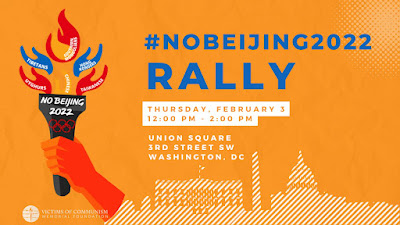
As was the case in the lead up to the 2008 Olympics friends of a free China need to increase scrutiny on the Chinese regime and boycott these Olympics. The consequences of  the IOC legitimizing such a regime cannot be overstated. If you are in the Washington DC area on Thursday, February 3rd at 12 noon please join the #NoBeijing2022 Rally at Union Square 3rd Street SW.

The 1936 Olympics held in Berlin and hosted by the Nazi Third Reich with the ceremonies formally opened by Adolph Hitler should serve as a cautionary example. The United States Holocaust Memorial Museum described the impact of the games as follows:

On August 1, 1936, Hitler opened the XIth Olympiad. Musical fanfares directed by the famous composer Richard Strauss announced the dictator's arrival to the largely German crowd. Hundreds of athletes in opening day regalia marched into the stadium, team by team in alphabetical order. Inaugurating a new Olympic ritual, a lone runner arrived bearing a torch carried by relay from the site of the ancient Games in Olympia, Greece.
[...] Concerted propaganda efforts continued well after the Olympics with the international release in 1938 of "Olympia," the controversial documentary directed by German film maker and Nazi sympathizer Leni Riefenstahl. She was commissioned by the Nazi regime to produce this film about the 1936 Summer Games. Germany emerged victorious from the XIth Olympiad. German athletes captured the most medals, and German hospitality and organization won the praises of visitors. Most newspaper accounts echoed the New York Times report that the Games put Germans "back in the fold of nations," and even made them "more human again." Some even found reason to hope that this peaceable interlude would endure. 

The 1936 Olympics whitewashed the brutality of the Nazi regime in Germany and led to acceptance of Hitler's criminal regime. The 2008 Olympics whitewashed the brutality of the Communist regime in China further legitimizing that criminal regime.

In 2022,  returning the Olympics to China and making this decision in the midst of the COVID-19 pandemic, the destruction of Hong Kong's democracy, threats against Taiwan, and the Uyghur genocide creates a historic moral hazard.

This is why I will not watch the Olympics, and encourage others to join me in this boycott, instead I will stand with Hong Kong, and Taiwan, share documentaries and films that reveal the facts of the genocidal regime in Beijing, and calls to nonviolent protests against the Chinese Communist dictatorship, and their enablers.

Below is a documentary about the 2019-2020 protests in Hong Kong titled "Do Not Split." Please share it with others.