"The first victory we can claim is that our hearts are free of hatred. Hence we say to those who persecute us and who try to dominate us: ‘You are my brother. I do not hate you, but you are not going to dominate me by fear. I do not wish to impose my truth, nor do I wish you to impose yours on me. We are going to seek the truth together’. THIS IS THE LIBERATION WHICH WE ARE PROCLAIMING."
Oswaldo José Payá Sardiñas (2002)
"If you tell the truth, you don't have to remember anything." - Mark Twain
Chris Matthews warns of the dangers of communism on MSNBC
Taken from CubaBrief
On February 7, 2020 MSNBC analyst Chris Matthews was right when he said, "I believe if Castro and the Reds had won the Cold War there would have been executions in Central Park and I might have been one of the ones getting executed. And certain other people would be there cheering, okay? So I have a problem with people who took the other side." He also raised the point that he was unsure about "who Bernie has supported over these years, I don't know what he means by socialism -- one week it's Denmark, we're going to be like Denmark. Okay, that's harmless. That's basically a capitalist country with good social welfare programs. Denmark." Matthews continued, "What does he think of Castro? That's a good question, what's he think of Fidelismo?"
Reason Magazine in June 2019 produced an overview of Senator Sanders political views throughout his career titled "Why Bernie Sanders' Communist Misadventures Still Matter." They point to a lifetime of statements and actions that demonstrate solidarity with communist dictatorships in Cuba, Nicaragua, and the Soviet Union.
Senator Sanders field staff caught on video advocating political violence.
There have also been video recordings of Senator Sanders field staff advocating political violence, justifying Gulags and re-education camps in the United States. Americans should not ignore the threats coming from some young members of Sanders’ campaign team about the kind of country they want to build.
"I have an attitude toward Castro. I believe if Castro and the Reds had won the Cold War there would have been executions in Central Park and I mighta been one of the ones getting executed... and certain other people would be cheering." - @HardballChrispic.twitter.com/4W2I2yzeuS
Bacardi is synonymous with Republican Cuba. Two generations of the Bacardi family
fought for Cuban independence with one family member fighting alongside
General Antonio Maceo. During the Republic the family not only had
enlightened business practices but also engaged in civic activities that
promoted a democratic culture.
Each time dictatorship arose in
Cuba under Machado, Batista and Castro the Bacardis joined the
democratic resistance. They have recognized the work of Oswaldo Payá
Sardiñas, and in 2017 that of his daughter, Rosa María Payá and they are supporting the Cuba Decide initiative to push for a democratic
transition.
Bacardi embodies the love of freedom and a good party. They are also patrons of the arts and were also involved in an immersive theater experience called The Amparo Experience.
The anti-Bacardi's, the antithesis of a free Cuba are the Castros throughout Cuban
history beginning with the war for independence through to the present day with the Castro dictatorship. Angel
Castro, Fidel and Raul Castro's father fought for the Spanish crown
against Cuban independence. The Castro brothers emerged out of the worse
elements of political gangsterism to impose a dictatorship that has
lasted 60 years and destroyed a great people.
"The Arechabala Family started their rum-making business in 1878 in Cuba
and first registered the original Havana Club trademark in 1934. It
wasn’t long before Havana Club Rum became a beloved and iconic Cuban
brand – becoming a favorite amongst locals as well as American and
European tourists.
Then everything changed. On January 1st, 1960, at gunpoint, the Cuban
regime unrightfully seized the company’s assets without compensation.
The Arechabala family lost everything and was forced to flee the
homeland they loved, with a scant few of their remaining possessions –
the precious Havana Club recipe being one of them. Meanwhile, the Cuban
Government started to sell their stolen version of Havana Club, and
continues to do so to this day.
It wasn’t until 1995 – after decades of rebuilding, the Arechabala
family finally joined forces with another Cuban family in exile:
Bacardi. The latter acquired the Havana Club brand and began producing
rum based on the original Havana Club recipe and selling it in the one
country that didn’t recognize the Cuban Government’s 1960 illegal
expropriation, the United States.
The Havana Club brand is an example of how, despite the circumstances,
Cubans in exile have never accepted their fate. Havana Club rum holds
onto its rich Cuban culture."
Worse yet the Castro regime's rum business in addition to providing a substandard product uses child labor. Back in 2016 news broke that Cuba wanted to pay off $276 million dollars in Czech debt with rum. "This Film Used To Be About Rum"
is an interesting attempted exploration of this agreement between the
Czech Republic and the Cuban dictatorship to negotiate Cuba's debt with the
Central European country through rum shipments.
The filmmakers interviewed Tomas Zdechovsky, a Czech representative of the European Parliament who made a shocking
revelation in the film.
"I don't think we've mentioned that the whole rum industry is based on
child labor. When you come out to the countryside and take a look at
who's working on the fields, you'll see ten, twelve-year-old children
working there. And then we go ahead and drink the rum wth no ethical
dilemmas whatsoever. We just accept it as being part of a culture.But
when you think about it, when you drink Cuban rum, you're helping the
Cuban regime survive."
Let us look forward to the day that both Bacardi and the real Havana Club can return to Cuba, and make the rum on their home turf and not in
exile. But that necessitates the return of freedom that also means
private property rights, freedom of expression and freedom of
association. It will also mean an end to child labor and a return to enlightened business practices were workers would get stock options as they did before the communist revolution.
First, it misrepresents Cuban-Americans and events in the island. The photograph at the top of the page of her article claims that “Cuban Americans protest Raul Castro leaving office.” The fact of the matter is that Cuban Americans are protesting because Raul Castro remains in power and Miguel Diaz Canel is a puppet and not a real political leader. Hence the protest sign that reads “Raul Castro thwarts the peoples will for self-rule.”
Second, there have been other refugee exoduses in Latin America. There are over 1.272 million Cubans in the United States. It is true that for decades Cubans had been the exception to the rule of immigrants from Latin America. They were political refugees fleeing a communist dictatorship. However, there were also political refugees fleeing Guatemala due to a civil war (involving Marxist guerillas with Cuban aide) between 1960 and 1996 with a total today of 1.364 million Guatemalans. Civil war in El Salvador (again with guerrillas backed by the Castro regime) erupted in the mid-1970s and lasted for 12 years with 1.387 million El Salvadorians now in the United States.
In 1979 when Marxists took over in Nicaragua with the Sandinistas sparking a huge exodus to neighboring countries and to the United States. However, Nicaragua being a smaller country the numbers were smaller than the Cuban exodus. Today there are 405,601 Nicaraguans in the United States, but those numbers will rise with the Ortega regime cracking down on dissent (again with help from the Castro regime). But the Castro takeover in Venezuela, first with Chavez and continued with Maduro, has led to an exodus that dwarfs in absolute numbers, all others with over 3 million in mid-2019 and on track to reach five million. Venezuelans are topping asylum claims to the United States. If you ask Venezuelans you will find that many will point out the negative role of the Castro regime in helping cause this disaster.
Third, Venezuelans are the largest group of refugees fleeing communism in Latin America and seeking asylum in the United States. Bodenheimer identifies “Cuban migrants” as “one of the largest groups seeking asylum at the US-Mexico border in recent years”, but the top group are Venezuelans. Special programs were created for Cuban refugees because their situation was unique. When one leaves Cuba, especially in the early years of the Castro regime, one was not able to return and their property was confiscated. It did not matter if you rich or poor, you were left with nothing when arriving in the United States after the regime consolidated.
Sadly, Bodenheimer is partially right but for the wrong reasons. Cubans fleeing the island are political refugees fleeing a communist dictatorship, but they are no longer exceptional in the Americas because Nicaraguans, and many more Venezuelans are also fleeing their respective communist regimes. Many of them are also moving to Florida. They also need assistance and special programs to prevent a humanitarian crisis.
Fourth, this is not preferential treatment, but dealing with human tragedies created by communist dictatorships. The U.S. in the past assisted Eastern European refugees, Vietnamese boat people, Cuban refugees, and today should be doing the same with Nicaraguan and Venezuelans refugees.
Fifth, Bodenheimer calls Fidel Castro’s communist regime socialist. Cuba is not Sweden, it has more in common with North Korea.
Ignoring that reality and the negative role it has played and is playing in this hemisphere is seriously problematic. The Castro dictatorship, like their North Korean counterpart, should not be normalized because it has been around for six decades.
Bodenheimer plays the race card highlighting the first wave of refugees, which she claims were immigrants, as “wealthy and white,” raising the question of their political status when she says “these Cubans were treated not as economic migrants, but political refugees fleeing a repressive dictatorship.” Nor does she mention that later waves reflected the racial demographics on the island.
Long time allies: Kim Il Sung and Fidel Castro in North Korea
Despite her claims, and that of unidentified experts, Cubans continue to suffer under a totalitarian dictatorship that systematically denies them of all their human rights. Furthermore, many Cuban “migrants” are not able to return to their homeland because of arbitrary restrictions of the Castro dictatorship. This is something that Mexicans and most Central Americans (with the possible exception of Nicaraguans) do not have to suffer.
Sixth, Bodenheimer makes the astounding claim that “Cuba is one of the least violent countries in the hemisphere.” Unlike the rest of Central America there is no legal free press in Cuba, and reporting on crime, health epidemics and other matters embarrassing to the regime are forbidden and invite prison and forced exile. How would one know what the actual levels of violence are? We do know that in the past Cubans have been shot by government snipers, their bodies pulled out with gaff hooks by agents of the Castro regime for trying to leave. Cubans on rafts in the high seas have had sand bags dropped on them for trying to leave. We also know that they have sunk a boatload of refugees for trying to leave.
We also know that when a government dissident tried to get a school reopened that she ended up the victim of a machete attack in May 2015, and a friend who warned her that the regime was going to harm her, was also killed. This woman, Sirley Avila Leon, fled Cuba for her life in November 2016.
Sirley Avila Leon lost her hand and use of her knees in 2015
Seventh, the claim that Cuban Americans have not backed other Latin American refugees and migrants is a libelous lie.
The 1997 Nicaraguan Adjustment and Central American Relief Act or NACARA was sponsored by Cuban American member of Congress Lincoln Diaz-Balart and co-sponsored by Cuban American members of Congress Ileana Ros-Lehtinen, and Robert Menendez that provided protections to Nicaraguans, El Salvadorans, and Guatemalans.
Cuban-American members of Congress, Ileana Ros-Lehtinen, Lincoln Diaz Balart and Robert Menendez also co-sponsored the Haitian Refugee Immigration Fairness Act in 1998 that provided protections to Haitian migrants.
Immigration champions: Lincoln Diaz Balart, Ileana Ros-Lehtinen, Robert Menendez
Eighth, Ms. Bodenheimer’s negative view of Cuban Americans is probably that they view with horror Latin Americans in the United States who wear Che Guevara t-shirts and express a positive view of the Castro dictatorship. This cools victims of the Castro dictatorship to their Latino counterparts. To expect Cuban-Americans not to push back and warn other Latin Americans of this folly is unrealistic.
The author quotes Cuban American sociologist Guillermo Grenier saying that Cubans have never viewed themselves as “illegals.” Question for Ms. Bodenheimer what Latin American migrant self identifies as “illegal”?
Ms. Bodenheimer also tries to frame the Cuban American vote within the immigration debate, ignoring the Obama Administration’s normalization of relations with the Castro dictatorship that involved the freeing of Cuban spies that had murdered four Cuban Americans in 1996.
This had much more to do with the Cuban American vote for Trump then immigration, and considering that the Democratic candidates today want to return to that policy it is more than likely that the President will do equally as well with Cuban Americans in 2020 or better.
The first individual in 2016 that told me in Spanish: “Sorry John, but Trump has to win was a middle-aged black Cuban who arrived in the United States in the early 2000s.”
Ms. Bodenheimer may want to look at Cuba and Venezuela policy to see what is driving Cuban American voters. Both Bill Clinton and Barack Obama understood this and ran as pro-sanctions candidates and did well in Florida. Hillary Clinton ran as an anti-sanctions pro-engagement candidate and lost the state.
Cubans are not exceptional, because Nicaraguans also vote Republican because of their anti-communism, and so will many Venezuelans when they get their citizenship.
Cubans, Nicaraguans, and Venezuelans have a common foe.
The regime in Havana has zero tolerance for artists who criticize the Castro dictatorship. Celia Cruz, Olga Guillot and others were not only not able to play in Cuba, but there music was and continues to banned from the airwaves, despite the artists having died years ago.
Therefore it is the height of irony that the Associated Press's Gisela Salomon writing an article titled "Miami sees a return to Cold War cultural hard line on Cuba" cited the tweet of the Ambassador to the Castro dictatorship, “Cultural terrorism? Miami politicians ask for Cuban artists to be excluded from a local concert” and failed to provide any context. Not to mention that the "cultural hard line" in Cuba has never lessened and is a zero tolerance policy. If excluding a Cuban artist from a local concert is "cultural terrorism" than what does one call removing all the works of an artist from their country of origin, banning their works from the national airwaves, and barring them from returning to their own country? This was done to Celia Cruz and many other artists, and has been described as "cultural genocide."
Salomon's article provides differing points of view from the Cuban Exile community on whether or not pro-communist, pro-regime artists should be able to play in Miami. This is what one would expect in a free society: a diversity of opinions. Over twitter I was volunteered into the conversation.
It is true that when quoting the dictatorship's ambassador uncritically that Salomon is "using regime propaganda rhetoric", but the claim that exiles have never been intolerant ignores history. Ironically, so does Salomon in her article.
In 1996 folks trying to attend a concert by Cuban jazz pianist Gonzalo Rubalcaba were verbally and physically assaulted by 200 exile protesters. I condemned it at the time, and still do today.
Three years later in 1999 there were violent protests at the Miami Arena during a performance of the Cuban salsa band Los Van Van that left one person injured, and eleven arrested. I spoke out again at that time condemning what happened, and still do today.
In April 2003 three young black Cuban men were summarily executed by the Castro regime for hijacking a boat and trying to flee Cuba. Cuban musicians and artists were obligated by the Castro dictatorship to sign a public letter supporting these executions, and more generalized repression, and many did, including Omara Portuondo, who years later would be invited by President Obama to perform at the White House.
This blog was started in 2009 responding to violent protests against the Colombian musician, Juanes, including death threats against his person, when he announced that he would be holding a concert in Cuba. I spoke out again at the time condemning the death threats, pleading for tolerance and free expression, and organized a petition denouncing the death threats. At the same time we gave a critical and nuanced assessment of the concert.
Nor was any mention made of Decree 349 or the fact that Cuban artists living in the island that are critical of the regime are beaten up, jailed, and systematically censored. According to Amnesty International, "under the decree, all artists, including collectives, musicians and
performers, are prohibited from operating in public or private spaces
without prior approval by the Ministry of Culture. Individuals or
businesses that hire artists without the authorization can be
sanctioned, and artists that work without prior approval can have their
materials confiscated or be substantially fined. Under the new decree,
the authorities also have the power to immediately suspend a performance
and to propose the cancellation of the authorization granted to carry
out the artistic activity."
The speculation made in the article that the passion aroused by visiting artists was due to the 2020 elections fails to take into account this partial history, or the fact that the Castro regime extrajudicially executed tens of thousands of Cubans and is still doing it today not only in Cuba, but also in Venezuela.
The fact that Cuban artists, to be able to continue performing in Cuba, have supported the summary executions of young black men is a legitimate cause for anger, and those who signed should not be granted visas to the United States.
However, those who did not, and do not have blood on their hands, regardless their ideological outlook should be able to play their music. We do not have an obligation to watch them play, but we do have an obligation not to censor or threaten those that we disagree with. That is what the Castro regime does. It is because I am a hardliner that completely rejects the Castro dictatorship that the defense of artistic freedom and freedom of expression more broadly are precious to me, along with the virtue of tolerance for those I disagree with.
Presentation made today at the Christian Democrat Movement's traditional lunch to celebrate the birth of Jose Julian Marti-Perez. The film Irene in Havana was screened during the lunch.
"Irene in Havana," is a short film by Lilo Villaplana that premiered on November 27, 2018 at the Manuel Artime Theater in Miami.
The images in the movie, The Cathedral, the Paseo del Prado, the Malecon and the Cabaña, were filmed clandestinely in the streets of Cuba. There were also some scenes filmed in Miami.
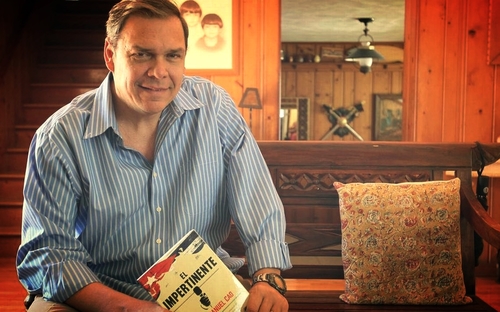
The script is by journalist Juan Manuel Cao, a prisoner of conscience in Cuba who at age 20 was jailed for three years for "enemy propaganda," and tortured. He spent time in the Combinado del Este, La Cabaña and Mazorra, a psychiatric facility were he was tortured.
Screenwriter Juan Manuel Cao
This short film speaks many truths of the first years of the Castro dictatorship.
Truths that continue to be suffered into the present.
24 years ago on February 24, 1996 four young men were killed while searching for rafters in the Florida Straits, in international space when Fidel and Raul Castro gave the orders to launch missiles and destroy two Brothers to the Rescue planes.
Ten years ago on February 23, 2010, the brick layer, human rights defender, and prisoner of conscience Orlando Zapata Tamayo, after seven years of torture, died on hunger strike. It was a death facilitated by regime officials who denied him water as punishment.
Four days ago Rolando Rodriguez Lobaina, a former political prisoner, freelance journalist and human rights defender "was regulated" - that is he was denied his rights to travel freely - despite having all his documents in order. His last message was that they were detaining him.
Rolando Rodriguez Lobaina
Today his family reports that the secret police say they arrested him but released him an hour later. The family knows nothing about Rolando and they fear for his life.
Cuba, under the Castros, is a profoundly anti-Marti regime. Marti believed in freedom, especially freedom of thought and expression.
Under the Castro regime freedom of expression can end in prison for engaging in "enemy propaganda," and freedom of thought can also lead you to prison for the crime of "dangerousness." This is an affront to Jose Marti's belief that "[l]iberty is the right of every man to be honest, to think and to speak without hypocrisy." Hypocrisy, under the Castro regime, is a currency for survival.
This is the Cuba of the Castros that has existed for six decades. This is the Cuba captured in "Irene in Havana."





 Posts

