"The first victory we can claim is that our hearts are free of hatred. Hence we say to those who persecute us and who try to dominate us: ‘You are my brother. I do not hate you, but you are not going to dominate me by fear. I do not wish to impose my truth, nor do I wish you to impose yours on me. We are going to seek the truth together’. THIS IS THE LIBERATION WHICH WE ARE PROCLAIMING."
Oswaldo José Payá Sardiñas (2002)
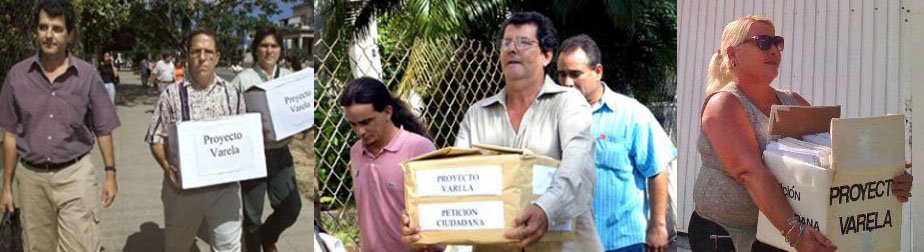
May 10, 2016 is the 14th anniversary of 11,020 Project Varela petitions turned in, in 2003 an additional14,384 petitions & in 2016, 10,009 more petitions
"Two days before a historic visit to Cuba by the
former President Jimmy Carter, human rights activists today delivered an
extraordinary challenge to the Communist government of President Fidel
Castro in the form of petitions signed by more than 11,000 people
seeking greater freedom.
The petition drive, known as the Varela Project,
calls for a referendum under the terms of the Cuban Constitution on
whether there should be more freedom of expression, an amnesty for
political prisoners and a chance for ordinary citizens to own small
businesses.
The signed petitions were delivered this morning to
the National Assembly, after supporters painstakingly verified each
signature, in the most significant peaceful effort to bring reform to
Cuba in four decades.
''All of these Cubans, who with great courage and
sacrifice have signed Project Varela, are the social vanguard for
peaceful change in Cuba,'' said Oswaldo Paya, who led the drive. He said
changes in the rights of Cubans could only be achieved peacefully.
The delivery of the petitions seemed timed to
coincide with the visit by Mr. Carter, who made human rights a leading
issue of his presidency. Not everyone in the dissident community
supported the move. Some had rejected the petitions because the proposed
referendum would be carried out by a political system they consider
illegitimate.
President Castro made no mention of the drive during
a speech tonight addressing another issue that arose in advance of Mr.
Carter's visit."
To no one will we sell, to no one deny or delay right or justice. - Magna Carta, June 15, 1215
Today the 800th anniversary of Magna Carta is being observed in the United Kingdom and it is important to look at societies where authoritarian or totalitarian dictatorships continue to systematically deny freedom and how citizens in those societies have appealed for change echoing elements of "The Great Charter." In Cuba, the Varela Project, under the dictatorship of the Castro brothers to date is the most serious challenge where more than 25,000 Cubans petitioned the regime to reform itself in 2002-2003. This led to the dictatorship altering the constitution to prevent amendments that would reform the system, imprisoning scores of petition organizers in March of 2003, and on July 22, 2012 extrajudicially killing Oswaldo Payá Sardiñas and Harold Cepero Escalante of the Christian Liberation Movement who had led the initiative. This citizen's demand remains active and like the Magna Carta was not a single event but a process that is still underway. Below is a translated excerpt of the Varela Project.
CITIZEN PETITION: SUPPORTEDINOURCONSTITUTIONAL RIGHTS
The undersignedat the end ofthis text, solicit the National Assemblyof People'sPowerto submitto popular consultation, by means of a referendum, each of thefollowing fiveproposals:
That the necessarychangesto the lawsare madeforpreservingthe common good andrespect foruniversally recognized human rightsand human dignity, guaranteeingcitizens:
Theright to associate freelyaccording to their interestsand ideas,so that they canlegallyform associations andsocial, political, economic, cultural, labor, student, religious, humanitarian and otherorganizations, respecting the principle of pluralismand diversityof ideaspresent in society. The rightsto freedom ofspeech and press, in a manner so that people, individually or in groups, candemonstrate andexpress theirideas,beliefs andopinions throughthe spokenandwritten word andby anymeans of communicationand expression.
The laws that guarantee these rights must be implemented no later than sixty days after this referendum is realized.That an
amnesty for all detainees is decreed, for those punished and imprisoned for
political reasons that have not participated in actions that directly endangered the lives of others. This amnesty law will go into effect no later than thirty days after this referendum is realized.That the
necessary changes be made to the laws that guarantee citizens the right
to establish both individual private enterprises such as cooperatives,
to develop economic activities that can be productive and of service, since
they can establish contracts between workers and companies
for the operation of these companies, under just conditions, in which no
subject can earn income from the exploitation of others' labor.
These new laws should also ensure respect for the rights of workers and citizens, and the interests of society.These new laws should enter into force no later than sixty days after this referendum is held.
The Great Charter of 1215 that established the Rule of Law
The Magna Carta
On June 15, 1215 40 barons pressured King John into affixing his seal on The Great Charter (Magna Carta in Latin) at a field in Runnymede, England. This document placed the sovereign under the rule of law and established this principle among English speaking peoples. The Nobles had risen up against the King and through peace negotiations sought this limitation of royal power in response to King John arbitrarily seizing properties and holding nobles hostage in order to raise funds in a failed attempt to take Normandy from the French. The document was originally written in Latin, then translated into French and finally into English.
The U.S. Declaration of Independence and Bill of Rights were directly influenced by this document. A full English translation is available online and below are some key excerpts still relevant in today's British law that resonate the world over:
(1) FIRST, THAT WE HAVE GRANTED TO GOD, and by this present charter have confirmed for us and our heirs in perpetuity, that the English Church shall be free, and shall have its rights undiminished, and its liberties unimpaired. That we wish this so to be observed, appears from the fact that of our own free will, before the outbreak of the present dispute between us and our barons, we granted and confirmed by charter the freedom of the Church's elections - a right reckoned to be of the greatest necessity and importance to it - and caused this to be confirmed by Pope Innocent III. This freedom we shall observe ourselves, and desire to be observed in good faith by our heirs in perpetuity. TO ALL FREE MEN OF OUR KINGDOM we have also granted, for us and our heirs for ever, all the liberties written out below, to have and to keep for them and their heirs, of us and our heirs:
(39) No free man shall be seized or imprisoned, or stripped of his rights or possessions, or outlawed or exiled, or deprived of his standing in any way, nor will we proceed with force against him, or send others to do so, except by the lawful judgment of his equals or by the law of the land.
(40) To no one will we sell, to no one deny or delay right or justice.
It is a day also to be dreaded by anyone in a position of power who abuses his authority, of tyrants both petty and grand around the globe because it is a day to reflect on the idea that no one is above the law and that everyone has rights. These principles established among English speaking peoples on June 15, 2015 that today extends to between a fourth and third of humankind living on the planet remains relevant giving hope to the oppressed and worry to the oppressors.
Friends of freedom tomorrow is a day to give a toast in celebration of the 800th anniversary of this important charter of liberty and to our British cousins who brought it into existence while at the same time studying this document and the continuing struggle to preserve our freedoms and extend them where and when possible.





 Posts
Posts

