"The first victory we can claim is that our hearts are free of hatred. Hence we say to those who persecute us and who try to dominate us: ‘You are my brother. I do not hate you, but you are not going to dominate me by fear. I do not wish to impose my truth, nor do I wish you to impose yours on me. We are going to seek the truth together’. THIS IS THE LIBERATION WHICH WE ARE PROCLAIMING."
Oswaldo José Payá Sardiñas (2002)
“Truth never damages a cause that is just.” - Mohandas Gandhi
Yesterday, Cuba’s communist dictatorship in New York City at the United Nations demonstrated that one can win a vote, and still lose.
The United States, together with 18 other democracies, distanced
themselves from the Cuban dictatorship and its falsehoods about the U.S.
embargo. The total vote was 165 in favor of the resolution, seven
against, 12 abstentions, and eight non votes. The dictatorship, and
their allies tried to spin this non-binding resolution, a propaganda
exercise, repeated annually since 1992, but this time was different.
It was a fiasco.
First, on October 28, 2025 Ambassador Mike Waltz, U.S. Representative to the United Nations factually and truthfully outlined the moral case for U.S. sanctions on the Cuban dictatorship,
and rebutted the distortions, and lies circulated by Havana. Ambassador
Bruno Rodriguez, the foreign minister for the Cuban dictatorship,
interrupted Ambassador Waltz’s address to the UN, but came away from the
encounter small, and diminished. Watch it for yourself here.
Secondly, Havana has been denying their involvement in Vladimir Putin’s
war in Ukraine, but that is a lie that was called out yesteday by
Ambassador Melnyk Andrii. Permanent Representative of Ukraine to the
United Nations. His excellency explained that the reason for Ukraine’s
vote against the resolution condemning the US embargo on Cuba was
Havana’s complicity in Moscow’s recruitment of thousands of Cuban
soldiers now fighting in Ukraine. You can watch his presentation below.
These are the reasons why Argentina,
Hungary, Israel, North Macedonia, Paraguay, and Ukraine joined with the
United States to vote against the resolution. These are also the
reasons why Albania, Bosnia, Costa Rica, the Czech Republic, Ecuador,
Estonia, Latvia, Lithuania, Poland, Moldavia, Morocco, and Romania
abstained this time.
In addition there were eight
countries that did not vote for whatever reason and they are: Bulgaria,
Dominican Republic, El Salvador, Madagascar, Myanmar, Naura, Syria, and
Venezuela.
The so-called “high point” in these non-binding votes
was in 2016 when both the United States, and Israel abstained, and no
one voted against the resolution. The vote was 191 in favor, 0 against,
and 2 abstentions. This was during the Obama thaw with Havana.
This
time was different, but not only due to the vote itself, but also the
debate, and the action that took place on the same day.
Today,
while the World was focused on Havana’s non-binding propaganda exercise,
Kyiv took concrete action in protest to Cuban soldiers waging war on
Ukraine for Putin.
It was not a good day for Ambassador Bruno Rodriguez, and the dictatorship in Havana.
Today, Vaclav Havel’s maxim uttered in his important essay, The Power of the Powerless,
was seen in action. “If the main pillar of the system is living a lie,
then it is not surprising that the fundamental threat to it is living in
truth.”
Truth and facts exposed the Cuban dictatorship before the international community, and left it shaken.
It was a bad day for the Cuban dictatorship, but a great day for Cuban dissidents, and for freedom in New York City.
The United States, Britain, France, West Germany, Italy, Spain, the Netherlands, Sweden, and Chinese students condemned the crackdown by the “People’s Liberation Army.” Chinese students around the world took to the streets and protested the bloodshed in Beijing.
People of conscience the world over were horrified. Beijing was diplomatically shunned.
Cuba’s dictatorship endorsed the Tiananmen massacre to normalize relations with Beijing
In
contrast, the dictatorship in Cuba saw an opportunity to rekindle and
old friendship. Together with North Korea, and East Germany expressed their support for the actions taken by Beijing.
Cuban foreign minister Isidoro Malmierca commended Chinese authorities for “defeating the counterrevolutionary acts.” Fidel Castro openly supported Beijing’s Tiananmen Square massacre in 1989, as a means to both preempt reform elements in the Cuban regime, and improve relations with Beijing.
“The
crackdown in Beijing, Qian says, completely changed the atmosphere
around his tour: many Latin American governments expressed their
disapproval of the suppression and cancelled his visits, and even the
overseas Chinese, who usually greeted visiting Chinese officials with
enthusiasm, had“stern faces” and questioned the reasons for using force.
Qian had planned a visit to Mexico before Cuba. The Mexican government
cancelled his visit but allowed him to go to Cuba via Mexico City.”
[…]
“But
Qian’s reception in Havana exceeded his expectations. He was greeted by
the Cuban foreign minister at the airport and brought to a welcome
dinner the next evening hosted by Fidel Castro himself. Castro had a
long talk with Qian at dinner which continued in his office until
midnight. Understanding Qian’s situation, Castro gave him a detailed
description of what had happened in Beijing since 4 June and the
international response, based on his collection of information and from
his own perspective. Castro said that he “completely supported the
Chinese government” and would offer “whatever occasions and facilities”
Qian might need to make his government’s voice heard.”
Cuba-Sino relations: From a warm embrace in 1960 to a decades long chill in relations
Communist China and Cuba had been close in the first years of the Castro regime. Mao Zedong had already been in power in China for a decade when the Castro regime took power in Cuba in 1959.
On September 28, 1960 the Cuban dictatorship diplomatically recognized the People’s Republic of China.
Ernesto “Che” Guevara led a Cuban delegation’s visit to Mainland China and met with Mao Zedong, Zhou Enlai, and other high ranking Chinese officials in November 1960 to discuss conditions in Cuba and in Latin America, and the prospects for communist revolution in the Americas.
Subsequently, between 1960 and 1964 the two regimes collaborated closely together.
Mao's regime in 1958 had embarked on the Great Leap Forward, a campaign to reorganize the Chinese populace to improve its agricultural and industrial production along communist ideological lines. The campaign was a disaster that led to mass famine and a death toll of at least 45 million which did not end until 1962.
The
visit by the Cuban delegation at the time did not go unnoticed in
Mainland China. Dimon Liu was born in China and immigrated to the United
States in 1965. She wrote about her early experiences growing up in the
midst of the Great Leap Forward in 2017 and her first encounter with Cuba while still in China.
It
was 1960, the height of famine during the years of Great Leap Forward. I
was a child living in the southern city of Guangzhou in China. Meal
time meant a little rice, and whatever we could scrape together. For
nearly two years, we had no meat, fish or even cooking oil. We were
starving.
All of a sudden, there was cane sugar from Cuba, and we
school kids had to learn Cuban songs. We had been on rations even before
the Great Leap Forward which began in 1958. Thirty jin (one jin is
about 1.1 pound) of grains per month for an adult, and fifteen jin for a
child above the age of seven. Two jin of meat and two ounces of cooking
oil, also for a month. [...] People on our streets were dying of many
infectious diseases, though no one dared to say anyone died of
hunger.[...]
Frank Dikotter, the historian at the University of
Hong Kong who wrote "Mao's Great Famine", a book about this period, said
in a social media post that "the first thing the regime did in
September 1960 was to procure an extra 100,000 tons of grain and ship it
to Cuba," in order to help break the economic blockade imposed by
Washington on the island. Dikotter added that "you can feed about 2000
people for a day with a ton of rice... Or over half a million people for
a year."
Properly fed people rarely existed in China at that
time, unless you belonged in the very small and exclusive club of
Chinese Communist elite. For a child like me who received coupons for
under 8 pounds of rice a month, you could have fed more than 2 million
of us for a year; or about half a million Chinese adults for a year on a
standard ration of 30 jin, or 33 pounds of rice per month for the
amount of grain sent to Cuba.
Cuba was not the only place that China exported food to during those harrowing years.
In
the midst of the Great Famine, while tens of millions of Chinese died
of hunger, Beijing exported food to their communist ally in Cuba.
Relations between China and the Castro regime cooled, and completely deteriorated following a February 6, 1966 speech
by Fidel Castro that was heavily critical of the Peoples Republic of
China. Havana finally sided with Moscow in the Sino-Soviet split.
Criticizing Mao
Castro, while receiving Soviet subsidies, would continue to slam the Chinese Communists in the 1970s.
“I
believe that Mao (Zedong) destroyed with his feet what he did with his
head for many years. I’m convinced of that. And some day the Chinese
people, the Communist party of China will have to recognize that,”
Castro told American journalist Barbara Walters in May 1977. He went on
to list what he said were Mao’s grave mistakes: a cult personality and
abuse of great power. “I also acquired that power, but I never abused
it, nor did I retain it in my hands,” Castro said. Although both Cuba
and China were functioning Communist states, Castro told Walters he
viewed China as a “good ally” of the US, which was a bitter enemy of
Cuba.
How Moscow drove Cuba into improving relations with Beijing
Russia’s
democratic spring in the mid to late 1980s under Mikhail Gorbachev led
to a cooling of relations between Havana and Moscow.
Perestroika
was a policy that recognized economic central planning was a failure,
and pursued reforming and restructuring the Soviet economy, and Glasnost was a policy that sought “more open consultative government and wider dissemination of information.”
These policies both instituted were viewed with great dread, and rejected by the Castro brothers. This was at a time when 75% of Cuba’s commercial exchanges were with the Soviet Union,
but that did not stop Havana from censoring Soviet publications, and
the beginning of the Castro brothers’ outreach to Beijing in 1989.
Havana’s successful engagement with Beijing: Harming U.S. interests and security
Backing
the massacre of thousands of Chinese nationals by the People’s
Liberation Army (PLA) on the orders of the Chinese Communist Party (CCP)
resulted in Chinese President Jiang Zemin’s high-level visit to Cuba in
1993. This was followed by Raul Castro’s first visit to China in 1997.
Prior
to this, Beijing quietly began in 1992 jointly operating intelligence
bases targeting the United States from Cuba, according to Chris Simmons,
a former head of the U.S. Defense Intelligence Agency’s Western
Hemisphere counterintelligence research section, revealed to the Miami Herald on July 4, 2024.
He said that U.S. surveillance services were unaware of the arrangement
until 2001, operating undetected for a period of nine years.
The Center for Strategic and International Studies (CSIS) published a report in December 2024
that identified four places in Cuba it believes are most likely to be
aiding China’s intelligence activities against the United States. One of
the authors of the report Ryan C. Berg,
Director, Americas Program, Center for Strategic and International
Studies, and Andrés Martínez-Fernández, Senior Policy Analyst, Latin
America, Allison Center for National Security, testified before Congress
on May 6, 2025. They point to these spy bases in Cuba being upgraded
with new technology.
This restored “special friendship” between two Communist
dictatorships was founded on the mass killing of Chinese civilians by
the PLA in June 1989, and Havana’s public support for this crime against humanity.
Following
this rapprochement, it is believed Havana began offering their biotech
knowledge, gained from Moscow, to their counterparts in Beijing, and in
2002, China and Cuba signed a formal agreement to produce monoclonal antibodies.
What
Cubans call “the Special Period” produced one notable success:
pharmaceuticals. In the wake of the Soviet collapse, Cuba got so good at
making knockoff drugs that a thriving industry took hold. Today the
country is the largest medicine exporter in Latin America and has more
than 50 nations on its client list. Cuban meds cost far less than their
first-world counterparts, and Fidel Castro’s government has helped
China, Malaysia, India, and Iran set up their own factories:
“south-to-south technology transfer.”
“Díaz-Canel
emphasized the notable progress made by Cuba and China in the sphere of
biotechnology over recent years while also highlighting the close
collaboration that the two countries share in the sector; providing
great benefits and knowledge for both peoples.”
Without
Havana’s joint ventures over the past 20 years in Cuba, Beijing may not
have been in a position to have the capability to run a biotech /
genetic engineering lab like the one in Wuhan that caused so much
tragedy during the COVID pandemic.
Modernizing big brother for the 21st century
Raúl Castro met with China’s Minister of Public Security on December 1, 2024,
and Chinese companies ZTE and Huawei are providing Havana censorship
tools that are used to block information, track dissidents, silence
dissent, and shut down the internet during anti-government protests.
Communist China’s Foreign Ministry spokeswoman Mao Ning on June 4, 2024 described Cuban Minister of Foreign Affairs Bruno Rodríguez Parrilla as a “good old friend of China.” Rodríguez’s official visit from June 5 to 9,
2024 as a special envoy of Cuban President Miguel Díaz-Canel
highlighted the two communist regimes’ “special friendship.” Never
forget that this rekindled friendship was forged in the blood spill 36
years ago in Tiananmen Square.
A reflection on the 54 year alliance between the Assad and Castro regimes.
Hafez al-Assad
seized power in November 1970 in a bloodless coup, and remained in power through brutal means until his death on June 10, 2000. The Syrian dictator ruled his country for over 30 years, and when he died in power, was succeeded by his equally brutal son
Bashar al-Assad who ruled Syria for another 24 years. Throughout these 54 years, the Castro brothers maintained a close relationship with the Assad regime.
Fidel Castro broke relations with Israel on the eve of the Yom Kippur War in 1973. This was required for all Soviet-aligned regimes, as the international communist line defined Israel as a colonial state and an arm of U.S. imperialism. However, the Cuban dictatorship went above and beyond in their hostility to the Jewish state. Noticias de Israel (News of Israel) provided a more in-depth description of what took place next.
From the highest levels of power in Havana, a secret operation was orchestrated to send military support to Syria.A tank brigade, helicopter pilots, communications agents, and intelligence and counterintelligence officers were meticulously selected for this mission.It was imperative that these men did not arouse suspicion and that they were perfectly prepared for the task entrusted to them.
The Military Brigade of Senén Casas Regueiro was mobilized, and under the command of General Leopoldo Cintra Frías, a recognized name in military circles, this surreptitious plan was put into action. In a carefully planned diversionary maneuver, the soldiers left Cuba dressed in civilian clothes, with forged passports that identified them as university students. They traveled on separate flights to East Germany, where they made a technical stopover, before reaching their final destination: Syria.
Once on Syrian territory, Soviet military equipment, including modern T-62 tanks and SAM rocket artillery, was ready for operation. Figures vary, but it is estimated that between 1,800 and 4,000 Cubans were present in Syria during the 1973 confrontation.
The surprise of this operation resulted in a series of significant losses for Israel, both in human lives and military equipment. Some civilian areas were also hit during the clash.
On March 31, 1974, Israeli Defense Minister Moshe Dayan announced on US television that 3,000 Cuban troops had been dispatched to support Syria during the Yom Kippur War. The Economist published two articles in its Foreign Report in 1978 that highlighted Cuba's role in Syria beginning shortly after the 1973 Arab-Israeli war. Cuban tank crews fought with Syrian troops. According to Foreign Report, 180 Cubans were killed and 250 were injured.
The bodies of hundreds of victims of the 1982 massacre that Hafez al-Assad ordered against Palestinians and Lebanese in the Tel al-Zaatar Palestinian refugee camp, northeast of Beirut, Lebanon are still interred in unidentified graves. Between 1,500 and 2,000 people, primarily civilians, are thought to have been killed, although some estimate that the total number of victims during the siege may exceed 4,000.
No criticism was made by Havana regarding the massacre of these Palestinians by Assad. On the contrary the relationship between Havana and Damascus remained strong.
"An August 1985 cable from Assad to Fidel Castro on the 20th anniversary of diplomatic relations between Syria and Cuba praised the two countries' friendship as beneficial 'for the two peoples in their joint struggle against world imperialism and its allies.' A telegram from the
Syrian foreign minister on the same occasion expressed 'Syria's admiration for the fraternal Cuban people's great achievements and their firm stands against imperialist aggression on the Latin American people.'”
In 2011, a nonviolent movement against the Assad regime emerged, which was met with extreme brutality, and resulted in a civil war.
When the international community, belatedly, demanded an accounting for the rights violations committed by the Assad regime in Syria, the regime in Havana was one of a handful of governments that voted against investigating the crimes of the dynastic dictatorship in Damascus.
On August 23, 2011 the Cuban
government along with China, Russia and Ecuador voted against investigating
gross and systematic human rights violations in Syria.
On June 1, 2012 at a Special
Session on the deteriorating human rights situation in Syria with a special
focus on
the massacre in El-Houleh the Cuban regime and its allies took a stand against holding the Assad regime accountable for its gross and systematic human
rights abuses.
The Associated Press reported that
the U.N. Human Rights Council voted overwhelmingly on September 25, 2014, to share its
evidence of Syrian atrocities in hopes it will be forwarded to the
world's war crimes tribunal. By a vote of 32-5, with 10 abstentions, the
47-nation council adopted
the resolution condemning the lack of cooperation by
President Bashar Assad's government with a U.N. commission investigating
rights violations since March 2011 in Syria. Cuba was one of five nations—the other four being Algeria, China, Russia, and Venezuela—that voted against sharing evidence of
gross and
systematic human rights violations in Syria.
Ten years of civil war and bloodshed with tens of thousands disappeared, millions displaced, and over 500,000 killed, yet the Syrian regime was being normalized in 2023 by too many in the international community.
It
appears that the Assad dynasty that ruled Syria over two generations of
incredible levels of brutality and terror has come to an end. Let us
pray that what comes next after so many decades of depravity and
repression is an improvement. Assad's
decision to engage in the mass murder of the Syrian nonviolent
opposition in 2011 sparked a civil war that has claimed hundreds of
thousands of lives. Now
is the time to make an assessment of the governments who backed the
Assad regime, and call them out as we learn of the crimes of this
dynastic dictatorship.This includes the dictatorships in Cuba, Venezuela, and Nicaragua. All supported Assad, and legitimized his rule.
"It appears that the Assad dynasty that ruled Syria over two generations of incredible levels of brutality and terror has come to an end. Let us pray that what comes next after so many decades of depravity and repression is an improvement." https://t.co/5dO3DpvHFn 1/4
“60 Minutes producers Michael Rey and Oriana Zill de Granados discuss the evolution of their 5-year investigation into ‘Havana Syndrome,’ which led them to what one source calls "a receipt" for acoustic weapon testing done by a Russian intelligence unit.”
Officials in the Cuban government have also been quick to dismiss the Havana Syndrome, but the record shows that if Russia was testing an acoustic weapon on American and Canadian diplomats stationed in Havana, the Cuban secret police would know about it, report it to their superiors, and approve it. Havana's role in supporting Putin's illegal war in Ukraine, including the deployment of Cuban soldiers in Russian uniforms fighting on the front lines, underscores their strategic relationship with Moscow.
60 Minutes, March 31, 2024
Havana Syndrome mystery continues as a lead military investigator says bar for proof was set impossibly high
By Scott Pelley
March 31, 2024 / 7:42 PM EDT / CBS News
This report is the result of a joint investigation by 60 Minutes, The Insider, and Der Spiegel
Tonight we have important developments in our five-year investigation of mysterious brain injuries reported by U.S. national security officials. The injured include White House staff, CIA officers, FBI agents, military officers and their families. Many believe that they were wounded by a secret weapon that fires a high-energy beam of microwaves or ultrasound. This is our fourth story and for the first time, we have evidence of who might be responsible. Most of the injured have fought for America, often in secret. And they're frustrated that the U.S. government publicly doubts that an adversary is targeting Americans.
One of them is Carrie. We're disguising her and not using her last name because she's still an FBI agent working in counterintelligence. She says, in 2021, she was home in Florida when she was hit by a crippling force.
Carrie: And bam, inside my right ear, it was like a dentist drilling on steroids. That feeling when it gets too close to your eardrum? It's like that, you know, times ten. It was like a high pitched, metallic drilling noise, and it knocked me forward at, like, a 45 degree angle this way.
"Cuba holds National Assembly elections Sunday, but there are only 470 candidates running for the 470 seats, with no opposition challengers and no campaigning," reports the Associated Press.
"Like in most communist countries, elections in Cuba are not aimed at
changing previously selected officials, but rather at highlighting
existing polices and mobilizing the population to support the communist
system."
This is not a secret, but established in existing regime rules.
Cuba's 2019 constitution declares
that the country is officially a one-party system with the Communist
Party serving as the "superior driving force of the society and the
state" and "orienting the communal forces" toward the creation of a
"communist society."
Internal democracy does not exist in the Cuban
Communist Party. It is a top down process.
Despite this, the Cuban dictatorship finds itself in a crisis. Cubans are losing their fear, and refusing to go along with the regime's charade.
Like a growing number of Cubans, 77-year-old Havana resident Humberto Avila says he will likely sit out Sunday's legislative elections. The retired university professor says he's done the math - 470 candidates, 470 open seats - and sees no point in voting. "That's the same number of candidates as open seats," he told Reuters. "There are no choices."
Cuban dissidents in the island are calling on citizens not to take part
in the sham. "Not attending the electoral farce orchestrated by the
regime is an act of elementary consistency with truth and justice. No to
tyranny," tweeted from Cuba Eduardo Cardet, national coordinator of the Christian Liberation Movement on March 24, 2023.
"Not attending the electoral farce orchestrated by the regime is an act of elementary consistency with truth and justice. No to tyranny," tweeted from Cuba Eduardo Cardet, national coordinator of the Christian Liberation Movement yesterday. https://t.co/pJ3z0ojS2e 14/
As Professor Suchlicki observed above, this is not a question of electing representatives in a democracy, but measuring the communist dictatorship's ability to influence or coerce mass support for the system in a vote.
This is also why they do not allow independent international observers, or independent domestic observers for today's vote, despite recognizing in law the ability of citizens to observe elections.
T @CubaDiceNO Since the early hours of the morning, the political police in #Cuba have prohibited several observers from leaving their homes with a patrol at the door. Among them, Zealandia Pérez, coordinator of #COCUDE, the #Cuban Electoral Defense Commission. https://t.co/CF2YRUMyXC
The Armed Conflict Location & Event Data Project in their March 23, 2023 report "Political Repression in Cuba Ahead of the 2023 Parliamentary Elections"
predicted that "unaddressed grievances and repression might lead to
lower voter turnout in the upcoming elections, which could, in turn,
further undermine the legitimacy of Cuba’s next government."
With no observers agents of the dictatorship can stuff the ballot boxes, and claim whatever result they want, but internally they will know the true level of dissatisfaction within the populace.
This dissatisfaction was observed on July 11-12, 2021 when tens of thousands of Cubans, knowing what dangers openly defying the regime entailed, took to the streets of Cuba in protest.
Soviet dictator Josef Stalin in 1923 commented the following about elections,“I consider it completely unimportant who in the party will
vote, or how; but what is extraordinarily important is this - who will
count the votes, and how.”
The
effort to stop the poll watchers, though poll watching is permitted
under current electoral law in Cuba, hearkens back to that principle of
control alluded to by Stalin 100 years ago.
This is why Cubans should stay home, and abstain from taking part in this charade.
1. MOBILIZATION for Rights & Conditions 2. COMPLIANCE with Rights & Conditions 3. BINDING PLEBISCITE to change the system 4. TRANSITION 5. FREE ELECTIONS#IDoNotVote with the dictatorship's rules. Mobilization for #SystemChangehttps://t.co/l7TOrQzfru
One last, but important observation that many have gotten wrong. Cuba has not entered the post-Castro era.
Osvaldo Dorticós Torrado and Miguel Díaz-Canel
President Osvaldo Dorticós Torrado held the title of president from July 17, 1959 through December 2, 1976. Cubans called him "president
spoon" (because he neither pricks [like a fork] nor cuts [like a knife]). It was their way of saying
he had no real power because it resided with Fidel Castro and his
brother Raul.
Miguel Díaz-Canel, the current president of Cuba is
another Dorticós Torrado, a figure head without any power. Raul Castro remains the strong man, and his son Alejandro Castro Espin, the heir apparent.
Act I: The storm hits, and Cuban hotels quickly recover power and return to business as normal. Rest of the island in darkness. Protests break out in Cuba.
Hurricane Ian over Cuba on September 26, 2022
Category 3 Hurricane Ian battered the west of Cuba on September 26th, and an already crumbling national electrical grid collapsed leaving
Cubans without electricity.
The entire island of Cuba went black without electricity. Not just the Western part that was impacted by Hurricane Ian.
Cuba seen from space on September 27, 2022 after Hurricane Ian.
However GAESA's hotels continued to have electricity and were promoting tourism to the island in the aftermath of
the storm on September 29th.
The Hotel Nacional of Cuba reported on September 29th over Twitter that all services were "available to our guests." They added that "some of the clients have even joined in cleaning and tidying up the outdoor areas."
Diaz-Canel prior to fleeing from Cubans.
Reports of protests emerged across Cuba on September 29th. Diaz-Canel fled from an encounter with Cuban citizens in Batabanó. Cubans repudiated the selected Cuban President, and his convoy sped out of the area.
Why are Cubans upset? Whereas hotels across the island are already operating normally, most Cubans are still in the dark without electricity. Food has already been hard to come by due to the Cuban dictatorship's internal blockade, and whatever meager amounts they have are rotting.
Yes, Cubans are protesting the incompetence of the regime. They are protesting the failure to maintain the infrastructure, and provide proper maintenance to the electrical grid. However, they are also calling for an end to the dictatorship and for freedom.
Act II: Protests expand across Cuba, and secret police, paramilitaries mobilize and travel to crackdown on demonstrations.
The Wall Street Journal reporters Vivian Salama and José de Córdoba broke the story that the Biden Administration had “received a rare request from Cuba’s government to provide emergency assistance” and that “the U.S. was still trying to determine whether the government in Havana would supplement the request as it works to determine the extent of the damage, according to the email communications.”
Civil society groups expressed concern that the Castro regime had a record of seizing and reselling humanitarian assistance, and called on the Biden Administration to provide humanitarian assistance directly to the Cuban people, or through independent civil society organizations and religious groups.
On September 30, 2022 the Center received reports of an expanded military presence in the streets in the neighborhoods of Arroyo, Cerro, and Guinera in Havana. Cubalex, the Cuban human rights NGO that provides legal assistance to Cubans, shared an image of a street lined with police cars.
Andrea Rodriguez, the AP correspondent in Cuba, reported that "an Associated Press journalist saw a total of about 400 people gathered in at least two spots in the Cerro neighborhood shouting, “We want light, we want light,” and banging pots and pans." 14ymedio reported on September 30th that the Castro regime had "cut off internet access on the evening of September 29th after protests continued in some parts of the capital. Demonstrations continued in Cerro and Arroyo Naranjo, another protest began in San Francisco de Paula, in the municipality of San Miguel del Padron."
Newsweek journalist Jack Dutton reported at 4:10am on September 30th that "people in Cuba have been protesting for 48 hours, according to multiple media reports, after the power went out due to Hurricane Ian and the internet has also reportedly been cut. Early on Friday, internet shutdown monitor NetBlocks.org posted on Twitter, showing a near total collapse of internet traffic from the Caribbean island."
The Center for a Free Cuba (CFC) in a Twitter thread called on the international community to support the Cuban people and called on the Cuban government to respect the rights of Cuban protesters. "There must not be a repeat of police and paramilitaries firing on unarmed civilians to terrorize populace as was done in July 2021," admonished CFC.
⚠️ Confirmed: Real-time network data show internet has been cut in #Cuba for the second evening in a row; metrics show a collapse in connectivity after 8 p.m. local time amid protests over poor conditions and power cuts worsened by Hurricane Ian 📉 #CubaPaLaCallepic.twitter.com/YDJ6ZsTjwX
Cubans continued to protest over the next three nights, despite the internet being shut down by the dictatorship the past two nights across the island while regime agents were mobilized in large numbers, and cracked down on demonstrators. Human rights organizations are trying to compile lists of those arrested and/or disappeared.
Act III: Reports emerge of Cubans beaten bloody by government agents in regime dress. Mass arrests, and international press claims that protests have diminished, but reports from Havana say different.
Military in civilian dress knocks down black Cuban woman protester.
Reports emerge, along with images and video of regime agents carrying baseball bats, and clubs that protesters have been badly beaten: faces smashed in, broken noses.
"Explicit testimony about repression in Calle Línea (Havana).Mentions several people badly beaten, [Justicia11J] has only been able to identify among them José Adalberto Fernández Cañizares, who needed care at the Calixto García hosp before being transferred to a detention center."
Video also emerges of regime agents carrying clubs and chanting "I am Fidel" through city streets to intimidate Cubans.
Other videos appear of what appear to be the unconscious bodies of demonstrators carried away by regime agents.It is also learned that Cubans video taping protests, and repressive acts are being rounded up and arbitrarily detained.
Coda: Hotels could have opened their doors to Cubans in need, and defused a volatile situation.
The Miami Herald reported on September 27th that "on Monday [September 26th], several prominent Cubans and Cuban Americans signed a petition asking the heads of Meliá Hotels International, Iberostar, Kempinski, NH Hotel Group and other foreign hotel chains operating in Cuba to 'make room for Cuban families, most of them with children, who will be left destitute and homeless as a result of Ian.' During natural disasters in the United States, when public shelters have been overwhelmed, hotels have been used as a temporary housing solution.
Cuban activist Rosa María Payá, musician Paquito de Rivera, Modesto Maidique, former president of Florida International University, and the Reverend Jose Conrado of the Parish of Trinidad in Cuba, led the appeal."
Seven days later, and no response has been received from these hotels.
Cubans and Cuban Americans have requested a humanitarian corridor to get assistance directly to Cubans in need on the island, and circumvent profiteering by Castro's military junta.
Newspapers, TV news, and their websites are losing an audience to levels never seen before. Some blame it on the departure of Trump, and others on the arrival of Biden. However, there is a more troublesome reason, and I will focus on an area that this blog is knowledgeable about to explain. The 2016 campaign accelerated negative trends, and the media has never recovered
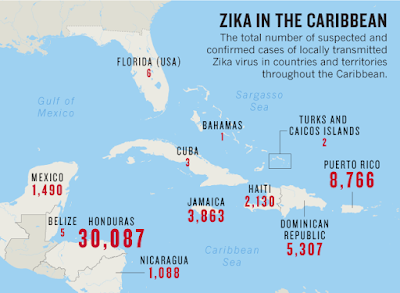
According to media reports, Zika was raging through all of the Caribbean in 2016, except Cuba. This blog at the time repeatedly raised concerns about these claims and found circumstantial evidence and a past history of coverups and underreporting by Havana that should have given one pause.
Fake news in Cuba: PAHO chart from 2016 was wrong (Source: PAHO/WHO)
On April 5, 2021, The Washington Post published a letter to the editor were I highlighted part of this history of regime obfuscation of health data, including Zika.
Repression patterns during this pandemic in Cuba indicate officials seek to downplay covid-19’s severity on the island. According to Duane Gubler at the Duke-NUS Medical School in Singapore, “Cuba has a history of not reporting epidemics until they become obvious,” and that is pretty bad.
Havana had claimed to be Zika free, until the impending March 2016 state visit by President Barack Obama necessitated their admitting to its existence on the island to avoid embarrassment if someone in the US delegation contracted the illness. [This is my hypothesis.] Meanwhile, Scientific American, the Associated Press, and too many others to list here continued peddling the official line that all was under control.
This turned out to be false, and scores of sick foreign tourists exposed the lie.
New Scientist broke the story on January 8, 2019 that "thousands of Zika virus
cases went unreported in Cuba in 2017, according to an analysis of data
on travelers to the Caribbean island. Veiling them may have led to
many other cases that year." Based on analysis based on the number of travelers infected in Cuba, the number of Zika infections were 5,400. Nowhere near the numbers reported by Cuban health officials.
What is shocking is that less than three years later the media continue to report Havana's claims without qualification, including New Scientist. They are doing this now with the deadly COVID-19 pandemic, and once again it does not pass the smell test.
Official regime journalist Leticia Martinez Hernandez over Twitter on May 18, 2021 bragged that "Cuba will be the first country in the world to vaccinate
their whole population with their own vaccines. Live to see!" She even
replied to her own Tweet that she would keep the above "tweet fixed
until then. I want to remember the feat on which we have bet." Havana's foreign ministry on June 9, 2021 repeated the same campaign theme
as the official journalist: "Cuba could be the
first country to immunize its entire population with its own vaccines.
The population wants and trusts the vaccine candidates, our science, and
the country's experience in vaccine development."
Officials rejected using alternative vaccines over the six months that they were available because their first "homegrown vaccines" were not ready for clinical trials until May 2021 in Havana and June 2021 in the rest of the island. Meanwhile thousands of Cubans died, and the regime could not cover it up. This was one of the causes of the July 2021 protests.
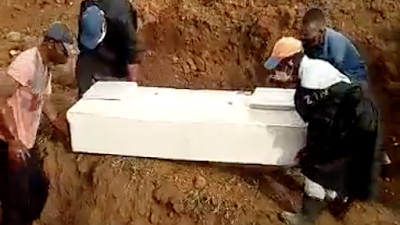
Tîcö Äwö Ôrümîlä, buried his grandmother in a mass grave at the Juan González
cemetery, in Santiago, Cuba. (Facebook)
No mention of this was made in the NBC News or New Scientist reports, which echoed glowing claims about vaccination and COVID-19 rates made by officials in Havana. The NBC News article in the first paragraph reads like Prensa Latina.
"Cuba has vaccinated more of its citizens against Covid-19 than most of the world’s largest and richest nations, a milestone that will make the poor, communist-run country a test case as the highly contagious Omicron variant begins to circle the globe."
It is only way down in paragraph nine that the NBC News article reveals that none of the Cuban vaccines have been peer reviewed. The Hill goes even further with a video extolling the regime's successes and claims that the regime will submit to being peer reviewed in 2022 by the World Health Organization.
Where are the fact checkers? Where is the institutional memory? These acts of journalistic malpractice are part of the reason that Newspapers, TV news, and their websites are losing their audiences. They want news not recycled government propaganda.
The data provided by Havana cannot be independently verified, but that is not revealed in the reporting. Also, why not compare Cuba's COVID-19 response with Taiwan's? They are both islands with powerful nations next door with competing ideologies.


.jpg)
_02.jpg)






 Posts
Posts


