Showing posts with label Marco Rubio. Show all posts

Sunday, February 16, 2025

Hate speech laws, not free speech, facilitated the rise of the Nazis in Germany. Fact checking Face the Nation.

Let me begin by making an admission of bias. I am a free speech absolutist, and was recently interviewed on the topic, and it is available online. Earlier today on Face the Nation, CBS news correspondent Margaret Brennan made a disturbing claim, that although correctly challenged and rebutted by Secretary of State Marco Rubio, needs closer examination. Below is the transcript that begins at 12 minutes and 12 seconds into the interview.


CBS News senior foreign affairs correspondent Margaret Brennan: "Well, he [ Vice President J.D. Vance ] was standing in a country where free speech was weaponized to conduct a genocide, and he met with the head of a political party that has far-right views and some historic ties to extreme groups. The context of that was changing the tone of it. And you know that, that the censorship was specifically about the right."

I also think it’s wrong – again, I go back to the point of his speech. The point of his speech was basically that there is an erosion in free speech and in tolerance for opposing points of view within Europe, and that’s of concern because that is eroding – it’s not an erosion of your military capabilities. That’s not an erosion of your economic standing. That’s an erosion of the actual values that bind us together in this transatlantic union that everybody talks about. And I think allies and friends and partners that have worked together now for 80 years should be able to speak frankly to one another in open forums without being offended, insulted, or upset. And I spoke to foreign ministers from multiple countries throughout Europe. Many of them probably didn’t like the speech or didn’t agree with it, but they were continuing to engage with us on all sorts of issues that unite us.

So again, at the end of the day, I think that people give all – that is a forum in which you’re supposed to be inviting people to give speeches, not basically a chorus where everyone is saying the exact same thing. That’s not always going to be the case when it’s a collection of democracies where leaders have the right and the privilege to speak their minds in forums such as these."

"Weimar Germany did have hate-speech laws, and they were applied quite frequently. The assertion that Nazi propaganda played a significant role in mobilizing anti-Jewish sentiment is, of course, irrefutable. But to claim that the Holocaust could have been prevented if only anti-Semitic speech and Nazi propaganda had been banned has little basis in reality. Leading Nazis such as Joseph Goebbels, Theodor Fritsch, and Julius Streicher were all prosecuted for anti-Semitic speech. Streicher served two prison sentences."
The outcome of silencing hate speech is not what those who advocate for it would expect as Rose continued to explain:
"Rather than deterring the Nazis and countering anti-Semitism, the many court cases served as effective public-relations machinery, affording Streicher the kind of attention he would never have found in a climate of a free and open debate. In the years from 1923 to 1933, Der Stürmer [Streicher's newspaper] was either confiscated or editors taken to court on no fewer than thirty-six occasions. The more charges Streicher faced, the greater became the admiration of his supporters. The courts became an important platform for Streicher's campaign against the Jews. In the words of a present-day civil-rights campaigner, pre-Hitler Germany had laws very much like the anti-hate laws of today, and they were enforced with some vigor."

When violence erupts in a society where the rule of law exists, it must not be tolerated, but dealt with an expeditious manner through the judicial system. However, where the poisonous tropes of anti-Semitism, and hatred against the Jewish people arise, it must not be censored by the government, but challenged by people of good will in the battle of ideas to expose both its intellectual and moral bankruptcy. 

Hate speech has Marxist origins that are in opposition to free expression. Perversely, it claims that language can be violence to censor speech while at the same time defending physical violence as justified. When you outlaw speech and drive it underground you imbue it with power and credibility it does not deserve. 

This approach in Wiemar Germany weaponized hate speech laws against the Nazis that created a backlash that helped them take power, and once in power free speech was completely eliminated in Germany.  

Ms. Brennan's claim on Face the Nation was not just wrong, but diametrically opposed to what actually happened, and a disservice to her audience.

Tuesday, January 9, 2018

Testimony by State Department officials on attacks on U.S. diplomats in Cuba

Some answers on the record

State Department officials testify before the Senate Committee on Foreign Relations
 This morning at 10:00am the U.S. Senate Committee on Foreign Relations held a hearing on attacks against U.S. diplomats in Cuba presided by Chairman Senator Marco Rubio and Ranking Member Senator Robert Menendez along with five other members. Following their testimony the three State Department officials answered questions from the Senators. Many questions remain but that 24 U.S. officials and their dependents were seriously harmed in Cuba between November 2016 and September 2016 remains an established fact.

Testimony of Senior Bureau Official Francisco L. Palmieri before the Senate Foreign Relations Subcommittee on the Western Hemisphere on “Attacks Against U.S. Diplomats in Cuba: Response and Oversight” 

Francisco L. Palmieri

 January 9 , 2018

Chairman Rubio, Ranking Member Menendez, and distinguished members of the Committee: thank you for the opportunity to speak about the attacks against U.S. diplomats in Cuba and the Department of State’s efforts in response. At the outset, I want to thank you for your concern for the safety and security of our diplomatic personnel in Havana. As you know, that is Secretary Tillerson’s top priority . It is mine as well.

I am pleased to be here today with my colleagues from the Bureau of Diplomatic Security and the Bureau of Medical Services, with whom the Bureau of Western Hemisphere Affairs ha s worked closely on this complex issue.

I would also like to emphasize up front that the investigation into these health attacks is ongoing. I understand that there are ongoing discussions within the committee regarding this matter, and the fact is, t here is still much we do not know, including who or what is behind the injuries to our personnel. We have the best experts in the government and the private sector working to help us understand it. At every step in our response to these events, we have worked closely with our medical and technical experts in evaluating health conditions and the nature of the attacks.

I will walk you through a general timeline , which will describe our diplomatic engagement with the Cubans on this issue , and review many of the actions we have taken to date . Then , I will defer to my colleagues to address the security and medical issues.

In late 2016 , some members of our diplomatic community serving at U.S. Embassy Havana complained about hearing strange noises and a variety of unexplained physical symptoms . As the Department investigated , we began to see signs suggesting that these events – initially in diplomatic residences , and later, at hotels – may have begun as early as November 2016.

As soon as we identified a pattern connecting these unusual events with certain health symptoms, U.S. officials approached the Cuban government in mid - February to demand it meet its obligations under the Vienna Convention to protect 2 our personnel. The Cubans denied involvement , offered their cooperation , and opened their own investigation. Since then we have engaged the Cubans more than 20 times, from the working level to the highest level of the Cuban government, both here in Washington and in Havana.

In addition to our diplomatic efforts, we prioritized the medical care of our personnel. State Department and private medical experts examined more than 80 post employees and their families, both in the United States and in Havana. Dr. Rosenfarb will provide you with additional details.

Separately, we launched a government - wide effort to find the cause and culprits behind these attacks . Apart from the investigation, we have met with U.S. interagency partners more than a dozen times to discuss and refine our response to these attacks.

The attacks initially appeared to occur in clusters, but starting in late March , sporadic attacks continued until late April and then seemed to stop . Beginning i n mid - April , we allowed anyone serving at Embassy Havana who did not feel safe at post to return to the United States. W e also expelled two Cuban diplomats in May in order to underscore the Cuban government’s responsibility to protect our personnel .

After a period without any attacks, there were two additional attacks reported in close proximity in late August , which were medically confirmed in September . Based on the resumption of these attacks, Secretary Tillerson ordered the departure of non - emergency personnel from post o n September 29. The Secretary assessed this was the only way to significantly reduce the risk to our diplomats and their families.

As a follow - on to the Ordered Departure decision, we expelled 15 more Cuban diplomats in October to ensure equity in the impact on our respective operations and to underscore to Cuba its obligation to stop the attacks . These decisions – both to draw down our personnel at Embassy Havana and to expel Cuban diplomats – did not signal a change in policy.

Prior to the Secretary ’s decision to institute Ordered Departure, our Embassy held 17 t own h all meetings with American staff . Since the return of U.S. diplomats to Washington , we have held a number of meetings with them. Secretary Tillerson personally met with these evacuees to explain his decision to institute Ordered Departure, and we have organized a number of meetings to address evacuees’ 3 concerns . The well-being of the 24 confirmed victims, as well as the well - being of all of our evacuees and those remaining in Havana, continues to be our priority, as does the ongoing investigation.

With that , I will turn it to my colleagues to discuss their areas of expertise. Then I will be happy to answer your questions.


STATEMENT BY 
Todd J. Brown 
Department of State 
Assistant Director, 
International Programs Directorate, 
Bureau of Diplomatic Security 

BEFORE THE SENATE FOREIGN RELATIONS COMMITTEE SUBCOMMITTEE ON WESTERN HEMISPHERE, TRANSNATIONAL CRIME, CIVILIAN SECURITY, DEMOCRACY, HUMAN RIGHTS, AND GLOBAL WOMEN’S ISSUES 

Todd Brown


January 9 , 2018

Good morning Chairman Rubio , Ranking Member Menendez, and other distinguished members of the Committee.

Thank you for your invitation to appear today to discuss the health attacks involving U.S. diplomatic personnel and their families in Havana. Along with my colleagues, I share your concerns regarding the safety and security of our personnel in Cuba , and welcome any discussion that may lead to a better understanding of this issue and stronger safeguard s for our employees.

From a security and investigative standpoint, we continue to work with Embassy Havana to aggressively counter, mitigate , and better understand who and what are causing injuries to our diplomatic staff. Unfortunately, this remains a perplexing case.

Our Regional Security Officer at Embassy Havana first became aware of potential health attacks involving Embassy personnel in late December 2016 . In the early stages of trying to understand what may have be en occurring , Post leadership and supporting offices in Washington believed it was likely a form of harassment by forces hostile to the United States and our presence in Cuba .

As more incidents were reported in early 2017 and greater awareness of the seriousness of symptoms became known , our level of concern and mitigation efforts rose exponentially . After senior level meetings with Cuban officials in February outlining Cuba’s responsibility to protect diplomats under the Vienna Convention , the Regional Security Officer received confirmation from Cuban counterparts that the Cuban government was conducting its own investigation into the matter.

Senior U.S. officials on Embassy Havana’s Emergency Action Committee met frequently as part of our ongoing attempt to better understand the nature of the apparent attack and protect staff. Among other things, the Embassy deployed recording devices in staff residences in an effort to better identify or capture the possible source behind the threat , as many victims had associated the attacks with an acoustic event .

After further investigative attempts and expert analysis failed to identify the cause or perpetrator, t he Federal Bureau of Investigation opened a case in early May. An FBI team has since visited Havana several times and met with Cuban officials. The FBI’s investigation has interviewed victims and conducted surveys of the residences and hotel rooms. However, the investigation remains ongoing and we would refer all specific questions concerning the investigation to the FBI. Thank you . I will be glad to answer any questions you may have.


ATTACKS ON U.S. DIPLOMATS IN CUBA: RESPONSE AND OVERSIGHT 

TESTIMONY OF CHARLES ROSENFARB, M.D. 

MEDICAL DIRECTOR BUREAU OF MEDICAL SERVICES U.S . DEPARTMENT OF STATE BEFORE THE SUBCOMMITTEE ON WESTERN HEMISPHERE, TRANSNATIONAL CRIME, CIVILIAN SECURITY, DEMOCRACY, HUMAN RIGHTS, AND GLOBAL WOMEN’S ISSUES SENATE COMMITTEE ON FOREIGN RELATIONS 

Charles Rosenfarb

JANUARY 9 , 2017

Chairman Rubio , Ranking Member Menendez, and Distinguished Members of the Committee:
Thank you for the opportunity to testify on the Department’s response to the recent health attacks in Havana . I will be describing the evolution of the medical response and what we currently know about the health effects.

From the individual and public health perspective, managing this evolving situation is challenging. Mission personnel describe a multitude of symptoms , many of which are not easily quantifiable and not easily attributable to a specific cause . The sharing of information that occurs in a small, tight - knit community has helped identify more affected personnel , but , as typically is the case with any community outbreak, also can complicate an epidemiological investigation . However, the most challenging factor is the lack of certainty about the causative agent and , therefore , the precise mechanism of the injuries suffered.

Individuals first visited our medical unit in Embassy Havana in late December 2016 and January 2017 reporting various symptoms including headache, ear pain, dizziness, and hearing problems . They associated the onset of these 2 symptoms to their exposures with unusual sound s or auditory sensations . Various descriptions were given: “ a high pitched beam of sound”; an “incapacitating sound”; a “baffling sensation” akin to driving with the windows partially open in a car; or just an intense pressure in one ear. Since t he symptoms first reported primarily affect ed auditory functions, an otolaryngologist at the University of Miami , highly experienced in evaluating acoustic injuries in military personnel, was identified to perform additional assessments.

Between February and April of last year, this specialist evaluated eighty members of the Embassy community . Of the individuals evaluated in this initial tranche , sixteen were identified to have symptoms and medically verifiable clinical findings of some combination similar to what might be seen in patients following mild traumatic brain injury or concussion.

In early July, my office convened a panel of academic experts to review t he case histories and the test results gathered to date. Although the assembled group identified that some of the symptoms and findings could be caused by other things such as viral illnesses, previous head trauma, aging, and even stress , the consensus was that the patterns of injuries that had so far been noted were most likely related to trauma from a non - natural source.

In light of the emerging clinical parallels to mild traumatic brain injury, the nationally - recognized brain injury center at the University of Pennsylvania was identified to provide detailed reevaluations of employees with prior exposures and to evaluate Embassy community members who reported new exposures. As a result of further evaluations begun in late August, additional individuals with exposures that occurred prior to April 24 were added to the list of confirmed cases. Two other individuals who reported exposures that occurred in mid - August 2017 were also medically confirmed as cases, bringing the total number of cases to 24.

I would like to now describe the health effects identified so far. While the descriptions of the reported auditory sensation s have varied, all medically - confirmed cases have described some combination of the following symptoms beginning within minutes to hours of the event : sharp, localized ear pain ; dull unilateral headache ; tinnitus in one ear ; vertigo; visual focusing issues;  disorientation ; nausea ; and extreme fatigue . In many of the patients, the acute symptom s resolved within days to weeks, but other health issues emerged that were more persistent. These have included : cognitive problems, including difficulty with concentration, working memory, and attention ; recurrent headache ; high - frequency unilateral hearing loss; sleep disturbance ; and imbalance walking . As in the acute phase, the duration and severity of these later symptoms have varied widely.

Defining the prognosis for the confirmed cases is extremely difficult since no precise analogue for this possibly novel syndrome exists . Some patients remain symptomatic months after their exposures. The persistent symptoms have improved to varying degrees in all individuals, some after extended rehabilitative therapy, some over time without treatment. Ten of the 24 patients have returned to either full or part - time work, while others continue to receive treatment with an anticipation of return to duty . However, at this time we are unable to state whether or not the injuries may result in adverse long - term consequences to the individuals’ future health or functional abilities.

All government personnel who travel to Havana on official duty now receive a detailed medical briefing and are encouraged to undergo pre-deployment screening including baseline audiograms and neurocognitive testing . W e have formally requested assistance from the Centers for Disease Control for performing a broader epidemiological analysis and providing appropriate medical information to the American public. Discussions have also been held with the National Institute of Neurological Disorders and Stroke at the National Institutes of Health regarding its participation in the ongoing medical investigation . I look forward to your questions .

Monday, January 8, 2018

Senate Subcommittee to hold hearing on 24 U.S. government officials and spouses attacked in Havana, Cuba in 2016-2017

The mystery continues and answers are needed.

U.S. Embassy in Havana, Cuba
 Senator Marco Rubio will be presiding over a public hearing titled "Attacks on U.S. Diplomats in Cuba: Response and Oversight" at the Subcommittee on Western Hemisphere, Transnational Crime, Civilian Security, Democracy, Human Rights, and Global Women's Issues on January 9, 2018 at 10:00am. There are numerous questions that have not been answered but there is one fact that has been established that is disturbing. Twenty four U.S. government officials and their spouses based in Havana were the victims of 50 attacks between November of 2016 and September of 2017 that caused serious harm.
 It is also known that Canadian diplomats were also impacted and their diplomatic cables were describing the incidents as attacks, months before the U.S. publicly acknowledged them, on April 26, 2017. CBS News reported on these newly declassified cables on January 6, 2018.

This is bad timing for Senator Jeff Flake, who has worked for years in pushing normalized relations with the Castro regime, who on January 5, 2018 tried to spin that there was "no evidence of  a sonic attack." Whether sonic or not, the fact remains that two dozen American government officials and their dependents have been harmed.

The Associated Press reported on January 5, 2018 in an interview with Secretary of State Rex Tillerson that the danger to diplomats is not over in Havana:
Tillerson said he's not convinced that what he calls the "deliberate attacks" are over. He defended his September decision to order most U.S. personnel and their relatives to leave Cuba and said he won't reverse course until Cuba's government assures they'll be safe.
"I'd be intentionally putting them back in harm's way. Why in the world would I do that when I have no means whatsoever to protect them?" Tillerson told the AP on Jan. 5. "I will push back on anybody who wants to force me to do that."
Four months earlier on October 12, 2017 White House Chief of Staff John Kelly stated, "[w]e believe that the Cuban government could stop the attacks on our diplomats."

How did we get to this dismal point in U.S. - Cuba relations?

On December 17, 2014 President Barack Obama claimed that the previous U.S. - Cuba policy of containment had been static and not achieved anything, but the new policy not only coincided with a rise in repression in Cuba, the deaths of high profile dissidents, but also this insidious attack on U.S. diplomats.

News reporting indicates that beginning in November 2016 U.S. diplomats suffered injuries to their health following odd sounds being directed at them. The story did not go public until August 9, 2017 when CBS Radio was going to break the story leaked by angry victims, who believed that not enough had been done, and that the State Department was ignoring their suffering.

Last year on January 2, 2017 Cuban troops marched in a parade over which Castro presided chanting that they would repeatedly shoot President Obama, the first African-American president, in the head so many times that they would make a “hat of lead to the head.”  

In September of 2017, it was announced that non-essential U.S. personnel would be evacuated from the U.S. Embassy in Havana. Prior to December 2014, a fully staffed U.S. Interests Section (an embassy all but in name) in Havana had been doing a lot of good work in Cuba since 1977. There is now a skeleton crew.


Tuesday, November 8, 2016

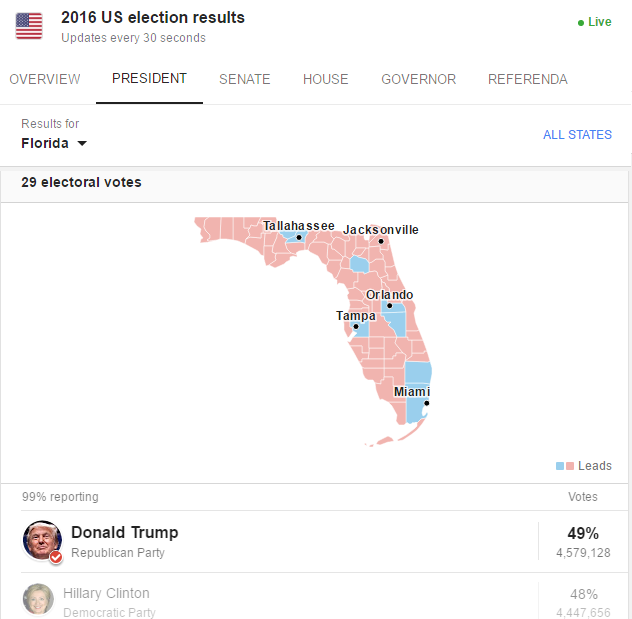
Pro-Embargo candidates sweep in Florida

2016 US Election Florida: Cuban Americans repudiated Obama Cuba policy and Hillary Clinton


Hillary Clinton should sue the Pro-Cuba trade lobby for fraud. They used push polls to peddle the false narrative that the Cuban-American community had changed and that backing an opening with the Castro dictatorship would not harm her electoral prospects. They should have seen it coming. On September 28, 2016 this blog reported:
"Cuba, so far this election cycle has not been high on the radar, but with this announcement the Obama Administration's controversial Cuba policy will be debated and at a time when polls indicate that the race in Florida is tightening the Cuban American vote could be decisive in swinging the state and its 29 electoral votes."
Let there be no doubt that this election in Florida was a rejection of Obama's Cuba policy consider the following:

Democratic candidate Joe Garcia running in 26th Congressional District that favored Democrats lost to Republican Carlos Curbelo by 11 points. Garcia had been a high profile champion of President Obama's failed and troubling Cuba policy.

Congresswoman Ileana Ros-Lehtinen defeated anti-embargo candidate Scott Furhman by ten points: 55% to 45% in the 27th Congressional District.

Congressman Mario Diaz-Balart defeated Democratic candidate Dr. Alina Valdes who supports Obama's Cuba policy by 62% to 38% in the 25th Congressional District.

Statewide Marco Rubio, who has been a severe critic of President Obama's Cuba policy defeated anti-embargo candidate Patrick Murphy 52% to 45% and was returned to the U.S. Senate.

Incidentally neither Carlos Curbelo or Ileana Ros-Lehtinen campaigned for Donald Trump. 

However Donald Trump who initially received 33% of the Cuban American vote while supporting Obama's Cuba policy until mid September 2016 found that when he rejected Obama's Cuba policy and promised repeatedly to back the aspirations of Cubans and Venezuelans to live in freedom his numbers went up to 52% and were probably even higher on election day.

The outcome of the Presidential election in the United States is still being determined tonight but the repudiation of Obama's Cuba policy legacy was felt today with Cuban Americans voting across Florida. 

The question asked by the Wall Street Journal: "Will Obama’s Cuba Policy Lose Florida for Clinton?" has been answered and the answer is yes.

AP Florida State wire reported the following on the exit polls:
"There was a significant divide between Cuban voters and non-Cuban Hispanics in Florida, the state with the nation's third-largest Hispanic population. Trump led with Cuban voters, but more almost three-quarters of non-Cuban Hispanics preferred Clinton. Trump's anti-immigration rhetoric has turned off many Hispanics, but Trump appealed to Cuban voters in September by saying he would reverse the deal Democratic President Barack Obama made with Cuba to reopen diplomatic relations - unless Cuba expands political freedoms."
Anti-embargo lobbyists and pollsters who pitched the lie to Democratic candidates in Florida did Donald Trump a solid that was part of the puzzle that gave him Florida. Mike Fernandez didn't campaign for Donald Trump but with the misrepresentation of the Cuban American community by some of its wealthy members did more to help the Republican nominee than the money showered on Hillary Clinton. 

Friday, September 16, 2016

Clinton, Trump and Cuba Policy: Only poll that counts is the one on Election Day

Obama's Cuba policy will be weighed at the polls in November

Donald Trump repudiated Obama Cuba policy today in Miami, FL
The 2016 presidential election was going to be a wash on Cuba policy with both Hillary Clinton and Donald Trump supporting Obama's failed Cuba policy. Until today when Mr. Trump in Miami announced that he had changed his mind on the President's Cuba policy. CNN reported on what the GOP presidential candidate said today in South Florida:
Trump -- speaking in a state with a heavy Cuban voting bloc -- characterized Obama's deal as "one-sided" and benefiting "only the Castro regime."
"But all of the concessions that Barack Obama has granted the Castro regime were done with executive order, which means the next president can reverse them. And that is what I will do unless the Castro regime meets our demands," Trump said Friday.
"Those demands will include religious and political freedom for the Cuban people and the freeing of political prisoners," Trump said.
This new contrast over Cuba will test the FIU poll of Miami Cubans and their supposed strong support for Obama's Cuba policy. Recall that Marco Rubio who has repudiated the Obama Cuba policy lost across the state of Florida in the Republican primary but won Miami-Dade County handily with the Cuban American vote. Trump's about face on Cuba policy will be good news for the GOP in South Florida where Cuban Americans upset over the December 17, 2014 announcement now have a candidate that they can support.  Jorge Perez, a prominent businessman promoting engagement with the Castro dictatorship, lost influence with candidate Trump over Cuba policy.

This will also turn around the erosion in support for the Republican Party by Cuban American voters. The bottom line is that like the Asian American vote, the Cuban American vote is profoundly anti-communist and in the case of Cuba taking a tough stand on the Castro brothers will deliver votes.

The Trump phenomenon is a rejection of the professional political class, of which Hillary Clinton is a paradigmatic example, due to the economic pain of the middle class.  In an anti-establishment year the GOP nominee holds the trump card as the non-politician in the race for the White House.

Now Cuban-Americans have a choice and not an echo on Cuba policy this November. This is good news for the United States and for GOP prospects in South Florida.

I still have my concerns with the Trump candidacy over issues of torture, complimenting Vladimir Putin and the Chinese communists, but at least on Cuba policy voters now have a clear choice.