"The first victory we can claim is that our hearts are free of hatred. Hence we say to those who persecute us and who try to dominate us: ‘You are my brother. I do not hate you, but you are not going to dominate me by fear. I do not wish to impose my truth, nor do I wish you to impose yours on me. We are going to seek the truth together’. THIS IS THE LIBERATION WHICH WE ARE PROCLAIMING."
Oswaldo José Payá Sardiñas (2002)
"When bad men combine, the good must associate; else they will fall one by one, an unpitied sacrifice in a contemptible struggle." - Edmund Burke
On Sunday, August 26, 2018 at 6:00pm at St. Michael Archangel Catholic Church in Miami, Florida people of goodwill gathered together for victims of repression in Bolivia, Nicaragua, Venezuela and Cuba as part of a world vigil united for the victims of repression. Hopefully this will be the beginning of new tradition to be observed annually where friends of freedom gather and network in order to collaborate in the struggle for liberty in the hemisphere.
The enemies of liberty have been gathering regularly for decades at the São Paulo Forum, and its most recent addition was held in Havana back in mid July 2018. The members of the Forum backed Daniel Ortega and his Sandinista Party despite their mass slaughter of civilians. For far too long democrats in this hemisphere have failed to join together in solidarity against those suffering under tyranny and others have fallen, one by one, failing to arouse sympathy or solidarity in far too many remaining in freedom. This is a recipe for disaster.
Berlin, Germany
Desde Berlín, Alemania 🇩🇪 @nazlyescalona venezolana y miembro fundadora de nuestra Red, junto con familiares, amigos y colegas realizaron la #VigiliaMundial Unidos por las Víctimas de la represión para conmemorases. pic.twitter.com/u9AAcake0h
However this past Sunday across the world people of goodwill gathered around the world for victims of repression in Bolivia, Nicaragua, Venezuela and Cuba. This was a good start.Let us pray that it is repeated in years to come.
If we do not join together to resist tyranny, support the rule of law, liberty, and the freedom of all prisoners of conscience then the list of countries succumbing to tyranny will continue to grow until freedom is extinguished in this hemisphere.
Therefore it is imperative for people of goodwill to join together in networks of freedom to counter totalitarian networks that seek to enslave free peoples. Free peoples must remain vigilant and not succumb to the complacency of living in freedom, only to lose it.
Buenos Aires, Argentina
Buenos Aires, Argentina 🇦🇷 contó con la participación de testimonios de miembros de la Red que han padecido las dictaduras. Unidos hoy en la #VigiliaMundial#UnidosPorLasVictimas y por la causa de la libertad y la democracia. pic.twitter.com/pGGiA5SNJA
Oswaldo Payá Sardiñas on December 17, 2002 addressing the European Parliament observed that
“the cause of human rights is a single cause, just as the people of the
world are a single people. The talk today is of globalization, but we
must state that unless there is global solidarity, not only human rights
but also the right to remain human will be jeopardized.” The world is witnessing his prophetic vision in Venezuela, Nicaragua, Bolivia, and Cuba. The distancing away from human rights has had dire consequences in these countries.
Witnessing these democrats and human rights defenders gathering together all over the world does give one hope for the future, but it must go beyond a symbolic act, to sustained concrete coordination and action.
The case against opening Cuban Consulates in the United States
Cuban diplomats denied U.S. re-entry visas following this plot being discovered
Cuban diplomats for more than 50 years have plotted and facilitated terrorist attacks, beaten up
peaceful protesters, threatened and bitten protesters using homophobic language, and
participated in the cover up of extrajudicial killings. In the ongoing conversation surrounding engagement with the Castro dictatorship some inconvenient facts are being overlooked.
Castro's Cuba even by the standards of a totalitarian regime does not behave as expected. The Castro regime has explicitly viewed terrorism as a legitimate tactic to advance its revolutionary objectives. In 1970 the Cuban
government published the "Mini Manual for Revolutionaries" in the
official Latin American Solidarity Organization (LASO) publication
Tricontinental and translated it into many languages, written by Brazilian urban terrorist Carlos Marighella,
which gives precise instructions in terror tactics, kidnappings, etc.
and translated into numerous languages which were distributed worldwide
by the Cuban dictatorship. There is a chapter on terrorism that declares, "Terrorism is a weapon the revolutionary can never
relinquish." This manual is still circulating today and the Cuban dictatorship has trained terrorists that targeted the United States and other countries in the 1960s, 1970s and 1980s with acts of violence with the objective of altering political behavior. John Hoyt Williams in a 1988 article in The Atlantic reported: "In the Arab world some 3,000 [Cuban advisers] can be found in Libya and Algeria, among other things training terrorists and Polisario guerrillas." Below is a partial record of Castro's diplomats, who are often spies, in their diplomatic posts around the world engaging in actions that should give White House policy makers pause before green lighting Cuban consulates across the United States.
New York City, USA (1969)
A Black Panther plot to bomb five Manhattan department stores on April 3, 1969 during the Easter shopping rush was broken up by the indictment of 21 members of the militant group on April 2nd. The Chicago Tribune reported that they had planned to "set off bombs in the midtown stores of Macy's Alexander's. Bloomingdale's, Korvette's and Abercombie & Fitch. The bombings were to be accompanied by gunfire in the crowded stores." They had also planned to dynamite the tracks of Penn Central railroad at six location and bomb a police station in the Morrisania section of the Bronx to divert police from the railroad bombings. On April 10, 1969 Andrew Tulley reported in the Reading Eagle that that the Communist Cuban mission to the United Nations has become a financial and propaganda headquarters for promoting revolution by black militants and white radicals. ... Specifically, it was said, these include the Black Panther Party. The United States denied re-entry visas to two Cuban U.N. diplomats ..."as a normal reaction to evidence that the Cuban mission is engaged in extensive subversive activities. One of the two diplomats, Jesus Jimenez Escobar, a mission counselor, is described as one of the Havana regime's leading experts in the export of revolution." Tully had met one of the five other Cuban diplomats then under investigation in Cuba in 1959: Lazaro Espinosa, third secretary at the U.N. missions was introduced to him by Che Guevara at the Havana Hilton Hotel as Castro's "leading technician in terrorism." The judge presiding over the Black Panther trial on February 21, 1970 had three gasoline bombs explode in front of his home. On May 13, 1971 a jury with five African American members acquitted the thirteen Black Panther members of murder conspiracy charges.
New York City, USA (1994)
The
United States expelled two Cuban diplomats on April 12, 1995, for having assaulted
people last August (1994) protesting in front of Cuba's mission to the United Nations. The diplomats, Edmundo Suarez Hernandez, a
counselor, and Saul Hermida Griego, an attache, and their families were
told are to leave by midnight Sunday. The Cuban Foreign Ministry responded with
a statement that the incident in August had been "provoked by terrorist
groups who go around unpunished because of the inefficiency of the New
York police." On August 30, 1994 anti-Castro protesters chained themselves to the Cuban Mission door. Cuban diplomats attacked them with sticks, screaming, "Cuba
Our Way!" Two diplomats wielded a crowbar and ax handle. More
than a dozen police officers suffered injuries.
Four Cuban Mission employees were arrested on assault charges. All four
were released after claiming diplomatic immunity.
US officials said it's unusual for diplomats to be expelled for violent behavior. Mexico City, Mexico (1996)
On March 8, 1996 a group of Mexican students belonging to various universities, a federal representative of the PAN Cristián Castaño Contreras, and a Cuban journalist were brutally assaulted by officers and employees of the Cuban embassy during a peaceful demonstration outside of the embassy. The attack left many injured. The Cuban embassy staff even attacked a student displaying a Mexican flag and tried to destroy it. The behavior was reminiscent of a Rapid Response Brigade in Cuba used to beat down dissidents in the island.
Washington, DC (2000)
On April 14, 2000 nonviolent protesters gathered in front of the
Cuban Interests Section in Washington DC. In the early evening, a band of about 10 Cuban
diplomats, alleged to have been drinking took off their coats, ties and jewelry, began screaming obscenities and yelling threats, and indiscriminately attacked 20 peaceful protesters with fists and sticks, even injuring a Secret
Service officer. Among the Cuban diplomats engaged in the violent assault, according to one of the victims, was Gustavo Machin Gomez. Paris, France (2003)
At the
Cuban embassy in Paris on April 24, 2003 Cuban
diplomats engaged in the brutal beating of nonviolent protesters with iron bars and threatened them with deadly force. "Not only did members of the embassy come out with iron bars to hit us,
but one of them was carrying a firearm, which he loaded while outside
the embassy," RSF Secretary-General Robert Ménard said. "This new
element is extremely serious. It is unacceptable that persons linked to a
foreign embassy should commit such offences on French territory."
Geneva, Switzerland (2004)
On April 15, 2004 when the United Nations Human Rights Commission decided by a single vote to censure the communist regime for its human rights record a Cuban human rights defender Frank Calzon was physically attacked by members of the Cuban diplomatic delegation. According to Freedom House: "Witnesses said a Cuban delegate punched Mr. Calzon, knocking him
unconscious. UN guards reportedly protected him from further assault by
additional members of the Cuban delegation."
San Jose, Costa Rica (2004)
Costa Rican members of the International Committee for Democracy in Cuba led by former president Luis Alberto Monge invited other Latin American and European leaders as well as representatives of civil society to hold a “International Forum for Democracy in Cuba” on the eve of the Ibero-American Summit on November 16, 2004. The Cuban government learned on November 9 that the event was being planned and attempted through diplomatic channels to have the event suspended, accusing participants of being: CIA agents, terrorists, and servants of the North American government, and requesting that Costa Rican authorities inform them of the steps taken to cancel the event. When Costa Rica refused to suspend the event on November 10 the Costa Rican consul was called to the Cuban Ministry of Foreign Relations and once again the demand to have the event cancelled was made. A diplomatic note was sent on November 11 followed by a second one on November 12 with the aim of canceling the forum.Having failed to stop the event Cuban diplomats organized an act of repudiation inside the Legislative Assembly.Costa
Rica's governing institutions are open to the public. The Cuban counsel Rafael Dausá Céspedes utilized groups with ideological affinities with the Cuban revolution in Costa Rica to physically storm the event to use physical intimidation and threats of violence to shut it down after it had started. Six activists including the vice-president
of the Czech Senate, Jan Ruml began a “sit-in” to protest the actions
of the mob. They refused to depart the room under a threat of violence. . This led to a two and a half hour stand off.
Meanwhile in another part of the same building the event went off without a hitch, because the sixty did not want to surrender the room to
the six.
Oslo, Norway (2010)
On May 22, 2010 Norwegian mediareported that Cuban diplomat, Carmen Julia Guerra,
insulted, threatened, and bit a young Norwegian woman, Alexandra
Joner age 19, of Cuban descent on her mother's side while she was across
the street from the Cuban embassy in Oslo. She was filming a
non-violent demonstration in solidarity with the Ladies in
White and in remembrance of martyred Cuban dissident Orlando Zapata Tamayo. The main national newspaper in Norway, Aftenposten, photographed the young girl with bite marks on her hand.
Panama (2015) On April 8, 2015 Cuban diplomats streamed out of the the Cuban Embassy in Panama attackingcivil society representatives who at the time were laying flowers at a bust of Jose Marti in a public park nearby. Several activists were injured and at least one required surgery. During the Summit of the Americas Cuban diplomats disrupted official meetings in order to block Cuban and Venezuelan dissidents from taking part, despite being officially accredited.
Havana, Cuba (2016)
Miami Beach mayor Philip Levine and Commissioner Ricky
Arriola, had a highly publicized meeting in Cuba to discuss opening a Cuba consulate on Miami Beach with Gustavo Machin Gomez a Cuban diplomat
who took part in a violent attack on peaceful demonstrators in 2000 in Washington DC. He was expelled from the United States for his espionage activities in 2002.
Chris S. Simmons, a 23-year Counterintelligence Officer, from
1996-2004 involved with the majority of US
Counterintelligence successes against the Castro regime provided the background on the Cuban Foreign Ministry's, deputy director of North
American affairs. According to Simmons, Machin was involved in the operation to "spin" the death of Oswaldo Payá Sardiñas in 2012. Oswaldo Payá Sardiñas and Harold Cepero were killed in an incident in which state security agents hit their car in a second vehicle, on July 22, 2012. These are the kind of individuals we will have in our community if a Cuban consulate is opened.
On April 1, 2016 The Miami Herald published my letter to the editor which discussed why a Cuba consulate in South Florida would be a bad idea. The response by a critic was that:
"We have consulates from countries we don't necessarily like but they're here."
This did not respond to the issue raised which was the concern that Cuban diplomats are often in reality intelligence officers, as was the case with the individual that the Miami Beach mayor and commissioner met with during President Obama's visit to Cuba. Furthermore that intelligence operations in the past in South Florida had crossed the line into sabotage, and murder conspiracy. Finally that these practices by Cuban intelligence agents stretches back over decades.
Cuban diplomats expelled in 1962 plotting terror attack in NYC
This un-diplomatic behavior is not limited to the United States. At the Cuban embassy in Paris, France on April 24, 2003 so-called Cuban diplomats engaged in the brutal beating of nonviolent protesters with iron bars and threatened them with deadly force.
"Not only did members of the embassy come out with iron bars to hit us,
but one of them was carrying a firearm, which he loaded while outside
the embassy," RSF Secretary-General Robert Ménard said. "This new
element is extremely serious. It is unacceptable that persons linked to a
foreign embassy should commit such offences on French territory."
The behavior of Cuban diplomats in other countries should also serve as reason for caution in opening consulates across the United States, and especially in South Florida with a population of Cuban-Americans that would be specially targeted by the dictatorship.
Norwegian girl of Cuban descent on her mom's side was bitten by a Cuban diplomat
On May 22, 2010 Norwegian mediareported that Cuban diplomat, Carmen Julia Guerra,
insulted, threatened, and bit a young Norwegian woman, Alexandra
Joner age 19, of Cuban descent on her mother's side while she was across the street from the Cuban embassy in Oslo. She was filming a non-violent demonstration in solidarity with the Ladies in
White and in remembrance of martyred Cuban dissident Orlando Zapata Tamayo. The main national newspaper in Norway, Aftenposten, photographed the young girl with bite marks on her hand. The video is embedded below.
The fact of the matter is that on occasion due to political and security issues consulates and embassies are closed by the United States. For example, on March 18, 2014 the Obama administration ordered the closing of the Syrian embassy in Washington DC and the closing of Syrian consulates elsewhere in the United States.
The United States does not have diplomatic relations with North Korea. North Korea does have a permanent UN mission in New York City but no embassy in Washington DC or consulates in the rest of the United States. This is a reasonable policy due to the Hermit Kingdom's outlaw behavior. Considering Cuba's extensive history of sponsoring terrorism North Korea is an appropriate comparison for U.S. policy makers considering opening up embassies.
Opening Cuban consulates around the United States is a bad idea that will come back to haunt those who are now advocating this.
Guess who are the only two brothers on the list of nominees?
Update 5/15/2013:Dictator of the year with 65 votes is Bashar al-Assad followed by Kim
Jong-un with 62 votes and Alexander Lukashenko with 21 votes. Incidentally, the Castro brothers have excellent relations with all three and both Lukashenkko and al-Assad have visited Cuba.
The Dictator of the Year at Oslo Freedom Forum
15 May 2013, 16:45
The Architects of Evil
The Dictator of the Yearinitiative is an endeavor to complement the most celebrated peace award in the world: the Nobel Peace Prize.
The idea behind the Dictator of the Year Prize
is that it is not enough to celebrate people who have contributed to
international peace; it is just as important to draw attention to the
architects of genocide, torture and mayhem – those who have wrecked
livelihoods of millions of people and who remain unpunished to this day.
This initiative is oriented towards both
bringing to focus the atrocities committed by political regimes as well
as inspiring hope for liberation from oppression and restoration of
human dignity in non-democratic countries around the world.
The student community of Oslo
University wants to name and shame the totalitarian political leaders in
a carnivalesque human rights ceremony, during the Oslo Freedom Forum 2013 festival.
The ceremony in which the Dictator
of the Year award well be bestowed upon the winning candidate, will take
place on the 15th of May 2013, 16:45, in front of the university main
building – Universitetsplassen, in Karl Johans gate.
The guest performer is Shabana Rehman Gaarder. The ceremony will be performed in cooperation with the Oslo Freedom Forum.
Yoani Sanchez received on Friday, May 3, 2013, the Sjur Lindebrækkes Prize for Democracy and Human Rights. Read more about her here. You can see her acceptance speech in the video above starting at 5:25
Sjur Lindebrække
About Sjur Lindebrække
Sjur Lindebrække(born 1909 in Voss, d 1998 in Bergen) was one of the Conservatives' most important politicians in the postwar period, and viewed, among other things, as historian Francis Sejerstad observed "the modern Conservative Party's father." He was a Member of Parliament from 1945 to 1953, the Conservative Party Vice Chairman from 1950 to 1954 and Conservative Party chairman from 1962 to 1970.
Lindebrække was a champion of liberal ideas and believed it essential that policy must be based on trust in the individual. A well-functioning democratic society requires a high degree of trust between people and trust between people and institutions. If such trust is created, maintained and strengthened in a society, the political authorities and political leaders meet individuals with confidence. At the same time demanded by politicians across the political and ideological spectrum the ability to work together to protect the democratic rules and democratic institutions.
Sjur Lindebrække was also a politician who sought cooperation to find solutions to the challenges of the future. Lindebrækkes "trust policy" was built on a strong defense of the liberal ideas of dignity and rights, property rights and economic freedom. His commitment that peace, freedom and human rights should come to people worldwide, made him a natural representative of the Conservative Parliamentary Nobel Committee.
About the award
Sjur Lindebrækkes prize for Democracy and Human Rights is awarded by the decision of an independent award committee. The award is given to individuals or organizations in Sjur Lindebrækkes spirit that actively and consistently promote fundamental political and economic freedoms and rights, and work to strengthen democratic institutions and processes in societies where democracy and human rights are suppressed or threatened. (The prize has been awarded every year since 2007 by Høyre.
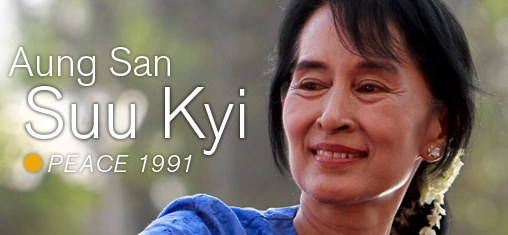
Aung San Suu Kyi, awarded the 1991 Nobel Peace Prize for her
non-violent struggle for democracy and human rights, is finally in Oslo, Norway, to deliver her Nobel Lecture.
Burmese democracy leader, Aung San Suu Kyi was under house arrest and unable to collect
the award in 1991. The Nobel Lecture will be delivered on
Saturday 16 June 2012, at 7:00am EST. Watch the lecture live below.
Nobel Lecture by Aung San Suu Kyi, Oslo, 16 June, 2012
Your Majesties, Your Royal Highness, Excellencies, Distinguished members of the Norwegian Nobel Committee, Dear Friends,
Long years ago, sometimes it seems many lives ago, I was at Oxford
listening to the radio programme Desert Island Discs with my young son
Alexander. It was a well-known programme (for all I know it still
continues) on which famous people from all walks of life were invited to
talk about the eight discs, the one book beside the bible and the
complete works of Shakespeare, and the one luxury item they would wish
to have with them were they to be marooned on a desert island. At the
end of the programme, which we had both enjoyed, Alexander asked me if I
thought I might ever be invited to speak on Desert Island Discs. “Why
not?” I responded lightly. Since he knew that in general only
celebrities took part in the programme he proceeded to ask, with
genuine interest, for what reason I thought I might be invited. I
considered this for a moment and then answered: “Perhaps because I’d
have won the Nobel Prize for literature,” and we both laughed. The
prospect seemed pleasant but hardly probable.
(I cannot now remember why I gave that answer, perhaps because I had
recently read a book by a Nobel Laureate or perhaps because the Desert
Island celebrity of that day had been a famous writer.)
In 1989, when my late husband Michael Aris came to see me during my
first term of house arrest, he told me that a friend, John Finnis, had
nominated me for the Nobel Peace Prize. This time also I laughed. For an
instant Michael looked amazed, then he realized why I was amused. The
Nobel Peace Prize? A pleasant prospect, but quite improbable! So how
did I feel when I was actually awarded the Nobel Prize for Peace? The
question has been put to me many times and this is surely the most
appropriate occasion on which to examine what the Nobel Prize means to
me and what peace means to me.
As I have said repeatedly in many an interview, I heard the news
that I had been awarded the Nobel Peace Prize on the radio one evening.
It did not altogether come as a surprise because I had been mentioned
as one of the frontrunners for the prize in a number of broadcasts
during the previous week. While drafting this lecture, I have tried
very hard to remember what my immediate reaction to the announcement of
the award had been. I think, I can no longer be sure, it was something
like: “Oh, so they’ve decided to give it to me.” It did not seem quite
real because in a sense I did not feel myself to be quite real at that
time.
Often during my days of house arrest it felt as though I were no
longer a part of the real world. There was the house which was my
world, there was the world of others who also were not free but who were
together in prison as a community, and there was the world of the
free; each was a different planet pursuing its own separate course in
an indifferent universe. What the Nobel Peace Prize did was to draw me
once again into the world of other human beings outside the isolated
area in which I lived, to restore a sense of reality to me. This did
not happen instantly, of course, but as the days and months went by and
news of reactions to the award came over the airwaves, I began to
understand the significance of the Nobel Prize. It had made me real
once again; it had drawn me back into the wider human community. And
what was more important, the Nobel Prize had drawn the attention of the
world to the struggle for democracy and human rights in Burma.
We were
not going to be forgotten.
To be forgotten. The French say that to part is to die a little. To
be forgotten too is to die a little. It is to lose some of the links
that anchor us to the rest of humanity. When I met Burmese migrant
workers and refugees during my recent visit to Thailand, many cried out:
“Don’t forget us!” They meant: “don’t forget our plight, don’t forget
to do what you can to help us, don’t forget we also belong to your
world.” When the Nobel Committee awarded the Peace Prize to me they
were recognizing that the oppressed and the isolated in Burma were also
a part of the world, they were recognizing the oneness of humanity. So
for me receiving the Nobel Peace Prize means personally extending my
concerns for democracy and human rights beyond national borders. The
Nobel Peace Prize opened up a door in my heart.
The Burmese concept of peace can be explained as the happiness
arising from the cessation of factors that militate against the
harmonious and the wholesome. The word nyein-chan translates literally
as the beneficial coolness that comes when a fire is extinguished.
Fires of suffering and strife are raging around the world. In my own
country, hostilities have not ceased in the far north; to the west,
communal violence resulting in arson and murder were taking place just
several days before I started out on the journey that has brought me
here today. News of atrocities in other reaches of the earth abound.
Reports of hunger, disease, displacement, joblessness, poverty,
injustice, discrimination, prejudice, bigotry; these are our daily fare.
Everywhere there are negative forces eating away at the foundations of
peace. Everywhere can be found thoughtless dissipation of material and
human resources that are necessary for the conservation of harmony and
happiness in our world.
The First World War represented a terrifying waste of youth and
potential, a cruel squandering of the positive forces of our planet.
The poetry of that era has a special significance for me because I first
read it at a time when I was the same age as many of those young men
who had to face the prospect of withering before they had barely
blossomed. A young American fighting with the French Foreign Legion
wrote before he was killed in action in 1916 that he would meet his
death: “at some disputed barricade;” “on some scarred slope of
battered hill;” “at midnight in some flaming town.” Youth and love and
life perishing forever in senseless attempts to capture nameless,
unremembered places. And for what? Nearly a century on, we have yet to
find a satisfactory answer.
Are we not still guilty, if to a less violent degree, of
recklessness, of improvidence with regard to our future and our
humanity? War is not the only arena where peace is done to death.
Wherever suffering is ignored, there will be the seeds of conflict, for
suffering degrades and embitters and enrages.
A positive aspect of living in isolation was that I had ample time
in which to ruminate over the meaning of words and precepts that I had
known and accepted all my life. As a Buddhist, I had heard about dukha,
generally translated as suffering, since I was a small child. Almost on
a daily basis elderly, and sometimes not so elderly, people around me
would murmur “dukha, dukha” when they suffered from aches and pains or
when they met with some small, annoying mishaps. However, it was only
during my years of house arrest that I got around to investigating the
nature of the six great dukha. These are: to be conceived, to age, to
sicken, to die, to be parted from those one loves, to be forced to live
in propinquity with those one does not love. I examined each of the
six great sufferings, not in a religious context but in the context of
our ordinary, everyday lives.
If suffering were an unavoidable part of
our existence, we should try to alleviate it as far as possible in
practical, earthly ways. I mulled over the effectiveness of ante- and
post-natal programmes and mother and childcare; of adequate facilities
for the aging population; of comprehensive health services; of
compassionate nursing and hospices. I was particularly intrigued by the
last two kinds of suffering: to be parted from those one loves and to
be forced to live in propinquity with those one does not love.
What
experiences might our Lord Buddha have undergone in his own life that
he had included these two states among the great sufferings? I thought
of prisoners and refugees, of migrant workers and victims of human
trafficking, of that great mass of the uprooted of the earth who have
been torn away from their homes, parted from families and friends,
forced to live out their lives among strangers who are not always
welcoming.
We are fortunate to be living in an age when social welfare and
humanitarian assistance are recognized not only as desirable but
necessary. I am fortunate to be living in an age when the fate of
prisoners of conscience anywhere has become the concern of peoples
everywhere, an age when democracy and human rights are widely, even if
not universally, accepted as the birthright of all. How often during my
years under house arrest have I drawn strength from my favourite
passages in the preamble to the Universal Declaration of Human Rights:
……. disregard and contempt for human rights have resulted in
barbarous acts which have outraged the conscience of mankind, and the
advent of a world in which human beings shall enjoy freedom of speech
and belief and freedom from fear and want has been proclaimed as the
highest aspirations of the common people,
…… it is essential, if man is not to be compelled to have recourse,
as a last resort, to rebellion against tyranny and oppression, that
human rights should be protected by the rule of law . . .
If I am asked why I am fighting for human rights in Burma the above
passages will provide the answer. If I am asked why I am fighting for
democracy in Burma, it is because I believe that democratic
institutions and practices are necessary for the guarantee of human
rights.
Over the past year there have been signs that the endeavours of
those who believe in democracy and human rights are beginning to bear
fruit in Burma. There have been changes in a positive direction; steps
towards democratization have been taken. If I advocate cautious optimism
it is not because I do not have faith in the future but because I do
not want to encourage blind faith. Without faith in the future, without
the conviction that democratic values and fundamental human rights are
not only necessary but possible for our society, our movement could
not have been sustained throughout the destroying years. Some of our
warriors fell at their post, some deserted us, but a dedicated core
remained strong and committed. At times when I think of the years that
have passed, I am amazed that so many remained staunch under the most
trying circumstances. Their faith in our cause is not blind; it is
based on a clear-eyed assessment of their own powers of endurance and a
profound respect for the aspirations of our people.
It is because of recent changes in my country that I am with you
today; and these changes have come about because of you and other
lovers of freedom and justice who contributed towards a global awareness
of our situation. Before continuing to speak of my country, may I
speak out for our prisoners of conscience. There still remain such
prisoners in Burma. It is to be feared that because the best known
detainees have been released, the remainder, the unknown ones, will be
forgotten. I am standing here because I was once a prisoner of
conscience. As you look at me and listen to me, please remember the
often repeated truth that one prisoner of conscience is one too many.
Those who have not yet been freed, those who have not yet been given
access to the benefits of justice in my country number much more than
one. Please remember them and do whatever is possible to effect their
earliest, unconditional release.
Burma is a country of many ethnic nationalities and faith in its
future can be founded only on a true spirit of union. Since we achieved
independence in 1948, there never has been a time when we could claim
the whole country was at peace. We have not been able to develop the
trust and understanding necessary to remove causes of conflict. Hopes
were raised by ceasefires that were maintained from the early 1990s
until 2010 when these broke down over the course of a few months. One
unconsidered move can be enough to remove long-standing ceasefires. In
recent months, negotiations between the government and ethnic
nationality forces have been making progress. We hope that ceasefire
agreements will lead to political settlements founded on the aspirations
of the peoples, and the spirit of union.
My party, the National League for Democracy, and I stand ready and
willing to play any role in the process of national reconciliation. The
reform measures that were put into motion by President U Thein Sein’s
government can be sustained only with the intelligent cooperation of
all internal forces: the military, our ethnic nationalities, political
parties, the media, civil society organizations, the business community
and, most important of all, the general public. We can say that reform
is effective only if the lives of the people are improved and in this
regard, the international community has a vital role to play.
Development and humanitarian aid, bi-lateral agreements and investments
should be coordinated and calibrated to ensure that these will promote
social, political and economic growth that is balanced and
sustainable. The potential of our country is enormous. This should be
nurtured and developed to create not just a more prosperous but also a
more harmonious, democratic society where our people can live in peace,
security and freedom.
The peace of our world is indivisible. As long as negative forces
are getting the better of positive forces anywhere, we are all at risk.
It may be questioned whether all negative forces could ever be
removed. The simple answer is: “No!” It is in human nature to contain
both the positive and the negative. However, it is also within human
capability to work to reinforce the positive and to minimize or
neutralize the negative. Absolute peace in our world is an unattainable
goal. But it is one towards which we must continue to journey, our
eyes fixed on it as a traveller in a desert fixes his eyes on the one
guiding star that will lead him to salvation. Even if we do not achieve
perfect peace on earth, because perfect peace is not of this earth,
common endeavours to gain peace will unite individuals and nations in
trust and friendship and help to make our human community safer and
kinder.
I used the word ‘kinder’ after careful deliberation; I might say the
careful deliberation of many years. Of the sweets of adversity, and
let me say that these are not numerous, I have found the sweetest, the
most precious of all, is the lesson I learnt on the value of kindness.
Every kindness I received, small or big, convinced me that there could
never be enough of it in our world. To be kind is to respond with
sensitivity and human warmth to the hopes and needs of others. Even the
briefest touch of kindness can lighten a heavy heart. Kindness can
change the lives of people. Norway has shown exemplary kindness in
providing a home for the displaced of the earth, offering sanctuary to
those who have been cut loose from the moorings of security and freedom
in their native lands.
There are refugees in all parts of the world. When I was at the
Maela refugee camp in Thailand recently, I met dedicated people who
were striving daily to make the lives of the inmates as free from
hardship as possible. They spoke of their concern over ‘donor fatigue,’
which could also translate as ‘compassion fatigue.’ ‘Donor fatigue’
expresses itself precisely in the reduction of funding. ‘Compassion
fatigue’ expresses itself less obviously in the reduction of concern.
One is the consequence of the other. Can we afford to indulge in
compassion fatigue? Is the cost of meeting the needs of refugees
greater than the cost that would be consequent on turning an
indifferent, if not a blind, eye on their suffering? I appeal to donors
the world over to fulfill the needs of these people who are in search,
often it must seem to them a vain search, of refuge.
At Maela, I had valuable discussions with Thai officials responsible
for the administration of Tak province where this and several other
camps are situated. They acquainted me with some of the more serious
problems related to refugee camps: violation of forestry laws, illegal
drug use, home brewed spirits, the problems of controlling malaria,
tuberculosis, dengue fever and cholera. The concerns of the
administration are as legitimate as the concerns of the refugees. Host
countries also deserve consideration and practical help in coping with
the difficulties related to their responsibilities.
Ultimately our aim should be to create a world free from the
displaced, the homeless and the hopeless, a world of which each and
every corner is a true sanctuary where the inhabitants will have the
freedom and the capacity to live in peace. Every thought, every word,
and every action that adds to the positive and the wholesome is a
contribution to peace. Each and every one of us is capable of making
such a contribution. Let us join hands to try to create a peaceful
world where we can sleep in security and wake in happiness.
The Nobel Committee concluded its statement of 14 October 1991 with
the words:
“In awarding the Nobel Peace Prize ... to Aung San Suu Kyi,
the Norwegian Nobel Committee wishes to honour this woman for her
unflagging efforts and to show its support for the many people
throughout the world who are striving to attain democracy, human rights
and ethnic conciliation by peaceful means.”
When I joined the
democracy movement in Burma it never occurred to me that I might ever
be the recipient of any prize or honour. The prize we were working for
was a free, secure and just society where our people might be able to
realize their full potential. The honour lay in our endeavour. History
had given us the opportunity to give of our best for a cause in which
we believed. When the Nobel Committee chose to honour me, the road I
had chosen of my own free will became a less lonely path to follow. For
this I thank the Committee, the people of Norway and peoples all over
the world whose support has strengthened my faith in the common quest
for peace.
"Evil is an anti-life force and if we start going out to kill it, exterminate it we then become contaminated by it because we become killers." - M. Scott Peck , The Open Mind, PBS 1983
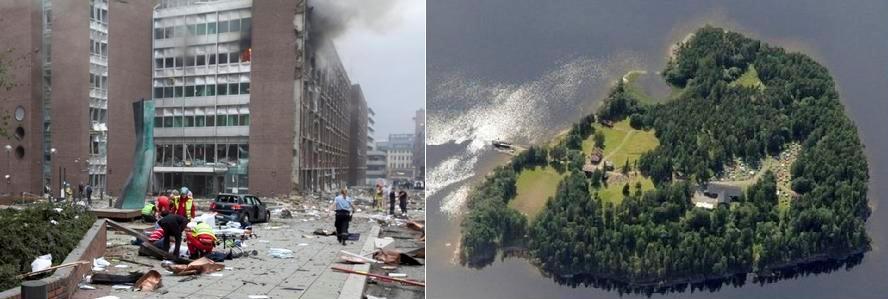
July 22, 2011 Terrorist attacks in Oslo and on Utøya island claim 76 lives with 96 injured.
On Friday July 22, 2011 Norway suffered two brutal terror attacks that claimed at least 76 lives and injured at least another 96 in downtown Oslo and a nearby island Utøya where Labor Party youth were gathered.
Today in Cuba is a public holiday that is celebrated with parades and speeches. On this day in 1953 a group of armed men organized by Fidel Castro led an assault on the Moncada barracks in Cuba. It was a disaster most of the men were killed and the rest captured. Fidel Castro went on trial and used it to spread his propaganda and later become a national figure in Cuba. During the revolutionary struggle between 1953 through 1959 acts of terrorism and bombing were common in Cuba. Following the Castro regime's consolidation of power state terrorism became a part of the revolutionary government's policy.
“I began the revolution with 82 men. If I had to do it again, I would do it with 10 or 15 individuals with absolute faith. It does not matter how small you are if you have faith and a plan of action.”
The adjectives this terrorist used in describing Castro condemn but the quote is part of what inspired this mass murderer to action. What is troubling is that this Castro quote is presented in popular literature as an inspirational message.
The embrace of hatred to overcome ones own conscience so as to enable a person to engage in gruesome atrocities is an approach described by Che Guevara in the quote above. This self-dehumanization is what makes the sinking of the tugboat, the bombings in Buenos Aires and Oslo combined with the systematic slaughter of children and young people at a youth camp all in service of political agendas possible. Bomb making and terrorism crosses ideological lines. In outlining how to be an effective bomb maker Breivikcites Che Guevara as an authoritative source on the manufacture of explosives:
And according the Marxist terrorist and mass-murderer Che Guevara; half of the people he sent to manufacture explosives blew themselves up (probably due to them using lacking instructions, ignoring precautions and using open flames.
Is this a religious vision, and am I right in calling Breivik a Christian terrorist? It is true that Breivik—and McVeigh, for that matter—were much more concerned about politics, race, and history than about scripture and religious belief; with Breivik even going so far as to write that “It is enough that you are a Christian-agnostic or a Christian atheist (an atheist who wants to preserve at least the basics of the European Christian cultural legacy (Christian holidays, Christmas and Easter)).”
But much the same can be said about Osama bin Laden, Ayman al-Zawahiri, and many other Islamist activists. Bin Laden was a businessman and engineer, and Zawahiri was a medical doctor; neither were theologians or clergy. Their writings show that they were much more interested in Islamic history than theology or scripture, and imagined themselves as re-creating glorious moments in Islamic history in their own imagined wars. Tellingly, Breivik writes of al Qaeda with admiration, as if he would love to create a Christian version of their religious cadre.
It is not only the Norwegian bomber that has expressed admiration for Osama Bin Laden but also admirers of Che Guevara that have profiled the Al Qaeda leader as a revolutionary leader in the Argentine website Che Guevara.com .
In addition to Bin Laden, Castro and Guevara, the Norwegian terrorist while denying he is a Nazi extensively quotes and mentions Adolph Hitler throughout his 1,500 page rant. There are no links to the manifesto on this page because there is no desire to promote it because it doesn't offer answers as to why. At its root terrorism, whether carried out by individuals or a state, is an evil act. This requires taking a look at the inner workings of a human being.
C.S. Lewis in his 1952 book Mere Christianity made the following observation: “Whenever we find that our religious life is making us feel that we are good - above all, that we are better than someone else - I think we may be sure that we are being acted on, not by God, but by the devil. ...“For Pride is spiritual cancer: it eats up the very possibility of love, or contentment, or even common sense.” One could add that it would also apply to those who have replaced a religious life with a secular/ideological substitute.
Swiss psychiatrist Carl Jung observed in the video below that "the only real danger that exists is man himself, he is the great danger....We are the origin of all coming evil."
Another and related perspective on the nature of evil is offered by the late American psychiatrist Morgan Scott Peck who wrote People of the Lie: The hope for healing human evil and in the 1983 video is interviewed about the book on PBS in the program The Open Mind. During the interview he states that "Evil is an anti-life force and if we start going out to kill it, exterminate it we then become contaminated by it because we become killers."
On the entry for Evil on Wikipedia there is a decent summary of M. Scott Peck's views on evil reproduced below:
Peck characterizes evil as a malignant type of self-righteousness which results in a projection of evil onto selected specific innocent victims (often children or other people in relatively powerless positions). Peck considers those he calls evil to be attempting to escape and hide from their own conscience (through self deception) and views this as being quite distinct from the apparent absence of conscience evident in sociopaths.
Is consistently self-deceiving, with the intent of avoiding guilt and maintaining a self-image of perfection
Deceives others as a consequence of their own self-deception
Projects his or her evils and sins onto very specific targets, scapegoating others while appearing normal with everyone else ("their insensitivity toward him was selective") [10]
Commonly hates with the pretense of love, for the purposes of self-deception as much as deception of others
Abuses political (emotional) power ("the imposition of one's will upon others by overt or covert coercion") [11]
Maintains a high level of respectability and lies incessantly in order to do so
Is consistent in his or her sins. Evil persons are characterized not so much by the magnitude of their sins, but by their consistency (of destructiveness)
Is unable to think from the viewpoint of their victim
Has a covert intolerance to criticism and other forms of narcissistic injury
He also considers certain institutions may be evil, as his discussion of the My Lai Massacre and its attempted cover up illustrate. By this definition, acts of criminal and state terrorism would also be considered evil.
In the end the man that called others terrorists and mass-murderers apparently as a critique became one himself and as M. Scott Peck would say crossed the line and slid into evil. There is a way to fight evil and that is to be able to spot it in yourself and struggle against it to be a better person and externally use nonviolence to combat it. Mohandas Gandhi issues a challenge when he says that "Nonviolence does not signify that man must not fight against the enemy, and by enemy is meant the evil which men do, not the human beings themselves." Norwegians demonstrated how to fight this enemy with their silent Rose March and rejection of hatred.
Two brutal and evil attacks carried out today in Norway have shocked the world. At least 87 dead in Oslo and nearby Utøya. Most of them young Norwegians interested in public service gunned down by a terrorist dressed in police uniform. Voices from the Cuban democratic opposition such as Oscar Elias Biscet, Yoani Sanchez and Oswaldo Paya have spoken out on the attacks in Norway:
TR @ElsaMorejon#Cuba Condolences for Norwegians, the families of the victims of the terrorist attacks, its government and kingdom are in our prayers. Dr Oscar Elias Biscet and family
TR @oswaldopaya Norway we are with you. Terror will not kill your faith in liberty and peace. Christian Liberation Movement.
TR @yoanisanchez Very Sad what occurred today in Norway. In one minute life changes, ends, its taken away from you.
Instead reflecting on Norway and praying for the good people of Oslo and Utøya. Horrified at the rising death toll and the evil behind it.
Tonight at the Pedro Luis Boitel Award ceremony in Miami to honor former prisoner of conscience Librado Linares took the stage to introduce a retired Czech diplomat and first reminded the audience of over a hundred Cubans of the terrorists attacks in Norway. Reminded them of the solidarity demonstrated by Norwegian parliamentarians, who represent the people of Norway, in organizing a committee for the freedom of Cuban political prisoners and named it after Normando Hernandez (who was present in the room). Everyone to stand up and a moment of silence was held for the victims of the terrorist attacks in Norway.
Remembering the first time I stepped foot in Norway was back in 1990 with a back pack and a Eurail pass traveling through Europe and trying to meet with Norwegian friends in the south of the country. The times over the years visiting different parts of Norway. Many times walking around downtown Oslo visiting the parliament building and the nearby pubs and restaurants. The political demonstrations, live music, gardens and all the sounds of Oslo and its people. How full that area of the city becomes on a late Friday afternoon and evening in the summer.
Thinking of all this then outraged and resolved to denounce the evil behind the premeditated murders of innocent people to make some sort of statement or simply terrorize.
Then remembered three concrete ideas from across the ages that seem to apply now.
1. Edmund Burke's simple yet profound observation that "When bad men combine, the good must associate; else they will fall one by one, an unpitied sacrifice in a contemptible struggle."
2. From the 1st Century A.D. Lucius Annaeus Seneca tells us of the importance of defiance and courage to live free: “Shall I tell you what the real evil is? To cringe to the things that are called evils, to surrender to them our freedom, in defiance of which we ought to face any suffering.”
3. Finally from the last century Mohandas Gandhi's council to have optimism in the battle against evil saying that "When I despair I remember that all through history there have been tyrants and murderers and for a time they seem invincible but in the end they always fall. Think of it always."
Have no idea whether the terrorist(s) behind the attacks today in Norway (is) are international or home grown but that does not matter his (or their) actions were and are evil and must be denounced. It also means that people of good will from around the world need to join together in preserving freedom and obtaining justice for the victims of today's horrid attacks.
In the mean time will continue to pray for the injured, the dead and the families of those affected by today's events in Oslo and Utøya. Tomorrow and in the days to come see what can be done to confront the evil behind these acts. Martin Luther King Jr. was right we are caught in an inescapable network of mutuality. What happens on the other side of the world can profoundly impact for good or ill.
In the future plan to return to Norway and walk through the streets of downtown Oslo once again and order a round of extremely over priced beers for my friends there.
[ Videos above have music by Norwegian composers and musicians.] Seems an appropriate time to introduce some of my non-Norwegian friends to some of their works of music.