Showing posts with label Mexico. Show all posts

Monday, September 27, 2021

Castro regime president smacked down by Uruguayan president at international summit in Mexico

Bad day for the Castro regime
 
President Luis Lacalle Pou smacks down the Castro regime

 
President Luis Lacalle Pou, the chief executive of Uruguay on September 18th at the VI Summit of the Community of Latin American and Caribbean States (CELAC) smacked down the Castro regime's Miguel Diaz-Canel. The Summit was held in Mexico and hosted by Mexico's president, Andrés Manuel López Obrador, and Castro ally. 
 
 
Furthermore, CELAC was created by Hugo Chavez to counter the Organization of American States. In this hostile environment President Lacalle Pou defended democracy, human rights, and called out the bad actors in the hemisphere:
“When one sees that in certain countries there is no full democracy, when the separation of powers is not respected, when the repressive apparatus is used to silence protests, when opponents are imprisoned, when human rights are not respected, we in a calm but firm voice must say with concern that we look seriously at what is happening in Cuba, Nicaragua and Venezuela.”
Cuban president Miguel Diaz-Canel, appointed by Raul Castro, responded to the critique citing Uruguayans gathering signatures against a law being proposed in Uruguay, and claimed that
“The courage of the Cuban people was demonstrated for six decades. Listen to your people who collected more than 700,000 signatures against the LUC (Law of Urgent Consideration). Monroism and the OAS is what you have just defended.”

Castro regime officials are not accustomed to critical voices being able to respond to their attacks.  President Lacalle Pou's response was devastating because it underscored the reality of the existing dictatorship in Cuba, contrasting it with Uruguay's democracy.

“If there is something that is true in my country, luckily, it is that the opposition can gather signatures, in my country, luckily, the opposition has democratic resources to lodge complaints, that is the great difference with the Cuban regime.” 

The Uruguayan president then crushed it by quoting the song Patria y Vida.

 “I just want to quote, and they are not my words, it is a very beautiful song and those who sing it feel oppressed by the Government: ’No longer shall flow the blood / Of those who dare to think differently / Who told you Cuba is yours? / Indeed, Cuba is for all my people’.”  

Below is the video of the response.

 14ymedio, September 18, 2021

Uruguay’s President Denounces the Imprisonment of Opponents in Cuba

Uruguay’s president Lacalle Pou speaking at the VI Summit of the  Celac. (@PPT_CELAC)

14ymedio/EFE, Havana, 18 September 2021 — The president of Uruguay, Luis Lacalle Pou, and the Cuban leader, Miguel Díaz-Canel, staged an exchange of accusations this Saturday at the VI Summit of the Community of Latin American and Caribbean States (Celac), in Mexico. The discussion began when the Uruguayan showed his concern because on the island, and in Venezuela and Nicaragua “there is not a full democracy” and opponents are imprisoned.

Lacalle’s speech began by recognizing that two principles promoted by Celac are “self-determination and non-intervention” but he also described democracy as “the best system that individuals have to be free” and that, for that reason, “participating in this forum does not mean being complacent.”

After that introduction, his criticisms were even more direct: “When one sees that in certain countries there is no full democracy, when the separation of powers is not respected, when the repressive apparatus is used to silence protests, when opponents are imprisoned, when human rights are not respected, we in a calm but firm voice must say with concern that we look seriously at what is happening in Cuba, Nicaragua and Venezuela.”

Lacalle’s statements gave rise to a strong exchange of words between the two leaders, which was only partially broadcast on Cuban television, but which is already generating comments in support of the Uruguayan on social networks for his direct comments to the President and First Secretary of the Communist Party on the island.

Visibly annoyed, Díaz-Canel responded to Lacalle saying that with his words he was showing a lack of knowledge of the Cuban reality. “The courage of the Cuban people was demonstrated for six decades. Listen to your people who collected more than 700,000 signatures against the LUC (Law of Urgent Consideration). Monroism and the OAS is what you have just defended,” he said.

The Uruguayan asked for the floor again and addressed Díaz-Canel: “If there is something that is true in my country, luckily, it is that the opposition can gather signatures, in my country, luckily, the opposition has democratic resources to lodge complaints, that is the great difference with the Cuban regime,” he added.

Lacalle went further and added: “I just want to quote, and they are not my words, it is a very beautiful song and those who sing it feel oppressed by the Government: ’No longer shall flow the blood / Of those who dare to think differently / Who told you Cuba is yours? / Indeed, Cuba is for all my people’,” he added, quoting the song Patria y Vida.

Source: https://translatingcuba.com/uruguays-president-denounces-the-imprisonment-of-opponents-in-cuba/

Monday, March 30, 2020

COVID-19 Shatters Cuba's Potemkin Village: Political pilgrims disillusioned with Castroism's failings

Castro regime's malign treatment of tourists continues.

Tourists trying to get out of Cuba before they can no longer return home.
COVID-19 may finally achieve what dengue, cholera, zika, and hurricanes could not, the shattering of Cuba's Potemkin village. Chilean and Mexican tourists are loudly protesting their conditions in Cuba. Carolina Cox, a prominent Chilean social influencer took to social media to denounce the conditions there and called on the Chilean government to get her home, before she erased her social media posts and presence. One would imagine that a retraction or alteration will be forthcoming in Orwellian fashion. She blames the "blockade" for the lack of internet access, but probably never heard of Alan Gross, who spent five years in a Cuban prison for trying to provide uncensored internet access to a Jewish community in Cuba.

This is a translation of what Carolina Cox said in the above video, and is worth reviewing before continuing to read this blog post.
"Hello, I am one of the 290 Chileans stranded in Cuba. Here in this "hotel" there are 60 people and they are in a center of infectious disease. Foreigners are constantly going in and out, there are plagues of mice. It is not a hotel that was open but they made it available now so that we could be here. ”

“You have to pay for this on your own, which is not cheap, it costs between 25 and 30,000 pesos a day for each one of us. In the case of the Argentine embassy they are covering accommodation and everything for us nothing.”

"Every day counts, we still do not have a flight number and if we do not insist it is likely that we could stay here so I ask for help please. We are also trying not to catch it and that nothing happens to us, because if any of us has coronavirus we are not going to return to our country."

“It is super distressing to be in such a moment in another country and in a country that also lacks soap and toilet paper. We have accounts blocked by the blockade that Cuba has, connecting to the internet is very difficult. ”

"The cards don't work for us. Please, please help us share this video. There are people who need medicine. Their are children, elderly and families. We demand a return plane, that the Government do something, that Copa, AeroMexico, Latam Airliners return us to our country. ”
This is not what they were promised.

Reuters reported on March 11, 2020 the Castro regime's claim that the first COVID-19 victims were "four Italian tourists who were staying at a hostel in the southern town of Trinidad after arriving at Havana airport on Monday had presented respiratory symptoms and were taken to a hospital on Tuesday." They tested positive for the coronavirus the following day.


Panama's Ministry of Health, a day earlier, on March 10th had reported that two Panamanians, ages 55 and 29 who visited Cuba had tested positive for the coronavirus when they returned home. Denying the presence of Wuhan virus in Cuba had become untenable.

This wasn't the Castro regime's first rodeo. The dictatorship has a long history of attracting tourists to the island under circumstances in which their safety was compromised.  Tourists traveled to the island during outbreaks of dengue, cholera, zika and now the Wuhan virus (SARS-CoV-2). But it wasn't always disease, other natural disasters were disregarded.


In September 2017 when Hurricane Irma, a deadly category five storm with 180 mile per hour winds was bearing down on Cuba and a hurricane watch already issued, tourists were still being flown into the island by British and Canadian travel agencies.The British travel agency "Thomas Cook defended itself saying the company followed the Cuban government's emergency instructions to the letter," BBC News reported.

Cayo Coco suffered the full impact of Hurricane Irma and was destroyed by the storm. They were flying tourists into Cuba to Cayo Coco a day prior to the storm's arrival, as reported by The Independent (United Kingdom).CBC News (Toronto) reported that Canadian tour operator Sunwing had elderly tourists flying into Cuba 24 hours before the Hurricane smashed into Cuba, forcing them to flee for their lives.

Returning to the current Wuhan virus (SARS-CoV-2) outbreak one should also take into account the false claims that Cuba had developed a cure. Nicolas Maduro on March 11th tweeted how Cuba's interferon had saved 3,500 lives in China.

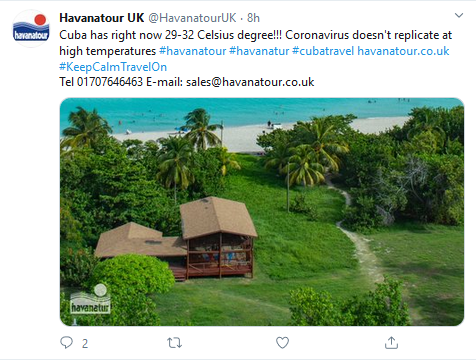
Castro's military run tourism company, Havanatour, continued to pitch Cuba as a travel destination and posted a tweet on March 13, 2020 claiming that Coronavirus does not replicate at high temperatures and that the island is now 29-32 degrees Celsius.

On March 14, 2020 the general director of marketing of the Ministry of Tourism, Bárbara Cruz, indicated that Cuba had a strong health care system with which the regime would be able to attend to all the inhabitants and tourists who wish to visit Cuba, with the condition of abiding by preventive measures.


Steve Sweeney, writing for the MorningStar for Peace and Socialism on March 15, 2020 made the following claim:
"So far it is known that one of the drugs manufactured by Cuba, Interferon alfa-2b, has managed to effectively cure more than 1,500 patients from the coronavirus and is one of 30 drugs chosen by the Chinese National Health Commission to combat respiratory disease."
The left wing press claims Cuba has a cure for the coronavirus, but the reality is that Interferon alfa-2b is not a cure, and has not even been confirmed to be a treatment for COVID-19.

The testimony of the left wing Chileans and Mexicans stuck in Cuba and their descriptions of what they are experiencing: lack of water, soap, basic hygiene, lack of medicines, and inability to communicate by phone or internet demonstrates the crude reality that exists in Cuba that does not correspond with the images and statements provided by Cuban officials.

Word of warning to these youth, you are no longer in Chile or Mexico.  Freedom of speech does not exist in Cuba, and there are consequences for making the dictatorship look bad.  

It is also important to recall that on March 29, 1997 a soldier of the Castro regime using an AK-47 gunned down a Danish student, who was studying Spanish at the University of Havana. He had crossed to the wrong side of the street, and a soldier fired a warning shot, but the official explanation was that the gun jammed and fired several rounds killing the young man. His name was Joachim Løvschall and he was just 27  years old.

Joachim Løvschall: December 7, 1970 - March 29, 1997


Friday, February 14, 2020

Castro again defaults on payments to Paris Club, but purchases more US products for cash than under Obama thaw

What the Chamber of Commerce won't tell you about trade with the Castro regime.
Under the Trump Administration trade has increased with Cuba.
Taken from CubaBrief

The United States since 2000 has not provided credits to the Castro regime and maintained a cash in advance trade arrangement for the purchase of agricultural and pharmaceutical products. This protects U.S. taxpayers from having to subsidize the Cuban dictatorship when it defaults on its financial obligations. Their European, Latin American and Asian counterparts cannot say the same to their respective taxpayers.

Under this cash in advance agreement American companies sold over $6.3 billion to the Castro regime and have gotten paid. Despite billions in debt forgiveness  on its restructured debt less than five years ago by the Paris Club, the Cuban dictatorship in 2019 again defaulted on its payments, reported Reuters on February 11, 2020.


How did the Castro regime raise the money to purchase U.S. goods?

James Prevor, President and Editor in Chief of the publication Produce Business in the October 2002 article, Cuba Caution, reported that Cuba "had exhausted all its credit lines and, at best, was simply rotating the accounts. When the opportunity came to buy from the United States, Cuba simply abandoned all those suppliers who supported the country for 40 years and began buying from us."

The suppliers were not the ones impacted by Cuba's failure to pay its debts, the taxpayers of the suppliers' home countries were the one's left holding the bag. The dirty little secret is that profit is private but risk has been socialized in what amounts to a perversion of capitalism.

On November 1, 2013 the government of Mexico announced that it was ready to waive 70 percent of a debt worth nearly $500 million that Cuba owes it. The former president of Mexico Vicente Fox protested the move stating: “Let the Cubans get to work and generate their own money…They’re normally like chupacabras.  The only thing they’re looking for is someone to give them money for free.”

“Let the Cubans get to work and generate their own money…They’re normally like chupacabras." - President Vicente Fox
In December 2015 it was announced that Spain would forgive $1.7 billion that the Castro regime owes it. In December of 2013, Russia and Cuba quietly signed an agreement to write off $29 billion of Cuba's debt to the former superpower. Western governments pursued Cuban maritime debts seizing Cuban vessels and negotiating payment through Canadian courts.

The 2015 debt restructuring accord between Cuba and the Paris Club, according to Reuters, "forgave $8.5 billion of $11.1 billion, representing debt Cuba defaulted on in 1986, plus charges."

The 19-member Paris Club owed money by Cuba is comprised of Australia, Austria, Belgium, Canada, Denmark, Finland, France, Britain, Italy, Japan, the Netherlands, Spain, Sweden and Switzerland. Companies, with the exception of American companies, doing business with Cuba when they are not paid pass the costs off to their respective governments, who in turn pass the costs off to taxpayers.

This is something to consider when the Chamber of Commerce argues that U.S. laws should be changed and the United States should join the long line of governments seeking to collect from the Castro regime, a deadbeat dictatorship.

Lastly, it is important to note that the U.S. Census Bureau documented the collapse of trade in goods with Cuba under the Obama thaw and have actually improved during the Trump Administration, despite tightened sanctions.


Wednesday, April 25, 2018

Carlos Alberto Montaner's cautionary prediction for Mexico

"When life goes wrong, a wet sponge erases the whole picture."-  Cassandra, from Agamemnon by Aiskhylos
Carlos Alberto Montaner (Left) warns of the threat AMLO presents to Mexico
Tonight my concerns for the future of Mexico deepened when a thinker that I greatly admire, Carlos Alberto Montaner, retweeted my tweet and added a cautionary prediction on the July 1, 2018 Presidential election in Mexico. He warned that, "AMLO [Andrés Manuel López Obrador] leads the polls in Mexico. The people commit suicide. Venezuelans and Cubans can attest to that. The Czechoslovaks also committed suicide after the Second World War. They paid with 40 years of communist totalitarianism. Until 1989 they did not breathe freedom again."

Montaner is well informed, wise and his opinion has considerable weight. Amazon provides the following biography on this scholar and defender of freedom which is excerpted below.
Born in Havana, Cuba, in 1943. Has lived in Madrid since 1970. Has been a university professor in various institutions in Latin America, the United States and Spain. He is a writer and journalist. Dozens of newspapers in Latin America, Spain and the United States have published his weekly column for the past 40 years at least. He has been described by the magazine ‘Poder’ (‘Power’) as one of the most widely read and most influential columnists in the Spanish-language world. The number of readers who have access to his articles every week is estimated at 6 million.

He has participated as an observer at several elections in Latin America and in numerous seminars devoted to the strengthening of democracy and the diffusion of the concepts of liberty.

Montaner received the Tolerance Prize awarded by the Comunidad de Madrid in 2007. In 2010 he was awarded the “Juan de Mariana for a life dedicated to the defense of freedom”. In 2009 the Universidad Francisco Marroquín in Guatemala was awarded the degree of Doctor Honoris Causa. Previously, the University of Applied Sciences in Peru (UPC) had appointed him a Visiting Professor. In 2007, during the democratic government of Enrique Bolaños, Nicaragua's government gave him the “Orden Rubén Darío”.

Montaner has published more than 25 books. Several of them have been translated into English, Portuguese, Russian and Italian. Among the better known and re-edited titles are Journey to the Heart of Cuba; How and Why Communism Disappeared; Liberty, the Key to Prosperity, and the novels Perromundo, A Dog's World, and 1898: The Plot. Some of his most controversial and most widely distributed essays are the best-sellers Guide to the Perfect Latin American Idiot and Manufacturers of Misery, both co-written with Plinio Apuleyo Mendoza and Álvaro Vargas Llosa. The Return of the Idiot, also by the three authors, has been published.
 Some claim that AMLO is no Hugo Chavez, but like the late Venezuelan despot, Lopez Obrador has distanced himself while following the same playbook and calling for a rewrite of the Mexican constitution. This is what Chavez did in 1998. Chavez even called Fidel Castro a dictator during the campaign, and pledged that he would turn over power prior to his five year term. Five years earlier the Venezuelan president turned dictator had been received in Cuba by Fidel Castro and celebrated as a hero. Let us hope and pray that history does not repeat itself in Mexico.


Sunday, July 23, 2017

How the world remembered Oswaldo Payá and Harold Cepero five years after their murders

Paying homage to two murdered human rights defenders across the Americas

Activists remember Oswaldo Payá and Harold Cepero in Guatemala

Five years ago on Sunday, July 22, 2012 near Bayamo in eastern Granma province of Cuba the incident provoked by State Security ended the lives of Oswaldo Payá Sardiñas and Harold Cepero Escalante. At 5:00pm, in a telephone call, Felix Rivero Cordoví from Bayamo reported"Oswaldo Payá has died in a collision with a police car."  Later we learned that Harold Cepero had also died of his injuries. Five years later and Cuban officials have still not handed over the autopsies to the families. Instead the Castro regime engaged in a massive coverup blaming the driver of the car for the deaths while denying that a second vehicle was involved.

Mass at Ermita de la Caridad celebrated lives of Oswaldo and Harold
 On the fifth anniversary of these suspicious deaths former world leaders such as former Chilean president Sebastian Piñera, former Mexican president Felipe Calderón, former Colombian president Andrés Pastrana, former Costa Rican president Laura Chinchilla, and Mariana Aylwin, daughter of the late Chilean president Patricio Aylwin issued statements recognizing the living legacy of Oswaldo Payá. Others also demanded an impartial investigation into what happened to Oswaldo Payá Sardiñas, and Harold Cepero Escalante on July 22, 2012. The current Secretary Genereral of the Organization American States issued a call "for a professional and impartial investigation."


Message from Secretary General on Anniversary of the Death of Oswaldo Payá

July 22, 2017

Five years ago, on July 22, 2012, Oswaldo Payá and Harold Cepero died when the vehicle they were riding in crashed into a tree in the eastern Cuban province of Bayamo. Ángel Carromero and Jens Aron Modig were also in the car.

Even today, series and well-founded doubts about the case persist. That is why on this new anniversary of the death of Oswaldo Payá, I join the call of the families of the victims and of all those who demand justice for a professional and impartial investigation.

Oswaldo Payá was perhaps the best-known activist in Cuba because of his tireless work in favor of democracy. Through the Varela Project he promoted the amendment of laws to respect the right to free expression, freedom of the press and freedom of association.

The Varela Project is based on the Constitution of Cuba itself, which under article 88 (g), grants legal initiative to citizens, among other powers.

The freedom to meet, associate and to speech are fundamental rights recognized in international human rights law and all democratic societies.

These principles must be respected. It is unacceptable that those who try to defend their rights are persecuted for their opinions and have their voices silenced.

From the OAS we must always promote respect for basic freedoms, that sovereignty lies in the people, and the most complete validity of human rights.

The struggle of Oswaldo Payá is absolutely inspiring for our defense of these principles and values.
Reference: S-022/17
U.S. Senator Marco Rubio in a tweet sent by his office expressed clearly that what happened on that day was an extrajudicial killing.
 Joining Senator Rubio in calling what happened on July 22, 2012 a murder are Senators Dick Durbin, Bill Nelson, Jeff Merkley, and Cuban Americans Bob Menéndez and Ted Cruz. They are demanding an independent and impartial investigation into what happened on that day.

Activities were carried out across the Americas remembering the legacy of Oswaldo Payá and Harold Cepero with peaceful gatherings and masses held in Miami, Cuba, Guatemala, Spain. The solidarity of the shaken was on display when family members of Venezuelan political prisoner Mayor Antonio Ledezma sent messages of solidarity and support recognizing Oswaldo's legacy. 
 
Hopefully the Inter-American Commission on Human Rights will do its job and complete its investigation into killings of Oswaldo Payá and Harold Cepero finally after five years. Currently we only have the report prepared by Human Rights Foundation that indicates that the official version put out by the Castro regime was a coverup and that this was most likely an extrajudicial killing.


Thursday, April 7, 2016

Partial Chronology of Cuban Diplomatic Malfeasance 1962 - 2015

The case against opening Cuban Consulates in the United States

Cuban diplomats denied U.S. re-entry visas following this plot being discovered
Cuban diplomats for more than 50 years have plotted and facilitated terrorist attacks, beaten up peaceful protesters, threatened and bitten protesters using homophobic language, and participated in the cover up of extrajudicial killings. In the ongoing conversation surrounding engagement with the Castro dictatorship some inconvenient facts are being overlooked.

Castro's Cuba even by the standards of a totalitarian regime does not behave as expected. The Castro regime has explicitly viewed terrorism as a legitimate tactic to advance its revolutionary objectives. In 1970 the Cuban government published the "Mini Manual for Revolutionaries" in the official Latin American Solidarity Organization (LASO) publication Tricontinental and translated it into many languages, written by Brazilian urban terrorist Carlos Marighella, which gives precise instructions in terror tactics, kidnappings, etc. and translated into numerous languages which were distributed worldwide by the Cuban dictatorship. There is a chapter on terrorism that declares, "Terrorism is a weapon the revolutionary can never relinquish." This manual is still circulating today and the Cuban dictatorship has trained terrorists that targeted the United States and other countries in the 1960s, 1970s and 1980s with acts of violence with the objective of altering political behavior. John Hoyt Williams in a 1988 article in The Atlantic reported: "In the Arab world some 3,000 [Cuban advisers] can be found in Libya and Algeria, among other things training terrorists and Polisario guerrillas."

Below is a partial record of Castro's diplomats, who are often spies, in their diplomatic posts around the world engaging in actions that should give White House policy makers pause before green lighting Cuban consulates across the United States.


New York City, USA (1962)
Cuban diplomats Elsa Montera Maldonado and Jose Gomez Abad, a husband and wife team at the Cuba Mission in New York City, who in reality were State Security agents who plotted to murder large numbers of Americans. Both were expelled for their role in a planned terrorist attack on the Friday after Thanksgiving in 1962 which sought to detonate 500 kilos of explosives inside Macy’s, Gimbel’s, Bloomingdale’s and Manhattan’s Grand Central Terminal.

New York City, USA (1969)
A Black Panther plot to bomb five Manhattan department stores on April 3, 1969 during the Easter shopping rush was broken up by the indictment of 21 members of the militant group on April 2nd. The Chicago Tribune reported that they had planned to "set off bombs in the midtown stores of Macy's Alexander's. Bloomingdale's, Korvette's and Abercombie & Fitch. The bombings were to be accompanied by gunfire in the crowded stores." They had also planned to dynamite the tracks of Penn Central railroad at six location and bomb a police station in the Morrisania section of the Bronx to divert police from the railroad bombings. On April 10, 1969 Andrew Tulley reported in the Reading Eagle that that the Communist Cuban mission to the United Nations has become a financial and propaganda headquarters for promoting revolution by black militants and white radicals. ... Specifically, it was said, these include the Black Panther Party. The United States denied re-entry visas to two Cuban U.N. diplomats ..."as a normal reaction to evidence that the Cuban mission is engaged in extensive subversive activities. One of the two diplomats, Jesus Jimenez Escobar, a mission counselor, is described as one of the Havana regime's leading experts in the export of revolution."  Tully had met one of the five other Cuban diplomats then under investigation in Cuba in  1959: Lazaro Espinosa, third secretary at the U.N. missions was introduced to him by Che Guevara at the Havana Hilton Hotel as Castro's "leading technician in terrorism." The judge presiding over the Black Panther trial on February 21, 1970 had three gasoline bombs explode in front of his home. On May 13, 1971 a jury with five African American members acquitted the thirteen Black Panther members of murder conspiracy charges.

New York City, USA (1994)
 The United States expelled two Cuban diplomats on April 12, 1995, for having assaulted people last August (1994) protesting in front of Cuba's mission to the United Nations. The diplomats, Edmundo Suarez Hernandez, a counselor, and Saul Hermida Griego, an attache, and their families were told are to leave by midnight Sunday. The Cuban Foreign Ministry responded with a statement that the incident in August had been "provoked by terrorist groups who go around unpunished because of the inefficiency of the New York police." On August 30, 1994 anti-Castro protesters chained themselves to the Cuban Mission door. Cuban diplomats attacked them with sticks, screaming, "Cuba Our Way!" Two diplomats wielded a crowbar and ax handle. More than a dozen police officers suffered injuries. Four Cuban Mission employees were arrested on assault charges. All four were released after claiming diplomatic immunity.  US officials said it's unusual for diplomats to be expelled for violent behavior.

Mexico City, Mexico (1996)
On March 8, 1996 a group of Mexican students belonging to various universities,  a federal representative of the PAN Cristián Castaño Contreras, and a Cuban journalist were brutally assaulted by officers and employees of the Cuban embassy during a peaceful demonstration outside of the embassy. The attack left many injured. The Cuban embassy staff even attacked a student displaying a Mexican flag and tried to destroy it. The behavior was reminiscent of a Rapid Response Brigade in Cuba used to beat down dissidents in the island.


Washington, DC (2000)
On April 14, 2000 nonviolent protesters gathered in front of the Cuban Interests Section in Washington DC. In the early evening, a band of about 10 Cuban diplomats, alleged to have been drinking took off their coats, ties and jewelry, began screaming obscenities and yelling threats, and indiscriminately attacked 20 peaceful protesters  with fists and sticks, even injuring a Secret Service officer. Among the Cuban diplomats engaged in the violent assault, according to one of the victims, was Gustavo Machin Gomez.

Paris, France (2003)
At the Cuban embassy in Paris on April 24, 2003 Cuban diplomats engaged in the brutal beating of nonviolent protesters with iron bars and threatened them with deadly force. "Not only did members of the embassy come out with iron bars to hit us, but one of them was carrying a firearm, which he loaded while outside the embassy," RSF Secretary-General Robert Ménard said. "This new element is extremely serious. It is unacceptable that persons linked to a foreign embassy should commit such offences on French territory."

Geneva, Switzerland (2004)
On April 15, 2004 when the United Nations Human Rights Commission  decided by a single vote to censure the communist regime for its human rights record a Cuban human rights defender Frank Calzon was physically attacked by members of the Cuban diplomatic delegation. According to Freedom House: "Witnesses said a Cuban delegate punched Mr. Calzon, knocking him unconscious. UN guards reportedly protected him from further assault by additional members of the Cuban delegation."

San Jose, Costa Rica (2004)
Costa Rican members of the International Committee for Democracy in Cuba led by former president Luis Alberto Monge invited other Latin American and European leaders as well as representatives of civil society to hold a “International Forum for Democracy in Cuba” on the eve of the Ibero-American Summit on November 16, 2004.  The Cuban government learned on November 9 that the event was being planned and attempted through diplomatic channels to have the event suspended, accusing participants of being: CIA agents, terrorists, and servants of the North American government, and requesting that Costa Rican authorities inform them of the steps taken to cancel the event. When Costa Rica refused to suspend the event on November 10 the Costa Rican consul was called to the Cuban Ministry of Foreign Relations and once again the demand to have the event cancelled was made.  A diplomatic note was sent on November 11 followed by a second one on November 12 with the aim of canceling the forum. Having failed to stop the event Cuban diplomats organized an act of repudiation inside the Legislative Assembly. Costa Rica's governing institutions are open to the public. The Cuban counsel Rafael Dausá Céspedes utilized groups with ideological affinities with the Cuban revolution in Costa Rica to physically storm the event to use physical intimidation and threats of violence to shut it down after it had started. Six activists including the vice-president of the Czech Senate, Jan Ruml began a “sit-in” to protest the actions of the mob. They refused to depart the room under a threat of violence. . This led to a two and a half hour stand off. Meanwhile in another part of the same building the event went off without a hitch, because the sixty did not want to surrender the room to the six.


Oslo, Norway (2010)
On May 22, 2010 Norwegian media reported that Cuban diplomat, Carmen Julia Guerra, insulted, threatened, and bit a young Norwegian woman, Alexandra Joner age 19, of Cuban descent on her mother's side while she was across the street from the Cuban embassy in Oslo. She was filming a non-violent demonstration in solidarity with the Ladies in White and in remembrance of martyred Cuban dissident Orlando Zapata Tamayo. The main national newspaper in Norway, Aftenposten,  photographed the young girl with bite marks on her hand.

Mexico (2012)
In January of 2012 there were reports in the media of Cuban, Iranian and Venezuelan diplomats meeting in Mexico to discuss cyber attacks on U.S. soil and allegedly seeking information about nuclear power plants in the United States. 

Dominican Republic (2012)
On January 28, 2012 in the Dominican Republic the Cuban ambassador physically assaulted a 70 year old Cuban exile who had screamed "Down with Fidel! Down with the Castros!" This same diplomat had been already expelled by the United States in 1995 for beating up peaceful demonstrators in New York City. 

Injured in Panama by Cuban diplomats
Panama (2015)
On April 8, 2015 Cuban diplomats streamed out of the the Cuban Embassy in Panama attacking civil society representatives who at the time were laying flowers at a bust of Jose Marti in a public park nearby. Several activists were injured and at least one required surgery. During the Summit of the Americas Cuban diplomats disrupted official meetings in order to block Cuban and Venezuelan dissidents from taking part, despite being officially accredited


Havana, Cuba (2016)
 Miami Beach mayor Philip Levine and Commissioner Ricky Arriola, had a highly publicized meeting in Cuba to discuss opening a Cuba consulate on Miami Beach with Gustavo Machin Gomez a Cuban diplomat who took part in a violent attack on peaceful demonstrators in 2000 in Washington DC. He was expelled from the United States for his espionage activities in 2002. Chris S. Simmons, a 23-year Counterintelligence Officer, from 1996-2004 involved with the majority of US Counterintelligence successes against the Castro regime provided the background on the Cuban Foreign Ministry's, deputy director of North American affairs. According to Simmons, Machin was involved in the operation to "spin" the death of Oswaldo Payá Sardiñas in 2012. Oswaldo Payá Sardiñas and Harold Cepero were killed in an incident in which state security agents hit their car in a second vehicle, on July 22, 2012. These are the kind of individuals we will have in our community if a Cuban consulate is opened.

Monday, February 1, 2016

Obama Administration's folly: copying French on Cuba policy

"They’re normally like chupacabras.  The only thing they’re looking for is someone to give them money for free." - Vicente Fox, Former Mexican President, in 2015 on the Castro regime

Shameful spectacle: Honor guard in France for a Cuban tyrant
Under the U.S. embargo American companies made $5.2 billion dollars in cash and carry trade with Cuba while at the same time with normal relations and financial institutions providing credits, France lost $4 billion to Cuba.

France is forgiving $4 billion dollars the Castro regime owes it on payments that are 30 years late. Meanwhile companies in the United States between 2000 and 2016 earned $5.2 billion dollars on a cash and carry basis. The Obama Treasury Department effective January 27, 2016 joined France and the rest of the world in legalizing financing of transactions between U.S. companies and the Castro regime.

This not only goes against U.S. law and the will of Congress as U.S. Senator Bob Menendez explained, but means that U.S. taxpayers will now be joining French taxpayers in subsidizing the Castro dictatorship.

This at a time when human rights continue to deteriorate on the island and the calls of international human rights NGOs, such as Reporters Without Borders, for Western countries to hold the Castro regime accountable are ignored.

Shameful.

Tuesday, January 26, 2016

U.S. Treasury Cuba Announcement in brief: "U.S. taxpayers get ready to pick up the tab for the Castro regime."

"They’re normally like chupacabras.  The only thing they’re looking for is someone to give them money for free." - Vicente Fox, Former Mexican President, in 2015 on the Castro regime

 
Today's press release from the Treasury Department appears innocuous titled: "Treasury and Commerce Announce Further Amendments to the Cuba Sanctions Regulations"  as does the "subheading Amendments Further Implement President Obama’s Policy Related to Easing of Sanctions on Cuba."  However the devil is in the details reproduced below from paragraph six:

Financing–
Removing financing restrictions for most types of authorized exports.
  • Restrictions on payment and financing terms for authorized exports and reexports, except for agricultural commodities and agricultural items, will be removed, and U.S. depository institutions will be authorized to provide financing, including, for example, issuing a letter of credit for such exports and reexports.  Currently, payment and financing terms for all authorized exports are restricted to cash-in-advance or third-country financing.  Effective January 27, 2016, examples of permissible payment and financing terms for authorized non-agricultural exports and reexports will include: payment of cash in advance; sales on an open account; and financing by third-country financial institutions or U.S. financial institutions.  OFAC is required by statute to maintain the existing limitations on payment and financing terms for the export and reexport of agricultural commodities and agricultural items. 
The United States is the only country in the world that since 2000 has had a cash and carry arrangement with the purchase of agricultural and pharmaceutical products.Under this arrangement American companies sold over $5.2 billion to the Castro regime. This arrangement protected U.S. taxpayers from having to subsidize the dictatorship when it defaulted on its financial obligations.

How did the Castro regime raise the money to purchase U.S. goods?

James Prevor, President and Editor in Chief of the publication Produce Business in October of 2002 in the article, Cuba Caution, reported on how Cuba "had exhausted all its credit lines and, at best, was simply rotating the accounts. When the opportunity came to buy from the United States, Cuba simply abandoned all those suppliers who supported the country for 40 years and began buying from us."  The suppliers were not the ones impacted by Cuba's failure to pay its debts, the taxpayers of the suppliers' home countries were the one's left holding the tab.  

For example in December 2015 it was announced that Spain would forgive $1.88 billion that the Castro regime owes it. In December of 2013, Russia and Cuba quietly signed an agreement to write off 90 percent of Cuba's $32 billion debt to the defunct Soviet Union, a deal that ends a 20-year squabble. Canadians have had to pursue Cuban maritime debts seizing Cuban vessels and negotiating payment through Canadian courts. On November 1, 2013 the government of Mexico announced that it was ready to waive 70 percent of a debt worth nearly $500 million that Cuba owes it. The former president of Mexico Vicente Fox protested the move stating: “Let the Cubans get to work and generate their own money…They’re normally like chupacabras.  The only thing they’re looking for is someone to give them money for free.”

Trade with the Castro regime peaked under the Bush administration and has crashed under the Obama administration. The Treasury Department's announcement today means that the United States will join the rest of the world in financing the Castro regime.

While the U.S. Chamber of Commerce touts the virtues of free trade, free markets and free enterprise in its advocacy for lifting economic sanctions on Cuba what it is actually pursuing is trade with the Cuban government that passes the risk of not getting paid on to taxpayers.  Darío Fernández-Morera an associate professor at North Western University in the May 1, 2014 issue of Chronicles in the article The Cost of Normalization reports that the Small Business Exporters Association announced 
"since March 2009, a select group of commercial banks now will be able to offer terms of 180 days to five years on federally-guaranteed loans to the foreign buyers of U.S. exports without having to obtain prior federal approval.  ... Because of the foreign risks involved  in export lending, most commercial banks through-out the world do not make these loans without government guarantees. In the U.S., the guarantees are provided by the Export-Import Bank of the United States (Ex-Im Bank), a federal agency.
This will mean that the Chamber of Commerce and Agriculture lobby will sell to the Cuban dictatorship and have the taxpayers pick up the tab if anything goes wrong.  The record with other countries over the past half century indicates that the Castro regime will default on what it owes. On April 23, 2014 Moody's Investor Service downgraded Cuba's already poor credit rating to Caa2 from Caa1which Nasdaq defines as follows: "Obligations rated Caa2 are judged to be of poor standing and are subject to very high credit risk."  


Tuesday, May 26, 2015

Living in Truth: 2015 Oslo Freedom Forum

Living in Truth


The theme of the 2015 Oslo Freedom Forum is "Living in Truth" in tribute to the late Czech dissident-turned-president Václav Havel.  Living in truth as both a dissident and later as a head of state while defending and embracing human rights no matter how remote the chances for success are the reasons why many continue to celebrate the life of Václav Havel and mourn his passing from the world stage. At the same time it is important to remember some of those who had an impact on developing this powerful idea.

Erazim V. Kohák in his book Jan Patočka: philosophy and selected writings delves into the writings of one such individual. Jan Patočka was the Czech philosopher and Charter 77 member who influenced Havel's approach to the questions surrounding the challenge of reconciling a personal moral order with an objective moral order that transcends individual subjectivity. Backing up his teaching with action, he was also Charter 77's first casualty dying under prolonged interrogations over a two month period. Kohák refers to Patočka’s “solidarity of the shaken” as a community freed “from the preoccupation with the pursuits of peace and prosperity that inevitably lead to war and turn it instead to the pursuit of the Good, the care of the soul” that is “living with a clear conscience, living in truth, or in far older terms, seeking first the Kingdom of God.”

Oslo Freedom Forum has asked the question: "Living in Truth, what does it mean to you?" This is my answer as of today, and subject to amendment. Living in truth is doing and saying what you believe is true no matter the cost. While at the same time recognizing that one does not know the whole truth and that there is an objective truth that exists outside of each one of us but can be arrived at with a combination of humility and engagement with others. When this is combined with nonviolence it can become a powerful and often unstoppable force that can topple dictatorships.

A more succinct and powerful summary was made by Janie Hsieh, PhD over twitter: "For me it's about acting in the service of Truth." Below is a statement released by Oslo Freedom Forum with some slight tweaking following the first day of talks. Please watch the live stream.

Watch Live: First Day of Talks at the 2015 Oslo Freedom Forum

OSLO (May 26, 2015) – Talks at the 2015 Oslo Freedom Forum (OFF) begin this morning at 9:30 Central European Time (3:30am EST, 12:30am PST) and will be streamed live at oslofreedomforum.com. A full schedule of events is available here.

The energy in the room is high and we’re ready to hear from activists, dissidents, business leaders, members of the media, policymakers, and technologists who are promoting individual rights across the globe.

Today’s speakers will cover a range of ideas: how individual people can force repressive governments to crumble, the evolving role communications and technology play in advancing human rights, stories of challenging arbitrary power and corruption, and the absolute need for freedom of expression – even when it offends others.

Please join us online. Follow @OsloFF on Twitter and Instagram and use the hashtag #OsloFF. Your voice is an important part of this conversation.


Following the opening musical performance by The Wanton Bishops on Tuesday, May 26, Norwegian foreign minister Børge Brende joined the Oslo Freedom Forum at the Oslo Nye Theater to introduce the first session, followed by talks on the communications revolution, the right to offend, and more. Speakers included Malaysian MP Nurul Izzah Anwar, North Korean refugee Ji Seong-ho, Twitter vice president Colin Crowell, Kenyan technologist and Ushahidi co-founder Juliana Rotich, Iranian comedian Kambiz Hosseini, Afghan entrepreneur Saad Mohseni, and Charlie Hebdo columnist Zineb el Rhazoui.

Former president of Ukraine Viktor Yushchenko will open the second day of talks on May 27. Other speakers include Moroccan writer, filmmaker, and gay rights advocate Abdellah Taia, Gabonese environmentalist Marc Ona Essangui, Stanford professor Larry Diamond, and Turkish journalist Mustafa Akyol. After lunch, attendees and those watching the livestream will get the chance to participate in an interactive on-stage discussion with a panel of OFF speakers by submitting questions via Twitter to @OsloFF or by emailing questions@oslofreedomforum.com.