Showing posts with label Hong Kong. Show all posts

Thursday, May 4, 2023

The Hong Konger: Jimmy Lai's Extraordinary Struggle for Freedom [Full Film]

"Maybe I’m a born rebel, maybe I’m someone who needs a lot of meaning to live my life besides money." - Jimmy Lai, June 18, 2020, interviewed by AFP


Check out this documentary by the Acton Institute.


"When Hong Kong’s basic freedoms come under attack, newspaper publisher and pro-democracy activist Jimmy Lai finds himself in the crosshairs of the state and must choose between defending Hong Kong’s long-standing liberties, or his own freedom." 

Learn more and take action at www.freejimmylai.com 

#FreeJimmyLai #FreeHongKong

Tuesday, February 1, 2022

Berlin 1936 and Beijing 2022: Legitimizing genocidal totalitarian regimes through sports is a profound immorality with bad outcomes

 "Those who cannot remember the past are condemned to repeat it."- George Santayana


Legitimizing genocidal totalitarian regimes through sports is a profound immorality with bad outcomes

The 2008 Summer Olympic Games in Beijing were a human rights disaster for China with scenes of Tibetan demonstrators gunned down by Chinese soldiers. 

14 years later, and the world has suffered over 5.6 million deaths due to COVID-19, and the Chinese Communist dictatorship of  Xi Jinping bears responsibility. The Chinese government did not reveal for weeks what it knew about COVID-19, allowing it to spread into a worldwide pandemic. The Frontline Documentary "China's COVID Secrets" is required viewing to understand what happened.

#NoBeijing2022 has listed some of the other outrages committed by the ruling Chinese Communist Party in Beijing.  "The Beijing 2022 Winter Olympics is set to happen amid one of the world’s worst crackdowns against freedom, democracy, and human rights."

  • At least TWO million Uyghur, Kazakh, and Uzbek Muslims are detained in “re-education camps” undergoing systematic torture, rape, and political re-education.
  • 80% of Tibetan children – as young as 4 – are forced away from their parents and housed in China’s colonial boarding schools, cut off from their families they face intense political indoctrination.
  • In Hong Kong, the Chinese government has implemented a draconian National Security Bill that effectively criminalises protest and curtails any remaining human rights.
  • Protests by Southern Mongolians, whose rights, language and culture being eradicated, are put down with force
  • Detention & disappearance of countless Chinese lawyers, feminists & activists
  • Intimidation and geopolitical bullying of Taiwan and aggression and expansion across borders – in the South China Sea and India-Tibet border – present a clear threat to regional and global security.

A second Frontline Documentary from April 2020, "China Undercover" examined the systematic crackdown on Chinese Muslims.

Despite this the International Olympic Committee (IOC) chose China once again to host the Olympics in 2022 in the midst of the historic crimes of the Chinese Communist Party dictatorship.  

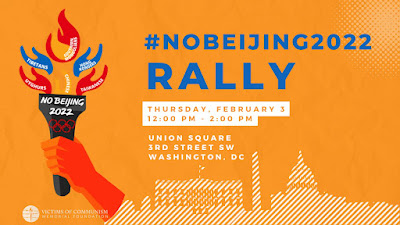
As was the case in the lead up to the 2008 Olympics friends of a free China need to increase scrutiny on the Chinese regime and boycott these Olympics. The consequences of  the IOC legitimizing such a regime cannot be overstated. If you are in the Washington DC area on Thursday, February 3rd at 12 noon please join the #NoBeijing2022 Rally at Union Square 3rd Street SW.

The 1936 Olympics held in Berlin and hosted by the Nazi Third Reich with the ceremonies formally opened by Adolph Hitler should serve as a cautionary example. The United States Holocaust Memorial Museum described the impact of the games as follows:

On August 1, 1936, Hitler opened the XIth Olympiad. Musical fanfares directed by the famous composer Richard Strauss announced the dictator's arrival to the largely German crowd. Hundreds of athletes in opening day regalia marched into the stadium, team by team in alphabetical order. Inaugurating a new Olympic ritual, a lone runner arrived bearing a torch carried by relay from the site of the ancient Games in Olympia, Greece.
[...] Concerted propaganda efforts continued well after the Olympics with the international release in 1938 of "Olympia," the controversial documentary directed by German film maker and Nazi sympathizer Leni Riefenstahl. She was commissioned by the Nazi regime to produce this film about the 1936 Summer Games. Germany emerged victorious from the XIth Olympiad. German athletes captured the most medals, and German hospitality and organization won the praises of visitors. Most newspaper accounts echoed the New York Times report that the Games put Germans "back in the fold of nations," and even made them "more human again." Some even found reason to hope that this peaceable interlude would endure. 

The 1936 Olympics whitewashed the brutality of the Nazi regime in Germany and led to acceptance of Hitler's criminal regime. The 2008 Olympics whitewashed the brutality of the Communist regime in China further legitimizing that criminal regime.

In 2022,  returning the Olympics to China and making this decision in the midst of the COVID-19 pandemic, the destruction of Hong Kong's democracy, threats against Taiwan, and the Uyghur genocide creates a historic moral hazard.

This is why I will not watch the Olympics, and encourage others to join me in this boycott, instead I will stand with Hong Kong, and Taiwan, share documentaries and films that reveal the facts of the genocidal regime in Beijing, and calls to nonviolent protests against the Chinese Communist dictatorship, and their enablers.

Below is a documentary about the 2019-2020 protests in Hong Kong titled "Do Not Split." Please share it with others.

Thursday, November 4, 2021

'1000 Years of Joys and Sorrows': A Memoir by Ai Weiwei (A Must read)

On November 2, 2021 the Chinese artist Ai Weiwei's memoir "1000 Years of Joys and Sorrows" came out.  Over the years this blog has followed his career as a dissident artist, and his solidarity with Cuban prisoners of conscience. Most recently he wrote the entry for Luis Manuel Otero Alcantara in Time Magazine.


Penguin Books South Africa provided a video, along with the below transcript, of Ai Weiwei on why he wrote the book.

‘The idea for this book came to me during the eighty-one days I was held in secret detention by the Chinese government in 2011. During those long weeks, I thought often of my father, a poet who had been exiled during Mao Zedong’s Anti-Rightist Campaign. I realized how incomplete my understanding of him was and how much I regretted the unbridgeable gap between us. I did not want my son to suffer the same regret. I resolved that if I was released I would write down what I knew of my father and tell my son honestly who I am, what life is like, why freedom is so precious, and why autocracy fears art.’ - Ai Weiwei


Back in July 2021 Benedict  Rogers of Hong Kong Watch interviewed the Chinese artist, who asked him about the 100th anniversary of the founding of the Chinese Communist Party. They also discussed the situation in Hong Kong, Taiwan, his film about the 2019 protest movement, Cockroach (2020) and his  memoir, '1000 Years of Joys and Sorrows'.

Although China and Cuba are geographically very far from each other, both nations are suffering the scourge of Communism, and this joins both peoples in the struggle for freedom. Ai Wei Wei's memoir is required reading.

Thursday, March 18, 2021

Remembering the Black Cuban Spring, the failure of the UN Human Rights Council, and the legacy today

 Remembering the Black Cuban Spring, the long winter, and the future spring

2003 - 2021 Spring will return
Eighteen years ago on March 18, 2003 a crackdown began in Cuba on the eve of the United States going to war in Iraq. Scores of Cuban dissidents were rounded up and subjected to political show trials. 75 were condemned to lengthy prison terms of up to 28 years in prison. This became known as the Black Cuban Spring
 
The majority of the imprisoned activists had participated in the Varela Project, a petition drive that called for a referendum under the terms of the Cuban Constitution on whether there should be more freedom of expression, an amnesty for political prisoners and a chance for ordinary citizens to own small businesses. 11,020 signatures had been turned in 10 months earlier on May 10, 2002. 
 
The regime responded with its own mandatory petition drive to make the Cuban Constitution unchangeable. 
 
The Economist in its December 14, 2005 issue published a conversation with Oswaldo Payá Sardiñas titled "An unsilenced voice for change" that outlined what had taken place:
Between 2001 and 2004, Mr Payá's movement gathered 25,000 signatures in a vain attempt to persuade Cuba's National Assembly to change the constitution to allow multi-party democracy. Activists of his Christian Liberation Movement made up more than two-thirds of the 75 dissidents and journalists rounded up and jailed for long terms in April 2003. [...] Spain is “complaisant” with Mr Castro's regime, Mr Payá says. “We need a campaign of support and solidarity with peaceful change in Cuba” of the kind that brought an end to apartheid in South Africa and to the Pinochet dictatorship in Chile.
It took over eight years, but the last of the group of the 75 were eventually released. Oswaldo was murdered along with the Christian Liberation Movement's youth leader Harold Cepero on July 22, 2012. His successor Eduardo Cardet was a prisoner of conscience from November 30, 2016 through September 3, 2019. He was jailed for giving a frank assessment of Fidel Castro's legacy following his death on November 25, 2016.

11,020 Varela Project signatures turned in on May 20, 2002

On April 2, 2003 three young black men were arrested, tried and executed by firing squad nine days later on April 11, 2003 for trying to flee the island in a hijacked ferry, in which no one had been physically harmed. This drew worldwide condemnation at the time, and became known as Cuba's Black Spring, but it did not prevent the end of the mandate for monitoring human rights violations in Cuba in a backroom deal for the establishment of the UN Human Rights Council on March 15, 2006.

Fifteen years ago the United Nations Human Rights Council was founded on a small moral compromise that sacrificed human rights oversight in Belarus and Cuba in what U.N. officials called the dawn of a new era. Special rapporteurs with mandates to specifically monitor the human rights situation in those two countries were formally gotten rid of in 2007 and a code of conduct established that undermined the independence of all special rapporteurs.

Ending oversight of Belarus and Cuba not only left the victims of these dictatorships exposed to more repression, with impunity by their oppressors, but emboldened these dictatorships not only to worsen their practices at home but to undermine human rights abroad. Worse yet, both would be elected to serve on the UN Human Rights Council with other outlaw regimes.

These failings have real world consequences.

Cuba led the charge to back up China's new security law for Hong Kong that strips citizens of Hong Kong of their human rights last year. On July 1, 2020 the Cuban dictatorship introduced a resolution at the UN Human Rights Council praising China for passing the Hong Kong National Security Law, also known as the 66 article law. 53 governments backed this resolution, endorsing the death of a free Hong Kong. Official Chinese media "celebrated" their victory at the human rights body. Belarus has also continued to back the new security law at international forums.

In spite of Cuba's terrible human rights record at home, and leading the charge to back China stripping Hong Kongers of their rights the Castro regime was re-elected to the UN Human Rights Council on October 12, 2020 with 170 out of a possible 192 votes at the General Assembly.

This did not improve Havana's behavior.

"Cuba, speaking on behalf of 64 countries including China [on March 12, 2021], said Xinjiang is 'an inseparable part of China' and urged states to 'stop interfering in China’s internal affairs by manipulating Xinjiang-related issues, (and) refrain from making unfounded allegations against China out of political motivations'." These countries led by the Castro regime are defending an ongoing genocide

Over the past 15 years the world has entered a long winter when it comes to human rights.

Spring will return to Cuba, but the struggle continues today in 2021 and the failures of solidarity by the international community with free Cuban is having a negative impact on human rights globally as the Castro regime backs the end of a free Hong Kong, and defends genocide in Xinjiang.

Wednesday, March 3, 2021

In Solidarity with the Hong Kong 47: A call for hope and action

“The solidarity of the shaken can say ‘no’ to the measures of mobilization that make the state of war permanent. … The solidarity of the shaken is built up in persecution and uncertainty: that is its front line, quiet, without fanfare or sensation even there where this aspect of the ruling Force seeks to seize it.” - Jan Patočka

Wong ji-yuet is on trial and faces a maximum sentence of life in prison

Over the past 71 years the Chinese Communist Party (CCP) has murdered tens of millions of Chinese citizens, backed the Khmer Rouge in Cambodia, and the Kim regime in North Korea. The CCP through its lack of transparency, silencing of Chinese scientists and journalists, has led to a global pandemic that has killed hundreds of thousands and crashed the global economy.

These are the fruits of engaging with a mass murdering totalitarian dictatorship, but too many have not learned the lesson, and seek to return to the old unacceptable status quo.

Press accounts report that "39 men and eight women are charged with 'conspiracy to commit subversion' in connection with the unofficial primary to choose opposition candidates for the now-postponed 2020 Legislative Council election, which attracted some 600,000 voters." These 47 activists face great legal jeopardy in China, but in a free country they would be congratulated for being good citizens.

In early January 2021 mass arrests were carried out and grueling bail hearings are now underway that have left four of the defendants hospitalized due to exhaustion.

One of the youngest defendants is 23-year-old Wong Ji-yuet, she is  a first time political hopeful. The pro-democratic primary nominee won 22,911 votes, and came in third in the NTW Constituency in Hong Kong. Let us speak up for her and the other 46 who are unjustly persecuted.

In the Orwellian world that is the Peoples Republic of China in the 21st century, exercising democratic rights under the National Security Law imposed last year on Hong Kong is grounds for a maximum sentence of life in prison

Worse yet, members of the UN Human Rights Council supported this law stifling democracy and freedom of expression.

On July 1, 2020 the Cuban dictatorship introduced a  resolution at the UN Human Rights Council praising China for passing the Hong Kong National Security Law, also known as 66 article law.  53 governments backed this resolution, endorsing the death of a free Hong Kong. Official Chinese media "celebrated" their victory at the human rights body.

The Chinese Communist Party in a secretive legislative process circumvented Hong Kong's sovereignty and imposed this new law a day earlier on June 30, 2020, the 23rd anniversary of the British handover of Hong Kong. 

This action is a breach of the agreement made with the British.  Professor Johannes Chan, a legal scholar at the University of Hong Kong in a BBC news report explained that "effectively, they are imposing the People's Republic of China's criminal system onto the Hong Kong common law system, leaving them with complete discretion to decide who should fall into which system." 

Hong Kong media tycoon Jimmy Lai, in an interview with the BBC put it more succinctly, "It spells the death knell for Hong Kong."

Today 47 citizens of Hong Kong are being subjected to China's communist legal system for exercising their fundamental human rights, that prior to June 30, 2020, had been recognized by the government in Hong Kong and tolerated by Beijing. 

It is worthwhile to explore Cuba's role in backing this repressive measure.

Communist China and Cuba are joined by ideology

President Xi, who is also general secretary of the Communist Party of China Central Committee, exchanged congratulatory messages with Raul Castro Ruz, first secretary of the Communist Party of Cuba Central Committee, and Cuban President Miguel Diaz-Canel to celebrate the 60th anniversary of diplomatic relations between the two communist dictatorships.

In September 1960 the Cuban government diplomatically recognized the Peoples Republic of China. Between 1960 and 1964 the two regimes would collaborate closely together. 

Ernesto "Che" Guevara with a Cuban delegation visited Mainland China and met with Mao Zedong, Zhou Enlai, and other high ranking Chinese officials in November 1960 to discuss conditions in Cuba and in Latin America, and the prospects for communist revolution in the Western Hemisphere.

This was at a time that Havana still had normal diplomatic relations with the United States. Diplomatic relations between Cuba and the United States were severed on January 3, 1961.

Relations between China and Cuba cooled in 1964 when the Castro regime sided with the Soviet Union in the Sino-Soviet  split, but warmed again in 1989 following the Tiananmen Massacre. The Castro regime was one of the few governments to support the massacre, and the Castro regime had distanced itself from the Soviet Union viewing Perestroika and Glasnost  as existential threats to their rule.

Cuba's relationship with the Soviet Union provided Havana with expertise in biological warfare and biotech that had been denied the Chinese due to the above mentioned split. The Castro regime beginning in the late 1980s began offering that knowledge to their counterparts in Beijing and signed a  formal agreement to produce monoclonal antibodies in 2002.

The two regimes have been working closely together during the COVID-19 pandemic that originated in Wuhan, China in December 2019.  Above is a video presentation given in April 2020 on this relationship.

Little surprise that on July 1, 2020 the Castro regime took the lead in backing the new security law in Hong Kong that effectively ends freedom there.

We must do what we can to speak up for our Chinese brothers and sisters imprisoned for non-violently exercising their rights in the defense of human rights and democracy.

Erazim V. Kohák in his book Jan Patočka: philosophy and selected writings refers to Patočka’s “solidarity of the shaken” as a community freed “from the preoccupation with the pursuits of peace and prosperity that inevitably lead to war and turn it instead to the pursuit of the Good, the care of the soul” that is “living with a clear conscience, living in truth, or in far older terms, seeking first the Kingdom of God.” 

This solidarity of the shaken is not passive resistance but an active nonviolent resistance to injustice. People of goodwill must join together to resist this expanding tide of totalitarianism and authoritarianism, and in doing so preserve freedom. 

In 1990 in his book, Disturbing the Peace, the late Czech President, and dissident, Vaclav Havel reflected on the nature of hope, and it is even more relevant in these challenging times. 

“Hope, in this deep and powerful sense, is not the same as joy that things are going well, or willingness to invest in enterprises that are obviously headed for early success, but rather an ability to work for something because it is good, not just because it stands a chance to succeed. The more unpromising the situation in which we demonstrate hope, the deeper that hope is. Hope is not the same thing as optimism. It is not the conviction that something will turn out well, but the certainty that something makes sense, regardless of how it turns out."

Let us be hopeful, and not despair, continuing to speak out for brethren in China and elsewhere that repression and injustice are operating.


Thursday, October 1, 2020

RESIST CCP: Solidarity with the peoples of Hong Kong, Tibet, Xinjiang, China, Southern Mongolia and Taiwan

 "The path of least resistance leads to crooked rivers and crooked men." - Henry David Thoreau


This blog has stood in solidarity with and continues to be in solidarity with the aspirations of the peoples of Hong Kong, Tibet, Xinjiang, China, Southern Mongolia and Taiwan to live in freedom.

The forces of oppression have  joined together  to maintain their people subjugated and to spread their communist system of totalitarian oppression to the four corners of the world.

It was the Castro regime that led the charge in July 2020 at the UN Human Rights Council in favor of the security law that ends Hong Kong's space of freedom in the Peoples Republic of China.

Sadly, Chinese and Cuban people now share a common date to mourn victims of repression in their respective countries: July 13th.

On July 13, 1994 six miles off the coast from Havana, 37 men, women and children were massacred by Cuban government agents who sank the tugboat they were on and used high pressure hoses to drown them. On July 13, 2017 Nobel Peace Prize Laureate and Chinese dissident Liu Xiaobo died of "multiple organ failure" while still under the custody of the Chinese communists. 

The Chinese Communist Party still refuses to apologize for the June 3rd-4th, 1989 massacre in Beijing when thousands were killed on the orders of the dictatorship.

The consequences of continued one party communist rule in China are being felt around the world today due to the COVID-19 pandemic that they initially covered up, and allowed to spread.

This is why now more  than ever it is important to #ResistCCP and stand with democrats and human rights defenders in Hong Kong, Tibet, Xinjiang, China, Southern Mongolia and Taiwan.


Wednesday, July 8, 2020

The Castro Regime's role in legitimizing Communist China ending Hong Kong's autonomy

The Castro regime stabbed Hong Kong in the back on July 1st, but it should surprise no one.
 
Cuba diplomat introduces 53-country pro-CCP resolution at UN Human Rights Council 
On July 1, 2020 the Cuban dictatorship introduced a  resolution at the UN Human Rights Council praising China for the passing of the Hong Kong National Security Law.  Fifty three governments backed this resolution endorsing the death of a free Hong Kong.

The Chinese Communist Party in a secretive legislative process circumvented Hong Kong's sovereignty and imposed this new law a day earlier on June 30, 2020, the 23rd anniversary of the British handover of Hong Kong. This action is a breach of the agreement made with the British.  Professor Johannes Chan, a legal scholar at the University of Hong Kong in a BBC news report explained that "effectively, they are imposing the People's Republic of China's criminal system onto the Hong Kong common law system, leaving them with complete discretion to decide who should fall into which system." Hong Kong media tycoon Jimmy Lai, in an interview with the BBC put it more succinctly, "It spells the death knell for Hong Kong."
However, this is consistent with Cuba's actions on the UN Human Rights Council over the years when they have been members. Below is a partial accounting of their defense of Communist China and its atrocities: 
The Castro regime was one of the few voices applauding the June 1989 Tiananmen Square Massacre in China congratulating them for "defeating the counterrevolutionary acts." 
On February 2, 2009 during the Universal Periodic Review of China the Cuban Ambassador, Juan Antonio Fernandez Palacios encouraged the Chinese regime to repress human rights defenders in China with more firmness. 
On March 21, 2014 at the United Nations Human Rights Council, the Castro dictatorship again applauded the human rights record of the People's Republic of China, and voted to block the effort of human rights defenders to hold a moment of silence for Cao Shunli. She was an activist who had tried to participate in China’s Universal Periodic Review, but was detained at the airport trying to get on a flight to attend the current session  and accused of "picking quarrels and provoking troubles." Within three months in detention and being denied medical care Cao Shunli died on March 14, 2014.

The Castro regime has had a relationship with China that stretches back to 1959 and saw a close relationship in the first years of Cuba's Communist revolution, but cooled with the Sino-Chinese split in 1966. Ernesto "Che" Guevara left Cuba siding with Mao Zedong and Communist China, while Fidel and Raul Castro backed the Soviet Union. Relations between the Castro regime and Communist China warmed again with the cooling of relations between Cuba and the Soviet Union during the Gorbachev years.  Cuba's defense of the Tinananmen Square massacre in 1989 was a key step to this new era of China-Cuba relations. Below is a presentation from earlier this year that explores this relationship in more detail.


However, the Cuban dictatorship's attack on human rights standards crosses ideological and geographical boundaries that extend far beyond China.
In the 1970s in addition to supporting guerrillas and terrorists the Castro regime also began an unusual relationship with the military dictatorship in Argentina helping to block efforts to condemn it at the United Nations Human Rights Commission for thousands of leftists disappeared by the regime. 
On April 15, 2004 when the United Nations Human Rights Commission decided by a single vote to censure Cuba for its human rights record a Cuban human rights defender Frank Calzon was physically attacked by members of the Cuban diplomatic delegation. According to Freedom House: "Witnesses said a Cuban delegate punched Mr. Calzon, knocking him unconscious. UN guards reportedly protected him from further assault by additional members of the Cuban delegation."
On March 28, 2008 the Castro regime’s delegation together with the Organization of Islamic Congress (OIC) successfully passed resolutions undermining international freedom of expression standards at the United Nations Human Rights Council.

The non-invitation invitation of Manfred Nowak, the UN special rapporteur on torture, by the Cuban Ambassador and the Cuban Minister of Justice in January of 2009 to visit Cuba later that same year. Only to be put off without notice again and again through 2009 and 2010 leading to this expert missing opportunities to visit other countries and on June 9, 2010, making the following statement:


“I regret that in spite of its clear invitation, the Government of Cuba has not allowed me to objectively assess the situation of torture and ill-treatment in the country by collecting first-hand evidence from all available sources.”

On August 23, 2011 the Cuban government along with China, Russia and Ecuador voted against investigating gross and systematic human rights violations in Syria.

On February 5, 2012 ALBA Countries reiterated rejection of "foreign interference" in Syria's internal affairs, expressing support for President Bashar al-Assad and confidence that he would resolve the Syrian crisis. ALBA Countries include Cuba, Venezuela, Ecuador, Bolivia, and Nicaragua. Meanwhile in Syria President al-Assad  engaged in massacres throughout the country

On June 1, 2012 at a Special Session on the deteriorating human rights situation in Syria with a special focus on the massacre in El-Houleh the Cuban regime and its allies took a stand against holding the Assad regime accountable for its gross and systematic human rights abuses.


On July 15, 2013: “Panama captured North Korean-flagged ship from Cuba with undeclared military cargo.”  On March 6, 2014 the United Nations released a report indicating that the Castro regime was in violation of international sanctions placed on North Korea and had not cooperated with the investigation.


On March 17, 2014 the UN Human Rights Council “was divided” in its discussion of the atrocities in North Korea between those who want the case to be elevated to the International Criminal Court and those who reject outright the existence of a commission of inquiry and conclusions. The Castro regime vigorously defended the North Korean regime and denounced the inquiry.


On March 28, 2014 at the United Nations Human Rights Council a resolution for “The promotion and protection of human rights in the context of peaceful protests, tried to safeguard this right” passed but with the narrow defeat of amendments that would have watered it down led by South Africa with the backing of Algeria, Belarus, China, Cuba, Egypt, Ethiopia, Russia, Saudi Arabia and Venezuela. Out of that list of countries the one with the closest relationship with South Africa is Cuba.  
Prior to the Castro regime there had been a democratic order that instead of undermining international human rights standards, championed them and played an important role in the drafting of the 1948 Universal Declaration of Human Rights.

The Castro regime seeks to return to the United Nations Human Rights Council for the 2021-2023 term and their application is a mockery of the process and full of falsehoods.  Cuba, under the Castros' has spun the yarn that they are the David to the United States' Goliath, but the reality is that they are the villain both on the international stage and domestically terrorizing and exploiting their own populace.

If there is a country that best fits the definition of a David then it is Taiwan that for the past 70 years has faced off against the Goliath of Communist China.  Betrayed by the Democratic West, they have managed to not only survive and endure, but thrive building a free society with rising living standards, and competent governance that is the envy of the world.

If the international order were one based in freedom and human rights then Taiwan would be on the United Nations Human Rights Council and the Castro regime would be banned from this international human rights organization.


Thursday, June 4, 2020

Tiananmen Square Massacre: 31 years later still no justice or freedom

“This is for the lost souls of June 4th.” - Liu Xiaobo, Nobel Peace Prize Lecture, 2010

Vigil for martyrs of the Tiananmen Square massacre in defiance of government ban.
Despite the orders from the authorities that Hong Kongers were forbidden from holding an act of remembrance for the martyrs of the Tiananmen Square massacre thousands took to the streets and held their vigil of remembrance.


A time to remember the thousands of students and workers murdered by the People's Liberation Army and the more than 800 imprisoned of which at least seven spent over two decades behind bars. There names are Zhu Gengsheng, Li Yujun, Jiang Yaqun, Chang Jinqiang, Miao Deshun, Shi Xuezhi, and Yang Pu. They were living ghosts. The last to be freed, that we know about, Miao Deshun, was freed on October 15, 2016. He was jailed for 27 years.


Candlelight vigils were held across Hong Kong, and across the world in remembrance of those massacred on June 3-4, 1989 standing up for truth, freedom and life in China.

It also continues to be the time to demand justice for the dead and to demonstrate our solidarity with brave citizens of Hong Kong and Taiwan who continue to live in freedom despite the threats from Beijing. Below is the statement of the Tiananmen Mothers in 2020 calling for the truth to be told.


Tell the Truth, Refuse to Forget, Lies Written in Ink Cannot Conceal the Facts Written in Blood On the 31st Anniversary of the June Fourth Massacre:

June 1, 2020
[English translation by Human Rights in China]

This year, 2020, is the 31st anniversary of the June Fourth massacre that took place in Beijing, China, in 1989. We will not forget the tragedy. That year, in peacetime, the Chinese government mobilized our nation’s military force—a force flaunted as "people's soldiers"—and deployed tanks and armored vehicles on Chang'an Avenue. On their way to Tiananmen Square, the troops opened fire randomly, ignoring crowds that lined the streets. They fired even at the students at Liubukou in Xidan who had retreated from Tiananmen Square. The troops first sprayed poisonous gas containing nerve-numbing agents to render people unconscious and then moved the tanks to crush the crowds, in bloody scenes of unparalleled brutality and inhumanity.

In a movement that had begun in April, around the time of the death of Hu Yaobang, the former General Secretary of the Communist Party of China, to the bloody crackdown on June 4, the students were always peaceful and rational in their petition for dialogue with the government. Outside the capital, students in many provinces and cities across the country also came forward to express their solidarity with the students in Beijing. This was the most magnificent and unprecedented student movement in modern Chinese history.

The students raised these demands: End to corruption and bureaucratic turpitude, democracy and freedom, official asset transparency, the right to speak freely, and a fair and equitable dialogue between the people and the government. The demands found great resonance throughout the society. Looking back, from 1979 to 1989, in the ten years of Reform and Opening-up policies that transformed the national economy from a planned economy to a market economy, the real beneficiaries of the reform were the extreme few who held power in their hands. This social injustice had caused dissatisfaction among the people. As a result, citizens from all walks of life participated in the marches, raised questions about people's livelihood, demanded citizens’ right to know, and made suggestions about people's livelihood. They proposed speeding up political reform, allowing freedom of the press and, grasping the true meaning of government, returning governance to the people. This was a moment of great awakening that brought forth questions and thoughts among the people about the social problems that had accumulated in the ten-year ravage of the Cultural Revolution.

It was unbelievable that the government completely ignored the voices and opinions of the people: it avoided the core substance and dwelled only on the trivial by only addressing the governance issue. It demanded the students withdraw from Tiananmen Square unconditionally. The government's demand was rejected by the students because they worried that, following their unconditional withdrawal, the government would come after them to settle scores. And the citizens of Beijing bore witness to the entire course of the 1989 student movement and the June Fourth massacre.

Our children and loved ones were killed in the June Fourth massacre. For 31 years, every family of the victims has lived in the mid of this suffering and life’s arduousness. We, as citizens of this country and relatives of the victims, have every reason to question the Chinese ruling party and the Chinese government. The government bears unavoidable responsibility for the harm done to all the citizens through the bloody tragedy that year. Legally, you owe the people accountability, and morally, you owe the people an apology. The specific reasons are as follows:

Reason One. The Communist Party of China established a new China in 1949, overthrowing the old system and establishing a new system. Article 5 of the Founding Program (the Common Program of the Chinese People ’s Political Consultative Conference) stipulates that the people of the People ’s Republic of China have the rights to freedom of thought, speech, publication, assembly, association, communication, person, residence, migration, religious belief, and demonstrations. Article 35 of the Constitution of the People ’s Republic of China also clearly provides the same: Citizens of the People's Republic of China enjoy freedom of speech, publication, assembly, association, procession, and demonstration. If the Chinese ruling Party and the Chinese government have not forgotten their original aspiration, they should abide by and implement the Founding Program and Constitution established in the early days of the founding of the country. However, in its highly centralized rule, the CPC has long forgotten the sacred rights conferred to citizens by the Constitution. We believe that the student movement of that year did not exceed the scope permitted by the law. If the government had conscientiously listened to the opinions of the people, instead of ending the student movement in such a cruel and barbaric manner, the process of civilizing the Chinese society would have accelerated its pace to integrate with the civilized society of the world, and the corruption in Chinese officialdom would not have been so rampant.

Reason Two. The politics of "the Elders" was most vividly manifested in their decision on the June Fourth tragedy. The government's functional departments were in chaos. The government of a civilized society resolves social contradictions in accordance with the law, and resolving social contradictions is the daily responsibility of a government. However, what we saw was the total disregard of the law by those who were enthroned as the older generation of proletariat revolutionaries, who ignored the lives of the people and the existence of government functions. Even though those old revolutionaries had already stepped down and yielded their power, they were allowed to wield the power of life and death of the people at will, and brand citizens as "counter-revolutionary rioters" and elements "endangering state power" at will, according to the needs of the ruling class.

Reason Three. We have to ask the Chinese ruling party and the Chinese government: Which civilized Chinese law expressly confers the government the right to use state military force to kill, at will, students and civilians in peaceful demonstrations? The Constitution provides that state military power is exercised by authorization by the National People’s Congress. At that time, the students repeatedly called for a special meeting of the Standing Committee of the People’s Congress to vote on the use of the army to carry out the crackdown. The government ignored the students’ appeals. We want to know exactly where and when the counterrevolutionary riots occurred? Where is the evidence? Who commanded the riots? What is the truth?

Reason Four. To measure the robustness of a civil society, the level of people’s happiness index, the level of civilization, and the freedom of speech are among the most important and necessary conditions. A large nation that allows only one voice from the authorities and not the diverse voices of the people, and that is blind to the people's well-intentioned criticism and supervision of the government's inadequacies will only produce this result: the unlimited expansion of the authority of those wielding hefty power, who lord over the people from the top and unchecked by the law, with the so-called equality before the law serving as decoration for them.

Over the past 31 years, we have repeatedly called for a legal resolution to a political problem, through fair and equitable dialogues with the government in accordance with the law. The government has remained silent on the June Fourth massacre, without demonstrating the slightest trace of remorse. With the passage  of time, 60 people among our group of victims’ families have passed away. Time can erase our lives, but our group ’s resolve in the pursuit of fairness and justice will not alter. We continue to adhere to our three demands: truth, compensation, and accountability—in order to obtain justice from the government for all the victims of the June Fourth tragedy. The dignity of every single life may not be stripped away and trampled on arbitrarily by power. They are our loved ones and your compatriots.

 124 living signatories, and an additional 60 who have passed away but requested to have their names on letter.

For more information visit:

Standoff At Tiananmen
How Chinese Students Shocked the World with a Magnificent Movement for Democracy and Liberty that Ended in the Tragic Tiananmen Massacre in 1989
http://www.standoffattiananmen.com/

Virtual Museum of China '89
http://museums.cnd.org/China89/

http://www.cnd.org/June4th/

Screams for help at China's secret 'black jails' - 27 Apr 09 AlJazeera
https://youtu.be/NsN4-A1G5zc

Seeking Justice, Chinese Land in Secret Jails / NY Times
https://www.nytimes.com/2009/03/09/world/asia/09jails.html

A piece of red cloth by Cui Jian (music video - song sang by him in the Square)
https://youtu.be/l8UPST1ZKSw

Wednesday, June 3, 2020

Tiananmen Square Massacre at 31: Bearing Witness and Standing with Hong Kong

#RememberingTiananmen


Thirty one years ago the Chinese Pro-Democracy Movement that had taken to the streets in April of 1989 was violently crushed by the Chinese communist dictatorship beginning on the evening of June 3, 1989. By dawn on June 4, 1989 scores of demonstrators had been shot and killed or run over and crushed by tanks of the so-called "People's Liberation Army." A 2017 declassified British diplomatic cable revealed that "at least 10,000 people were killed. The Chinese Communist regime still defends committing this massacre.

The Chinese Communist regime still refuses to apologize for the June 3rd-4th, 1989 massacre when thousands were killed on the orders of the dictatorship.

For thirty years tens of thousands of citizens in Hong Kong would gather in June to remember and bear witness for the victims of the June 4, 1989 Tiananmen Square massacre.

Looking the other way at the crimes visited on tens of millions of Chinese nationals is now threatening many more lives around the world following the coronavirus coverup and the active complicity of the World Health Organization. Reverend Martin Luther King Jr. was right "Injustice anywhere is a threat to justice everywhere."


The failure to hold China to account has led to a global pandemic that is killing hundreds of thousands of people and crashed the global economy.

This year, for the first time, using the pretext of COVID-19 the gathering to remember in Hong Kong was banned.


We in the free world will continue to bear witness, demand justice and stand with Hong Kong.


Friday, May 22, 2020

Stand With Hong Kong

The really frightening thing about totalitarianism is not that it commits 'atrocities' but that it attacks the concept of objective truth; it claims to control the past as well as the future. - George Orwell, "As I Please," Tribune (4 February 1944)

 
Over the past 71 years the Chinese Communist Party (CCP) has murdered tens of millions of Chinese citizens, backed the Khmer Rouge in Cambodia, and the Kim regime in North Korea. The CCP through its lack of transparency, silencing of Chinese scientists and journalists, has led to a global pandemic that has killed hundreds of thousands and crashed the global economy.

This blog has followed the freedom struggle in Hong Kong over the years.  The Umbrella Revolution in 2014, and continued the resistance to totalitarian repression. Students were jailed for non-violently defending their city's freedom and the world  responded with acts of solidarity in the midst of worsening repression.
With Nathan Law at Initiatives for China event in 2015

We cannot remain silent before the enslavement of the citizens of Hong Kong by the Chinese communist dictatorship that is violating its obligations under the Sino-British Joint Declaration.  We must stand with Hong Kong and the forces of freedom and democracy. Now is the time to speak out and be counted.  


China will bypass the city’s own legislators to clamp down on activists in Hong Kong

Thursday, May 21, 2020 12:07 PM

Beijing has today announced that it will impose new national security legislation on Hong Kong.
It is said that the Chinese National People’s Congress plans to chart legislation for a new national security law tailor-made for Hong Kong; the new law is to be introduced to the city through promulgation. This signals Beijing’s abandonment of previous plans to instruct the Hong Kong Legislative Council to enact Article 23 of the city's Basic Law, which allows the criminalisation of acts of “treason, secession, sedition, or subversion” against China.

The act to bypass the city’s own legislators is a significant shift, as it demonstrates that Beijing is now unafraid and willing to renounce the very principle of “One Country, Two Systems”, the foundation for the transfer of sovereignty agreed in the Joint Declaration, thus marking an end to the city’s autonomy.

A previous attempt to enact Article 23 in 2003, which coincided with the SARS epidemic, was successfully stalled after 500,000 people bravely took to the streets in protest. Widespread resistance forced the administration to announce that further attempts to introduce the legislation would have to first undergo public consultation. Yet the Chinese government is now ramming through its planned legislation without giving Hongkongers any say.

The Beijing-controlled administration in Hong Kong has already arrested peaceful pro-democracy campaigners and used COVID-19 related social distancing laws to stifle protests. This startling new development sounds a death knell for the city’s autonomy under One Country, Two Systems, signalling unprecedented and fundamental threats to Hongkongers’ rights, freedoms, and way of life.
A spokesperson from grassroots campaign group “Stand with Hong Kong” commented:
“Hong Kong is being frog-marched towards a police state. What is left of our legal and political system is being shredded up before our eyes. Any pretence at autonomy is being rapidly undermined. Hongkongers oppose any introduction of laws to criminalise free speech and expression. As Hongkongers, we will keep fighting to defend our rights and freedoms.

We call upon the British Foreign Secretary and the British government to denounce these actions and to hold China to account for this latest fundamental breach of the Sino-British Joint Declaration, before it is too late.”

standwithhk.org