Showing posts with label strategic nonviolence. Show all posts

Saturday, September 30, 2023

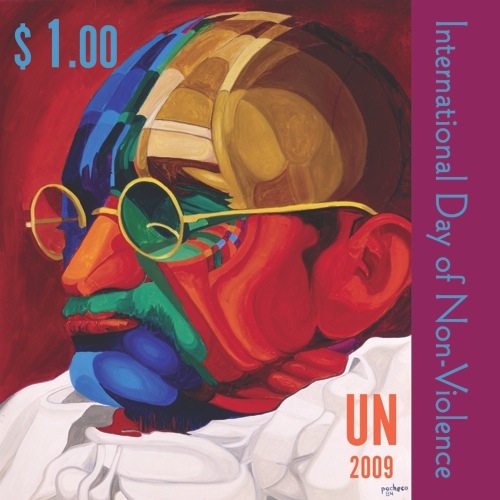
International Day of Non-Violence 2023: Raising hope with Satyagraha

 We may never be strong enough to be entirely nonviolent in thought, word and deed. But we must keep nonviolence as our goal and make strong progress towards it. - Mohandas Gandhi

Mohandas Gandhi

The United Nations has designated October 2nd as International Day of Non-Violence. This date was chosen to reflect on this profound idea since Mohandas Gandhi was born in India on October 2, 1869.  According to the United Nations, Gandhi was the "leader of the Indian independence movement and a pioneer of the philosophy and strategy of non-violence." 

On September 11, 1906 in South Africa, dissatisfied with the term passive resistance to describe nonviolence he convened a contest that resulted in a new word "Satyagraha" derived from Sanskrit that Gandhi described as follows: "Truth (Satya) implies love, and firmness (agraha) engenders and therefore serves as a synonym for force."

Monday, October 2nd is the day to share the message of nonviolence through education and awareness. It is a powerful idea that recognizes the dignity and power inherent in each individual, while at the same time recognizing that harnessing force through disciplined, strategic and non-violent action magnifies the power of the individual and when working in concert with others can become an unstoppable force for positive change. The life and example of Congressman John Lewis, who passed away in 2020, is an example of this.

Critics often cite that both Mohandas Gandhi and Martin Luther King Jr. were assassinated, and that this demonstrates the failure of their nonviolent philosophy, but they fail to look at what they accomplished in the wider societies they inhabited, and their respective legacies decades later. Both changed their respective countries. Gandhi achieved Indian independence, and King ended official segregation, empowered African Americans with their full voting rights, and achieved much more.

Gene Sharp who also taught generations of activists that there was an alternative to bloody conflict and that it was non-violent armed conflict. He demonstrated, as both Gandhi and King understood and practiced, that there was nothing passive about nonviolent resistance and that it also required strategy to increase the odds of success in a struggle. In 1990 at the National Conference on Nonviolent Sanctions and Defense in Boston, Gene Sharp succinctly outlined his argument.

"I say nonviolent struggle is armed struggle. And we have to take back that term from those advocates of violence who seek to justify with pretty words that kind of combat. Only with this type of struggle one fights with psychological weapons, social weapons, economic weapons and political weapons. And that this is ultimately more powerful against oppression, injustice and tyranny then violence."

This idea has extended to many places, and cultures around the world, but it is co-existing in conflict with ideologies like Marxism-Leninism that are based in class struggle, revenge redefined as justice, and violence exalted as a superior tool of struggle. Both Gandhi and King saw the latter approach as extremely counterproductive. 

Michael Nagler, a long time non-violence scholar, presents this idea as follows: Nonviolence sometimes “works” and always works, while by contrast, Violence sometimes “works” and never works.  Nagler offers a more detailed explanation.

The exercise of violence always has a destructive effect on human relationships even when, as sometimes happens, it accomplishes some short-term goal. The exercise of nonviolence, or Satyagraha, always brings people closer. This explains why Gandhi, after fifty years of experimentation in every walk of life, could declare that he “knew of no single case in which it had failed.” Where it seemed to fail he concluded that he or the other satyagrahis had in some way failed to live up to its steep challenge.  Taking the long view, he was able to declare that “There is no such thing as defeat in non-violence. The end of violence is surest defeat.”

 Below are several videos that introduce nonviolence and how it works. Please share them with others.

The secret to effective nonviolent resistance | Jamila Raqib


The 20th Annual Mahatma Gandhi Lecture on Nonviolence


Groundbreaking New Study: The Role of External Support in Nonviolent Campaigns (ICNC Webinar)

Czech dissident, play write, author, and former president Václav Havel who carried out a nonviolent revolution in his homeland offered a reflection on hope in his book , Disturbing the Peace, that complements Satyagraha.
 
“Hope, in this deep and powerful sense, is not the same as joy that things are going well, or willingness to invest in enterprises that are obviously headed for early success, but rather an ability to work for something because it is good, not just because it stands a chance to succeed. The more unpromising the situation in which we demonstrate hope, the deeper that hope is. Hope is not the same thing as optimism. It is not the conviction that something will turn out well, but the certainty that something makes sense, regardless of how it turns out. 

Thursday, September 30, 2021

International Day of Non-Violence 2021: Raising awareness with Satyagraha

 We may never be strong enough to be entirely nonviolent in thought, word and deed. But we must keep nonviolence as our goal and make strong progress towards it. - Mohandas Gandhi

Mohandas Gandhi

October 2nd has been recognized by the United Nations as the International Day of Non-Violence. This date was selected to reflect on this powerful idea, because on October 2, 1869 Mohandas Gandhi was born in India.  The United Nations describes Gandhi as the "leader of the Indian independence movement and pioneer of the philosophy and strategy of non-violence." 

On September 11, 1906 in South Africa, unhappy with the term passive resistance to describe nonviolence he convened a contest that led to a new word "Satyagraha" taken from Sanskrit words that Gandhi described as follows: "Truth (Satya) [that] implies love, and firmness (agraha) engenders and therefore serves as a synonym for force."

Saturday, October 2nd is the day to share the message of nonviolence through education and awareness. It is a powerful idea that recognizes the dignity and power inherent in each individual, while at the same time recognizing that harnessing force through disciplined, strategic and non-violent action magnifies the power of the individual and when working in concert with others can become an unstoppable force for positive change. The life and example of Congressman John Lewis, who passed away in 2020, is an example of this.

Critics often cite that both Mohandas Gandhi and Martin Luther King Jr. were assassinated, and that this demonstrates the failure of their nonviolent philosophy, but they fail to look at what they accomplished in the wider societies they inhabited, and their respective legacies decades later. Both changed their respective countries. Gandhi achieved Indian independence, and King ended official segregation, empowered African Americans with their full voting rights, and achieved much more.

Gene Sharp who also taught generations of activists that there was an alternative to bloody conflict and that it was non-violent armed conflict. He demonstrated, as both Gandhi and King understood and practiced, that there was nothing passive about nonviolent resistance and that it also required strategy to increase the odds of success in a struggle. In 1990 at the National Conference on Nonviolent Sanctions and Defense in Boston, Gene Sharp succinctly outlined his argument.

"I say nonviolent struggle is armed struggle. And we have to take back that term from those advocates of violence who seek to justify with pretty words that kind of combat. Only with this type of struggle one fights with psychological weapons, social weapons, economic weapons and political weapons. And that this is ultimately more powerful against oppression, injustice and tyranny then violence."

This idea has extended to many places, and cultures around the world, but it is co-existing in conflict with ideologies like Marxism-Leninism that are based in class struggle, revenge redefined as justice, and violence elevated as a superior tool of struggle. Both Gandhi and King understood this latter approach to be profoundly counterproductive. 

Michael Nagler, a long time peace scholar, presents this idea as follows: Nonviolence sometimes “works” and always works, while by contrast, Violence sometimes “works” and never works.  Nagler offers a more detailed explanation.

The exercise of violence always has a destructive effect on human relationships even when, as sometimes happens, it accomplishes some short-term goal. The exercise of nonviolence, or Satyagraha, always brings people closer. This explains why Gandhi, after fifty years of experimentation in every walk of life, could declare that he “knew of no single case in which it had failed.” Where it seemed to fail he concluded that he or the other satyagrahis had in some way failed to live up to its steep challenge.  Taking the long view, he was able to declare that “There is no such thing as defeat in non-violence. The end of violence is surest defeat.”

 Below are several videos that introduce nonviolence and how it works.


The secret to effective nonviolent resistance | Jamila Raqib


The 20th Annual Mahatma Gandhi Lecture on Nonviolence


Groundbreaking New Study: The Role of External Support in Nonviolent Campaigns (ICNC Webinar)

Tuesday, September 29, 2020

Associated Press claims debit card controlled by company run by Castro's military is "popular." Not exactly true.

Company card, with fees, for a store that marks up prices is not popular but a bitter necessity pushed on Cubans by the Castro regime to take more of their hard currency.  

The Associated Press (AP) long ago jumped the shark on its Cuba coverage, but it still continues to surprise. On September 28th Andrea Rodriguez of the AP made the claim that "a debit card backed by remittances" had "recently became popular in Cuba because people can use it to buy home appliances, food and replacement parts." When other options are chocked off by the communist bureaucracy does not make what remains popular, but the only alternative.

American International Service (AIS) cards are produced by AIS, a company registered in Panama,  but controlled by Fincimex, one of the companies in the Grupo de Administración Empresarial, S.A., or better known by its acronym GAESA.  

They receive transfer fees through AIS and FINCIMEX and keep the hard currency while dispensing local currency that has no value outside Cuba, or issues debit cards loaded with international currency for accounts it alone controls. For example if you transfer 100 Euros then you pay a "transfer fee" of 7.50 Euros.  GAESA is a conglomerate of the Castro regime's military that is able to funnel those funds into maintaining the repressive apparatus on the island, or also use it for repressive forces in Venezuela that have been training Maduro's military and security forces in psychological and physical torture techniques.

This reality is left out of the AP's reporting, but also everyday Cubans are also getting a raw deal.

Like a company store, the state owned, or more often and accurately termed "military owned stores" mark up prices on badly needed products, but have no competition. In the Miami Herald  Emilio Morales, president of The Havana Consulting Group, reports that "the Cuban military, which controls remittances, the tourism industry, and several chain stores, has benefited from remittances to the island, appropriating nearly 74 percent of every dollar sent by the Cuban exiles. Morales, who has been tracking the money sent to Cuba over the years, estimates that since 1993, Cuba has received around $46.8 billion in remittances. Almost $20 billion passed through the hands of the Cuban military."

The AIS cards are the latest manifestation of the Castro dictatorship's desire to vacuum up hard currency in Cuba, and leave Cubans with worthless paper and products that they have had to purchase at an exorbitant price.

U.S. sanctions placed on FINCIMEX to restrict hard currency to the Castro regime's repressive apparatus is a positive step, and at a time when the dictatorship is in need of hard currency, it has proven to be more flexible in its policies due to external pressure. It is a nonviolent tactic and can fit within an overall strategic nonviolent approach.

The AP has ignored this pattern of government behavior that stretches back decades that demonstrates when pressured, despite the hostile rhetoric, the dictatorship seeks accommodation to relieve pressure and survive.

It has also ignored how appeasing Havana time and time again cost lives, not only in Cuba, but also the United States.

Sunday, June 2, 2013

Non-violent Resistance: A different kind of armed struggle

"I say nonviolent struggle is armed struggle. And we have to take back that term from those advocates of violence who seek to justify with pretty words that kind of combat. Only with this type of struggle one fights with psychological weapons, social weapons, economic weapons and political weapons. And that this is ultimately more powerful against oppression, injustice and tyranny then violence." - Gene Sharp, 1990 at the National Conference on Nonviolent Sanctions and Defense in Boston


On Friday received a request from a friend in Turkey: "Please follow what's happening in Taksim, and use your channels to mobilize news and what have you. You are good at it and we need you." Watching the news unfold and the nonviolent protesters met with brutal force from the government and elements of the protesters, according to the press accounts, responding with violence to violence has led to this essay and the posting of this video.

There is a prejudice to view nonviolent resistance as either naive or successful due to exceptional circumstances but history has demonstrated otherwise. Gene Sharp, an expert on nonviolent, who works out of a think tank called the Albert Einstein Institute has spent an entire career documenting the power and reality of nonviolent resistance over the course of history and instances now in the present. Most of the books and articles are available for free download in a number of different languages.

High pressure hoses turned on nonviolent demonstrators in Turkey
 Its not only Gene Sharp who has discovered the historical track record of nonviolent resistance. University Academics Maria J. Stephan and Erica Chenoweth in their 2008 study "Why Civil Resistance Works: The Strategic Logic on Nonviolent Conflict" compared the outcomes of 323 nonviolent and violent resistance campaigns from 1900 to 2006. They found that major nonviolent campaigns have achieved success 53 percent of the time, compared with just under half that at 26 percent for violent resistance campaigns. Finally there study also suggests “that nonviolent campaigns are more likely than violent campaigns to succeed in the face of brutal repression.” This also depends on the nonviolent opposition movement having a strategic vision and maintaining its non-violent posture even under the worse repression.

The author of this blog back in June 14-15, 1996 spent two days in a training led by Gene Sharp in Miami, Florida at Florida International University that was sponsored by Brothers to the Rescue. Sharp gave a presentation on how to face dictatorship's realistically. It was a life changing experience.

The video above is the Spanish version of the documentary How to Start a Revolution: Meet the most important man you've never heard of and you can purchase a copy the English version on Amazon or on their website: http://howtostartarevolutionfilm.com/

Dear friends in Turkey who at this hour are engaged in a struggle for the future of their country please consider nonviolent resistance and its track record and recall what is now taking place in Libya and in Syria both products of a nonviolent resistance that succumbed and turned violent in response to regime violence.  The stakes are high: the future of your country not only for you but also for your children and their children. This is not a time for improvisation but for strategic thinking and sound tactics to dislodge an entrenched adversary who is threatening your democracy.

Demonstrators on the streets of Istanbul, Turkey on Saturday
It is worthwhile to take a closer look at the writings of Gene Sharp and his observation that: "If you fight with violence, you are fighting with your enemy’s best weapon and you may be a brave but dead hero."

In the meantime, in solidarity, will continue to follow what is happening and mobilize people of good will to support the just aspirations of the people of Turkey.

Wednesday, January 9, 2013

Óscar Elías Biscet Presents Manifesto for Democracy in Cuba

Cuban opposition figure Oscar Elias Biscet on Wednesday presented a manifesto on which he intends to collect signatures to promote a move toward democracy on the Communist-ruled island. Accompanied by about a dozen dissidents, Biscet read the document at an appearance before international media where he demanded a “total change” in Cuba because “the people are tired of tyranny.” The initiative is called Proyecto Emilia, in remembrance of Emilia Teurbe Tolon, who embroidered the first Cuban flag in the mid-19th century.  Biscet, a physician and veteran human rights activist, was among the “Group of 75” dissidents jailed amid a harsh crackdown in March 2003." - EFE & Latin American Herald, "Cuban Opposition Figure Promotes Democracy Manifesto"
Emilia Teurbe Tolón


PROJECT EMILIA
This project, imbued with a deep love of country, bears the name of one of the Cuban heroes who devoted the best of her fruitful life to the struggle for the independence and freedom of Cuba.
We refer to Emilia Teurbe Tolón,  designated in 1950 by the Congress of the Republic of Cuba, to mark the centenary of our national flag, as the incarnation of the Woman of Cuba.
Emilia was the first Cuban woman banished from our country for political reasons. She also had the honor of working on the original Cuban flag that was designed by her husband and poet Miguel Teurbe Tolón,  on the initiative of General Narciso Lopez. Born into a wealthy family in the city of Matanzas, she had the human sensitivity to donate her property to benefit the education of the poor.
Those of us who sign this document, inspired by her patriotic example, propose to carry out this project whose main objectives are: the conquest of fundamental human rights, democracy and freedom of the Cuban people.
We assume that Cuba's communist regime bases its legality in the 1976 Constitution, as amended in 2003. In article 69, the Constitution refers to the People's National Assembly as the organ of state power. It also adds that the assembly represents and expresses the sovereign will of the people. To leave no doubt, Article 70 states that the National Assembly of People's Power is the only body with constituent and legislative authority in the Republic of Cuba.

Whereas: We have confirmed for years that the National Assembly of People's Power has transgressed to cede their sovereign rights and power the Council of State.

Whereas: We verified that the National Assembly of People's Power has complied passively and given legal force to all Decree-laws adopted by the Council of State.

Whereas: The National Assembly of People's Power has lost its sovereign power by accepting the mandate of the Council of State in convening extraordinary sessions. 

Whereas: The National Assembly of People's Power has infringed on the freedom of our people by allowing the Council of State to declare as irrevocable in the National Constitution social, political, and ideological ideas contrary to the interests of the Cuban people.

Whereas: The National Assembly of People's Power has violated the respect for the views of minorities enshrined in the world's most advanced constitutions and granted extreme power to docile majorities.

Whereas: The National Assembly of People's Power, violating the constitutional principle of the separation and independence of powers, has given the Council of State the power to issue guidelines and impose decisions on the Judiciary.

Whereas: The National Assembly of People's Power has ignored the popular will and limited civic freedom by subordinating it to the Local Assemblies of People's Power.

Whereas: The National Assembly of People's Power has stipulated that the Local Assemblies of People's Power are subordinated to the Council of State.


Whereas: The National Assembly of People's Power has stifled freedom of expression, association, speech and press to those not aligned with the policy and ideology of the state.

Whereas: The National Assembly of People's Power has given the government the power to strip Cubans born in our country of their citizenship .

Whereas: The National Assembly of People's Power, in not objecting to the measures of the Council of State that have sunk into misery and desperation our people, it has become complicit in this infamy. 


Whereas: The National Assembly of People's Power has exalted one Party above the state and the nation. 
Therefore: We declare that these laws, compiled in the 1976 Constitution, constitute an abuse of power that flagrantly violates the dignity of Cuban citizens.

Therefore: The 1976 Constitution, as amended in 2003, permanently institutionalizes the communist regime of Cuba.
 
Therefore: The National Assembly of People's Power has no validity whatsoever and ceases to be the expression of the will of the people by giving the Council of State all the prerogatives enshrined in the Cuban Constitution.

We consider that the current communist constitution violates the Universal Declaration of Human Rights and the Human Rights Covenants on Civil and Political Rights of the United Nations.

We agree to declare illegitimate the Communist Constitution and the National Assembly of People's Power with its organs of state power.

We call on the Cuban people to subscribe to this project to take steps toward a sovereign, democratic, free and just Cuba.

We proclaim that the new democratic and free Parliament that emerges from these exigencies is declared in Constitutional Assembly; and ratify a constitution that respects the dignity of all Cubans.
 

We insist that the Constitution contain the bases for the democracy and freedom that so many of our compatriots from our wars of independence have fought and given their lives for.

We demand that the legal system of our country has as a base the democratic principles that prevail in other nations of the civilized world. These are: sovereignty of the people, government based on the consent of the governed, majority rule, minority rights, guarantee of basic human rights, free and fair elections, equality before the law, due process, constitutional limits on government, independent balance of powers, social , economic and political
pluralism; as well as the values ​​of tolerance, pragmatism, cooperation and compromise.  

Unfortunately, we have seen through more years than we would like to recall how Cuba's communist regime has not conceded even one atom of freedom and has rigidly and arbitrarily resisted any changes that would ensure a decent life for our people.

Consequently, we have no alternative but to launch the non-violent political challenge to realize the freedom of our people. To do this, we ask the assistance and protection of God, and we ask the Creator to guide us in this just cause for the freedom and prosperity of the Cuban people.

VIVA CUBA LIBRE!

Given in Havana, Cuba, on January 9, 2013
 

Source: Blog Punt de Vista

Original Text in Spanish: 

 
PROYECTO EMILIA
Este proyecto, imbuido de un profundo amor patrio, lleva el nombre de una de las heroínas cubanas que dedicó lo mejor de su vida fructífera a la lucha por la independencia y la libertad de Cuba.
Nos referimos a Emilia Teurbe Tolón, designada en 1950 por el Congreso de la República de Cuba, con motivo del centenario de nuestra Bandera Nacional, como la Encarnación de la Mujer de Cuba.
Emilia fue la primera mujer cubana desterrada de nuestra patria por motivos políticos. Tuvo además el honor de laborar en el original de la bandera cubana que fuera diseñada por su esposo y poeta Miguel Teurbe Tolón, a iniciativa del General Narciso López. Perteneciente a una acaudalada familia de la ciudad de Matanzas, tuvo la sensibilidad humana de donar sus bienes en beneficio de la enseñanza de los pobres. 
Quienes suscribimos este documento, inspirados en su ejemplo patriótico, nos proponemos realizar este proyecto cuyos objetivos esenciales son: la conquista de los derechos humanos fundamentales, la democracia y la libertad del pueblo cubano. 
Partimos de la base de que el régimen comunista de Cuba fundamenta su legalidad en la Constitución de 1976, con sus modificaciones de 2003. En su artículo 69, esta Constitución designa a la Asamblea Nacional del Poder Popular como el órgano de poder del Estado. Asimismo añade que dicha asamblea representa y expresa la voluntad soberana de todo el pueblo. Para no dejar dudas, en su artículo 70 afirma que la Asamblea Nacional del Poder Popular es el único órgano con potestad constituyente y legislativa en la Republica de Cuba. 
Por Cuanto: Hemos confirmado durante años que la Asamblea Nacional del Poder Popular ha prevaricado al ceder sus derechos soberanos y su poder al Consejo de Estado. 
Por Cuanto: Hemos verificado que la Asamblea Nacional del Poder Popular ha acatado pasivamente y dado fuerza legal a todos los Decreto-leyes adoptados por el Consejo de Estado. 
Por Cuanto: La Asamblea Nacional del Poder Popular ha perdido su poder soberano al aceptar el mandato del Consejo de Estado en la convocatoria a sesiones extraordinarias. 
Por Cuanto: La Asamblea Nacional del Poder Popular ha atentado contra la libertad de nuestro pueblo al permitir que el Consejo de Estado declare como irrevocables en la Constitución Nacional ideas políticas, sociales e ideológicas contrarias a los intereses del pueblo cubano.

Por Cuanto: La Asamblea Nacional del Poder Popular ha violado el respeto a la opinión de las minorías plasmado en las constituciones más avanzadas del mundo y otorgado extremo poder a mayorías dóciles. 
Por Cuanto: La Asamblea Nacional de Poder Popular, violando el principio constitucional de la separación e independencia de poderes, ha otorgado el Consejo de Estado el poder de dictar pautas e imponer decisiones sobre el Poder Judicial. 
Por Cuanto: La Asamblea Nacional del Poder Popular ha desconocido la voluntad popular y limitado la libertad ciudadana al subordinar a ella las Asambleas Locales del Poder Popular. 
Por Cuanto: La Asamblea Nacional del Poder Popular ha estipulado que la Asambleas Locales del Poder Popular están subordinadas al Consejo de Estado. 
Por Cuanto: La Asamblea Nacional del Poder Popular ha asfixiado la libertad de expresión, asociación, palabra y prensa a los que no se alineen a la política e ideología del Estado. 
Por Cuanto: La Asamblea Nacional del Poder Popular ha otorgado al gobierno la potestad de despojar de su ciudadanía a cubanos nacidos en nuestro territorio nacional. 
Por Cuanto: La Asamblea Nacional del Poder Popular, al no objetar las medidas del Consejo de Estado que han hundido en la miseria y la desesperación a nuestro pueblo, se ha hecho cómplice de esa infamia. 
Por Cuanto: La Asamblea Nacional del Poder Popular ha exaltado a un Partido por encima del estado y de la nación.


Por Tanto: Declaramos que estas leyes, compiladas en la Constitución de 1976, constituyen un abuso de poder que viola flagrantemente la dignidad de los ciudadanos cubanos. 
Por Tanto: La Constitución de 1976, modificada en el 2003, institucionaliza de manera permanente al régimen comunista de Cuba.

Por Tanto:
 La Asamblea Nacional del Poder Popular carece de toda validez y deja de ser la expresión de la voluntad del pueblo al otorgarle al Consejo de Estado todas las prerrogativas consagradas en la Constitución Cubana.

Consideramos que la vigente Constitución comunista viola la Declaración Universal de Derechos Humanos y los Pactos de Derechos Humanos Civiles y Políticos de las Naciones Unidas. 
Concordamos en declarar ilegitima a la Constitución Comunista y a la Asamblea Nacional del Poder Popular con sus órganos de poder del Estado. 
Convocamos al pueblo cubano a que suscriba este proyecto para dar pasos hacia una Cuba soberana, democrática, libre y justa. 
Proclamamos que el nuevo Parlamento democrático y libre surgido de estas exigencias se declare en Constituyente; y rubrique una Constitución que respete la dignidad de todos los cubanos.

Insistimos en que esta Constitución contenga las bases de la democracia y la libertad por la que han luchado y ofrendado sus vidas tantos de nuestros compatriotas desde nuestras guerras de independencia. 
Demandamos que el ordenamiento jurídico de nuestra patria tenga como base los principios democráticos que predominan en otras naciones del mundo civilizado. Estos son: Soberanía del pueblo, gobierno basado en el consentimiento de los gobernados, gobierno de la mayoría, derechos de las minorías, garantía de los derechos humanos básicos, elecciones libres y transparentes, igualdad ante la ley, debido proceso judicial, límites constitucionales al gobierno, equilibrio de poderes independientes, pluralismo social, económico y político; así como los valores de tolerancia, pragmatismo, cooperación y compromiso.

Por desgracia, hemos visto a través de más años de los que quisiéramos recordar como el régimen comunista de Cuba no ha concedido ni un átomo de libertad y ha resistido de manera rígida y arbitraria cualquier cambio que garantice una vida digna para nuestro pueblo. 
Por consiguiente, no nos queda otra alternativa que poner en marcha el desafío político no violento para hacer realidad la libertad de nuestro pueblo. Para ello, suplicamos la asistencia y la protección de Dios, así como le pedimos al Creador que nos guie en esta justa causa para lograr la libertad y la prosperidad del pueblo cubano. 
¡VIVA CUBA LIBRE! 
Dado en La Habana, República de Cuba, el 9 de enero de 2013
Fuente: Blog Punt de Vista

Saturday, May 5, 2012

The Advantage of Nonviolent Resistance in the Cuban Struggle for Freedom

In the debate over bringing change to Cuba there is a false dichotomy either you are for a violent blood filled conflagration that precipitates rapid political change or you favor slow and gradual change initiated by the dictatorship. It is a false dichotomy because Cubans on the island since 1976 have opted for a third option non-violent change from the bottom up through campaigns of civil disobedience with the Universal Declaration of Human Rights as a common reference point. It has been a long and difficult struggle, and that should not be ignored nor the fact that these courageous activists have refused to remain passive before injustice but actively confront it. This approach is not unique to Cuba and is part of an international trend.  

The Mennonite Central Committee in Ontario Canada prepared the video below titled "The Last 100 years of nonviolence" which offers a quick over view around the world of successful nonviolent resistance campaigns that toppled repressive regimes and systems in Asia, Africa, Europe and the Americas.


It is important to underline the importance of strategic analysis and planning in order for a nonviolent movement to have a greater chance at a successful outcome. The Reverend James Lawson, a contemporary of Martin Luther King Jr.'s who trained the Nashville Student movement in nonviolent direct action is still engaged in training activists in the present day and has a life time of experience to share. An important talk to listen to was  given by Reverend Lawson at the 2010 keynote address at the Fletcher Summer Institute for the Advanced Study of Nonviolent Conflict.


Reverend Lawson not only studied the theory but placed it into practice in confronting Jim Crow Segregation in the Deep South and dismantling a system that had been in place for nearly a century. A more academic and systematic study of  nonviolent resistance and its successful application has been provided by scholars such as Gene Sharp and Erica Chenoweth. Professor Chenoweth offers a quantitative analysis of nonviolent action over the past century compared to violent action in the video below comparing both successes and failures.


In extreme situations such as Syria nonviolence is able to frustrate even the most brutal and violent dictators. more so than violent resistance. The regime in Cuba is a brutal and murderous regime that not only sponsors international terrorism but also perpetrates acts of state terrorism against Cuban nationals. It is for that precise reason that the Cuban democratic opposition over a generation ago departed from centuries of violent Cuban political history and adopted nonviolent resistance. According to Professor Chenoweth the triumph of nonviolent resistance depends on strategic considerations, planning and interactions.

Sunday, March 27, 2011

Gene Sharp: Why Burmese Resistance Has Failed So Far

Irrawaddy

Gene Sharp, 83, is known for writing about nonviolence. (Photo: AP)

He has been called the man who toppled Mubarak, a description he says demeans what he sees as a wholly Egyptian uprising against authoritarian rule. Before that, he was the victim of a whispering campaign in which his work was alleged to be a US front for regime change in the guise of citizen uprisings. He calls those allegations “a joke” and reminds that he went to prison in the US for civil disobedience there.

From Dictatorship to Democracy is perhaps his best-known and most-influential work. Renowned as a handbook for strategic non-violent protest around the world, it originated in Dr Sharp's work with Burmese opposition and ethnic groups in the early 1990s, and was intended as a blueprint for the liberation of the country from military rule.

With the army in control since 1962, and seemingly entrenched behind a parliamentary makeover, the challenges facing activists and opposition groups in Burma are among the most daunting anywhere. Now 83 years old, and with a CV that dates back to working with Norwegian opponents of Nazi/Quisling rule during World War II, Dr Gene Sharp shared his thoughts on the recent events in North Africa and the Middle East with Simon Roughneen, as well as outlining why he believes that resistance in Burma has failed to dislodge the military rulers of that country.

Question: Dr. Sharp, your interest in Burma and the pro-democracy movement there goes back a long way. Can you tell The Irrawaddy readers about the history of your engagement with Burma?

Answer: I was brought to Burma by Robert Helvey, a former US military attache in Rangoon, who became sympathetic to the groups opposing the regime, particularly the Karen. I was asked to write some articles for Khit Pyaing, a Burmese and English journal based in Bangkok, and run by the late U Tin Maung Win, and those eventually became part of the publication known as “From Dictatorship to Democracy.” I also visited Manerplaw a few times and met with Burmese exiles in Thailand.

Q: Why in your view has non-violent resistance failed, so far, to undermine military rule in Burma? What are the factors differentiating Burma from recent changes in Egypt and Tunisia, as well as older examples such as the Color Revolutions in the former Soviet bloc, Serbia in 2000 and the Philippines in 1986?

A: I think there are a few explanations for that. For a start, many of the opposition groups, the various nationality groups such as the Karen, Mon and others, they all had their armies and mini-armies, and they thought they would be weakened by departing from those and going over to non-violence, or “political defiance” as it was known in Burma. Other groups, such as the All Burma Students Democratic Front (ABSDF), had their mini-army, and people in the camps, though temporarily agreeing to switch over to just political defiance, reversed that after a couple of years. All the various armed groups thought they could defeat the Army, but I think that was a foolish judgment on their part, as the Army was bigger and stronger and had more weapons.

The so-called National Coalition Government of the Union of Burma, which isn't really a coalition government at all, with headquarters in Washington DC—not very close to Burma—they had their own ways, they thought, to get independence and defeat the government, but they didn't show much signs of learning something new.

And, Aung San Suu Kyi, for all her wonderful qualities, and her heroism and inspiration for those who believe in democratic rights and the rights of Burmese people—she is not a strategist, she is a moral leader. That is not sufficient to plan a strategy.

Although “From Dictatorship to Democracy” was written for Burmese, there were no Burmese groups who really took that analysis seriously or used at as a strategy for the liberation of Burma. People got arrested and sent to prison for carrying it, in Burmese and other languages, they could organize very powerful and brave demonstrations in Rangoon and elsewhere, but they did not plan a grand struggle. If you don't plan, if you don't have a bigger strategy, you're not going to win.


Q: Do you see any change in Burma since the elections last November and the convening of Parliament on Jan 31? Is there now a viable outlet for non-violent opposition to express itself in Burma, without having to take to the streets, without having recourse to some of the methods you have outlined over the years?

A: I am not sufficiently up to date on the details of the situation to comment, I am sorry.

Q: Moving away from Burma, what do you say to conspiracy theorists who allege that your ideas are a convenient intellectual front for US or Western interference or intervention in the internal affairs of sovereign states, a sort of power projection masquerading as locally motivated non-violent resistance?

A: It is a big joke. We have had no support from the US government or military or from intelligence agencies. Our office is very small. We have very little money to operate. Someone is trying to discredit the analysis we have offered, and that is all there is to it. Such charges are false.

Q: Some of the critiques of your work, by seeing an external or meddling hand in what might be local or nationally focused events, are themselves guilty of a sort of colonialism of the mind, implying that Burmese or Egyptians or whoever the case may be are incapable of taking action autonomously, or reacting themselves to the conditions in their own country, without a guiding hand from outside.

A: I think that is a good point, and a key thing to remember when people try to discredit the analysis I offer, which is based on work over decades in many countries, and contact with freedom-loving people in many parts of the world.

Often it is people who believe in violence who attack us, because they want to weaken peoples adherence to non-violence, and to the practical usefulness of a strategy of non-violence. Look at those people and ask what do they offer? Genuine criticism is always welcome, but proffering false charges is ridiculous.

For those who want to make such allegations, to say that I am a tool of the United States government, they should remember that I spent over 9 months of a two-year prison sentence for civil disobedience and for criticizing the policies of the US government.

Q: Your work has come back into public focus due to events in North Africa and the Middle East. One newspaper headline went as follows: “Gene Sharp, the 83 year old who toppled Egypt.” What is your take on that?

A: I may or may not have provided some analysis that fed into the actions taken by the people there, I have no confirmation of that, but the Egyptian people deserve the credit for toppling the Mubarak regime, not me.

Q: Since Tunisia and Egypt, the protests in the region have changed. Libya's uprising has become an armed revolt. Do you feel that—even with UN Security Council and Arab League support—it is right to intervene in Libya at this juncture?

A: It is not the course of action I would have chosen. I think the Libyan democrats did not do their homework in advance like the Egyptians did—in Egypt, they appeared to have a plan and studied quite some time in advance to develop a program of non-violence without fear, which brought them victory quite quickly. In Libya, this appears not to have been the case. The Libyans have gotten in over their heads, and should have expected the type of repression that Gaddafi is capable of.

People who are realistic about the power of political defiance know that if it is a threat, the regime will see it that way and will fight back. The regime will jail and beat and kill, and that is a sign that what you are doing is threatening the regime.

Dictators can beat you with violence, if you fight on those terms, and of course the rebels cannot defeat the Gaddafi regime on the level of armed force. So they are left to call in help from outside, which cannot give them the empowerment or victory they seek.

Q: Do you think that when legitimate peaceful protest—such as in Burma—is met with state violence, the protesters then have the right to self-defense? To fight back? To seek alliances with sympathizers in the country's police and army? To appeal for international military support, as the Libyan rebels have done?

A: I think it is an unfortunate choice that people make. It is predictable that your opponent will have the means of violence, the means of oppression. If you get someone else to come and help you, they will come with their interests, and potentially turn your country into a battlefield. Even if they help defeat the oppressor, it will not result in empowerment. People will not be ready to fight the next oppressor who tries to take over the country. In contrast, if the Egyptian military tries again to take control, the people know how to counter this, they have the sense of empowerment, of their own power.

Ultimately, in any non-violent resistance, you have to plan, you have to study. You have to know what the hell you are doing.

Q: You have been credited with influencing the actions of thinkers and doers around the world. But who has influenced you?

A: I have learned from the many people I have met around the world over the decades, but have no single guiding light. I learned from Gandhi, that is, Gandhi as a shrewd political strategist. I learned from the Norwegian resistance against the Quisling fascist government during World War II. I learned from the non-violent resistance undertaken by Baltic countries—Estonia, Latvia and Lithuania—whose governments also read some of my work. I don't have any political doctrine, no political messiah, just my own thinking and learning, for the most part.

http://www.irrawaddy.org/article.php?art_id=20981