Monday, December 19, 2022

Revisiting the courageous flight by Orestes Lorenzo Pérez to save his wife and children

"If Lorenzo had the balls to leave with one of my MiGs," he said, "maybe he has the balls to come and get his family." - Raul Castro

Orestes Lorenzo campaigning for his families release.

Abridged version taken from CubaBrief.

Thirty years ago, on December 19, 1992, Cuban Air Force Major Orestes Lorenzo Pérez flew back to Cuba and rescued his family. One year and nine months after defecting to the United States in a MiG-23 and months of petitioning the Cuban government to allow his family to leave the island without success, Orestes flew to Cuba in a civilian plane and picked up his wife and two sons.

Mikhail Gorbachev's glasnost rejected by Castro left a deep impact on the Cuban military. Cuban General Arnaldo Ochoa Sanchez, who had studied in the Soviet Union, and had close ties there  was arrested on June 12, 1989, subjected to a political show trial and executed by firing squad on July 13, 1989. This was seen as sending a message to Cuban officials sympathetic to Glasnost and Perestroika.

Major Orestes Lorenzo Pérez, who had fought in Angola, then gone for further training in the Soviet Union, was also deeply affected by the glasnost of Mikhail Gorbachev. He realized that the history that he had been taught in Cuba was a lie, and that he was being manipulated.

This is why he defected on March 20, 1991.The Cuban Air Force Major would spend the next 22 months trying to get his family out of Cuba.  Gigi Anders in her February 14, 1993 article published in The Washington Post, titled THE MOST ROMANTIC STORY IN THE WORLD highlighted some of the actions taken, and people successfully petitioned.

"People of great sensitivities responded positively and tried their best to help liberate my family," he says. "Coretta Scott King, President Bush, Mikhail Gorbachev, more than 50 senators and congressmen, the Valladares Foundation {a Virginia-based human rights organization} ... they all wrote to Fidel Castro." He pleaded his case before the U.N. Commission on Human Rights. Diplomacy was failing. In the summer of 1992, Orestes participated in a week-long hunger strike in Madrid, where Castro was attending the Iberian-American Summit. There was plenty of publicity for seven days. And then the conference ended.

Raul Castro sent a challenging response to the request for family reunification: "If Lorenzo had the pants to leave with one of my MiGs," he said, "maybe he has the pants to come and get his family." Inside Cuba, Raul Castro's assistant explained to Vicky Lorenzo that she and her children would never be reunited with her husband and their father. When she asked why, she was told, "Because you are scum."

On December 19, 1992 flying low in a 1961 Cessna 310, Orestes Lorenzo returned to Cuba to pick up his family. He had one minute to land, pick them up, and take off back for Florida.

"I came in very low, very low, about 10 feet above the waves, and I saw the bridge near Matanzas. I banked hard. I saw a car, a truck and bus on the road," Lorenzo, 36, said this morning, his eyes red from almost three days without sleep. "There was a concrete barricade. A street sign. I banked again and landed hard, fast. I had one chance to land. One chance. That was it." Lorenzo says he will never forget the look of shock on the face of the truck driver on the road, who stared at the pilot as he turned his plane about 30 feet away. Lorenzo's wife, Victoria, 35, and their two sons, Reyniel, 11, and Alejandro, 6, ran to the aircraft. His younger son was still without shoes this morning. He had lost them running to the plane." ... "After a dramatic takeoff from the same road, the family returned to Marathon, where they were met by a handful of friends and supporters, including Kristina Arriaga, executive director of the Valladares Foundation in Alexandria, Va., a Cuban-exile group headed by Armando Valladares, a former political prisoner in Cuba."

Orestes Lorenzo Pérez has a presence on Youtube, and has demonstrated over the past thirty years his dedication to nonviolence, and speaking truth to power. Today he is also a loving grandfather. You can learn the details of what happened thirty years ago in the book "Wings of the Morning: The Flights of Orestes Lorenzo" by Orestes Lorenzo Pérez on Amazon


Sunday, December 18, 2022

Remembering Václav Havel, Oswaldo Payá Sardiñas and nonviolent action

"A single idea, if it is right, saves us the labor of an infinity of experiences." - Jacques Maritain

Oswaldo Payá Sardiñas and President Václav Havel in Prague (2002)

Twenty years ago on December 17, 2002 Oswaldo Paya addressed the European Parliament in Strasbourg at a ceremony awarding him the the Sakharov Prize where he outlined his nonviolent vision for change in Cuba.

The first victory we can claim is that our hearts are free of hatred. Hence we say to those who persecute us and who try to dominate us: ‘You are my brother. I do not hate you, but you are not going to dominate me by fear. I do not wish to impose my truth, nor do I wish you to impose yours on me. We are going to seek the truth together.’
 Václav Havel passed away eleven years ago today, on December 18, 2011, and his nonviolent resistance and dedication to truth in successfully resisting totalitarian rule in Czechoslovakia remain powerful legacies and examples that remain relevant today. In 2002, President Vaclav Havel addressed the Cuban people and offered words that should be heeded now:
"Our world, as a whole, is not in the best of shape and the direction it is headed in may well be quite ambivalent. But this does not mean that we are permitted to give up on free and cultivated thinking and to replace it with a set of utopian clichés. That would not make the world a better place, it would only make it worse. On the contrary, it means that we must do more for our own freedom, and that of others."
Nonviolence requires recognizing these extreme injustices and the justifiable anger that it generates but at the same time channeling it into creative and productive means to end the injustices. Some would argue that one must remove their anger, as one takes off a back pack, but that is profoundly mistaken. Martin Luther King Jr. offered a different approach that has proven far more powerful: 
"The supreme task [of a leader] is to organize and unite people so that their anger becomes a transforming force." 

Mohandas Gandhi spoke in 1920 of learning "through bitter experience the one supreme lesson to conserve my anger, and as heat conserved is transmuted into energy, even so our anger controlled can be transmuted into a power that can move the world."
 

This is not hating but harnessing a powerful spiritual energy and channeling it productively. Blowing up and screaming at someone is a waste of that energy that can be channeled into creative solutions to end the injustice.

Nonviolence theoretician Gene Sharp also recognizes that there is a moral dimension that cannot be ignored without dire consequences (as the recent drive to normalize relations with the Castro regime in Cuba demonstrated): "It is unreasonable to aim for a 'win- win' resolution. Brutal dictators and perpetrators of genocide do not deserve to win anything."

Nonviolent thought can be divided into two general categories: strategic nonviolence and principled nonviolence but although emphasizing different perspectives they need not be in conflict.
Strategic nonviolence takes a pragmatic approach that is based on being more effective then violence. 

Non-violent resistance is an armed struggle but its weapons are not deployed to do violence or kill. These arms are  psychological, social, economic and political weapons. Gene Sharp argues with much evidence "that this is ultimately more powerful against oppression, injustice and tyranny then violence. Historical studies are cited that demonstrate the higher success rates of nonviolent movements when compared against violent ones:

University Academics Maria J. Stephan and Erica Chenoweth in their 2008 study "Why Civil Resistance Works: The Strategic Logic on Nonviolent Conflict" compared the outcomes of 323 nonviolent and violent resistance campaigns from 1900 to 2006. They found that major nonviolent campaigns have achieved success 53 percent of the time, compared with just under half that at 26 percent for violent resistance campaigns. Finally there study also suggests “that nonviolent campaigns are more likely than violent campaigns to succeed in the face of brutal repression.”
Principled nonviolence looks at the spiritual dimension, and the power of an individual to change and in doing so impact the world. Mohandas Gandhi described it as follows on September 8, 1913 in Indian Opinion:
"We but mirror the world. All the tendencies present in the outer world are to be found in the world of our body. If we could change ourselves, the tendencies in the world would also change. As a man changes his own nature, so does the attitude of the world change towards him. This is the divine mystery supreme. A wonderful thing it is and the source of our happiness. We need not wait to see what others do."
The advantage of principled non-violence and taking it up as a daily practice in ones life is that it gives one the strength to resist provocations and builds up the character of the practitioner that assists in carrying out a strategic nonviolent plan.

Critics of nonviolence often argue that nonviolence works well against democracies but not brutal regimes, often citing the Nazis. Nevertheless in 1943 in Germany on Rosenstrasse street German wives married to Jewish men, who had been taken to concentration camps, organized a series of strikes and protests that forced the Nazis to return their Jewish husbands back from the death camps. Those men survived the Holocaust thanks to their wives courageous and nonviolent action.  

The disturbing questions that should arise are: What would have happened if instead of the violent Antifa movement, that fought the Nazis in street battles throughout the 1930s that escalated violence, opponents of the Nazis had followed Gandhi's advice at the time and resisted them nonviolently? What would have happened if the Weimar Republic instead of attempting to silence the Nazis by repeatedly prosecuting them for violating hate speech laws had challenged their evil ideas in the court of public opinion?

Since the founding of the Cuban Committee for Human Rights in 1976 there has existed in overall terms a general strategy of change that can be summed up as: " Carrying out a nonviolent struggle in defense of human rights for the freedom of Cuba."

Looking at another definition of strategy that divides it into three parts gives a better idea of the challenges facing the democratic opposition in Cuba:

1. Diagnostic: A totalitarian dictatorship with dynastic elements with the political will to hang on to power.
2. Guiding policy: nonviolence
3. Action plan: There exist different areas of emphasis by the opposition and civil society that is also something found in nonviolent struggles.
Strategic nonviolence takes a pragmatic approach that is based on being more effective then violence: 
Non-violent resistance is an armed struggle but its weapons are not deployed to do violence or kill. These arms are  psychological, social, economic and political weapons. Gene Sharp argues with much evidence "that this is ultimately more powerful against oppression, injustice and tyranny then violence." 

The reason for the greater success rate of nonviolent resistance is that it is easier to mobilize large numbers of people to take nonviolent action than to engage in violent action. Success is not only defined by overthrowing the existing regime, but having a transition that ends in a democratic regime. The methods used in nonviolent struggle translate better to democratic practices then violent resistance because they involve nonviolent discipline, the mobilization of large numbers and the encouragement of civic virtue.  

Furthermore the use of humor is not to be underestimated. Václav Havel in an address to the Central European University on June 24, 1999 at a difficult moment on the international scene made the case for laughter.

"The only thing I can recommend at this stage is a sense of humor, an ability to see things in their ridiculous and absurd dimensions, to laugh at others and at ourselves, a sense of irony regarding everything that calls out for parody in this world."
Following his death in 2011, every year on the anniversary of his passing admirers of Václav Havel the world over wear short trousers in his memory. Organizers explained its historic significance along with its particular Czech sensibility.
The “Short Trousers for Václav Havel” initiative started in 2012 to honor the memory of Václav Havel with a gesture that was unique, memorable and easily achieved by supporters of this exceptional person in modern Czech and European history.  Short Trousers is a reference to Havel stepping into political life in 1989 and his inauguration to the presidency in visibly short trousers. He explained vainly that rather than a tailor’s mistake it was his habit to pull his pants up at every dramatic situation. To this, one might say global mythology of his short trousers, he added with a smile: "I must say that I am glad of it, more or less. From my point of view it’s a pretty gentle way of mocking myself."  An effort to honor such a respectable person by a gesture that points to this humorous episode might appear, at first sight, as a contradictory act. But the opposite is true. We believe that rolled up trousers on the anniversary of the death of Václav Havel is a gesture which is Czech, slightly satirical and which can be easily joined by anyone who wants to honor the memory of the last Czechoslovak and the first Czech president Havel in a cheerful way.

This method of spontaneous remembrance contrasts dramatically with how dictators forcibly demand that they be remembered on penalty of imprisonment for dissenting as has been the case following the 2016 death of Fidel Castro

Saturday, December 17, 2022

20 years ago today, Oswaldo Paya received the European Parliament's Sakharov Prize


SPEECH DELIVERED BY MR. OSWALDO PAYÁ UPON ACCEPTING THE SAKHAROV PRICE FOR FREEDOM OF THOUGHT


Strasbourg, December 17, 2002

English translation below:

First of all, I should like to express my thanks to Mr. Pat Cox, President, and to this Parliament in which the many peoples of Europe are represented.

You have awarded the Andrei Sakharov Prize to the people of Cuba. I say “the people of Cuba” because they are the ones who so richly deserve such an award. I say it without excluding any of my fellow countrymen, irrespective of their political stance, because rights have no political, racial or cultural hue. Nor have dictatorships any political color: they are neither right-wing nor left-wing, they are merely dictatorships. In my country there are thousands of men and women who are fighting in the midst of persecution for the rights of all Cubans. Hundreds of them have been imprisoned solely for having proclaimed and stood up for those rights, and this is why I am receiving this award on their behalf.

I say that this prize is for all Cubans because I believe that, in awarding it, Europe wishes to say to them: “You too are entitled to rights.”

This is something which we have always firmly believed, but there are times when this truth has seemed to be less than self-evident to many of the world’s people.

I have not come here to ask you to support those who oppose the Cuban Government or to condemn those who persecute us. It is of no help to Cuba that some people in the world side with the country’s government or with the latter’s opponents on the basis of an ideological standpoint. We want others to side with the Cuban people - with all Cubans – and this means upholding all their rights, supporting openness, supporting our demand that our people should be consulted via the ballot box regarding the changes we are calling for. We are asking for solidarity so that our people can be given an opportunity to speak through the ballot box, as proposed in the Varela Project.

Many people have linked this prize to the Varela Project, and rightly so, since the thousands of Cubans who, in the midst of repression, have signed the petition calling for a referendum are making a decisive contribution to bringing about the changes which Cuba needs. Those changes would mean involvement in cultural and economic life, civil and political rights, and national reconciliation. That would constitute a genuine exercise in self-determination by our people. We must reject the myth that we Cubans have to live without rights in order to support our country’s independence and sovereignty.

Father Felix Varela has taught us that independence and national sovereignty are inseparable from the exercise of basic rights. We Cubans – whether we live in Cuba or in the diaspora – are a single people and we have both the determination and the ability to build a just, free and democratic society, without hatred and without the desire for revenge. In the words of José Marti, ‘With everyone and for everyone’s benefit’.

We have not chosen the path of peace as a tactic, but because it is inseparable from the goal for which our people are striving. Experience teaches us that violence begets more violence and that when political change is brought about by such means, new forms of oppression and injustice arise. It is our wish that violence and force should never be used as ways of overcoming crises or toppling unjust governments. This time we shall bring about change by means of this civic movement which is already opening a new chapter in Cuba’s history, in which dialogue, democratic involvement, and solidarity will prevail. In such a way we shall foster genuine peace. Cuba’s civic combatant heroes – the ordinary people who have signed the Varela Project – carry no weapons. Not a single hand is armed. We walk with both arms outstretched, offering our hands to all Cubans as brothers and sisters, and to all peoples of the world.

The first victory we can claim is that our hearts are free of hatred. Hence we say to those who persecute us and who try to dominate us: ‘You are my brother. I do not hate you, but you are not going to dominate me by fear. I do not wish to impose my truth, nor do I wish you to impose yours on me. We are going to seek the truth together’. THIS IS THE LIBERATION WHICH WE ARE PROCLAIMING.

There are still those who perpetuate the myth that the exercising of political and civil rights is an alternative to a society’s ability to achieve social justice and development. They are not mutually exclusive. The absence of any civil and political rights in Cuba has had serious consequences such as inequality, the poverty of the majority and privileges of a minority and the deterioration of certain services, even though these were conceived as a positive system to benefit the people. In this way, although many Cubans have for years worked out of love and in good faith, the situation as regards civil and political rights is now serious, quite apart from a widening inequality and the deterioration in the quality of life of the majority of the population. Among other things, the freedom of action of the citizens of Cuba has been limited, which has neutralized their huge potential for creativity and productiveness and is the main reason for the country’s poverty.

This state of affairs cannot be justified by saying that the Cuban people have adopted this system out of choice. You all know that none of the peoples represented in this Parliament, and no people in the world, would ever give up the right to exercise their fundamental freedoms.

It is becoming increasingly apparent that well-being and economic and social progress are the fruits of being able to exercise one’s rights. In the same way, a democracy is not genuine and complete if it cannot initiate and sustain a process that raises the quality of life of all its citizens, because no people would freely vote for the kind of poverty and inequality that results in the masses becoming disadvantaged and marginalized. The peoples of Latin America are calling for a genuine democracy which will enable justice to be established. It is scandalous that methods intended to overcome a crisis and end poverty can be applied in the name of efficiency when in reality they threaten to obliterate the poor. I cannot claim to herald new positions or propose new models, but the people of Cuba have lived and suffered under various political and economic systems.

We now know that any method or model which purportedly aims to achieve justice, development, and efficiency but takes precedence over the individual or cancels out any of the fundamental rights leads to a form of oppression and to exclusion and is calamitous for the people. We wish to express our solidarity with all those who suffer from any form of oppression and injustice, and with those in the world who have been silenced or marginalized.

The cause of human rights is a single cause, just as the people of the world are a single people. The talk today is of globalization, but we must state that unless there is global solidarity, not only human rights but also the right to remain human will be jeopardized. If there is no solidarity between people we will be unable to preserve a fair world in which it is possible to continue living as human beings. I therefore humbly believe that rather than new models, both for societies and for relations between countries, what we need is a new spirit.

This new spirit, which should find expression in solidarity, cooperation, and justice in the relations between countries, will not impede development, because if policies and models are made secondary to personal realization and the establishment of justice and democracy, and if policies are humanized, we will bridge the gulfs that divide peoples and will become a true human family.

We bring from Cuba a message of peace and solidarity for all peoples. The people of Cuba accept this prize with dignity and in the hope that we can rebuild our society with love for all, as brothers, and as children of God. Cubans are straightforward people and want nothing more than to live in peace and progress in our work, but WE CANNOT, WE DO NOT KNOW HOW TO, AND WE DO NOT WANT TO LIVE WITHOUT FREEDOM.

We dedicate this prize and our hopes to the Lord Jesus, born in a lowly manger.

Thank you and Merry Christmas.

Oswaldo Payá Sardiñas addressed European Parliament  in 2002


Friday, December 9, 2022

International Human Rights Day: Recovering Cuba's Pre-Castro human rights legacy

Over the past 20 years, I witnessed how Cuban diplomats undermined international human rights standards, first at the United Nations Human Rights Commission and later at the UN Human Rights Council.

 Artists were arrested in Cuba in 2018 for protesting Decree 349, a law that eliminated the few artistic freedoms remaining there.

Prisoner of conscience Eduardo Cardet spent two years and 10 months in prison for speaking critically of Castro’s legacy. The sentence ended on September 30, 2019.

There are over a thousand political prisoners in Cuba today.

Luis Robles and Luis Manuel Otero are prisoners of conscience

On December 2, 2022 two prisoners of conscience observed their second birthdays behind bars. Luis Robles turned 30 years old, and was behind bars for holding up a sign silently in a public space that read " “Freedom. No more repression. #free-Denis [Solís].” He was arrested and jailed on December 20, 2020, and on March 28, 2022 was sentenced to five years in prison

Luis Manuel Otero Alcántara turned 35 years old. He was arrested and jailed on July 11, 2021 when he announced that he was heading out to join the mass protests that broke out across the island. He was also sentenced to five years in prison on June 24, 2022.

Worse yet, the penal code in Cuba on December 1, 2022 became still more draconian. Amnesty International on December 2nd reported on its severity calling it "a chilling prospect for 2023," highlighting the expansion of the death penalty to 23 crimes, and punishing expression for even longer prison sentences.

It was not always this way.

Seventy four years ago, a democratic Cuba helped draft the Universal Declaration of Human Rights and establish the UN Human Rights Commission.

Cuba’s last democratic president, Carlos Prio Socarras, was elected in free and fair elections and assumed office on Oct. 10, 1948. President Prio respected human rights, and this was reflected by the actions taken by his diplomats at the founding of the UN.

Cuba, Panama, and Chile were the first three countries to submit full drafts of human rights charters to the Commission. Latin American delegations, especially Mexico, Cuba, and Chile inserted language about the right to justice into the Universal Declaration of Human Rights, in what would become Article 8.

Guy Pérez-Cisneros (center) &  Ernesto Dihigo (right) in Palace of Chaillot, París, December 1948.

Cuban delegate Guy Pérez-Cisneros addressed the UN General Assembly on Dec. 10, 1948 proposing to vote for the Universal Declaration of Human Rights. The Cuban Ambassador celebrated that it was his colleague who submitted the first draft, that the final document condemned racism and sexism, and also addressed the importance of the rule of law:

"Cuba could not fail to participate in the choir of nations that wish to celebrate the Universal Declaration of the Rights of Man. We feel great pride that the first, very modest draft officially submitted to serve as the basis for the Universal Declaration of the Rights of Man was written by Dr. Ernesto Díhigo, an eminent professor at the University of Havana and a member of the Cuban delegation." ...

“My delegation had the honor of inspiring the final text, which finds it essential that the rights of man be protected by the rule of law, so that man will not be compelled to exercise the extreme recourse of rebellion against tyranny and oppression.”

This democratic Cuba was overthrown 70 years ago on March 10, 1952 by Fulgencio Batista and hopes of a democratic restoration frustrated by the Castro brothers in 1959.

Guy Pérez-Cisneros died of a stroke in 1953.

Ernesto Dihigo, like Pérez-Cisneros, left the diplomatic corps following the 1952 coup, but returned as Cuba’s Ambassador to the United States in January of 1959 retiring in 1960. He left Cuba in 1989 and died in Miami in 1991.

The Center for a Free Cuba will share this history on December 10, 2022 at 12 noon to remind their international community that civil and political rights are an intrinsic part of a shared Cuban heritage that in 1948 made world history and that the Castro regime has spent 63 years trying to erase.

The event will be held in English. You can RSVP here.

Sunday, November 27, 2022

Reflections on the electoral fraud in Cuba

 “I consider it completely unimportant who in the party will vote, or how; but what is extraordinarily important is this - who will count the votes, and how.” - Josef Stalin (1923)

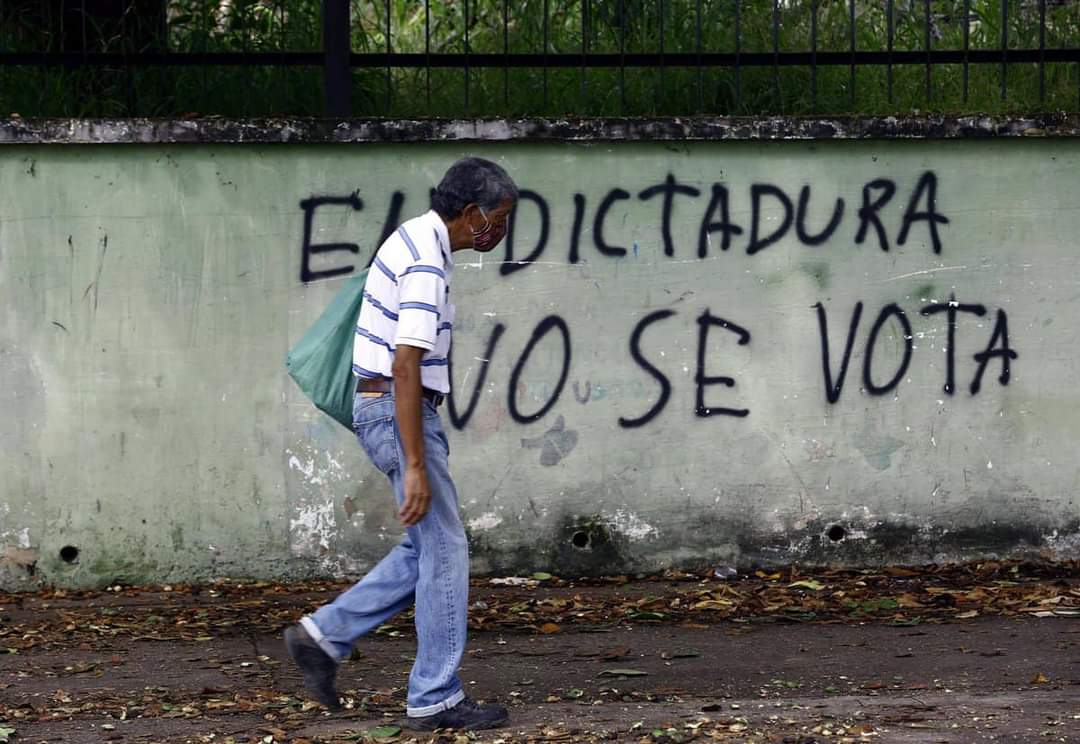
"En Dictadura No Se Vota" translates to "In Dictatorship You Don't Vote"

In a free society, one elects who will represent them, and one can petition their neighbors to vote for them and run for office. In a communist regime, one decides whether or not to suffer the consequences of not affirming the dictatorship by voting in an exercise in which there is no choice in representation. The Castro regime held what it called "municipal elections" on Sunday, November 27, 2022. Those in power made the decision about who would be selected before the public vote.

There was also a massive internet outage for over six hours on the eve of the election. 

Independent observers who wanted to monitor the vote were blocked from doing so, and some of them were placed under house arrest reported Marti Noticias today.

No transparency, candidates vetoed by dictatorship, independent monitoring of the vote blocked, and disillusioned voters pressured to go vote in the polls to demonstrate their fidelity to the dictatorship.

These are not free elections for voters to select candidates that will represent them, but a vote imposed by the dictatorship that demonstrates a "revolutionary affirmation" for the communist regime.

It is an electoral fraud, and Cubans are tired of it. Even the regime's official numbers that are not independently verifiable are reflecting it.

There has been a nonviolent effort to encourage Cubans not to take part in this electoral farce by various civil society actors. Below are two English translations of Tweets related to the ongoing fraudulent vote in Cuba.