Showing posts with label Ladies in White. Show all posts

Monday, March 23, 2026

Remembering two Cuban Springs over ten years apart and the crackdowns that followed

Two Cuban springs ended in crackdowns, but the democracy movement knows it will return.

Jose Cipriano Rodriguez, corporal in Batista's regime, prepared for firing squad (1959).

 
Winter arrives

Winter arrived in Cuba in 1959, and its darkest nights continued into 1969 when the Castro regime ended Christmas under the pretext of conducting the 10 million ton sugar harvest. It was supposed to be a temporary measure, but Christmas did not return until 1997.

The Castro dictatorship replaced the family as the primary unit of social organization in Cuba during this darkest of winters. By doing so, it displaced the family and encouraged family members to spy on one another, creating widespread mistrust that persists today.

During this time, the Castro dictatorship's prison inmates were the keepers of Cuba’s human rights and democratic legacy, which later emerged in 1976 when the Cuban Committee for Human Rights was founded.

First thaw

Ricardo Bofill, Cuban Committee for Human Rights, Havana 1987

The international community first learned about their human rights reports through paper scraps they smuggled out of these prisons. The scandal that followed forced the Castro dictatorship 12 years later to allow visits from the Office of the High Commissioner for Human Rights, the International Committee of the Red Cross, Amnesty International, and Human Rights Watch to Cuba and the prisons throughout the island. This thaw lasted between 1988 and 1989.

Many resistance organizations were formed during this time and in the years that followed. One of these organizations was the Christian Liberation Movement, which was founded in 1988.

Over the course of 10 years, this movement discovered ways to mobilize the Cuban people and demand that the communist government uphold its own laws and regulations, which on paper purported to include democratic components but were not observed in fact.

The Brothers to the Rescue shootdown on February 24, 1996
, which resulted in the deaths of four human rights advocates, prompted the adoption of the Cuban Democracy and Solidarity Act on March 12, 1996, which tightened sanctions on Havana.

Castro decided that the Pope visiting Cuba would be a good way to obtain favorable coverage for the regime in its efforts to relax or lift sanctions.

When Spring started in December


In the weeks leading up to the first Papal visit to Cuba, the Castro regime relaxed certain restrictions on the Catholic church in December 1997. "The church was granted permission to conduct open-air services and processions. Lay workers were allowed to go door-to-door to inform parishioners of the visit and the church had access to media for the publishing of the Pope's Christmas message in Granma by allowing a televised speech by Cardinal Ortega, and by providing at the last minute, live coverage of the papal masses."

The return of Christmas was also supposed to be a temporary measure, in honor of Pope John Paul II's apostolic visit to Cuba (January 21- 26, 1998) . However, 25 years later Christmas continues to be celebrated in Cuba.

Some have pointed to this Papal visit as the beginning of a Cuban spring, where cracks appeared in the totalitarian edifice of Cuba’s communist dictatorship that over five years, forever changed the island nation.

The Cuban Democratic Directorate published Steps to Freedom analyzing democratic resistance beginning in 1997 with 44 civic actions, saw an increase to 233 civic actions in 1999, following Pope John Paul II's visit, then 444 in 2000, 600 in 2001, 959 in 2002, and 1,328 in 2003.

The Christian Liberation Movement, founded in 1988, following the 1998 visit of Pope John Paul II launched their most ambitious initiative, the Varela Project, named after the Cuban Priest, Felix Varela, who in the 19th century was credited with being the one who taught Cubans how to think. Father Varela sought Cuban independence, and was a fierce opponent of slavery.

On May 10, 2002, carrying 11,020 signed petitions in support of the Varela Project, the Christian Liberation Movement's Oswaldo Payá Sardiñas, Antonio Diaz Sanchez, and Regis Iglesias Ramirez delivered them to the Cuban National Assembly.

Former President James Carter visited Cuba in May 2002. On May 15th Mr. Carter gave a speech at the University of Havana, where he advocated for the lifting of economic sanctions on Cuba and "called for the Varela Project petition to be published in the official newspaper so that people could learn about it."

Havana’s response to this nonviolent citizen's initiative, and to President Carter's request? Coerced Cubans into signing another petition declaring the Constitution unchangeable and quickly passed it through the rubber stamp legislature.

The Varela Project was never presented for debate before the National Assembly, which violated the regime’s existing laws.

Winter returned in March 2003

Ten months later on March 18, 2003 the secret police began rounding up Cubans who had made the Varela Project possible. Seventy five activists would be put on trial and condemned to long prison terms. Over 40 of them had taken part in the Varela initiative. 

It was the end of a Cuban Spring, but the democracy movement knew that Spring would return.

Out of the 2003 crackdown emerged the Ladies in White. These were the wives, mothers, sisters, and daughters of the men arrested. Using nonviolent means, and suffering violent repression they campaigned for their release, and on March 23, 2011 they achieved their immediate goal.

Twenty years later on March 18, 2023, three of the former prisoners of conscience arrested two decades earlier reflected on the events of that day, and the aftermath in a panel discussion organized by the Center for a Free Cuba. It is long, but worth the watch. However, it is in Spanish.

Saturday, May 10, 2025

Project Varela at Twenty Three

 "The solution to the Cuban problem lies with the Cubans, and that's why we created the Varela Project." - Oswaldo Payá , Havana, February 2012

Oswaldo Payá, Regis Iglesias, and Antonio Diaz, turn in petitions

Twenty three years ago today on May 10, 2002, carrying 11,020 signed petitions in support of the Varela Project, the Christian Liberation Movement's Oswaldo Payá Sardiñas, Antonio Diaz Sanchez, and Regis Iglesias Ramirez delivered them to the Cuban National Assembly.

Milan Kundera, the Czech writer, in his 1999 novel The Book of Laughter and Forgetting observed that "the struggle of man against power is the struggle of memory against forgetting." Memory provides context to unfolding events today, and helps to render informed judgements.

This blog entry is an exercise in preserving memory.

The Varela Project, named after the Cuban Catholic Priest Felix Varela, sought to reform the Cuban legal system to bring it in line with international human rights standards. They had followed the letter of the law in organizing the campaign. They specifically asked for the following in the petition.

  • Guarantee the right to free expression and free association that guarantee pluralism, opening Cuban society to political debate and facilitating a more participatory democracy. 
  • Amnesty for all those imprisoned for political reasons.  
  • Right of Cubans to form companies, both individually owned and in cooperatives. 
  • Proposal for a new electoral law that truly guarantees the right to elect and be elected to all Cubans and the holding of free elections

The Christian Liberation Movement was founded by Catholic lay people in Havana in September 1988, and is part of a non-violent dissident movement that traces its origins and influences to the Cuban Committee for Human Rights that was founded in 1976.

President James Carter at the University of Havana.

Former President James Carter visited Cuba in May 2002 and on May 15th gave a speech at the University of Havana, where he advocated for the lifting of economic sanctions on Cuba and "called for the Varela Project petition to be published in the official newspaper so that people could learn about it."

Yet the dictatorship's response to the nonviolent citizen's initiative, and to President Carter's request, was to coerce Cubans into signing another petition declaring the Constitution unchangeable and quickly passed it through the rubber stamp legislature.

The Varela Project was not presented for debate before the National Assembly, which according to then existing law drafted by the Cuban government meant that it should have been deliberated in that legislative body. 

Less than a year after the petitions were turned in, starting on March 18, 2003 the Cuban Spring would end with a massive crackdown on Cuban civil society with many of the Project Varela organizers, imprisoned and summarily sentenced up to 28 years in prison. 

The 75 activists with long prison sentences became known as the "group of the 75."

With the end of the Cuban Spring Antonio Diaz Sanchez was sentenced to 20 years in prison, and Regis Iglesias Ramirez was sentenced to 18 years in prison.

The Castro regime announced, at the time, that the Cuban dissident movement had been destroyed. 

They spoke prematurely. 

First, the remaining activists who were still free continued gathering signatures and would turn in another 14,384 petition signatures on October 5, 2003, and they continued to gather more. 

Secondly, the mothers, wives, sisters and daughters of the activists who had been detained and imprisoned organized themselves into the "Ladies in White." A movement that sought the freedom of their loved ones and organized regular marches through the streets of Cuba, despite regime organized violence visited upon them. This new movement was led by Laura Inés Pollán Toledo, a former school teacher.

Antonio Diaz Sanchez and Regis Iglesias Ramirez were released from prison into forced exile in 2010. 

President Carter made a second trip to Cuba in March 2011, and did not publicly mention Project Varela during that visit, but instead focused efforts on trading Alan Gross for the remaining members of the WASP network jailed in the United States on charges of espionage, and murder conspiracy that killed three Americans and a US resident in 1996, and calling for the lifting of economic sanctions on the Castro regime. President Carter also downplayed the threat of FARC, ETA, and ELN terrorists harbored in Cuba.

Less than two months after the visit, Cuban dissident and former political prisoner, Juan Wilfredo Soto Garcia (age 46) was arrested and beaten to death by Cuban regime police while protesting the dictatorship and died early on Sunday May 8, 2011. Months later on October 15, 2011 Laura Inés Pollán Toledo died under suspicious circumstances at the Calixto Garcia hospital.

Oswaldo Payá Sardiñas was killed on July 22, 2012 together with Harold Cepero, a youth leader of the Christian Liberation Movement, in a car "accident" that all the hallmarks of a state security operation copied after the East German Stasi, who trained intelligence operatives in the Castro regime.

Revisiting and remembering these historic moments is part of the struggle against forgetting, and the conversation that it may arouse will only serve, when backed up with facts, to strengthen memory with truth. Memory, and retentiveness are defenses against the Castro regime's totalitarian rewriting of history. 

Oswaldo Payá Sardiñas in a July 14, 2003 opinion piece in the Los Angeles Times provided context to the aftermath of Project Varela, and the March 18, 2003 crackdown in which 75 Cuban dissidents, many of them organizers of the petition drive were sentenced to prison terms of up to 28 years. 

"Cuba finds itself in a grave crisis. In the last few years, thousands of its citizens have participated in what’s known as the Varela Project, overcoming a culture of fear and calling for a national referendum on civil rights, the peaceful evolution of freedom and reconciliation. But now a cloud of terror hangs over that quest for change."

This analysis remains relevant today. 

In 2023 Antonio Diaz Sanchez, Regis Iglesias Ramirez and other members of the Christian Liberation Movement reflected on the significance of the Varela Project. 

Monday, May 22, 2023

Twenty years ago brave Cuban women took the name Ladies in White.

Today four Ladies in White are in prison for demanding freedom for political prisoners and respect for human rights.

Ladies in White Tania Echevarría, Saylí Navarro, Sissi Abascal & Aymara Nieto jailed.
 

May 22, 2023 marks the day twenty years  ago when a group of brave Cuban women took the name the Ladies in White.  

They first came together on March 30, 2003 in the aftermath of a major crackdown that began on March 18, 2003, and with political show trials underway targeting their loved ones. 

Claudia Márquez (L) , Blanca Reyes (center) y Miriam Leiva (Rt), on 4/7/03 (Martí Noticias)

These courageous women carried out marches demanding the freedom of all prisoners of conscience and recognition of international human rights standards. 

Their objective was to see an end to prisoners of conscience in Cuba. 

Recognizing their struggle, the European Parliament awarded the Ladies in White the Sakharov Prize in 2005.

They've paid a high price for this stand. Movement leader Laura Pollán may have paid the highest price.  

Laura Pollán, February 13, 1948 - October 14, 2011

Mary O'Grady in The Wall Street Journal on October 24, 2011 reported that Pollán instead of disbanding sought to expand "the movement across the country and promised to convert it to a human rights organization open to all women. Speaking from the Guanajay prison as her condition was deteriorating, jailed former Cuban counterintelligence officer Ernesto Borges Pérez told the Hablemos Press that making public those objectives likely sealed her fate." Laura Pollán died on October 14, 2011 and was cremated shortly afterwards.

Twenty years later, and the Ladies in White continue to be subjected to brutal repression, and four women of this movement are now jailed in Cuba for calling for the release of political prisoners, and nonviolently defending human rights.

The current elected leader of the Ladies in White in Cuba is Berta Soler Fernandez.


Artists have celebrated them over the years, and their work endures. Mike Porcel in 2005 composed the song "Damas de Blanco" for a documentary about the Ladies in White.

In 2011, following Laura Pollán's death, Amaury Gutierrez composed the song "Laura", and in 2013 played it for Berta Soler and other Ladies in White at Our Lady of Charity when she visited Miami.

Today, 20 years later, we remember their courageous example, and the need to follow their lead both inside and outside of Cuba. 

Freedom for Tania, Sayli, Sissi, Aymara, and the over 1,000 other prisoners of conscience in Cuba.

Wednesday, May 10, 2023

Project Varela at Twenty One


Oswaldo Payá, Regis Iglesias, and Antonio Diaz, walk to turn in petitions

Twenty one years ago today on May 10, 2002, carrying 11,020 signed petitions in support of the Varela Project, the Christian Liberation Movement's Oswaldo Payá Sardiñas, Antonio Diaz Sanchez, and Regis Iglesias Ramirez delivered them to the Cuban National Assembly.

Milan Kundera, the Czech writer, in his 1999 novel The Book of Laughter and Forgetting observed that "the struggle of man against power is the struggle of memory against forgetting." Memory provides context to unfolding events today, and helps to render informed judgements.

This blog entry is an exercise in recovering memory.


The Varela Project, named after the Cuban Catholic Priest Felix Varela, sought to reform the Cuban legal system to bring it in line with international human rights standards. They had followed the letter of the law in organizing the campaign. They specifically asked for the following in the petition.

  • Guarantee the right to free expression and free association that guarantee pluralism, opening Cuban society to political debate and facilitating a more participatory democracy. 
  • Amnesty for all those imprisoned for political reasons.  
  • Right of Cubans to form companies, both individually owned and in cooperatives. 
  • Proposal for a new electoral law that truly guarantees the right to elect and be elected to all Cubans and the holding of free elections

The Christian Liberation Movement was founded by Catholic lay people in Havana in September 1988, and is part of a non-violent dissident movement that traces its origins and influences to the Cuban Committee for Human Rights that was founded in 1976.

President James Carter at the University of Havana.

Former President James Carter visited Cuba in May 2002 and on May 15th gave a speech at the University of Havana, where he advocated for the lifting of economic sanctions on Cuba and "called for the Varela Project petition to be published in the official newspaper so that people could learn about it."

Yet the dictatorship's response to the nonviolent citizen's initiative, and to President Carter's request, was to coerce Cubans into signing another petition declaring the Constitution unchangeable and quickly passed it through the rubber stamp legislature.

The Varela Project was not presented for debate before the National Assembly, which according to then existing law drafted by the Castro dictatorship meant that it should have been debated in that legislative body. 

Less than a year after the petitions were turned in, starting on March 18, 2003 the Cuban Spring would end with a massive crackdown on Cuba's civil society with many of the Project Varela organizers, imprisoned and summarily sentenced up to 28 years in prison. 

The 75 activists with long prison sentences became known as the "group of the 75."


With the end of the Cuban Spring Antonio Diaz Sanchez was sentenced to 20 years in prison, and Regis Iglesias Ramirez was sentenced to 18 years in prison.

The Castro regime announced, at the time, that the Cuban dissident movement had been destroyed. 

They spoke prematurely. 

First, the remaining activists who were still free continued gathering signatures and would turn in another 14,384 petition signatures on October 5, 2003, and they continued to gather more. 

Secondly, the mothers, wives, sisters and daughters of the activists who had been detained and imprisoned organized themselves into the "Ladies in White." A movement that sought the freedom of their loved ones and organized regular marches through the streets of Cuba, despite regime organized violence visited upon them. This new movement was led by Laura Inés Pollán Toledo, a former school teacher.

Antonio Diaz Sanchez and Regis Iglesias Ramirez were released from prison into forced exile in 2010. 

President Carter made a second trip to Cuba in March 2011, and did not publicly mention Project Varela during that visit, but instead focused efforts on trading Alan Gross for the remaining members of the WASP network jailed in the United States on charges of espionage, and murder conspiracy that killed three Americans and a US resident in 1996, and calling for the lifting of economic sanctions on the Castro regime. President Carter also downplayed the threat of FARC, ETA, and ELN terrorists harbored in Cuba.

Less than two months after the visit, Cuban dissident and former political prisoner, Juan Wilfredo Soto Garcia (age 46) was arrested and beaten to death by Cuban regime police while protesting the dictatorship and died early on Sunday May 8, 2011. Months later on October 15, 2011 Laura Inés Pollán Toledo died under suspicious circumstances at the Calixto Garcia hospital.

Oswaldo Payá Sardiñas was killed on July 22, 2012 together with Harold Cepero, a youth leader of the Christian Liberation Movement, in a car "accident" that all the hallmarks of a state security operation copied after the East German Stasi, who trained intelligence operatives in the Castro regime.

Revisiting and remembering these historic moments is part of the struggle against forgetting, and the conversation that it may arouse will only serve, when backed up with facts, to strengthen memory with truth. Memory, and retentiveness are defenses against the Castro regime's totalitarian rewriting of history. 

Oswaldo Payá Sardiñas in a July 14, 2003 opinion piece in the Los Angeles Times provided context to the aftermath of Project Varela, and the March 18, 2003 crackdown in which 75 Cuban dissidents, many of them organizers of the petition drive were sentenced to prison terms of up to 28 years. 

"Cuba finds itself in a grave crisis. In the last few years, thousands of its citizens have participated in what’s known as the Varela Project, overcoming a culture of fear and calling for a national referendum on civil rights, the peaceful evolution of freedom and reconciliation. But now a cloud of terror hangs over that quest for change."

This analysis remains relevant today. 


Thursday, March 30, 2023

The Ladies in White Founders: A look back to their first gathering 20 years ago today

 What's past is prologue. = William Shakespeare, The Tempest, Act 2, Scene I.

Claudia Márquez Linares (left), Blanca Reyes Castañón (center) and Miriam Leiva (right).

The Ladies in White were founded by Claudia Márquez Linares, Blanca Reyes Castañón, Dolia Leal Francisco, Miriam Leiva Viamonte, Gisela Delgado Sablón, Yolanda Huerga Cedeño, Marcela Sánchez Santa Cruz, and Berta de los Angeles Soler Fernandez, whose husbands were imprisoned in March 2003.

 On March 30, 2003, this group of women, later known as the Ladies in White, visited the Santa Rita Church in Havana, Cuba for the first time.

Claudia Márquez Linares, was then leading the Sociedad de Periodistas Independientes "Manuel Márquez Sterling" ("Manuel Márquez Sterling" Society of Independent Journalists.)  Her husband was opposition leader Osvaldo Alfonso Valdés.  Osvaldo, led the Partido Liberal Democrático de Cuba (Liberal Democratic Party of Cuba), and was sentenced to 18 years in prison following the March 2003 crackdown. 

Blanca Reyes Castañón, one of the founders of the movement and wife of the prestigious writer, poet and journalist, now deceased, Raúl Rivero, sentenced to 20 years in prison, declared to The New York Times in 2003: ''This is so arbitrary for a man whose only crime is to write what he thinks,'' said Mr. Rivero's wife, Blanca Reyes. ''What they found on him was a tape recorder, not a grenade.''

Dolia Leal Francisco is the wife of Nelson Aguiar, sentenced to 13 years in prison in 2003. At the time of his arrest Aguiar was president of the Cuban Orthodox Party. "Before her husband was sentenced to 13 years in prison, Dolia Leal Francisco had little contact with the other wives of Cuba's dissidents.
Today, they are like a surrogate family to her, a sort of sisterhood bound by shared summary trials", reported the Havana Bureau of the South Florida Sun Sentinel on May 4, 2003. 

Miriam Leiva Viamonte was a Cuban diplomat, translator and English professor who was expelled from her job at the Ministry of Foreign Relations after working their for 20 years in September 1992 for "loss of political confidence" because she had refused to conspire against her husband on their behalf, who they had accused of being a "counter-revolutionary subject." She became a human rights defender in 1995, and independent journalist in 1996. Her husband Oscar Espinosa Chepe, an economist, was arrested in the March 2003 crackdown and sentenced to 20 years in prison.


Gisela Delgado Sablón is the wife of Héctor Palacios Ruiz, who was arrested in the March 2003 crackdown and sentenced to 25 years in prison. Héctor Palacio, was president of the Partido Solidaridad Democrático (PSD), Democratic Solidarity Party, and had been a member of the national coordinating council of Concilio Cubano, Cuban Concilium in the late 1990s. 


Yolanda Huerga Cedeño is the wife of Manuel Vázquez Portal. On April 4, 2004, Manuel Vázquez was "sentenced to 18 years in prison for "endangering Cuba's independence" through his articles and his meetings with US officials."

Marcela Sánchez Santa Cruz Pacheco is the sister of human rights activist Elizardo Sánchez Santacruz.

Berta de los Angeles Soler Fernandez studied microbiology and became a hospital technician in Havana. In 1988, Berta married Angel Moya Acosta, an opposition activist who became one of 75 nonviolent dissidents arrested during the March 2003 crackdown. Her activism began after Cuban authorities jailed her husband in 2003, and sentenced him to 20 years in prison.  In October 2004, the Ladies in White staged protests in front of the Communist Party’s headquarters in Revolution Square, pressuring the government to allow Berta’s husband to undergo surgery for a herniated disc. The protest went on for two days until the regime permitted Angel’s operation.

Wednesday, March 8, 2023

International Women's Day 2023: Reflection on women's resistance in Cuba and Iran

  "We still think of a powerful man as a born leader and a powerful woman as an anomaly". - Margaret Atwood, author of The Handmaid's Tale


In 2022 focused on the different treatment of women under capitalist and communist regimes. Explored how a communist regime in Romania was a main inspiration for Margaret Atwood's dystopian novel, The Handmaid's Tale.

Shannon Quinn, an author at History Collection, in her post  "17 Moments In History that Inspired the Handmaid’s Tale" in History Collection cited Nicolae Ceausescu's Decree 770 policy targeting Romanian women.

One of the specific events that Margaret Atwood found during her research process was “Decree 770” in Romania. This was a law that passed in 1967 that made abortions and all forms of contraception illegal. This had nothing to do with religious beliefs. It was an action that the government believed was necessary for the future of their country. The government already taxed married couples a 6% income tax if they did not have children between the ages of 25 and 50, but they realized that this was not enough to stop people from using contraception. 


In 2020 focused on the problematic origins of International Women's Day, but today reflect on women who are resisting tyranny.

Specifically, this year will examine how women in Cuba and Iran are challenging totalitarian rule in a communist and theocratic regime respectively. 

Cuba

Over the past sixty four years the Castro dictatorship has systematically violated the human rights of prisoners of conscience and political prisoners in Cuba. Between 1959 and 1988 no international organizations were allowed to visit prisons in Cuba. This included the International Committee of the Red Cross. Lilo Vilaplana’s film Plantadas, screened on Sunday at the Miami Film Festival, examines this chapter of Cuban history, how it impacted Cuban women, and offers viewers the opportunity to revisit some important works to accompany this important movie.

In 1995 Ana Rodriguez with the assistance of Glenn Garvin wrote her memoir DIARY OF A SURVIVOR: Nineteen Years in a Cuban Women's Prison. Ana Rodriguez, a medical student who first conspired against the Batista dictatorship, first welcoming the arrival of Fidel Castro to power she soon became disillusioned and turned against the emerging communist dictatorship. Captured, Ana was sentenced to a 30 year prison sentence for her non-violent dissent in the anti-Castro underground. Over the 19 years she spent in prison, Ana "consistently defied the authorities' brutal and at times comically inept efforts to break her will." She is an example of a plantada, and she was not alone.

Sadly, there were many others like Ana Rodriguez, Gloria Argudín and Luisa Pérez who endured years of torture and mistreatment in Cuban prisons for their political beliefs.

The testimony of Luisa Pérez, another former plantada ( defiant) political prisoner about Cuban prisons in "Nobody listened" (1987), a documentary by Néstor Almendros and Jorge Ulla, is consistent with the testimony of Dora Delgado "Japón" on pages. 175-176 of the 2007 book Todo Lo Dieron Por Cuba (They Gave Everything For Cuba) by Mignon Medrano:

... Mother's Day falls on the 14th again. It was a month full of fights with the militia, of beatings, it was a terrible month. On the 6th they came to galley 1 with a list and called Caridad Roque, me and others. As they called, the others said, "Hey, save me a good bed, and if there are mangoes, pick one for me," because we thought we were going to the farm. But when they noticed that they were taking five from here, two from there and four from another place, and they heard the names, they said, "This smells rotten to us... that the first transfer to the farm is with these people? ... listen, girls, whatever happens, shout!" ...

Indeed, at the end of the long and dark corridor, Ramiro Valdés himself was waiting for us in front of about 600 men. I could not shout and alert because the galleys were open and they would have launched into a certain massacre. I kept walking, behind me came Pola and noticing my reaction she also hid it. That helped the others do the same. But when those who stayed behind found out that we had been taken to Guanajay with the general prison population, they began to break everything that was within their reach and clang metal objects against the iron bars of the cells that was so loud that it became famous in the history of the prison...

... I would like to add to the story of the escape from Guanabacoa that when the verdeolivos caught us and they dragged us to the galley, they had some long weapons that looked like old muskets, which we began to make fun of. We didn't know they were gas launchers. They fired them at point-blank range and with the flashes they burned her face, shattered the face of Luisa Pérez… It was a tremendous fight, blows come and go… They burned all of us with flashes.

Without giving us medical attention, they threw us into the cells like pigs and several days later they separated us in different places…"

Today there are at least 125 Cuban women jailed for exercising their fundamental human rights, and many of them are Plantadas.

 
The women political prisoners who signed with their blood a letter demanding that Miguel Díaz-Canel fulfill Pope Francis' wish that the protesters of July 11, 2021 be released, were taken this past Thursday to a disciplinary court in the women's prison of Guatao in Havana.
 

In 1987 the documentary "Nobody Listened" captured Cuba's human rights reality combining interviews with former political prisoners, including some Plantadas, archival footage of firing squads and other instances of repression. Former prisoners described show trials, extajudicial executions, and cruel and unusual punishment that rose to the level of torture. This is the perfect documentary to accompany the new film, Plantadas and provides historical context to the new movie, and is available online and for purchase on Amazon. 
 
Please follow these courageous Cuban women: Anamely Ramos González @AnamelyRamos, Berta Soler Fernández @bertasolerf, Carolina Barrero @carolinabferrer, Damas de Blanco @DamasdBlanco, Mar por Cuba @MARporCuba, Omara @OmaraRUrquiola, Ileana Ros-Lehtinen @RosLehtinen, Rosa María Payá A. @RosaMariaPaya, Sirley Avila Leon @Sirleyavilaleon and there are many more that are impossible to list all here.

,

Iran

In September 2022 this blog published a "Call for solidarity with protesters in Iran. Please share hashtags: #MahsaAmini #ZhinaAmini #IranProtests," that highlighted the killing of Mahsa Amini by the Guidance Patrol, also called the morality police, massive nationwide protests that followed, how to help, provided some historic context on relations between Tehran and Cuba, and highlighted the important role of Iranian women in this nationwide uprising. A revolution driven by a celebration and defense of Women, Life, Freedom.

In July 2022, Tehran tried to kidnap, then murder Masih Alinejad.

Iranian journalist Masih Alinejad, who was repeatedly cited in the previous blog post, was targeted by the Iranian Intelligence Services in a plot to kidnap her for Rendition to Iran, revealed the FBI on July 13, 2021. A little over a year later on July 31, 2022 Khalid Mehdiyev, age 23, was found outside her home with an AK-47, a high-capacity magazine and more than $1,000 in cash.

Khalid Mehdiyev is from Azerbaijan, and according to Jason Brodsky at the United Against Nuclear Iran nonprofit the dictatorship in Iran has been known to contract "Azeri hitmen to target Israelis in Cyprus."   

Ayatollah Khomeini, then supreme leader of Iran, issued a fatwa on February 14, 1989 condemning Salman Rushdie to death for blasphemy, and it was never rescinded. Salman Rushdie was attacked by Hadi Matar, age 24, on August 12, 2022 and stabbed in the stomach, chest, eye, hand and thigh. Rushdie needed to be placed on a respirator following the attack, and nearly died. 

U.S. residents are being targeted for kidnapping and murder by agents of Iran in 2022. This is happening in America. This is unacceptable.

Ignoring the injustices taking place in Iran, brought them to New York. Time to pay attention, and hold the mullahs accountable.

Seven months later and it appears that the Mullahs in Iran, in their desperation before women's and young girls resistance to their theocratic rule, may be poisoning young girls who attend school in a war against girl's education.  

The time for solidarity with Iranian women continues.

Please follow Masih Alinejad @AlinejadMasih on Twitter and amplify her voice, and that of other Iranian women such as:  Nazanin Nour @NazaninNour, Roya Hakakian @RoyaTheWriter, Nazanin Boniadi @NazaninBoniadi, Nazenin Ansari @NazeninA, Nazanin Afshin-Jam MacKay @NazaninAJ, and Mariam Memarsadeghi @memarsadeghi. 

On Saturday at 2:00pm in Washington DC Iranian activists will gather at Freedom Plaza and hold a Global Women's March for Iran.


Tuesday, May 10, 2022

Project Varela at Twenty

Oswaldo Payá, Regis Iglesias, and Antonio Diaz, walk to turn in petitions

Twenty years ago today on May 10, 2002, carrying 11,020 signed petitions in support of the Varela Project, the Christian Liberation Movement's Oswaldo Payá Sardiñas, Antonio Diaz Sanchez, and Regis Iglesias Ramirez delivered them to the Cuban National Assembly.

Milan Kundera, the Czech writer, in his 1999 novel The Book of Laughter and Forgetting observed that "the struggle of man against power is the struggle of memory against forgetting." Memory provides context to unfolding events today, and helps to render informed judgements.

This blog entry is an exercise in recovering memory. 

The Varela Project, named after the Cuban Catholic Priest Felix Varela, sought to reform the Cuban legal system to bring it in line with international human rights standards. They had followed the letter of the law in organizing the campaign. They specifically asked for the following in the petition.

  • Guarantee the right to free expression and free association that guarantee pluralism, opening Cuban society to political debate and facilitating a more participatory democracy. 
  • Amnesty for all those imprisoned for political reasons.  
  • Right of Cubans to form companies, both individually owned and in cooperatives. 
  • Proposal for a new electoral law that truly guarantees the right to elect and be elected to all Cubans and the holding of free elections

The Christian Liberation Movement was founded by Catholic lay people in Havana in September 1988, and is part of a non-violent dissident movement that traces its origins and influences to the Cuban Committee for Human Rights that was founded in 1976.

President James Carter at the University of Havana.

Former President James Carter visited Cuba in May 2002 and on May 15th gave a speech at the University of Havana, where he advocated for the lifting of economic sanctions on Cuba and "called for the Varela Project petition to be published in the official newspaper so that people could learn about it."

Yet the dictatorship's response to the nonviolent citizen's initiative, and to President Carter's request, was to coerce Cubans into signing another petition declaring the Constitution unchangeable and quickly passed it through the rubber stamp legislature. 

 The Varela Project was not presented for debate before the National Assembly, which according to then existing law drafted by the Castro dictatorship meant that it should have been debated in that legislative body. 

On May 7, 2022 at the West Dade Regional Library (9445 Coral Way) in Miami, Florida,  the Christian Liberation Movement  hosted a discussion that commemorated the 20th anniversary of the Varela project in Cuba, its legacy and impact.

Project Varela organizers gathered at the West Dade Regional Library on May 7, 2022

Many of the participants on Saturday focused on the immediate aftermath of the first signatures being turned in, and the wave of repression that followed. 

Less than a year after the petitions were turned in, starting on March 18, 2003 the Cuban Spring would end with a massive crackdown on Cuba's civil society with many of the Project Varela organizers, imprisoned and summarily sentenced up to 28 years in prison. 

The 75 activists with long prison sentences became known as the "group of the 75."

With the end of the Cuban Spring Antonio Diaz Sanchez was sentenced to 20 years in prison, and Regis Iglesias Ramirez was sentenced to 18 years in prison.

The Castro regime announced, at the time, that the Cuban dissident movement had been destroyed. 

They spoke prematurely. 

First, the remaining activists who were still free continued gathering signatures and would turn in another 14,384 petition signatures on October 5, 2003, and they continued to gather more. 

Secondly, the mothers, wives, sisters and daughters of the activists who had been detained and imprisoned organized themselves into the "Ladies in White." A movement that sought the freedom of their loved ones and organized regular marches through the streets of Cuba, despite regime organized violence visited upon them. This new movement was led by Laura Inés Pollán Toledo, a former school teacher.

Antonio Diaz Sanchez and Regis Iglesias Ramirez were released from prison into forced exile in 2010. Today marking this anniversary of the Varela Project, the Christian Liberation Movement released the following statement.

"Exactly 20 years ago, with hundreds of political prisoners in jail and a mostly terrified people, 11,020 Cubans peacefully demanded the freedom of political prisoners and free elections, so that Cubans could freely choose their political and economic model. 

The response of the tyranny was repression, exile and even murder. 

Two decades later, political prisoners multiply and terror expands on the island through repression, while the solidarity of many bows to petty interests, providing impunity to the regime, today more tyrannical and more despotic than ever. 

On the 20th anniversary of that civic gesture of the people of Cuba, honoring the memory of Oswaldo Paya and Harold Cepero and all those who have fallen in this struggle, thinking of the thousands of political prisoners who are today in communist dungeons, living with the Cuban people the lack of freedom and rights, we proclaim our will to continue working indefinitely together with the people, until freedom and democracy arrive in Cuba, which by right belongs to all Cubans. 

ALL CUBANS! 

ALL BROTHERS! 

AND NOW FREEDOM." 

President Carter made a second trip to Cuba in March 2011, and did not publicly mention Project Varela during that visit, but instead focused efforts on trading Alan Gross for the remaining members of the WASP network jailed in the United States on charges of espionage, and murder conspiracy that killed three Americans and a US resident in 1996, and calling for the lifting of economic sanctions on the Castro regime. President Carter also downplayed the threat of FARC, ETA, and ELN terrorists harbored in Cuba.

Less than two months after the visit, Cuban dissident and former political prisoner, Juan Wilfredo Soto Garcia (age 46) was arrested and beaten to death by Cuban regime police while protesting the dictatorship and died early on Sunday May 8, 2011. Months later on October 15, 2011 Laura Inés Pollán Toledo died under suspicious circumstances at the Calixto Garcia hospital.

Oswaldo Payá Sardiñas was killed on July 22, 2012 together with Harold Cepero, a youth leader of the Christian Liberation Movement, in a car "accident" that all the hallmarks of a state security operation copied after the East German Stasi, who trained intelligence operatives in the Castro regime.

Revisiting and remembering these historic moments is part of the struggle against forgetting, and the conversation that it may arouse will only serve, when backed up with facts, to strengthen memory with truth. Memory, and retentiveness are defenses against the Castro regime's totalitarian rewriting of history. 

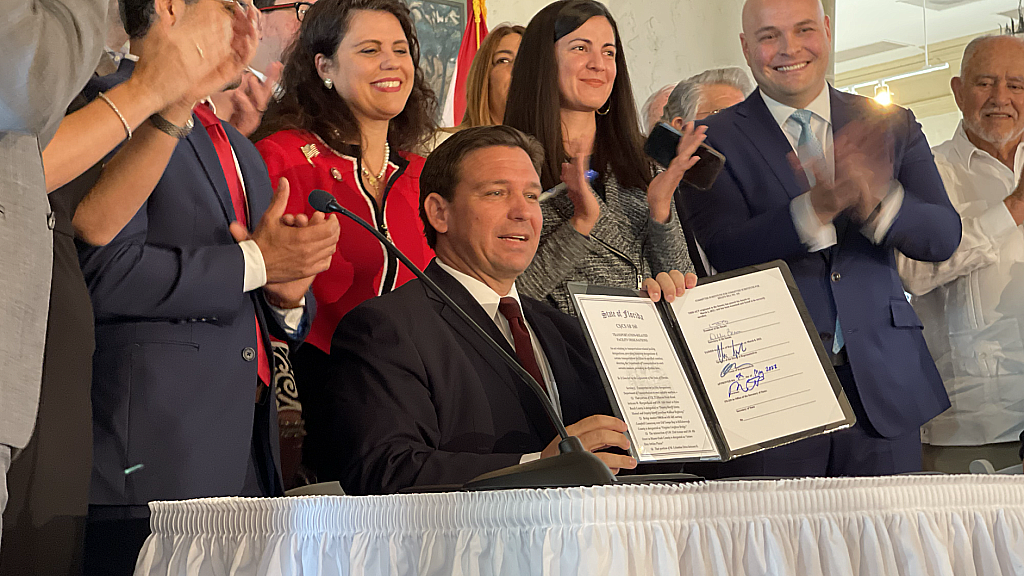
Florida Governor Ron DeSantis signs bill designating Le Jeune Rd Oswaldo Payá Way

On May 9, 2022, the eve of the 20th anniversary of the first Varela Project petitions being turned in to the National Assembly in Cuba, Florida Governor Ron DeSantis signed a bill that designated "a portion of State Road 953, known as Le Jeune Road, between Northwest 11th Street and Northwest 14th Street in Miami-Dade County" as Oswaldo Payá Way. 

This was a concrete act against forgetting and in defense of this important legacy by free Cubans. 

Oswaldo Payá Sardiñas in a July 14, 2003 opinion piece in the Los Angeles Times provided context to the aftermath of Project Varela, and the March 18, 2003 crackdown in which 75 Cuban dissidents, many of them organizers of the petition drive were sentenced to prison terms of up to 28 years. 

"Cuba finds itself in a grave crisis. In the last few years, thousands of its citizens have participated in what’s known as the Varela Project, overcoming a culture of fear and calling for a national referendum on civil rights, the peaceful evolution of freedom and reconciliation. But now a cloud of terror hangs over that quest for change."

This analysis remains relevant today.