HKFS: is NOT revolution, it's a democratic movement, we heard there'll be violent clearance tonite, will stay alert. - Occupy Central, October 4, 2014 over twitter
"I have criticized the revolutionary because I have felt for him. He has the
same right to hold me to be in error as I believe him to be in error." - Mohandas Gandhi
The Umbrella movement was officially launched at 1.45am on Sunday, September 28, 2014 because Mainland China is
not honoring its treaty obligations regarding Hong Kong maintaining its democratic system. Police
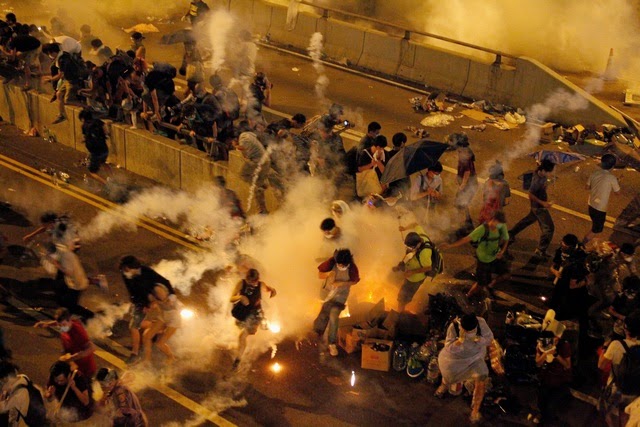
used tear gas and pepper spray on Sunday, September 28th in an attempt to disperse the nonviolent demonstrators which outraged many more Hong Kong residents who then joined the demonstrations. Tens of thousands of protesters
have taken to the streets over the past week, paralyzing not just Central Hong Kong but also parts of Causeway Bay, Admiralty and Mong Kok
demanding universal suffrage. On October 3, 2014 pro-government thugs,
some apparently connected with organized crime (the triads), attacked nonviolent demonstrators while police looked on passively.
Amnesty International and Human Rights Watch have issued statements on
events surrounding the protests in Hong Kong over the past week carried
out by the Umbrella Movement. On October 3rd Amnesty International denounced the failure of Hong Kong police to protect hundreds of demonstrators, including women and girls targeted for sexual assault and harassment, attacked by
pro-government protesters who appeared on the scene. Two days earlier on October 1, 2014 Amnesty reported on arrests in mainland China of Chinese nationals who had demonstrated sympathy or support for the Umbrella Movement in Hong Kong. Human Rights Watch in
an open letter expressed its concern for the ultimatum by the Hong Kong executive to use all means to clear the streets on October 6th and outlined three concrete steps the authorities must take to honor international legal obligations
and to uphold its reputation as a territory committed to the rule of
law.
Hong Kong: Women and girls attacked as police fail to protect peaceful protesters
Hong Kong’s police failed in their duty to protect hundreds of
peaceful pro-democracy protesters from attacks by counter demonstrators
on Friday evening (October 3, 2014) , Amnesty International said.
Women and girls
were among those targeted, including incidents of sexual assault,
harassment and intimidation, as counter-demonstrators clashed with
pro-democracy protesters in the Mongkok and Causeway Bay areas of Hong
Kong on Friday evening.
"The police inaction tonight is shameful.
The authorities have failed in their duty to protect peaceful
protesters who came under attack," said Mabel Au, Director of Amnesty
International Hong Kong.
[
Read the rest here]
China: Immediately release supporters of Hong Kong protests
The Chinese authorities must immediately and unconditionally release
all those detained for peacefully showing support for pro-democracy
protests in Hong Kong, said Amnesty International.
At least 20 people have been detained by police in several cities
in mainland China over the past two days for posting pictures online
with messages of support for the protesters, shaving their heads in
solidarity, or for planning to travel to Hong Kong to participate in the
protests.
A further 60 have been called in for questioning by the authorities, known as being 'invited for tea'.
"The rounding up of activists in mainland China only underlines why
so many people in Hong Kong fear the growing control Beijing has in
their city's affairs," said William Nee, China researcher at Amnesty
International.
"The fundamental freedoms being exercised by hundreds of thousands of
people in Hong Kong continue to be denied to those in mainland China."
Police are known to have detained people in Beijing, Jiangsu, and the
southern cities of Guangzhou and Shenzhen, which are close to Hong
Kong.
[
Read the rest here]
>Human Rights Watch Letter to Chief Executive Leung on Hong Kong Protests
Human Rights Watch in an open letter to the Hong Kong Chief Executive C.Y. Leung expressed its concern with Leung's insistence that protesters must leave the streets by Monday, October 6th and that "all actions necessary" would be used to achieve that goal and went on to say:
"These remarks raise serious concerns
about whether the government will adhere to international obligations to
use force only where necessary and only to the minimum extent needed.
The poor performance of some police officers in protecting some
protesters from violent counter-demonstrators, as well as the government
and the police’s initial failure to condemn that violence, raises
questions about whether protesters’ rights and safety will be respected
and protected. We believe that such words and actions can only
exacerbate tensions, particularly about whether ongoing peaceful
protests will be dispersed with force.
In order to comply with Hong Kong’s international legal obligations
and to uphold its reputation as a territory committed to the rule of
law, we urge that you:
1. Ensure that security forces abide by the United Nations (UN) Basic Principles on the Use of Force and Firearms.
We urge that security forces strictly adhere to these principles.
Under the Basic Principles, law enforcement officials shall, as far as
possible, “apply non-violent means before resorting to the use of
force.” When the lawful use of force is unavoidable, law enforcement
officials must “[e]xercise restraint in such use and act in proportion
to the seriousness of the offence and the legitimate objective to be
achieved.” Police restraint is particularly called for given that the
demonstrations in Hong Kong have been overwhelmingly peaceful.
2. Ensure maximum respect for ongoing peaceful demonstrations.
The International Covenant on Civil and Political Rights guarantees
the rights to peaceful assembly, association, and expression, and
tolerates no restrictions except those necessary for national security,
public order, and public safety. The government has failed to offer a
justification for the use of tear gas and pepper spray against peaceful
protesters on September 28 and 29.
If the government believes that the provision of public order
necessitates removing peaceful protesters from particular areas, it must
justify its decision in terms of why less restrictive measures would
not suffice to protect public order, offer alternative venues for
protest that are still central and accessible, and refrain from using
excessive force in clearing those areas where the burden to public
safety and health require clearance. Moreover, the government cannot
prohibit peaceful assembly and expression city-wide.
3. Swiftly investigate and prosecute all those suspected of violence against peaceful protesters.
There can be no impunity for those who have attacked peaceful
protesters. Hong Kong’s reputation as a city tolerant of peaceful
protest and as the home of a professional police force is deeply
tarnished as a result of the October 4 incidents in Mong Kok and
Causeway Bay. Peaceful protesters, journalists, and onlookers were
kicked, punched, and knocked to the ground by unidentified men. We have
received multiple credible reports of female protesters being sexually
assaulted. Protesters have also told Human Rights Watch that police
officers failed or refused to assist when pro-democracy protesters were
beaten or harassed by those who oppose them or that police officers let
suspected assailants leave without having taken down their details or
arresting them. These attacks took place over several hours, and
throughout that time police were few in number and appeared unwilling to
protect the protesters, raising concerns about collusion and biased law
enforcement.
[
Read the entire letter]






 Posts
Posts

