Friday, December 24, 2021

Join the campaign for Christmas without political prisoners in Cuba

 #ChristmasWithoutPoliticalPrisoners

A group of intellectuals, artists, former diplomats, religious leaders, and human rights defenders from around the world made an appeal during this holiday season that Catholic bishops "issue statements backing their Cuban counterparts' call for the release of Cubans jailed for the events of July 2021 and before, and a rejection of violence by the regime," and that they "include the freedom of Cuba's political prisoners, justice for the victims of repression, and national reconciliation for Cuba in prayers said at Mass, during this Christmas."

There are hundreds of Cuban political prisoners, and over 90 have been subjected to political show trials over the past ten days. Ambassador Brian A. Nichols, Assistant Secretary for Western Hemisphere Affairs on December 23rd tweeted that 90 + July 11th protesters across Cuba are being subjected to unjust legal proceedings and prison sentences of up to 25 years under atrocious prison conditions to terrorize Cubans and silence and intimidate peaceful demonstrators.

They are still ongoing, and those jailed are enduring terrible circumstances.

Prisoners of conscience such as Maykel Castillo Pérez, Franco Benítez, Esteban Rodríguez, Luis Manuel Otero Alcántara, Yandier García Labrada, José Daniel Ferrer García, Felix Navarro Rodriguez, Virgilio Mantilla Arango, Roberto Pérez Fonseca, Eloy Bárbaro Cardoso Pedroso, are in a precarious condition in facilities where COVID-19, Hepatitis, and other diseases run rampant with zero outside oversight. 

Now is the time to demonstrate our solidarity with those unjustly imprisoned for their political convictions. The late Vaclav Havel in an interview with Amnesty International in 2011 understood the need for people of good will to take action: "It's up to all of us to try, and those that say that individuals are not capable of changing anything are only looking for excuses."

Solidarity has been described as an act of resistance, but it is also an act of hope. Let us take action together and demand a general amnesty for all political prisoners, and in light of the present crises in Cuba let us pay special attention to what is going on in this island nation.

Please share information on ongoing political show trials, and messages from family members calling for their loved ones freedom.

The human rights organization CubaLex is asking that this artwork for Christmas be shared over social media with the hashtag in Spanish of #NavidadSinPresosPoliticos which translates into English as #ChristmasWithoutPoliticalPrisoners.

This is a time of unity, solidarity and generosity. Please share the following hashtags along with this campaign for a general amnesty for political prisoners and specific and documented information on the political captives of this regime.

1. Please  ask your pastor, rabbi, or priest to pray for the freedom of political prisoners during their religious services during this holiday season.

2. Please write letters to religious leaders in your community to request that the governments of Cuba, Venezuela and Nicaragua free their political prisoners.

3. Please use the following hashtags to spread this message.

#LiberenLosYa
#FreeThemNow
#FreedomForPoliticalPrisoners
#LibertadParaLosPresosPoliticos
#NavidadSinPresosPolíticos
#NavidadSinPresos
#ChristmasWithoutPoliticalPrisoners

Tuesday, December 14, 2021

RFK Human Rights calls on the IACHR to hold Cuba responsible for the 2012 death of pro-democracy leaders Oswaldo Paya and Harold Cepero

Hearing held today starting at 2pm EST at the Inter-American Commission on Human Rights regarding Case 14.196 - Oswaldo Payá Sardiñas, Harold Cepero and others vs Cuba. Below is the Youtube video.


IN THE NEWS

RFK Human Rights calls on the IACHR to hold Cuba responsible for the 2012 death of pro-democracy leaders Oswaldo Paya and Harold Cepero

On Tuesday, December 14th, during its 182nd period of sessions, the Inter-American Commission on Human Rights (IACHR) based in Washington, DC, held a public hearing on the case of Oswaldo Payá Sardiñas, Harold Cepero et al. V. Cuba.

On July 22, 2012, Oswaldo José Payá Sardiñas, a renowned Cuban dissident and human rights leader, was killed in a car crash near Bayamo, Cuba. Harold Cepero, a young activist who was traveling with him, died in the hospital soon afterwards. Both were prominent figures in the Christian Liberation Movement, which Mr. Payá had founded in the late 1980s to promote democracy and human rights in Cuba. At the time of the crash, they were on their way to the city of Santiago to meet with other movement leaders.

The car’s two other occupants, Ángel Carromero Barrios of Spain and Jens Aron Modig of Sweden, survived with minor injuries. According to Mr. Carromero, who was driving that day, official state vehicles had been following them for hours when they were suddenly hit from behind. Cuban authorities detained, drugged and threatened Mr. Carromero, ultimately forcing him to publicly confirm the official narrative that he had lost control and hit a tree. Despite evidence that the car was intentionally rammed by a vehicle bearing state license plates, Mr. Carromero was sentenced to four years in prison after a summary trial. 

Oswaldo Payá Sardiñas, and Harold Cepero killed in a car crash near Bayamo, Cuba.

Left with no possibility of legal recourse in Cuba, Payá and Cepero’s family members turned to the Inter-American Commission on Human Rights. Robert F. Kennedy Human Rights filed an initial petition on their behalf in 2013. In their merits brief submitted earlier this year, the victims and their representatives call upon the IACHR to hold the Cuban State accountable for the persecution and extrajudicial executions of Mr. Payá and Mr. Cepero, as well as the failure to duly investigate their deaths. They also allege that the families were threatened, harassed, and denied their rights to justice and due process. Finally, they accuse the state of arbitrarily detaining Mr. Carromero, mistreating him during his confinement, and subjecting him to judicial proceedings that did not meet international standards of justice and due process.

Family members of both Mr. Payá and Mr. Cepero attended the hearing, along with Mr. Carromero and representatives from RFK Human Rights. The IACHR heard the testimonies of Mr. Payá’s widow, Ofelia Payá Acevedo, and his daughter, Rosa Maria Payá, who described years of harassment by Cuban government officials, previous attempts on Mr. Payá’s life, as well as the circumstances and evidence of the attack. The hearing also presented an important opportunity to update the IACHR about the intensifying repression of human rights advocacy and dissent in Cuba. Just last month, state police and security agents surrounded protest leaders’ homes in an apparent bid to intimidate the population and quash a planned nationwide demonstration.

“This case offers an opportunity to illustrate the systematic patterns of repression and persecution of dissent by the State of Cuba, and the extreme length to which the regime is prepared to go to stall democracy from flourishing in the country,” said Kerry Kennedy, president of Robert F. Kennedy Human Rights. “It is our great hope that putting the details of this case on full display after so many years will prompt the IACHR to act and issue a favorable decision soon holding the State of Cuba responsible for the murders of Payá and Cepero.”

For decades, the Cuban State has severely restricted its people’s rights to free expression and association. The facts of this case reflect a broader pattern of repressive tactics employed against political dissidents and human rights defenders, including harassment, physical attacks, and arbitrary arrests and detention. Mr. Payá and Mr. Cepero themselves had been the victims of various threats and attacks long before the collision that took their lives. Less than two months before Mr. Payá’s death, another vehicle rammed into his own with such force that his car slid across the road and overturned.

“To challenge a totalitarian system seeking truth, justice, changes that will enable Cubans to access their rights, to move to sincere democratic changes—in totalitarian systems almost always costs people their lives, or else great sacrifice,” said Ms. Acevedo. “Since Oswaldo founded the [Christian Liberation Movement] in 1988, he was threatened with death multiple times by state security, following orders, of course, from the Castros.”

Mr. Payá refused to accept financial support from the United States, defying the Cuban government’s attempts to paint him as a foreign agent. His relentless activism in support of a peaceful transition to democracy—including the Varela Project, a petition drive that garnered more than 25,000 signatures in support of a referendum to guarantee civic freedoms—won him international acclaim and numerous awards. Today, his legacy lives on in the work of his daughter, Rosa Maria, who is recognized as one of the country’s leading democracy advocates.

The Inter-American Commission thanked the participants and sent a message of solidarity to the Cuban people. “Those of us who work on human rights in the Commission sometimes ask ourselves, why continue in this, why do they [victims] keep coming? And it is because dignity is like that, and because truth and justice have to make way,” said Julissa Mantilla, first vicepresident of the IACHR.

RFK Human Rights is honored to represent the Payá and Cepero families in their quest for truth and justice, which are the necessary foundations of a real democratic future for Cuba.

Source: https://rfkhumanrights.org/rfkhr-calls-on-iachr-to-hold-cuba-responsible-for-deaths-of-paya-and-cepero

Sunday, December 12, 2021

Nonviolent resistance has a history of success in combating repression in Cuba by Regis Iglesias and John Suarez

Maria J. Stephan and Erica Chenoweth in their 2008 study "Why Civil Resistance Works: The Strategic Logic on Nonviolent Conflict" compared the outcomes of 323 nonviolent and violent resistance campaigns from 1900 to 2006. They found that major nonviolent campaigns achieved success 53 percent of the time, compared with just under half that at 26 percent for violent resistance campaigns."

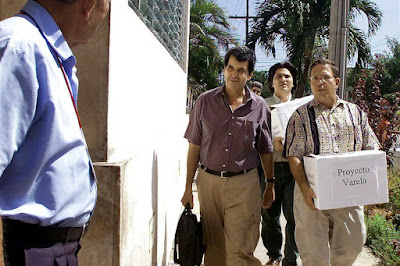
Oswaldo Payá Sardiñas, Regis Iglesias, and Tony Diaz Sanchez deliver petitions

Grassroots movements in Cuba have fought for liberty for decades, mobilizing Cubans to defend human rights and freedom. The July 11 nationwide protests marked a historic moment, but they did not arise from nowhere.

In November 2020, hundreds of artists mobilized outside of the Ministry of Culture in a 15-day effort to free political prisoner Denis Solís González. They demanded both his release and greater artistic freedoms.

The San Isidro Movement (MSI), an artists collective formed in 2018 to nonviolently defend artistic freedom, challenged regime officials to free their unjustly jailed compatriot. Solís González was charged with contempt for protesting an illegal search of his home by a policeman, whom he had called a coward.

Rather than accede to MSI’s demands, officials repeatedly and violently escalated repression over 15 days, but they were met with nonviolent responses that inspired hundreds of artists and intellectuals to gather outside the Ministry of Culture, bringing officials to the negotiating table for dialogue.

The San Isidro Movement’s exercise in nonviolent power led to the formation of a new movement, 27N, and increased civic resistance. The pattern continued through 2021, reaching millions of Cubans across the island with the movement's art and music — in particular the song, “Patria y Vida.” The rapper Maykel Castillo Perez (Osorbo), co-author of the song and also a member of MSI, is currently in prison and severely ill.

This is not the first time nonviolent tactics have been carried out successfully in Cuba. The Cuban Committee for Human Rights, founded in 1976, systematically documented human-rights violations, information smuggled out of Cuba to international human rights organizations, which led to the installation of a special rapporteur focused on Cuba’s human-rights situation and the Castro regime’s condemnation over a 15-year period beginning in 1991. Havana’s record was carefully scrutinized, and it was held accountable annually until 2006.

The Christian Liberation Movement (MCL), founded in 1988 to work for Cuba’s democratization, is best known for the Varela Project, a petition signed by 11,020 Cubans in May 2002 calling on the regime to guarantee international human-rights norms in law. Fidel Castro changed his constitution to prevent it from being amended that same year.

The regime responded with violence, not so much because of the number of signatures presented to the National Assembly, but because more than 120 Citizens’ Committees had been created throughout the country in the process and imprisoned most of their leaders. Despite this repression, MCL turned in an additional 14,384 signatures in October 2003.

Castro expected the March 2003 crackdown, dubbed the “Black Cuban Spring,” to be the end of the opposition. Instead, it sparked the emergence of a new movement, the Ladies in White, led by the wives, mothers, sisters and daughters of the men jailed. For eight years, these women lobbied, protested and marched for their loved ones’ freedom. They were successful, and the last of the men were released from prison in 2011, a nonviolent victory over the dictatorship. The Ladies in White continue to the present day, demanding human rights be respected in Cuba.

The price of nonviolent defiance has been high: long prison terms, exile, deportations and extrajudicial killings. Tempted by the understanding that Cubans are exerting power through nonviolent action, some voices have emerged advocating a turn to violence in the belief that it would expedite a democratic transition.

Strategic studies have demonstrated that the more brutal the regime, the less effective and successful violent movements are. Counterintuitively, nonviolent movements have been more successful in overthrowing brutal dictators and transitioning to lasting democracies.

The Castro dictatorship, with decades of experience in terrorism, torture and genocide around the world, is an expert in war, as demonstrated in the 1960s when it efficiently and ruthlessly crushed a violent opposition in Cuba with the aid of Soviet advisors to consolidate power.

Nonviolent resistance is better able to mobilize citizens to demand change and obtain global solidarity and sanctions, creating the political, diplomatic and economic isolation of the regime and punishing the individuals and entities that violate Cubans’ rights. 

Regis Iglesias Ramírez is spokesperson for the Movimiento Cristiano Liberación. 

John Suarez is executive director of Centro por una Cuba Libre.

Note: This article was published in The Miami Herald on Tuesday, November 30, 2021.

Saturday, December 11, 2021

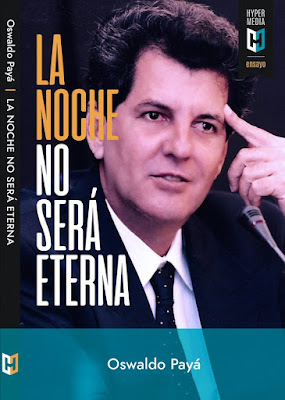
New digital edition of murdered Cuban dissident Oswaldo Payá Sardiñas's book presented at the John F. Kennedy Library

"This book is a beacon for the future of Cuba, a vision of the precious freedom for which Oswaldo Payá fought all his life, and this will inspire new generations." - David Hoffman of The Washington Post, Pulitzer Prize winner  

The digital version of the book by Oswaldo Payá Sardiñas is available today in digital format on Amazon and published by Editorial Hypermedia Inc. 

On December 8, 2021 over social media Rosa María Payá announced that the digital edition of the book titled "The night will not be eternal" would be released, and become available.

There was a formal book presentation on Saturday, December 11, 2021 at 2:000pm in the John F. Kennedy Library in Hialeah, Florida. The presentation was made by journalist Juan Manuel Cao , with Juan Rumín Domínguez, Hypermedia editor Ladislao Aguado  and Ofelia Acevedo. 

14ymedio reported during the original book launch on July 3, 2018:

The book, subtitled “Dangers and Hopes for Cuba,” has a preface by Paya’s widow, Ofelia Acevedo, and its purpose, as explained by its author, is none other than “to help to discover that we can, indeed, live through the process of liberation and reconciliation and move into the future in peace.”

“In this book my father reflects on how and why we Cubans have come to this point in history and how we can emerge from it,” says Rosa Maria Paya, director of the Cuba Decides movement which promotes holding a plebiscite so that the Cuban people can decide what political system they want for their country.  “A process of liberation is possible,” says the dissident about what her father left in writing before being “assassinated,” in her words.

This book, and documentaries such as Dissident ( 2002) by the National Democratic Institute and The Cuban Spring (2003) by Carlos Gonzalez, of the CASLA Institute. Both in the book, and in these two documentaries readers and viewers can understand how Oswaldo lived, and the real danger he and others faced for exercising nonviolent dissent in Cuba.

The Human Rights Foundation (HRF) published a legal report on July 22, 2015 highlighting the inaccuracies and inconsistencies of the official government investigation following Payá’s death in 2012. HRF documented numerous due process violations, including damning witness accounts, a grossly inadequate autopsy examination, and other key pieces of evidence that were overlooked by the Cuban judicial system. HRF’s report concludes that the “evidence, which was deliberately ignored, strongly suggests that the events of July 22, 2012 were not an accident, but instead the result of a car crash directly caused by agents of the state.” 

Ten long years will have passed this upcoming July 22, 2022 and the silent complicity of many governments in the world is deafening, and further proof of the international decline in human rights standards, but the friends and family of Oswaldo Payá Sardiñas, and Harold Cepero Escalante continue to demand justice for their loved ones murdered on July 22, 2012.

Friday, December 10, 2021

International Human Rights Day: Recovering Cuba's Pre-Castro human rights legacy

 For freedom and justice

On the streets of Cuba on July 11, 2021

Human rights are an intrinsic part of Cuban history that the current dictatorship has spent decades systematically trying to erase and deny, but  every day Cubans for decades have stood up for the defense of human rights and dignity at great cost to themselves.  Below is an essay from three years ago that remains relevant today in light of the San Isidro protest in Havana, Cuba and the 11J protests across the island on July 11, 2021.

The Miami Herald, December 8, 2018

Can Cuba’s human rights legacy be recovered?

Less than a month later, Cuban diplomats led an “act of repudiation“ at the UN to prevent a discussion on political prisoners in Cuba.

Artists are now being arrested in Cuba for protesting Decree 349, a law that would eliminate the few artistic freedoms remaining there.

Prisoner of conscience Eduardo Cardet marked two years in prison on Nov. 30 for speaking critically of Castro’s legacy.

International Human Rights Day in Cuba will be a day that the Cuban secret police harass, detain, and assault human rights defenders attempting to exercise their rights.

It was not always this way.

Seventy years ago, a democratic Cuba helped draft the Universal Declaration of Human Rights and establish the UN Human Rights Commission.

Cuba’s last democratic president, Carlos Prio Socarras, was elected in free and fair elections and assumed office on Oct. 10, 1948. President Prio respected human rights, and this was reflected by the actions taken by his diplomats at the founding of the UN.

Cuba, Panama, and Chile were the first three countries to submit full drafts of human rights charters to the Commission. Latin American delegations, especially Mexico, Cuba, and Chile inserted language about the right to justice into the Universal Declaration of Human Rights, in what would become Article 8.

Cuban delegate Guy Pérez-Cisneros addressed the UN General Assembly on Dec. 10, 1948 proposing to vote for the Universal Declaration of Human Rights. The Cuban Ambassador celebrated that it condemned racism and sexism, and also addressed the importance of the rule of law:
“My delegation had the honor of inspiring the final text, which finds it essential that the rights of man be protected by the rule of law, so that man will not be compelled to exercise the extreme recourse of rebellion against tyranny and oppression.”

This democratic Cuba was overthrown on March 10, 1952 by Fulgencio Batista and hopes of a democratic restoration frustrated by the Castro brothers in 1959.

Guy Pérez-Cisneros died of a stroke in 1953.

Ernesto Dihigo, like Pérez-Cisneros, left the diplomatic corps following the 1952 coup, but returned as Cuba’s Ambassador to the United States in January of 1959 retiring in 1960. He left Cuba in 1989 and died in Miami in 1991.

Democrats should share this history with Cubans on the island to demonstrate that civil and political rights are an intrinsic part of a shared Cuban heritage that in 1948 made world history and that the regime in the island today would like erased.


John Suarez is a program officer for Latin America Programs at Freedom House in Washington, D.C.