Showing posts with label IACHR. Show all posts

Monday, June 12, 2023

Inter-American Commission on Human Rights holds Cuban government responsible for extrajudicial killings of pro-democracy leaders Oswaldo Payá and Harold Cepero

The Inter-American Commission on Human Rights (IACHR) today made public its “Report on Admissibility and Merits No. 83/23 of Case 14,196” in which it held the State of Cuba responsible for the deaths of Oswaldo Payá and Harold Cepero. This has been a 10 year struggle for truth and justice for the Payá and Cepero families.

Many questions remain unanswered that demand a thorough investigation. The Washington Post editorial published today with the title “The case of Oswaldo Payá’s death in Cuba is not closed” is right. There are too many questions that still need to be answered.

“Cuba has never lifted a finger to properly investigate Payá’s death. Payá’s wife, Ofelia Acevedo Maura, has repeatedly requested the autopsy report but never got one. Many unanswered questions remain about the deaths. One of the most important — not answered by the commission — is: Who were the Cuban agents in that car that rammed Payá? Who sent them?”

Over 10 years ago on March 16, 2013 UN Watch issued an appeal for an international inquiry into the deaths of Oswaldo Payá and Harold Cepero that was addressed to United Nations Secretary-General Ban Ki-moon, High Commissioner for Human Rights Navi Pillay, and Ambassadors of all Member States. On March 22, 2013 the UN Secretary General's spokesman acknowledged the appeal during a briefing.  

Less than a month later on April 15, 2013, the Inter-American Commission on Human Rights (IACHR) received a petition filed by the Robert F. Kennedy Center for Human Rights to investigate if the Cuban government was responsible for the deaths of Oswaldo Payá and Harold Cepero, on July 22, 2012.

On July 22, 2015, Javier El-Hage and Roberto González of the Human Rights Foundation released a 147-page report titled The Case of Oswaldo Payá that concluded Harold and Oswaldo’s deaths were "the result of a car crash directly caused by agents of the State, acting (1) with the intent to kill Oswaldo Payá and the passengers in the vehicle he was riding, (2) with the intent to inflict grievous bodily harm to them, or (3) with reckless or depraved indifference to an unjustifiably high risk to the life of the most prominent Cuban activist in the last twenty-five years and the passengers riding with him in the car."

On December 14, 2021 the Inter-American Commission on Human Rights held an audience with family members of the two victims, and one of the surviving victims.

Ten years later after the Robert F. Kennedy Center for Human Rights delivered their petition to the IACHR, the 28 page decision was published today in Spanish and in English on their website.

Based on the findings of fact and law, the Inter-American Commission on Human Rights concludes that the State of Cuba is responsible for the violation of the rights established in Articles I, IV, V, VIII, IX, X, XVIII, XXII, XXIV and XXV of the American Declaration to the detriment of Oswaldo Paýa; also is responsible for the violations of the rights established in Articles I, IV, V, XXII, XVIII and XXIV to the detriment of Harold Cepero; also is responsible for the violation of the rights established in Articles I, XXVI y XXV to the detriment of Ángel Carromero; and responsible for the violation of the rights established in articles VIII, IX and X in detriment of the relatives of Oswaldo Paya and Harold Cepero.

Robert F. Kennedy Human Rights celebrated the decision published today by the IACHR, and Kerry Kennedy, president of the organization said in a video statement: “It has been our honor to represent the Payá and Cepero families in their pursuit of justice and accountability, and it is my sincere hope that this long-awaited verdict brings them some degree of peace and healing.”

Today, let us also remember Oswaldo Payá and Harold Cepero, and how they lived.

Oswaldo Payá was sixty years old when he was murdered by Castro regime agents. He was a family man and lay Catholic from Havana, an engineer, who in September 1988 founded the Christian Liberation Movement with fellow Catholics in the neighborhood of El Cerro. Over the next 23 years he carried out important campaigns to support human rights and a transition to democracy in Cuba. He spoke out against human rights violations and demand dignity for victims, even if it meant criticizing the US for the mistreatment of Al Qaeda prisoners at the Guantanamo Naval Base prison in 2002. Oswaldo was a consistent defender of human rights. He was awarded the Sakharov Prize for Freedom of Thought by the European Parliament in 2002.

Harold Cepero was 32 years old when he was killed along with Oswaldo. He was from the town of Chambas in Ciego de Ávila. At age 18, he began to study at the University of Camaguey, and in 2002, together with other students, Harold signed the Varela Project. It was an initiative that was legal within the existing Cuban constitution that had been authored by the Christian Liberation Movement. Despite this, Harold and other students were expelled from the university for signing it and sharing it with others. The secret police would organize a mob to "judge", scream at, insult, threaten and expel the students who had signed the Varela Project. Following his expulsion on November 13, 2002, Harold wrote a letter in which he cautioned that "Those who steal the rights of others steal from themselves. Those who remove and crush freedom are the true slaves."


Friday, February 24, 2023

The Brothers to the Rescue shootdown 27 years later: Continuing the struggle for truth, justice, and memory

#TruthJusticeMemory


On February 24, 1996, at 3:21 and 3:27 PM, heat-seeking air-to-air missiles fired from a MiG-29 UB piloted by Lorenzo Alberto Peréz Peréz that destroyed the two planes the men were onboard, and killed Mario de la Peña, age 24; Carlos Costa, Pablo Morales, both 30, and Armando Alejandre Jr., 45. Mario, Carlos,Pablo and Armando were members of the humanitarian organization Brothers to the Rescue.

This was a premeditated act of state terrorism carried out by Mr. Peréz Peréz on the orders of both Fidel and Raul Castro and through the chain of command issuing the unlawful order that murdered these four men.

Cuban spies learned the flight schedules and were instructed not to fly on February 24 and, if they had to, to alert the MiGs with a motion while in flight to save them from suffering the same fate as the other planes. 

This was a premeditated killing over international airspace. The International Civil Aviation Organization (ICAO) concluded that the two planes "were shot down miles away from Cuba’s boundary having never entered or touched it on that day and the planes had been in contact with the Cuban tower throughout the flight."

They failed to destroy a third plane with Sylvia Iriondo, Andrés Iriondo, Jose Basulto, and Arnaldo Iglesias on board. 

There is no statue of limitations on murder and state terrorism.  There is much more in the Inter-American Commission on Human Rights reports on the Brothers to the Rescue shoot down, and worth reading.

Over the past 27 years friends, and family have continued to demand truth, respect memory and demand justice through protests, petitions, and law suits. 

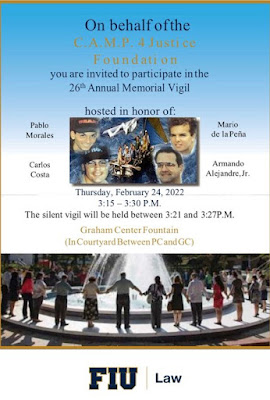
They will hold a silent vigil for their loved ones later today at 3:15 pm at Florida International University.


Thursday, February 24, 2022

The Brothers to the Rescue shootdown 26 years later: Continuing the struggle for truth, justice, and memory

 #TruthJusticeMemory


Mario de la Peña, age 24; Carlos Costa, Pablo Morales, both 30, and Armando Alejandre Jr., 45 were murdered in international airspace on February 24, 1996 at 3:21pm and 3:27pm by heat-seeking air-to-air missiles launched from a MiG-29 UB piloted by Lorenzo Alberto Peréz Peréz that destroyed the two planes the men were onboard. Mario, Carlos, Pablo and Armando were members of the humanitarian organization Brothers to the Rescue.

This was a premeditated act of state terrorism carried out by Mr. Peréz Peréz on the orders of both Fidel and Raul Castro and through the chain of command issuing the unlawful order that killed these four men.

Cuban spies obtained the information on flight times, and were told not to fly on February 24th, and if they did have to fly to signal the MiGs with a motion while in flight to avoid the fate of the others.

This was a premeditated killing over international airspace. The International Civil Aviation Organization (ICAO) concluded that the two planes "were shot down miles away from Cuba’s boundary having never entered or touched it on that day and the planes had been in contact with the Cuban tower throughout the flight."

They failed to destroy a third plane with Sylvia Iriondo, Andrés Iriondo, Jose Basulto, and Arnaldo Iglesias on board. 

There is no statue of limitations on murder and state terrorism.  There is much more in the Inter-American Commission on Human Rights reports on the Brothers to the Rescue shoot down, and worth reading.

Over the past 26 years friends, and family have continued to demand truth, respect memory and demand justice through protests, petitions, and law suits. 

Later today they will be hosting a silent vigil at Florida International University at 3:15pm in remembrance of their loved ones.


Tuesday, December 14, 2021

RFK Human Rights calls on the IACHR to hold Cuba responsible for the 2012 death of pro-democracy leaders Oswaldo Paya and Harold Cepero

Hearing held today starting at 2pm EST at the Inter-American Commission on Human Rights regarding Case 14.196 - Oswaldo Payá Sardiñas, Harold Cepero and others vs Cuba. Below is the Youtube video.


IN THE NEWS

RFK Human Rights calls on the IACHR to hold Cuba responsible for the 2012 death of pro-democracy leaders Oswaldo Paya and Harold Cepero

On Tuesday, December 14th, during its 182nd period of sessions, the Inter-American Commission on Human Rights (IACHR) based in Washington, DC, held a public hearing on the case of Oswaldo Payá Sardiñas, Harold Cepero et al. V. Cuba.

On July 22, 2012, Oswaldo José Payá Sardiñas, a renowned Cuban dissident and human rights leader, was killed in a car crash near Bayamo, Cuba. Harold Cepero, a young activist who was traveling with him, died in the hospital soon afterwards. Both were prominent figures in the Christian Liberation Movement, which Mr. Payá had founded in the late 1980s to promote democracy and human rights in Cuba. At the time of the crash, they were on their way to the city of Santiago to meet with other movement leaders.

The car’s two other occupants, Ángel Carromero Barrios of Spain and Jens Aron Modig of Sweden, survived with minor injuries. According to Mr. Carromero, who was driving that day, official state vehicles had been following them for hours when they were suddenly hit from behind. Cuban authorities detained, drugged and threatened Mr. Carromero, ultimately forcing him to publicly confirm the official narrative that he had lost control and hit a tree. Despite evidence that the car was intentionally rammed by a vehicle bearing state license plates, Mr. Carromero was sentenced to four years in prison after a summary trial. 

Oswaldo Payá Sardiñas, and Harold Cepero killed in a car crash near Bayamo, Cuba.

Left with no possibility of legal recourse in Cuba, Payá and Cepero’s family members turned to the Inter-American Commission on Human Rights. Robert F. Kennedy Human Rights filed an initial petition on their behalf in 2013. In their merits brief submitted earlier this year, the victims and their representatives call upon the IACHR to hold the Cuban State accountable for the persecution and extrajudicial executions of Mr. Payá and Mr. Cepero, as well as the failure to duly investigate their deaths. They also allege that the families were threatened, harassed, and denied their rights to justice and due process. Finally, they accuse the state of arbitrarily detaining Mr. Carromero, mistreating him during his confinement, and subjecting him to judicial proceedings that did not meet international standards of justice and due process.

Family members of both Mr. Payá and Mr. Cepero attended the hearing, along with Mr. Carromero and representatives from RFK Human Rights. The IACHR heard the testimonies of Mr. Payá’s widow, Ofelia Payá Acevedo, and his daughter, Rosa Maria Payá, who described years of harassment by Cuban government officials, previous attempts on Mr. Payá’s life, as well as the circumstances and evidence of the attack. The hearing also presented an important opportunity to update the IACHR about the intensifying repression of human rights advocacy and dissent in Cuba. Just last month, state police and security agents surrounded protest leaders’ homes in an apparent bid to intimidate the population and quash a planned nationwide demonstration.

“This case offers an opportunity to illustrate the systematic patterns of repression and persecution of dissent by the State of Cuba, and the extreme length to which the regime is prepared to go to stall democracy from flourishing in the country,” said Kerry Kennedy, president of Robert F. Kennedy Human Rights. “It is our great hope that putting the details of this case on full display after so many years will prompt the IACHR to act and issue a favorable decision soon holding the State of Cuba responsible for the murders of Payá and Cepero.”

For decades, the Cuban State has severely restricted its people’s rights to free expression and association. The facts of this case reflect a broader pattern of repressive tactics employed against political dissidents and human rights defenders, including harassment, physical attacks, and arbitrary arrests and detention. Mr. Payá and Mr. Cepero themselves had been the victims of various threats and attacks long before the collision that took their lives. Less than two months before Mr. Payá’s death, another vehicle rammed into his own with such force that his car slid across the road and overturned.

“To challenge a totalitarian system seeking truth, justice, changes that will enable Cubans to access their rights, to move to sincere democratic changes—in totalitarian systems almost always costs people their lives, or else great sacrifice,” said Ms. Acevedo. “Since Oswaldo founded the [Christian Liberation Movement] in 1988, he was threatened with death multiple times by state security, following orders, of course, from the Castros.”

Mr. Payá refused to accept financial support from the United States, defying the Cuban government’s attempts to paint him as a foreign agent. His relentless activism in support of a peaceful transition to democracy—including the Varela Project, a petition drive that garnered more than 25,000 signatures in support of a referendum to guarantee civic freedoms—won him international acclaim and numerous awards. Today, his legacy lives on in the work of his daughter, Rosa Maria, who is recognized as one of the country’s leading democracy advocates.

The Inter-American Commission thanked the participants and sent a message of solidarity to the Cuban people. “Those of us who work on human rights in the Commission sometimes ask ourselves, why continue in this, why do they [victims] keep coming? And it is because dignity is like that, and because truth and justice have to make way,” said Julissa Mantilla, first vicepresident of the IACHR.

RFK Human Rights is honored to represent the Payá and Cepero families in their quest for truth and justice, which are the necessary foundations of a real democratic future for Cuba.

Source: https://rfkhumanrights.org/rfkhr-calls-on-iachr-to-hold-cuba-responsible-for-deaths-of-paya-and-cepero

Wednesday, February 24, 2021

The Brothers to the Rescue shootdown 25 years later: Continuing the struggle for truth, justice, and memory

#TruthJusticeMemory

Mario de la Peña, age 24; Carlos Costa, Pablo Morales, both 30, and Armando Alejandre Jr., 45 were murdered in international airspace on February 24, 1996 at 3:21pm and 3:27pm by heat-seeking air-to-air missiles launched from a MiG-29 UB piloted by Lorenzo Alberto Peréz Peréz that destroyed the two planes the men were onboard. Mario, Carlos, Pablo and Armando were members of the humanitarian organization Brothers to the Rescue.

This was a premeditated act of state terrorism carried out by Mr. Peréz Peréz on the orders of both Fidel and Raul Castro and through the chain of command issuing the unlawful order that killed these four men.

Cuban spies obtained the information on flight times, and were told not to fly on February 24th, and if they did have to fly to signal the MiGs with a motion while in flight to avoid the fate of the others.

This was a premeditated killing over international airspace. The International Civil Aviation Organization (ICAO) concluded that the two planes "were shot down miles away from Cuba’s boundary having never entered or touched it on that day and the planes had been in contact with the Cuban tower throughout the flight."

They failed to destroy a third plane with Sylvia Iriondo, Andrés Iriondo, Jose Basulto, and Arnaldo Iglesias on board. 

There is no statue of limitations on murder and state terrorism.  There is much more in the Inter-American Commission on Human Rights reports on the Brothers to the Rescue shoot down, and worth reading.

Over the past 25 years friends, and family have continued to demand truth, respect memory and demand justice through protests, petitions, and law suits.

Saturday, July 13, 2019

Crimes of the Castro regime: The attack on and sinking of the "13 de Marzo" tugboat on July 13, 1994

To forget would be not only dangerous but offensive; to forget the dead would be akin to killing them a second time.” - Elie Wiesel, Night
Twenty five years without justice, but we remember and continue to demand justice for the 37 victims of the "13 de Marzo" tugboat who were extrajudicially executed on July 13, 1994.

Please share the report and testimony with others. Let them know of this atrocity.


REPORT Nº 47/96
CASE 11.436
 VICTIMS OF THE TUGBOAT "13 DE MARZO" vs. CUBA
October 16, 1996
 Inter-American Commission on Human Rights


Excerpts from the report:
"82. The evidence clearly shows that the sinking of the tug "13 de Marzo" was not an accident but rather a premeditated, intentional act.  In fact, Jorge Hernández, a survivor of the events that occurred on July 13, 1994, states that, "After leaving the pier, boat No. 2 rammed them" and once out to "sea they began to be attacked by boats No. 2, No. 3 and No. 5."  That "the tug they were in was hit on the port and starboard sides" and that "they attacked them with jets of water."  "After the last attack, the boat sank because the stern was destroyed."  Finally, "the tugs did not help them" but rather "they told them to keep swimming toward the coast guard cutters."  For his part, Arquímedes Lebrigio stated that "when the boat weighed anchor, he was below deck and could see that there was no leak anywhere" and "when he went onto the deck of the boat he saw that the stern and the bow were smashed."  María Victoria García Suarez states that "that's when we saw that two firefighting tugs were coming after us," "they hit the sides and then they began to shoot water at us."  "Then we kept going and told them not to harm us, that there were children on board and we showed them the children and they kept shooting water."  "Later we saw two more [tugs] about seven miles out and they positioned themselves one on each side:  one in front, another in back, and one on each side" and "then all four started shooting us with water and one of the boats rammed us...."  Finally, the witness states that "there were the four tugs--the ones that were sinking us--and we asked them to save us, to take us on board, that there were children, and what they did was laugh.... " 
"VIII.                 CONCLUSIONS
 
          105.    The Cuban State is responsible for violating the right to life (Article 1 of the American Declaration of the Rights and Duties of Man) of the 41 people who were shipwrecked and perished as a result of the sinking of the tug "13 de Marzo", which events occurred seven miles off  the Cuban coast on July 13, 1994.  The persons who died that morning are:  Leonardo Notario Góngora, Marta Tacoronte Vega, Caridad Leyva Tacoronte, Yausel Eugenio Pérez Tacoronte, Mayulis Méndez Tacoronte, Odalys Muñoz García, Pilar Almanza Romero, Yaser Perodín Almanza, Manuel Sánchez Callol, Juliana Enriquez Carrasana, Helen Martínez Enríquez, Reynaldo Marrero, Joel García Suárez, Juan Mario Gutiérrez García, Ernesto Alfonso Joureiro, Amado Gonzáles Raices, Lázaro Borges Priel, Liset Alvarez Guerra, Yisel Borges Alvarez , Guillermo Cruz Martínez, Fidelio Ramel Prieto-Hernández, Rosa María Alcalde Preig, Yaltamira Anaya Carrasco, José Carlos Nicole Anaya, María Carrasco Anaya, Julia Caridad Ruiz Blanco, Angel René Abreu Ruiz, Jorge Arquímides Lebrijio Flores, Eduardo Suárez Esquivel, Elicer Suárez Plascencia, Omar Rodríguez Suárez, Miralis Fernández Rodríguez, Cindy Rodríguez Fernández, José Gregorio Balmaceda Castillo, Rigoberto Feut Gonzáles, Midalis Sanabria Cabrera, and four other victims who could not be identified."

Please  consider wherever you are to hold a silent vigil every July 13th and invite others to join in this continuing demand for justice is achieved. Let others know about your action and use the hashtags #JusticeForThe37, and #WeRemember.

25 minute silent vigil for justice for the "13 de Marzo"tugboat victims

Thursday, October 11, 2018

Cuba’s worsening human rights situation: Machete attacks, more restrictive laws, and zero human rights monitoring

“The ultimate obscenity is not caring, not doing something about what you feel, not feeling! Just drawing back and drawing in, becoming narcissistic.”― Rod Serling 


Sirley Avila Leon after testifying at the UN Human Rights Council
Cuban human rights defender Sirley Avila Leon, a victim of repression, on September 24, 2018 addressed the UN Human Rights Council on what agents of the Cuban government had done to her.

“On May 24, 2015 living in Cuba I suffered an attack orchestrated by agents of the state, I was attacked with a machete to kill me cutting off my left hand and right shoulder while I covered my head with them, then cut my knees leaving me disabled for life, This was not the first attack I suffered, I was previously attacked several times, physically and verbally by the political police in Cuba: they burned my bed, I suffered arbitrary arrests, death threats, economic damages.  Only for demanding better living conditions for the peasants and their children in a rural area of ​​Las Tunas. My case is not isolated. In Cuba, the state continues to violate the human rights of Cubans, murders, imprisons and banishes those who demand rights and repress their families. To save my life, in 2016 I escaped from Cuba, since then my son, Yoerlis Peña Avila, has been threatened with death and repressed on several occasions. At this moment I fear for his life.”

Sirley had been elected to a local peoples’ power assembly at the municipal level. She thought she could help those who needed help, but the reality of the existing system demonstrated otherwise. 


Sirley Avila Leon following the May 24, 2015 machete attack
Expectations are high that a constitutional “reform” in Cuba and a new president “could help democratize the country,” but instead changes are going in the wrong direction.

The existing constitution in Cuba was not decided in a free and democratic vote nor the “reforms” that are being drafted now. It is taking an existing anti-democratic document and making it even more restrictive. For example, in the old constitution there existed a clause that a citizen initiative required 10,000 signatures for it to be officially recognized, now under the draft of the proposed constitution it raises that requirement to 50,000 signatures. They never thought 10,000 Cubans would sign a document calling for human rights reforms, because of the consequences to the signatory and their families, but with the Varela Project over 30,000 signatures were gathered. In the existing constitution there is a freedom of religion and conscience clause, but in the new draft it is just freedom of religion. Although, in practice, religion in Cuba remains subject to Communist Party control and discrimination.

Raul Castro handed over the office of the presidency to his handpicked successor Miguel Díaz-Canel on April 19, 2018. This was done to give the impression that a transition is underway in Cuba. This is not the case. General Raul Castro remains head of the Cuban Communist Party and in control of the government. General Alberto Rodriguez Lopez-Callejas, Raul's son-in-law, runs the economy. Raul Castro's son, Colonel Alexandro Castro, who negotiated the normalization of relations with the Obama Administration is an intelligence officer with close ties to the secret police. Diaz-Canel, like Osvaldo Dorticos who was president of Cuba from 1959 to 1976, answers to General Raul Castro. The succession does not empower Miguel Díaz-Canel but maintains the Castro dynasty in power.


Blanca Reyes, of the Ladies in White with other activists and members of the IACHR
One of the new laws, Decree 349, signed by President Díaz-Canel in April of 2018 further restricts spaces for artists to exercise their vocation. According to Amnesty International:

“Under the decree, all artists, including collectives, musicians and performers, are prohibited from operating in public or private spaces without prior approval by the Ministry of Culture. Individuals or businesses that hire artists without the authorization can be sanctioned, and artists that work without prior approval can have their materials confiscated or be substantially fined. Under the new decree, the authorities also have the power to immediately suspend a performance and to propose the cancelation of the authorization granted to carry out the artistic activity.”

Despite the government of Cuba being a long time and active member of the UN Human Rights Council it has missed opportunity after opportunity to address key human rights issues constructively and worked with other bad actors to weaken international human rights standards and silence human rights defenders. Thankfully, they do not always succeed.

Over the past two weeks at the UN HumanRights Council (UNHRC) in Geneva, Switzerland and the Inter-American Commissionon Human Rights (IACHR) in Boulder, Colorado the human rights situation in Cuba was addressed by Cuban human rights defenders. The testimony and information provided point to human rights worsening in the island nation. 


Sirley Avila Leon addresses the UN Human Rights Council on September 24, 2018
UNHRC
For decades, international human rights monitors have been and continue to be barred from Cuba by the government to evade scrutiny and isolate Cubans. During the adoption of the Universal Periodic Review outcome of Cuba, June 21-25, 2018, Amnesty International raised the issue that Cuba was the only country in the Americas that was closed to them. Later on Pedro Luis Pedroso Cuesta, Permanent Representative of Cuba to the United Nations Office at Geneva replied to Amnesty International’s comment on the refusal to accept monitors in the island, that Cuba did not require such instruments.

In addition to not allowing credible international human rights monitors into the island, the Cuban government has not permitted the existence of an independent national human rights institution in Cuba.

Furthermore, Cuba’s courts remain subordinated to Raul Castro, head of the Cuban Communist Party. This is has had repercussions on the human rights situation in Cuba.

The World Evangelical Alliance informed the UN Human Rights Council that in 2015, two thousand places of worship of a single church union had been threatened with demolition and several places of worship had been destroyed.  Christian Solidarity Worldwide reported that Cuba used a range of measures against religious leaders and human rights defenders.  Arbitrary detention remained a common tactic.  

There are prisoners of conscience in Cuba today. Dr. Eduardo Cardet of the Christian Liberation Movement, jailed since November 30, 2016, under terrible conditions, for his human rights and democracy advocacy for Cubans is one of them.

Tomás Núñez Magdariaga who has been on hunger strike for over 50 days protesting his unjust imprisonment is another. Prisoners of conscience, such as Orlando Zapata Tamayo in 2010 and Wilman Villar Mendoza in 2012, died on hunger strikes.

Extrajudicial killings by the State continue in Cuba, and they are not limited to opposition activists. The case of Mr. Alejandro Pupo Echemendia is a recent and high profile example. Police detained Mr. Pupo Echemendia and took him to a police station in Las Villas Cuba, allegedly for participating in illicit horse races. Eyewitness Abel Santiago Tamayo said Alejandro suffered a panic attack on August 9, 2018, and asked for help. A guard handcuffed Alejandro from behind and began to kick him in the back until he died. Alejandro Pupo Echemendia was 46 years old, a caregiver for the mentally ill in a psychiatric hospital. Government agents placed witnesses and Alejandro's family under duress to retract their statements.


Blanca Reyes, of the Ladies in White, addresses the IACHR
IACHR
One week later, in Boulder Colorado, during the 169th Period of Sessions of the Inter-American Commission on Human Rights (IACHR), Cuban independent journalists and human rights defenders presented “Reports on the Criminalization of Social Activists and Journalists in Cuba.”

The representative of the Ladies in White in the United States, Blanca Reyes, denounced the cruelty of the Cuban government and asked for help to free five women from her organization who are presently jailed.

"In Cuba there is a special sign of cruelty of the totalitarian Communist Government against the entire female mass and, in particular, against the Ladies in White," she affirmed. "Women who belong to that organization are imprisoned, they directly suffer the threat of being taken to a cell, they are imposed heavy fines for their public activities and their families, including their children, are also victims of the unpunished conduct of the political police.”

Blanca identified five Ladies in White presently in prison and they are: Martha Sánchez González, Nieves Matamoros, Aimara Nieto Muñoz, Yolanda Santana Ayala and Xiomara de las Mercedes Cruz Miranda.

Unlike at the UNHRC, the Cuban government does not recognize the competence of the IACHR, despite having been invited to return to the Organization of American States in 2009.


Cuban human rights defender impeded from attending UN-CERD Cuba review
Human rights defenders barred from traveling to human rights forums
The Cuban government has denied human rights defenders the right to travel to attend both the UN Human Rights Council and the Inter-American Commission on Human Rights over the past couple of months.

MiriamCardet Concepción, the sister of prisoner of conscience Eduardo Cardet, was not permitted by the Cuban government to travel to attend the IACHR hearing in Boulder, Colorado. She was able, with some difficulty, to send her video testimony that was broadcast during the hearing on Monday, October 1, 2018.

The UN Committee on the Elimination of All Forms of Racial Discrimination (UN-CERD) met in Geneva on August 15, 2018 to examine racism in Cuba. The Cuban government not only claimed that racism was not a problem in Cuba but also told the UN-CERD that human rights defenders in Cuba face no limitations to exercise their activities. Cuban diplomats assured that there had been no reprisals or harassment of activists.

Cuban human rights defenders Juan Antonio Madrazo and Norberto Mesa, both Cubans of African descent, who were to attend the same session were detained arbitrarilyand banned by Cuban government officials from traveling to Geneva to address the question of racism in Cuba.

Two other Cuban human rights defenders were also barred by the Cuban government from traveling to Geneva to speak at the pre-session to Cuba’s third Universal Periodic Review (UPR) in April of 2018.


Pinkwashing
There is one element of the Constitutional reform that has garnered positive international attention and that is an opening to gay marriage. It does not endanger the power monopoly that the regime seeks to preserve. This constitutional initiative by the Cuban government is a textbook example of pinkwashing. It is "the practice of presenting something, particularly a state, as gay-friendly in order to soften or downplay aspects of its reputation considered negative."

The Cuban government’s leadership, who remain in power today, carried out anti-Gay draconian policies in the past, and they are the same ones now advocating for the change on gay marriage in the constitution.

The Cuban government placed Gays and Lesbians in forced labor camps beginning in 1964 in what they called Military Units to Aid Production or UMAPs (Unidades Militares de Ayuda a la Producción). These forced labor camps were for those suspected of or found guilty of "improper conduct."  Persons with "effeminate mannerisms": what the Cuban government called "extravagant behavior" were taken to these camps. Twenty years later with the outbreak of the AIDS epidemic in Cuba the regime rounded up all who were HIV positive. Cuba is the only nation in the world that mandated universal HIV testing and enforced isolation of all virus carriers in detention facilities from 1986 to 1994.

This is not a Gay-friendly regime, despite the PR offensive.

Conclusion
Cuban human rights defenders continue to be barred from travel, subjected to harassment, arbitrary detentions and targeted for physical attacks ordered by the secret police. There are changes taking place in Cuba, but they are either cosmetic or make the state more repressive with the goal of perpetuating the dynastic rule of the Castro family.

If Cuba is to once again be free then one must understand the difficult existing reality and the challenges confronting the democratic resistance in the island.

Friday, June 1, 2018

Bloody Mother's Day in Nicaragua: Pro-government forces fire on non-violent protest by mothers

Ortega's massacre of moms on Mother's Day in Nicaragua.
 
Moms in Nicaragua peacefully protested for children killed by government.
Wednesday, May 30, 2018 was Mother's Day in Nicaragua, and it is a day traditionally of great celebrations across the country. This year Ortega's Sandinista regime, in the midst of protests sparked on April 18, 2018 by a pension "reform" that cut benefits to pensioners while raising the amount taken from current workers, continued the bloody crackdown on Mother's Day to silence dissent.

Nicaraguan mothers marched on this day to remember the children, who were among the 80 killed since the start of the protests. Pro-government para-police called "shock forces" and armed third parties fired on the non-violent demonstrators. Official reports are that 15 people were killed and 199 were injured in Managua, Estelí and Masaya.

Last month the  Inter-American Commission on Human Rights (IACHR) visited Nicaragua from May 17-21, 2018 to observe the human rights situation in the country and on May 21st  reported that "since April 18 at least 76 persons have died and 868 have been wounded, the vast majority in the context of the protests. Of the wounded, five remain in hospitals in critical condition. In addition, 438 persons were detained, including students, human rights defenders, journalists and other members of the civilian population."

Following the IACHR visit the violence continued in "Managua, Leon and Chinandega, in Nicaragua, where three people died and scores were injured"  on May 23rd.

The IACHR is now calling on the Nicaraguan government "to investigate and punish the use of force by parapolice forces, to dismantle such groups and to find a peaceful, constitutional and democratic solution to the ongoing political crisis in the country."

At least 97 people have been killed since the start of the protests.

Ortega regime responds to call for an end to the killing by killing protesters.


Thursday, September 7, 2017

IACHR's Office of the Special Rapporteur for Freedom of Expression condemns closure of more than 50 media outlets in Venezuela

The slow death of freedom of expression in Venezuela nears the end point.


The Office of the Special Rapporteur condemns the closure of more than 50 media outlets in Venezuela without legal guarantees and for reasons related to their editorial line


September 6, 2017

Washington, DC- The Office of the Special Rapporteur for Freedom of Expression of the Inter-American Commission on Human Rights (IACHR) condemns the closure of more than 50 media outlets in Venezuela under procedures that depart from the principles that guarantee freedom of expression, and urges the State to urgently adopt the necessary measures to ensure that the media outlets -both domestic and foreign- can operate in the country with legal guarantees and without any distinction based on their editorial line.

According to information received by the Office of the Special Rapporteur, on August 24, subscription television providers in Venezuela withdrew from the programming grid the Colombian channels Caracol TV and RCN, on orders from the National Telecommunications Commission (Conatel). William Castillo, vice minister for International Communication of the Ministry of Popular Power for Foreign Affairs, stated in an interview with an official outlet "RCN and Canal Caracol are instruments of a media war who have behaved, in Venezuela, as a machinery of aggression against Venezuelanity and legitimate authorities." The minister accused Caracol TV of committing "a series of very serious crimes, offenses against Venezuela, its authorities, and our laws." A similar criterion would have been used previously to order the suppression of CNN and NTN 24 signals.

The Office of the Special Rapporteur also received information that in the evening hours of Friday August 25, Conatel representatives entered the radio stations 92.9 FM and Mágica 99.1 FM in the city of Caracas and ordered the definitive termination of their transmissions. It was reported that minutes after both media went off air their frequencies were taken by two new stations linked to the official party. The signal of the Caracas radio station 92.9 FM, which had a large audience news programming, was replaced that night by Radio Corazón Llanero, operated by a foundation under the control of an army Captain, ​​the aide-de-camp of former Venezuelan President Hugo Chávez, and current member of the National Constituent Assembly. The signal of the Mágica 99.1 FM station was replaced by the station Vinotinto FM, whose owner is until now unknown. On September 5, Conatel reportedly ordered the radio station 88.1 FM, operated by the emblematic educational radio network Fe y Alegria in Maracaibo, to cease its operations. Hours later the decision was revoked without any explanation.

On July 16, ULA TV, the television channel of the Universidad de los Andes in Mérida, had also been closed by Conatel, invoking a lack of documents.

According to the information provided by several organizations, during 2017 at least 49 national radios have been shut down and 5 international television channels have reportedly been withdrawn from national subscription television, by government orders. As the Office of the Special Rapporteur has expressed in previous statements, most of the media operates in Venezuela with their licenses expired and the regulatory body does not have procedures with guarantees for the adjudication and / or renewal of these frequencies.

The Office of the Special Rapporteur reminds the Venezuelan State that any restriction on the right to freedom of expression must be based on a law and be proportionate and strictly necessary to protect legitimate ends in a democratic society. The closure of media outlets as punishment for maintaining a critical editorial line of a government arbitrarily suppresses the right that assists all Venezuelans to express themselves without fear of reprisals and receive plural and diverse information, and it is also a form of indirect censorship under international law.

Although the State has the power of administering the radio spectrum, this must be done in accordance with the basic principles of international human rights law that prohibit the restriction of the right to freedom of expression through abuse of the power to regulate and manage the radio frequencies.

According to these principles, the processes of adjudication, revocation, and renewal of licenses must be strictly regulated by a law and be guided by objective, clear, impartial, public, and compatible criteria with a democratic society; the process must be transparent; the decision granting or denying the request must be duly substantiated; and be subject to proper judicial control. The administration of the radio spectrum must also be guided by the principles of equality and non-discrimination, and should never be used to pressure, reward, or punish a media outlet according to its editorial line or its position concerning the government in charge.

Venezuela had already been condemned by the Inter-American Court of Human Rights in June 2015 for breaching these principles when it decided not to renew the concession of the RCTV television channel on May 27, 2007. In the Inter-American Court opinion’s, RCTV's closure involved "a misuse of power, since a State faculty was used with the objective of editorially aligning the media outlet with the government."

The Court also pointed out that the misuse of power in that case "had an impact on the exercise of freedom of expression, not only in the workers and managers of RCTV, but also in the social dimension of that right." In effect, the Court stated "the real purpose was to silence critical voices against the government, which together with pluralism, tolerance, and the spirit of openness, constitute the demand of a democratic debate which, rightly, freedom of expression seeks to protect."

The Office of the Special Rapporteur urgently calls for the reestablishment of the radio stations and television stations that have been shut down, as well as the restoration of all the necessary guarantees for the full exercise of the right to freedom of expression in Venezuela.


Contact details:
Office of the Special Rapporteur for Freedom of Expression
Tel. (+1) 202 370 0816
cidhexpresion@oas.org


Our mailing address is:
CIDH / IACHR
Sede / Headquarters
1889 F Street NW
Washington, D.C. 20006

Tuesday, August 1, 2017

IACHR condemns arbitrary restrictions on freedom of expression and assembly in Venezuela

The Office of the Special Rapporteur for Freedom of Expression of the IACHR condemns arbitrary restrictions on freedom of expression and assembly in Venezuela


July 29, 2017

The Office of the Special Rapporteur for Freedom of Expression of the Inter-American Commission on Human Rights (IACHR) condemns the new measures taken by the Government of Venezuela to prevent the exercise of the right to freedom of expression, freedom of the press, and to prohibit the exercise of the right to protest and peaceful assembly in the context of the electoral process convened on July 30, 2017 for the National Constituent Assembly. The Office of the Special Rapporteur urgently calls on the Venezuelan State to discontinue these measures and to adjust its action to international human rights standards.

An electoral process of this nature, which seeks the adoption of a new Constitution and its withdrawal has been requested by millions of Venezuelans, opposition parties, civic and academic associations, as well as member states of the Organization of American States, cannot be carried out under restrictions on freedom of expression and the right to peaceful assembly which would arbitrarily prevent the wide dissemination of all political opinions.

Arbitrary Restrictions to the Exercise of Journalism

On the morning of July 28, immigration officials would have denied entry to the country to the Argentine investigative journalist Jorge Lanata because he did not have a journalist visa. On that occasion, he would have been held incommunicado at Caracas airport facilities for several hours and questioned by officers of the Army and the Bolivarian National Intelligence Service (SEBIN) until he was deported.

The incident would have taken place a day after Portuguese reporters Luis Garriapa and Odacir Junior, of Sociedade Independente de Comunicação (SIC), were declared inadmissible on Venezuelan territory by the Administrative Service of Identification, Migration and Aliens (SAIME) for allegedly not meeting the requirements established for legal entry into the country. Also, on July 26, the Venezuelan embassy in Mexico denied accreditation and visa to work in the country to the Mexican journalists Lourdes Murguía and Antonio Mandujano, of the television channel Imagen televisión.
These events are in addition to the cases of at least 6 foreign journalists expelled from Venezuela in 2017.

Likewise, on July 27, it was made public that the National Electoral Council (CNE) would have denied credentials to press organizations of local significance such as Correo del Caroní and El Pitazo.

Freedom of expression protects the right of every person to seek, receive, and impart information and ideas of all kinds, without borders. Given the important role of control played by journalists and the media in the democratic system, this Office of the Special Rapporteur has been emphatic in stating that journalists should not be required to be licensed or registered to carry out their work.

The accreditation and registration schemes of journalists are only appropriate if they are necessary to provide privileged access to places or events, such schemes must be supervised by independent bodies and decisions on this accreditation, having a fair procedure, based on clear, reasonable criteria, transparent and previously published. In addition, decisions on accreditation must be neutral to content and cannot discriminate based on the editorial line or type of coverage.
Protest: prohibition, criminalization, and militarization

On July 27, the Minister of the Interior, Justice, and Peace, Major General Néstor Reverol, announced the prohibition throughout the Venezuelan national territory of "public demonstrations and meetings, concentrations of persons or any similar act that may disturb the normal development of the electoral process" The ban extends for five days, from July 28 to August 1. The General announced that he had ordered the implementation of a "National Plan of Patrolling with Active Containment," which includes "intelligence actions, patrolling, and immediate reaction to address any incidents that occur before, during, and after the electoral process," including the establishment of 96 places for prosecution of electoral crimes and crimes of a military nature, in accordance with the provisions of the Decree of the National Security Law. He also indicated that during the electoral period the Strategic Operational Command of the Bolivarian National Armed Forces (CEOFANB) will be in charge and will have operational control of all state and municipal civilian police units.

These measures were announced after four months of protest in Venezuela, in which at least 113 people have been killed, likewise massive arrests and opening proceedings in military criminal jurisdiction against demonstrators and political and social leaders have been registered.

The Office of the Special Rapporteur recalls that, in democracy, States must act on the basis of the lawfulness of public protests or demonstrations and on the assumption that they do not constitute a threat to public order. This implies a focus on strengthening political participation and building higher levels of citizen participation, with streets and plazas as privileged places for public expression.

In this sense, restrictions on the means, place, and time to the exercise the right to freedom of expression and peaceful assembly must conform to the strict criteria of legality, necessity, and proportionality. General prohibitions on the exercise of the right of persons to participate in peaceful protests are inherently disproportionate and excessive, and cannot serve as a basis for monitoring, arresting, and submitting civil or military criminal proceedings to demonstrators or social leaders for the sole reason of expressing their opinions on a governmental policy or measure.

Likewise, this office reiterates that in the area of social protest management, the participation of military and armed forces should be excluded. States must have civilian police corps with exclusive competence in monitoring and preserving the safety of all persons under their jurisdiction, especially in the operations of management of public demonstrations.

Finally, the Office of the Special Rapporteur renews its rejection to violence in the context of protests and calls on the Venezuelan State to guarantee the rights to freedom of expression and peaceful assembly in accordance with its international human rights obligations.

The Office of the Special Rapporteur for Freedom of Expression is an office created by the IACHR to stimulate a hemispheric defense of the right to freedom of thought and expression, considering its fundamental role in the consolidation and development of the democratic system.


http://www.oas.org/en/iachr/expression/showarticle.asp?artID=1072&lID=1