Tuesday, November 22, 2022

John F. Kennedy was killed 59 years ago today. Did Fidel Castro get him first?

Fifty-nine years ago, on November 22, 1963, John F. Kennedy was assassinated. At 12:30pm Central Standard Time, the Kennedys in their convertible limousine turned off Main Street at Dealey Plaza in Dallas, Texas. As they were passing the Texas School Book Depository, President John F. Kennedy was shot twice and slumped over toward First Lady Jackie Kennedy. The governor of Texas was also hit. At 1:00pm, President Kennedy was pronounced dead.

On the 59th anniversary of this political assassination the spin doctors and agents of influence continue to cloud the circumstances leading up to the murder of America's 35th president. However, the question that needs to be asked looking back to that fateful day: who benefited most from his death? Cui bono?

Following the Bay of Pigs debacle in April 1961 the White House initiated Operation Mongoose. President Kennedy's brother and Attorney General of the United States, Robert Kennedy, headed up the sustained effort to topple the Castro regime and this included the assassination of Fidel Castro.

On December 29, 1962, President John F. Kennedy and First Lady Jacqueline Kennedy met with the Bay of Pigs veterans, and over 40,000 Cuban exiles at the Orange Bowl. On that day the returning soldiers gave President Kennedy the flag of Brigade 2506. " I want to express my great appreciation to the brigade for making the United States the custodian of this flag. I can assure you that this flag will be returned to this brigade in a free Havana," stated President Kennedy to all assembled there.

Daniel Harker of the Associated Press interviewed Fidel Castro on September 7, 1963 at the Brazilian Embassy in Havana at a reception, and in it the communist dictator made an explicit threat. “We are prepared to fight them and answer in kind. U.S. leaders should think that if they are aiding terrorist plans to eliminate Cuban leaders, they themselves will not be safe.”

It is evident in a White House memorandum from ten days before President Kennedy was killed on November 12, 1963, that the Kennedy Administration was still committed to pursuing an aggressive strategy to topple the Castro regime:

Support of Autonomous Anti-Castro Groups. The question was asked from where would the autonomous groups operate. Mr. FitzGerald replied that they would operate from outside U.S. territory. He mentioned two bases of the Artime group, one in Costa Rica and the other in Nicaragua. Also it was hoped that the autonomous group under Manolo Ray would soon get itself established in a working base, possibly Costa Rica. Mr. FitzGerald said that much could be accomplished by these autonomous groups once they become operational. A question was asked as to what decisions remain to be made. Mr. FitzGerald replied that we were looking for a reaffirmation of the program as presented, including sabotage and harassment. When asked what was planned in sabotage for the immediate future, he said that destruction operations should be carried out against a large oil refinery and storage facilities, a large electric plant, sugar refineries, railroad bridges, harbor facilities, and underwater demolition of docks and ships. The question was also raised as to whether an air strike would be effective on some of these principal targets. The consensus was that CIA should proceed with its planning for this type of activity looking toward January.

Less than eleven months after making his pledge at the Orange Bowl, President Kennedy was assassinated in Dallas, Texas by Lee Harvey Oswald.


On November 29, 1963 in a phone call with President Lyndon Baines Johnson, J. Edgar Hoover, the director of the FBI revealed Oswald’s links with the Castro regime. "This angle in Mexico is giving us a great deal of trouble because the story is they have this man Oswald getting $6500 from the Cuban Embassy and then coming back to this country with it."

Politico in 2014 reported, "White House aide Joseph Califano, who was part of the anti-Castro plotting, said he was convinced that 'Robert Kennedy experienced this unbelievable grief after his brother’s death because he believed it was linked to his—Bobby’s—efforts to kill Castro.'” 

Lee Harvey Oswald raises his fist after being captured in Dallas, TX

In 1968, Johnson told ABC reporter Howard K. Smith that “Kennedy was trying to get to Castro, but Castro got him first.

Leo Janos, one of President Lyndon B. Johnson's former speech writers, interviewed him for the July 1973 issue of The Atlantic in which LBJ "expressed his belief that the assassination in Dallas had been part of a conspiracy. 'I never believed that Oswald acted alone, although I can accept that he pulled the trigger." Johnson said that when he had taken office he found that "we had been operating a damned Murder Inc. in the Caribbean.' A year or so before Kennedy's death a CIA-backed assassination team had been picked up in Havana. Johnson speculated that Dallas had been a retaliation for this thwarted attempt, although he couldn't prove it."

Following the President's assassination within a year Operation Mongoose was scrapped and Fidel Castro would remain in power until 2006, then replaced by his brother Raul in a dynastic succession following a health crisis. General Raul Castro remains the maximum authority in Cuba. Fidel Castro died of old age after causing much suffering in Cuba and around the world in places such as Ethiopia, Nicaragua, and Venezuela.

Respected German documentary filmmaker Wilfried Huismann in 2006 made the case that Fidel Castro was behind the killing of the 35th president, and explained why.

We settled the question of why in three years of research on this documentary in Mexico, USA and Cuba. Oswald had been an agent for the Cuban intelligence services since November 1962. He was a political fanatic and allowed himself to be used by the Cuban intelligence services to kill John F. Kennedy. It was a Cuban reaction to the repeated attempts of the Kennedy brothers, above all the younger Kennedy, Robert, to get rid of Fidel Castro through political assassination -- a duel between the Kennedys and the Castros, which, like in a Greek tragedy, left one of the duelists dead.

 
Fidel Castro and John F. Kennedy.
 
One last observation: What does it mean that today is the day Vladimir Putin chose to dedicate a statue of Fidel Castro in Moscow with Miguel Diaz-Canel of the Castro dictatorship in attendance, given the probability that Fidel Castro had President Kennedy assassinated on this day in 1963? 


Monday, November 21, 2022

With all due respect, Cuban leaders in Cuba and Miami have been sitting down to talk for decades and have made great progress.

National dialogues in Cuba

Cuba's democratic nonviolent opposition has repeatedly engaged in dialogues, including national dialogues, in order to mobilize and coordinate Cubans to reflect on our homeland’s future. 

Gustavo Arcos Bergnes and Sebastian Arcos Bergnes called for dialogue in 1990.

In 1990, against the protests of many Cuban exiles, Gustavo Arcos issued a statement to Castro asking him to convene a "National Dialogue," which would include all segments of Cuban society, on the island and in exile. During his address to the Worker's Congress on January 28, 1990, Castro issued his response noting that "the Cuban people" will take care of those activists. On March 5, 1990, government sponsored mobs attacked Sebastian Arcos's home. On March 8, another mob, led by future Foreign Minister Roberto Robaina, attacked Gustavo's home.

Oswaldo Payá throughout his life called for unity and dialogue between all Cubans, in and outside the country. His National Dialogue program and All Cubans Forum in 2005- 2006, involved over 15,000 thousand Cubans both inside and outside of Cuba in discussions on a proposal for a nonviolent change towards democracy. I proudly participated in this dialogue that sought a transition from the existing laws of the dictatorship to the rule of law in a restored democratic order. Payá near the end of his life called for a referendum on basic human rights. He was murdered, together with his movement's youth leader, on July 22, 2012.

Oswaldo Payá shows tentative program for a national dialogue in Havana on Feb 17, 2005.

In November 2020, the San Isidro Movement, a movement of artists founded in 2018 to protest Decree 349 that increased censorship in the arts in Cuba, engaged in a series of escalating nonviolent protests, demanding the release of their colleague Denis Solís González unjustly jailed on November 9, 2020, and in response to increasing regime repression against them for protesting for his release. On November  26, 2020 the San Isidro Movement's headquarters was raided and artists protesting inside taken by the secret police.

Activists under siege at the Isidro Movement headquarters in Havana, Cuba

The Castro regime ended up with a much larger problem than 14 protesters in a small space in the San Isidro neighborhood in Havana. Young people, mostly artists and academics, began gathering throughout the day of November 27, 2020 outside the Ministry of Culture. 

Young Cubans gathered outside the Ministry of Culture on November 27, 2020

Their numbers continued growing into the evening demanding the Minister meet with protesters to negotiate terms for a dialogue.  Thirty representatives, elected by the hundreds gathered, went in and met with officials. 

They emerged with a commitment to dialogue and to consider the points raised by the protesters. Meanwhile the dictatorship sent truckloads of plainclothes security to surround the demonstrators, and to intimidate them. They also closed off the path to the Ministry of Culture, and began using tear gas and physical force to prevent others from continuing to join the protesters. Instead of following through with a dialogue to resolve the differences that had generated the protests the regime launched a media assault against the San Isidro Movement against the protesters.

Today, San Isidro Movement leaders Luis Manuel Otero Alcántara and Maykel Castillo Pérez are prisoners of conscience serving five and nine year prison sentences in Cuba. Other members of the San Isidro Movement, such as Anamely Ramos González and Omara Ruiz Urquiola, were exiled by the Castro dictatorship and are not allowed to return home.

The Center for a Free Cuba in April 2021 hosted a conversation titled "The San Isidro Movement: Nonviolent Resistance, Power and Dialogue" with Professor Jorge Sanguinetty and Cuban artists Kizzy Macias and Eligio Perez Merino. It is available on YouTube in Spanish. It was moderated by Sebastian Arcos Cazabon.

Do not confuse the dictatorship with the Cuban people

On March 22, 2016, President Obama did the wave with dictator Raul Castro

The United States Institute of Peace published a Peace Brief on October 23, 2015 by Susan Stigant; and Elizabeth Murray titled "National Dialogues: A Tool for Conflict Transformation?" that highlights both the opportunities and risks in adopting this tool.

"National dialogue is an increasingly popular tool for conflict resolution and political transformation. It can broaden debate regarding a country’s trajectory beyond the usual elite decision makers; however, it can also be misused and manipulated by leaders to consolidate their power."

The Cuban dictatorship's Miguel Díaz-Canel claims that they "want to strengthen [their] relationships with the United States, regardless of ideological differences,” but this is not the main problem. The main problem is the abusive relationship between the Cuban dictatorship, and the Cuban people.

The Castro regime has not indicated a desire to dialogue with the Cuban people, but to dialogue with the United States. This is not the first time that has happened, and it is not a game changer, but a tactic to prolong the dictatorship. It has been successfully carried out before.

Lessons for Cuba from the experience in Romania

President Richard Nixon and President Jimmy Carter met with Ceasescu 

The United States made this mistake before in Eastern Europe with their "successful" embrace of the Nicolae Ceasescu regime in Romania.

Out of all the countries of Eastern Europe, the United States had the closest diplomatic relations with Romania. This was due to the Nixon administration seeking to exploit differences between Romania and the Soviet Union. Nicolae Ceasescu denounced the Soviet invasion of Czechoslovakia in 1968 and continued diplomatic relations with Israel maintaining an independent foreign policy from the Soviet Union.

Richard Nixon visited Romania in August of 1969. In 1972 Romania became eligible for U.S. Export-Import Bank credits and in 1975 was accorded most favored nation status. In 1978 Nicolae Ceasescu and his wife visited Washington, DC on a state visit and was hosted by President Jimmy Carter who welcomed the dictator and described him in the following glowing terms:

"I've enjoyed being with him. He's a very good adviser. He's a man who in the past has suffered greatly, imprisoned, tortured, but because of his courage and because of his belief in the future of his own country, notable achievements have been brought to the people who have confidence in him. It's a great pleasure for me again to express my welcome to him to our country, and I would like to propose a toast to a great leader, President Ceausescu, and to the brave and friendly people of Romania. Mr. President, to you and your people."

Despite having the worse human rights record in Eastern Europe it was not until 1988 that to preempt congressional action, Ceausescu renounced MFN treatment, calling Jackson-Vanik and other human rights requirements unacceptable interference in Romanian sovereignty. Secretary of State Schultz had warned Ceausescu in 1985 to improve his human rights behavior or lose favorable trade status. The Heritage Foundation argued in 1985 that the previous twenty years of U.S. engagement with the regime in Romania had coincided with deteriorating human rights standards.

Ceasescu's regime was one of the nastier dictatorships of the East block. In addition to the typical accoutrements of a Stalinist regime this "American ally" managed to reach new lows. Imagine for a moment being born and placed in a cage as a newborn washed via a hose with cold water and never experiencing human touch.

10,000 Romanian babies infected with HIV through dirty needles.

Fed like animals and contracting HIV, hepatitis, and other diseases through dirty needles used to inject the children with vitamins. This was done by Ceausescu's communist regime in Romania. The regime decided it needed to increase its population and in 2013 Scientific American explained how this crime was systematically planned out and its aftermath in the article Tragedy Leads to Study of Severe Child Neglect.

Nicolae Ceausescu decreed in 1966 that Romania would develop its “human capital” via a government-enforced mandate to increase the country's population. Ceauşescu, Romania's leader from 1965 to 1989, banned contraception and abortions and imposed a “celibacy tax” on families that had fewer than five children. State doctors—the menstrual police—conducted gynecologic examinations in the workplace of women of childbearing age to see whether they were producing sufficient offspring. The birth rate initially skyrocketed. Yet because families were too poor to keep their children, they abandoned many of them to large state-run institutions.
 Hundreds of thousands of children were subjected to this. This was the country that US taxpayers subsidized with US Export-Import Bank credits. Romania under Ceausescu inspired Margaret Atwood to write The Handmaid's Tale.

Romania, the country with the closest diplomatic and economic relationship with the United States in Eastern Europe, saw the rule of  Nicolae Ceasescu end in a violent blood bath. The dictator and his wife executed in a show trial on Christmas day and scores of innocent Romanians shot by the state security services. More than a thousand people were killed. The communists in power under Ceasescu remained in power until 1996 in a system marked by continuity until democrats were able to wrest control from them nonviolently.  

Relations between the United States and Communist Romania were "great", but the relation with the Romanian people was horrid, and that defined how things would end - not U.S. - Romanian relations. Furthermore, the good relations between the perverse regime in Romania and the United States, is a stain upon the honor of America.

Lessons from Poland

Thankfully, Ronald Reagan took a different approach in Poland, and the rest of Eastern Europe.

Ronald Reagan entered office on January 20, 1981 and on December 13, 1981 the communist regime in Poland had declared martial law and was cracking down on the Solidarity movement. 10,000 people were rounded up and about 100 died during martial law. Ronald Reagan in his Christmas Address on December 23, 1981 denounced the crackdown (beginning at 4 minutes into the above video) and outlined economic sanctions against Poland while demanding that the human rights of the Polish people be respected. He didn't call on Poles from the diaspora to represent American interests in normalizing relations with the Polish Communist regime while Polish dissidents were being rounded up and killed. The United States took a stand recognizing the sovereignty of the Polish people.

The Reagan Administration revoked most-favored-nation (MFN) status in response to the Polish Government's decision to ban Solidarity in 1981. The outcome in Poland was a nonviolent transition led by the Polish solidarity movement in a national dialogue between the government and the opposition that ended in free elections in 1989. 

The approach being advocated in Cuba, by some policy makers, pursues the approach pursued in Romania, and will likely have a similar, bloody outcome to the shame of those who have advocated it.

We need a real national dialogue in Cuba, and that does not mean the United States siding with the dictatorship in Cuba, downplaying its crimes against the Cuban people as Washington did in Romania under three presidencies. It means recognizing the dictatorship for what it is, and not what you'd like it to be and side with the Cuban people, not their oppressor. 

This is my first contribution to the current dialogue.

Saturday, November 19, 2022

Freedom Rally for Iran today at 4:00pm at the Torch of Friendship in Miami, FL.

 #WomenLifeFreedom #MujeresVidaLibertad #MahsaAmini #SOSIran


Massive protests continue in Iran, two months after the killing of Mahsa Amini on September 16, 2022 for improperly wearing a hijab by the morality police. Throughout this time, the Castro regime in Cuba has repeatedly demonstrated its support for the murderous and misogynistic Islamist regime in Iran and denounced U.S. sanctions against the mullahs.

The mullahs have murdered over 400 protesters, including 58 children, and jailed over 16,800 Iranians, subjecting them to political show trials. Five Iranian demonstrators were sentenced to death this week.

On November 1, 2022 a number of prominent Cuban American women asked President Biden to remove "the murderous Iranian regime from the United Nations Commission on the Status of Women." They are calling attention to the Iranian people protesting the murder of 22-year-old Mahsa Amini on September 16, 2022 by the morality police of the misogynist mullahs. In addition they asked if perhaps First Lady Jill Biden "could ask women leaders around the world to call on Iran to stop its repression of women.

Protests are taking place today in over a 100 cities.

Today at 4:00pm in Miami free Cubans have an opportunity to demonstrate their solidarity with the free people of Iran at the Torch of Friendship located at 301 Biscayne Blvd., Miami, FL 33132.

Saturday, November 12, 2022

Update on the national nonviolent uprising in Iran: #MahsaAmini #ZhinaAmini #WomenLifeFreedom #IranRevolution #IranProtests

Women, Life, Freedom.


Mahsa Amini, a 22-year-old Kurdish woman, was arrested in Iran by the Morality police on September 13, 2022. They beat her badly, left her in a coma, and she died on September 16th. She was beaten to death for not properly wearing her hijab. A little bit of her hair was visible. 


News of her extrajudicial killing at the hand of agents of the Islamist regime in Iran sparked nationwide protests. 

Protests have been underway across Iran for the past 56 days. 916 protests have erupted in 140 cities throughout Iran. Over 15,000 Iranians have been arrested, and 1,981 detainees have been identified. 339 protesters have been killed, out of which 52 children have been killed, reports Human Rights Activists in Iran.   

Iranians are writing a new chapter in the history of their country. 

Concerned about the life of prominent Iranian dissident Hossein Ronaghi that is in danger. His family asked for Iranians to surround the hospital that security forces took him to, to protect him from further harm. He is thought to be in the surgery ward, surrounded by doctors and nurses loyal to the Islamist regime.

On November 1, 2022 a number of prominent Cuban American women asked President Biden to remove "the murderous Iranian regime from the United Nations Commission on the Status of Women." They are calling attention to the Iranian people protesting the murder of 22-year-old Mahsa Amini on September 16, 2022 by the morality police of the misogynist mullahs. In addition they asked if perhaps First Lady Jill Biden "could ask women leaders around the world to call on Iran to stop its repression of women."

The protest song Baraye continues to have an international outreach. In Buenos Aires, Argentina at a Coldplay concert on October 28, 2022 the song was played by the band, and exiled Iranian actress Golshifteh Farahani.

Thursday, November 10, 2022

Cuban-American congressmen ask U.S. Representative to the United Nations for an investigation into the massacre in Bahía Honda

On October 28, 2022 a Cuban coast guard ship purposefully rammed and sank a boat just north of Bahía Honda, in the province of Artemisa that was heading north to the United States with Cuban refugees.

The names of the seven victims are: Aimara Meizoso León, Elizabeth Meizoso, Indira Serrano Cala, Omar Reyes Valdés, Nathali Acosta Lemus, Yerandy García Meizoso, and Israel Gómez. 

Five Cuban-American Members of Congress wrote a letter to the U.S. Representative to the United Nations for an investigation into the massacre in Bahía Honda on November 10, 2022.


November 10, 2022
 

The Honorable Linda Thomas-Greenfield
U.S. Representative to the United Nations
U.S. Mission to the United Nations
799 United Nations Plaza
New York, NY 10017
 

Dear Ambassador Thomas-Greenfield,
 

We write to express our profound concern regarding the Cuban regime’s sinking of a boat near Bahía Honda which reportedly resulted in the deaths of at least seven Cubans, including one child. Accordingly, we respectfully request that you condemn these murders at the United Nations, and call for an international investigation into whether they constitute crimes against humanity. 

Article 7 of the Rome Statute of the International Criminal Court defines crimes against humanity as actions such as murder, torture, persecution, “imprisonment or other severe deprivation of physical liberty,” or other “inhumane acts of a similar character intentionally causing great suffering, or serious injury to body or to mental or physical health” which is knowingly “committed as part of a widespread or systematic attack directed against any civilian population.” We believe that the sinking of a civilian boat by a Cuban regime vessel, resulting in the deaths of vulnerable, unarmed Cuban civilians was knowing, purposeful, and part of a systematic campaign of oppression against those who dare to oppose the regime – even if that “opposition” is simply attempting to escape.

Such action at the United Nations has precedent. As you know, the United Nations Human Rights Council established the UN Independent International Fact-Finding Mission on the Bolivarian Republic of Venezuela (FFMV) in September 2019 with a one-year mandate (resolution 42/25). The FFMV was extended another two years (resolution 45/20). Throughout those three years, the FFMV has produced three reports documenting the Maduro dictatorship’s egregious human rights abuses and numerous crimes, such as extrajudicial executions, enforced disappearances, arbitrary detentions, and torture. These reports have highlighted not only the abuses, but also the state’s systematic complicity in committing them.

While Venezuela voluntarily subjected itself to the jurisdiction of the ICC long before Maduro seized power, Cuba never did so. However, the UN and the ICC both have authority to investigate crimes against humanity. Shamefully, the regime in Cuba has committed egregious human rights abuses systematically and knowingly for nearly six decades with few repercussions; the perpetrators of these crimes have not been held accountable for their atrocities at the United Nations nor the International Criminal Court. The victims of firing squads, political persecution, arbitrary imprisonment, widespread expropriations, the Tugboat Massacre, Brothers to the Rescue shoot down, reprisals following repatriations or failed refugee attempts, torture, terrorism, forced disappearances, and arbitrary killings deserve to have their cases heard and documented by the international bodies charged with safeguarding human rights.

Most recently in Cuba, in the case of the boat sinking near Bahía Honda, the regime has not been forced to account for the deaths of these Cubans whose only crime was attempting to flee their island prison. Persecuting those who attempt escape has become a reprehensible pattern of the regime, following the dozens of innocent lives lost in the deliberate and vicious Tugboat “13 de Marzo” Massacre of 1994, the executions of three men who attempted to escape by seizing a ferry in 2003, and now the regime’s sinking of a boat off Bahía Honda. We believe that the knowing and systematic nature of the regime’s actions in murdering innocent Cubans is well established.

It is past time that the regime in Cuba, and those who carry out its malign directives, are held accountable for the torment that they inflict on the Cuban people. When these crimes are no longer committed with impunity, perhaps those receiving these heinous orders will decline to follow them. Accordingly, within all applicable rules and regulations, we respectfully request that you unequivocally condemn these barbaric acts at every opportunity. We further request that you call for a full, fair, and expeditious investigation into these killings with particular consideration as to whether they constitute crimes against humanity, as defined in the Rome Statute of the International Criminal Court, or other customary international rules and norms.

Thank you for your attention to this matter of utmost importance.

Sincerely,


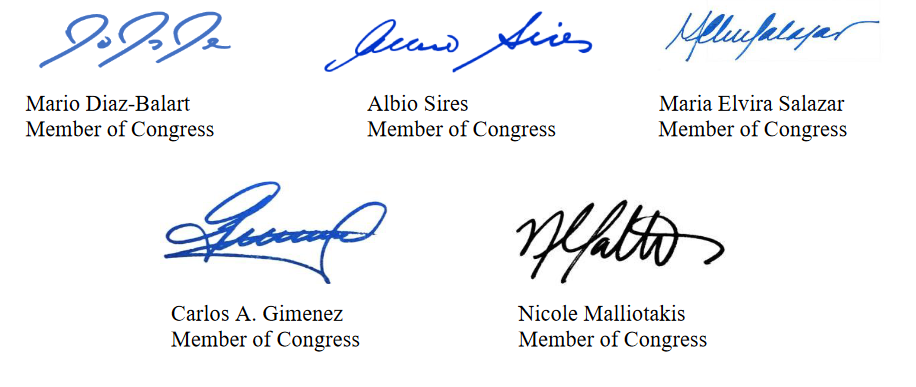
Mario Diaz-Balart, Member of Congress

Albio Sires, Member of Congress

Maria Elvira Salazar, Member of Congress 

Carlos A. Gimenez, Member of Congress

Nicole Malliotakis, Member of Congress