Showing posts with label Czech Republic. Show all posts

Saturday, June 27, 2026

Remember Milada Horáková, who was martyred on this day in 1950, by the Communist regime for her nonviolent defense of Czechoslovak democracy.

Remember her 

Milada Horakova at her show trial in 1950.

Milada Horakova was hanged with three others in Prague’s Pankrac Prison as a spy and traitor to the Communist Czechoslovakian government on June 27, 1950. She was a  lawyer, social democrat, and a prominent feminist in the interwar and postwar periods. 

Milada had been a member of the Czech resistance to the Nazi occupation of her homeland and survived a Nazi prison. After Czechoslovakia was liberated from the Nazis in 1945 by the Soviets she became a member of parliament in 1946 but resigned her seat after the Communist coup of 1948

However she refused to abandon her country.  She was arrested at her office on September 27, 1949 "on charges of conspiracy and espionage against the state." 

Milada was subjected to a show trial. 

Oxford Languages defines a show trial as "a judicial trial held in public with the intention of influencing or satisfying public opinion, rather than of ensuring justice." 

Vladimir Lenin called them "model trials", but they would eventually become known as show trials under Josef Stalin with hundreds of thousands executed and millions sent to work camps in Siberia, and they would take place not only in the Soviet Union, but in the East Bloc including Czechoslovakia, and as far away as Cuba. The Nazis also copied the practice, and so have other repressive regimes.

"I have declared to the State Police that I remain faithful to my convictions, and that the reason I remain faithful to them is because I adhere to the ideas, the opinions and the beliefs of those who are figures of authority to me. And among them are two people who remain the most important figures to me, two people who made an enormous impression on me throughout my life. Those people are Tomas Garrigue Masaryk and Eduard Benes. And I want to say something to those who were also inspired by those two men when forming their own convictions and their own ideas. I want to say this: no-one in this country should be made to die for their beliefs. And no-one should go to prison for them."

Her life story was brought to big screen in 2017and on January 12, 2018 was available on Netflix, and is now available on Amazon. Below is an English trailer for this important film.

 Adam D. E. Watkins in his 2010 paper "The Show Trial of J U Dr. Milada Horáková: The Catalyst for Social Revolution in Communist Czechoslovakia, 1950" explains the importance of the show trial in gutting democratic traditions and replacing them with Stalinism:

The study deconstructs the show trial’s influence on inducing a country to foster the Communist movement against decades of democratic traditions. The research reveals the impact of the show trial of Dr. Milada Horáková in 1950 and how it was instrumental in reforming a society, marked the beginning of Stalinism, and ushered forth a perverted system of justice leading to a cultural transformation after the Communist putsch. Furthermore, the revolution truncated intellectual thought and signified the end of many social movements – including the women’s rights movement
According to D. E. Watkings Horáková was seen by the public as a symbol of  the First Republic and of democracy. Unlike others who did break under the relentless psychological and physical torture she never did. The communists tried to edit her testimony for propaganda purposes but as Radio Prague in their 2005 report on the discovery of the unedited tapes of her trial:
[S]he faced her show trial with calm and defiance, refusing to be broken. Audio recordings - intended to be used by the Communists for propaganda purposes - were mostly never aired, for the large part because for the Party's purposes, they were unusable.

Because she refused to cooperate with the Stalinists her punishment was particularly severe, even for the death penalty. In 2007 her prosecutor Ludmila Brozova-Polednova who in 1950 had helped to condemn Horakova to death, now 86, was tried as an accomplice to murder


During the trial Radio Prague reported that a note written by an anonymous eye-witness to Milada Horakova's execution quoted the young prosecutor recommending: "Don't break her neck on the noose, Suffocate the bitch - and the others too." Milada Horáková  was executed in Pankrác Prison on 27 June 1950 by a particularly torturous method: "intentionally slow strangulation, which according to historians took 15 minutes. She was 48 years old." The urn with her ashes was never given to her family nor is it known what became of them.

In a letter to her 16 year old teenage daughter Milada explained why she had refused to compromise with evil. Her daughter received the letter 40 years later after the end of communist rule:

The reason was not that I loved you little; I love you just as purely and fervently as other mothers love their children. But I understood that my task here in the world was to do you good … by seeing to it that life becomes better, and that all children can live well. … Don’t be frightened and sad because I am not coming back any more. Learn, my child, to look at life early as a serious matter. Life is hard, it does not pamper anybody, and for every time it strokes you it gives you ten blows. Become accustomed to that soon, but don’t let it defeat you. Decide to fight.
Hours prior to her execution she reaffirmed her position to her family:
I go with my head held high. One also has to know how to lose. That is no disgrace. An enemy also does not lose honor if he is truthful and honorable. One falls in battle; what is life other than struggle? (Both quotes excerpts taken from here)

Ms. Brožová-Polednová, the prosecutor,  was found guilty and sentenced to six years in prison in 2008 but was given a presidential pardon by Vaclav Klaus on humanitarian grounds one year and six months into her sentence and released in 2010. The former prosecutor defended her actions claiming that what she did was legal and that she was "following orders." She tried to appeal her conviction at the Strasbourg Court in 2011 and lost.

Today, June 27, the day of Milada Horakova's execution is now recognized in the Czech Republic as  “Commemoration day for the victims of the Communist regime.” 

Yesterday in Argentina, CADAL activists screened the film MILADA.

Biopic of the life of Milada Horáková (2017)


Sunday, June 8, 2025

75 years ago today: Milada Horáková sentenced to death in Communist show trial in Czechoslovakia

"When you realize that something is just and true, then be so resolute that you will be able to die for it.”   – Milada Horáková, in a letter to her daughter


Image of Milada Horáková at her show trial

First wrote about Milada Horáková, the Czech democrat who resisted both Nazis and Communists, back in 2014, and her refusal to go along with the political show trial organized against her in 1950. 

She had been a member of the Czech resistance to the Nazi occupation of her homeland and survived torture in a Nazi prison. After Czechoslovakia was liberated from the Nazis in 1945 by the Soviets she became a member of parliament in 1946 but resigned her seat after the Communist coup of 1948

However she refused to abandon her country. 

She was arrested at her office on September 27, 1949 "on charges of conspiracy and espionage against the state." 

The show trial of Horáková and twelve of her colleagues began on May 31, 1950. 

Oxford Languages defines a show trial as "a judicial trial held in public with the intention of influencing or satisfying public opinion, rather than of ensuring justice." 

Vladimir Lenin called them "model trials", but they would eventually become known as show trials under Josef Stalin with hundreds of thousands executed and millions sent to work camps in Siberia, and they would take place not only in the Soviet Union, but in the East Bloc including Czechoslovakia, and as far away as Cuba. The Nazis also copied the practice, and so have other repressive regimes.

Adam D. E. Watkins in his 2010 paper "The Show Trial of J U Dr. Milada Horáková: The Catalyst for Social Revolution in Communist Czechoslovakia, 1950" explains the importance of the show trial in gutting democratic traditions and replacing them with Stalinism.

"The study deconstructs the show trial’s influence on inducing a country to foster the Communist movement against decades of democratic traditions. The research reveals the impact of the show trial of Dr. Milada Horáková in 1950 and how it was instrumental in reforming a society, marked the beginning of Stalinism, and ushered forth a perverted system of justice leading to a cultural transformation after the Communist putsch. Furthermore, the revolution truncated intellectual thought and signified the end of many social movements – including the women’s rights movement."
According to Watkins, Horáková was seen by the public as a symbol of  the First Republic and of democracy. Unlike others who did break under the relentless psychological and physical torture she never did. The communists tried to edit her testimony for propaganda purposes but as Radio Prague in their 2005 report on the discovery of the unedited tapes of her trial.
[S]he faced her show trial with calm and defiance, refusing to be broken. Audio recordings - intended to be used by the Communists for propaganda purposes - were mostly never aired, for the large part because for the Party's purposes, they were unusable.

Milada Horakova addressed the court in the final day of her show trial on June 8, 1950 in which she refused to go along with the script prepared for her. 

"I have declared to the State Police that I remain faithful to my convictions, and that the reason I remain faithful to them is because I adhere to the ideas, the opinions and the beliefs of those who are figures of authority to me. And among them are two people who remain the most important figures to me, two people who made an enormous impression on me throughout my life. Those people are Tomas Garrigue Masaryk and Eduard Benes. And I want to say something to those who were also inspired by those two men when forming their own convictions and their own ideas. I want to say this: no-one in this country should be made to die for their beliefs. And no-one should go to prison for them."

Because she refused to cooperate with the Stalinists her punishment was particularly severe, death by hanging.

During the trial Radio Prague reported that a note written by an anonymous eye-witness to Milada's execution quoted the young prosecutor recommending: "Don't break her neck on the noose, Suffocate the bitch - and the others too."  

Milada Horáková  was executed in Pankrác Prison on June 27, 1950 through "intentionally slow strangulation, which according to historians took 15 minutes. She was 48 years old." 

The urn with her ashes was never given to her family nor is it known what became of them.  She wrote letters to her mother-in-law, husband, and daughter. Only her daughter, Jana, would learn of the contents of the letter when it was published in an underground publication in Czechoslovakia in 1970. She finally received the letters in 1990.

In the letter to her 16 year old teenage daughter Milada explained why she had refused to compromise with evil. 

The reason was not that I loved you little; I love you just as purely and fervently as other mothers love their children. But I understood that my task here in the world was to do you good … by seeing to it that life becomes better, and that all children can live well. … Don’t be frightened and sad because I am not coming back any more. Learn, my child, to look at life early as a serious matter. Life is hard, it does not pamper anybody, and for every time it strokes you it gives you ten blows. Become accustomed to that soon, but don’t let it defeat you. Decide to fight.
Hours prior to her execution she reaffirmed her position to her family:
I go with my head held high. One also has to know how to lose. That is no disgrace. An enemy also does not lose honor if he is truthful and honorable. One falls in battle; what is life other than struggle?  

In 2007 her prosecutor Ludmila Brozova-Polednova who in 1950 had helped to condemn Horakova to death, then 86, was tried as an accomplice to murder.  She was found guilty and sentenced to six years in prison in 2008 but was given a presidential pardon by Vaclav Klaus on humanitarian grounds one year and six months into her sentence and released in 2010. 

The former prosecutor defended her actions claiming that what she did was legal and that she was "following orders." Brozova-Polednova tried to appeal her conviction at the Strasbourg Court in 2011 and lost. She died on January 15, 2015 at age 93.


Milada's life story was brought to the big screen in 2017, was available on Netflix, and can be purchased on Amazon. Below is an English trailer for this important film.

Thursday, June 27, 2024

Remember her: Milada Horakova martyred on this day in 1950 by communist government for her nonviolent defense of Czechoslovakian democracy

Remember her 

Milada Horakova at her show trial in 1950.

Milada Horakova was hanged with three others in Prague’s Pankrac Prison as a spy and traitor to the Communist Czechoslovakian government on June 27, 1950. She was a  lawyer, social democrat, and a prominent feminist in the interwar and postwar periods. 

Milada had been a member of the Czech resistance to the Nazi occupation of her homeland and survived a Nazi prison. After Czechoslovakia was liberated from the Nazis in 1945 by the Soviets she became a member of parliament in 1946 but resigned her seat after the Communist coup of 1948

However she refused to abandon her country.  She was arrested at her office on September 27, 1949 "on charges of conspiracy and espionage against the state." 

Milada was subjected to a show trial. 

Oxford Languages defines a show trial as "a judicial trial held in public with the intention of influencing or satisfying public opinion, rather than of ensuring justice." 

Vladimir Lenin called them "model trials", but they would eventually become known as show trials under Josef Stalin with hundreds of thousands executed and millions sent to work camps in Siberia, and they would take place not only in the Soviet Union, but in the East Bloc including Czechoslovakia, and as far away as Cuba. The Nazis also copied the practice, and so have other repressive regimes.

Seventy three years after Milada Horakova addressed the court in the final day of her show trial on June 8, 1950 her words ring true and strong:

"I have declared to the State Police that I remain faithful to my convictions, and that the reason I remain faithful to them is because I adhere to the ideas, the opinions and the beliefs of those who are figures of authority to me. And among them are two people who remain the most important figures to me, two people who made an enormous impression on me throughout my life. Those people are Tomas Garrigue Masaryk and Eduard Benes. And I want to say something to those who were also inspired by those two men when forming their own convictions and their own ideas. I want to say this: no-one in this country should be made to die for their beliefs. And no-one should go to prison for them."

Her life story was brought to big screen in 2017and on January 12, 2018 was available on Netflix, and is now available on Amazon. Below is an English trailer for this important film.

 Adam D. E. Watkins in his 2010 paper "The Show Trial of J U Dr. Milada Horáková: The Catalyst for Social Revolution in Communist Czechoslovakia, 1950" explains the importance of the show trial in gutting democratic traditions and replacing them with Stalinism:

The study deconstructs the show trial’s influence on inducing a country to foster the Communist movement against decades of democratic traditions. The research reveals the impact of the show trial of Dr. Milada Horáková in 1950 and how it was instrumental in reforming a society, marked the beginning of Stalinism, and ushered forth a perverted system of justice leading to a cultural transformation after the Communist putsch. Furthermore, the revolution truncated intellectual thought and signified the end of many social movements – including the women’s rights movement
According to D. E. Watkings Horáková was seen by the public as a symbol of  the First Republic and of democracy. Unlike others who did break under the relentless psychological and physical torture she never did. The communists tried to edit her testimony for propaganda purposes but as Radio Prague in their 2005 report on the discovery of the unedited tapes of her trial:
[S]he faced her show trial with calm and defiance, refusing to be broken. Audio recordings - intended to be used by the Communists for propaganda purposes - were mostly never aired, for the large part because for the Party's purposes, they were unusable.

Because she refused to cooperate with the Stalinists her punishment was particularly severe, even for the death penalty. In 2007 her prosecutor Ludmila Brozova-Polednova who in 1950 had helped to condemn Horakova to death, now 86, was tried as an accomplice to murder


During the trial Radio Prague reported that a note written by an anonymous eye-witness to Milada Horakova's execution quoted the young prosecutor recommending: "Don't break her neck on the noose, Suffocate the bitch - and the others too." Milada Horáková  was executed in Pankrác Prison on 27 June 1950 by a particularly torturous method: "intentionally slow strangulation, which according to historians took 15 minutes. She was 48 years old." The urn with her ashes was never given to her family nor is it known what became of them.

In a letter to her 16 year old teenage daughter Milada explained why she had refused to compromise with evil. Her daughter received the letter 40 years later after the end of communist rule:

The reason was not that I loved you little; I love you just as purely and fervently as other mothers love their children. But I understood that my task here in the world was to do you good … by seeing to it that life becomes better, and that all children can live well. … Don’t be frightened and sad because I am not coming back any more. Learn, my child, to look at life early as a serious matter. Life is hard, it does not pamper anybody, and for every time it strokes you it gives you ten blows. Become accustomed to that soon, but don’t let it defeat you. Decide to fight.
Hours prior to her execution she reaffirmed her position to her family:
I go with my head held high. One also has to know how to lose. That is no disgrace. An enemy also does not lose honor if he is truthful and honorable. One falls in battle; what is life other than struggle? (Both quotes excerpts taken from here)

Ms. Brožová-Polednová, the prosecutor,  was found guilty and sentenced to six years in prison in 2008 but was given a presidential pardon by Vaclav Klaus on humanitarian grounds one year and six months into her sentence and released in 2010. The former prosecutor defended her actions claiming that what she did was legal and that she was "following orders." She tried to appeal her conviction at the Strasbourg Court in 2011 and lost.

Today, June 27, the day of Milada Horakova's execution is now recognized in the Czech Republic as  “Commemoration day for the victims of the Communist regime.”

Biopic of the life of Milada Horáková (2017)


Friday, November 17, 2023

The Velvet Revolution at 34: Václav Havel, The Power of the Powerless, and the hope that it inspires today

 "The salvation of this human world lies nowhere else than in the human heart, in the human power to reflect, in human meekness and human responsibility."- Václav Havel IHT (21 February 1990) 

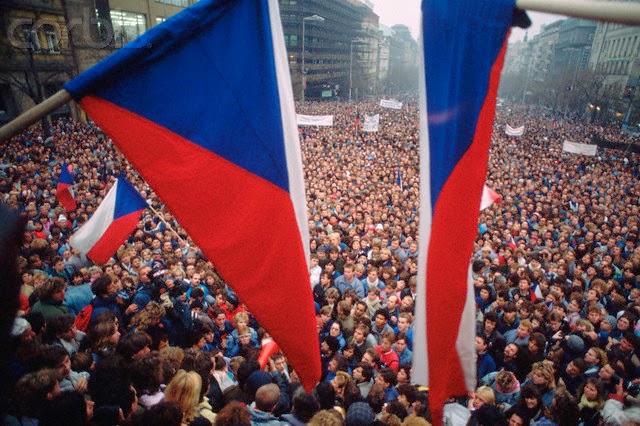
The Velvet Revolution in Prague on November 17, 1989

What was achieved 34 years ago in Czechoslovakia on November 17, 1989 that makes it a day of celebration around the world? 

It was a rejection of totalitarianism and the system of lies and hatred on which the regime thrived. It was a rebirth of freedom and of normal human relationships. In Vaclav Havel's address to the European Parliament on November 11, 2009 he outlined the daunting challenges faced after the transition:

A democratic political culture cannot be created or renewed overnight. It takes a lot of time and in the meantime there are plenty of unanticipated problems to be solved. Communism ruled just once in modern times (and, hopefully, for the last time), so the phenomenon of post-Communism was also a novelty. We had to confront the consequences of the rule of fear that lasted for so many years, as well as all the dangers related to a redistribution of property without precedent in history. So there were and are lots of obstacles and we are only now acquiring experience of such a state of affairs.
Months earlier in the summer of 1989 Jiří Křižan and Václav Havel had drafted "A Few Sentences" Petition calling for the release of political prisoners and respect for human rights. Tens of thousands of Czechoslovakians signed the petition and it contributed to the Velvet Revolution and the fall of communism in Czechoslovakia.

What took place on November 17, 1989 was the nonviolent triumph of the power of the powerless over a brutal totalitarian regime.This is in profound contrast to the centenary of the start of World War One that was supposed to make the world safe for democracy and instead ushered in two totalitarian systems: Nazism and Communism, a Second World War, a Cold War, and the age of nuclear weapons.

The Velvet Revolution was not inevitable, but a combination of providence, free will, and principled human action. The "Velvet Revolution" achieved profound non-violent change without wholesale slaughter and violence associated historically with revolutions. A cursory look would claim that the "revolution" took 11 days in November for the Communists to relinquish power. 

Some say it began in 1976 after the beating and arrest of the rock band, the Plastic People of the Universe, led to a number of intellectuals, Vaclav Havel, among them drafting and signing Charter 77 challenging the Czech communists to honor the rights outlined in their own constitution, and in the Helsinki accords which the communist government had signed in 1975.

Plastic People of the Universe

However some nonviolent theoreticians place the roots of the 1989 success even further back in the nonviolent response to the Soviet invasion of Czechoslovakia in 1968. After Soviet tanks crushed the Prague Spring, an effort by Czechoslovak communist reformers to build socialism with a human face, Havel wrote the following to the Czechoslovak President Alexander Dubcek who had been one of the reformers later purged: "Even a purely moral act that has no hope of any immediate and visible political effect can gradually and indirectly, over time, gain in political significance." The response by Czechs in what later became known as a civilian based defense, nonviolently bogged down the advancing Soviet army for eight months. The nonviolent lessons learned in 1968 planted seeds that bore fruit in 1989.  

Havel passed away on December 18, 2011 but his legacy endures and his ideas remains relevant raising the call to vigilance at a conference at Charles University titled “Freedom and its Enemies”:

The era of dictatorships and totalitarian systems has not ended at all. It may have ended in a traditional form as we know it from the 20th century, but new, far more sophisticated ways of controlling society are being born. It requires alertness, carefulness, caution, study and a detached view.

I've had the privilege to have walked the streets and breathed the air of Prague in May of 1990, barely five months after Havel went to the Castle in December of 1989, and returned nineteen years later in October of 2009 to participate in Forum 2000 and see the changes that had taken place. 

Although Czechs may no longer look in awe at all that they have accomplished after walking around the center of the city visiting shops and a grocery store, and talking with Czechs over a few beers I left impressed by all that had been accomplished, and with an overwhelming sense of happiness at bearing witness to a flowering of freedom and creativity that continues to endure and thrive. 

Vaclav Havel greets crowds in Wenceslas Square during 'Velvet Revolution'.

Victims of dictatorship the world over have experienced first hand the solidarity of the Czech and Slovak peoples. Further evidence that 34 years later the ideals of the Velvet Revolution endure.

 In Cuba, three years ago the San Isidro Movement, a collective of artists founded in 2018 to resist new restrictions on artistic freedom imposed by Havana's Decree 349 has marked a before and after in Cuban history with their civic protest, and the regime's violent reaction. 

Artists from the San Isidro Movement celebrating Cuban culture

Two years ago members of the San Isidro Movement together with compatriots in the diaspora challenged the dictatorship's culture of death embodied in the phrase "Patria o Muerte" (Homeland or Death) with a song titled "Patria y Vida" (Homeland and Life). Let us pray that soon Cuba will have its nonviolent revolution and its people freed from seven decades of first authoritarian, then totalitarian dictatorship and the old phrase of a democratic Cuba returns "Patria y Libertad" (Homeland and Freedom).

The Velvet Revolution gives us hope that freedom can be achieved in Cuba, and Cuban artists are on the front lines of this effort. Some of them, including Luis Manuel Otero Alcántara and Maykel Castillo Pérez, "El Osorbo" are enduring prison today in Cuba.

Tuesday, June 27, 2023

Remember her: Milada Horakova martyred on this day in 1950 by communist government for her nonviolent defense of Czechoslovakian democracy

Remember her.

Milada Horakova at her show trial in 1950.

Milada Horakova was hanged with three others in Prague’s Pankrac Prison as a spy and traitor to the Communist Czechoslovakian government on June 27, 1950. She was a  lawyer, social democrat, and a prominent feminist in the interwar and postwar periods. 

Milada had been a member of the Czech resistance to the Nazi occupation of her homeland and survived a Nazi prison. After Czechoslovakia was liberated from the Nazis in 1945 by the Soviets she became a member of parliament in 1946 but resigned her seat after the Communist coup of 1948

However she refused to abandon her country.  She was arrested at her office on September 27, 1949 "on charges of conspiracy and espionage against the state." 

Milada was subjected to a show trial. 

Oxford Languages defines a show trial as "a judicial trial held in public with the intention of influencing or satisfying public opinion, rather than of ensuring justice." 

Vladimir Lenin called them "model trials", but they would eventually become known as show trials under Josef Stalin with hundreds of thousands executed and millions sent to work camps in Siberia, and they would take place not only in the Soviet Union, but in the East Bloc including Czechoslovakia, and as far away as Cuba. The Nazis also copied the practice, and so have other repressive regimes

Seventy three years after Milada Horakova addressed the court in the final day of her show trial on June 8, 1950 her words ring true and strong:

"I have declared to the State Police that I remain faithful to my convictions, and that the reason I remain faithful to them is because I adhere to the ideas, the opinions and the beliefs of those who are figures of authority to me. And among them are two people who remain the most important figures to me, two people who made an enormous impression on me throughout my life. Those people are Tomas Garrigue Masaryk and Eduard Benes. And I want to say something to those who were also inspired by those two men when forming their own convictions and their own ideas. I want to say this: no-one in this country should be made to die for their beliefs. And no-one should go to prison for them."

Her life story was brought to big screen in 2017and on January 12, 2018 was available on Netflix, and is now available on Amazon. Below is an English trailer for this important film.

 Adam D. E. Watkins in his 2010 paper "The Show Trial of J U Dr. Milada Horáková: The Catalyst for Social Revolution in Communist Czechoslovakia, 1950" explains the importance of the show trial in gutting democratic traditions and replacing them with Stalinism:

The study deconstructs the show trial’s influence on inducing a country to foster the Communist movement against decades of democratic traditions. The research reveals the impact of the show trial of Dr. Milada Horáková in 1950 and how it was instrumental in reforming a society, marked the beginning of Stalinism, and ushered forth a perverted system of justice leading to a cultural transformation after the Communist putsch. Furthermore, the revolution truncated intellectual thought and signified the end of many social movements – including the women’s rights movement
According to D. E. Watkings Horáková was seen by the public as a symbol of  the First Republic and of democracy. Unlike others who did break under the relentless psychological and physical torture she never did. The communists tried to edit her testimony for propaganda purposes but as Radio Prague in their 2005 report on the discovery of the unedited tapes of her trial:
[S]he faced her show trial with calm and defiance, refusing to be broken. Audio recordings - intended to be used by the Communists for propaganda purposes - were mostly never aired, for the large part because for the Party's purposes, they were unusable.

Because she refused to cooperate with the Stalinists her punishment was particularly severe, even for the death penalty. In 2007 her prosecutor Ludmila Brozova-Polednova who in 1950 had helped to condemn Horakova to death, now 86, was tried as an accomplice to murder. During the trial Radio Prague reported that a note written by an anonymous eye-witness to Milada Horakova's execution quoted the young prosecutor recommending: "Don't break her neck on the noose, Suffocate the bitch - and the others too." Milada Horáková  was executed in Pankrác Prison on 27 June 1950 by a particularly torturous method: "intentionally slow strangulation, which according to historians took 15 minutes. She was 48 years old." The urn with her ashes was never given to her family nor is it known what became of them.


In a letter to her 16 year old teenage daughter Milada explained why she had refused to compromise with evil. Her daughter received the letter 40 years later after the end of communist rule:

The reason was not that I loved you little; I love you just as purely and fervently as other mothers love their children. But I understood that my task here in the world was to do you good … by seeing to it that life becomes better, and that all children can live well. … Don’t be frightened and sad because I am not coming back any more. Learn, my child, to look at life early as a serious matter. Life is hard, it does not pamper anybody, and for every time it strokes you it gives you ten blows. Become accustomed to that soon, but don’t let it defeat you. Decide to fight.
Hours prior to her execution she reaffirmed her position to her family:
I go with my head held high. One also has to know how to lose. That is no disgrace. An enemy also does not lose honor if he is truthful and honorable. One falls in battle; what is life other than struggle? (Both quotes excerpts taken from here)

Ms. Brožová-Polednová, the prosecutor,  was found guilty and sentenced to six years in prison in 2008 but was given a presidential pardon by Vaclav Klaus on humanitarian grounds one year and six months into her sentence and released in 2010. The former prosecutor defended her actions claiming that what she did was legal and that she was "following orders." She tried to appeal her conviction at the Strasbourg Court in 2011 and lost.

Today, June 27, the day of Milada Horakova's execution is now recognized in the Czech Republic as  “Commemoration day for the victims of the Communist regime.”


Biopic of the life of Milada Horáková (2017)

Wednesday, November 17, 2021

The Velvet Revolution at 32: Václav Havel, The Power of the Powerless, and the hope that it inspires today

 "The salvation of this human world lies nowhere else than in the human heart, in the human power to reflect, in human meekness and human responsibility."- Václav Havel IHT (21 February 1990) 

The Velvet Revolution in Prague on November 17, 1989

What was achieved 32 years ago in Czechoslovakia on November 17, 1989 that makes it a day of celebration around the world? 

It was a rejection of totalitarianism and the system of lies and hatred on which the regime thrived. It was a rebirth of freedom and of normal human relationships.  In Vaclav Havel's address to the European Parliament on November 11, 2009 he outlined the daunting challenges faced after the transition:

A democratic political culture cannot be created or renewed overnight. It takes a lot of time and in the meantime there are plenty of unanticipated problems to be solved. Communism ruled just once in modern times (and, hopefully, for the last time), so the phenomenon of post-Communism was also a novelty. We had to confront the consequences of the rule of fear that lasted for so many years, as well as all the dangers related to a redistribution of property without precedent in history. So there were and are lots of obstacles and we are only now acquiring experience of such a state of affairs.

Months earlier in the summer of 1989 Jiří Křižan and Václav Havel had drafted "A Few Sentences" Petition calling for the release of political prisoners and respect for human rights. Tens of thousands of Czechoslovakians signed the petition and it contributed to the Velvet Revolution and the fall of communism in Czechoslovakia.

What took place on November 17, 1989 was the nonviolent triumph of the power of the powerless over a brutal totalitarian regime.This is in profound contrast to the centenary of the start of World War One that was supposed to make the world safe for democracy and instead ushered in two totalitarian systems: Nazism and Communism, a Second World War, a Cold War, and the age of nuclear weapons.

The Velvet Revolution was not inevitable, but a combination of providence, free will, and principled human action. The "Velvet Revolution" achieved profound non-violent change without wholesale slaughter and violence associated historically with revolutions. A cursory look would claim that the "revolution" took 11 days in November for the Communists to relinquish power. 

Some say it began in 1976 after the beating and arrest of the rock band the Plastic People of the Universe led to a number of intellectuals, Vaclav Havel, among them drafting and signing Charter 77 challenging the Czech communists to honor the rights outlined in their own constitution and in the Helsinki accords which the communist government had signed in 1975.

However some nonviolent theoreticians place the roots of the 1989 success even further back in the nonviolent response to the Soviet invasion of Czechoslovakia in 1968. After Soviet tanks crushed the Prague Spring, an effort by Czechoslovak communist reformers to build socialism with a human face, Havel wrote the following to the Czechoslovak President Alexander Dubcek who had been one of the reformers later purged: "Even a purely moral act that has no hope of any immediate and visible political effect can gradually and indirectly, over time, gain in political significance." The response by Czechs in what later became known as a civilian based defense, nonviolently bogged down the advancing Soviet army for eight months. The nonviolent lessons learned in 1968 planted seeds that bore fruit in 1989.  

Havel passed away on December 18, 2011 but his legacy endures and his ideas remains relevant raising the call to vigilance at a conference at Charles University titled “Freedom and its Enemies”:

The era of dictatorships and totalitarian systems has not ended at all. It may have ended in a traditional form as we know it from the 20th century, but new, far more sophisticated ways of controlling society are being born. It requires alertness, carefulness, caution, study and a detached view.

I've had the privilege to have walked the streets and breathed the air of Prague in May of 1990, barely five months after Havel went to the Castle in December of 1989, and returned nineteen years later in October of 2009 to participate in Forum 2000 and see the changes that had taken place. 

Although Czechs may no longer look in awe at all that they have accomplished after walking around the center of the city visiting shops and a grocery store, and talking with Czechs over a few beers I left impressed by all that had been accomplished, and with an overwhelming sense of happiness at bearing witness to a flowering of freedom and creativity that continues to endure and thrive. 

Vaclav Havel greets crowds in Wenceslas Square during 'Velvet Revolution'.

Victims of dictatorship the world over have experienced first hand the solidarity of the Czech and Slovak peoples. Further evidence that 25 years later the ideals of the Velvet Revolution endure.

 In Cuba, a year ago the San Isidro Movement, a collective of artists founded in 2018 to resist new restrictions on artistic freedom imposed by Havana's Decree 349 has marked a before and after in Cuban history with their civic protest, and the regime's violent reaction. 

Artists from the San Isidro Movement celebrating Cuban culture

Earlier this year members of the San Isidro Movement together with compatriots in the diaspora challenged the dictatorship's culture of death embodied in the phrase "Patria o Muerte" (Homeland or Death) with a song titled "Patria y Vida" (Homeland and Life). Let us pray that soon Cuba will have its nonviolent revolution and its people freed from seven decades of first authoritarian, then totalitarian dictatorship and the old phrase of a democratic Cuba returns "Patria y Libertad" (Homeland and Freedom).

The Velvet Revolution gives us hope that it can be achieved, and Cuban artists are on the front lines of this effort.

Friday, December 18, 2020

Remembering Havel: Nine years after his passing

"Politicians at international forums may reiterate a thousand times that the basis of the new world order must be universal respect for human rights, but it will mean nothing as long as this imperative does not derive from the respect of the miracle of Being, the miracle of the universe, the miracle of nature, the miracle of our own existence." - Vaclav Havel, Independence Hall, July 4, 1994


Nine years ago on December 18, 2011 Václav Havel passed away. Victims of repression the world over were heartbroken because they had lost a steadfast friend.

Nine years later Forum 2000 remains a living legacy that gathers together politicians, victims of repression, human rights defenders, artists and intellectuals to focus on particular problems threatening the world today and seeking solutions. 

There is also a tradition that continues to be observed that celebrates Vaclav Havel's humor and sense of the absurd that is called the "Short Trousers for Vaclav Havel" initiative. 

Havel continues to be held in high esteem by free Cubans who remember his 2004 message to the Cuban people and his unfinished 2003 dialogue with Oswaldo Payá Sardiñas. In December 2016, FIU’s Václav Havel Program for Human Rights and Diplomacy unveiled a documentary that explored this friendship between these two human rights icons.

Nine years later and the example and writings of Vaclav Havel live on and serve as an example to democrats and friends of freedom everywhere.

Wednesday, December 18, 2019

Remembering Havel: Eight years after his passing

"Politicians at international forums may reiterate a thousand times that the basis of the new world order must be universal respect for human rights, but it will mean nothing as long as this imperative does not derive from the respect of the miracle of Being, the miracle of the universe, the miracle of nature, the miracle of our own existence." - Vaclav Havel, Independence Hall, July 4, 1994

Remembering Havel
Eight years ago on December 18, 2011 Václav Havel passed away. Victims of repression the world over were heartbroken because they had lost a steadfast friend.

Eight years later Forum 2000 remains a living legacy that gathers together politicians, victims of repression, human rights defenders, artists and intellectuals to focus on particular problems threatening the world today and seeking solutions. 

There is also a tradition that continues to be observed that celebrates Vaclav Havel's humor and sense of the absurd that is called the "Short Trousers for Vaclav Havel" initiative.

Havel continues to be held in high esteem by free Cubans who remember his 2004 message to the Cuban people and his unfinished 2003 dialogue with Oswaldo Payá Sardiñas. In December 2016, FIU’s Václav Havel Program for Human Rights and Diplomacy unveiled a documentary that explored this friendship between these two human rights icons.

Eight years later and the example and writings of Vaclav Havel live on and serve as an example to democrats and friends of freedom everywhere.

Tuesday, December 18, 2018

Remembering Havel

"If there is to be any chance at all of success, there is only one way to strive for decency, reason, responsibility, sincerity, civility and tolerance, and this is decently, reasonably, responsibly, sincerely, civilly, and tolerantly" - Václav Havel 

Seven years ago on December 18, 2018 Václav Havel passed away. He would have been 82 this year. Over the course of his life he worked in a brewery, became a play write, a dissident, a political prisoner, president of his country, and then a citizen, but through his example he was much more than all of that put together and is greatly missed.

Havel believed that moral actions, no matter how small or futile they may appear at the time can have profound consequences for both freedom and a just society. It is because the world is not a puzzle to be solved but incredibly much more complex that decisions of right and wrong made by each person have such great importance.

Oswaldo Payá Sardiñas and President Václav Havel in Prague (2002)
At the same time, he did not link hope with success but rather the certainty that what one is doing is both good and coherent. In 1990 in the book, Disturbing the Peace, Havel explained how he viewed hope.
“Hope, in this deep and powerful sense, is not the same as joy that things are going well, or willingness to invest in enterprises that are obviously headed for early success, but rather an ability to work for something because it is good, not just because it stands a chance to succeed. The more unpromising the situation in which we demonstrate hope, the deeper that hope is. Hope is not the same thing as optimism. It is not the conviction that something will turn out well, but the certainty that something makes sense, regardless of how it turns out.
The fruits of his legacy can be seen in the work of Forum 2000, an annual gathering of politicians, philosophers, artists, scientists, and the public to reflect on important issues challenging civilization. The topic on the twentieth gathering of Forum 2000 was "The Courage to take Responsibility." In such times this is wise counsel both for citizens and political leaders. 

Short trousers for Havel.
At the same time he also understood the value of humor. Václav Havel in an address to the Central European University on June 24, 1999 at a difficult moment on the international scene made the case for laughter.
"The only thing I can recommend at this stage is a sense of humor, an ability to see things in their ridiculous and absurd dimensions, to laugh at others and at ourselves, a sense of irony regarding everything that calls out for parody in this world."
Following his death in 2011, every year on the anniversary of his passing admirers of Václav Havel the world over wear short trousers in his memory. Organizers explained its historic significance along with its particular Czech sensibility.
The “Short Trousers for Václav Havel” initiative started in 2012 to honor the memory of Václav Havel with a gesture that was unique, memorable and easily achieved by supporters of this exceptional person in modern Czech and European history.  Short Trousers is a reference to Havel stepping into political life in 1989 and his inauguration to the presidency in visibly short trousers. He explained vainly that rather than a tailor’s mistake it was his habit to pull his pants up at every dramatic situation. To this, one might say global mythology of his short trousers, he added with a smile: "I must say that I am glad of it, more or less. From my point of view it’s a pretty gentle way of mocking myself."  An effort to honor such a respectable person by a gesture that points to this humorous episode might appear, at first sight, as a contradictory act. But the opposite is true. We believe that rolled up trousers on the anniversary of the death of Václav Havel is a gesture which is Czech, slightly satirical and which can be easily joined by anyone who wants to honor the memory of the last Czechoslovak and the first Czech president Havel in a cheerful way.
This method of spontaneous remembrance contrasts dramatically with how dictators forcibly demand that they be remembered on penalty of imprisonment for dissenting as has been the case following the 2016 death of Fidel Castro

Czechs remember and honor Vaclav Havel by wearing short trousers