Showing posts with label Hitler Stalin Pact. Show all posts

Monday, August 23, 2021

Black Ribbon Day 2021: The Hitler-Stalin Pact that started WW2 which communists would like to erase.

 "The struggle of man against power is the struggle of memory against forgetting." - Milan Kundera


Eighty two years ago on August 23, 1939 the world was shocked to learn that Communist Russia and Nazi Germany had signed a non-aggression pact, the Molotov-Ribbentrop pact. It was named after their respective foreign ministers, Vyacheslav Molotov and Joachim von Ribbentrop. Observers would have been even more horrified had they known of the secret protocols that divided Eastern Europe between the two totalitarian regimes. What they called a "peace treaty" in reality was a war treaty.

Rolling Soviet tanks and Nazi motorcyclists in Poland (September 1939).

Nine days later on September 1, 1939 at 4:45 am Nazi Germany invaded Poland and World War II started. Sixteen days later the Soviet Union exercising its secret agreement with the Nazis invaded Poland from the East and met their German allies in the middle of Poland. 

Nazi and Soviet soldiers greet one another in Poland (1939)

On September 22, 1939 the German Nazi army joined with the Soviet Communist army in a military parade in Brest-Litovsk and the two sides celebrated together. Soviet Foreign Minister Vyacheslav Molotov in a October 31, 1939  speech spoke candidly about the Nazi-Communist alliance, and ridiculed its victims.

"The ruling circles of Poland boasted quite a lot about the ‘stability’ of their state and the ‘might’ of their army. However, one swift blow to Poland, first by the German Army and then by the Red Army, and nothing was left of this ugly offspring of the Versailles Treaty which had existed by oppressing non-Polish nationalities."

Approximately 230,000 Polish soldiers and officers and thousands of military service representatives were taken captive by the Russians. The Soviet precursor to the KGB was the NKVD. "From October 1939, the delegated NKVD officials from Moscow heard the prisoners, encouraged them to cooperate and collected data. Only a few of the prisoners agreed to collaborate. The commanding officers’ reports included opinions about hostile attitudes of the Poles and a minimal chance of them being useful to the USSR authorities."

The decision to shoot the prisoners was signed on March 5, 1940 by seven members of the All- Union Communist Party (Bolsheviks) authorities: Joseph Stalin, Lavrentiy Beria (proposer), Kliment Voroshilov, Vyacheslav Molotov, Anastas Mikoyan, Mikhail Kalinin and Lazar Kaganovich.  Thousands of Polish Army officers and intellectual leaders were taken into the Katyn Forest near Smolensk in the Soviet Union, shot in the back of the head or in the neck and buried in mass graves.

Secret protocols of the Hitler-Stalin Pact not only partitioned Poland but also divided up Lithuania, Latvia, Estonia, Finland and Romania into Nazi and Soviet "spheres of influence." The Soviet Union invaded and annexed the Baltic States in June 1940.  

Soviet Foreign Minister Vyacheslav Molotov meets with Adolf Hitler (1940)

Soviet Foreign Minister Vyacheslav Molotov in a speech delivered on August 1, 1940 while the Soviet Union was then still allied with Nazi Germany continued to describe their military alliance as a "non-aggression pact."   

 "A radical change for the better in the relations between the Soviet Union and Germany found its expression in the non-aggression pact signed last August. These new, good relations between the USSR and Germany have been tested in practice in connection with events in former Poland, and their strength has been sufficiently proved."

Another sign of Nazi-Soviet cooperation was the Soviet Union’s deportation of hundreds of refugees to Nazi authorities. Most of them were German anti-fascists, communists, and Jews who had sought asylum in the Soviet Union.

This should not have come as a complete surprise.

Communist morality has no problem with any of it because as the communist revolutionary Vladimir Lenin observed in a speech to Russian communist youth on October 2, 1920:

"The class struggle is continuing and it is our task to subordinate all interests to that struggle. Our communist morality is also subordinated to that task. We say: morality is what serves to destroy the old exploiting society and to unite all the working people around the proletariat, which is building up a new, communist society."

Both ideologies sought to destroy the old existing order and replace it with a new one. The Nazis with a society based in ideas of racial purity and the Communists with the destruction of all existing class structure. On the surface these ideas are in conflict, but in practical terms both sought to destroy the existing social and political order.

The same people who would join Hitler's brown shirts were also susceptible recruits to join Antifa. Communists viewed the SA as a "proletarian-revolutionary paramilitary wing"of the Nazi movement and susceptible to being recruited to the communist cause. The case of Richard Scheringer, a supporter of Adolf Hitler and army officer who converted to communism in the early 1930s is a high profile example of this. 

Richard Scheringer: From Nazi to Communist

Harvey Klehr, the Andrew W. Mellon Professor of Politics and History, Emeritus, at Emory University, described how communists had mistakenly viewed the Nazis as a means to achieving power and undermining capitalist democracies. Antifa identified all political parties that were not communist as fascist. This meant that social democrats, centrist political parties, and conservative parties were together with the Nazis all labeled fascist. This was the Comintern's class against class approach and fractured any potential broad anti-Nazi coalition.

"Adolf Hitler’s rise to power in 1932 had been immeasurably aided by the German communists' steadfast support for the Comintern tactic of “class against class,” which demanded no cooperation with other anti-Nazi forces. German communists blithely insisted that Hitler’s triumph would be evanescent—summarized in their optimistic slogan, Nach Hitler, kommen wir ('After Hitler, us'). 

The Molotov-Ribbentrop pact is this strategy but on a grander scale. Let the Western democracies and the Nazis exhaust each other in the conflict and then seize everything. Victor Davis Hanson, a Senior Fellow at the Hoover Institution. reported that "Stalin shipped huge supplies of food and fuel for the German war effort against the West." 

Soviet and Nazi soldiers fraternize after conquering Poland in 1939

The Communist International (Comintern) issued new orders to their members once the non-aggression pact was made public. Professor Klehr described the new directive.

Good communists were ordered to oppose anyone intending to stand in Hitler’s way.  With Ribbentrop’s second visit to Moscow at the end of September and the signing of a German-Soviet Treaty of Friendship, the Comintern emphasized that the primary adversary was those countries that were at war with Germany, and those socialists and social democrats fighting against fascism. Germany had concluded a pact with the USSR, while “reactionary” England, at the helm of a vast colonial empire, was the “bulwark of capitalism.” Thus, communist parties in England and France were ordered to call for the defeat of their countries—ordered, in other words, to officially embrace treason. 
According to Klehr, Nazi reports confirmed that Communists were fulfilling their part of the agreement siding against Western Democracies.
 A June 1940 Gestapo report approvingly noted that the Soviet government was favorably disposed to the Third Reich and had endorsed its invasions of the Scandinavian states and Belgium and Holland “as necessary and proper.” The report went on to note that the Comintern had avoided open attacks on Germany,  and that the parties and publications allied with the Comintern were not pushing for communists to struggle against National Socialism or denounce fascism.

This alliance ended on June 22, 1941 when Hitler launched Operation Barbarossa, the invasion of the Soviet Union, betraying his ally Josef Stalin. 

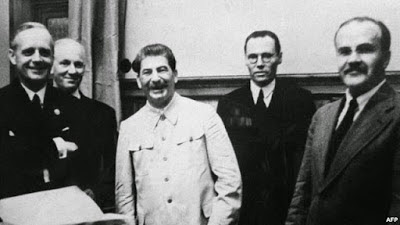
Nazi Foreign Minister Ribbentrop, Joseph Stalin, and Soviet foreign minister, Molotov

"Stalin was shocked; he had received a plethora of warnings of an imminent invasion – notably from Winston Churchill, informed by British intelligence briefings. The communist dictator had refused to believe them," reported Agence France Press. Stalin preferred to rely on Hitler's assurances.  

Today, communist apologists will continue to defend Stalin and attempt to cover up this history of collaboration between the Soviet Union and Nazi Germany. It may also explain the real reason behind attacks on the legacy of Winston Churchill. His observation on the relationship between the Communists and the Nazis in his book The Second World War, Volume 1, The Gathering Storm (1948) is damning and accurate.

"Fascism was the shadow or ugly child of communism… As Fascism sprang from Communism, so Nazism developed from Fascism. Thus were set on foot those kindred movements which were destined soon to plunge the world into more hideous strife, which none can say has ended with their destruction." 

The Molotov-Ribbentrop Pact and the reckless strategy pursued by Stalin and the Communist International cost 22 to 28 million Russian lives alone in World War Two, and nearly led to the Nazi conquest and occupation of the Soviet Union.


It also led to Poland spending another half century under Soviet domination and Lithuania, Latvia and Estonia territories absorbed by the Soviet Union. A conquest that arose out of the Hitler-Stalin pact that endured following the end of WW2.

It was a nonviolent movement thirty two years ago that liberated the Baltic nations. The Baltic Way brought an end to this part of the Nazi-Soviet non-aggression pact.

The Baltic Way brought an end to one key element of Molotov Ribbentrop


 On June 4, 1989 the Solidarity labor movement won in free elections and the Polish people finally regained their sovereignty after nearly 50 years under Soviet domination. They did it nonviolently. 

So did the people of the Baltic states when two million Latvians, Lithuanians and Estonians joined hands together in a giant human chain stretching 370 miles on August 23, 1989. Fifty years to the day after the treaty that brought them so much grief had been signed.


This history must not be forgotten. The Spanish scholar George Santayana understood that "those who cannot remember the past are condemned to repeat it."  

Across the world in Europe and the Americas Black Ribbon Day continues to be remembered with acts of remembrance. Today at 3:00pm at the Legislative Assembly in Alberta Canada there will be a Black Ribbon Day commemoration. The Honourable Nathan Cooper, Speaker of the Legislative Assembly of Alberta, will host the event and made the following video.

Over social media the Lithuanian Foreign Ministry offers an overview of the Hitler-Stalin Pact.

The Polish government is also remembering this day.

Remembrance of the nonviolent action that brought the Hitler-Stalin Pact finally to an end is also being shared on social media.

Sunday, August 23, 2020

Black Ribbon Day 2020: The Hitler-Stalin Pact that started WW2 and that communists would like to erase.

"The struggle of man against power is the struggle of memory against forgetting." - Milan Kundera


Eighty one years ago on August 23, 1939 the world was shocked to learn that Communist Russia and Nazi Germany had signed a non-aggression pact, the Molotov-Ribbentrop pact. It was named after their respective foreign ministers, Vyacheslav Molotov and Joachim von Ribbentrop. Observers would have been even more horrified had they known of the secret protocols that divided Eastern Europe between the two totalitarian powers. What they called a "peace treaty" in reality was a war treaty.

Rolling Soviet tanks and Nazi motorcyclists in Poland (September 1939).
 Nine days later on September 1, 1939 at 4:45 am Nazi Germany invaded Poland and World War II started. Sixteen days later the Soviet Union exercising its secret agreement with the Nazis invaded Poland from the East and met their German allies in the middle of Poland. On September 22, 1939 the German Nazi army joined with the Soviet Communist army in a military parade in Brest-Litovsk and the two sides celebrated together.
Nazi and Soviet soldiers greet one another in Poland (1939)
About 230,000 Polish soldiers and officers and thousands of military service representatives were taken captive by the Russians. The Soviet precursor to the KGB was the NKVD. "From October 1939, the delegated NKVD officials from Moscow heard the prisoners, encouraged them to cooperate and collected data. Only a few of the prisoners agreed to collaborate. The commanding officers’ reports included opinions about hostile attitudes of the Poles and a minimal chance of them being useful to the USSR authorities."

The decision to shoot the prisoners was signed on March 5, 1940 by seven members of the All- Union Communist Party (Bolsheviks) authorities: Joseph Stalin, Lavrentiy Beria (proposer), Kliment Voroshilov, Vyacheslav Molotov, Anastas Mikoyan, Mikhail Kalinin and Lazar Kaganovich.  

Thousands of Polish Army officers and intellectual leaders were taken into the Katyn Forest near Smolensk in the Soviet Union, shot in the back of the head or in the neck and buried in mass graves.
Months later, the Soviet Union invaded and annexed the Baltic States in June 1940. 


This should not have come as a complete surprise.
 
The same people who would join Hitler's brown shirts were also susceptible recruits to join Antifa. Communists viewed the SA as a "proletarian-revolutionary paramilitary wing"of the Nazi movement and susceptible to being recruited to the communist cause. The case of Richard Scheringer, a supporter of Adolf Hitler and army officer who converted to communism in the early 1930s is a high profile example of this.
 
Harvey Klehr, the Andrew W. Mellon Professor of Politics and History, Emeritus, at Emory University, described how communists had mistakenly viewed the Nazis as a means to achieving power and undermining capitalist democracies. Antifa identified all political parties that were not communist as fascist. This meant that social democrats, centrist political parties, and conservative parties were together with the Nazis all labeled fascist. Fascism, according to Antifa, is anti-capitalism. This was the Comintern's class against class approach and fractured any potential broad anti-Nazi coalition.
"Adolf Hitler’s rise to power in 1932 had been immeasurably aided by the German communists' steadfast support for the Comintern tactic of “class against class,” which demanded no cooperation with other anti-Nazi forces. German communists blithely insisted that Hitler’s triumph would be evanescent—summarized in their optimistic slogan, Nach Hitler, kommen wir ('After Hitler, us'). 
The Molotov-Ribbentrop pact is this strategy but on a grander scale. Let the Western democracies and the Nazis exhaust each other in the conflict and then seize everything. Victor Davis Hanson, a Senior Fellow at the Hoover Institution. reported that "Stalin shipped huge supplies of food and fuel for the German war effort against the West."

Soviet and Nazi soldiers fraternize after conquering Poland in 1939
The Communist International (Comintern) issued new orders to their members once the non-aggression pact had been made public.  Professor Klehr described the new directive.
Good communists were ordered to oppose anyone intending to stand in Hitler’s way.  With Ribbentrop’s second visit to Moscow at the end of September and the signing of a German-Soviet Treaty of Friendship, the Comintern emphasized that the primary adversary was those countries that were at war with Germany, and those socialists and social democrats fighting against fascism. Germany had concluded a pact with the USSR, while “reactionary” England, at the helm of a vast colonial empire, was the “bulwark of capitalism.” Thus, communist parties in England and France were ordered to call for the defeat of their countries—ordered, in other words, to officially embrace treason. 
According to Klehr, Nazi reports confirmed that Communists were fulfilling their part of the agreement siding against Western Democracies. 
A June 1940 Gestapo report approvingly noted that the Soviet government was favorably disposed to the Third Reich and had endorsed its invasions of the Scandinavian states and Belgium and Holland “as necessary and proper.” The report went on to note that the Comintern had avoided open attacks on Germany,  and that the parties and publications allied with the Comintern were not pushing for communists to struggle against National Socialism or denounce fascism.
This arrangement only ended on June 22, 1941 when the Nazis double crossed their Soviet allies and launched Operation Barbarossa, the invasion of the Soviet Union.

Nazi Foreign Minister Ribbentrop, Joseph Stalin, and Soviet foreign minister, Molotov
Communist morality has no problem with any of it because as the communist revolutionary Vladimir Lenin observed in a speech to Russian communist youth on October 2, 1920:
"The class struggle is continuing and it is our task to subordinate all interests to that struggle. Our communist morality is also subordinated to that task. We say: morality is what serves to destroy the old exploiting society and to unite all the working people around the proletariat, which is building up a new, communist society."
The myth that the communists were anti-fascists is a dangerous one, and the fact is that they viewed the Nazis as an instrument to wipe out Western Democracies and replace them with communist regimes believing that the fascists would quickly fade out of power.

This reckless strategy cost 22 to 28 million Russian lives in World War Two, and nearly led to the Nazi conquest and occupation of Russia.

It also led to Poland spending another half century under Soviet domination and Lithuania, Latvia and Estonia occupied by the Russians.  A conquest that arose out of the Hitler-Stalin pact that endured following the end of the war. 

The Baltic Way brought an end to one key element of Molotov Ribbentrop
It was a nonviolent movement thirty years ago that liberated the Baltic nations. The Baltic Way brought an end to this part of the Nazi-Soviet non-aggression pact.

On June 4, 1989 the Solidarity labor movement won in free elections and the Polish people finally regained their sovereignty after nearly 50 years under Soviet domination. They did it nonviolently.

So did the people of the Baltic states when two million Latvians, Lithuanians and Estonians joined hands together in a giant human chain stretching 370 miles on August 23, 1989. Fifty years to the day after the treaty that brought them so much grief had been signed.

This history must not be forgotten. The Spanish scholar George Santayana understood that "those who cannot remember the past are condemned to repeat it."


The Embassy of Estonia, Embassy of Latvia, Embassy of Lithuania, JBANC, Estonian American National Council, EU Delegation to the USA, Lithuanian American Council, and the Victims of Communism Memorial Foundation organized a reenactment of this nonviolent action that freed three peoples on the 80th anniversary of the signing of the pact.

In Washington DC on August 23, 2019, we held hands in a human chain to celebrate freedom in front of the U.S. Capitol and afterwards gathered at Biergarten Haus


At a time when communists are using the Antifa label to legitimize their deadly ideology it is important to remember their alliance with Nazism, and call on others to learn from this history.
 

Sunday, September 22, 2019

Joint Soviet-Nazi military parade held 80 years ago today in Poland

"A radical change for the better in the relations between the Soviet Union and Germany found its expression in the non-aggression pact signed last August. These new, good relations between the USSR and Germany have been tested in practice in connection with events in former Poland, and their strength has been sufficiently proved." - Vyacheslav Molotov, Soviet Foreign Minister,  Speech Delivered on 1 August 1940

Soviet and Nazi soldiers fraternize after conquering Poland in 1939
Eighty years ago on September 22, 1939 a joint Nazi–Soviet military parade in Brest-Litovsk was held to celebrate the successful invasion of Poland.


Soviet troops paid their respects as the Swastika flag was lowered, and Germans moved west to their agreed upon line of partition.  

German and Soviet soldiers salute lowering of the Nazi flag on September 22, 1939 in Poland
Russian chess master and human rights defender, Garry Kasparov, described the event and its significance.
"On September 22, 1939, conquering Soviet and German forces held a joint victory parade in the Polish city of Brest-Litovsk, before the German military withdrew back behind the line agreed by Molotov-Ribbentrop. Less than a year later, the Baltic states were next to be occupied and annexed by the USSR. People who wanted only independence were trapped between two evil superior forces trying to destroy and enslave them."
One day earlier on September 21, 1939 Soviet Commander Vladimir Yulianovich Borovitsky and Nazi General Heinz Guderian in Brest, Poland (now Brest, Belarus) work out the Nazi-Soviet boundary demarcation of occupied Poland.
Soviet Commander Yulianovich Borovitsky and German General Guderian in Brest, Poland
Six days earlier, in the early morning hours of September 17, 1939, the Soviet Union invaded Poland from the East. 

21 days earlier at 4:45am on September 1, 1939 Nazi Germany invaded Poland from the west. This marked the start of World War II.

On August 23, 1939 the Hitler-Stalin Pact (formal name the Molotov-Ribbentrop pact) was signed that publicly proclaimed a non-aggression treaty, but had secret protocols that divided up Central Europe and partitioned Poland.

This was not the first time Nazis and Communists would collaborate nor would it be the last.  This history calls for a deeper reflection on the two ideologies and their commonalities.

Friday, August 23, 2019

Black Ribbon Day 2019: Day of Remembrance for Victims of Totalitarian Regimes

"In continental Europe Fascist movements were largely recruited from among Communists, and the opposite process may well happen within the next few years." - George Orwell, Notes on Nationalism, 1945
Nazi and Soviet soldiers celebrate their military victory in Poland (1939)
Eighty years ago on August 23, 1939 Josef Stalin, the leader of the Soviet Union, the first communist regime, signed a treaty with Adolph Hitler, the leader of Nazi Germany it was initially named after their respective foreign ministers, V.M. Molotov and Joachim von Ribbentrop, as the Molotov-Ribbentrop Pact. However it also became known as the Hitler-Stalin Pact


It was publicly described by both parties as a non-aggression treaty but it had a secret additional protocol that divided up Poland and the Baltic states. In reality it was a an aggression treaty in which the two aggressors Nazi Germany and Soviet Russia agreed before hand how to divide up the spoils as follows:
Article I.
 In the event of a territorial and political rearrangement in the areas belonging to the Baltic States (Finland, Estonia, Latvia, Lithuania), the northern boundary of Lithuania shall represent the boundary of the spheres of influence of Germany and U.S.S.R. In this connection the interest of Lithuania in the Vilna area is recognized by each party.

Article II.
In the event of a territorial and political rearrangement of the areas belonging to the Polish state, the spheres of influence of Germany and the U.S.S.R. shall be bounded approximately by the line of the rivers Narev, Vistula and San. The question of whether the interests of both parties make desirable the maintenance of an independent Polish States and how such a state should be bounded can only be definitely determined in the course of further political developments. In any event both Governments will resolve this question by means of a friendly agreement.  ...
Nine days later on September 1, 1939 at 4:45 am Nazi Germany invaded Poland and World War II started. Sixteen days later the Soviet Union exercising its secret agreement with the Nazis invaded Poland from the East and met their German allies in the middle of Poland. 


On September 22, 1939 the German Nazi army joined with the Soviet Communist army in a military parade in Brest-Litovsk and the two sides celebrated together. In the above picture German Lieutenant-General Mauritz von Wiktorin, General Heinz Guderian and Soviet tank commander Semyon Moiseevich Krivoshein fraternize in Brest-Litovsk, Poland.

Each year on August 23rd beginning in 2009 there is a day of remembrance for the victims of Soviet Communism and Nazi Tyranny across Europe, Canada and the United States.

We should remember the long history of Communist-Nazi collaboration that began long before August 23, 1939 and resumed after the end of World War II, and the nature of these totalitarian regimes.

This is an important moment to hold such acts of remembrance because Russia is engaged in a campaign to rewrite this history, justifying the Molotov-Ribbentrop pact to whitewash Josef Stalin's crimes. This is also why the statement below is now needed.

Joint Statement by Estonia, Latvia, Lithuania, Poland and Romania on the occasion of 80 years since the signing of Molotov-Ribbentrop Pact


August 23 will mark 80 years since the signing of the Molotov-Ribbentrop Pact between the Soviet Union and Nazi Germany that sparked World War II and doomed half of Europe to decades of misery. The Pact contained the secret protocol which effectively carved up Eastern Europe into spheres of influence. 
This is why on this day proclaimed by the European Parliament as a European Day of Remembrance for Victims of Totalitarian Regimes we remember all those whose deaths and broken lives were a consequence of the crimes perpetrated under the ideology of Nazism and Stalinism. 
Pain and injustice will never fall into oblivion. We will remember.
Remembering and commemorating past horrors gives us the knowledge and strength to reject those who seek to revive these ideologies or who seek to exonerate these ideologies of their crimes and culpability. The memory of the victims compels us to promote historical justice by continuing research and raising public awareness of the totalitarian legacy on the European continent.
The basis for sustainable conciliation and building a common future is justice and objective truth. Victims of totalitarian crimes have a right to justice. Unfortunately, the practice of investigating and prosecuting the crimes of totalitarian regimes has been insufficient and inconsistent across countries.
We call upon the governments of all European countries to provide both moral and material support to the ongoing historical investigation of the totalitarian regimes. By acting in a concerted manner, we can counter more effectively disinformation campaigns and attempts to manipulate historical facts.
We must stand together against totalitarianism. A clear and firm position of the international community will pave the way to further reconciliation.
We are confident that today's Europe is a safe place for all peoples, and ready to resolutely resist any kind of injustice. We believe that Europeans will never tolerate totalitarianism or genocide against any people.
Our countries have been reborn as free and democratic nations after decades of totalitarian rule. Thirty years ago, our nations started the democratic transformations that eventually made us equal and vigorous members of the European Union. Our countries are determined to continue working with our partners in Europe and around the world so that the horrors of the past never re-emerge.
Minister of Foreign Affairs of the Republic of Estonia Urmas Reinsalu
Minister of Foreign Affairs of the Republic of Latvia Edgars Rinkēvičs
Minister of Foreign Affairs of the Republic of Lithuania Linas Linkevičius
Minister of Foreign Affairs of the Republic of Poland Jacek Czaputowicz
Minister of Foreign Affairs of Romania Ramona-Nicole Mănescu

Wednesday, August 23, 2017

Black Ribbon Day 2017: Remembering some of the new victims of Communist and Nazi totalitarianism

 "Those who cannot remember the past are condemned to repeat it." - George Santayana

78 years ago on August 23, 1939 Josef Stalin and Adolph Hitler signed a treaty that was called a non-aggression treaty but it had a secret additional protocol that divided up Eastern Europe. It was a an aggression treaty were Nazi Germany and Soviet Russia plotted against their neighbors leading to the outbreak of WW2 on September 1, 1939 when Poland was invaded and occupied.

Today in Europe, Canada and the United States many observe Black Ribbon Day in remembrance for victims of totalitarian regimes. Sadly, this body count continues to rise in 2017. Even in democracies totalitarian movements attempt to sow chaos and try to destabilize and undermine free societies.

Germany recognizes the evil of the Nazi regime and has sought to pursue reconciliation through truth, memory, and justice. Sadly, in Russia today the Putin regime has backtracked and denied Soviet complicity with the Nazis in the start of WW2. This is dangerous because communist regimes continue to ally with fascist regimes and engage in systemic racism when it suits them.

Neo-Nazis are not in power at the national level but their movements wreak havoc around the world. Communists remain in power in 2017 in China, Vietnam, North Korea, Laos, Cuba, and in Venezuela with a rising body count of victims.

Susan Bro holds up photo of murdered daughter Heather Heyer
Last week I heard the heart breaking testimony of Susan Bro whose daughter Heather Heyer, age 32, was run over and murdered by a white supremacist on August 12, 2017 in Charlottesville, Virginia while 19 others were badly in the attack.

Earlier today I listened to the heart breaking testimony of Venezuelan exile Maria Eugenia Tovar whose daughter Génesis Carmona, age 22, was shot in the head and killed in Venezuela in 2014 by the Maduro regime and talked about her loss. 


Maria Eugenia Tovar holds up photo of murdered daughter Génesis Carmona
In light of events over the past few months more citizens of good will should organize events on Black Ribbon Day, write letters to the editor, and opinion pieces reminding the world of the need to remember what happened on August 23, 1939 and to denounce totalitarianism of all stripes. I hope that next year there will be a high profile Black Ribbon Day event in Miami.

Read more here: http://www.miamiherald.com/news/nation-world/world/americas/venezuela/article168971367.html#storylink=cpy

Tuesday, August 22, 2017

Black Ribbon Day 2017: Remembering the victims of Soviet Communism and Nazi Tyranny

"Those who cannot remember the past are condemned to repeat it." - George Santayana

Seventy eight years ago on August 23, 1939 Josef Stalin, the leader of the Soviet Union, the first communist regime, signed a treaty with Adolph Hitler, the leader of Nazi Germany it was initially named after their respective foreign ministers, V.M. Molotov and Joachim von Ribbentrop, as the Molotov-Ribbentrop Pact. However it also became known as the Hitler-Stalin Pact. It was publicly described by both parties as a non-aggression treaty but it had a secret additional protocol that divided up Poland and the Baltic states. In reality it was a an aggression treaty in which the two aggressors Nazi Germany and Soviet Russia agreed before hand how to divide up the spoils as follows:
Article I.
 In the event of a territorial and political rearrangement in the areas belonging to the Baltic States (Finland, Estonia, Latvia, Lithuania), the northern boundary of Lithuania shall represent the boundary of the spheres of influence of Germany and U.S.S.R. In this connection the interest of Lithuania in the Vilna area is recognized by each party.

Article II.
In the event of a territorial and political rearrangement of the areas belonging to the Polish state, the spheres of influence of Germany and the U.S.S.R. shall be bounded approximately by the line of the rivers Narev, Vistula and San. The question of whether the interests of both parties make desirable the maintenance of an independent Polish States and how such a state should be bounded can only be definitely determined in the course of further political developments. In any event both Governments will resolve this question by means of a friendly agreement.  ...

Nine days later on September 1, 1939 at 4:45 am Nazi Germany invaded Poland and World War II started. Sixteen days later the Soviet Union exercising its secret agreement with the Nazis invaded Poland from the East and met their German allies in the middle of Poland and on September 22, 1939 the German Nazi army joined with the Soviet Communist army in a military parade in Brest-Litovsk and the two sides celebrated together.

Rolling Soviet tanks and Nazi motorcyclists in Poland (September 1939).
Each year on August 23rd beginning in 2009 there is a day of remembrance for the victims of Soviet Communism and Nazi Tyranny across Europe, Canada and the United States. The Victims of Communism Memorial Foundation will hold a Black Ribbon Day on Wednesday from 5:00pm to 6:00pm at the Victims of Communism Memorial located at the intersection of New Jersey Avenue NW and Massachusetts Avenue NW, in Washington, DC. If you plan to attend please RSVP.

Soviet soldier and Nazi soldiers fraternize after conquering Poland in 1939
This is an important moment to hold such a ceremony here in the United States when far too many Americans have openly marched in 2017 with Nazi Swastika flags and Soviet hammer and sickle flags there is a heightened need for acts of remembrance at the horrors unleashed by these twin symbols of hate and how the bloodiest and most brutal war in human history was unleashed on the world when these two evil systems conspired together under a banner of peace and non-aggression that was a lie. Between 1939 and 1945 an estimated 50 to 85 million people were killed in this conflict.  Furthermore the anti-racist credentials of the Workers World Party should be called into question when they support North Korea despite its racist screed against President Obama.

Marching with Communist and Nazi flags in Charlottesville, Virginia
In times of great moral confusion it is important to recall past errors to avoid committing them again in the future. The ongoing debate in the United States of how to confront the menace of violent Neo-Nazism finds far too many Americans looking to AntiFa, a violent fringe group, linked to the Communist Party, to violently counter the white supremacists. The belief is that countering a violent and hateful ideologically motivated movement with another violent and hateful ideologically motivated movement will lead to at least the destruction of one or of both.

Hitler and Stalin salute each other over the corpse of Poland in this 1939 caricature
 In the 1920s and 1930s in Germany groups with the same names and carrying the same flags fought in the streets, with each creating their own heroic narratives, in their decade long violent skirmishes. Fires were set, businesses trashed, and brawls carried out with each side portraying the other as dangerous terrorists, but in reality their radical movements fed off one another while weakening German democratic institutions as mob rule co-opted Weimar Germany, eventually it was taken over by Adolph Hitler and the Nazi Party, consolidating power by blaming the communists for burning down of the German Parliament building on February 27, 1933 with the Enabling Laws.

Source: Library of Congress
There were other factors that fueled the rise of Nazism: the Great Depression, the punishing Treaty of Versailles, and the later appeasement of the West but the violent dynamic between the Communist Party and AntiFa against the Nazis in the 1930s helped the rise of Hitler more than impede it.

Nazism and Communism are two ideologies that together have claimed more than 160 million lives and remain a threat to civilization. They should not be underestimated, their histories remembered and condemned. This is why it is so important to observe Black Ribbon Day on August 23rd.