Showing posts with label Maria Corina Machado. Show all posts

Thursday, August 22, 2024

Elections in Venezuela are not a guarantee, but an opportunity

The Power of the powerless.


On four occasions in 2012in 2015, in 2018, and now in 2024, this blog has offered reflections on elections in Venezuela under Hugo Chavez, and later Nicolas Maduro. Each time the question that the vote on election day would decide who would remain in power was discarded.  What mattered was not the vote on election day, but what the opposition would do afterwards to hold the dictatorship accountable for stealing the election, and use the moment to mobilize the populace, and non-violently challenge the regime.

In 2015, this blog concluded with a quote by Maria Corina Machado that proved prophetic in 2024. The Venezuelan opposition leader over twitter on December 5, 2015 explained the stakes in this election: "Win by a landslide or a monumental fraud will be done that we will not accept." 

It is true that "free and fair elections are not possible in totalitarian police states such as Venezuela, Cuba, and Nicaragua."  Gene Sharp, the late strategic nonviolence scholar,  explained why in his 1993 work,  FROM DICTATORSHIP TO DEMOCRACY: A conceptual framework for liberation, published on the website of the Cuban NGO Brothers to the Rescue. 

"Elections are not available under dictatorships as an instrument of significant political change. Some dictatorial regimes, such as those of the former Soviet-dominated Eastern bloc, went through the motions in order to appear democratic. Those elections, however, were merely rigidly controlled plebiscites to get public endorsement of candidates already hand picked by the dictators. Dictators under pressure may at times agree to new elections, but then rig them to place civilian puppets in government offices. If opposition candidates have been allowed to run and were actually elected, as occurred in Burma in 1990 and Nigeria in 1993, results may simply be ignored and the "victors" subjected to intimidation, arrest, or even execution. Dictators are not in the business of allowing elections that could remove them from their thrones."

Elections are not an instrument of political change, but they can be used as a tool of political mobilization in a nonviolent struggle, and this is what I believe is taking place in Venezuela today. Sharp offers a hard truth, but one that reveals that the power to change resides, not in foreign powers, but in the people themselves. An important excerpt is reproduced below.

Facing the hard truth

The conclusion is a hard one. When one wants to bring down a dictatorship most effectively and with the least cost then one has four immediate tasks:

  •  One must strengthen the oppressed population themselves in their determination, self-confidence, and resistance skills;
  •  One must strengthen the independent social groups and institutions of the oppressed people;
  •  One must create a powerful internal resistance force; and
  •  One must develop a wise grand strategic plan for liberation and implement it skillfully.

A liberation struggle is a time for self-reliance and internal strengthening of the struggle group. As Charles Stewart Parnell called out during the Irish rent strike campaign in 1879 and 1880:

It is no use relying on the Government . . . . You must only rely upon your own determination . . . . [H]elp yourselves by standing together . . . strengthen those amongst yourselves who are weak . . . , band yourselves together, organize yourselves . . . and you must win . . . .

When you have made this question ripe for settlement, then and not till then will it be settled.(4)

Against a strong self-reliant force, given wise strategy, disciplined and courageous action, and genuine strength, the dictatorship will eventually crumble. Minimally, however, the above four requirements must be fulfilled.

As the above discussion indicates, liberation from dictatorships ultimately depends on the people's ability to liberate themselves.


Wednesday, December 23, 2015

Venezuela Update: Maduro's Christmas Coup versus The Democratic Opposition's Call for an Amnesty

"We knew that they were elections in a dictatorship; that is why we fought in the streets and tables. Today, it is the same dictatorship, defeated politically and electorally." - María Corina Machado, Venezuelan opposition leader over twitter on December 22, 2015

Maria Corina Machado, Leopoldo López Mendoza, on February 18, 2014

Venezuela is not a democracy but a country where contested elections are held within an anti-democratic regime. This has meant that the opposition had had to take to the street to ensure that the vote be respected on and following December 6, 2015. There are prisoners of conscience today in Venezuela and the democratic opposition is demanding their release in an amnesty before Christmas which Maduro has rejected. 

Furthermore the Maduro regime has packed the Supreme Court and is seeking to use this court to undo the results of the National Assembly elections by challenging the results in 22 races. By denying the opposition its super majority it opens the path to gutting the National Assembly's powers replacing it with a newly created and un-elected communal congress. This is generating a political crisis in Venezuela. 

However the opposition understands that this is a political struggle with a dictatorship and is waging a nonviolent struggle to regain the rule of law and the respect for democratic practices.
Their message is a transparent and open challenge to the continuing irregularities of Nicolas Maduro and his regime. Freddy Guevara of the opposition party, Voluntad Popular over twitter declared: "Let it be clear: We defended the December 6th vote and didn't allow one deputy to be stolen. Now they are less able to do it. Strength and faith!"
Prisoner of conscience Leopoldo López Mendoza from his prison cell got the following message out: "If Maduro and the rest of the powers kidnapped by a corrupt elite torpedo change then we must remove them." Leopoldo is a prisoner of conscience who is falsely imprisoned because of his massive popularity and nonviolent defiance of the Maduro regime. 

The democratic opposition has had a message of reconciliation and a call for an amnesty for political prisoners following their December 6, 2015 victory while Nicolas Maduro has rejected call and is trying to carry out a Christmas Coup against the newly elected National Assembly that has the support of a vast majority of Venezuelans. 

For more information on developments in Venezuela:

The anti-democratic maneuvers of Venezuela’s leaders / The Washington Post 

U.S. says $1 billion linked to Venezuelan energy corruption scheme / Reuters

Venezuela-Argentina spat over human rights comments / BBC

Sunday, December 6, 2015

Venezuela: Contested elections in a country with an anti-democratic regime

Voting in Venezuela is a militarized process full of irregularities

Armed forces sent to "guard" the electoral process in Venezuela
 Today's vote in Venezuela is important but it won't be the decisive factor in restoring democracy in that country. If the opposition truly believe that the majority voting against Maduro's political party, the PSUV will alone end his dictatorship then they have lost before the first ballot was cast.  On Tuesday, December 1st on his weekly television show Nicolas Maduro spoke clearly on how he would respond to an opposition victory in the legislative elections: "I will never allow this to happen, ever. I would go out on the streets and fight side by side with the people." His government's approval ratings are languishing around 22 percent but may narrow the opposition's margin of victory or yet "win" the vote today through massive fraud. Even if he were to lose in the elections Maduro has declared: "Were we to lose, which I find unimaginable, I will govern with the people in a civilian-military alliance." Civil society and the democratic opposition need to do much more to ensure that the votes of Venezuelans today and their right to vote are respected. These are contested elections in a country with an anti-democratic regime in power.

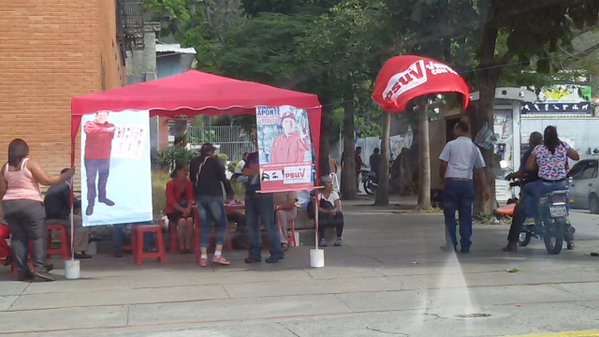
Maduro's PSUV campaigning on election day in violation of the law
The Maduro regime has demonstrated once again today that it does not respect the rule of law when it comes to the ruling party and its own regime. There have been reports that the military have blocked entry of opposition poll watchers to the polling stations. According to Venezuelan electoral law campaigning should have ended on Thursday night at midnight, but Maduro's political party has set up campaigning tents near voting centers today drawing complaints from citizens in Caracas, La Florida, and elsewhere. Reports have emerged of voting centers with broken equipment and voter intimidation by PSUV supporters. Attorney Edicson Cubillan and Franklin Gavidia of the opposition Democratic Unity were detained  in Aragua when they opposed massive "assisted voting."

Former presidents from Latin America, Luis Alberto Lacalle of Uruguay, Andrés Pastrana of Colombia, Jorge Quiroga of Bolivia and Laura Chinchilla of Costa Rica had their credentials suspended and Diosdado Cabello called for their expulsion from Venezuela for having criticized the irregularities in the election. 

Venezuelans lining up to vote this morning in legislative elections (Photo: RMP)
Human rights defender Santiago A. Canton gave seven reasons in an article in CNN en Español on why the Venezuelan elections will not be free, or transparent or fair because of the actions taken by the Maduro regime to compromise them before election day: 
(1) Ballot positioning: the ruling party is highlighted in the first ballot box, the main opposition party gets lost among countless squares, colors and symbols of minor parties. 
(2) Mainstream media controlled by Maduro. Since 2000 the Inter-American Commission on Human Rights and the Special Rapporteur on Freedom of Expression, have reiterated the lack of freedom of expression in Venezuela. On November 30, 2015 international reporters were required to sign a good conduct pledge before the election.
(3) Political violence and intimidation are constant. Opposition candidate Luis Manuel Diaz was assassinated. President Nicolas Maduro said that the murder of Diaz was due to a clash between gangs
(4.) Maduro set the clock back in Latin America three decades, when he did not accept international election observation
(5) Leopoldo Lopez, one of the leading opposition leaders remains in prison  despite  complaints from the UN, the IACHR and human rights organizations. Next to him are about seventy others made up of political leaders and students. Lopez was sentenced to 13 years, 9 months, 7 days and 12 hours in prison in a political show trial. 
(6) Several opposition leaders have been declared ineligible to be candidates in the elections by Maduro including popular candidates Leopoldo Lopez Mendoza and more recently María Corina Machado. Regional human rights courts found Maduro's disqualification procedure running afoul of the American Convention.
(7) State of siege extended to 23 municipalities in the states of Zulia, Tachira and Apure, prohibiting, among others the rights to public assembly, of transit and to demonstrate peacefully. In these municipalities the military is the "sole authority" that responds directly to Nicolas Maduro who appointed them.
These are some of the reasons that international organizations have expressed their concerns about today's legislative elections and are trying to assist with observers. María Corina Machado over twitter yesterday explained the stakes: "Win by a landslide or a monumental fraud will be done that we will not accept." 

Sunday, February 22, 2015

Killing the future in Cuba and Venezuela

Remembering Harold and Geraldine
Victims of Repression: Harold Cepero and Geraldine Moreno
The regimes in Cuba and Venezuela are so focused on preserving power and the repressive status quo that they are willing to kill future leaders that represent a nonviolent alternative to them. The untimely deaths of Oswaldo Payá Sardiñas and  Laura Inés Pollán Toledo in Cuba and the threats to the lives of  Leopoldo López Mendoza and Maria Corina Machado in Venezuela are ever present reminders of this harsh reality.

Sadly, these regimes are also targeting the next generation of democratic leaders as well.

In Venezuela, Geraldine Moreno Orozco, (age 23 year) was shot repeatedly in the face by members of the Bolivarian National Guard (GNB) on February 19, 2014 and died from these injuries three days later on February 22nd one year ago today. Today at 6pm in Geraldine Moreno Park in Venezuela United Friends Tazajal and Victims Against Repression will paying homage to Geraldine Moreno Orozco and Génesis Carmona.

Two years and seven months ago today Harold Cepero Escalante (age 32) and Oswaldo Payá Sardiñas were killed in Cuba. This was done so that with impunity the Castro regime would carry out the fraudulent change that both of them had denounced. Oswaldo was a founder and leader of the Christian Liberation Movement and Harold was its youth leader. The Christian Liberation Movement is circulating a petition calling for an international investigation into their untimely deaths.

Democracy and human rights are in decline in the Americas. Part of the reason is the coordination of resources and repression techniques between authoritarians and totalitarians throughout the region. If the fortunes of democracy and human rights are to be turned around for the better in this hemisphere then democrats need to join together and coordinate resources and best practices. Learning how to be more effective in denouncing the murder, unjust imprisonment and terrorizing of democrats, human rights defenders and journalists in the hemisphere and coordinating efforts to campaign against these practices is a necessary part of the puzzle for making things better.


Thursday, February 12, 2015

12 months after 12F: The Youth Day when Maduro Executed Nonviolent Youth

"Today I was hit with a rock in the back, a helmet in my nose. I swallowed tear-gas, Carried the kid who died, and what did you do?" - Robert Redman, age 28, murdered later that same day by Maduro's security forces
Student movement organizing action today in Venezuela
Started a 24 hour fast at 7:00pm on February 11, 2015 in remembrance of Venezuelan students gun down by Maduro's state security beginning on February 12, 2014 while nonviolently protesting rising insecurity in their country.  It began on that day with Bassil Alejandro Dacosta, age 24 , who over Facebook the day before on February 11, 2014 had written: "Gentlemen, he who is here will go out tomorrow to find a better future." 

Bassil Dacosta murdered by Maduro's agents on February 12, 2014
 Hours later on February 12, 2014 he had been gunned down. One of the youths who carried him away to seek medical assistance, Robert Redman, age 28, reported later that day over twitter: ""Today I was hit with a rock in the back, a helmet in my nose. I swallowed tear-gas, Carried the kid who died, and what did you do?" That same day he was also gunned down by Maduro's security forces and murdered. The known number today stands at 43.

Robert Redman murdered by Maduro's agents on February 12, 2014
 Today, February 12, 2015 facing a regime that has now approved the use of lethal force against nonviolent protesters the stakes are higher than a year ago. Students and in many cases their parents and grand parents will be taking to the street today.


Maria Corina Machado explained why they are going out tomorrow:  
"Tomorrow February 12,  I will go out for the young heroes of yesterday and today, who started the protests that unmasked the regime and changed the history of our noble country. See you in Caracas at 10 am at Plaza The Three Graces. We will march to the San Pedro Church where Mass will be held for the fallen."
"March for the Fallen"
Hard to believe that it has been one year and still the murderers of these nonviolent student protesters have not been brought to justice. 28 out of the 44 killed in the 2014 protests in Venezuela were shot. They are remembered along with the continuing demand for justice.


Tuesday, June 24, 2014

Today Multitudes of Venezuelans took to the streets for freedom and independence

" At four months of unjust imprisonment, I affirm that we have to be United to get out of a corrupt, inefficient and undemocratic regime." - Leopoldo López Mendoza, from Ramo Verde Prison, June 18, 2014


Today, a multitude of Venezuelan citizens took to the streets across their country to demand their freedom and independence. The images can be found on social media. Students who organized today's demonstrations called it the March for Independence.

Opposiiton leader Maria Corina Machado tweeted the above image today
You wouldn't know it from the mainstream media but there is a mass democratic movement in Venezuela that has maintained itself since February turning hundreds of thousands of Venezuelans to the street and its shaking the foundations of the Maduro Regime. Today across Venezuela students mobilized and took to the streets. They were met by security forces firing tear gas and rubber bullets in order to break up the nonviolent demonstrations.

The death toll during these protests by agents of the Maduro regime has reached 43. Josue Farias died in Maracaibo on June 21, 2014. The 18 year old student was injured by a  bullet during protests at URBE on May 29, 2014. 

Repression and tear gas in Carabobo, Venezuela

Opposition leader Leopoldo Lopez has been unjustly imprisoned since February 18, 2014 when marching alongside a multitude of Venezuelans he turned himself  in to the Venezuelan authorities knowing that justice was not guaranteed.


Meanwhile as an innocent man is imprisoned and kept away from his wife and children the killers of young Venezuelans remain free. on March 23, 2014 Adriana Urquiola was shot twice and killed. She was 5 months pregnant. Three months later and her killer remains free. Seven of the eight accused of murdering Bassil da Costa will be judged in freedom. Considering that the judiciary is completely politicized and subject to the whims of the executive branch and the Cubans the hope of justice is at best naive. Remember Venezuela is a country were a judge following the law both national and international was arrested and raped while in detention for freeing an individual who was arbitrarily detained.

Alvaro Vargas Llosa outlines the crisis that the Maduro regime is facing and it is one of legtimiacy:
Every serious poll confirms, for the first time, that a solid majority of the public opposes the government. Even pro-“chavista” polling companies, such as Instituto Venezolano de Análisis de Datos, agree: In its most recent survey, 55 percent of Venezuelans considered Maduro a dictator. Key opposition figures are all more popular than Maduro, including Machado and López—who is now even ahead of Capriles.
Four months later following a trumped up hearing and now awaiting a political show trial in August that will be orchestrated from Havana, Cuba with the assistance of President Maduro, Leopoldo Lopez released the audio of his defense before the Court which was an indictment of the regime highlighting the ridiculousness of the charges.


Venezuelan students abroad just last week addressed a forum at the United Nations Human Rights Council to denounce the human rights situation in their home country alongside Cuban dissidents, and a survivor in the incident that claimed the lives of Oswaldo Payá Sardiñas and Harold Cepero Escalante on July 22, 2012. The students discussed protester deaths at the United Nations.

The struggle for the future of Venezuela continues. As long as the opposition is able to nonviolently resist the Maduro regime while articulating a coherent strategy and maintaining nonviolent discipline they have an excellent change of achieving a democratic change that will usher in a new and better Venezuela.


Tuesday, May 6, 2014

Cuban and Venezuelan solidarity in the midst of crisis: A brief and incomplete summary

"To save freedom in Venezuela is do it in Cuba. Everyone to participate in this historic event. Neither Maduro nor Castro, we want freedom!" -  Jorge Luis García Pérez Antúnez, announcing from Cuba solidarity protests in support of Venezuelan Democratic Resistance on February 20, 2014 

Activists in Cuba protesting in support of Leopoldo López and Venezuela
Cubans have suffered under the grip of a totalitarian communist dictatorship imposed by the Castro brothers since 1959. They understand better than most what the stakes are for the democratic resistance in Venezuela. On August 25, 2013, Rosa Maria Payá Acevedo of the Christian Liberation Movement in an address to the Christian Democrats of the Americas placed the Venezuelan situation in a regional context:
"The Cuban government is not legitimate, as the Venezuelan government is not and will not be because presidents of the world shake hands with the impostors in power, it will be much less because they spearhead regional organizations like the CELAC, as is the case of the Cuban dictator, to the shame of Latin America. Legitimacy is delivered by the people at the polls, in free elections, in an atmosphere of respect and safety. We all know that's not what happened in April in Venezuela and we all know that has not occurred in Cuba for more than 60 years."

Christian Liberation Movement's logo in Venezuelan colors

 Both on the island and in exile there have been actions in solidarity with people of Venezuela struggling to be free. These are but a small sample there are many more examples:
On February 16, 2014 the Christian Liberation Movement tweeted: "Castro tyranny sends thugs to Venezuela, we send them the L of Liberation" and posted the above logo with Venezuelan colors.
On February 20, 2014 members of the internal Venezuelan resistance and their Cuban counterparts released a joint declaration of coordinated actions in their respective countries at a press conference held in Miami

On February 24, 2014 members of the Cuban exile and FIU communities gathered to hold a silent vigil for four victims of the 1996 Brothers to the Rescue shootdown and the students murdered since February 12, 2014 in Venezuela.

On February 28, 2014 the Christian Liberation Movement held a teach-in on "Cuba and Venezuela: Challenges for Democracy" with a prominent member of the Venezuela opposition in attendance on what should have been Oswaldo Payá Sardiñas's 62nd birthday.  

On March 14, 2014 Cuban exiles held a mass at the Our Lady of Charity (La Ermita) praying for liberty and justice in Venezuela.

On April 2, 2014 over twitter Oscar Elías Bicet posted photos of a march by Project Emilia activists in Cuba in support of imprisoned Venezuelan opposition leader Leopoldo López Mendoza, congresswoman Maria Corina Machado, and Venezuela.

On April 8, 2014 activists from Cuba, Ukraine and Venezuela signed a joint document for freedom and democracy at the Institute for Cuban and Cuban American Studies at the University of Miami.
 Over social networks, Cubans have been retweeting the posts of Venezuelan activists engaged in nonviolent resistance in their homeland. Furthermore, Cuban exiles have joined in solidarity with protest marches in South Florida. Below Aramis Perez, of the Cuban Democratic Directorate on February 22, 2014 at a massive rally in Doral, Florida took part in the protest to demonstrate his solidarity.

The Castro and Maduro regime's want to impose totalitarianism on the people of Venezuela and maintain it on the Cuban people and are using all the means at their disposal. At the same time the free peoples of Cuba and Venezuela are joining together in a struggle to free themselves of these two tyrants using nonviolent means. 

They need your solidarity.

Saturday, April 5, 2014

Message from Venezuelan Opposition Leader to Castro and Maduro: Get Out and Resign

@MariaCorinaYA Here I send you my article today in "Resign" 
 
Maria Corina: "Direct from airport, join students protesting in tents in front of UN in Ccs!"
 Resign
by María Corina Machado / El Universal

I leave the Congress of Brazil, emotionally moved for exercising the duty and the honor of speaking as a member, on behalf of all Venezuelans. It coincided with a tribute to parliamentarians that 50 years ago were expelled by the dictatorship from the Congress, accused of  "treason to the nation for criticizing their country abroad ." This could have influenced the enthusiasm with which the deputies, standing, shouted: "Venezuela", "democracy", "brave" and "freedom" as I withdraw from the plenary.

The operation of the regime to prevent the world knowing about their cruel violations of human rights, popular sovereignty and freedom of expression, has been costly and useless. Parliaments, newspapers and homes from every continent call the Venezuelan regime for what it is: a dictatorship.

Until two months ago, the regime led to believe that we had resigned ourselves. Venezuela awoke. The Cuban orders to suppress every "little candle " with the fury of paramilitary criminal gangs, PNB (The Bolivarian National Police) and the  GNB (Bolivarian National Guard) provoked more outrage and energy for the deepest and most widespread civic movement in our history. The regime crossed a red line and now for foreign actors, indifference is complicity.


A people is in the street, decided to advance irreversibly and without delay in the transition to democracy. A country that demands a change, not just of policy or rulers, but in the values, ​​in the model of society, and that are determined to do so through democratic means under the Constitution. For them we won't accept a new deception with a call for dialogue that seeks to demobilize protests or give the semblance of legitimacy. As for the public powers, we declined the offer of cosmetic quotas. Imposing a total restructuring of the CNE , the Attorney General, the Ombudsman and the Comptroller, just for starters.


Two years ago , in a public letter to Fidel Castro, I told him, "Cmdr Castro, stop interfering in the internal affairs of Venezuela. Do it willingly or the democratic forces in Venezuela will make him understand as was done 50 years ago" The Castros already understood that Venezuelans will fight to win democracy, national sovereignty and freedom. As a member of the National Assembly and citizen, I say, Mr. Maduro:  the time has arrived for you also to understand: Resign.

Original en Castellano

Saturday, June 29, 2013

What was not seen on Venezuelan television today

Mass nonviolent protest march for academic freedom and autonomy 

RCTV_CONTIGO: What you did NOT see on TV
First learned of this march in Venezuela on June 25, 2013  via the twitter feed of María Corina Machado an opposition member of the National Assembly who explained it in 140 characters that: "Great National March in defense of the FREE, PLURAL, DEMOCRATIC, and AUTONOMOUS UNIVERSITY Saturday 29 at 10am."

Photo from Maria Corina Machado's twitter

Tens of thousands of Venezuelans went out to march for academic autonomy and freedom in their universities. It was a remarkable demonstration of civic solidarity and resistance.

The Maduro government had called for a counter march by regime supporters in an effort to disrupt the opposition march and generate violent clashes. He failed. The opposition was able to take counter-measures and maintain its nonviolent discipline in the defense of freedom. 

Opposition activist, Roderick Navarro responded over twitter that "The "countermarch" is a sign of weakness that is so evident" and in a previous tweet said: "Don't ask me to be nice to Madurisms fanatics: who I insulted only with indifference! This regime won't last forever."

Roderick concluded on Saturday night, after the march and countermarch, over twitter: "Day of deep reflection, analysis and decision making for the future..."

As was done in Cuba over a half century ago the Maduro government is trying to do away with independent universities.

All eyes on Venezuela. The freedom of Venezuelans hang in the balance.

Photo from Maria Corina Machado's twitter