Showing posts with label Amnesty. Show all posts

Friday, December 24, 2021

Join the campaign for Christmas without political prisoners in Cuba

 #ChristmasWithoutPoliticalPrisoners

A group of intellectuals, artists, former diplomats, religious leaders, and human rights defenders from around the world made an appeal during this holiday season that Catholic bishops "issue statements backing their Cuban counterparts' call for the release of Cubans jailed for the events of July 2021 and before, and a rejection of violence by the regime," and that they "include the freedom of Cuba's political prisoners, justice for the victims of repression, and national reconciliation for Cuba in prayers said at Mass, during this Christmas."

There are hundreds of Cuban political prisoners, and over 90 have been subjected to political show trials over the past ten days. Ambassador Brian A. Nichols, Assistant Secretary for Western Hemisphere Affairs on December 23rd tweeted that 90 + July 11th protesters across Cuba are being subjected to unjust legal proceedings and prison sentences of up to 25 years under atrocious prison conditions to terrorize Cubans and silence and intimidate peaceful demonstrators.

They are still ongoing, and those jailed are enduring terrible circumstances.

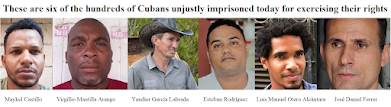
Prisoners of conscience such as Maykel Castillo Pérez, Franco Benítez, Esteban Rodríguez, Luis Manuel Otero Alcántara, Yandier García Labrada, José Daniel Ferrer García, Felix Navarro Rodriguez, Virgilio Mantilla Arango, Roberto Pérez Fonseca, Eloy Bárbaro Cardoso Pedroso, are in a precarious condition in facilities where COVID-19, Hepatitis, and other diseases run rampant with zero outside oversight. 

Now is the time to demonstrate our solidarity with those unjustly imprisoned for their political convictions. The late Vaclav Havel in an interview with Amnesty International in 2011 understood the need for people of good will to take action: "It's up to all of us to try, and those that say that individuals are not capable of changing anything are only looking for excuses."

Solidarity has been described as an act of resistance, but it is also an act of hope. Let us take action together and demand a general amnesty for all political prisoners, and in light of the present crises in Cuba let us pay special attention to what is going on in this island nation.

Please share information on ongoing political show trials, and messages from family members calling for their loved ones freedom.

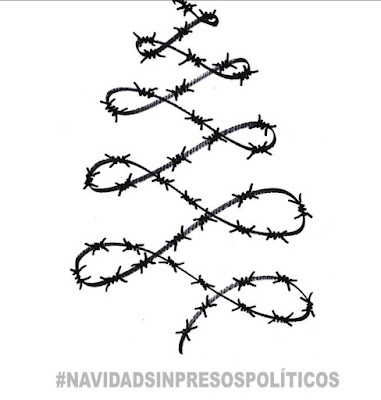
The human rights organization CubaLex is asking that this artwork for Christmas be shared over social media with the hashtag in Spanish of #NavidadSinPresosPoliticos which translates into English as #ChristmasWithoutPoliticalPrisoners.

This is a time of unity, solidarity and generosity. Please share the following hashtags along with this campaign for a general amnesty for political prisoners and specific and documented information on the political captives of this regime.

1. Please  ask your pastor, rabbi, or priest to pray for the freedom of political prisoners during their religious services during this holiday season.

2. Please write letters to religious leaders in your community to request that the governments of Cuba, Venezuela and Nicaragua free their political prisoners.

3. Please use the following hashtags to spread this message.

#LiberenLosYa
#FreeThemNow
#FreedomForPoliticalPrisoners
#LibertadParaLosPresosPoliticos
#NavidadSinPresosPolíticos
#NavidadSinPresos
#ChristmasWithoutPoliticalPrisoners
Sunday, December 23, 2018

Join the campaign for Christmas without political prisoners in Cuba, Venezuela and Nicaragua

Campaign for general amnesty for political prisoners in Cuba, Venezuela and Nicaragua.


More than a dozen human rights and pro-democracy organizations from Latin America, Europe and the United States have made a request during this holiday season that bishops, priests, pastors, rabbis, and men and women of good will to engage in all possible efforts with the authorities to obtain the amnesty of all political prisoners in Cuba, Venezuela, and Nicaragua.

Now is the time to demonstrate our solidarity with those unjustly imprisoned for their political convictions. The late Vaclav Havel in an interview with Amnesty International in 2011 understood the need for people of good will to take action: "It's up to all of us to try, and those that say that individuals are not capable of changing anything are only looking for excuses."

Uruguayan campaign for freedom of political prisoners in Cuba, Venezuela and Nicaragua
In addition to the dozen human rights and pro-democracy groups mentioned above, the Urguayan Network for Democracy in Cuba has also launched a campaign titled "Christmas without political prisoners in Cuba, Venezuela and Nicaragua."
Partial lists provided by internal human rights groups indicate that there are at least 120 political prisoners in Cuba, 576 political prisoners in Nicaragua, and 288 political prisoners in Venezuela spending the holiday season behind bars.

New political prisoners are being unjustly imprisoned in these countries in conditions that constitute cruel and unusual punishment. Between the months of November and December 15 members of a workers movement in Venezuela were jailed for their activism.

Jose Alberto Marulanda is a Venezuelan political prisoner
Medical professionals, like their counterparts in Cuba, are also subjected to politically motivated arbitrary imprisonment. Venezuelan medical surgeon José Alberto Marulanda has been imprisoned since May 19, 2018 in Ramo Verde prison.

 Hugo Damián Prieto Blanco is a new Cuban political prisoner
On December 18, 2018 in Cuba Hugo Damián Prieto Blanco, a leader in the Orlando Zapata Civic Action Front was sentenced to a year in prison for "pre-criminal dangerousness."This is an Orwellian charge reminiscent of thought crime or Philip K. Dick's pre-crime, and is totalitarian.

In Nicaragua, student activists are facing prison sentences in excess of 30 years, torture, and rape. Amaya Coppens, reported on in this blog back in September of 2018, remains in prison and faces a political show trial with a Sandinista judge in February of 2019. She was just 23 years old at the time of her arrest.

Amaya Coppens is a Nicaraguan political prisoner
 Solidarity has been described as an act of resistance, but it is also an act of hope. Let us take action together and demand a general amnesty for all political prisoners, and in light of the present crises in Cuba, Venezuela, and Nicaragua let us pay special attention to what is going on in these three countries.

This is a time of unity, solidarity and generosity. Please share the following hashtags along with this campaign for a general amnesty for political prisoners and specific and documented information on the political captives of these three regimes.

1. Please  ask your pastor, rabbi, or priest to pray for the freedom of political prisoners during their religious services during this holiday season.

2. Please write letters to religious leaders in your community to request that the governments of Cuba, Venezuela and Nicaragua free their political prisoners.

3. Please use the following hashtags to spread this message.

#LiberenLosYa
#FreeThemNow
#FreedomForPoliticalPrisoners
#LibertadParaLosPresosPoliticos
#CubaNicaraguaVenezuela
#NavidadSinPresosPolíticosEnCubaVenezuelaYNicaragua. #ChristmasWithoutPoliticalPrisonersInCubaVenezuelaAndNicaragua 

Tuesday, April 19, 2016

The Maduro regime's inhumane treatment of Venezuela's political prisoners

"In Venezuela there is a tomb for prisoners, in Venezuela human rights are violated " - Lilian Tintori over twitter, April 18, 2016

Lilian Tintori, wife of Venezuelan prisoner of conscience and opposition Leopoldo Lopez alluded in her tweet to a powerful article that appeared the same day. Attorney and human rights defender Tamara Suju Roa began her essay "The Tomb and the isolation cell" on the unseen harm done to Venezuelan prisoners of conscience:

The invisible wounds that Lorent Saleh and Gabriel Valles present may be overcome, maybe not. Perhaps only time really know what physical and psychological damage that confinement in The Tomb is going to leave them for the rest of their lives. Fear, humiliation, guilt, profound sadness, nervous disorder, despair, boredom for their physical appearance, form part of the psychological symptoms that those long isolated in extreme locations without ventilation and natural light.
 Venezuela, under the Maduro regime, continues to be a country in which there is not an independent judiciary that has rejected an amnesty law for prisoners of conscience and where Cuba's Castro regime continues to have undue influence over the internal affairs of the country. More information on the Tomb continues in the video below.

Thursday, February 18, 2016

Freedom Now for Leopoldo López and Venezuela

"Two years in prison but free in mind and spirit. Seeing that the hours of the dictatorship are numbered, I know that it has been worth it." -  Leopoldo López, over twitter on February 18, 2016


 Unjustly imprisoned for two years for advocating for the nonviolent defense of democracy in Venezuela,  Leopoldo López has become from his prison cell the most important political figure in the country. On February 18, 2014 with hundreds of thousands of supporters gathered in Venezuela he turned himself over to the agents of the Maduro regime but not before addressing them and calling on them to maintain nonviolent discipline:
"Well brothers and sisters I ask you to continue in this fight and do not leave the street, to assume our right to protest, but to do it in peace and without violence, I ask that us, all of us that are here, all of the Venezuelans that want a change, to get informed, educated, organized, and to execute non-violent protests, the protests of masses, and the will of souls and hearts that want to change, but without hurting your neighbor. " 
Since then he has been subjected to a political show trial in a Venezuela that no longer has an independent judiciary and sentenced to 13 years and nine months in prison. Leopoldo went on hunger strike for 30 days demanding that a date be set for the National Assembly elections. This nonviolent action led to the elections being held on December 6, 2015 and the democratic will of the Venezuelan people being exercised and the opposition taking over the National Assembly.

Today the struggle for a free Venezuela continues and the next step is the freedom of all prisoners of conscience in an amnesty. Looking forward to seeing Leopoldo López reunited with his family in freedom and continuing the nonviolent movement to the restoration of the rule of law in Venezuela.

Wednesday, December 23, 2015

Venezuela Update: Maduro's Christmas Coup versus The Democratic Opposition's Call for an Amnesty

"We knew that they were elections in a dictatorship; that is why we fought in the streets and tables. Today, it is the same dictatorship, defeated politically and electorally." - María Corina Machado, Venezuelan opposition leader over twitter on December 22, 2015

Maria Corina Machado, Leopoldo López Mendoza, on February 18, 2014

Venezuela is not a democracy but a country where contested elections are held within an anti-democratic regime. This has meant that the opposition had had to take to the street to ensure that the vote be respected on and following December 6, 2015. There are prisoners of conscience today in Venezuela and the democratic opposition is demanding their release in an amnesty before Christmas which Maduro has rejected. 

Furthermore the Maduro regime has packed the Supreme Court and is seeking to use this court to undo the results of the National Assembly elections by challenging the results in 22 races. By denying the opposition its super majority it opens the path to gutting the National Assembly's powers replacing it with a newly created and un-elected communal congress. This is generating a political crisis in Venezuela. 

However the opposition understands that this is a political struggle with a dictatorship and is waging a nonviolent struggle to regain the rule of law and the respect for democratic practices.
Their message is a transparent and open challenge to the continuing irregularities of Nicolas Maduro and his regime. Freddy Guevara of the opposition party, Voluntad Popular over twitter declared: "Let it be clear: We defended the December 6th vote and didn't allow one deputy to be stolen. Now they are less able to do it. Strength and faith!"
Prisoner of conscience Leopoldo López Mendoza from his prison cell got the following message out: "If Maduro and the rest of the powers kidnapped by a corrupt elite torpedo change then we must remove them." Leopoldo is a prisoner of conscience who is falsely imprisoned because of his massive popularity and nonviolent defiance of the Maduro regime. 

The democratic opposition has had a message of reconciliation and a call for an amnesty for political prisoners following their December 6, 2015 victory while Nicolas Maduro has rejected call and is trying to carry out a Christmas Coup against the newly elected National Assembly that has the support of a vast majority of Venezuelans. 

For more information on developments in Venezuela:

The anti-democratic maneuvers of Venezuela’s leaders / The Washington Post 

U.S. says $1 billion linked to Venezuelan energy corruption scheme / Reuters

Venezuela-Argentina spat over human rights comments / BBC

Wednesday, May 7, 2014

The Human Rights Situation in Venezuela: Video Testimony

Venezuelan Penal Forum: Whats happening in Venezuela? Violations of Human Rights.


Human Rights Watch and Amnesty International have both released worrying reports about the human rights situation in Venezuela. Amnesty International also has an online petition circulating addressed to Maduro. The above video is provided by a Venezuelan human rights organization the Venezuelan Penal Forum. Be prepared, some of the footage is disturbing.


Sunday, August 4, 2013

Amnesty International Urgent Action: 3 brothers designated prisoners of conscience in Cuba


UA: 201/13 Index: AMR 25/005/2013 Cuba Date: 2 August 2013
URGENT ACTION

THREE BROTHERS DETAINED FOR DISSENT
Three brothers who are members of a dissident organization are being detained on trumped-up charges. Amnesty International believes them to be prisoners of conscience, detained solely for peacefully exercising their right to freedom of expression.
Alexeis Vargas Martín and his two 17-year-old twin brothers, Vianco Vargas Martín and Django Vargas Martín have been detained, charged by the police with using “violence or intimidation” against a state official (atentado). The brothers, who live in the neighbourhood of Veguita de Galo in the city of Santiago de Cuba are all members of the Patriotic Union of Cuba (Unión Patriótica de Cuba, UNPACU).

In the afternoon of 27 November 2012, Alexeis was returning to his house where a government-sanctioned demonstration (acto de repudio, see background information) was underway at the time. 

The house was surrounded by government supporters as his mother, Miraida Martín Calderín, a member of the Ladies in White protest group, was meeting with other members of the same organization. Alexeis was refused entry to his own home and arrested by police and officials from the Department of State Security. On 2 December, Vianco and Django Vargas Martín - then only 16 years old - went with friends to protest outside the Micro 9 police station in the city of Santiago de Cuba against the detention of their brother. They were arrested and also charged by police with atentado.

The three brothers have yet to be formally charged by the public prosecutor and their lawyer has been refused access to their case-files. Amnesty International believes that their arrest and detention is in response to their peaceful exercise of their right to freedom of expression and that it is intended to send a message of intimidation to other government critics, particularly other members of UNPACU. For this reason the organization has adopted them as prisoners of conscience and is calling for their immediate and unconditional release.
Please write immediately in Spanish or your own language:

Calling on the authorities to release Alexeis Vargas Martín, Vianco Vargas Martín and Django Vargas Martín immediately and unconditionally, as they are prisoners of conscience, detained solely for peacefully exercising their right to freedom of expression;
Urging them to remove unlawful restrictions on freedoms of expression, association and assembly.
PLEASE SEND APPEALS BEFORE 13 SEPTEMBER 2013 TO:

Head of State and Government Raúl Castro Ruz
Presidente de la República de Cuba
La Habana, Cuba
Fax: +41 22 758 9431 (Cuba office in Geneva); +1 212 779 1697 (via Cuban Mission to UN)
Email: cuba@un.int (c/o Cuban Mission to UN)
Salutation: Your Excellency
Attorney General
Dr. Darío Delgado Cura
Fiscal General de la República, Fiscalía General de la República, Amistad 552, e/Monte y Estrella, Centro Habana,
La Habana, Cuba
Salutation: Dear Attorney General
And copies to:
Interior Minister
General Abelardo Coloma Ibarra
Ministro del Interior y Prisiones
Ministerio del Interior, Plaza de la Revolución, La Habana, Cuba
Fax: +1 212 779 1697 (via Cuban Mission to UN)
Email: correominint@mn.mn.co.cu
Salutation: Your Excellency

Also send copies to diplomatic representatives accredited to your country. Please insert local diplomatic addresses below:
Please check with your section office if sending appeals after the above date.

URGENT ACTION
THREE BROTHERS DETAINED FOR DISSENT

Additional Information

Alexeis Vargas Martín, aged 22, is being held at Aguadores Prison in Santiago de Cuba province, while Vianco and Django Vargas Martín are held at the Mar Verde prison for men in the same province. They are housed in a special prison wing (destacamento) for minors.

The charge of atentado carries a prison sentence of up to five years.
In early July 2013, officials from the Department of State Security told the brothers’ family that they could be released on bail. The three brothers, however, have refused this as they reject the charges made by the police and insist on their innocence.

Miraida Martín Calderín was also arrested on 2 December 2012 as she protested outside the Tercera Unidad police station in Santiago de Cuba city and charged by police with public disorder (desordenes públicos). She was held at the Mar Verde prison for women and released on 20 February 2013, and charges against her were dropped.

Acts of repudiation (actos de repudio) are government-coordinated demonstrations, usually carried out in front of the homes of government critics, attended by government supporters, state officials and law enforcement agencies, aimed at harassing and intimidating opponents of the government, and are often used to prevent them from travelling to take part in activities. During an act of repudiation, political opponents and human rights activists are subjected to verbal and physical abuse by groups of people chanting pro-government slogans. Police are usually present but do not intervene to stop the assaults. Such incidents frequently involve the Rapid Response Brigades (Brigadas de Respuesta Rápida), a structure set up in 1991 and composed of Communist Party volunteers whose task is to deal with any sign of "counter-revolution". Local human rights activists and others believe these incidents are orchestrated by Cuba's security services to intimidate any opposition. Miraida Martin Calderin has told Amnesty International that members of the Rapid Response Brigade threw stones at her house during the act of repudiation on 27 November 2012. 

The Patriotic Union of Cuba is a civil society organization which advocates for greater civil liberties on the island.

Names: Alexeis Vargas Martín, Vianco Vargas Martín and Django Vargas Martín
m/f: all m

UA: 201/13 Index: AMR 25/005/2013 Issue Date: 02 August 2013

Tuesday, April 12, 2011

The Cuban Regime's International Impact on Human Rights: Sri Lanka

“Dime con quién andas y te diré quién eres”. ["Tell me with whom you walk, and I will tell you who you are."] - Spanish proverb

May 30, 2011 Update: Cuba opposed a reopening of the Sri Lanka case before the 17th Session of the UN Human Rights Council according to Navi Pillai, the High Commissioner for Human Rights.

When dealing with human rights and Cuba there is an obvious focus on the systematic human rights violations inside of Cuba that often leads to overlooking the impact of the regime in multinational and international institutions. In the past this blog has reported on some of the many countries the Castro regime has made an impact in: Angola, Argentina, Ethiopia and Venezuela now Sri Lanka is added to this list.


Back on May 28, 2009 the Cuban regime was one of 29 developing countries that backed a Sri Lankan-proposed resolution describing the conflict as a “domestic matter that doesn’t warrant outside interference”. The Cuban government's diplomats took the lead in blocking efforts to address the wholesale slaughter taking place in Sri Lanka. The Foreign Policy Association reported that:
As expected, Cuba’s seat on the United Nations Human Rights Council has already become an obstacle to the process of investigation and recognition of gross human rights offenses. Yesterday Cuba succeeded in blocking debate on abuses in Sri Lanka, which many countries have pushed for after the extreme violence that rocked the country earlier this month.
Amnesty International at the time said that “[t]he vote is extremely disappointing and is a low point for the Human Rights Council. It abandons hundreds of thousands of people in Sri Lanka to cynical political considerations.”

The consequences of that vote continued to be felt in 2010 and Amnesty International continued to campaign for victims of repression in Sri Lanka. On April 8, 2011 Amnesty International issued a call to the United Nations Secretary General (UNSG) Ban Ki-moon to make public the report prepared by a 'panel of experts' that is to be handed to the UNSG on April 13, 2011.

All of the above is proof of the wisdom of Martin Luther King Jr.'s observation written in 1963 from a Birmingham jail that:"Injustice anywhere is a threat to justice everywhere. We are caught in an inescapable network of mutuality, tied in a single garment of destiny. Whatever affects one directly, affects all indirectly."

Do your part to demand justice for the victims of systematic human rights violations in Sri Lanka and in doing so help undo some of the damage committed against the people of Sri Lanka by the Castro regime. Remind the world that justice anywhere is a threat to injustice everywhere because we are all "caught in an inescapable network of mutuality" for good or ill. Let it be for the good.

Tuesday, June 1, 2010

Transfering some political prisoners to their home provinces is a first step


They can either kills us, put us in jail or release them. We will never stop marching no matter what happens. - Laura Pollán, Lady in White marching in Cuba, March 2010


Orlando Zapata Tamayo did not die in vain and Cuba's Ladies in White's courageous resistance to government organized mobs and violent intimidation did not go unnoticed. The current hunger strikers demanding improved conditions and the release of sick political prisoners are being heard not only in Cuba but around the world. Thanks to human rights activists like Juan Carlos Gonzalez Leiva the facts are getting out there.

Amnesty International is calling on the Cuban dictatorship to reform itself by revoking its repressive laws and releasing its prisoners of conscience.

This has led the dictatorship to reach out to the Cuban Catholic Church and for the first time in half a century ask it to serve as a mediator between the democratic opposition and the regime in power.

Cuba's Catholic Church said in a statement today that six men, [Felix Navarro, Jose Luis Garcia, Ivan Adolfo Hernandez Carrillo, Diosdado Gonzalez, Arnaldo Ramos and Antonio Ramon Diaz ] who were among 75 government opponents jailed in a 2003 crackdown, were in the process of being transferred to prisons nearer their families. The statement by the Archbishop of Havana is signed by Orlando Márquez Hidalgo in Havana, dated June 1, 2010 and contains the following list of transfers:

1- FÉLIX NAVARRO RODRÍGUEZ, from Ciego de Ávila to Matanzas
2- JOSÉ LUIS GARCÍA PANEQUE, from Granma to Las Tunas
3- IVÁN ADOLFO HERNÁNEZ CARRILLO, from Villa Clara to Matanzas
4- DIOSDADO GONZÁLEZ MARRERO, from Pinar del Río to Matanzas
5- ARNALDO RAMOS LAUZURIQUE, from Sancti Spíritus to City of Havana
6- ANTONIO RAMÓN DÍAZ SÁNCHEZ, from Ciego de Ávila to City of Havana

Amnesty International recognizes all these men as prisoners of conscience but the dictatorship continues to refer to them as mercenaries. The 2010 Amnesty International report found that in Cuba there were 55 prisoners of conscience detained solely for the peaceful exercise of their right to freedom of expression.According to the Inter-American Commission on Human Rights prison conditions in Cuba are harsh and run afoul of international standards.

Human rights reporting; the weekly public marches; the hunger strikes; fasts; protests; strikes; and public displays of dissent fall under non-violent resistance. The dictatorship in Cuba is heavily armed with all the instruments of repression at the disposal of a totalitarian state, but it cannot survive when confronted by an adversary committed to speaking truth to power and armed with the moral authority endowed by the courage and cleverness in carrying out a disciplined non-violent struggle. The Ladies in White demonstrated this over seven years and with great courage in March of 2010 facing down violent and aggressive government mobs. Orlando Zapata Tamayo demonstrated it carrying out a 83-day water only hunger strike and when prison officials tried to break him by denying him water for more than two weeks. They failed, but only succeeded in being complicit in his death. Both actions required courage, discipline, and determination.

Non-violent discipline as described by Gandhi is essential to achieving victory in a struggle against a powerful adversary. "For non-co-operation is a measure of discipline and sacrifice and it demands patience and respect for opposite views. And unless we are able to evolve a spirit of mutual toleration for diametrically opposite views, non-co-operation is an impossibility. I have learnt through bitter experience the one supreme lesson to conserve my anger, and as heat conserved is transmuted into energy, even so, our anger controlled can be transmuted into a power which can move the world."