"The first victory we can claim is that our hearts are free of hatred. Hence we say to those who persecute us and who try to dominate us: ‘You are my brother. I do not hate you, but you are not going to dominate me by fear. I do not wish to impose my truth, nor do I wish you to impose yours on me. We are going to seek the truth together’. THIS IS THE LIBERATION WHICH WE ARE PROCLAIMING."
Oswaldo José Payá Sardiñas (2002)
"Read not to contradict and confute; nor to believe and take for granted; nor to find talk and discourse; but to weigh and consider."—Francis Bacon
Woman greets her father who was repatriated Friday and arrived at Miami International Airport from Cuba. (Local 10 News)
On Friday, April 24, 2020 Local 10 reported that "300 U.S. citizens who had been stranded in Cuba since authorities suspended flights earlier this month" arrived back home in Miami. Flights to and from Cuba were suspended at midnight on April 1st.
This is great news.
However there are some observations that need to be raised.
1. Cuba has a history of covering up prior epidemics of contagious diseases including dengue, cholera, and most recently zika.
2. Cuba has extremely poor hygiene conditions, with shortages of soap, and other toiletries due to an internal blockade constructed by the Castro regime that makes it difficult for Cubans even to make their own soap using house hold items. The regime, prior to the suspension of flights, limited how much soap or detergent Cubans could bring in.
3. Cubans inside and outside of the island are warning of a humanitarian crisis with both rising numbers of Wuhan virus cases and rising repression by the dictatorship. Independent reporting on what is actually taking place on the ground in the island is punishable by hefty fines and prison, at a time when coronavirus can turn a prison detention into a death sentence.
Taking all of this into consideration the following questions arise:
Will both asymptomatic and symptomatic cases be kept in quarantine, and for how long?
When travel opens up again will these kind of screening measures be in place to limit the spread of Wuhan virus from international travelers especially from governments such as China, North Korea, Nicaragua, Venezuela and Cuba that can not be trusted to give accurate information on outbreaks?
We are in a new world with the current pandemic and recent history has shown that it is better to be prepared than caught by surprise because other countries and international health agencies have not done their due diligence endangering millions.
Policymakers should look to what Taiwan, South Korea, and Australia have done to prevent the spread of the Wuhan virus and keep death rates low while maintaining democratic norms.
Victims of Communism Memorial Foundation (VOC) is hosting the "Understanding China" online event series to help Americans understand the nature of the People's Republic of China, the Chinese Communist Party (CCP), and key issues in U.S.-China relations.
Join VOC for continuing virtual talks from experts on the impact of the CCP's misinformation campaign surrounding the coronavirus, cultural genocide and internment camps in China, high tech totalitarianism, religious liberty, trade and economics, and more. Visit www.victimsofcommunism.org/events for more information.
On April 21, 2020 had the privilege of discussing "China, Cuba and the Coronavirus: How are Cuba and China connected in the context of coronavirus?" in the webinar hosted and moderated by the Victims of Communism Memorial Foundation.
Castro regime's malign treatment of tourists continues.
Tourists trying to get out of Cuba before they can no longer return home.
COVID-19 may finally achieve what dengue, cholera, zika, and hurricanes could not, the shattering of Cuba's Potemkin village. Chilean and Mexican tourists are loudly protesting their conditions in Cuba. Carolina Cox, a prominent Chilean social influencer took to social media to denounce the conditions there and called on the Chilean government to get her home, before she erased her social media posts and presence. One would imagine that a retraction or alteration will be forthcoming in Orwellian fashion. She blames the "blockade" for the lack of internet access, but probably never heard of Alan Gross, who spent five years in a Cuban prison for trying to provide uncensored internet access to a Jewish community in Cuba.
This is a translation of what Carolina Cox said in the above video, and is worth reviewing before continuing to read this blog post.
"Hello, I am one of the 290 Chileans stranded in Cuba. Here in this "hotel" there are 60 people and they are in a center of infectious disease. Foreigners are constantly going in and out, there are plagues of mice. It is not a hotel that was open but they made it available now so that we could be here. ”
“You have to pay for this on your own, which is not cheap, it costs between 25 and 30,000 pesos a day for each one of us. In the case of the Argentine embassy they are covering accommodation and everything for us nothing.”
"Every day counts, we still do not have a flight number and if we do not insist it is likely that we could stay here so I ask for help please. We are also trying not to catch it and that nothing happens to us, because if any of us has coronavirus we are not going to return to our country."
“It is super distressing to be in such a moment in another country and in a country that also lacks soap and toilet paper. We have accounts blocked by the blockade that Cuba has, connecting to the internet is very difficult. ”
"The cards don't work for us. Please, please help us share this video. There are people who need medicine. Their are children, elderly and families. We demand a return plane, that the Government do something, that Copa, AeroMexico, Latam Airliners return us to our country. ”
This is not what they were promised.
Reuters reported on March 11, 2020 the Castro regime's claim that the first COVID-19 victims were "four Italian tourists who were staying at a
hostel in the southern town of Trinidad after arriving at Havana
airport on Monday had presented respiratory symptoms and were taken to a
hospital on Tuesday." They tested positive for the coronavirus the following day.
Panama's Ministry of Health, a day earlier, on March 10th had reported that two Panamanians, ages 55 and 29 who visited Cuba had tested positive for the coronavirus when they returned home. Denying the presence of Wuhan virus in Cuba had become untenable.
This wasn't the Castro regime's first rodeo. The dictatorship has a long history of attracting tourists to the island under circumstances in which their safety was compromised. Tourists traveled to the island during outbreaks of dengue, cholera, zika and now the Wuhan virus (SARS-CoV-2). But it wasn't always disease, other natural disasters were disregarded.
In September 2017 when Hurricane Irma, a deadly category five storm
with 180 mile per hour winds was bearing down on Cuba and a hurricane
watch already issued, tourists were still being flown into the island
by British and Canadian travel agencies.The British travel agency
"Thomas Cook defended itself saying the company followed the Cuban
government's emergency instructions to the letter," BBC News reported.
Cayo Coco suffered the full impact of Hurricane Irma and was destroyed
by the storm. They were flying tourists into Cuba to Cayo Coco a day
prior to the storm's arrival, as reported by The Independent
(United Kingdom).CBC News (Toronto) reported that Canadian tour
operator Sunwing had elderly tourists flying into Cuba 24 hours before
the Hurricane smashed into Cuba, forcing them to flee for their lives.
Returning to the current Wuhan virus (SARS-CoV-2) outbreak one should also take into account the false claims that Cuba had developed a cure. Nicolas Maduro on March 11th tweeted how Cuba's interferon had saved 3,500 lives in China.
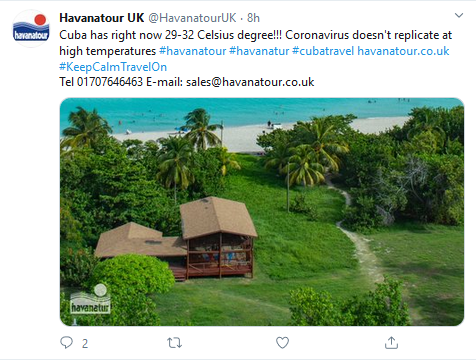
Castro's military run tourism company, Havanatour, continued to pitch Cuba as a travel destination and posted a tweet on March 13, 2020 claiming that Coronavirus does not replicate at high temperatures and
that the island is now 29-32 degrees Celsius.
On March 14, 2020 the general director of marketing of the Ministry of Tourism, Bárbara Cruz, indicated that Cuba had a strong health care system with which the regime would be able to attend to all the inhabitants and tourists who wish to visit Cuba, with the condition of abiding by preventive measures.
Steve Sweeney, writing for the MorningStar for Peace and Socialism on March 15, 2020 made the following claim:
"So far it is known that one of the drugs manufactured by Cuba,
Interferon alfa-2b, has managed to effectively cure more than 1,500
patients from the coronavirus and is one of 30 drugs chosen by the
Chinese National Health Commission to combat respiratory disease."
The left wing press claims Cuba has a cure for the coronavirus, but the reality is that Interferon alfa-2b is not a cure, and has not even been confirmed to be a treatment for COVID-19.
Chilenos en atrapados en Cuba, fuera de los resorts, comienza a vivir el drama que viven los Cubanos a diario.pic.twitter.com/eU5GX7AXMw
The testimony of the left wing Chileans and Mexicans stuck in Cuba and their descriptions of what they are experiencing: lack of water, soap, basic hygiene, lack of medicines, and inability to communicate by phone or internet demonstrates the crude reality that exists in Cuba that does not correspond with the images and statements provided by Cuban officials.
Mexicano simpatizante de la dictadura comunistas de Cuba se queda varado en el aeropuerto de La Havana y le pide a gritos al capitalismo que le rescate.pic.twitter.com/QaHUQQ7rlY
Word of warning to these youth, you are no longer in Chile or Mexico. Freedom of speech does not exist in Cuba, and there are consequences for making the dictatorship look bad.
It is also important to recall that on March 29, 1997 a soldier of the Castro regime using an AK-47 gunned down a Danish student, who was studying Spanish at the University of Havana. He had crossed to the wrong side of the street, and a soldier fired a warning shot, but the official explanation was that the gun jammed and fired several rounds killing the young man. His name was Joachim
Løvschall and he was just 27 years old.
Joachim
Løvschall: December 7, 1970 - March 29, 1997
3 patients who died in Cuba of exposure at a hospital facility due to neglect in 2010
There are many myths that the Castro regime has successfully propagated over the years. The international community deeply believes one of the biggest and most dangerous whoppers, that Cuba’s healthcare system under the current communist system is a success that turned the island into a medical super power. This fabricated fiction needs to be addressed to save lives both inside and outside of the island at this critical time.
These are some of the facts that Havana has spent decades covering up.
The healthcare system that existed in Cuba prior to 1959 was superior to what came after. Professor James W. McGuire and Laura B. Frankel in their paper published in the Latin American Research Review, “Mortality Decline in Cuba, 1900-1959: Patterns, Comparisons, and Causes” found that “Cuba's progress relative to other Latin American countries at reducing infant mortality was even greater from 1900 to 1960 than from 1960 to 1995. During the earlier period, Cuba led all Latin American countries for which data are available at raising life expectancy and reducing infant mortality. From 1960 to 1995, by contrast, it came in fourth and fifth respectively.”
Healthcare in Cuba is not free, nor are the medical missions sent around the world, and at times can be expensive, and unforgiving. Tourists visiting Cuba who have become ill found that they were presented expensive bills for medical care received.
In the summer of 2013 Sheila Dumbleton, age 57, fell ill six days into a birthday trip to Cuba was hospitalized before passing away. “Sheila was left to die because we had no money to pay for treatment, it’s as simple as that. If she had fallen ill in this country she would still be here,” said her husband Ray Dumbleton, who is from the United Kingdom, adding, “As soon as the hospital knew we couldn’t pay, they just left her to deteriorate. All the doctors kept saying to us was ‘payment, payment’ but we simply didn’t have that sort of money to give them.” He wasn’t even allowed to bid farewell to his wife when she died. To add insult to injury, the Cuban hospital wouldn’t release the body, and threatened the husband with prison if he didn’t come up with the $26,700 bill.
Ray and Sheila Dumbleton
Cuba's health tourism effort has roused bitter reproach from
the nation's critics, who accuse the Castro regime of
creating an apartheid system of health care, in which foreigners - and
Cuban party elite - get top-class service while average Cubans must make
do with dilapidated facilities, outdated equipment and meagerly stocked
pharmacies.These greatly contrast with Cuban elite hospitals promoted by "health tourism" enterprises such as SERVIMED.
Hilda Molina, one of Cuba 's most noted scientists, founder and a
former director of Havana 's International Center for Neurological
Restoration broke with the regime and resigned both from her high-level
position there and as a member of Cuba 's National Assembly to protest
the system of medical apartheid.
In a long document smuggled out of
Cuba after her resignation, Dr. Molina describes a campaign by Cuba to
present itself as a "medical superpower" attractive to foreign patients
looking for bargain-basement health care. Instead, she writes, these
patients have often found themselves subject to substandard, sometimes
fraudulent medical care: "The lack of adequate professional
qualifications, the absence of medical ethics, and the drive toward
financial enrichment characterize Cuba 's medical system and often yield
unfortunate results."
According to Dr. Molina, "Foreign patients are
routinely inadequately or falsely informed about their medical
conditions to increase their medical bills or to hide the fact that Cuba
often advertises medical services it is unable to provide."
Cubans that express disagreement with their political leaders, and government policy have been known to be punished by having medical care denied.
Human rights defender Sebastián Arcos Bergnes, in 1992 was charged with "enemy propaganda" and "inciting rebellion," he was
sentenced to four years and eight months in prison. Sebastian was transferred to Ariza
Prison in Cienfuegos Province,
more than 130 miles from Havana, where he was imprisoned alongside
dangerous criminals and systematically denied medical attention. In 1993 the regime offered Sebastian a deal: He would be released
immediately if he only agreed to leave the island for good. Sebastian
rejected the deal, choosing
prison in Cuba over freedom in exile.
Following an international campaign that included his designation as an
Amnesty International prisoner of conscience and a request by France Libertés, the organization founded by former French first lady Danielle Mitterrand,
Sebastian Arcos was released in 1995. A few weeks after his release,
Arcos was diagnosed with a malignant tumor in the rectum, for which he had previously been denied medical care
in prison. After a Cuban doctor was fired from his post for diagnosing
Arcos, he traveled to Miami for further care. Sebastián Arcos Bergnes died in Miami on December 22, 1997
Sirley Avila Leon.
Sirley was a true believer who grew up in the revolution and was a
member of a local municipal assembly. She believed the claims that free
education was a right for all Cubans. This belief left her an invalid
and nearly led to a violent death. She lobbied and agitated for a school to be opened in her municipality
so that the children there would not have to trek 5.6 miles to go to
class and then trek the same distance back to get home.
Sirley Avila Leon
On May 24, 2015, Sirley Ávila León was the victim of a brutal machete attack
that cost her her left hand and also left her right upper arm
nearly severed and knees slashed, leaving her crippled. She was denied
adequate medical care and was told quietly by medical doctors that if
she wanted to get better she would need to leave Cuba. The regime had
been embarrassed by a campaign she organized to keep a school open. She
arrived in Miami on March 8, 2016 unable to bend her legs, or use her
remaining had.Thanks to a team of medical doctors treating her, by
September 2016 Sirley had regained the use of her hand, and was able to walk short distances.
Lady in White Xiomara Cruz was arrested on April 16, 2016 for speaking out during a human rights demonstration in Havana's Central park. She was placed on parole in January of 2018. She was re-arrested in mid-September 2018 under the charge of being "threatening." On September 19, 2018 she was tried and sentenced to one year and four months in prison. She was sent to a prison 400 kilometers from her home. This was an added hardship for her family to visit her, and keep an eye on her well being.
Xiomara de las Mercedes Cruz Miranda before and during her jailing.
On August 8, 2019 she was transferred to intensive care. Cuban dissident Angel Juan Moya posted videos of interviews from August 6th and August 7th
with doctors at the hospital. Family members complained that they
are receiving differing diagnoses and her situation continues to worsen.
Xiomara was in intensive care and doctors were saying that it could be
lung cancer. A doctor refused to update the family saying: "that he did
not want to see those people." Near death she arrived in Miami on January 21, 2020 on a humanitarian visa, and was immediately placed in intensive care.
Xiomara de las Mercedes Cruz Miranda arrived in Miami on January 21, 2020
This practice of rationing care based on political fidelity has also been practiced overseas. Nicholas Casey’s article “‘It Is Unspeakable’: How Maduro Used Cuban Doctors to Coerce Venezuela Voters” published in The New York Times on March 17, 2019 interviewed Cuban doctors haunted by what the Castro regime required them to do in their overseas assignments.
Dr. Yansnier Arias “had been sent to Venezuela by the Cuban government, one of thousands of doctors deployed to shore up ties between the two allies and alleviate Venezuela’s collapsing medical system. But with President Nicolás Maduro’s re-election on the line, not everyone was allowed to be treated, Dr. Arias said. A 65-year-old patient with heart failure entered his clinic — and urgently needed oxygen, he said. The tanks sat in another room at the ready, he recalled. But he said his Cuban and Venezuelan superiors told him to use the oxygen as a political weapon instead: Not for medical emergencies that day, but to be doled out closer to the election, part of a national strategy to compel patients to vote for the government.”
Dr. Yansnier Arias spoke out on abuses on Cuban medical missions
Casey reported that “16 members of Cuba’s medical missions to Venezuela — a signature element of relations between the two countries — described a system of deliberate political manipulation in which their services were wielded to secure votes for the governing Socialist Party, often through coercion. Many tactics were used, they said, from simple reminders to vote for the government to denying treatment for opposition supporters with life-threatening ailments.”
Not all the Cuban personnel, dressed up as doctors to treat patients around the world, are in fact doctors. Raúl Manuel, a Cuban doctor now in Brazil described in the same New York Times article how in 2015 on Election Day “he was sent to an opposition stronghold. When early returns showed the opposition ahead, a gun battle broke out. … After the shootout, Dr. Manuel said he returned to the clinic, shaken, only to learn that government officials from other departments — including the sports and culture agencies — were going out, too, posing as doctors. ‘We, the doctors, were asked to give our extra robes to people,’ he said. The fake doctors were even giving out medicines, without knowing what they were or how to use them.”
But it was not only for the votes. Sending doctors to work abroad in other countries is Cuba’s biggest export bringing in $11 billion per year to the dictatorship. The Cuban government signs secret agreements with these countries and in the case of Qatar, keeps 90% of Cuban doctors’ wages.
Cuba’s Communist dictatorship, like their Chinese counterparts, covered up epidemics endangering the lives of many. This was most recently revealed in 2019 when Yale School of Public Health’s Nathan Grubaugh and his colleagues estimated that the total cases of Zika in Cuba in 2017 alone would have been 5,700, and added that the “2017 Zika outbreak in Cuba was similar in size to the known 2016 outbreaks in countries with similar population sizes.”
Duane Gubler at the Duke-NUS Medical School in Singapore on January 8, 2019 said “Cuba has a history of not reporting epidemics until they become obvious.” Doctors and journalists who had spoken out warning about past outbreaks of dengue in 1997 and cholera in 2012 have been punished and some were jailed.
Elderly Cubans have borne the brunt of revolutionary responses to crises. Between 1982 and 1993 during the “special period” according to a letter published in the Canadian Medical Association Journal (CMAJ) on July 29, 2008 in Cuba the death rate among the elderly increased by 20% from 1982 to 1993.”
In 1997 a Cuban doctor was silenced for warning about a deadly dengue
epidemic. Dr Desi Mendoza Rivero, married with four children at the
time, was arrested on June 25, 1997. On November 28, 1997 he was sentenced to eight years in prison for "enemy propaganda." Amnesty International declared Dr. Mendoza Rivero a prisoner of conscience and campaigned for his freedom. He was released on
November 20, 1998 due to health reasons following the visit of the
Spanish Foreign Minister, under the condition that he leave Cuba for
exile in Spain.
First official report to the World Health Organization of the dengue outbreak was six months after initial identification made by the jailed and later forcibly exiled physician. Mendoza Rivero's reports were eventually confirmed. This episode would have a chilling effect on other doctors coming forward.
News of a cholera outbreak in Manzanillo, in the east of the island, broke in El Nuevo Herald
on June 29, 2012 thanks to the reporting of an independent reporter in
the island. Calixto Martinez, the independent Cuban journalist who broke
the story was jailed. The state controlled media did not confirm the outbreak until days later on July 3, 2012. The BBC reported on July 7, 2012 that a patient had been diagnosed with cholera in Havana. The Cuban government stated that it had it under control and on August 28, 2012 said the outbreak was over.
They are doing it again now with the Coronavirus outbreak
Havanatour, tourist agency owned and run by the Cuban military, continued to pitch Cuba as a travel destination and posted tweets in mid-March claiming that Coronavirus does not replicate at high temperatures, that the island is now 29-32 degrees Celsius, and that it was safe to travel there.
"Cuba - No restrictions on entering the country. Screening on arrival, if presenting symptoms you may be taken to health facilities in Havana."
This at a time when Cuba is suffering from shortages of soap, and toiletries for Cubans in the island, and conditions in hospitals that do not meet minimum hygiene standards.
Translation:“Cuba is bathed in the rays of the sun all year and
taking pertinent measures we have greater strengths to face COVID-19.
From the #Caribbean it’s #Cubaisasafedestination. Come visit with
#Havanatur.”
Cuban dictatorship officials confirmed that a 61 year old Italian tourist had died of SARS-CoV-2 on March 18, 2020 and a 45 year old Russian tourist with diabetes died of SARS-CoV-2 on March 25, 2020. The true scope of the SARS-CoV-2 outbreak in Cuba is still not known but at a minimum numbers in the tens of thousands, and people are dying. On March 24, 2020 the doors were officially closed to international tourism amidst rising dissent in the population. Mark Fitzpatrick, an American tourist, has gone missing. According to Cuban official media there are 9,000 tourists stuck in Cuba, and being called to quarantine.
Without human rights, healthcare is compromised. Sherri L. Porcelain, an adjunct professor who taught Global Public Health in World
Affairs at the University of Miami for more than 30 years, wrote an important analysis titled "U.S. & Cuba: A Question of Indifference?" Dr. Porcelain's analysis revealed that Cuban healthcare system is not the panacea that it is billed as:
"Investment in the health of people includes protecting human rights.
This means allowing the health community to speak out and not to be
jailed for releasing information about a dengue epidemic considered a
state secret, or not sharing timely data on a cholera outbreak until
laboratory confirmation of travelers returning from Cuba arrive home
with a surprising diagnosis. This causes me to reflect upon my personal
interviews where the remaining vigor of public health actions in Cuba
exists to fight vector and water borne diseases. Sadly, however, health
professionals are directed to euphemistically use the vague terms of
febrile illness in place of dengue and gastrointestinal upset for
cholera, in contradiction to promoting public health transparency."
Cubans today are outraged that officials waited until March 24th to take substantive measures to mitigate the spread of the coronavirus, and they fear that the dictatorship is preparing to cover up a humanitarian disaster at home while exporting their doctors abroad.
Italian tourist in Cuba: "“[w]e
are in a terrible hospital, in awful sanitary conditions"
Channel News Asia reported on March 24th, "[a]s Latin American countries slowly began to close themselves off from
the outside world against the threat of the virus over the last few
weeks, Cuba continued to try to woo tourists - who brought in US$3.3
billion in 2018 - with wide-open borders and touting itself as a safe
destination."
Cubanet reported on March 15th that Marta Cavallo, an Italian tourist diagnosed with coronavirus
and admitted to the “Pedro Kourí” Institute of Tropical Medicine (IPK),
over Facebook denounced conditions at the hospital, located west of Havana stating,“[w]e
are in a terrible hospital, in awful sanitary conditions, when they
give us food, they ask us to drink the soup from the plate, [without a
spoon], there is not even toilet paper … they do not give us news of any
kind, and it is impossible to talk with any doctor.”
Below is an advertisement posted on March 9, 2020 by Havanatur,
a tourism company owned by the Cuban military that claims that because
"Cuba is bathed in the rays of the sun all year, and taking pertinent
measures they have greater strengths before COVID-19 and that Cuba is a
safe destination" showing a picture of folks on the beach in Cuba,
without masks contrasted with two women with masks in an urban setting
somewhere else.
"Cuba - No restrictions on entering the country. Screening on arrival, if
presenting symptoms you may be taken to health facilities in Havana."
This at a time when Cuba is suffering from shortages of soap, and toiletries for Cubans in the island, and conditions in hospitals that do not meet minimum hygiene standards. Below is video smuggled out of a hospital in Cuba with patients exhibiting coronavirus symptoms.
On March 11, 2020 the official press reported that four Italian tourists who were staying at a
hostel in the southern town of Trinidad after arriving at Havana
airport on March 9, 2020 had presented respiratory symptoms and were taken to a
hospital on March 10th, and on Wednesday the hospital confirmed three
of the tourists had tested positive for the coronavirus.
This was most likely a clever move after Panama's Ministry of Health, a day earlier, on March 10th reported that two Panamanians, ages 55 and 29 who visited Cuba had tested positive for the coronavirus when they returned home.
The Castro regime has invested heavily in international propaganda campaigns, and doctor diplomacy (that often times turns out to be human trafficking) to create a positive, but false, image of Cuba as a medical super power. Worse yet, the Cuban dictatorship has a history of covering up epidemics in order to lure in unsuspecting tourists. Prior to the coronavirus outbreak the most recent documented outrage was a Zika outbreak in 2017. The 2017 Zika hidden outbreak in Cuba should have given pause to those planning to travel to the island on holiday in the midst of the coronavirus pandemic. Yale School of Public Health’s Nathan Grubaugh and his colleagues in a 2019 report revealed a total of 5,700 Zika cases in 2017 that went unreported by the Castro regime, and observed that the “2017 Zika outbreak in Cuba was similar in size to the known 2016 outbreaks in countries with similar population sizes.”
Duane Gubler at the Duke-NUS Medical School in Singapore said Cuba had "a history of not reporting epidemics until they become obvious," and that this was due to their desire to maintain high levels of tourism into the country.
The Castro regime has confirmed 57coronavirus cases, 1,479 people are hospitalized for surveillance and 37,788 are being checked in on by medical students. Based on past history, things are most probably far worse on the island.
This is what the Cuban military that runs tourism in Cuba delivered.
"The class struggle
is continuing and it is our task to subordinate all interests to
that struggle. Our communist morality is also subordinated to
that task." - Vladimir Lenin (1920)
CCTV broadcast Xi Jinping's visit to Wuhan at a Beijing shopping center March 10.
The past couple of months should have been a wake up call on the international community's credulity regarding health data provided by communist regimes, such as China, and Cuba. It is now known that the first case was diagnosed on November 17, 2019 in Hubei, China.
China's focus from the start has been on its international image, and this includes censoring information that would have been useful to stopping the spread of the pandemic, but also helping coronavirus victims. The Committee to Protect Journalists reported on specific cases.
Li Wenliang, a doctor in Wuhan who was reprimanded for warning
colleagues of a new coronavirus earlier this year, used the messaging
app WeChat to share his concerns on December 30, 2019, according to The Wall Street Journal.
“Be careful, our group chat can be suspended,” a contact responded, according to screenshots
purporting to show the private exchange. CPJ could not independently
verify the screenshots, which were widely cited in online discussions
and media reportsafter Li sickened and later died from the COVID-19 disease.
On March 7, 2020 a five-story Xinjia Hotel in China's Fujian province that had been converted into a "quarantine hotel" collapsed and killed 29 patients. China built what it called "two new coronavirus hospitals" in 12 days and used it as part of a propaganda campaign to promote its regime. Business Insider noted that
"Official data [which should also be questioned], however, shows that
the utility of the hospitals has yet to match the pace or spectacle of
their construction, with the facilities running at less than half their
projected 2,600 capacity."
Search for survivors in rubble of collapsed hotel in Quanzhou, in China's Fujian province, March 7th AFP
Now Communist China is trying to spin conspiracy theories to draw attention away from its own culpability in making a bad situation worse, continuing to disappear prominent Chinese voices that have criticized the regime's response, and with their Cuban and Venezuelan allies they are spinning a yarn of Cuban medicine saving thousands of Chinese lives with a pioneering treatment, but that in fact arose out of research surrounding SARS and MERS years ago patented by private firms. However that doesn't stop Venezuelan tyrant Nicolas Maduro and the propaganda organ teleSur from repeating the talking points.
It is in this upside down environment that Marion Smith of the Victims of Communism Memorial Foundation has published an article in National Review titled "Why Do Global Medical Institutions Trust China?" in which he describes the role played by international organizations in the initial cover up of what now has become a pandemic.
"As the coronavirus spread from China across the world in January and February, the World Health Organization repeatedly praised Beijing’s efforts to contain it. The agency did so despite China’s censorship of medical professionals and evidence of undercounting deaths. As the second-largest donor to the United Nations, which oversees the WHO, China, it appears, has induced the agency to provide a veneer of legitimacy while it engages in cover-up, thereby worsening the global crisis."
Context must be provided to the unfolding global tragedy that began in China. The Roman orator Marcus Tullius Cicero observed in Oratio Pro Animo Milone XVI that "Maxima illecebra est peccandi impunitatis spes." (The hope of impunity is the greatest inducement to do wrong.) Communist China has been able to act with impunity invading and occupying Tibet in 1950, killing tens of millions of Chinese in the Great Leap Forward (1958 - 62), the Cultural Revolution (1966-1976), crushing the Tiananmen Square protests (1989), and forced organ harvesting (2000 - present).
Chinese Tycoon Who Criticized Xi’s Response to Coronavirus Has Vanished https://t.co/A72RibZVw8
Looking the other way at the crimes visited on tens of millions of Chinese nationals is now threatening many more lives around the world following the coronavirus coverup and the active complicity of the World Health Organization. Reverend Martin Luther King Jr. was right "Injustice anywhere is a threat to justice everywhere."
This is the same World Health Organization (WHO), who has a subsidiary, the Pan American Health Organization (PAHO), profiting of the trafficking of Cuban doctors in a questionable arrangement with Cuba's dictatorship.
The Castro regime, that also has a history of committing crimes and covering up epidemics with impunity is once again being given the benefit of the doubt with regards to its claims that it has been coronavirus free.
This despite the February 2020 announcement by the Castro regime that there is a shortage of soap and detergent in Cuba that will not be alleviated until April 2020 or later, due to decisions made by the central planning authorities. This means that Cubans will not have access to soap to wash their hands.
Secondly that tens of thousands of travelers from Europe, China, and other areas heavily impacted by the coronavirus have been entering Cuba throughout this outbreak. At least 147,900 Italian tourists and 49,781 Chinese tourists traveled to Cuba in 2018 and Cuba's military run tourism industry sought to double the number of Chinese tourists.
The claim that Cuba did not have coronavirus in larger numbers under these circumstances was highly unlikely, but then North Korea continues to claim that they have no cases of coronavirus, despite having a border with Communist China, and South Korea having 7,979 cases.
Daniel Ortega and Rosario Murillo forced public workers to march in a pro-govt rally today
In Nicaragua, where dictator Daniel Ortega and his wife, and first lady, Rosario Murillo carried out a mass march titled, "Amor en tiempos del Covid-19" (Love in the time of Covid-19), and mandated that public workers attend on Saturday, March 14, 2020. This was done against recommendations of the World Health Organization.
Poster calling for walks in midst of coronavirus threat in Nicaragua.
Unlike their North Korean and Nicaraguan counterparts, the Castro regime recognized reality to a certain extent. Three days ago the Cuban government reached a point where they had to acknowledge that the situation had changed and that Cubans were finally being impacted by coronavirus, after denying its presence for weeks.
Reuters reported the Cuban dictatorship's official press on March 11, 2020 that "four Italian tourists who were staying at a hostel in the southern town of Trinidad after arriving at Havana airport on Monday had presented respiratory symptoms and were taken to a hospital on Tuesday. On Wednesday, the hospital confirmed that three of the tourists had tested positive for the coronavirus, the broadcaster said."
It is important to note that Panama's Ministry of Health, a day earlier, on March 10th had reported that two Panamanians, ages 55 and 29 who visited Cuba had tested positive for the coronavirus when they returned home.
Despite this, the Cuban dictatorship's military run tourism industry continues to pitch Cuba as a travel destination and posted a tweet on March 13, 2020 at 11:01am claiming that Coronavirus does not replicate at high temperatures and that the island is now 29-32 degrees Celsius. Havanatour is owned and run by the Cuban military.
However even non-Cuban tour operators, in the past, have demonstrated a callous indifference for the lives of their clients. In September 2017 when Hurricane Irma, a deadly category five storm with 180 mile per hour winds was bearing down on Cuba and a hurricane watch already issued, tourists were still being flown into the island by British and Canadian travel agencies.The British travel agency "Thomas Cook defended itself saying the company followed the Cuban government's emergency instructions to the letter," BBC News reported.
Cayo Coco suffered the full impact of Hurricane Irma and was destroyed by the storm. They were flying tourists into Cuba to Cayo Coco a day prior to the storm's arrival, as reported by The Independent (United Kingdom).CBC News (Toronto) reported that Canadian tour operator Sunwing had elderly tourists flying into Cuba 24 hours before the Hurricane smashed into Cuba, forcing them to flee for their lives.
Needless to say, the Cuba's dictatorship has a no money back policy.
Meanwhile, the Castro regime sought to shut down a markets in Villa Clara, where merchants would sell products not available in government stores, leading to a large scale demonstration for communist Cuba with protesters shouting, “We want commerce! We want a solution! We want answers! We are not delinquents!” Rumors are circulating that they were going to shut them down to prevent the spread of coronavirus.
Returning to the issue of data and statistics, but shifting from health data to educational data. USA Today has published an important article on the literacy rates in Cuba pre-1959 and post-1959 that is a must read, but would also recommend reading Herald columnist Fabiola Santiago's essay on the subject.
Observing these lies that have been bought into by many who should know better, and many others who just absorbed it without critical thought. Theodore Dalrymple gave an analysis of the purpose of communist propaganda that, although terrible, is sadly too optimistic, but there is much truth to it for those already living under communism.
“In my study of communist societies, I came to the conclusion that the purpose of communist propaganda was not to persuade or convince, not to inform, but to humiliate; and therefore, the less it corresponded to reality the better. When people are forced to remain silent when they are being told the most obvious lies, or even worse when they are forced to repeat the lies themselves, they lose once and for all their sense of probity. To assent to obvious lies is...in some small way to become evil oneself. One's standing to resist anything is thus eroded, and even destroyed. A society of emasculated liars is easy to control. I think if you examine political correctness, it has the same effect and is intended to.”
Flagg Taylor in his 2015 essay in National Review, "What’s New in the New Political Correctness?" responded to Dalrymple's view, "My one quibble with Mr. Dalrymple is that communist propaganda’s purpose
surely went beyond humiliation—it attempted to disrupt the link between
people’s inner thoughts and reality—to erase the distinction between
true and false." Both Taylor and Dalrymple ignore communist morality, which would give a better understanding of how communist propaganda operates.Vladimir Lenin stated the primary element of communist morality clearly in a speech to Russian communist youth on October 2, 1920.
"The class struggle
is continuing and it is our task to subordinate all interests to
that struggle. Our communist morality is also subordinated to
that task. We say: morality is what serves to destroy the old
exploiting society and to unite all the working people around
the proletariat, which is building up a new, communist society."
This is why Fidel Castro
denied being a communist, why Hugo Chavez called Fidel Castro a
dictator during his first presidential campaign, and why Senator Sanders
claims to be critical of Cuba and Nicaragua, when he has been a long time apologist, and was resistant to calling Venezuela a dictatorship.
This denial of objective reality, truth and an ability to systematically lie to achieve is sometimes effective in taking over a country and imposing a totalitarian dictatorship, but is a total disaster when dealing with infectious diseases, and an outbreak such as the coronavirus.
On the other hand, democracies such as South Korea, and Taiwan (despite being diplomatically isolated by communist China) have successfully contained the spread of the disease and are exemplars that are the antithesis of the communist model.








 Posts
Posts

