Showing posts with label Ramon Grau San Martin. Show all posts

Sunday, September 4, 2022

Placing the Cuban Revolution of 1933 in context: How the Sergeants Revolt marked a before and after in Cuban history

Governing pentarchy of the 1933 Cuban Revolution
 
 
Prologue to the 1933 Revolution

How the Cuban Republic obtained independence through protracted diplomatic efforts.

Cubans through political intrigue managed to avoid the fate of Puerto Rico and the Philippines during the Spanish-Cuban-American War. The United States military had occupied Cuba from 1898 to 1902, and the bitter price of independence was accepting the Platt Amendment, which permitted U.S. interference in Cuban internal affairs to preserve order and protect American interests, put into question the status of Cuba's Isle of Pines as a possible U.S. possession. 

Cuban nationalists elected in 1900 during U.S. occupation
 
 
Cuba's first elections were held in June 1900 under the U.S. occupation for local officials, and pro-U.S. candidates did not fare well losing to nationalist candidates, and the pattern was repeated again in August 1900 to elect candidates to the constitutional convention. 
 
The majority elected were war veterans, Mambises, who fiercely opposed the U.S. occupation, and Juan Gualberto Gómez, a black intellectual, he had been a close ally of José  Martí in the war of independence, who spent the rest of his life opposing the Platt Amendment, and advocating for racial equality representing his constituency in Havana.  
 
In 1892 the black Cuban journalist and future statesman founded the Central Directory of Societies of Color, a network that would spend the next sixty seven years pushing for Black advancement in Cuba.

Reclaiming Cuban territory, and reducing American military presence.

The Cuban Republic formally came into existence on May 20, 1902 and it began to achieve concrete results. American speculators had bought up land on what was then called the Isle of Pines, and renamed the Isle of Youth during the Castro regime, following the U.S. occupation of Cuba and the island had been settled by American settlers, and its status as a U.S. territory a political question, according to American courts. 

Cubans successfully negotiated the maintenance of the Isle of Pines as part of Cuba on July 2, 1903 in the Hay-Quesada Treaty that was negotiated between U.S. Secretary of State John Hay and Gonzalo de Quesada, the Cuban Ambassador to the United States, and the treaty was finally ratified on March 13, 1925 following years of pressure from economic and political interests wishing otherwise.

The United States had wanted to build four military bases in Cuba, but the Cuban government successfully negotiated this down to two in 1903, those being Guantanamo and Bahia Honda.  Bahia was given back to Cuba in 1912 for more land for the Guantanamo military base. By 1912 there was only one U.S. military base operating in the island.

 
Cuba's first dictator: Cuban nationalist Gerardo Machado
 
Gerardo Machado ruled Cuba from 1924 through 1933.

Gerardo Machado, a brigadier general in the war of independence and later a businessman was elected president of Cuba in 1924 but seized power over all political parties in 1927 and became Cuba's first dictator.

Cosme de la Torriente y Peraza, Cuban statesman and President of the League of Nations in the 1920s, wrote in an October 1940 essay titled "Cuba, America, and the War":

In 1925 General Machado succeeded Dr. Zayas as President. In spite of his promise not to stand for reelection, Machado sought to have the Constitution of 1901 modified so that he could maintain himself in power. As a result, a widespread state of public disorder became almost permanent. It was under these circumstances that Machado was reelected without opposition in 1928.

On January 19, 1928 President Calvin Coolidge and the First Lady visited Cuba and met with General Gerardo Machado who at the time was transforming his rule into Cuba's first dictatorship
 

Alvaro Vargas Llosa in a 2008 book review published in The Wall Street Journal titled "The Family Spirit" described Bacardi's clash with the new Cuban authoritarian leader.
"José Bosch, called Pepín, a young businessman who also married into the Bacardi family and was an early opponent of Gerardo Machado's corrupt rule in the 1920s. Machado made Bacardi, one of Cuba's most successful companies, a target of predatory taxation, but a proposed rum tax was more than the distiller could stand. Bacardi opened new facilities in Mexico and threatened to move its operations there if the tax was enacted."
 

Cuban Revolution of 1933: The Sergeants Revolt

Fulgencio Batista and Ramon Grau in 1933

On September 12, 1933 The Madera Tribune carried an editorial titled "America Will Never Consent to Removal Of Platt Amendment."  Cuba was in the midst of a crisis caused by President Gerardo Machado. He was democratically elected, but had made changes the constitution to break a campaign promise, run for re-election and perpetuate his presidency for a second term. Together with the arrival of the Great Depression in 1929, a period of political and economic crisis led to the end of Machado's presidency in a revolutionary environment in 1933.  

At a critical moment in the struggle against Machado when populists and students called for a general strike, it was the communists who broke the strike and sought an accommodation with the Cuban tyrant. It made the communist party extremely unpopular in Cuba.

Nevertheless, Machado was driven from office and into exile in 1933 by a successful general strike. Cosme de la Torriente y Peraza, in the already mentioned 1940 essay "Cuba, America, and the War" described what happened next:

"Shortly after assuming office in 1933, President Roosevelt authorized his new Ambassador to Cuba, Mr. Sumner Welles, to act as mediator between Machado and the majority of his opponents. The proposal was accepted and the basis for an agreement was reached which would have ended the conflict between government and governed in Cuba, if General Machado had given effect to his offer to resign. Instead, influenced by the evil advice of some of his friends and by his own intemperance, he carried out acts of such violence that on August 11, 1933, the Cuban Army declared against his authority, thus obliging him to renounce his office and leave the country the very next day." 

Carlos Manuel de Céspedes y Quesada, a Cuban diplomat and opponent of Machado, was offered the position of President when Machado fled. He took office on August 13, 1933.

U.S. Ambassador to Cuba, Benjamin  Sumner Welles in a August 24, 1933 telegram warned of continuing instability in Cuba. 

"I am rapidly coming to the conclusion that my original hope that the present Government of Cuba (Céspedes' administration) could govern as a constitutional government for the remainder of the term for which General Machado had himself elected must be abandoned. If the solid and unwavering support of the Army could be counted on, and if the groups and parties represented in the present Government were unanimous in their support of the administration, it might be possible for the existing Government to maintain itself, pass the necessary legislation of all kinds required, and hold the general national elections in November 1934 as originally anticipated. As a matter of fact, however, a general process of disintegration is going on. The Army is by no means in a satisfactory condition and the relapse in the health of General Sanguily, Chief of Staff and the one ranking officer in the Cuban Army who can command the support of his subordinates, has delayed the taking of the measures necessary to enforce discipline within the Army which he alone could have undertaken satisfactorily."

This was followed by a revolution led by Sergeant Fulgencio Batista with other enlisted men and university students in what became known as the Sergeants Revolt on September 4, 1933. 

On September 4, 1933, Fulgencio Batista seized the moment and organized his troops in the military ranks and gave them instructions.

"From this moment forward, do not obey anyone's orders but mine. First sergeants must immediately take control of their respective military units. If there is no first sergeant, or if he refuses to take command, the senior sergeant must do so. If there is no sergeant, a corporal. If there is no willing corporal, then a soldier, and if not, then a recruit. The units must have someone in command and he must be an enlisted man."

The sergeants took uncontested control of Columbia barracks and were soon joined by members of the student directory "beginning with José Leyva, Ramiro Valdés Daussá, Juan António Rubio Padilla, Carlos Prío Socarrás, Rubén de León, and Justo Carrillo."

Four hundred military officers opposed to Batista regrouped at the Hotel Nacional, but Batista with his enlisted men crushed the officers at what became known as the Battle of Hotel Nacional, and the revolutionary forces consolidated control. 

Carlos Manuel de Céspedes y Quesada had been outside of Havana to examine damage done by a hurricane, and returned to the Capitol city to learn that he was no longer the President of Cuba, and accepted the outcome of the coup. He would go on to continue his long and distinguished career as a Cuban diplomat until his death six years later in 1939 from a heart attack.

On September 5, 1933 both Fulgencio Batista and Ramon Grau San Martin visited Ambassador Sumner Welles to determine the position of the United States with regards to the events unfolding. The revolutionaries initially created a governing pentarchy, but that gave way to Ramon Grau San Martin as president for a hundred days, followed by Batista becoming a behind the scenes strong man.

President Ramón Grau San Martín waves to crowd in 1933.

On September 10, 1933 Ramón Grau San Martín,  assumed the presidency of Cuba, but due to his opposition to the Platt Amendment, refused to take the oath of office before the Supreme Court or to the Cuban Constitution of 1901 but pledged his fidelity to the Cuban people. His government lasted for 127 days, but the Platt Amendment was abrogated on May 29, 1934 when the United States and Cuba signed a new treaty of relations that canceled the treaties that enforced the Platt Amendment. 

Platt Amendment ended in 1934

This revolutionary process put Fulgencio Batista into the national spotlight and by 1934, pushing Grau San Martin out of power, he became the strong man behind the scenes even though democratic formalities were restored.

Cuban Presidents: 1902 to 1952 and dictator Batista 1952-1959

Cuba's democratic renaissance 1940-1952

In 1940 all the political tendencies in Cuba met to draft what became known as the 1940 Constitution.

There was no Platt Amendment in the 1940 Constitution.

A presidential election was held and Fulgencio Batista elected. He served out his term as president from 1940 to 1944. Due to a clause in the new Constitution he was unable to run for re-election. 

In the election of 1944 the opposition candidate, Ramon Grau San Martin, won and served a term as president from 1944-1948 and in the election of 1948, Batista’s political party again lost in the general elections and Carlos Prios Socarras was elected president.

Cuba's republic during this democratic period played an important role in the drafting of the Universal Declaration of Human Rights of the United Nations.

Cuba's last freely elected presidents: Carlos Prío and Ramon Grau

Over a 20 year period beginning in 1933 two men, first allied, then bitter political enemies would dominate Cuban politics:the Cuban sergeant Fulgencio Batista, and the university professor Ramon Grau San Martin,

Sunday, September 5, 2021

In Defense of Cuba's "Infernal Little Republic": A brief overview of some of the Cuban Republic's successes 1902 - 1952

In defense of Cuba's first democratic period.

U.S. Flag lowered and Cuban Flag raised in Havana on May 20, 1902

Read the book review by Felipe Fernández-Armesto titled ‘Cuba: An American History’ Review: That Infernal Little Republic published in The Wall Street Journal on September 4, 2021.  He was reviewing the 576 page book Cuba: An American History by Ada Ferrer which is a best seller in Amazon. Hopefully, the book review by Mr. Fernández-Armesto does not reflect the content of what Professor Ferre wrote in her book on the Cuban Republic. Here is what he wrote:

The jaws stayed menacingly open. The U.S. kept its Guantánamo base and imposed a settlement that conferred a right—formally, an obligation—to intervene, in effect, at will. This was a prerogative, as Ms. Ferrer says, “to exercise permanent, indirect rule.” Foreigners took over most rural property and almost the entire sugar industry. The arrangement favored corrupt and sometimes criminal elites.

This was most glaring in the 1950s, the era of Mambo italiano, when the Mafia ran the island. While U.S. settlers held “church bake sales and youth dances,” Ms. Ferrer tells us, there were 338 brothels in Havana. In 1952 Fulgencio Batista seized Cuba in a coup and ruled it as a fief. Seven years later, in revulsion from U.S. tutelage, Cubans welcomed Fidel Castro from the “mountain kingdom,” where he ruled as theatrically as the Bandolero.

This historical shorthand does a disservice to the actual history of the Cuban Republic (1902- 1952), its democratic character, and its achievements for Cubans over a half century that overshadow the failures of Castroism. This is the reason that the Castro regime has sought to erase it, and replace it with a series of myths to justify its totalitarian rule. 

Mr. Fernández-Armesto in his review recognized that Hugh Thomas has written the best history of the island, called  Cuba : The Pursuit of Freedom (1971) that was updated in a paperback edition in 1998 titled Cuba Or The Pursuit Of Freedom that recognizes both the lights and shadows of the Cuban Republic.

Cuban Presidents: 1902 to 1952 and dictator Batista 1952-1959

Hugh Thomas is not alone in his assessment of the Cuban Republic.

Mary Speck, of the The Wilson Center’s prestigious Latin American Program, wrote a chapter for the book Cuba Future Series: Historical Perspectives by The Cuba Project published in 2011 by the Bildner Center for Western Hemisphere Studies titled "Democracy in Cuba:  Principles and Practice,  1902–1952"

Ms. Speck found that Cuba during the Republican period had competitive democratic elections, and achieved social progress for all Cubans.

Pre-1959 social indicators place Cuba among the top tier of Latin America. The infant mortality rate in Cuba in the mid-1950s (33 per 1,000 live births) was roughly equal to rates in Europe and a third of the Latin American average (105 deaths per 1,000). Life expectancy at birth in Cuba (64) was also far higher than in Latin America as a whole (50).51 James W. McGuire and Laura B. Frankel have shown that between 1900 and 1959 Cuba outperformed other Latin American countries at raising longevity and reducing infant mortality.52 That may reflect the strength of Cuba’s health care system. The island had 10 doctors per 10,000 people (10), nearly as many as Europe (11) and the United States (13). Latin America lagged far behind with only 4 doctors per 10,000 inhabitants.53

A review of the historical record finds Cuban political leadership that did not permit the United States to exercise indirect rule in Cuba, but rather found ways to exploit the American presence for their own interests while reducing it over the short, medium, and long term when and where possible.

Unlike the Castro regime the Cuban Republic achieved concrete successes in reducing U.S. influence in Cuba while improving living standards for Cubans, and made a positive mark on the international stage following WW2. Cuba's healthcare system was world class throughout the Cuban Republic with two Cuban physicians nominated for the Nobel Prize in Medicine.

America Arias Maternity Hospital Building (Havana, Cuba 1930s)

Despite U.S. occupation of Cuba the Cuban Republic obtained independence through protracted diplomatic efforts.

Cubans through political intrigue managed to avoid the fate of Puerto Rico and the Philippines during the Spanish - American War. The United States military had occupied Cuba from 1898 to 1902, and the bitter price of independence was accepting the Platt Amendment, which permitted U.S. interference in Cuban internal affairs to preserve order and protect American interests, put into question the status of Cuba's Isle of Pines as a possible U.S. possession. 

Cuban nationalists elected in 1900 during U.S. occupation 


Cuba's first elections were held in June 1900 under the U.S. occupation for local officials, and pro-U.S. candidates did not fare well losing to nationalist candidates, and the pattern was repeated again in August 1900 to elect candidates to the constitutional convention. The majority elected were war veterans, Mambises, who fiercely opposed the U.S. occupation, and Juan Gualberto Gómez, a black intellectual, he had been a close ally of José  Martí in the war of independence, who spent the rest of his life opposing the Platt Amendment, and advocating for racial equality representing his constituency in Havana.  In 1892 the black Cuban journalist and future statesman founded the Central Directory of Societies of Color, a network that would spend the next sixty seven years pushing for Black advancement in Cuba.

Reclaiming Cuban territory, and reducing American military presence.

The Cuban Republic formally came into existence on May 20, 1902 and it began to achieve concrete results. American speculators had bought up land on what was then called the Isle of Pines, and renamed the Isle of Youth during the Castro regime, following the U.S. occupation of Cuba and the island had been settled by American settlers, and its status as a U.S. territory a political question, according to American courts. 

Isle of Youth ( used to be Isle of Pines)

Cubans successfully negotiated the maintenance of the Isle of Pines as part of Cuba on July 2, 1903 in the Hay-Quesada Treaty that was negotiated between U.S. Secretary of State John Hay and Gonzalo de Quesada, the Cuban Ambassador to the United States, and the treaty was finally ratified on March 13, 1925 following years of pressure from economic and political interests wishing otherwise.

The United States had wanted to build four military bases in Cuba, but the Cuban government successfully negotiated this down to two in 1903, those being Guantanamo and Bahia Honda.  Bahia was given back to Cuba in 1912 for more land for the Guantanamo military base. By 1912 there was only one U.S. military base operating in the island. 

President Ramón Grau San Martín waves to crowd in 1933.

Platt Amendment ended in 1934

On September 12, 1933 The Madera Tribune carried an editorial titled "America Will Never Consent to Removal Of Platt Amendment."  Cuba was in the midst of a crisis caused by President Gerardo Machado. He was democratically elected, but had made changes the constitution to perpetuate his presidency, and along with the arrival of the Great Depression in 1929, a period of political and economic crisis led to the end of Machado's presidency in a revolutionary environment in 1933.  On September 10, 1933 Ramón Grau San Martín,  assumed the presidency of Cuba, but due to his opposition to the Platt Amendment, refused to take the oath of office before the Supreme Court or to the Cuban Constitution of 1901 but pledged his fidelity to the Cuban people. His government lasted for 127 days, but the Platt Amendment was abrogated on May 29, 1934 when the United States and Cuba signed a new treaty of relations that canceled the treaties that enforced the Platt Amendment. There was no Platt Amendment in the 1940 Constitution.

Republican Cuba makes it mark on the international stage.

The Universal Declaration of Human Rights was an initiative led by Latin Americans, and Cubans in particular. Some of the language placed in the Declaration was taken from the 1940 Cuban Constitution. 

Cuba's last democratic president, Carlos Prio Socarras, was elected by Cubans in free and fair elections on July 1, 1948 and assumed office on October 10, 1948. He was a democrat who respected civil liberties and presided over years of prosperity and freedom for Cubans. 

President Carlos Prio Socarras (l) and President Harry S. Truman (r)  December 8, 1948

President Prio belonged to the Autentico Party and was succeeding Ramon Grau San Martin, another member of the same political party, in the Cuban presidency who had completed his four year term (1944-48). Both men respected human rights, and this was reflected by the actions taken by their diplomats at the founding of the United Nations, and in the Organization of American States.

Beginning in 1945 Cuba took part in lobbying for and participating in the drafting of the declaration and submitted nine proposals of which five made it into the final document. The first meetings of the General Assembly and the Security Council took place in London starting on January 10, 1946.


Cuban Ambassador Willy De Blanc in December 1945 hosts former British Prime Minister Winston Churchill at a lunch in the Cuban Embassy in London with other Cuban diplomats (including delegates to the U.N. Preparatory Commission Dr. Guy Pérez-Cisneros y Bonnel and Cuban jurist Dr. Ernesto Dihigo y López Trigo) where they requested his assistance in the creation of a human rights commission for the United Nations. Churchill recommended that the Cubans lobby Mrs. Eleanor Roosevelt, and they followed his advice. Eventually the former First Lady was selected as chairwoman to the Human Rights Commission. 

Sir Winston Churchill visited Cuba in February 1946. He had been invited to visit Cuba as a private citizen by President Ramon Grau San Martin who received the former British Prime Minister together with Cuba's next president, Carlos Prio.

Cuba, Panama, and Chile were the first three countries to submit full drafts of human rights charters to the Commission. The Cuban draft contained references to rights to education, food, and health care, and other social security. Latin American delegations, especially Mexico, Cuba, and Chile inserted language about the right to justice into the Universal Declaration of Human Rights, in what would become Article 8. 

Guy Pérez-Cisneros and Ernesto Dihigo

Cuban delegate Guy Pérez-Cisneros in his speech on December 10, 1948 proposing to vote for the Universal Declaration of Human Rights before the third General Assembly of the United Nations in addition to highlighting the importance of the Declaration of the Rights and Duties of Man and how it inspired the Third Committee’s work on this document also addressed the importance of the rule of law:

My delegation had the honor of inspiring the final text, which finds it essential that the rights of man be protected by the rule of law, so that man will not be compelled to exercise the extreme recourse of rebellion against tyranny and oppression.
The Cuban delegate also celebrated that the Universal Declaration of Human Rights condemned racism and sexism.
"My country and my people are highly satisfied to see that the odious racial discrimination and the unfair differences between men and women have been condemned forever."

Thanks to the legacy of Juan Gualberto Gómez and  the Central Directory of Societies of Color he had created black civil society in Cuba advanced through out the years of the Republic, and their efforts were made manifest in the 1940 Constitution in a democratic Cuba.

End of the first period of democracy in the Cuban Republic

This democratic Cuba was overthrown on March 10, 1952, by a relatively bloodless military coup led by Fulgencio Batista because he did not have a chance to win the presidential elections that were taking place in a few weeks time. The last democratic president Carlos Prio and his first lady went into exile.   

 Guy Pérez-Cisneros died suddenly of natural causes in 1953 trying to establish a Christian Democrat Party in Cuba in the early years of the Batista regime. 

Over the next seven years a corrupt and authoritarian dictatorship ruled Cuba becoming increasingly unpopular.

The refusal of Batista to peacefully give up power through a process of dialogue opened the path to Fidel and Raul Castro to violently seize it.  

With the help of the Communist International, The New York Times, an arms embargo placed on Batista in March 1958 by the United States, and pressure from the U.S. Ambassador to Cuba in December 1958 Fulgencio Batista fled Cuba in the early morning hours of January 1, 1959.

Ernesto Dihigo, like Pérez-Cisneros, left the diplomatic corps following the 1952 coup, but returned in 1959 as Cuba’s Ambassador to the United States in January of 1959 but retired in 1960. No longer a diplomat or a college professor, he dedicated the next forty years of his life to private study focused on philology. He left Cuba, with his wife Caridad Larrondo in 1989 and died in Miami in 1991.  

Cuba is suffering under sixty nine years of dictatorship.

The Castro brothers had pledged a democratic restoration since the start of their struggle in 1953, but had planned a Marxist-Leninist takeover and the imposition of a communist dictatorship killing tens of thousands of Cubans. They systematically denied human rights to all Cubans while exporting their repressive model to Africa and Latin America helping to create misery for millions more.

The Castro dictatorship rewrote history creating myths to justify its tyrannical rule. The reality is that between 1902 and 1952 there existed a democratic system in Cuba that had overseen rising living standards for five decades, created a system of world class healthcare for all Cubans, and had been on the cutting edge of advancing international human rights standards.

The continuing question of the Guantanamo Naval Base

If Cuba had returned to democracy in 1959 would the United States have a military base in Guantanamo today? Recall that the US wanted to have four military bases in Cuba, and had a claim to the Isle of Pines in 1903, but a democratic Cuba had been able through diplomacy to reduce the number of bases down to one, and gain sovereignty over the Isle of Pines.

The Castro regime despite its violent rhetoric has not been able to get the United States to leave the military base in Guantanamo.

At the same time, although still a colony, Puerto Rico through nonviolent means has been able to shut down all the U.S. military basis on its territory. The highest profile example of this was the campaign to demilitarize the U.S. military base in Vieques that was successfully carried out between 1999 and 2003.

Would an independent and democratic Cuba have been less successful than their Puerto Rican brethren?

The legacy of Cuba's Republic and its democratic period are worth remembering and defending.


Sunday, September 26, 2010

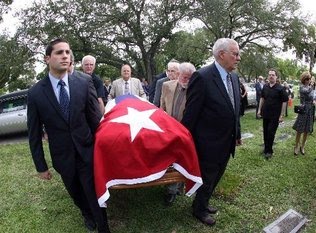
Mary Tarrero de Prío: The Last First Lady of a Democratic Cuba

Requiescat in pace

Mary Tarrero de Prío

The last First Lady of a Democratic Cuba Maria Dolores "Mary" Tarrero de Prío died in Miami on September 23, 2010 and was laid to rest on Saturday, September 25, 2010. She was the widow of Carlos Prío Socarras, the last democratically elected president of Cuba. Carlos Prío died in Miami in 1977 and is also buried there.

Cuban democracy ended on March 10, 1952 with Fulgencio Batista's coup and 58 years later it has still not returned. Sadly as the years pass and those who lived those glory years of democracy leave us they begin to be viewed as myth. Add to that the current dictatorship's rewriting of history to diminish this democratic age in order to justify its own tyrannical rule and one can understand how the world would forget Cuba's own democratic chapter.

Carlos Prío Socarras, Ramon Grau San Martin, Carlos Hevia

Yet there is one witness who spoke out on behalf of the Republic on October 16, 1953 that the tyranny cannot ignore: Fidel Castro. During his trial for the July 26, 1953 armed assault on the Moncada Barracks he addresed the court and described Ramon Grau's and Carlos Prío's presidencies:
Once upon a time there was a Republic. It had its Constitution, its laws, its freedoms, a President, a Congress and Courts of Law. Everyone could assemble, associate, speak and write with complete freedom. The people were not satisfied with the government officials at that time, but they had the power to elect new officials and only a few days remained before they would do so. Public opinion was respected and heeded and all problems of common interest were freely discussed. There were political parties, radio and television debates and forums and public meetings. The whole nation pulsated with enthusiasm. This people had suffered greatly and although it was unhappy, it longed to be happy and had a right to be happy. It had been deceived many times and it looked upon the past with real horror. This country innocently believed that such a past could not return; the people were proud of their love of freedom and they carried their heads high in the conviction that liberty would be respected as a sacred right. They felt confident that no one would dare commit the crime of violating their democratic institutions. They wanted a change for the better, aspired to progress; and they saw all this at hand. All their hope was in the future.
President Carlos Prío Socarras and his wife Mary Tarrero de Prío went into exile in Miami, but his struggle for a democratic Cuba did not end there. He would be arrested on more than one occasion accused of smuggling arms to rebels in Cuba seeking to overthrow Fulgencio Batista.

According to Ramón L. Bonachea and Marta San Martin in their book The Cuban insurrection, 1952-1959 in August of 1956, Fidel Castro and Carlos Prío met at a small hotel in McAllen, Texas where for over an hour they discussed the future of the insurrection against Batista. Castro asked Prío for money and the former president agreed to finance Castro’s expedition to Cuba. Prío would send the Cuban guerrillas almost one quarter of a million dollars in arms and money. Prío got other associates to contribute thousands of dollars more in cash to the guerrillas.

The last constitutional president of Cuba had publicly announced his plan to return to the island as early as 1955 and did so during a brief "amnesty" in 1956 only to be expelled at gun point a short time later and would return again in January 1959 with Fulgencio Batista's departure into exile. Only to depart for exile again in December 1960 as they saw the new government turning into a military dictatorship.

On June 11, 1961 Carlos Prío Socarras addressed 1,200 Cubans in exile and pledged to aid the Cuban underground. He would go on to aide and plan efforts to combat Castro's military dictatorship as he had done earlier against Batista.

As the 1960s drew to a close and the armed struggle against Castro's dictatorship drew to a close Carlos Prío in 1973 sought to preempt efforts at a negotiated solution in which democratic Cubans were not participants boldly proposing that Cuban exiles seek to insert themselves in the dialogue taking place between Nixon and Breshnev and negotiate the island's future. The proposal was met with wariness and opposition going no where.

Carlos Prío Socarras died from a self-inflicted gun shot wound on April 5, 1977 in his garage in Miami. Carlos Prío from his youth battling the Machado dictatorship as a University student in the 1930s to his later struggles against Batista in the 1950s and Castro in the 1960s and 70s he spent a life struggling against dictatorship of all ideological tendencies. Seeing the destruction of Cuba and the suffering of the Cuban people led him to despair.

As we remember Mary Tarrero de Prío who "never completely recovered" from her husband's death we can say a prayer for her, Carlos Prío Socarras and their family remembering the price they paid for Cuban freedom and ensure with the continued efforts of Cuban democrats that those sacrifices not be in vain. Here is one historian's take on the presidency of Carlos Prío Socarras:
They were a time of constitutional order and political freedom. They were not 'golden years' by any means, but in two elections (1944 and 1948), Cubans had the opportunity to express their desire for a rule of civil liberties, primacy of Cuban culture, and achievement of economic independence. If there were sharp contradictions in Cuban society under the Autenticos, the circumstances differed only in degree from the complexities and dynamics encountered in free societies everywhere.

Sample ballot from 1944 Cuban elections in which different political parties vied for power. The last democratic presidential elections were held in 1948 and won by Carlos Prío Socarras.


News clip from Carlos Prío Socarras 1951 visit to the United States


Reparto de Raciones (1950) from Memoria de Cuba on Vimeo.


First Lady Mary Tarrero at the Presidential Palace hands out Easter baskets to those in need in Easter 1950