Showing posts with label Carlos Prío Socarras. Show all posts

Saturday, January 18, 2020

Cuba's last free election was in 1950. Cubans want to change that.

Fake change continues in Cuba.

Regime propaganda. No free elections in Cuba since June 1, 1950
Today there is a farce underway in Cuba that the Castro regime calls an "election."  The reality is that the last free national election in Cuba was held on June 1, 1950, and it was a parliamentary election.

Cuba's last democratic president, Carlos Prio Socarras, was elected by Cubans in free and fair elections on July 1, 1948 and assumed office on October 10, 1948.

Sadly, on March 10, 1952 Fulgencio Batista staged a coup against President Prio that ended Cuban democracy, established a military dictatorship and opened the path for something even worse in 1959 with the arrival of Castro's totalitarian dictatorship that has ruled Cuba with an iron fist for 61 years.

President Prío met with Castro in Mexico and financed him with the objective of restoring democracy in Cuba. The goal publicly claimed by Fidel Castro as early as 1953. Prio also returned to Cuba to dialogue with Batista in 1955, to achieve a negotiated restoration of democracy but was forced out again at gun point in 1956.

Carlos Prío would return to Cuba again in January 1959 with Batista's ouster pushing for a democratic restoration. Only to depart for exile again in December 1960 as President Prío saw Castro turning the government into a communist military dictatorship.  He continued his resistance to the Castro regime until his death in Miami in April 1977.

However, over six decades there has been a democratic resistance and those voices continues to cry out for freedom.

The Castro regime has been trying to engineer a fake change to maintain power and carry out a generational succession. Oswaldo Payá denounced it months prior to his extrajudicial execution at the hands of agents of the dictatorship.

Rosa Maria Payá Acevedo addressing the Geneva Summit for Human Rights and Democracy gave voice to this tradition when she stated, "it is time to put an end to the impunity of the Cuban government, which has never been chosen by Cubans in free, fair and pluralistic elections. It is time for the younger generations  to assume our responsibility to build together a better Cuba."

 Below is a new video from the initiative CubaDecide calling for real elections in Cuba.


Thursday, October 10, 2019

Grito de Yara 151: Cubans' continuing call for freedom and democratic elections

151 years later, Cubans are still shouting for freedom in the island nation.


October 10, 1868 holds special meaning for Cubans. It is the day that Cubans issued a call for rebellion and independence from Spain in the town of Yara. This marked the start of the Ten Years War that forever marked both Cuba and Spain. Under Cuba's old democratic system it was the day that the democratically elected president would assume office.  

Today, a brutal sixty year old totalitarian dictatorship has organized a farce that it calls an election to legitimize its continued totalitarian rule. History says otherwise. This is the latest rebranding of the Castro dictatorship.

Cuba's last freely elected president, Carlos Prio Socarras, was elected by Cubans in free and fair elections on July 1, 1948 and assumed office 71 years ago today on October 10, 1948. He was not perfect, but he was a democrat who respected civil liberties and presided over years of prosperity and freedom for Cubans. On his watch Cuban diplomats played an important role in the drafting of the Universal Declaration of Human Rights. President Socarras warned Cubans not to be consumed by hatred, but his warnings were not heeded.

Carlos Prio Socarras, Cuba's last freely elected president
It has been sixty seven years without democracy in Cuba. On March 10, 1952 Fulgencio Batista carried out a coup and overthrew the democratic order. Fidel Castro and his guerillas promised to restore democracy obtaining the support of the United States, but transitioned Cuba from an authoritarian left wing dictatorship to a totalitarian communist dictatorship that continues to hold power in Cuba today.  Fidel Castro in a 1960 interview with a Brazilian journalist explained his disdain for elections:
"It never functioned in Latin America. Elections are a myth. The parliamentary system in Cuba reflected the old system, which we are now destroying. Elections now would be a step backward, with time and effort wasted in sterile discussions and theoretical considerations."
The only "elections" held in Cuba in recent years have been that of the dictatorship electing which opposition leader that threatens to be a political alternative will die under suspicious circumstances. On October 14, 2011 the founder of the Ladies in White, Laura Pollán and on July 22, 2012 the founder of the Christian Liberation Movement, Oswaldo Payá Sardiñas each died under strange circumstances that point to Cuban state security's involvement.

Murdered by dictatorship: Oswaldo Payá Sardiñas, Laura Pollán Toledo.
Today we are concerned for the life of Xiomara Cruz Miranda, a Lady in White, whose health has been seriously deteriorating without a diagnosis of her condition by Cuban doctors. We are also concerned for the life of Jose Daniel Ferrer Garcia, who has been detained since October 1, 2019.

Now is the time to speak out and speak up for those who can no longer do so for themselves.

Tuesday, October 30, 2018

Remembering Cuba's last democratically elected president and the many years of dictatorship since 1952

"They say that I was a terrible president of Cuba. That may be true. But I was the best president Cuba ever had." - President Carlos Prio Socarras, the last democratically elected president of Cuba

Carlos Prio Socarras, Cuba's last freely elected president
Past is prologue 

Cuba's last democratic president, Carlos Prio Socarras, was elected by Cubans in free and fair elections on July 1, 1948 and assumed office 70 years ago this month on October 10, 1948. He was not perfect, but he was a democrat who respected civil liberties and presided over years of prosperity and freedom for Cubans. On his watch Cuban diplomats played an important role in the drafting of the Universal Declaration of Human Rights. He warned Cubans not to be consumed by hatred, but his warnings were not heeded.

An authoritarian dictatorship was imposed by Fulgencio Batista in Cuba on March 10, 1952 that was both unexpected and unwanted but that drove President Prio Socarras from office. However there were numerous newspapers, radio and television stations that challenged the Batista regime along with a vibrant civil society that struggled and protested against the government for seven years.

Fulgencio Batista overthrew Cuba's last democratic president in 1952
Sadly, many in Cuba were seduced by the seductive call to revolutionary violence to overthrow the Batista regime in order to restore the old democratic order. On July 26, 1953 with the assault on the Moncada Barracks that was a military disaster for Castro but a great public relations move that made him a household name in the island. However it was not the military successes that won Castro the day but the ability to manipulate the political situation. Fidel Castro's July 26th Movement successfully lobbied Washington to impose an arms embargo on Batista on March 14, 1958, and the old dictator seeing that the United States was siding with the enemy made the calculated decision to flee on December 31, 1958.

Revolution
Now with the arrival of the Castro regime in 1959 promising the restoration of democracy and the rule of law – the exact opposite was done. Mass executions were broadcast and filmed to terrorize the population. While Fidel Castro claimed to be a defender of freedom of expression, independent newspaper editors, were first warned that their lives were at hazard if they wrote critically against the regime and by May 13, 1960 all of the independent newspapers were shutdown, on occasion by violent mobs organized by the dictatorship. They were replaced with regime publications subordinated to the communist party line to the present day. The same was done with all radio and television stations. This took place while Cuba and the United States had normal diplomatic relations. Relations did not end until January 3, 1961.

Realizing that the Castro regime was allying itself with the Soviet Union and seeking to destabilize and overthrow neighboring states, the United States attempted to overthrow the dictatorship in Cuba in April of 1961 at the Bay of Pigs with a force of Cuban exiles that failed and instead consolidated the Castro regime.

On December 2, 1961 Castro explained the reason for the lie that he was not a communist: "If we had paused to tell the people that we were Marxist-Leninists while we were on Pico Turquino and not yet strong, it is possible that we would never have been able to descend to the plains." Communism and the communist party were deeply unpopular in Cuba because of its links to the Batista regime.

Fidel Castro and Huber Matos in 1959
 Cuba's democratic resistance
As the totalitarian dictatorship became evident, Cuba's democratic resistance defied the Castro regime in two phases: 1959-1966 (violent resistance) and 1976 - present (non-violent resistance).
Those who had fought by Castro's side in good faith believing it was a struggle to restore democracy became uneasy with the course of the revolution. Some, like Huber Matos, Julio Ruiz Pitaluga, and Mario Chanes de Armas who spoke out spent decades in prison. Many, who had fought alongside Fidel Castro, returned to the hills of the Escambray to carry on the struggle for the democratic restoration. This resistance was crushed in 1966 after the Castro regime had five years of assistance from 400 Soviet counterinsurgency advisors.

Ten years later on January 28, 1976 a candle of resistance was re-lit in Cuba and a new type of struggle for freedom initiated when Ricardo Bofill together with Marta Frayde at her home in Havana founded the Cuban Committee for Human Rights.

These groups documented human rights violations in Cuba, and distributed copies of the Universal Declaration of Human Rights. Their reports reached the United Nations Human Rights Commission and non-governmental organizations such as Amnesty International and Human Rights Watch. Over time this dissident movement went from documenting abuses to mobilizing Cubans to demand their rights.

Cuban healthcare facility
Healthcare and Education claims
Katherine Hirschfeld, an associate professor in the department of anthropology at the University of Oklahoma, in her book Health, Politics, and Revolution in Cuba Since 1898 describes how her idealistic preconceptions were dashed by 'discrepancies between rhetoric and reality,' she observed a repressive, bureaucratized and secretive system, long on 'militarization' and short on patients' rights.
"Public criticism of the government is a crime in Cuba," and as a result "formally eliciting critical narratives about health care would be viewed as a criminal act." Hirschfeld also says that because Cuba recognizes that its health care system is a key way to impress the rest of the world, there is pressure to paint an overly rosy picture. For instance, filmmaker Michael Moore championed Cuba's health care system as superior to the United State in his 2007 documentary "Sicko," but critics later said he was given VIP treatment when he visited the island. In addition, Hirschfeld says that "individual doctors are pressured by their superiors to reach certain statistical targets," and face the possibility of being fired if there is an increase in infant mortality in their district. "There is pressure to falsify statistics," Hirschfeld says.

The focus on outcomes may also lead to heavy-handed patient care. According to Hirschfeld, "Cuba does have a very low infant mortality rate, but pregnant women are treated with very authoritarian tactics to maintain [favorable] statistics." Furthermore Roberto M. Gonzalez in his 2015 study on Infant Mortality in Cuba: Myth and Reality concludes that “that Cuba’s reported IMR seems very misleading. By exploring a sharp discrepancy between late fetal and early neonatal deaths, I develop a method for adjusting Cuba’s reported IMR. The results indicate that the adjusted IMR might be twice the reported one.”

According to Gonzalez, even with these adjusted numbers, Cuba’s infant mortality rate is lower that most Latin American countries but might not be the lowest (Costa Rica and Chile might have lower IMR’s).

There is a health care system which is decent for regime elites in good favor and tourists with hard currency and another one for everyday Cubans that is not. There have been outbreaks of cholera and dengue. In 1997 when a Dengue epidemic broke out in Cuba the dictatorship tried to cover it up. When a courageous doctor spoke out he was locked up on June 25, 1997 and later sentenced to 8 years in prison. Amnesty International recognized Dr. Desi Mendoza Rivero as a prisoner of conscience. He was released from prison under condition he go into exile in December of 1998. The regime eventually had to recognize that there had been a dengue epidemic.

Imagine for a moment the tools of psychiatry used against an individual for their political beliefs.
Amnesty International raised the issue in their report Psychiatry: A Human Rights Perspective in 1995:
In Cuba, there have been allegations in recent years that not only the criminally insane but also political prisoners have been sent to forensic wards of state psychiatric institutions where they are kept in unhygienic and dangerous conditions and where they are exposed to ill-treatment either at the hands of staff or fellow inmates.
Observers need to take into account that in addition to the negligence and indifference to human suffering that led to a situation in which more than 40 patients died of malnutrition and exposure to cold in a tropical country that this psychiatric hospital was also employed in the mistreatment and torture of Cuban dissidents and human rights activists. Worse yet, it is still happening today.

This also ignores that prior to Fidel Castro's dictatorship Cuba already had a decent healthcare system by international standards.

Children in Cuba are indoctrinated not educated.
Education
The Slovak-based People in Peril conducted a study between 2005 and 2006 that generated a 77 page analysis, What is the future of education in Cuba?, that a decade ago found an educational system in ruins . Eliska Slavikova of People in Peril interviewed by El Nuevo Herald on October 23, 2007 observed ''Cuban education is destroyed, with grave problems like the deterioration of the schools, the predominance of ideology over teaching and the bad preparation of teachers.'' The study made the following findings:
• There's been a ''pronounced'' departure of teachers to other jobs because of low salaries and the lack of social recognition.
• Many teachers also left their jobs because of the government's growing ideological pressures. The primary objective of education is the formation of future revolutionary communists.
• The great majority of schools lack the equipment and installations needed to provide a good education.
• High school graduates have been put to teach after only an eight-month special course. But much of the teaching now is done through educational TV channels. 

Page from first grade textbook in Cuba to indoctrinate children.
 A later analyses of Cuba's educational system in 2008 and more recently in 2015 arrived at the same conclusions on lack of quality, resources and continued politicization of the curriculum. Although Amnesty International mentions "people who have been expelled from university for accessing 'unapproved' information" there is no mention of students expelled and professors fired for their political views or familial ties to Cuban dissidents.

Promoting worldwide armed struggle at the Tricontinental

 The Tricontinental
According to Major David E. Smith USMC in his 1995 paper "The Training of Terrorist Organizations":
Although terrorism originated centuries ago, modern international terrorism orchestrated by the Soviet Union arguably began at the Tricontinental Conference conceived by Moscow and conducted in Havana, Cuba during January l966.[13] The purpose of the conference was to devise a "global revolutionary strategy to counter the global strategy of American imperialism."[14] It resulted in the creation of an African, Asian, and Latin American Solidarity Organization based in Havana. The Conference also passed resolutions advocating outside aid for groups fighting for "liberation". During late l966, the Cubans opened a number of training camps for guerrilla fighters in Cuba that were under Soviet supervision. Palestinian groups began sending students to these facilities on the "Isle of Pines" during l966, and upon graduation, those students spawned the terrorist groups that exploded in the Middle East during the l97O's. Castro's terrorism schools were under the supervision of the Dirección General de Inteligencia (DGI). Students were flown into the country from connecting airports, or arrived in Cuban harbors by boat. Upon debarkation in Havana, they were segregated by nationality and moved to their individual training locations. The guerrilla courses lasted from three to six months. Subject material included "tactics, weapons training, bomb making- particularly how to blow up oil pipelines, map reading, cryptography, photography, falsification of documents, and disguise."
Tricontinental Conference in Havana in 1966 was a call to violence

There was an upsurge of terrorism in the late 1960s and 1970s and some of the artifacts from that time remain in circulation today. In 1970 the Cuban government published the "Mini Manual for Revolutionaries" in the official Latin American Solidarity Organization (LASO) publication Tricontinental. It was written by Brazilian urban terrorist Carlos Marighella, and it gives precise instructions on terror tactics, kidnappings, etc. and was translated into numerous languages which were distributed worldwide by the Cuban government. This is an excerpt from the chapter advocating terrorism:
Terrorism is an action, usually involving the placement of an explosive or firebomb of great destructive power, which is capable of effecting irreparable loss against the enemy. Terrorism requires that the urban guerrilla should have adequate theoretical and practical knowledge of how to make explosives. The terrorist act, apart from the apparent ease with which it can be carried out, is no different from other guerrilla acts and actions whose success depends on planning and determination. It is an action which the urban guerrilla must execute with the greatest calmness and determination. Although terrorism generally involves an explosion, there are cases in which it may be carried out through executions or the systematic burning of installations, properties, plantations, etc. It is essential to point out the importance of fires and the construction of incendiary devices such as gasoline bombs in the technique of guerrilla terrorism. […] Terrorism is a weapon the revolutionary can never relinquish.
Daniel Ortega first came to power in 1979 in Nicaragua thanks to the active assistance of Cuban troops, Castro's intelligence service, and trainings in guerilla warfare that overthrew Nicaraguan dictator Anastasio Somoza after a long and bloody struggle.

Sao Paulo Forum in 2018 met in Havana, Cuba

 Foro de Sao Paulo or the Sao Paulo Forum
In 1990 many believed that the Cold War was over. Fidel Castro and a handful of radical left wing political parties and terrorist organizations believed otherwise and began plotting their comeback.
Ortega was voted out of office in free, fair, and internationally supervised elections after a long and bloody war in 1990. In 1990 following a request made by Fidel Castro to Lula Da Silva the Sao Paulo Forum was established with the goal: “To reconquer in Latin America all that we lost in East Europe.” The FSP is a communist network comprised of over 100 left wing political parties, various social movements, and guerrilla terrorist organizations such as the Fuerzas Armadas Revolucionarias de Colombia (FARC) and the Chilean Movimiento de la Izquierda Revolucionaria (MIR). This network helped set the course for the rise of Hugo Chavez in Venezuela that was a game changer regionally.

With the help of Venezuela's riches and the corruption of some of Nicaragua's politicians Daniel Ortega was able to return to power in Nicaragua in 2007 through the ballot box with a minority of the popular vote.

Today the Nicaraguan strong man is engaged in an existential struggle murdering hundreds of his countrymen and torturing thousands more, but the Sandinista's are not alone. The members of the São Paulo Forum go beyond words and take action. Nicaraguan student leader Victor Cuadras on July 13, 2018 explained that "there are many people who, while being tortured, heard the accents of Venezuela and Cuba in the clandestine prisons.”

Cuban general Ramiro Valdes has spent a lot of time in Venezuela.
 Cuban role in the rise of Chavism
In addition to domestic repressive forces there is a foreign presence heavily embedded in the Venezuelan military and intelligence services. The head of the opposition National Assembly of Venezuela on May 15, 2016 was complaining, over social media, of the presence of 60 Cuban officers. This included a Cuban general, who he identified by the last name Gregorich, who had a leadership role that included issuing orders to Venezuelan troops. Capitol Hill Cubans identified the Cuban General as Raul Acosta Gregorich.

It is also surprising that when reviewing Cuban involvement in Venezuela that the February 2010 hiring of Ramiro Valdes, then age 77, "as a consultant for that country's energy crisis" did not raise more eyebrows. He is viewed by some Cuba experts as "the No. 3 man in the Cuban hierarchy."
The Castro regime's interest in Venezuela began from the earliest days of the dictatorship.

Venezuelans understood the threat poised by the Cubans by 1960 when Ernesto "Che" Guevara was giving unsolicited advice to Rómulo Betancourt, the democratically elected president of Venezuela. Guevara called for Betancourt to use the firing squad against his "rightist opponents." In 1963 Congressional Quarterly reported on how:
"Riots led by Communists and other pro-Castro elements in Caracas [in the autumn of 1960] took the lives of 13 persons and injured 100. Venezuela recalled its ambassador to Cuba, and Betancourt ordered out the army to end the rioting, which he termed an attempt to “install a regime similar to that in Cuba.” Cuban Communist leader Blas Roca, told a Havana rally on January 23, 1963 that when the communists gained full control and “make themselves owners of the great riches in oil, aluminum and everything their earth imprisons, then all of America shall burn.” A cache of three tons of weapons was found on a Venezuelan beach in November 1963 that was to be used to disrupt the democratic elections there.
Fidel Castro would continue to agitate for revolution in Venezuela. A well documented incident occurred on May 8, 1967 and was reported by Francisco Toro in The Washington Post who described how: "two small boats carrying a dozen heavily armed fighters made landfall near Machurucuto, a tiny fishing village 100 miles east of the Venezuelan capital, Caracas. Their plan was to march inland and recruit Venezuelan peasants to the cause of socialist revolution." An all night gun battle with the Venezuelan military led to nine guerrillas dead, two captured, and one who had escaped.

The Castro regime's efforts would not begin to bear fruit until December 1994 with the arrival of Hugo Chavez in Havana to a hero's welcome following two years in prison for a coup attempt in Venezuela. Four years later Chavez had won the presidency of Venezuela and the Castro regime finally had its entry to Venezuela. By 2007, Chávez had declared that Cuba and Venezuela were a single nation. “Deep down,” he said, “we are one single government.” When Hugo Chavez died in 2013 the succession to Nicolas Maduro was planned in Havana.

Consequences of Cubazuela
The name of this "single nation" is Cubazuela and is a term that has been used by mainstream press publications such as The Wall Street Journal. The consequences to the people of Venezuela are well known. Violence has escalated during the Chavez-Maduro era to levels never seen before. There is widespread hunger now in Venezuela. Civil liberties and the rule of law are rapidly disappearing.

What is not generally known are the consequences for the United States and the role the Castro regime plays in this. There are numerous news reports about the Venezuelan regime's links to international drug trafficking, and that U.S. investigations point to high ranking officials in Venezuela turning the country "into a global hub for cocaine trafficking and money laundering," but little is said about the Castro regime's decades long involvement in it that still continues. Panamanian police seized more than 400 kilograms of cocaine in a Cuban ship on its way to Belgium in April of 2016.
Cuba was placed on the list of state sponsors of terrorism on March 1, 1982, less than three months after the US State Department confirmed that the Cuban government was using a narcotics ring to funnel both arms and cash to the Colombian M19 terrorist group then battling to overthrow Colombia’s democratic government.

In a 1991 Frontline documentary, Cuba and Cocaine, U.S. Coast Guard Lt. Commander Jeff Karonis, stated, "We would observe in the middle of the day an air drop going on inside Cuban waters. The scenario would be for a small twin-engine airplane with maybe 1,000 to 2,000 pounds of cocaine to fly over Cuba, drop the drugs to a predesignated rendezvous point to several boats. Then it would exit back down off Cuba, and many times a Cuban military vessel would be in the immediate vicinity, right on scene with them.''

However it is no longer just Cuba but a hemisphere wide totalitarian network that carries out mass murder, torture and narcotics trafficking to fuel violent revolution. The fruits of the Castro regime have caused great harm throughout the hemisphere and around the world.

It is also important to remember the positive legacy of Carlos Prio Socarras and the Cuban diplomats that helped usher in the Universal Declaration of Human Rights in 1948. This is the antithesis of the Castro regime and the democratic legacy that needs to be restored and improved upon.




Wednesday, October 10, 2018

Carlos Prio Socarras: Cuba's last democratically elected president ( October 10,1948 - March 10, 1952)

There once was a free republic in Cuba.


Cuba's last democratic president, Carlos Prio Socarras, was elected by Cubans in free and fair elections on July 1, 1948 and assumed office 70 years ago today on October 10, 1948. He was not perfect, but he was a democrat who respected civil liberties and presided over years of prosperity and freedom for Cubans. 

President Prio belonged to the Autentico Party and was succeeding Ramon Grau San Martin, another member of the same political party in the Cuban presidency. Both men respected human rights, and this was reflected by the actions taken by their diplomats at the founding of the United Nations.


Cuban diplomats invited Winston Churchill to lunch at the Cuban Embassy in London in December of 1945 and proposed the creation of a human rights commission for the United Nations. Beginning in 1945 Cuba took part in the drafting of the declaration and submitted nine proposals of which five made it into the final document.

The late Bishop Agustín Román on December 16, 2006 spoke of this chapter in Cuban history and "the important role the delegation of the Republic of Cuba to the United Nations in 1948 in the drafting and promulgation of the Universal Charter, particularly by Drs. Dihigo Ernesto, Guillermo Belt, and Guy Pérez-Cisneros is a historical fact."

The final draft of the Universal Declaration of Human Rights in 1948 was recognized by these Cuban diplomats as one that would have been “accepted by that generous spirit who was the apostle of our independence: Jose Marti, the hero who -- as he turned his homeland into a nation -- gave us forever this generous rule: ‘With everyone and for the good of everyone.’”


On December 9, 2017 Pablo Pérez-Cisneros Barreto, the son of Guy Pérez-Cisneros y Bonnel, wrote of his father and the national legacy that is bound up in the Universal Declaration of Human Rights.

    My late father believed that the declaration is the fruit of the great efforts of our civilization and human progress, a unique moment in which humanity came of age in its civic education; that it is also a source of inspiration for the formation of today’s citizens, and not cause for divisions among them. [...] Cuba had the distinction of being the country that proposed the finished declaration be put up for its final UN vote on Dec. 10, 1948. Hard to believe now but Cuba was once a leader when it came to human rights. And it is important to note that nine initiatives proposed in 1945’s Cuba became part of the final declaration, and that Cuba was the country that entrusted the Economic and Social Council of the United Nations in San Francisco to prepare the declaration as early as 1946. The third preamble of the declaration is a copy of one of the articles of the famed 1940 Cuban Constitution, and Cuba had the initiative to include in the declaration the right to honor one’s human rights and reputation, as well as protect citizens against arbitrary government interference in their private lives.  Cuba presented the first amendment to the draft declaration which was accepted, adding the right of citizens of any member country to follow the vocation they choose. Cuba presented a second amendment which was also accepted — the right of every worker to receive an equitable and satisfactory payment for their work.
The Castro regime claims to be a nationalist regime proud of Cuba's accomplishments, but when it comes to the Universal Declaration of Human Rights and the role played by a democratic Cuba in 1948 in its drafting, it is silent and the document itself is banned in Cuba.

 
Both Carlos Prio Socarras and Ramon Grau San Martin were democrats who rejected hatred and offered a pluralistic path to governance. They were the anti-thesis of what came later.  President Prio Socarras warned Cubans not to be consumed by hatred, but his warnings were not heeded and as we approach more than six decades of dictatorship his words were all to prophetic.
Do not be overly alarmed, however, by my words. For there is no reign of evil in Cuba, nor is your nation governed by the violence unleashed. What I fear is that it may be one day, because you knew how to decipher the secret of the times when you warned that "whips will pick up who sows whips" and that "the one who unleashes winds harvests storms", and for that day of the harvest of storms and whips, you see me from now worried. Rise up and tell the few Cubans that tend to the garden of your island, that they uproot the poisonous flower of hatred and throw the plant into the abysses of oblivion!*
Cuban democracy ended on March 10, 1952 with Fulgencio Batista's coup and 68 years later it has still not returned. Sadly as the years pass and those who lived those glory years of democracy leave us they begin to be viewed as myth. Add to that the current dictatorship's rewriting of history to diminish this democratic age in order to justify its own tyrannical rule and one can understand how the world would forget Cuba's own democratic chapter. 

Carlos Prio, Ramon Grau, Carlos Hevia: Three Cuban presidents
 Yet there is one witness who spoke out on behalf of the Republic on October 16, 1953 that the tyranny cannot ignore: Fidel Castro. During his trial for the July 26, 1953 armed assault on the Moncada Barracks he addresed the court and described Ramon Grau's and Carlos Prío's presidencies:
Once upon a time there was a Republic. It had its Constitution, its laws, its freedoms, a President, a Congress and Courts of Law. Everyone could assemble, associate, speak and write with complete freedom. The people were not satisfied with the government officials at that time, but they had the power to elect new officials and only a few days remained before they would do so. Public opinion was respected and heeded and all problems of common interest were freely discussed. There were political parties, radio and television debates and forums and public meetings. The whole nation pulsated with enthusiasm. This people had suffered greatly and although it was unhappy, it longed to be happy and had a right to be happy. It had been deceived many times and it looked upon the past with real horror. This country innocently believed that such a past could not return; the people were proud of their love of freedom and they carried their heads high in the conviction that liberty would be respected as a sacred right. They felt confident that no one would dare commit the crime of violating their democratic institutions. They wanted a change for the better, aspired to progress; and they saw all this at hand. All their hope was in the future.
President Carlos Prío Socarras and his wife Mary Tarrero de Prío went into exile in Miami, but his struggle for a democratic Cuba did not end there. He would be arrested on more than one occasion accused of smuggling arms to rebels in Cuba seeking to overthrow Fulgencio Batista.

According to Ramón L. Bonachea and Marta San Martin in their book The Cuban insurrection, 1952-1959 in August of 1956, Fidel Castro and Carlos Prío met at a small hotel in McAllen, Texas where for over an hour they discussed the future of the insurrection against Batista. Castro asked Prío for money and the former president agreed to finance Castro’s expedition to Cuba. Prío would send the Cuban guerrillas almost one quarter of a million dollars in arms and money. Prío got other associates to contribute thousands of dollars more in cash to the guerrillas.

President Harry Truman shakes hands with President Carlos Prio
The last constitutional president of Cuba had publicly announced his plan to return to the island as early as 1955 and did so during a brief "amnesty" in 1956 only to be expelled at gun point a short time later and would return again in January 1959 with Fulgencio Batista's departure into exile. Only to depart for exile again in December 1960 as they saw the new government turning into a military dictatorship.

On June 11, 1961 Carlos Prío Socarras addressed 1,200 Cubans in exile and pledged to aid the Cuban underground. He would go on to aide and plan efforts to combat Castro's military dictatorship as he had done earlier against Batista.

As the 1960s drew to a close and the armed struggle against Castro's dictatorship drew to a close Carlos Prío in 1973 sought to preempt efforts at a negotiated solution in which democratic Cubans were not participants boldly proposing that Cuban exiles seek to insert themselves in the dialogue taking place between Nixon and Breshnev and negotiate the island's future. The proposal was met with wariness and opposition going no where.

Carlos Prío Socarras died from a self-inflicted gun shot wound on April 5, 1977 in his garage in Miami. Carlos Prío from his youth battling the Machado dictatorship as a University student in the 1930s to his later struggles against Batista in the 1950s and Castro in the 1960s and 70s he spent a life struggling against dictatorships of all ideological tendencies. Seeing the destruction of Cuba and the suffering of the Cuban people led him to despair.


First Lady of Cuba: Maria Dolores Tarrero de Prío
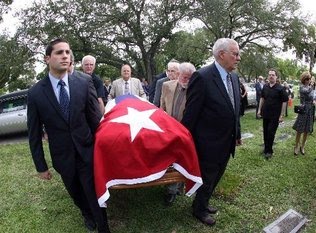
The last First Lady of a free Cuba, Maria Dolores "Mary" Tarrero de Prío died in Miami on September 23, 2010 and was laid to rest on September 25, 2010. She was the widow of Carlos Prío Socarras, the last democratically elected president of Cuba. She was buried alongside her husband.

Seventy years after he became Cuba's last democratic president, part of Carlos Prio's legacy lives on in the Universal Declaration of Human Rights, and his own example of civility and the defense of freedom of expression during his presidency. These are values that deserve to be honored and a legacy to be both respected and defended.

*"No te alarmen en exceso, sin embargo, mis palabras. Pues no hay reino de la maldad en Cuba ni tu pueblo está regido por la violencia desatada. Lo que temo es que pueda estarlo un día, porque tu supiste descifrar el secreto de los tiempos cuando advertiste que «fustas recogerá quien siembra fustas» y que «el que desata vientos cosecha tempestades», y por ese día de la cosecha de tempestades y de fustas, me ves desde ahora preocupado. Levántate y diles a los pocos cubanos que cuidan en el jardín de tu isla la venenosa flor del odio, que la arranquen de raíz y arrojen la planta a los abismos del olvido!"

Sunday, September 26, 2010

Mary Tarrero de Prío: The Last First Lady of a Democratic Cuba

Requiescat in pace

Mary Tarrero de Prío

The last First Lady of a Democratic Cuba Maria Dolores "Mary" Tarrero de Prío died in Miami on September 23, 2010 and was laid to rest on Saturday, September 25, 2010. She was the widow of Carlos Prío Socarras, the last democratically elected president of Cuba. Carlos Prío died in Miami in 1977 and is also buried there.

Cuban democracy ended on March 10, 1952 with Fulgencio Batista's coup and 58 years later it has still not returned. Sadly as the years pass and those who lived those glory years of democracy leave us they begin to be viewed as myth. Add to that the current dictatorship's rewriting of history to diminish this democratic age in order to justify its own tyrannical rule and one can understand how the world would forget Cuba's own democratic chapter.

Carlos Prío Socarras, Ramon Grau San Martin, Carlos Hevia

Yet there is one witness who spoke out on behalf of the Republic on October 16, 1953 that the tyranny cannot ignore: Fidel Castro. During his trial for the July 26, 1953 armed assault on the Moncada Barracks he addresed the court and described Ramon Grau's and Carlos Prío's presidencies:
Once upon a time there was a Republic. It had its Constitution, its laws, its freedoms, a President, a Congress and Courts of Law. Everyone could assemble, associate, speak and write with complete freedom. The people were not satisfied with the government officials at that time, but they had the power to elect new officials and only a few days remained before they would do so. Public opinion was respected and heeded and all problems of common interest were freely discussed. There were political parties, radio and television debates and forums and public meetings. The whole nation pulsated with enthusiasm. This people had suffered greatly and although it was unhappy, it longed to be happy and had a right to be happy. It had been deceived many times and it looked upon the past with real horror. This country innocently believed that such a past could not return; the people were proud of their love of freedom and they carried their heads high in the conviction that liberty would be respected as a sacred right. They felt confident that no one would dare commit the crime of violating their democratic institutions. They wanted a change for the better, aspired to progress; and they saw all this at hand. All their hope was in the future.
President Carlos Prío Socarras and his wife Mary Tarrero de Prío went into exile in Miami, but his struggle for a democratic Cuba did not end there. He would be arrested on more than one occasion accused of smuggling arms to rebels in Cuba seeking to overthrow Fulgencio Batista.

According to Ramón L. Bonachea and Marta San Martin in their book The Cuban insurrection, 1952-1959 in August of 1956, Fidel Castro and Carlos Prío met at a small hotel in McAllen, Texas where for over an hour they discussed the future of the insurrection against Batista. Castro asked Prío for money and the former president agreed to finance Castro’s expedition to Cuba. Prío would send the Cuban guerrillas almost one quarter of a million dollars in arms and money. Prío got other associates to contribute thousands of dollars more in cash to the guerrillas.

The last constitutional president of Cuba had publicly announced his plan to return to the island as early as 1955 and did so during a brief "amnesty" in 1956 only to be expelled at gun point a short time later and would return again in January 1959 with Fulgencio Batista's departure into exile. Only to depart for exile again in December 1960 as they saw the new government turning into a military dictatorship.

On June 11, 1961 Carlos Prío Socarras addressed 1,200 Cubans in exile and pledged to aid the Cuban underground. He would go on to aide and plan efforts to combat Castro's military dictatorship as he had done earlier against Batista.

As the 1960s drew to a close and the armed struggle against Castro's dictatorship drew to a close Carlos Prío in 1973 sought to preempt efforts at a negotiated solution in which democratic Cubans were not participants boldly proposing that Cuban exiles seek to insert themselves in the dialogue taking place between Nixon and Breshnev and negotiate the island's future. The proposal was met with wariness and opposition going no where.

Carlos Prío Socarras died from a self-inflicted gun shot wound on April 5, 1977 in his garage in Miami. Carlos Prío from his youth battling the Machado dictatorship as a University student in the 1930s to his later struggles against Batista in the 1950s and Castro in the 1960s and 70s he spent a life struggling against dictatorship of all ideological tendencies. Seeing the destruction of Cuba and the suffering of the Cuban people led him to despair.

As we remember Mary Tarrero de Prío who "never completely recovered" from her husband's death we can say a prayer for her, Carlos Prío Socarras and their family remembering the price they paid for Cuban freedom and ensure with the continued efforts of Cuban democrats that those sacrifices not be in vain. Here is one historian's take on the presidency of Carlos Prío Socarras:
They were a time of constitutional order and political freedom. They were not 'golden years' by any means, but in two elections (1944 and 1948), Cubans had the opportunity to express their desire for a rule of civil liberties, primacy of Cuban culture, and achievement of economic independence. If there were sharp contradictions in Cuban society under the Autenticos, the circumstances differed only in degree from the complexities and dynamics encountered in free societies everywhere.

Sample ballot from 1944 Cuban elections in which different political parties vied for power. The last democratic presidential elections were held in 1948 and won by Carlos Prío Socarras.


News clip from Carlos Prío Socarras 1951 visit to the United States


Reparto de Raciones (1950) from Memoria de Cuba on Vimeo.


First Lady Mary Tarrero at the Presidential Palace hands out Easter baskets to those in need in Easter 1950
