"'To speak the truth is a petit-bourgeois habit. To lie, on the
contrary, is often justified by the lie's aim." - Vladimir Ilyich Ulyanov (Lenin)
"If we had paused to tell the people that we were Marxist-Leninists while we were on Pico Turquino and not yet strong, it is possible that we would never have been able to descend to the plains." - Fidel Castro, December 2, 1961

Chinese general, military strategist and philosopher Sun Tzu in his sixth century B.C. treatise The Art of War provides two important insights for the purpose of this conversation: 1) the importance of knowing yourself and your adversary in a struggle 2) To analyze how you are going to win in a struggle before you start it.
It is no accident that modern conservatism is traced back to a profound and nuanced rejection of the French Revolution of 1789 found in the writings of Edmund Burke, and especially Reflections on the Revolution in France published in November of 1790. Burke knew the basis and structure of a traditional society and the threat of revolution to these important social structures that make civilization both possible and tolerable.
Pre-Marx Communism
The word and idea of communism predates Karl Marx and first arises out of Enlightenment ideas that would fully express themselves in the French Revolution. French philosopher Victor d'Hupay in his 1777 book Projet de communauté philosophe, advanced Enlightenment principles that are the basis of a communist philosophy defined as a lifestyle called a "commune" that advises to "share all economic and material products between members of the commune, so that all benefit equally from each other's work". Communists are initially defined as those living in the commune. The Jacobins, supported the idea of redistributing wealth equally among the people, including Jean-Paul Marat and Gracchus Babeuf. Babeuf was involved in the Conspiracy of the Equals of 1796 intending to establish a revolutionary regime based on communal ownership, egalitarianism and the redistribution of property. The plot was however detected and he and several others involved were arrested and executed, but there attempt would inspire radicals in the future.
Karl Marx, Friedrich Engels, the Communist League, and the Communist Manifesto
On February 21, 1848, The Communist Manifesto, written by Karl Marx with the assistance and patronage of Friedrich Engels is published. This political pamphlet was commissioned by the Communist League which had come into existence in 1847and is considered the first Marxist party. The darker aspects of Marxism had already been self evident to some of his contemporaries as early as 1844 as Joshua Dill, the Assistant Director of Publications at the Victims of Communism Memorial Foundation, documented in in the September 15, 2017 article "Communism: A bad idea even in 1844." The Manifesto didn't offer anything new in communist theory, but a synthesis of these ideas packaged in a way that made it readily accessible, unlike some of other Marxist works such as "Das Kapital." They were also blessed by some good timing because the tract predicted that revolution was imminent, a natural outcome of materialist historical processes, and within days of the publication, coincidentally, revolutions broke out first in France and then across Europe, but were put down by conservative forces.
Third time was the charm for totalitarianism: The Three Internationals
International political networks focused on a single issue (anti-slavery for example) crossed national boundaries and were effective. However the communists took it to new level but it took time to perfect and can be found in three international communist networks that span over a century. The First International, also known as the International Workingmen's Association (IWA) 1864–1876 aimed at uniting a variety of different left-wing socialist, communist and anarchist political groups and trade union organizations that were all based on the working class and class struggle. It was founded in 1864 in London. The first congress was held two years later in 1866 in Geneva, Switzerland. This network had over five million members but it split in 1872 over conflicts between communist and anarchist factions and dissolved in 1876.
The Second International was founded on July 14, 1889 and excluded the anarchists. Their influence is still felt today around the world and important days of action were set up by them. In 1889 they declared May 1st as International Workers' Day. In 1910 they declared March 19th International Women's Day but then changed the day to March 8th to celebrate the women's marches during the Russian Revolution in 1917. They campaigned for the eight hour work day. Vladimir Ilyich Lenin had been a member since 1905. The Second international dissolved in 1916 over differences of how to respond to World War One but formed again in 1923 and a version of it continues to the present as the Socialist International. There were three primary divisions: parties that remained loyal to their nation state, anti-war socialists, and communists like Lenin who sought to exploit the war to unleash worldwide revolution with a redefinition that would come to be known as Marxism-Leninism in which a vanguard party leads the change to a communist future.
Communist Morality
The first leader of the Soviet Union, Vladimir Lenin on October 2, 1920 in a speech to Russian communist youth stated: "The class struggle is continuing and it is our task to subordinate all interests to that struggle. Our communist morality is also subordinated to that task. We say: morality is what serves to destroy the old exploiting society and to unite all the working people around the proletariat, which is building up a new, communist society." This is at the heart of communist morality, the ends justify the means, a profound immorality and a pillar of international communism.
The Third International was founded by Lenin in 1915 and held its first of seven world congresses on March 2, 1919 and was also known as the Communist International, and was known by its abbreviated form the Comintern. It was an international communist organization that advocated world communism. The International intended to fight "by all available means, including armed force, for the overthrow of the international bourgeoisie and for the creation of an international Soviet republic as a transition stage to the complete abolition of the State". The communists came to power in Russia on November 7, 1917. The Comintern was officially dissolved by Joseph Stalin in 1943 to calm the fears of his non-communist allies, but this totalitarian network remained intact but not as visible.
The power of propaganda
The Communists were excellent at diagnosing problems in society and using propaganda to exploit them, even if their solutions did not improve them. The Communist Manifesto is a perfect example of this. However they also operated in international totalitarian networks to spread the propaganda and to engage in coordinated international campaigns to achieve political power. These innovations would give communists an organizational and message advantage over traditional political parties.

The rise of Batista and his alliance with the communists
Machado was driven out of power by students and sergeants in 1933. Fulgencio Batista emerged as the strong man behind the scenes. However in 1940 a new constitution is drafted were all political tendencies, including the communists, take part. Batista forges an electoral alliance with the Cuban Communists, who in 1944 called themselves the Popular Socialist Party. Two close associates of Batista were also later to become high ranking Communist members of Fidel Castro‘s regime, Juan Marinello (later a member of Castro's Politburo), who lost his attempt to win the post of mayor of Havana in the 1940 elections and Carlos Rafael Rodriguez (who eventually became Castro's Vice-President). Rodriguez would be a member of Batista's cabinet in 1942. This relationship grew even stronger after 1942 when the Soviet Union joined allied powers in the fight against Hitler (after having been in a de facto alliance with the Nazis from 1939 until the summer of 1941 when they were invaded by the Germans). Following the end of WW2 Batista's political party went into opposition and anti-communist populists entered power under the presidencies of Ramon Grau San Martin (1944-1948) and Carlos Prio Socarras (1948 - 1952). Batista returns from the political wilderness and on March 10, 1952 engages in a coup de etat against the democratic order driving President Prio Socarras into exile.
Prior to 1959, Cuba had problems – an authoritarian dictatorship imposed in 1952 that was unwanted – however it did have numerous newspapers, radio stations and television that challenged the Batista regime along with a vibrant civil society that struggled and protested against the dictator. Things outlawed under the Castro regime since 1960.
Fake News
We hear a lot about fake news these days, but it has a long pedigree. The New York Times has a shameful history as not only an apologist, but as a booster for totalitarians. Walter Duranty in the 1930s covered up the deaths of millions in Ukraine in a famine engineered by Stalin to eliminate those who resisted him and in the 1950s Herbert Matthews rescued Fidel Castro from obscurity in a series of articles. Both men wrote for The New York Times.
Beginning in 1957 Herbert Matthews built up Fidel Castro's image both inside and outside of Cuba with a series of misleading articles in The New York Times. In July of 1959 Matthews reported: "[t]his is not a Communist Revolution in any sense of the term. Fidel Castro is not only not a Communist, he is decidedly anti-Communist." Anthony De Palma has written a book on Herbert Matthews titled, "The Man Who Invented Fidel" and describes how his heroic portrayal of Fidel Castro influenced the fall of the Batista dictatorship and the consolidation of the future dictator as a national figure.
Fidel Castro's July 26th Movement successfully lobbied Washington to impose an arms embargo on Batista on March 14, 1958, and the old dictator seeing that Washington was siding with the enemy made the calculated decision to flee on December 31, 1958.
William F. Buckley Jr. in an article in the March 1961 issue of The American Legion magazine outlined the impact of Mr. Matthews on the imposition of communism in Cuba and placed it in a larger context:
Fidel Castro repackages Lenin's communist morality for a new generation
Meanwhile the long time communist Rafael Rodríguez first met Fidel Castro a few days before the July 26, 1953 attack on the Moncada Barracks. Rafael Rodríguez denounced the attack after it occurred, along with other communists describing it as a Hitlerian style putsch. Nevertheless he would eventually ally himself with Castro. In July 1958, Carlos Rafael Rodriguez joined the 26th of July Movement in the Sierra Maestra mountain range in support of its guerrilla war against Batista; it was the first such public gesture of support by the Communist Party for the rebels.
Fidel Castro at the time was repeatedly claiming that he was not a communist because he knew that speaking the truth would lead Cubans to abandon him. Years later on March 26, 1964 after consolidating power and announcing that he had always been a Marxist Leninist he explained how he defined "truth" by rejecting objective truth: "I conceive the truth in terms of a just and noble end, and that is when the truth is truly true. If it does not serve a just, noble and positive end, truth, as an abstract entity, philosophical category, in my opinion, does not exist." Jose Ignacio Rasco, who knew Fidel Castro from school and afterwards concluded that the Cuban revolutionary had been a committed communist by 1950. Rasco, in an analysis of Fidel Castro, talked about the key role played by Batista's former communist minister:
Its pages gave voice to a wide range of opinion. It gave a platform to many distinguished Cuban intellectuals. Over its long history La Marina kept faith with a conservative philosophy that from 1902 to 1959 defended the best interests of a democratic Cuba, while opposing the dictatorships of Gerardo Machado in the 1930s and Fulgencio Batista in the 1950s. It was the only newspaper in Cuba that published the letters of Huber Matos, one of the commanders of the revolution, denouncing the emerging communist dictatorship written from his prison cell after his October 1959 arrest for “counter-revolutionary treason”.
On May 12, 1960—the Diario de la Marina newspaper was closed, a day after José Ignacio Rivero took refuge in the Peruvian Embassy in Havana. The day following the closing of La Marina, Cuba's last remaining privately-owned newspaper (Prensa Libre) “Free Press” was attacked by a mob and shut down. La Marina’s offices and equipment were confiscated by the dictatorship and used to publish its dictatorship controlled newspapers.
It did not matter to the communists whether the newspaper was liberal or conservative all were shutdown and taken over. This was part of their strategy to monopolize control of all media. The same was done with radio and television.Today the only legal media in Cuba broadcast over the national airwaves and distributed in print are regime monopolies that tow the Communist Party line.
"If we had paused to tell the people that we were Marxist-Leninists while we were on Pico Turquino and not yet strong, it is possible that we would never have been able to descend to the plains." - Fidel Castro, December 2, 1961

Chinese general, military strategist and philosopher Sun Tzu in his sixth century B.C. treatise The Art of War provides two important insights for the purpose of this conversation: 1) the importance of knowing yourself and your adversary in a struggle 2) To analyze how you are going to win in a struggle before you start it.
It is no accident that modern conservatism is traced back to a profound and nuanced rejection of the French Revolution of 1789 found in the writings of Edmund Burke, and especially Reflections on the Revolution in France published in November of 1790. Burke knew the basis and structure of a traditional society and the threat of revolution to these important social structures that make civilization both possible and tolerable.
Pre-Marx Communism
The word and idea of communism predates Karl Marx and first arises out of Enlightenment ideas that would fully express themselves in the French Revolution. French philosopher Victor d'Hupay in his 1777 book Projet de communauté philosophe, advanced Enlightenment principles that are the basis of a communist philosophy defined as a lifestyle called a "commune" that advises to "share all economic and material products between members of the commune, so that all benefit equally from each other's work". Communists are initially defined as those living in the commune. The Jacobins, supported the idea of redistributing wealth equally among the people, including Jean-Paul Marat and Gracchus Babeuf. Babeuf was involved in the Conspiracy of the Equals of 1796 intending to establish a revolutionary regime based on communal ownership, egalitarianism and the redistribution of property. The plot was however detected and he and several others involved were arrested and executed, but there attempt would inspire radicals in the future.
Karl Marx, Friedrich Engels, the Communist League, and the Communist Manifesto
On February 21, 1848, The Communist Manifesto, written by Karl Marx with the assistance and patronage of Friedrich Engels is published. This political pamphlet was commissioned by the Communist League which had come into existence in 1847and is considered the first Marxist party. The darker aspects of Marxism had already been self evident to some of his contemporaries as early as 1844 as Joshua Dill, the Assistant Director of Publications at the Victims of Communism Memorial Foundation, documented in in the September 15, 2017 article "Communism: A bad idea even in 1844." The Manifesto didn't offer anything new in communist theory, but a synthesis of these ideas packaged in a way that made it readily accessible, unlike some of other Marxist works such as "Das Kapital." They were also blessed by some good timing because the tract predicted that revolution was imminent, a natural outcome of materialist historical processes, and within days of the publication, coincidentally, revolutions broke out first in France and then across Europe, but were put down by conservative forces.
 |
| Soviet propaganda of the Third International |
International political networks focused on a single issue (anti-slavery for example) crossed national boundaries and were effective. However the communists took it to new level but it took time to perfect and can be found in three international communist networks that span over a century. The First International, also known as the International Workingmen's Association (IWA) 1864–1876 aimed at uniting a variety of different left-wing socialist, communist and anarchist political groups and trade union organizations that were all based on the working class and class struggle. It was founded in 1864 in London. The first congress was held two years later in 1866 in Geneva, Switzerland. This network had over five million members but it split in 1872 over conflicts between communist and anarchist factions and dissolved in 1876.
The Second International was founded on July 14, 1889 and excluded the anarchists. Their influence is still felt today around the world and important days of action were set up by them. In 1889 they declared May 1st as International Workers' Day. In 1910 they declared March 19th International Women's Day but then changed the day to March 8th to celebrate the women's marches during the Russian Revolution in 1917. They campaigned for the eight hour work day. Vladimir Ilyich Lenin had been a member since 1905. The Second international dissolved in 1916 over differences of how to respond to World War One but formed again in 1923 and a version of it continues to the present as the Socialist International. There were three primary divisions: parties that remained loyal to their nation state, anti-war socialists, and communists like Lenin who sought to exploit the war to unleash worldwide revolution with a redefinition that would come to be known as Marxism-Leninism in which a vanguard party leads the change to a communist future.
Communist Morality
The first leader of the Soviet Union, Vladimir Lenin on October 2, 1920 in a speech to Russian communist youth stated: "The class struggle is continuing and it is our task to subordinate all interests to that struggle. Our communist morality is also subordinated to that task. We say: morality is what serves to destroy the old exploiting society and to unite all the working people around the proletariat, which is building up a new, communist society." This is at the heart of communist morality, the ends justify the means, a profound immorality and a pillar of international communism.
The Third International was founded by Lenin in 1915 and held its first of seven world congresses on March 2, 1919 and was also known as the Communist International, and was known by its abbreviated form the Comintern. It was an international communist organization that advocated world communism. The International intended to fight "by all available means, including armed force, for the overthrow of the international bourgeoisie and for the creation of an international Soviet republic as a transition stage to the complete abolition of the State". The communists came to power in Russia on November 7, 1917. The Comintern was officially dissolved by Joseph Stalin in 1943 to calm the fears of his non-communist allies, but this totalitarian network remained intact but not as visible.
 |
| Totalitarian networks and propaganda pioneer: Wilhelm Münzenberg |
The Communists were excellent at diagnosing problems in society and using propaganda to exploit them, even if their solutions did not improve them. The Communist Manifesto is a perfect example of this. However they also operated in international totalitarian networks to spread the propaganda and to engage in coordinated international campaigns to achieve political power. These innovations would give communists an organizational and message advantage over traditional political parties.
Perfecting totalitarian networks
The pioneer in totalitarian networks was Wilhelm "Willi" Münzenberg who impacted much of the 20th century. Münzenberg met the Russian communist revolutionary Lenin in Bern, Switzerland in 1915. It was León Trotsky who recognized in Münzenberg the talent to organize clandestine networks from almost nothing. He was part of the original Bolshevik network prior to the 1917 revolution. Following the arrival of the Soviets to power and the COMINTERN as a means to disseminate the Soviet revolution and consolidate dominance of Marxism-Leninism over the global Left; Münzenberg also used it to organize cultural power and further expand international influence.
The first congress of the Communist International included delegates from communist or socialist parties from Russia, Germany, Austria, Hungary, Poland, Finland, Ukraine, Latvia, Lithuania, Belarus, Estonia, Armenia, France, Switzerland, China, Korea, Bulgaria, Switzerland, Sweden, the United States, Azerbaijan, Yugoslavia, and the Netherlands among other countries. In 1921 Münzenberg became the director of clandestine operations of propaganda aimed at the West. To create networks of supporters Münzenberg used all the resources propaganda from high culture to the most basic. He organized the media: film, radio, theater, books, magazines, and newspapers. He was able to connect to and use all types of formers of opinion respected by the public: writers, artists, actors, priests, ministers, teachers, businessmen, scientists, and psychologists.
The Münzenberg network was one of the key factors for the direction taken in political attitudes that operated in the 1930s. He manipulated and influenced public opinion using a network of writers and intellectuals such as: Ernest Hemingway, John Dos Passos, Lillian Hellman, George Grosz, Erwin Piscator, André Malraux, André Gide, Bertolt Brecht, Dorothy Parker to Kim Philby, Guy Burgess and Anthony Blunt. He organized protest marches, politicized writers conferences, politicized art festivals, ad hoc committees signed by famous celebrities for causes without end.
These networks are still active today and have operated over the years in campaigns for Angela Davis (1970), Mumia Abdul Jamal (1982-2011), the Cuban Five (2000- 2014) just to name a few high profile cases.
The pioneer in totalitarian networks was Wilhelm "Willi" Münzenberg who impacted much of the 20th century. Münzenberg met the Russian communist revolutionary Lenin in Bern, Switzerland in 1915. It was León Trotsky who recognized in Münzenberg the talent to organize clandestine networks from almost nothing. He was part of the original Bolshevik network prior to the 1917 revolution. Following the arrival of the Soviets to power and the COMINTERN as a means to disseminate the Soviet revolution and consolidate dominance of Marxism-Leninism over the global Left; Münzenberg also used it to organize cultural power and further expand international influence.
The first congress of the Communist International included delegates from communist or socialist parties from Russia, Germany, Austria, Hungary, Poland, Finland, Ukraine, Latvia, Lithuania, Belarus, Estonia, Armenia, France, Switzerland, China, Korea, Bulgaria, Switzerland, Sweden, the United States, Azerbaijan, Yugoslavia, and the Netherlands among other countries. In 1921 Münzenberg became the director of clandestine operations of propaganda aimed at the West. To create networks of supporters Münzenberg used all the resources propaganda from high culture to the most basic. He organized the media: film, radio, theater, books, magazines, and newspapers. He was able to connect to and use all types of formers of opinion respected by the public: writers, artists, actors, priests, ministers, teachers, businessmen, scientists, and psychologists.
The Münzenberg network was one of the key factors for the direction taken in political attitudes that operated in the 1930s. He manipulated and influenced public opinion using a network of writers and intellectuals such as: Ernest Hemingway, John Dos Passos, Lillian Hellman, George Grosz, Erwin Piscator, André Malraux, André Gide, Bertolt Brecht, Dorothy Parker to Kim Philby, Guy Burgess and Anthony Blunt. He organized protest marches, politicized writers conferences, politicized art festivals, ad hoc committees signed by famous celebrities for causes without end.
These networks are still active today and have operated over the years in campaigns for Angela Davis (1970), Mumia Abdul Jamal (1982-2011), the Cuban Five (2000- 2014) just to name a few high profile cases.
How communism arrived in Cuba (1923 - 1959)
Samuel Farber in his book The Origins of the Cuban Revolution Reconsidered provided an overview of the early years of communist infiltration into Cuba. Communist activity began in Cuba in 1923 and the first communist party was established in 1925 by Moscow trained members of the Third International (Comintern). This Cuban communist party underwent a rapid Stalinization and assumed the policy advanced by the Soviet Union between 1928 and 1934 following the "Communist International's Third Period line, an ultra-left policy imposed by Moscow that required Communists to direct their main attacks at social democrats, who were denounced as 'social -fascists.'" Cuba did not have an organized social democratic party but did have populists students and nationalist groups that were resisting the Machado dictatorship. Gerardo Machado, a brigadier general in the war of independence and later a businessman was elected president of Cuba in 1924 but seized power over all political parties in 1927 and became Cuba's first dictator. At a critical moment in the struggle against Machado when populists and students called for a general strike, it was the communists who broke the strike and sought an accommodation with the Cuban tyrant. It made the communist party extremely unpopular in Cuba.
The rise of Batista and his alliance with the communists
Machado was driven out of power by students and sergeants in 1933. Fulgencio Batista emerged as the strong man behind the scenes. However in 1940 a new constitution is drafted were all political tendencies, including the communists, take part. Batista forges an electoral alliance with the Cuban Communists, who in 1944 called themselves the Popular Socialist Party. Two close associates of Batista were also later to become high ranking Communist members of Fidel Castro‘s regime, Juan Marinello (later a member of Castro's Politburo), who lost his attempt to win the post of mayor of Havana in the 1940 elections and Carlos Rafael Rodriguez (who eventually became Castro's Vice-President). Rodriguez would be a member of Batista's cabinet in 1942. This relationship grew even stronger after 1942 when the Soviet Union joined allied powers in the fight against Hitler (after having been in a de facto alliance with the Nazis from 1939 until the summer of 1941 when they were invaded by the Germans). Following the end of WW2 Batista's political party went into opposition and anti-communist populists entered power under the presidencies of Ramon Grau San Martin (1944-1948) and Carlos Prio Socarras (1948 - 1952). Batista returns from the political wilderness and on March 10, 1952 engages in a coup de etat against the democratic order driving President Prio Socarras into exile.
Prior to 1959, Cuba had problems – an authoritarian dictatorship imposed in 1952 that was unwanted – however it did have numerous newspapers, radio stations and television that challenged the Batista regime along with a vibrant civil society that struggled and protested against the dictator. Things outlawed under the Castro regime since 1960.
Fake News
We hear a lot about fake news these days, but it has a long pedigree. The New York Times has a shameful history as not only an apologist, but as a booster for totalitarians. Walter Duranty in the 1930s covered up the deaths of millions in Ukraine in a famine engineered by Stalin to eliminate those who resisted him and in the 1950s Herbert Matthews rescued Fidel Castro from obscurity in a series of articles. Both men wrote for The New York Times.
Beginning in 1957 Herbert Matthews built up Fidel Castro's image both inside and outside of Cuba with a series of misleading articles in The New York Times. In July of 1959 Matthews reported: "[t]his is not a Communist Revolution in any sense of the term. Fidel Castro is not only not a Communist, he is decidedly anti-Communist." Anthony De Palma has written a book on Herbert Matthews titled, "The Man Who Invented Fidel" and describes how his heroic portrayal of Fidel Castro influenced the fall of the Batista dictatorship and the consolidation of the future dictator as a national figure.
Fidel Castro's July 26th Movement successfully lobbied Washington to impose an arms embargo on Batista on March 14, 1958, and the old dictator seeing that Washington was siding with the enemy made the calculated decision to flee on December 31, 1958.
William F. Buckley Jr. in an article in the March 1961 issue of The American Legion magazine outlined the impact of Mr. Matthews on the imposition of communism in Cuba and placed it in a larger context:
"The leader of pro-Castro opinion in the United States is Herbert L. Matthews , a member of the editorial staff of the New York Times. He did more than any other single man to bring Fidel Castro to power. It could be said - with a little license - that Matthews was to Castro what Owen Lattimore was to Red China, and that the New York Times was Matthews's Institute of Pacific Relations: stressing this important difference, that no one has publicly developed against Matthews anything like the evidence subsequently turned up against Lattimore tending to show, in the words of a Senate investigating committee, that Lattimore was 'a conscious, articulate instrument of the Soviet conspiracy.'"
Fidel Castro repackages Lenin's communist morality for a new generation
Meanwhile the long time communist Rafael Rodríguez first met Fidel Castro a few days before the July 26, 1953 attack on the Moncada Barracks. Rafael Rodríguez denounced the attack after it occurred, along with other communists describing it as a Hitlerian style putsch. Nevertheless he would eventually ally himself with Castro. In July 1958, Carlos Rafael Rodriguez joined the 26th of July Movement in the Sierra Maestra mountain range in support of its guerrilla war against Batista; it was the first such public gesture of support by the Communist Party for the rebels.
Fidel Castro at the time was repeatedly claiming that he was not a communist because he knew that speaking the truth would lead Cubans to abandon him. Years later on March 26, 1964 after consolidating power and announcing that he had always been a Marxist Leninist he explained how he defined "truth" by rejecting objective truth: "I conceive the truth in terms of a just and noble end, and that is when the truth is truly true. If it does not serve a just, noble and positive end, truth, as an abstract entity, philosophical category, in my opinion, does not exist." Jose Ignacio Rasco, who knew Fidel Castro from school and afterwards concluded that the Cuban revolutionary had been a committed communist by 1950. Rasco, in an analysis of Fidel Castro, talked about the key role played by Batista's former communist minister:
Carlos Rafael Rodriguez played a key role in the process of the Marxist affirmation of Castro and the marriage of what was originally a mere concubinage of the Commander in Chief with old and new communists. So that first the ORI (Integrated Revolutionary Organizations) was formed that harbored within the acronym the most involved in the process. Later it was called the PURS (United Party of the Socialist Revolution) and finally unmasked, the PCC (Cuban Communist Party) in 1965.While Fidel Castro spoke in public of how his revolution respected human rights, democracy and freedom of speech in private his followers warned journalists that if they criticized the new regime they would be killed. As the months passed newspaper after newspaper was shut down.
 |
| Executed in Santiago de Cuba by the Castro regime in 1959 |
On August 3, 2011, José Ignacio Rivero passed away in exile in Miami he was the last publisher of Cuba’s legendary Diario de la Marina from 1944 to 1960. It was a family paper handed down from father to son over three generations. José Ignacio was the son of Pepín Rivero (publisher from 1919-1944) and the grandson of its founder Nicolás Rivero. It was Cuba’s longest running newspaper with the highest circulation with roots back to two newspapers: 1813 with El Lucero de la Habana (The Havana Star) and the Noticioso Mercantil (The Mercantile Seer) whose 1832 merger established El Noticioso y Lucero de la Habana, which in 1844 was renamed the Diario de la Marina.
Its pages gave voice to a wide range of opinion. It gave a platform to many distinguished Cuban intellectuals. Over its long history La Marina kept faith with a conservative philosophy that from 1902 to 1959 defended the best interests of a democratic Cuba, while opposing the dictatorships of Gerardo Machado in the 1930s and Fulgencio Batista in the 1950s. It was the only newspaper in Cuba that published the letters of Huber Matos, one of the commanders of the revolution, denouncing the emerging communist dictatorship written from his prison cell after his October 1959 arrest for “counter-revolutionary treason”.
On May 12, 1960—the Diario de la Marina newspaper was closed, a day after José Ignacio Rivero took refuge in the Peruvian Embassy in Havana. The day following the closing of La Marina, Cuba's last remaining privately-owned newspaper (Prensa Libre) “Free Press” was attacked by a mob and shut down. La Marina’s offices and equipment were confiscated by the dictatorship and used to publish its dictatorship controlled newspapers.
It did not matter to the communists whether the newspaper was liberal or conservative all were shutdown and taken over. This was part of their strategy to monopolize control of all media. The same was done with radio and television.Today the only legal media in Cuba broadcast over the national airwaves and distributed in print are regime monopolies that tow the Communist Party line.
The first pillar of the totalitarian regime was set: MONOPOLY CONTROL OVER ALL MEDIA
Other pillars of the totalitarian regime were imposed. The second pillar: FEAR. Terror imposed on the population through the widely broadcast mass executions and a huge population of political prisoners. The third pillar: ABILITY TO REPRESS was achieved when the army was politicized with officers trained in the Soviet Union and a massive state security apparatus set up to spy on Cubans.
The East German Stasi came to Cuba and trained and formed the Cuban State Security apparatus. 40,000 Soviet troops would be stationed in Cuba and the Lourdes spy base constructed to spy on the United States. After the fall of the Soviet Union the Chinese moved in and took over the base to continue spying on the United States.
Over time the totalitarian apparatus passed “laws” which justified the already existing practices of outlawing free speech both spoken and written. Written and Oral Enemy propaganda or assisting in the distribution of either would net you lengthy prison terms and are still on the books today. In the late 90s the dictatorship passed Law 88, also known as the gag law, which threatened Cubans with 20 year prison sentences and even the death penalty for speaking critically of the regime to an international media source.
On December 2, 1961 in a speech on the anniversary of his landing back in Cuba aboard the Granma Yacht to carry out the overthrow of Batista, Fidel Castro explained why he had denied being a communist "If we had paused to tell the people that we were Marxist-Leninists while we were on Pico Turquino and not yet strong, it is possible that we would never have been able to descend to the plains."
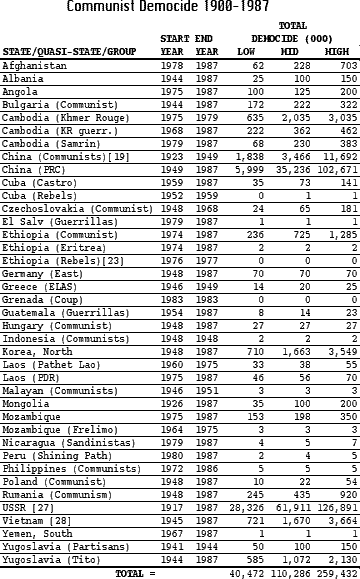
A conservative estimate gives the range, according to Matthew White in his website Necrometrics, at between 5,000-12,000 Cubans killed by the Castro regime compared with Chileans killed by the Pinochet regime which number 3,197. Rudolph Joseph Rummel, a political science professor at the University of Hawaii and an expert in Democide (murder by government) also takes into account the Cuban boat people who have died fleeing the dictatorship and estimates 73,000 dead Cubans between 1959 and 1987. In The Black Book of Communism in chapter 25 "Communism in Latin America" by Pascal Fontaine states that in Cuba between 1959 through the late 1990s "between 15,000 and 17,000 people were shot." All these are conservative numbers.
This is how communism arrived in Cuba with lies, repression, terror and murder. The same way the Castro regime has been maintained in power for 58 years and as other communist regimes are today.
First part of October 26, 2017 lecture sponsored by the Young Conservatives of
Texas held in the
Escondido Theater of the Student Union Building at Texas Tech University. The talk was entitled
'How Communism Arrived in Cuba.Other pillars of the totalitarian regime were imposed. The second pillar: FEAR. Terror imposed on the population through the widely broadcast mass executions and a huge population of political prisoners. The third pillar: ABILITY TO REPRESS was achieved when the army was politicized with officers trained in the Soviet Union and a massive state security apparatus set up to spy on Cubans.
The East German Stasi came to Cuba and trained and formed the Cuban State Security apparatus. 40,000 Soviet troops would be stationed in Cuba and the Lourdes spy base constructed to spy on the United States. After the fall of the Soviet Union the Chinese moved in and took over the base to continue spying on the United States.
Over time the totalitarian apparatus passed “laws” which justified the already existing practices of outlawing free speech both spoken and written. Written and Oral Enemy propaganda or assisting in the distribution of either would net you lengthy prison terms and are still on the books today. In the late 90s the dictatorship passed Law 88, also known as the gag law, which threatened Cubans with 20 year prison sentences and even the death penalty for speaking critically of the regime to an international media source.
On December 2, 1961 in a speech on the anniversary of his landing back in Cuba aboard the Granma Yacht to carry out the overthrow of Batista, Fidel Castro explained why he had denied being a communist "If we had paused to tell the people that we were Marxist-Leninists while we were on Pico Turquino and not yet strong, it is possible that we would never have been able to descend to the plains."
How many killed?
Between 1960 and 1966 there was an insurgency in the mountains of the
Escambray that fought the Castro regime made up mostly of farmers and
Revolutionary Directorate rebels that had fought the Batista Regime
demanding a democratic restoration. The dictatorship called it the "War against the Bandits." Tom Gjelten in his book Bacardi and the Long Fight for Freedom gives an account of what took place:
The peasants in the Escambray Mountains, an independent group even during the anti-Batista struggle, took up arms again, this time in opposition to the government's heavy hand. Castro had taken a lesson from Batista's hapless efforts at counterinsurgency, however, and he responded to the Escambray guerrillas with more force and ruthlessness than Batista had dared employ. With the guidance of Soviet counterinsurgency experts, Castro sent thousands of army troops into the mountains to pursue the guerrillas. Captured Escambray insurgents were often executed on the spot, and in a move reminiscent of the Spanish army's "reconcentration" strategy during the independence war, Castro ordered the relocation of entire villages where the guerillas enjoyed mass support. The villagers were moved en masse to western Cuba, where they could be closely monitored.The guerrillas were eventually exterminated and the uprising was crushed by 1966. The full number of dead may never be known. In addition, for the Castro regime, merely wanting to flee the country was considered an offense and was often punished with death. There are conflicting estimates that range from thousands to tens of thousands.
A conservative estimate gives the range, according to Matthew White in his website Necrometrics, at between 5,000-12,000 Cubans killed by the Castro regime compared with Chileans killed by the Pinochet regime which number 3,197. Rudolph Joseph Rummel, a political science professor at the University of Hawaii and an expert in Democide (murder by government) also takes into account the Cuban boat people who have died fleeing the dictatorship and estimates 73,000 dead Cubans between 1959 and 1987. In The Black Book of Communism in chapter 25 "Communism in Latin America" by Pascal Fontaine states that in Cuba between 1959 through the late 1990s "between 15,000 and 17,000 people were shot." All these are conservative numbers.
This is how communism arrived in Cuba with lies, repression, terror and murder. The same way the Castro regime has been maintained in power for 58 years and as other communist regimes are today.
Communism is the political equivalent of HIV. It weakens and destroys civil society, eliminates free media, compromises families,it destroys lives and like HIV it is almost impossible to get rid of.
 |
| Raul Castro preparing one of his victims for execution |



 Posts
Posts