"The first victory we can claim is that our hearts are free of hatred. Hence we say to those who persecute us and who try to dominate us: ‘You are my brother. I do not hate you, but you are not going to dominate me by fear. I do not wish to impose my truth, nor do I wish you to impose yours on me. We are going to seek the truth together’. THIS IS THE LIBERATION WHICH WE ARE PROCLAIMING."
Oswaldo José Payá Sardiñas (2002)
Amaya Coppens finally freed after nine months in prison
First the good news in Nicaragua. 106 political prisoners have been freed (50 on Monday, June 10, 2019 and 56 on Tuesday, June 11, 2019) in Nicaragua after having been unjustly imprisoned. Two of the prisoners of conscience freed had been featured on this blog: Nicaraguan-Belgian student Amaya Coppens, and journalists Lucia Pineda. Amaya had been jailed since September 10, 2019 due to her courageous defense of democracy and Lucia since December 21, 2019 had been jailed for her journalism. Managua's auxiliary bishop Silvio Baez said it best: "I greet with immense joy the news that so many Nicaraguans are out of prison that should never have been there." The bad news is that Ortega's troops who left at least 325 dead, 800 in prison and thousands in exile were also granted an amnesty. With regards to those who engaged in killings and torture this is not an act of amnesty but an act of impunity. The struggle for freedom and the rule of law continue in Nicaragua.
Nicaragua is in mourning. Protests and repression mark one year of resistance.
One year ago in Nicaragua on April 18, 2018 long standing frustrations with the Sandinista regime
of Daniel Ortega erupted across Managua in response to a "reform" of the
pension system that reduced them for current recipients while raising
the amount taken from salaries of current workers. At 5:00pm "Sandinista
youth" and national police attack protesters, destroyed commercial establishments and took over the Central American University.
The following day classes were canceled across the country and the
government continued to call on the police and the Sandinista youth to
counter-protest.
On Sunday, April 22, 2018 with over 25 confirmed dead
Ortega rescinds the "reform." This would have ended the protests on
April 18, 2018, but after the thuggish behavior of the regime combined
with the wholesale violation of freedom of the press, freedom of
expression and association the citizenry was aroused.
Tens of thousands protested against Ortega regime on April 28
On Tuesday, April 24, 2018 the Inter-American Commission on Human Rights (IACHR) of the Organization of American States issued a statement in which they condemned "the deaths of at least 25 people in a context of repression of
protests against plans to reform the social security system in
Nicaragua." The IACHR also made known that "four TV channels that were reporting on the protests were taken off the air following government orders."
Photos of seven of the youth killed in Nicaragua during anti-government protests
The death toll would continue to mount over the upcoming days and weeks.
Wednesday, May 30, 2018 was Mother's Day in Nicaragua, and it is a day traditionally of great celebrations across the country. Nicaraguan mothers marched on this day to remember the children, who were among the 80 killed since the start of the protests at that time. Pro-government para-police called "shock forces" and armed third parties fired on the non-violent demonstrators. Official reports are that 15 people were killed and 199 were injured in Managua, Estelí and Masaya.
Moms in Nicaragua peacefully protested for children killed by government.
By July 14, 2018 the Sandinista regime's
campaign of extrajudicial killings and political terror to hang on to power had reached new lows. 350 Nicaraguans
had been reported killed, 169 disappeared and 3,000 have been wounded
by police agents since the protests began reported
Nicaraguan student leader Victor Cuardas. At least 20 people were
killed on July 8, the Economist reported, and reports of new killings flooded social media every day.
However one aspect that is not being widely reported is that Nicaraguan
torture victims have disclosed hearing Venezuelan and Cuban accents in
the regime's secret prisons. The Miami Herald quoted Nicaraguan student leader Victor Cuadras on July 13, 2018:
“Castro copied his recipe for repression and harassment in Venezuela,
and now they are doing it in Nicaragua. There are many people who,
while being tortured, heard the accents of Venezuela and Cuba in the
clandestine prisons.”
Two day later the São Paulo Forum gathered in Havana, Cuba and backed Daniel Ortega and the Sandinista regime despite their slaughter of civilians.
Daniel Ortega of Nicaragua and Nicolas Maduro of Venezuela
Agence France Press reported on July 27, 2018
that more than a dozen doctors, nurses, and technical staff in a public
hospital in Nicaragua were fired because they treated wounded
anti-government protesters. The Associated Press reported that eight public hospital doctors in Nicaragua said Friday that they have been
fired after violating alleged orders not to treat wounded protesters
opposing President Daniel Ortega’s government.
Despite all of this the protests continued and students continued to put their lives on the lines. There are more than 600 identified political prisoners. On September 10, 2018 Amaya Coppens, a fifth year medicine student at the Universidad Nacional Autónoma de León in Nicaragua was arrested and accused of "terrorism." She was arbitrarily detained along with
Sergio Alberto Midence Delgadillo by hooded police that used violence to
detain them, and taken away in a van.
Amnesty International estimated that 322 Nicaraguans had been killed "as of September 18, 2018, most of them caused by gunshots to the head, neck, and torso."
Amaya Eva Coppens has been arbitrarily detained since September 10, 2018
The Committee of Concerned Scientists reported thaton October 26, 2018 "she and 18 other women confined at La Speranza prison were
attacked and beaten by over 20 unidentified, hooded men. None of the
women received medical treatment. Four days following the attack
members of the Special Monitoring Mechanism for Nicaragua accompanied by
the Permanent Human Rights Commission attempted to visit the prison to
observe the condition of the attacked prisoners but were denied
entrance." Amaya Eva Coppens has both Nicaraguan and Belgian nationality. She remains arbitrarily detained in a Nicaraguan prison as of today.
Amnesty International has described the past year in Nicaragua as one of "brutal repression." They are not exaggerating. On April 17, 2019 police in riot gear disrupted a peaceful protest to mark the one year anniversary, and several dozen were arrested, according to news reports. Across the United States acts of remembrance and protest are being carried out to demand freedom for Nicaragua and justice for Ortega's victims. One year later and the opposition estimates the total number killed at more than 550. Other news accounts document that there have been "over 3,000 injured, dozens missing, more than 700 political prisoners
and approximately 60,000 exiled due to the political persecution."
Continue to remember those in prison as if you were together with
them in prison, and those who are mistreated as if you yourselves were
suffering."- Hebrews 13:3
Catholic youth of the world are gathering together in Panama City, Panama to spend January 22nd through January 27th at a World Youth Daywhich is a celebration of and
putting trust in youth; giving youth a chance to make a
pilgrimage; and to give young people a chance to encounter the worldwide
Catholic community. This year’s theme is taken from Mary’s affirmation
of God’s will in Luke 1:38: “I am the servant of the Lord. May it be
done to me according to your word.”
This is the first World Youth Day in Central America. It is taking place at a time where dictators are taking power through bloodshed and repression, and youth are being killed, tortured, and imprisoned nearby in Nicaragua, Venezuela, and Cuba. Next door in Colombia, terrorists detonated a car bomb killing 20 cadets between the ages of 18 and 23at the Santander National Police Academy in Bogotá and called it a "legitimate act of war."
More than a dozen human rights and pro-democracy organizations from Latin America, Europe and the United States made a request during Christmas for bishops, priests, pastors, rabbis, and men and women of good will
to engage in all possible efforts with the authorities to obtain an amnesty for all political prisoners in Cuba, Venezuela, and Nicaragua.
Many of them are young people, students, peacefully demonstrating against governments becoming increasingly authoritarian and violent. Below are three cases, but there are many more.
Cuba
Maykel Castillo Pérez: Prisoner of conscience on hunger strike.
In September of 2018 Cuban rapper Maykel Castillo Pérez, "El
Osokbo" protested against Decree 349/2018 during a show. This is a new law that further outlaws independent art in Cuba. Three days after the concert, he was detained by the Cuban secret police. On November 15th Maykel sewed his mouth shut and began a hunger strike demanding to be
freed. An official told him that they would meet his demand, and he ended the strike. But as the days turned into weeks, and the imprisonment continued, the Cuban artist on December 4th re-started the hunger strike.
This is not the first time that he has been the victim of a politically motivated prosecution. On January 28, 2015, Maykel Castillo Pérez was sentenced to a year in prison in Havana. He was targeted for having used music to express his dissenting political opinions. He was charged with ‘peligrosidad predelictiva’ (‘pre-crime
dangerousness’), which is used to imprison dissidents for what they
potentially do in the future due to their associations and/or views..
His defense
attorney told a reporter from Diario de Cuba that prosecutors wanted the
judge to sentence him to five years. He once described his musical
style as that of someone who “doesn’t make concessions with a system
full of liars.”
Maykel remains jailed in Cuba as of January 22, 2019.
Venezuela
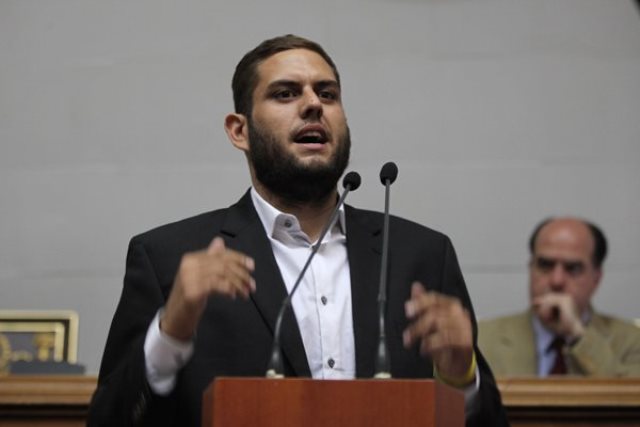
Opposition deputy Juan Requesens in custody without a hearing (PanAm Post)
Former student opposition leader
and opposition deputy of the Venezuelan National Assembly, Juan
Requesens, has been a steadfast, moderate, non-violent opposition leader
to the Maduro regime in Venezuela. The Maduro regime has manufactured charges
that the opposition leader planned the assassination of Nicolas Maduro
and is seeking to sentence him to 30 years in prison. He is 29 years
old, married and father to two young children. He has been arbitrarily detained for 197 days. He has been the target in the past of brutal beatings.
On August 7, 2018, “fourteen men of the SEBIN (Maduro's intelligence agency) forcefully kidnapped
lawmaker Juan Requesens and his sister Rafaela Requesens, the president
of the Federation of University Centers, ” reported the Justice First
party, to which Requesens belongs. His sister was released a short time
later.
Nicaragua
Political prisoner in Nicaragua Amaya Copens, age 23
Amaya Coppens, a fifth year medical student at the Universidad Nacional Autónoma de León in Nicaragua was arrested and accused of "terrorism." She was detained on September 10, 2018, along with
Sergio Alberto Midence Delgadillo, by hooded police that used violence to
detain them, and take them away in a van. Her "crime" is being outspoken against the violence visited on peaceful protesters and belonging
to the University Coalition for Democracy along with the Justice (CUDJ)
and the Civic Alliance and Social Movements Network. She is the eighth
member of the CUDJ to be arbitrarily detained in what is a campaign of
harassment and repression against a dozen university organizations
working together at the national level for a free Nicaragua.
She faces a political show trial with a Sandinista judge in February of 2019. She was just 23 years old at the time of her arrest and has been held in prison since then.
Please share this post with others. Please call on those presiding over mass in Panama and elsewhere to pray for these political prisoners in Cuba, Venezuela and Nicaragua, and for the Church to intercede on their behalf and request an amnesty for all political prisoners and an end to the violence.
The end of democracy in Nicaragua examined by the Organization of American States.
Special Meeting of the OASPermanent Council to “Consider the situation in Nicaragua”
On Friday, January 11, 2019 the Organization of American States began the Inter-American Democratic Charter process regarding Nicaragua. Representatives from Nicaragua, Venezuela, Bolivia and the usual suspects howled in protest, but events in the Central American country under the regime of Daniel Ortega indicate that something must be done.
The Nicaraguan magazine Confidencial reported that the "Mothers of April Association of Nicaragua, formed by women who have
lost their children or relatives in the demonstrations against President
Ortega, demanded on Thursday ( January 10, 2019) to the OAS member countries to apply the
Democratic Charter to the Government of Nicaragua."
Articles 20 and 21, of the the Inter-American Democratic Charter provides the procedures against a
member State that is no longer a democracy and suspending its participation in the programs of the organization.
There is ample reason to suspend Nicaragua from the Organization of American States.
On April 18, 2018 long standing frustrations with the Sandinista regime
of Daniel Ortega erupted across Managua in response to a "reform" of the
pension system that reduced them for current recipients while raising
the amount taken from salaries of current workers. At 5:00pm "Sandinista
youth" and national police attacked protesters, destroyed commercial establishments and took over the Central American University.This is how crackdown on the remnants of Nicaraguan democracy began and have continued over the past eight months.
Tens of thousands of Nicaraguans took to the streets demanding an end to the repression. Peaceful protesters and journalists were shot and killed by government forces. The São Paulo Forum, a network of communists, radical leftists, and terrorists groups met in Havana to back Daniel Ortega and the Sandinistas' actions in Nicaragua.
The Inter-American Commission on Human Rights (IACHR) reported"325 deaths and over 2000 injuries, 550 arrests
and prosecutions, the dismissal of 300 health professionals, and the
expulsion of at least 144 students from the National Autonomous University
of Nicaragua (UNAN)." Furthermore that the Ortega regime has created a climate of impunity "with the de facto
implementation of a state of exception that is characterized by the abusive
use of public forces to repress dissidents, raids, the closure and
censorship of media outlets, the imprisonment or exile of journalists and
social leaders, and interference by the office of the president in other
branches of government."
Nicaraguan torture victims have reported hearing Venezuelan and Cuban accents in the regime's secret prisons. The Miami Herald quoted Nicaraguan student leader Victor Cuadras on July 13, 2018:
“Castro copied his recipe for repression and harassment in Venezuela,
and now they are doing it in Nicaragua. There are many people who,
while being tortured, heard the accents of Venezuela and Cuba in the
clandestine prisons.”
Victor is right to cite Venezuela. Beginning in February of 2014 the
high profile torture and killing of Venezuelan student opposition
activists were carried out to terrorize the student pro-democracy movement. Reports in the media at the time
described individuals with Cuban accents involved in the brutality.
Protests erupted in Venezuela with Cuban flags being burned while denouncing the Castro regime’s role in the repression. The pattern is being repeated today in Nicaragua.
Medical student Amaya Coppens arbitrarily detained in Nicaragua
CPJ, more than 200 international journalists express deep concern over deteriorating press freedom climate in #Nicaragua, call for release of detained reporters Miguel Mora and Lucía Pineda Ubau https://t.co/DrRQPE06U3
Journalists have been the targets of extrajudicial killings and arbitrary detentions in Nicaragua over the past eight months. The Committee to Protect Journalists issued an open letter that highlighted some of the more egregious incidents during the Ortega crackdown.
We strongly condemn the December raids
on the offices of two major independent news outlets, and the detention
of Miguel Mora and Lucía Pineda Ubau, journalists from independent
cable and digital channel 100% Noticias, on multiple anti-state charges.
These latest anti-press actions occurred shortly before the Christmas
holiday, when many in the international community might typically be
distracted; however, they did not go unnoticed.
Mora and Pineda, arrested during a December 21 police raid on the
100% Noticias offices in Managua and rushed through court appearances
with no access to legal representation, stand accused of crimes
including "inciting violence and hate" and "promoting terrorism." The
government has not presented any evidence to date to support the charges
against these journalists, who took a lead role in their channel's
critical reporting over the last eight months. More than two weeks after
their arrest, both journalists remain in pre-trial detention, and their
channel is still banned from broadcasting.
Just a week before the raid on 100% Noticias, riot police ransacked the Managua offices of independent news website Confidencial
and two affiliated television programs, all led by renowned journalist
Carlos Fernando Chamorro, and confiscated equipment and documents.
These are just the latest hostile acts capping off a year that saw dozens of attacks on the media, including the April 20 arson attack on Radio Darío in León and the April 21 death of reporter Ángel Eduardo Gahona, who was shot and killed on camera while reporting on protests in Bluefields.
The failure of the international community to call out the Ortega regime for its decade long assault on democratic institutions led to the conditions that made the April 2018 crackdown possible. According to a defecting Sandinista Supreme Court justice the possibility of civil war and economic chaos in Nicaragua is closer now than every before.
Medical student Amaya Coppens arbitrarily detained in Nicaragua
Daniel Ortega's Sandinista regime in Nicaragua is murdering hundreds and is backed by the dictatorship of Cuba and Venezuela. Torture is widespread, and a high ranking perpetrator is being promoted and given new responsibilities. The numbers are overwhelming and numbing. This is why it is necessary to focus on individuals such as Amaya Coppens.
Amaya stands accused of having set fire to the university facilities known as the CUUN, which occurred on April 20. They also hold her responsible for attacking National Police officers with firearms, as well as for the burning and destruction of the Germán Pomares Ordoñez complex, a building in León where a delegation of the Attorney General's Office operated, the intendancy of the property and a winery of the Fotestal Agricultural Ministry. She was detained on Monday night, September 10, along with Sergio Alberto Midence Delgadillo by hooded police that used violence to detain them, and take them away in a van.
This is a fabrication.
Her real "crime" is being outspoken against the violence visited on peaceful protesters and belonging to the University Coalition for Democracy along with the Justice (CUDJ) and the Civic Alliance and Social Movements Network. She is the eighth member of the CUDJ to be arbitrarily detained in what is a campaign of harassment and repression against a dozen university organizations working together at the national level for a free Nicaragua.
The charges against Amaya are a smoke screen to cover up the serious crimes against humanity committed by the Ortega regime against scores of Nicaraguans.
Amaya Evans Coppens is a human rights defender who is both Nicaraguan and Belgian. Friends and family are concerned because her whereabouts are unknown. A slogan in Spanish reads: "Viva se la llevaron, via la queremos!" - Alive you took her, alive we want her back! Sadly, since April 18, 2018 hundreds of Nicaraguans have been extrajudicially executed by Daniel Ortega's Sandinista regime, and thousands more mistreated and tortured.
This is another sign of the Cubanization of Nicaragua. The imprisonment of a medical student for her human rights activism is reminiscent of the case of medical doctor and family man, Eduardo Cardet jailed in a Cuban prison since November 30, 2016 for his support of a nonviolent democratic transition in Cuba and outspoken criticism of the legacy of Fidel Castro in that island nation. Dr. Cardet is an Amnesty International prisoner of conscience. Amnesty International should look into the plight of Amaya Evans Coppens and past the smoke screen erected by the Ortega regime.





 Posts

