Showing posts with label Election 2016. Show all posts

Friday, November 11, 2016

Cuba policy and the 2016 election in Florida

"Soon someone will come out with another push poll telling us Cuban Americans support Obama Cuba policy. Forget polls and watch the elections." - Frank Calzon, over twitter on November 8, 2016


Bay of Pigs Veterans endorsed Donald Trump
The usual suspects are trying to diminish the message sent by Cuban American voters this past Tuesday. The argument made is that Miami-Dade County went massively for Hillary Clinton and at the same time use a poll circulated by the radical National Council of La Raza called Latino Decisions to claim that Cuban Americans voted massively Democrat, but they have an ideological agenda not served by Trump doing better than expected among "Latinos." Furthermore they claim that votes for Trump were not necessarily related to Cuba policy but the facts say otherwise.

First the well respected Pew Research Center placed Latino support for Donald Trump at 29% who outperformed Mitt Romney (who got 27% in 2012). According to exit polls Trump got 54% of the Cuban American vote, but the actual vote may have been higher.

Secondly, the turn out in Miami-Dade County was due to the Hillary Clinton campaign having a fully developed Get Out the Vote Effort and infrastructure that got out more of the vote than Obama in 2012. The Trump campaign did not have that but still Donald Trump in 2016 got slightly more votes than Mitt Romney got in 2012 (333,666 vs 332,981).

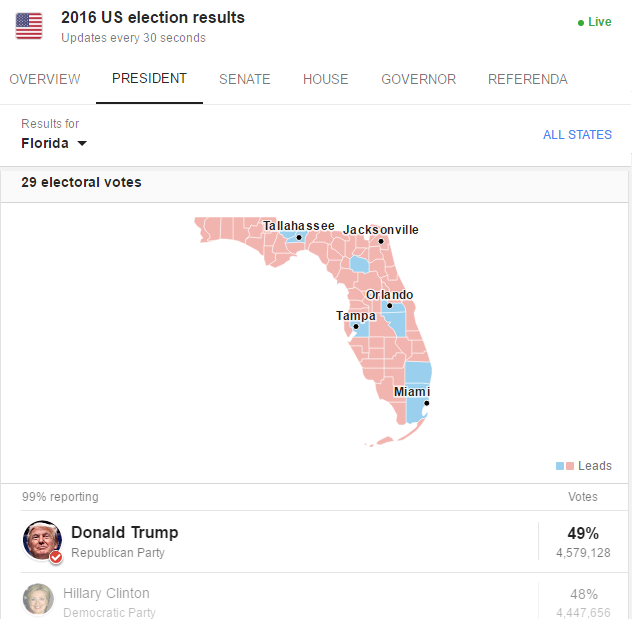
However what is left out in this "analysis" is that statewide the margin that won Donald Trump Florida and the presidency was just 119,970 votes. It also ignores how critics of President Obama's Cuba policy won big in Miami-Dade County.

Donald Trump, perhaps looking at the same flawed polls claiming that Cuban Americans supported Obama's Cuba policy gave it luke warm support and in May of 2016 was polling 33% among Cuban Americans. This changed radically in mid September when Mr. Trump contrasted himself from Hillary Clinton promising to overturn Obama's Cuba policy if human rights did not improve on the island. His change on Cuba policy was welcomed by Congressman Mario Diaz - Balart.

How the Hillary Clinton campaign responded during the past two months: downplaying her anti-embargo position, a hit piece in Newsweek and putting out radio ads accusing Trump of violating the Cuban Embargo and partisans going after him with the same message on social media. This was obviously done to peel off Cuban American support. They of course ignored that President Bill Clinton in the 1990s like President Barack Obama today was encouraging businesses to explore business opportunities in Cuba, loosening economic sanctions and shook hands with a Castro.


Mr. Trump responded by doubling down and pledging his support for a free Cuba and in October he was endorsed by the Bay of Pigs Veteran Association. This was the first time in the organization's history that they had endorsed a presidential candidate. Over twitter both he and Governor Mike Pence tweeted their support for freedom in Cuba.

The Obama administration issuing a Presidential policy directive on United States-Cuba Normalization on October 14th that called for US intelligence agencies to share information with the Castro dictatorship's secret police outraged many. Add to that the failure of the Obama administration to defend current US law at the United Nations by abstaining in a vote on the Cuban embargo and repeating regime talking points angered many. By October 27, 2016 polls placed the Cuban American vote at 52% which was a 15 point shift.

There was a final factor that was death of Janet Reno on the eve of the election brought back the traumatic Elian Gonzalez episode to many Cuban Americans in Miami. On that same day Mary O'Grady asked in The Wall Street Journal: "Will Obama's Cuba Policy Lose Florida for Clinton?" and the answer a day later was, despite the claims of the anti-embargo lobby and the National Council of La Raza, was an unequivocal yes.

Obama's Cuba policy and Hillary Clinton's strident support for it were profoundly unpopular with Cuban American voters and contributed to a Trump victory in Florida on November 8th.

Like it or not the claims made by some that the Cuban American community had changed and politicians could support rapprochement with the Castro regime and not suffer on election day were wrong and contributed 29 electoral votes to President Elect Donald Trump.

Consider the following breakdown. Pew placed the number of Cuban American voters in 2012 at 771,000. The Associated Press in a video report offered a lower estimate for the Cuban American vote citing a source that said 8% of over 8 million votes in FL would be Cuban American which would total 640,000.

Using the above numbers and looking at the shift in support for Donald Trump in May 2016 when he supported Obama's Cuba policy and was getting between 33% and 37% of the Cuban American vote compared to October 2016 when he rejected the White House's Cuba policy and saw his support rise to 52%.

Lowest range of Cuban American support shifting before and after was 96,000 votes and the highest range was 146,490. The average of the two was 121,245 votes. Considering that Mr. Trump won Florida by just 119,970 and the importance of this shift in the Cuban vote over Cuba policy shows that it was decisive in delivering the 270 electoral votes.

Conclusion: Obama Cuba policy cost Hillary Clinton the White House.

Tuesday, November 8, 2016

Pro-Embargo candidates sweep in Florida

2016 US Election Florida: Cuban Americans repudiated Obama Cuba policy and Hillary Clinton


Hillary Clinton should sue the Pro-Cuba trade lobby for fraud. They used push polls to peddle the false narrative that the Cuban-American community had changed and that backing an opening with the Castro dictatorship would not harm her electoral prospects. They should have seen it coming. On September 28, 2016 this blog reported:
"Cuba, so far this election cycle has not been high on the radar, but with this announcement the Obama Administration's controversial Cuba policy will be debated and at a time when polls indicate that the race in Florida is tightening the Cuban American vote could be decisive in swinging the state and its 29 electoral votes."
Let there be no doubt that this election in Florida was a rejection of Obama's Cuba policy consider the following:

Democratic candidate Joe Garcia running in 26th Congressional District that favored Democrats lost to Republican Carlos Curbelo by 11 points. Garcia had been a high profile champion of President Obama's failed and troubling Cuba policy.

Congresswoman Ileana Ros-Lehtinen defeated anti-embargo candidate Scott Furhman by ten points: 55% to 45% in the 27th Congressional District.

Congressman Mario Diaz-Balart defeated Democratic candidate Dr. Alina Valdes who supports Obama's Cuba policy by 62% to 38% in the 25th Congressional District.

Statewide Marco Rubio, who has been a severe critic of President Obama's Cuba policy defeated anti-embargo candidate Patrick Murphy 52% to 45% and was returned to the U.S. Senate.

Incidentally neither Carlos Curbelo or Ileana Ros-Lehtinen campaigned for Donald Trump. 

However Donald Trump who initially received 33% of the Cuban American vote while supporting Obama's Cuba policy until mid September 2016 found that when he rejected Obama's Cuba policy and promised repeatedly to back the aspirations of Cubans and Venezuelans to live in freedom his numbers went up to 52% and were probably even higher on election day.

The outcome of the Presidential election in the United States is still being determined tonight but the repudiation of Obama's Cuba policy legacy was felt today with Cuban Americans voting across Florida. 

The question asked by the Wall Street Journal: "Will Obama’s Cuba Policy Lose Florida for Clinton?" has been answered and the answer is yes.

AP Florida State wire reported the following on the exit polls:
"There was a significant divide between Cuban voters and non-Cuban Hispanics in Florida, the state with the nation's third-largest Hispanic population. Trump led with Cuban voters, but more almost three-quarters of non-Cuban Hispanics preferred Clinton. Trump's anti-immigration rhetoric has turned off many Hispanics, but Trump appealed to Cuban voters in September by saying he would reverse the deal Democratic President Barack Obama made with Cuba to reopen diplomatic relations - unless Cuba expands political freedoms."
Anti-embargo lobbyists and pollsters who pitched the lie to Democratic candidates in Florida did Donald Trump a solid that was part of the puzzle that gave him Florida. Mike Fernandez didn't campaign for Donald Trump but with the misrepresentation of the Cuban American community by some of its wealthy members did more to help the Republican nominee than the money showered on Hillary Clinton. 

Wednesday, July 20, 2016

Election 2016: A Reflection

 Failure of the political and media elite fuel Trump and Sanders phenomenons in both parties

Anti-system candidates: Donald Trump and Bernie Sanders
Donald Trump officially won the Republican nomination for President of the United States last night in Cleveland. The question many are asking is: How did the country get here? Consider the following facts and the reasons for the political earthquake become clear.

A silent epidemic
African Americans in the United States can expect to live until age 76, while white Americans are likely to live until age 79, on average there is a 3.4 year difference. This is an improvement over previous years with both African Americans and Hispanic mortality rates steadily dropping. However since 1995 white mortality rates have dropped at a slower rate when compared to other groups. Worse yet between 1999 and 2014 mortality rates among middle class whites have actually increased while that of other racial groups have continued to decline. Main causes of this increased mortality are: suicide, chronic liver diseases and cirrhosis, alcohol and drug poisoning.

This trend is not being repeated in other European countries. According to a December 2015 Princeton study this "silent epidemic" has claimed half a million lives and can be traced to distress in the population with the inability to find work a major factor. There is also new data that points to increasing mortality not only among middle age but also young whites. How does all this relate to the 2016 presidential election? According to Jeff Guo in The Washington Post on March 4, 2016 Donald Trump performed the best in places where middle-aged whites are dying the fastest.

Economic distress

The official government unemployment figure is 4.9% but other reliable and more accurate statistics range between 6.3% on the low end to  the U6 unemployment range which is 9.9%. More controversial but accepted in some quarters is John Williams' Shadow Government Stats that places June 2016 unemployment at 22.9%. These numbers provide plenty of room for despair. First is the fact that official numbers promoted in the mass media are not necessarily accurate.

Secondly, the disappearance of higher paying manufacturing jobs has been the result of trade agreements that have negatively impacted U.S. workers but at the same time has benefited and enriched a powerful few.  Most of U.S. manufacturing ended up in mainland China and has assisted in modernizing that country and its military which is now expanding in the region and making itself felt worldwide to the detriment of U.S. national and security interests. How has this bipartisan China policy benefited the average American? This is not being discussed on the national stage.

If the political and media elite are unwilling even to address the problem with accurate statistics then what hope is there of solving the problem?  This is why the Trump and Sanders phenomenons erupted on the national political scene. Voters are frustrated.

Exacerbating racial tensions
Meanwhile rather than having this national conversation the debate has been returned to the old obsession and the so-called "original sin" of the United States: Race.

Consider for a moment that according to The Washington Post 990 people were killed by police officers in 2015 out of  a total of 12.2 million arrests with nearly half of all killed being white non-hispanics followed by a little over a quarter that were African American and 17%  who were hispanic.  A disturbing subset of data was the statistical breakdown of 93 unarmed individuals killed by the police in 2015 with four out of ten being African American followed by three out of ten being white non-hispanics and nearly two out of ten hispanics. Meanwhile there were 42 police officers shot and killed in 2015.

There is a problem that needs to be addressed but it has been magnified and distorted by the media and political actors to create the sensation of a clear and present danger for African Americans when being stopped by the police facing a great risk of being killed. The high profile killing of police in the United States in reaction to a media campaign demonizing the police will also have an impact in the presidential election.

It is interesting that those publicly mentioned as possibly funding Black Lives Matter have an interest in maintaining the status quo on trade and globalism in the United States and avoiding a national conversation on these two subjects. This brings us to a topic that the political and media elite are at odds with the majority of the citizens of the United States and that is immigration.

Illegal immigration and changing the political culture
Fredo Arias-King served as senior adviser to the National Action Party of Mexico during its presidential campaign in 1999–2000.  In July of 2006 he wrote an important paper for the Center for Immigration Studies titled "Immigration and Usurpation: Elites, Power, and the People’s Will" about the disconnect between public opinion and elite actions in the United States with regards to illegal immigration.

Arias-King speculated in this paper what motivated U.S. politicians to tolerate and even encourage the phenomenon of illegal immigration and where it could eventually lead predicting the rise of a Trump-like candidate that could seize the immigration issue to respond to the demands of a populace outraged at the lack of response from the political class.
Samuel Huntington speculated that the American "creed" (values and beliefs) cannot be used to openly oppose mass immigration.16 That may change. So far, the immigration debate has centered on the immigrants themselves—whether they are worthy or unworthy. This debate is a red herring, since average Americans are unusually kind and restrained in the face of mass immigration, something that cannot be said about other nations (including Mexico).17 Recent poll findings from Zogby challenge the popular belief that the average American somehow has negative or overtly prejudicial feelings toward Mexicans in particular.18 However, Huntington did not take into account the possibility that the debate could yet be framed in terms of potential usurpation from the political class using immigration as a tool. If an organizeable mass of Americans comes to suspect that mass immigration from Latin America is being used by the political class to undermine their democracy and as a tool to liberate the political elites from the Jeffersonian and Madisonian constraints, then indeed we may witness a reaction—but hopefully not against the immigrants themselves, as they are also objects of elite manipulations in more than one country. The Founding Fathers also prescribed a cure for usurpation. Hopefully the American people will not apply it so literally, for the sake of those legislators.
The conclusion reached by the author that the American political class was using mass immigration to change the electorate in order to make the citizenry more malleable and thus politicians able to get away with being less accountable was a controversial proposition in 2006 but seems much less so today. The loss of faith in governing institutions in the United States by large sectors of the electorate is behind the success of Donald Trump, a business man with no political experience and Bernie Sanders, a socialist with a communist background who honeymooned in the Soviet Union in 1988. However Sanders was against open borders and globalization but his support for an amnesty for 11 million in the United States probably cost him the nomination.

Shadows in the Fall: Foreign policy
Foreign policy failures are felt here in the United States. The argument that we fight them over there to avoid fighting them over here rings hollow in the electorate who are now backing a candidate who opposed the war in Iraq.  Terror attacks linked to Islamic extremism have impacted across the nation in recent years: Orlando, Florida (2016),  Chattanooga, Tennessee (2015), San Bernardino, California (2015), and Boston, Massachusetts (2013). Meanwhile events in Turkey point to an ominous new turn with Erdogan's consolidation of power, purges, and crushing of the military following what appears to have been a coup with a counter-coup underway that could lead to the rise of a fully Islamic regime in NATO. The cry of "who lost Turkey?" may become a theme in the foreign policy debate in the presidential election in the United States this fall. There are other hot spots in the world and Libya can be blamed directly on Hillary Clinton.

These are trying times for the American Republic and the social, political, and media elite had best wake up, look out for the interests of their fellow citizens, and how to rebuild the middle class or get out of the way.


Monday, May 2, 2016

Republican's potential loss of the Cuban-American vote has the making of a Greek tragedy

How to avoid a self-fulfilling prophecy

Donald Trump is likely taking bad advice on Cuba policy from Jorge Perez
 The Republican party's potential loss of the Cuban-American vote has the making of a Greek tragedy. Pollsters have been predicting for more than a decade that the continuing influx of Cuban refugees combined with that of younger Cuban Americans with voting tendencies more in line with the general population would lead to a shift in voter demographics harmful to the GOP.

In response to this perceived threat, it appears beginning with Congressman David Rivera in 2012 there has been an effort to gut the Cuban Adjustment Act, under the guise of reforming it, to avoid this outcome.  Worse yet, the claim that because President Obama has sought to normalize relations with the Castro dictatorship, that somehow the regime has changed and the Cuban Adjustment Act is no longer needed, will do more harm to the Republican brand among Cuban American voters.

Local Cuban-American elected officials remain overwhelmingly popular because of their principled Cuba policy stance. The Miami Herald reported that a poll conducted by Dario Moreno, a Coral Gables pollster found that "Miami Mayor Tomás Regalado, U.S. Representative Ileana Ros-Lehtinen, former Rep. Lincoln Diaz-Balart and Senator Marco Rubio all have approval ratings of more than 70 percent among Cuban Americans in Miami-Dade, the only Florida county Rubio won as a presidential candidate."

This will change dramatically if and when the Cuban Adjustment Act is ended, especially if local members are perceived as having had a roll in its end. Cuban-American support for the Republican party centers around Cuba policy and the marked contrast between the anti-communist position taken by Republicans supporting economic sanctions and a principled human rights first policy.

The case of Donald Trump, who publicly supports President Obama's failed Cuba policy, should be a cautionary tale for Republicans. According to the Moreno poll "37% of respondents supported Trump, a number that is still higher than the 31% who backed Clinton — but also 'the lowest in history that any potential Republican candidate polls among this traditionally loyal demographic.'"

This should not be a surprise. Winning Democrats historically have known to take a hard line on Cuba to get into and stay in office. Both Bill Clinton and Barack Obama ran supporting economic sanctions on Castro and a human rights first policy. Candidate Obama in 2008 in Miami flip flopped from a previous position stating:
“Don’t be confused about this. I will maintain the embargo,” Mr. Obama said. “It provides us with the leverage to present the regime with a clear choice: If you take significant steps toward democracy, beginning with the freeing of all political prisoners, we will take steps to begin normalizing relations.”
 It was only after both Clinton and Obama were re-elected that they shifted full speed on a normalization policy with the Castro dictatorship.

Hillary Clinton is openly supporting President Obama's Cuba policy but does not have it as a big negative because her likely Republican opponent, Donald Trump, has the same position that alienates him from Cuban-American Republican voters.

The Castro regime for decades has wanted the end of the Cuban Embargo and Cuban Adjustment Act in order to legitimize and consolidate its rule. Thanks to Ronald Reagan the effort of Jimmy Carter between 1977-1980 to normalize relations with Castro was undone and replaced with a principled human rights first policy highlighting the Cuban democratic resistance.

Ending the Cuban Adjustment Act would assist the Castro regime in achieving a long term goal that is part of the normalization process being advanced by the White House. The Obama administration's non-enforcement of the embargo and turning a blind eye to abuses seeks to obtain the overturning of the Cuban Adjustment Act without having to get their hands dirty, with Republicans taking the hit with their Cuban American base after the consequences of ending it become evident.

The belief that newly arrived Cubans would overwhelmingly register to vote Democrat will become a self-fulfilling prophecy and political suicide for South Florida Republicans. The way to avoid this is to contrast the Obama administration's failed Cuba policy with a principled one that looks out for American taxpayers, U.S. national security and human rights in Cuba.

If Donald Trump wants to obtain more than 37% of the Cuban-American vote he needs to stop listening to Jorge Perez and other shills for doing business with the Castro regime then listen to Cuban American members of congress that have 70% approval ratings.


Read more here: http://www.mcclatchydc.com/news/politics-government/article75100892.html#storylink=cpy


Read more here: http://www.mcclatchydc.com/news/politics-government/article75100892.html#storylink=cpy