"The first victory we can claim is that our hearts are free of hatred. Hence we say to those who persecute us and who try to dominate us: ‘You are my brother. I do not hate you, but you are not going to dominate me by fear. I do not wish to impose my truth, nor do I wish you to impose yours on me. We are going to seek the truth together’. THIS IS THE LIBERATION WHICH WE ARE PROCLAIMING."
Oswaldo José Payá Sardiñas (2002)
Ambassador Mike Waltz highlights Luis Manuel Otero Alcantara's case at the UN
Yesterday, Cuba’s communist dictatorship in New York City at the United
Nations demonstrated once again that one can win a vote, and still lose.
There was a vote on whether or not to have an additional debate on the
Cuban embargo, and it won with 136 votes with nine against and 30
abstentions. This was a further erosion of 29 votes when compared to the resolution from October 2025.
Even more important, Ambassador Waltz highlighted and named some of the over 1,300 Cuban political prisoners jailed today.
He called out the Cuban delegation for trying to shut down his presentation.
"For 67 years, the Cuban regime has enriched itself, its ruling
elites, while abusing its people, strangling private enterprise,
criminalizing dissent, and clinging to failed communist economics.
Colleagues, communism has never worked, it doesn’t work, and it will not work.
And when the Cuban people demanded something better, something
different, to have a voice, the regime could choose to listen, but it
did not. Instead, it chose to imprison 800 of its own people.
And I want to take a moment to read a few of their names. You should hear their names. You should see their faces.
Luis Manuel Otero Alcantara. You know what his crime was? He’s in
maximum security prison. His crime, and this is according to the regime
is “artistic expression.” His crime is being an artist, Mr. President.
Fernando Almenares Rivera. His crime? He’s a musician, and he writes songs the regime doesn’t like, calling for freedom.
Maykel Castillo Perez. Another musician in a maximum security prison.
What did he do? He also wrote rap songs the regime doesn’t like.
This young man, this amazing young man, Duannis Dabel León Taboada,
is a young poet. He’s a poet. He writes poetry, colleagues. 14 years in a
maximum security prison.
And these two brothers, Jorge Martín, Nadir Martín Perdomo. The
UN—you all—have condemned their imprisonment and called for their
release. See their faces as you make your speeches today. Remember them.
Because they’re in prison for daring for freedom.
Colleagues, they’re not armed. They’re not violent. They carry
flowers, and write poems, and write music. And for that, the regime
beats them, detains them, and tries to break them.
These are the names the delegation here banging on the table doesn’t
want you to hear. They don’t want this Assembly to hear it. They don’t
like free speech. They don’t like dissent."
Yesterday, Vaclav Havel’s maxim written in his important essay, The Power of the Powerless,
was seen in action. “If the main pillar of the system is living a lie,
then it is not surprising that the fundamental threat to it is living in
truth.”
Truth and facts are exposing the Cuban dictatorship before the international community, and shaking the regime's pillars to their very core.
This is the first of two blog entries on the UN vote.
“Truth never damages a cause that is just.” - Mohandas Gandhi
Yesterday, Cuba’s communist dictatorship in New York City at the United Nations demonstrated that one can win a vote, and still lose.
The United States, together with 18 other democracies, distanced
themselves from the Cuban dictatorship and its falsehoods about the U.S.
embargo. The total vote was 165 in favor of the resolution, seven
against, 12 abstentions, and eight non votes. The dictatorship, and
their allies tried to spin this non-binding resolution, a propaganda
exercise, repeated annually since 1992, but this time was different.
It was a fiasco.
First, on October 28, 2025 Ambassador Mike Waltz, U.S. Representative to the United Nations factually and truthfully outlined the moral case for U.S. sanctions on the Cuban dictatorship,
and rebutted the distortions, and lies circulated by Havana. Ambassador
Bruno Rodriguez, the foreign minister for the Cuban dictatorship,
interrupted Ambassador Waltz’s address to the UN, but came away from the
encounter small, and diminished. Watch it for yourself here.
Secondly, Havana has been denying their involvement in Vladimir Putin’s
war in Ukraine, but that is a lie that was called out yesteday by
Ambassador Melnyk Andrii. Permanent Representative of Ukraine to the
United Nations. His excellency explained that the reason for Ukraine’s
vote against the resolution condemning the US embargo on Cuba was
Havana’s complicity in Moscow’s recruitment of thousands of Cuban
soldiers now fighting in Ukraine. You can watch his presentation below.
These are the reasons why Argentina,
Hungary, Israel, North Macedonia, Paraguay, and Ukraine joined with the
United States to vote against the resolution. These are also the
reasons why Albania, Bosnia, Costa Rica, the Czech Republic, Ecuador,
Estonia, Latvia, Lithuania, Poland, Moldavia, Morocco, and Romania
abstained this time.
In addition there were eight
countries that did not vote for whatever reason and they are: Bulgaria,
Dominican Republic, El Salvador, Madagascar, Myanmar, Naura, Syria, and
Venezuela.
The so-called “high point” in these non-binding votes
was in 2016 when both the United States, and Israel abstained, and no
one voted against the resolution. The vote was 191 in favor, 0 against,
and 2 abstentions. This was during the Obama thaw with Havana.
This
time was different, but not only due to the vote itself, but also the
debate, and the action that took place on the same day.
Today,
while the World was focused on Havana’s non-binding propaganda exercise,
Kyiv took concrete action in protest to Cuban soldiers waging war on
Ukraine for Putin.
It was not a good day for Ambassador Bruno Rodriguez, and the dictatorship in Havana.
Today, Vaclav Havel’s maxim uttered in his important essay, The Power of the Powerless,
was seen in action. “If the main pillar of the system is living a lie,
then it is not surprising that the fundamental threat to it is living in
truth.”
Truth and facts exposed the Cuban dictatorship before the international community, and left it shaken.
It was a bad day for the Cuban dictatorship, but a great day for Cuban dissidents, and for freedom in New York City.
Dec. 1945. Ex-PM Winston Churchill invited to lunch at the Cuban Embassy in the UK.
Human rights are an intrinsic part of Cuban history that the current
dictatorship has spent decades systematically trying to erase, denigrate, and deny,
but every day Cubans for decades have stood up for the defense of human rights and dignity at great cost to themselves.There are over 1,000 political prisoners today in Cuba, more than in the rest of Latin America combined for demanding the restoration of human rights and democracy.
Fidel Castro in a 1986 interview claimed that
"[y]our political concepts of liberty, equality, justice are
very different from ours. You try to measure a country like Cuba with
European ideas. And we do not resign ourselves to or accept being
measured by those standards."
However the now dead Cuban dictator omitted that the Universal Declaration of Human Rights was an initiative
led by Latin Americans, and Cubans in particular. Furthermore that language placed in the Declaration was taken from the 1940 Cuban Constitution.
Beginning in 1945 Cuba took part in lobbying for and participating in the drafting of the declaration and submitted nine proposals
of which five made it into the final document.
Cuban diplomats invited Winston Churchill
to lunch at the Cuban Embassy in London in December of 1945 and
proposed the creation of a human rights commission for the United
Nations.
Cuban Ambassador Willy De Blanc hosted the former British Prime Minister with other Cuban diplomats
(including delegates to the U.N. Preparatory Commission Dr. Guy
Pérez-Cisneros y Bonnel and Cuban jurist Dr. Ernesto Dihigo y López
Trigo) where they requested his assistance in the creation of a human
rights commission for the United Nations.
Churchill recommended that the
Cubans lobby Mrs. Eleanor Roosevelt, and they followed his advice.
Eventually the former First Lady was selected as chairwoman to the Human
Rights Commission.
The first meetings of
the General Assembly and the Security Council took place in London on January 10, 1946. On December 10, 1948 the Universal Declaration of Human Rights was voted on, and a Cuban diplomat played a high profile role that day.
On December 10, 2017 in the Miami Herald's letters to the editor section, Pablo Pérez-Cisneros Barreto, the son of Guy Pérez-Cisneros y Bonnel, wrote of his family's and Cuba's legacy in drafting of the Universal Declaration of Human Rights.
My late father believed that the declaration is the fruit of the
great efforts of our civilization and human progress, a unique moment in
which humanity came of age in its civic education; that it is also a
source of inspiration for the formation of today’s citizens, and not
cause for divisions among them. [...] Cuba had the distinction of being
the country that proposed the finished declaration be put up for its
final UN vote on Dec. 10, 1948. Hard to believe now but Cuba was once a
leader when it came to human rights. And it is important to note that
nine initiatives proposed in 1945’s Cuba became part of the final
declaration, and that Cuba was the country that entrusted the Economic
and Social Council of the United Nations in San Francisco to prepare the
declaration as early as 1946. The third preamble of the declaration is a
copy of one of the articles of the famed 1940 Cuban Constitution, and
Cuba had the initiative to include in the declaration the right to honor
one’s human rights and reputation, as well as protect citizens against
arbitrary government interference in their private lives. Cuba
presented the first amendment to the draft declaration which was
accepted, adding the right of citizens of any member country to follow
the vocation they choose. Cuba presented a second amendment which was
also accepted — the right of every worker to receive an equitable and
satisfactory payment for their work.
Last month Cuba underwent a universal periodic review of its human rights record at the UN Human Rights Council. On the eve of this examination, a UN side event was held with witnesses testifying on the human rights violations committed by Castroism over the past five years.
Communist Cuba underwent its fourth Universal Periodic Review (UPR)
on November 15, 2023, at the UN Human Rights Council, a process Havana
repeatedly subverted since 2009 by using front groups to drown out critical human rights reports by established human rights organizations.
Cuban Foreign Minister Bruno Rodriguez began the UPR session attacking Israel, went on to blame the Cuban dictatorship’s shortcomings on U.S. sanctions, and turned the review into a politicized circus.
Over 20 years, I’ve witnessed Cuban diplomats undermine international
human rights standards, first at the United Nations Human Rights
Commission and later at the UN Human Rights Council, making a mockery of
human rights.
On April 15, 2004 when the UN Human Rights Commission decided by a
single vote to censure Cuba for its human rights record, a Cuban human
rights defender attending the session, Frank Calzon, was physically attacked by a Cuban diplomat.
On March 28, 2008 the Castro regime’s delegation, together with the
Organization of Islamic Congress, successfully passed resolutions that
turned the UN special rapporteur on freedom of expression into an investigator policing “abuses” of freedom of expression.
On Sept. 21, 2018 Cuban Ambassador to the UN, Pedro Luis Pedroso
Cuesta, during the Universal Periodic Review on Cuba at the UN Human
Rights Council stated that
“our country will not accept monitors. Amnesty International will not
enter Cuba and we do not need their advice.” Less than a month later,
Cuban diplomats led an “act of repudiation“ at the UN shutting down a discussion on political prisoners in Cuba.
On July 1, 2020 the Cuban dictatorship introduced a resolution
at the UN Human Rights Council endorsing the death of a free Hong Kong
and praising China for passing the Hong Kong National Security Law.
What the diplomats of Cuba’s communist dictatorship do in Geneva is
horrible, but it pales compared to what they do to Cubans on the island.
On July 11, 2021 when Cubans across the island
protested in huge numbers called for freedom, and an end to
dictatorship. Raul Castro’s hand picked president, Miguel Díaz-Canel
went on national television and gave the “order of combat.”
Regime agents opened fire on unarmed Cubans, the number killed remains
unknown due to regime repression, and lack of transparency, but the
video of 36 year old singer Diubis Laurencio Tejeda shot in the back by police, and dying in his friends’ arms is devastating.
Artists Luis Manuel Otero Alcántara and Maykel “Osorbo” Castillo Pérez
are imprisoned in Cuba today for authoring a song about “homeland and
life.” The dictatorship has severely restricted artistic freedoms,
passed laws outlawing criticism of the regime on the internet, and
passed an even more draconian penal code that expands the death penalty.
Human rights defenders Felix Navarro and his daughter Sayli Navarro,
who sought to ascertain the plight of detained Cuban protesters, were
themselves arrested and sentenced to long prison terms. There are over
1,000 prisoners of conscience in Cuba.
It was not always this way.
A democratic Cuba helped draft the Universal Declaration of Human
Rights 75 years ago. Carlos Prío Socarrás, Cuba’s last democratic
president, was elected in free and fair elections and took office on October 10, 1948. President Prío valued human rights, as seen by the activities of his diplomats during the United Nations’ founding.
Cuba, Panama, and Chile were the first three countries to submit full drafts of human rights charters.
Latin American delegations, especially Mexico, Cuba, and Chile inserted
language about the right to justice into the Universal Declaration of
Human Rights, in what would become Article 8.
“My delegation had the honor of inspiring the final text, which
finds it essential that the rights of man be protected by the rule of
law, so that man will not be compelled to exercise the extreme recourse
of rebellion against tyranny and oppression.”
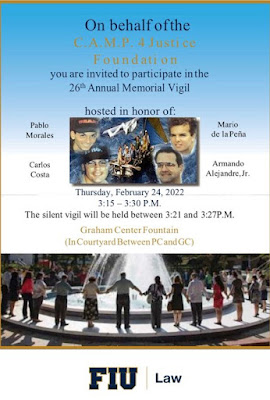
On February 24, 1996, at 3:21 and 3:27 PM, heat-seeking air-to-air missiles fired from a MiG-29 UB piloted by Lorenzo Alberto Peréz Peréz that destroyed the two planes the men were onboard, and killed Mario de la Peña, age 24; Carlos Costa, Pablo Morales, both 30, and Armando Alejandre Jr., 45. Mario, Carlos,Pablo and Armando were members of the humanitarian organization Brothers to the Rescue.
This was a premeditated act of state terrorism carried out by Mr.
Peréz Peréz on the orders of both Fidel and Raul Castro and through the
chain of command issuing the unlawful order that murdered these four men.
Cuban spies learned the flight schedules and were instructed not to fly on February 24 and, if they had to, to alert the MiGs with a motion while in flight to save them from suffering the same fate as the other planes.
This was a premeditated killing over international airspace. The International Civil Aviation Organization (ICAO) concluded that the two planes "were shot down miles away from Cuba’s boundary having never entered or touched it on that day and the planes had been in contact with the Cuban tower throughout the flight."
They failed to destroy a third plane with Sylvia Iriondo, Andrés Iriondo, Jose Basulto, and Arnaldo Iglesias on board.
There is no statue of limitations on murder and state terrorism. There is much more in the Inter-American Commission on Human Rights reports on the Brothers to the Rescue shoot down, and worth reading.
Over
the past 27 years friends, and family have continued to demand truth, respect memory and demand justice through protests, petitions, and law suits.
They will hold a silent vigil for their loved ones later today at 3:15 pm at Florida International University.
Mario de la Peña, age 24; Carlos Costa, Pablo Morales, both 30, and
Armando Alejandre Jr., 45 were murdered in international airspace
on February 24, 1996 at 3:21pm and 3:27pm by heat-seeking air-to-air
missiles launched from a MiG-29 UB piloted by Lorenzo Alberto Peréz
Peréz that destroyed the two planes the men were onboard. Mario, Carlos,
Pablo and Armando were members of the humanitarian organization
Brothers to the Rescue.
This was a premeditated act of state terrorism carried out by Mr.
Peréz Peréz on the orders of both Fidel and Raul Castro and through the
chain of command issuing the unlawful order that killed these four men.
Cuban
spies obtained the information on flight times, and were told not to
fly on February 24th, and if they did have to fly to signal the MiGs
with a motion while in flight to avoid the fate of the others.
This was a premeditated killing over international airspace. The International Civil Aviation Organization (ICAO) concluded that the two planes "were shot down miles away from Cuba’s boundary
having never entered or touched it on that day and the planes had been in contact with the Cuban
tower throughout the flight."
They failed to destroy a third plane with Sylvia Iriondo, Andrés Iriondo, Jose Basulto, and Arnaldo Iglesias on board.
There is no statue of limitations on murder and state terrorism. There is much more in the Inter-American Commission on Human Rights reports on the Brothers to the Rescue shoot down, and worth reading.
Over
the past 26 years friends, and family have continued to demand truth,
respect memory and demand justice through protests, petitions, and law suits.
Later today they will be hosting a silent vigil at Florida International University at 3:15pm in remembrance of their loved ones.
Three Cuban women are on hunger strike in front of the United Nations in New York City. There names are Anisley Pérez, Niurka Prestamos and Yamisderky Pelier, They are on a hunger strike until a United Nations official meets with them and recognizes that there is a humanitarian emergency underway in Cuba. They traveled from Miami to New York City and initiated the hunger strike on Saturday, August 28, 2021.
They are not alone. Seven human rights organizations on July 13, 2021 issued a call for international solidarity with Cubans and denounced violent repression on the Island.
Among the organizations are the Christian Democrat Organization of
America, UN Watch, Christian Solidarity Worldwide, Victims of Communism,
the International Society for Human Rights, and the Forum for Religious
Freedom - Europe and among the five points agreed to, the fifth was a request for a humanitarian corridor.
"We ask for the opening of a humanitarian channel, independent of the
Cuban state, which allows the arrival of food and medicines directly to
the people, understanding that on numerous previous occasions the Cuban
government has blocked and confiscated the aid collected and sent in the
past.”
If you are in the New York City area, or can get up there for a few days, these women need help to maintain their hunger strike. They are exposed to the elements, and need water. Now is the time for solidarity.
"I'd like to confess, at that moment I discovered that I really like killing." - Ernesto "Che" Guevara, in a letter to his father after executing an unarmed man.
Yesterday marked the 55th anniversary of Ernesto “Che” Guevara’s 1964 address to the United Nations General Assembly in New York City. Telesur, today presented sanitized excerpts to promote their international agenda promoting socialism and communism. Australian publisher Ocean Press also has a sanitized version of the speech translated to English that leaves out Guevara's reference to his adversaries as "worms" and that the firing squads were operating.
Guevara in his speech called out the Venezuelan government as murderers of students while failing to mention the pro-Castro elements in Caracas [in the autumn of 1960] that took the lives of 13 persons and injured 100 in an attempt to overthrow the social democracy led by Rómulo Betancourt.
Nor did Guevara mention that Cuban Communist leader Blas Roca, told a Havana rally on January 23, 1963 that when the communists gained full control [in Venezuela] and “make themselves owners of the great
riches in oil, aluminum and everything their earth imprisons, then all
of America shall burn.” A cache of three tons of weapons was found on a Venezuelan beach in November
1963 that was to be used to disrupt the democratic elections there.
On December 11, 1964, the Argentine guerilla gave an inflammatory speech at the United Nations General Assembly, attacking Western countries with a special focus on the United States and countries of Latin America. Several states took the floor to challenge him and exercise their right to reply. Venezuela noted Che Guevara’s hypocrisy in slamming other countries given that “repressive measures, which include executions by a firing squad, that are continually carried out by the Cuban Government against its own people do not seem to wound his sensibility.” Guevara replied:
"The representative of Venezuela also used a moderate, though emphatic tone. He said that the accusations of genocide are vile and that it was really incredible that the Cuban Government care about these things in Venezuela with such repression against its own people. We must say here something that is a well-known truth and that we have always asserted before the whole world: executions? Yes, we have executed people; we are executing people and shall continue to execute people as long as it is necessary. We know what the result of a losing battle would be and the worms also have to know what the result of the lost battle is today in Cuba. In these conditions we live by the imposition of US imperialism."
Below we will highlight an excerpt from that speech and provide the historical context that raises some fundamental questions about this speech using language that dehumanizes the other (a first step on the road to genocide) and celebrates terrorists and assassins.
For example, Guevara highlighted the plight of Pedro Albizu Campos, a Puerto Rican Nationalist as an example of American cruelty. However, he did not provide the context and actions that led to his imprisonment. Below is a brief description of what led to his imprisonment.
Don Pedro Albizu Campos led a series of coordinated armed actions called the Puerto Rican Nationalist Party Revolts in the 1950s for the independence of Puerto Rico that were carried out in Puerto Rico and Washington DC. Between 1950 and 1954 they killed one soldier, seven policemen, and wounded six soldiers and twenty-three policemen. The terrorists saw 16 of their own killed and nine wounded in these actions.
Two of the most high-profile actions, were the attempted assassination of a sitting U.S. President and the wounding of five congressman shot during a floor debate in the U.S. Capitol.
On November 1, 1950 two Puerto Rican Nationalists from New York City stormed the Blair House in Washington DC in a failed effort to assassinate U.S. President Harry S. Truman.
On March 1, 1954 four Puerto Rican Nationalists fired shots from the visitors' gallery in the House of Representatives of the United States Capitol during a floor debate, wounding five Congressmen, one seriously.
Now that the context has been provided. Here is what Mr. Guevara stated about this individual at his UN address on December 11, 1964:
“We express our solidarity to the people of Puerto Rico and their great leader, Pedro Albizu Campos, who, in another act of hypocrisy, has been released at age 72, almost unable to speak, paralyzed after having spent a lifetime in jail. Albizu Campos is a symbol of America still unredeemed but untamed. Years and years of prison, almost unbearable pressures in jail, mental torture, loneliness, total isolation from his people and his family, the insolence of the conqueror and its lackeys in the land where he was born; nothing broke his will. The delegation of Cuba, in the name of its people, pays a tribute of admiration and gratitude to a patriot who dignifies our America.”
The same degree of scrutiny should be observed when reviewing Che Guevara's other writings and speeches. The communist revolution in Cuba was built on carefully constructed lies. Guevara's objective was not to speak categorical truths, but to seize power. His political descendants today continue to have the same agenda: the violent overthrow of democracies and the imposition of totalitarian communist regimes.
Today is the first International Day of Remembrance of and Tribute to the Victims of Terrorism, and it is a proper occasion to remember, continue to demand justice, and demand an end to the dehumanization and violence visited on our fellow human beings.
Victims of the Castro regime's state terrorism on February 24, 1996
Last year the United Nations General Assembly, "in its resolution 72/165 (2017), established 21 August 2017 as the International Day of Remembrance of and Tribute to the Victims of Terrorism in order to honor and support the victims and survivors of terrorism and to promote and protect the full enjoyment of their human rights and fundamental freedoms. Resolution 72/165 builds on existing efforts by the General Assembly, the Commission of Human Rights and the Human Rights Council to promote and protect the rights of victims of terrorism."
According to the United Nations this action reaffirms the "promotion and the protection of human rights and the rule of law at the national; and international levels are essential for preventing and combating terrorism."
But far too often the United Nations has honored those who have systematically violated human rights, ended the rule of law in their country, been a negative force internationally, and even sponsored and perpetrated terrorist acts.
Victims of the Castro regime's state terrorism on July 13, 1994
In the first year of the revolution in Cuba (1959) Mr Guevara remarked on the mass executions taking place: “To send men to the firing squad, judicial proof is unnecessary … These procedures are an archaic bourgeois detail. This is a revolution!” Eight years later (1967) he offered up a terrifying vision of what should drive a combatant. “Blind hate against the enemy creates a forceful impulse that cracks the boundaries of natural human limitations, transforming the soldier in an effective, selective and cold killing machine. A people without hate cannot triumph against the adversary.” This is a recipe for war crimes.
On December 5, 2016 delegates of the U.N. Human Rights Council opened a meeting in Geneva by standing silently after Venezuela’s delegation requested a minute of silence to “honor” the late Cuban dictator Fidel Castro. Meanwhile in Cuba those Cubans that refused to mourn the dead tyrant were being beaten down, jailed and threatened with 15 year prison terms for speaking out. At least 20 cases were documented and one high profile example stands out two years later, the medical doctor beaten down in front of his family and jailed for freely expressing himself: Dr. Eduardo Cardet. He remains in prison today as a prisoner of conscience.
It appears that the UN had forgotten that Fidel Castro presided over the extrajudicial executions of thousands of his countrymen, the destruction of Cuba, twice called for a nuclear first strike on the United States, sponsored terrorism across the world, collaborated with genocidal dictators who murdered millions in LatinAmerica, Africa, Asia, Europe and the Middle East. In 1976 Fidel Castro addressed the Ministry of the Interior (MININT) and declared: "If we decide to carry out terrorism, it is a sure thing we would be efficient. But the mere fact that the Cuban revolution has never implemented terrorism does not mean that we renounce it. We would like to issue this warning." What Castro failed to mention was that his revolutionary movement came to power not only through a guerrilla struggle in the hills but also widespread urban terrorism and the placing of a huge number of bombs. On New Year’s Eve in 1956 members of Castro's 26th of July movement set off bombs in the Tropicana nightclub, blowing off the arm of a seventeen-year-old girl. From bombings, killings, and arson in 1957 to a botched plane hijacking to smuggle weapons to the Cuban guerrillas that led to 14 dead and the night of the 100 bombs in 1958 . The organizer of the bombing campaign Sergio González López nicknamed “El Curita” and the terrorist action itself are remembered fondly by the dictatorship. A park is named in his honor along with a plaque pictured below. The Castro regime views terrorism as a legitimate tactic to advance its revolutionary objectives. In 1970 the Cuban government published the "Mini Manual for Revolutionaries" in the official Latin American Solidarity Organization (LASO), a publication of the Tricontinentaland translated it into many languages. The manual is written by Brazilian urban terrorist Carlos Marighella, and it gives precise instructions in terror tactics, kidnappings, etc. and distributed worldwide by the Cuban dictatorship. There is a chapter on terrorism that declares, "Terrorism is a weapon the revolutionary can never relinquish." This manual is still circulating today.
Plaque erected by Castro regime to honor bomber Sergio González López “El Curita”
On this first International Day of Remembrance of and Tribute to the Victims of Terrorism people of goodwill should call the United Nations to task for its hypocrisy in honoring terrorists with moments of silence and disseminating the writings of another in the world registrar. Let us remember, pay tribute to the victims of terrorism, and show our solidarity but let us also honor them by demanding justice, the rule of law, and the defense of human dignity.
Democratic Cuba's leadership in the drafting of the Universal Declaration of Human Rights and lobbying for the establishment of a UN human rights commission in 1945.
One of the great lies of the Castro regime, and there are many, is the claim that the Universal Declaration of Human Rights contains rights that are alien to Cubans. Fidel Castro claimed that "[y]our political concepts of liberty, equality, justice are
very different from ours. You try to measure a country like Cuba with
European ideas. And we do not resign ourselves to or accept being
measured by those standards." However the Cuban dictator failed to mention that the Universal Declaration of Human Rights was an initiative led by Latin Americans, and Cubans in particular. Furthermore that language placed in the Declaration was taken from the 1940 Cuban Constitution. Cuban diplomats invited Winston Churchill to lunch at the Cuban Embassy in London in December of 1945 and proposed the creation of a human rights commission for the United Nations. Beginning in 1945 Cuba took part in the drafting of the declaration and submitted nine proposals of which five made it into the final document.
The late Bishop Agustín Román on December 16, 2006 spoke of this chapter in Cuban history and "the important role the delegation of the Republic of Cuba to the United
Nations in 1948 in the drafting and promulgation of the Universal
Charter, particularly by Drs. Dihigo Ernesto, Guillermo Belt, and Guy Pérez-Cisneros is a historical fact."
The final draft of the Universal Declaration of Human Rights in 1948 was recognized by these Cuban
diplomats as one that would have been “accepted by that generous spirit
who was the apostle of our independence: Jose Marti, the hero who -- as
he turned his homeland into a nation -- gave us forever this generous
rule: ‘With everyone and for the good of everyone.’”
This morning in The Miami Herald's letters to the editor section, Pablo Pérez-Cisneros Barreto, the son of Guy Pérez-Cisneros y Bonnel, wrote of this family and national legacy that is bound up in the Universal Declaration of Human Rights.
My late father believed that the declaration is the fruit of the great efforts of our civilization and human progress, a unique moment in which humanity came of age in its civic education; that it is also a source of inspiration for the formation of today’s citizens, and not cause for divisions among them. [...] Cuba had the distinction of being the country that proposed the finished declaration be put up for its final UN vote on Dec. 10, 1948. Hard to believe now but Cuba was once a leader when it came to human rights. And it is important to note that nine initiatives proposed in 1945’s Cuba became part of the final declaration, and that Cuba was the country that entrusted the Economic and Social Council of the United Nations in San Francisco to prepare the declaration as early as 1946. The third preamble of the declaration is a copy of one of the articles of the famed 1940 Cuban Constitution, and Cuba had the initiative to include in the declaration the right to honor one’s human rights and reputation, as well as protect citizens against arbitrary government interference in their private lives. Cuba presented the first amendment to the draft declaration which was accepted, adding the right of citizens of any member country to follow the vocation they choose. Cuba presented a second amendment which was also accepted — the right of every worker to receive an equitable and satisfactory payment for their work.
In December of 2008 at the offices of the Cuban Democratic Directorate we met with Pablo Pérez-Cisneros Barreto, who discussed his father's role in the drafting of the declaration in the later 1940s. This history is not well known.
The Castro regime claims to be a nationalist regime proud of Cuba's accomplishments, but when it comes to the Universal Declaration of Human Rights and the role played by a democratic Cuba in 1948 in its drafting, it is silent.
Furthermore the Universal Declaration of Human Rights is banned in Cuba. Possession of the human rights declaration has been presented in evidence against nonviolent dissidents and human rights defenders in Cuba. Copies of the Universal Declaration of Human Rights have been burned.
December 10th, the day it was signed and that is observed around the world as Human Rights Day, in Cuba is a day of heightened surveillance and repression.
There are two traditions competing for control in Cuba. One tradition,
embodied by the Castro regime, based on violence and the destruction of
the other has dominated Cuba's political discourse for over half a century.
It views dissent as treason and demands unanimity; the only acceptable
ideas are the regime's. The second, an older tradition that built
the institutions of Cuban democracy in the 19th Century using civic means, who founded companies with a social conscience such as Bacardi that contributed to the common good until forced out of their homeland, and of the democrats who helped draft the Universal Declaration of Human Rights in 1948.
This is the reason why the Castro regime has sought to bury this human rights legacy of the Cuban Republic and why it is so hostile to the Universal Declaration of Human Rights.
“The generalized and systematic use of excessive
force during demonstrations and the arbitrary detention of protestors and
perceived political opponents indicate that these were not the illegal
or rogue acts of isolated officials...” - UN Human Rights Office
Venezuela: Human rights
violations indicate ‘policy to repress’ - UN report
GENEVA (30 August 2017) – Extensive human
rights violations and abuses have been committed in the context of anti-Government
protests in Venezuela and point to “the existence of a policy to repress
political dissent and instill fear in the population to curb demonstrations,”
a report* by the UN Human Rights Office has found. “The generalized and systematic use of excessive
force during demonstrations and the arbitrary detention of protestors and
perceived political opponents indicate that these were not the illegal
or rogue acts of isolated officials,” the report says.
The report calls on the UN Human Rights Council
to consider taking measures to prevent the human rights situation in Venezuela,
currently a Council member, from worsening. Analysis by the UN Human Rights Office indicates
that of the 124 deaths linked to the protests being investigated by the
Attorney General’s Office as of 31 July, the security forces were reportedly
responsible for 46 and pro-Government armed groups, known as armed colectivos,
for 27.
Responsibility for the remaining 51 deaths has not yet been determined.
During the period covered by the report, 1
April to 31 July, the Attorney-General’s Office opened investigations
into at least 1,958 cases of reported injuries in the context of demonstrations.
The report’s analysis of injuries shows the use of force progressively
escalated. In the first half of April, the majority of injuries were from
inhaling tear gas; by July, medical personnel were treating gunshot injuries.
“The policies pursued by the authorities
in their response to the protests have been at the cost of Venezuelans’
rights and freedoms,” said UN High Commissioner for Human Rights Zeid
Ra’ad Al Hussein.
“The Government must ensure there are prompt, independent
and effective investigations of the human rights violations allegedly committed
by the security forces and of the abuses involving armed colectivos
or violent protesters. This includes ensuring that the investigations initiated
by the Attorney General during the period covered by this report continue
and are scrupulously and visibly impartial,” he stressed.
“The right to peaceful assembly was systematically
violated, with protestors and people identified as political opponents
detained in great numbers. The report also identifies serious violations
of due process and patterns of ill-treatment, in some cases amounting to
torture,” Zeid said.
According to reliable estimates from a local
NGO, more than 5,000 people were detained since 1 April, with more than
1,000 reportedly still held as of 31 July. At least 609 civilians arrested
in the context of protests were presented before military tribunals. The
report calls on the Government to halt arbitrary detention and the use
of military courts to try civilians.
Loosely organized groups of anti-Government
protestors resorted to violent means, using improvised weapons ranging
from rocks and slingshots to Molotov cocktails and homemade mortars, the
report says. At least four people were allegedly killed by anti-Government
groups or individuals and, according to the Government, nine members of
the security forces had been killed as of 31 July. The report calls on
the opposition parties to condemn all acts of violence, in particular when
these originated from groups of violent protesters.
The report documents attacks against journalists
and media workers by security forces that were apparently aimed at preventing
them from covering demonstrations. “Demonstrators and journalists were
labelled by high-level authorities as ‘enemies’ and ‘terrorists’ –
words that did little to counter, and may even have contributed to, the
climate of violence and polarization,” the High Commissioner said.
While acknowledging that the number of demonstrations,
detentions and deaths have decreased since 1 August, Zeid expressed concern
about recent measures taken by authorities to criminalize leaders of the
political opposition through the Commission of Truth, Justice and Peace.
“The Commission, recently established by
the Constituent Assembly, does not meet the basic requirements of transparency
and impartiality, to conduct investigations that are independent and free
from political motivation on human rights violations and abuses,” he said.
The High Commissioner warned that amid continuing
economic and social crises and rising political tensions, there is a grave
risk the situation in Venezuela will deteriorate further.
“I encourage the Venezuelan Government to
follow up on the recommendations made in the report and to use its findings
as guidelines to seek truth and justice for the victims of human rights
violations and abuses. I once again call on the Government to renounce
any measure that could increase political tension in the country and appeal
to all parties to pursue meaningful dialogue to bring an end to this crisis,”
Zeid said.
*As the Venezuelan Government did not respond
to requests for access, a team of human rights investigators conducted
remote monitoring from 6 June to 31 July. The report is based on their
analysis of the information they gathered, including through some 135 interviews
with victims and their families, witnesses, civil society organizations,
journalists, lawyers, doctors, first responders and the Attorney General’s
Office. Read the full report here: http://www.ohchr.org/Documents/Countries/VE/HCReportVenezuela_1April-31July2017_EN.pdf
Video interview with Hernán Vales, UN Human
Rights Officer, about the report. Link available for download for
7 days:https://we.tl/GpcWWlSXpP
For more information and media requests, please
contact:






 Posts

