Showing posts with label Prague Spring. Show all posts

Sunday, August 23, 2026

On this day 58 years ago, Fidel Castro backed Russia's imperial venture in Czechoslovakia

 Today, thousands of Cuban troops are fighting for Putin's imperial venture in Ukraine.

Castro backs Brezhnev invading Czechoslovakia 29 years after Hitler-Stalin Pact.

Today marks two anniversaries. It is the “Day of Remembrance for Victims of Totalitarian Regimes,” and it is also a day to celebrate the “Baltic Way.” These two observances are connected through history, but the Castro regime has a connection to the first that is not well known.

Eighty seven years ago on August 23, 1939 Josef Stalin signed a treaty with Adolph Hitler formally known as a “non-aggression pact” but it came to be known after the names of their respective foreign ministers, V.M. Molotov and Joachim von Ribbentrop, as the Molotov-Ribbentrop Pact. Eventually it also became known as the Hitler-Stalin Pact.

It contained secret protocols to invade and conquer Poland, and split up the rest of Central and Eastern Europe into spheres of influence for Nazi Germany, and the Soviet Union.


 Nine days later on September 1, 1939 Nazi Germany invaded Poland and World War II started. Sixteen days later the Soviet Union, exercising its secret agreement with the Germans, invaded Poland from the East and met their Nazi allies on September 22, 1939 in a joint military parade in Brest-Litovsk to celebrate their victory.

 The Nazi-Soviet alliance continued

230,000 Polish soldiers and officers and thousands of military service representatives were taken captive by the Soviets. On March 5, 1940 the order to shoot the prisoners was signed by seven members of the All- Union Communist Party (Bolsheviks) authorities: Joseph Stalin, Lavrentiy Beria (proposer), Kliment Voroshilov, Vyacheslav Molotov, Anastas Mikoyan, Mikhail Kalinin and Lazar Kaganovich. Thousands of Polish Army officers and intellectual leaders were taken into the Katyn Forest near Smolensk in the Soviet Union, shot in the back of the head or in the neck and buried in mass graves.

Months later, the Soviet Union invaded and annexed the Baltic States in June 1940.

 How the alliance ended in 1941

This arrangement ended on July 22, 1941 when the Nazis double crossed their Soviet allies and launched Operation Barbarossa, the invasion of the Soviet Union. This alliance cost the Soviet Union 22 to 28 million Russian lives in World War Two.

However it also ended with the Soviet Union retaking and absorbing the Baltic states for decades, and Poland firmly under Soviet control as a satellite state. This was a legacy of the Molotov-Ribbentrop Pact that did not end until fifty years later.

Czechoslovakia, a Soviet satellite since 1948, had its Prague Spring in 1968, a moment when reformers in the government sought socialism with a human face and it was ended on August 21, 1968 with the arrival of Warsaw Pact tanks on Soviet leader Leonid Brezhnev’s orders followed by an occupation that crushed the reformist initiative.

Fidel Castro backed Soviet invasion and occupation of Czechoslovakia on August 23, 1968

Two days after the Soviet led Warsaw Pact invasion of Czechoslovakia on August 23, 1968 Fidel Castro publicly supported the invasion and occupation of the central European country.


 Castro’s support of Soviet imperialism on the 29th anniversary of the Molotov-Ribbentrop pact revealed the true nature of his regime in Cuba.

The Soviet empire collapsed through nonviolent resistance

On June 4, 1989 the Solidarity labor movement won in free elections and the Polish people finally regained their sovereignty from Soviet domination through nonviolent means.

The End of Molotov Ribbentrop

Thirty seven years ago today two million Latvians, Lithuanians and Estonians joined hands together in a giant human chain stretching 370 miles on August 23, 1989. Fifty years to the day after the treaty that brought them so much grief had been signed. This non-violent act of defiance was a crucial event that led to the liberation of the Baltic States and their restored independence in 1991.

It was the end of the last vestige of the Molotov-Ribbentrop Pact.

Black Ribbon Day

Today, the European Union observes Black Ribbon Day. This anniversary is observed to honor the memory of all the victims of totalitarianism and authoritarianism in the world. This includes the victims of communism in Cuba.

Sadly, the Castro regime continues to back Russian imperial ventures in Europe, this time in Ukraine, and its own ventures in Venezuela to frustrate the sovereignty of their respective peoples.

Since 2022, according to Ukrainian intelligence, 20,000 Cubans have fought in Putin’s imperial war in Ukraine. There are currently between six to seven thousand Cubans fighting on the frontlines. Estimates are that up to 300 Cubans have been killed in the fighting.

The Center for a Free Cuba has prepared a CubaBrief to observe Black Ribbon Day.


 In Washington D.C. last year a delegation from the Center for a Free Cuba formed part of a human chain in McPherson Square in observance of the Baltic Way anniversary. Celebrating the nonviolent victory over Russian imperialism by the peoples of Lithuania, Estonia, and Latvia.


 Tomorrow, Monday, August 24, 2026 at 2:00pm in Washington DC at McPherson Square join the Joint Baltic American National Committee – JBANC, the Victims of Communism Memorial Foundation and the Embassy of Estonia, Embassy of Latvia to the USA, and Embassy of Lithuania in Washington, D.C. for this commemoration of the Baltic Way anniversary, which marked the beginning of the end of the last remnant of the Molotov-Ribbentrop Pact that was finally achieved in 1991.


Sunday, August 21, 2022

Castroism backs imperialism: Czechoslovakia 1968 and Ukraine 2024


Modern Soviet and Russian imperialism
Cornell University's Legal Information Institute defines imperialism as "a doctrine, political strategy, practice, state policy, or advocacy that consists in extending power by territorial acquisition or by extending political and economic control outward over other areas. Imperialism oftentimes involves the use of military and economic power, and always aims for more expansion and collective or individual domination." 

The Soviet Union expanded its empire into Central Europe in the aftermath of WW2, but its first large scale imperial expansion began in a diplomatic agreement signed with Nazi Germany on August 23, 1939 that divided up Poland and the rest of Eastern Europe into sphere's of influence by the two revolutionary regimes in the Molotov-Ribbentrop pact.

Despite the Soviet Union's early ideological antipathy to imperialism the revolutionary communist dictatorship began its own era of empire building between 1917 and 1921 with one of the first victims, Ukrainian independence.

Ukrainians were one of the first modern victims of famine politics. According to Felix Wemheuer, professor of Modern China Studies at the University of Cologne, in his book Famine Politics in Maoist China and the Soviet Union," during the twentieth century, 80 percent of all famine victims worldwide died in China and the Soviet Union." 
 
Millions starved to death under brutal famine imposed by Joseph Stalin
 
The planned famine in Ukraine, known as the Holodomor, took place between 1932 -1933. Millions of children died in this artificial famine. This crime was ignored by the United States as it formally recognized the Soviet Union in 1933.  The Economist in 2012 reported on the 80th anniversary of this man-made famine:

Holodomor literally means death by hunger. In 1932 and 1933, a vast famine in Soviet Ukraine killed three to seven million people, according to estimates. While people starved, the grain was shut away in barns for export.

Social science research has demonstrated that famines "happen only with some degree of human complicity."  Human decisions "determine whether a crisis deteriorates into a full-blown famine." What took place in Ukraine was a Soviet genocide. Cubans would play a role in another genocide in Ethiopia in the 1980s.

 
Invasion and Occupation as described by Czech radio with images 

Czechs nonviolently resisted the 1968 invasion of the Warsaw Pact that ended the Prague Spring

Czechoslovakia, a Soviet satellite since 1948, had its Prague Spring in 1968, a moment when reformers in the government sought socialism with a human face and it was ended 54 years ago today with the arrival of Warsaw Pact tanks on Soviet leader
Leonid Brezhnev's orders and the occupation that crushed the reformist initiative. Two days after the Soviet led Warsaw Pact invasion of Czechoslovakia on August 23, 1968 Fidel Castro publicly supported the invasion and occupation of the central European country. 
 
Leonid Brezhnev and Fidel Castro meet.

Part of Castro's defense of the invasion and occupation of Czechoslovakia was that basic human rights standards such as freedom of expression were being re-established or in Castro's words:
"A series of slogans began to be put forward and in fact certain measures were taken such as the establishment of the bourgeois "freedom" of the press. This means that the counter-revolution and the exploiters, the very enemies of socialism, were granted the right to speak and write freely against socialism." 
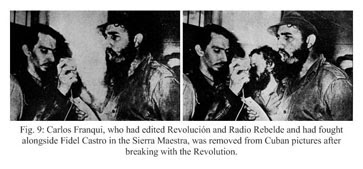
This led to Carlos Franqui, one of the early backers of Fidel Castro's July 26 movement and a leader of the Revolution to break with the regime in 1968 over Castro's support of the invasion.

Revolutionary dissident figure erased for opposing Soviet imperialism

Carlos Franqui's protest of conscience would lead him to then suffer a Stalinist erasure from Cuba's revolutionary history. 
 
Josef Stalin had pioneered airbrushing colleagues who had fallen out of favor. Nikolai Yezhov ,a Stalin loyalist, had written the treatise that intellectually justified the need for purges in 1935 and became head of the Soviet secret police (NKVD) in 1936. He staunchly maintained that it was better for "ten innocent people to suffer than one enemy of the people to escape."
 
Nikolai Yezhov, erased by Josef Stalin
 
He presided over the execution of hundreds of thousands only to fall out of favor with Stalin in 1939 and disappeared, but unlike Franqui, not just in official photos and publications, he was never heard from again.In the picture below Nikolai Yezhov, appears next to Josef Stalin only to be airbrushed out in the picture directly below redone years later. 

In the picture below Carlos Franqui appears on the right (in the middle of the picture) and is airbrushed out of the picture on the left.
 
 
Franqui wrote a short poem about being erased that is translated and reproduced below:
I discover my photographic death.

Do I exist?

 I am a little black,
 I am a little white,

I am a little shit,

On Fidel's vest. 
 
Four decades later Carlos Franqui would return to the Czech Republic which he had visited in 1960 to contrast what he characterized the slave society of 1960s and the free society of today.  He offered the following description of Prague in 1960 as he lived it:
The Prague I saw in 1960 under communism was a Prague with tense, dramatic people there were many police everywhere, gross corruption on the part of the regime. I came with a delegation of journalists and went to the hotel Jalta. There was a dance and there were very pretty young Czech girls ... Most of the journalists who were with me were good dancers and they began to dance. And they were very happy because they thought they were going to have an affair with these girls. But when the dance ended at midnight the girls told them that if they wanted to go with them that it would cost them the equivalent of thirty dollars. Then, as I was the treasurer of the delegation they came to borrow the money. I said I was sorry but could not justify it and they spent all night together with these girls. These girls told them that the police gave them apartments, and that they had to deliver foreign currency to the police chief the next day, that they had to ask the foreigners questions about politics, record and then deliver them . After that we went to the shops where only Tuzex could be purchased with foreign currency and actually saw official representatives doing the currency changes.
Contrasting with what he saw on his return to Prague in 2000:
I believe that slavery affects people in many ways. In countries where there is tyranny, where communism, normally people faces are tense, everybody is worried. It is difficult to find the relaxation, people simply smiling on the streets. And of course there were some great privileges among the Communist leaders, who lived as upper hierarchy, and people who had to work and obey. Now with what I have seen I have a different impression. It is clear that the heritage communism left is difficult to overcome because it is a legacy not only material but spiritual. Communism destroys the individual. And when the individual is free it is hard to recover the idea of being free. Under communism it is as if the state was the father of all the children. Then, to change that mentality is difficult but very important. A society can progress only through the efforts of all ... in all walks of life. [...] I think it was a country with a great industrial development, with a culture with certain traditions, which despite everything communism failed to destroy. I also think that having Václav Havel as a president has contributed mightily to create a balance, to solve serious problems like the thing with Slovakia in a peaceful and civil manner.
The Castro regime's claim of "anti-imperialism" proved hollow and history demonstrated that it was conditioned upon ideology. This was witnessed with the Castro regime’s support of the Soviet invasion of Czechoslovakia in 1968, its invasion of Afghanistan in 1979.
 
Carlos Franqui died exiled in Puerto Rico on April 16, 2010. Fidel Castro died in Cuba with his brother Raul wielding absolute power on November 25, 2016. The dictatorship in Cuba did not change, and the regime has proudly claimed to be a continuation of Fidel Castro's rule continuing a cult of personality of the dead communist despot.
 
Vladimir Putin and Raul Castro: close allies

The Castro regime has continued this practice to the present day with Russia's repeated aggression against its neighbors.
Vladimir Putin's attacks against Georgia in 2008, Crimea in 2014 and the eight years long low intensity war in the Donbas region in Eastern Ukraine, and the February 24, 2022, multi-pronged Russian invasion of Ukraine were all imperialist acts of aggression in violation of international law.

Havana backed these imperialist ventures in 2008, 2014 and now in 2022. The Cuban dictatorship's foreign minister Bruno Rodriguez defended Putin's latest invasion of Ukraine claiming that Russia “has the right to defend itself."
 
Russian Soldiers of the 31st Guards Air Assault Brigade in Ukraine. vk.com/milinfolive
 
Fifty four years later and the totalitarian temptation continues to threaten free nations through academic and cultural institutions on the one hand and an ascendant communist China, and authoritarian Russia on the other, but the legacy and writings of Vaclav Havel continue to be relevant and required reading to confront dictatorships around the world.
 

Thursday, August 20, 2020

Fidel Castro, Carlos Franqui and the 1968 Invasion of Czechoslovakia

"Totalitarian or authoritarian forms of government tend to have very inconspicuous beginnings and employ very ingenious means of controlling society. Only now, in hindsight, do many of us realize how deviously they were entangled in the totalitarian web."  -Vaclav Havel November 11, 2009 Brussels
Czechs nonviolently resisted the 1968 invasion of the Warsaw Pact that ended the Prague Spring
Invasion and Occupation as described by Czech radio with images
Czechoslovakia had its Prague Spring in 1968, a moment when reformers in the government sought socialism with a human face and it was ended 52 years ago today with the arrival of Warsaw Pact tanks and occupation that crushed the reformist initiative.
Two days after the Soviet led Warsaw Pact invasion of Czechoslovakia on August 23, 1968 Fidel Castro publicly supported the invasion and occupation of the central European country.
Part of Castro's defense of the invasion and occupation was that basic human rights standards such as freedom of expression were being re-established or in Castro's words:
A series of slogans began to be put forward and in fact certain measures were taken such as the establishment of the bourgeois "freedom" of the press. This means that the counter-revolution and the exploiters, the very enemies of socialism, were granted the right to speak and write freely against socialism. 
This led to Carlos Franqui, one of the early backers of Fidel Castro's July 26 movement and a leader of the Revolution to break with the regime in 1968 over Castro's support of the invasion. 
Dissident figure erased 
Carlos Franqui's protest of conscience would lead him to then suffer a Stalinist erasure from Cuba's revolutionary history. 
Josef Stalin had pioneered airbrushing colleagues who had fallen out of favor. Nikolai Yezhov ,a Stalin loyalist, had written the treatise that intellectually justified the need for purges in 1935 and became head of the Soviet secret police (NKVD) in 1936. He staunchly maintained that it was better for "ten innocent people to suffer than one enemy of the people to escape." He presided over the execution of hundreds of thousands only to fall out of favor with Stalin in 1939 and disappeared, but unlike Franqui, not just in official photos and publications, he was never heard from again.In the picture below Nikolai Yezhov, appears next to Josef Stalin only to be airbrushed out in the picture directly below redone years later. 
Nikolai Yezhov, erased by Josef Stalin
In the picture below Carlos Franqui appears on the right (in the middle of the picture) and is airbrushed out of the picture on the left. 
Carlos Franqui erased by Fidel Castro from official photograph
Franqui wrote a short poem about being erased that is translated and reproduced below:
I discover my photographic death.

Do I exist?

 I am a little black,
I am a little white,

I am a little shit,

On Fidel's vest.
Four decades later Carlos Franqui would return to the Czech Republic which he had visited in 1960 to contrast
 what he characterized the slave society of 1960s and the free society of today. He offered the following description of Prague in 1960 as he 
lived it:
The Prague I saw in 1960 under communism was a Prague with tense, dramatic people there were many police everywhere, gross corruption on the part of the regime. I came with a delegation of journalists and went to the hotel Jalta. There was a dance and there were very pretty young Czech girls ... Most of the journalists who were with me were good dancers and they began to dance. And they were very happy because they thought they were going to have an affair with these girls. But when the dance ended at midnight the girls told them that if they wanted to go with them that it would cost them the equivalent of thirty dollars. Then, as I was the treasurer of the delegation they came to borrow the money. I said I was sorry but could not justify it and they spent all night together with these girls. These girls told them that the police gave them apartments, and that they had to deliver foreign currency to the police chief the next day, that they had to ask the foreigners questions about politics, record and then deliver them . After that we went to the shops where only Tuzex could be purchased with foreign currency and actually saw official representatives doing the currency changes.
Contrasting with what he saw on his return to Prague in 2000:
I believe that slavery affects people in many ways. In countries where there is tyranny, where communism, normally people faces are tense, everybody is worried. It is difficult to find the relaxation, people simply smiling on the streets. And of course there were some great privileges among the Communist leaders, who lived as upper hierarchy, and people who had to work and obey. Now with what I have seen I have a different impression. It is clear that the heritage communism left is difficult to overcome because it is a legacy not only material but spiritual. Communism destroys the individual. And when the individual is free it is hard to recover the idea of being free. Under communism it is as if the state was the father of all the children. Then, to change that mentality is difficult but very important. A society can progress only through the efforts of all ... in all walks of life. [...] I think it was a country with a great industrial development, with a culture with certain traditions, which despite everything communism failed to destroy. I also think that having Václav Havel as a president has contributed mightily to create a balance, to solve serious problems like the thing with Slovakia in a peaceful and civil manner.
Fifty two years later and the totalitarian temptation continues to threaten free nations through academic and cultural institutions on the one hand and an ascendant communist China on the other hand, but the legacy and writings of Vaclav Havel continue to be relevant and required reading.
We also remember that end of the Prague Spring in 1968 was the prelude to the Velvet Revolution in 1989 that ushered in thirty years and counting of freedom.