Saturday, October 11, 2014

Forum 2000: Democracy and Its Discontents A Quarter-Century After the Iron Curtain and Tiananmen

"I really do inhabit a system in which words are capable of shaking the entire structure of government, where words can prove mightier than ten military divisions." - Václav Havel, Speech of October 1989


Tomorrow begins the 18th Forum 2000 Conference in Prague which coincides with the 25th anniversary of the end of Communism in Eastern Europe and the brutal crackdown in China that killed scores of nonviolent demonstrators. Therefore it should come as no surprise that the title of this conference is "Democracy and Its Discontents A Quarter-Century After the Iron Curtain and Tiananmen."

Delegates meet Forum 2000 co-founders Oldřich Černý and Václav Havel in 2009
Having physically been present at Forum 2000 as a presenter in 2009 and later as an attendee in 2013 I can affirm that it is a gathering and program worth attending and supporting. In addition to engaging in the great exchange of ideas there are also opportunities for activists to obtain support for causes from the international dignitaries in attendance. At the same time when not able to travel to Prague following it over the internet on a live video stream has also been incredibly worthwhile and highly recommend it to others.

Forum 2000 delegates in Prague in 2013 at H.H. Dalai Lama event
Please consider becoming a friend of Forum 2000 with concrete and regular support by following Forum 2000 on Twitter, watching the Forum 2000 events between October 12th through the 15th, and letting others know about this treasure trove of accumulated wisdom. Forum 2000 is one of the many positive legacies of  Václav Havel and Oldřich Černý.

Below is the video program for 2014 of Forum 2000 reproduced from their web page.

Watch the Forum 2000 Conference, “Democracy and Its Discontents,” Live Online

Venezuelan prisoner of conscience Leopoldo Lopez at Forum 2000
We invite you to watch the live video broadcast of the panel discussions held during this year’s Forum 2000 Conference, “Democracy and Its Discontents: A Quarter-Century After the Iron Curtain and Tiananmen,” which takes place October 12–15, 2014 in Prague and 12 other Central European cities.
 
On Sunday, October 12 you can watch a live stream of the Opening Ceremony at Prague Crossroads with the keynote speech by Russian businessman and former prisoner of conscience Mikhail Khodorkovsky.

On Monday, October 13 and Tuesday, October 14 you can follow the live broadcast of the sessions held in the main hall of Žofín Palace (Forum Hall). Speakers include Mikhail Khodorkovsky, Belarusian writer and activist Ales Bialiatski, Sikyong of the Central Tibetan Administration Lobsang Sangay, Minister of the Kurdistan Regional Government in Iraq Falah Mustafa Bakir, Cuban blogger Yoani Sánchez, and former Spanish Prime Minister José María Aznar.

You can watch these proceedings in the Video section of our website. Recordings of these discussions as well as other events will be posted there shortly after the conference. The live broadcast will be held in English.
Online reporting from the entire conference can be followed on Facebook, Twitter, and Google+ via #Forum2000.

More information about the conference and its program can be found here.
  

Broadcast Program

Sunday, October 12

19.00–21.00
Opening Ceremony
Jakub Klepal, Ivan M. Havel, Jürgen Hoffmeister, Mikhail Khodorkovsky, Igor Blaževič
  
Monday, October 13

09.30–11.00
Democracy and Its Discontents
Jacques Rupnik, Iveta Radičová, Karel Schwarzenberg, Zhang Qianfan, Ramin Jahanbegloo, Michael Novak

11.15–12.45
The Significance of Václav Havel’s Value Based Foreign Policy
John Shattuck, Lobsang Sangay, Carl Gershman, Ales Bialiatski, Andrew Schapiro, Yoani Sánchez

14.00–15.30
Is Democracy in Decline? Reflections from the Fall of the Berlin Wall to the Euromaidan
Christopher Walker, Marc Plattner, Alina Mungiu-Pippidi, Tarek Osman, Yoani Sánchez, Yevhen Hlibovytsky

15.45–17.15
Russia: A Non-Democratic Power on the World Stage?
Petr Kolář, Mikhail Khodorkovsky, Vytautas Landsbergis, Andrey Zubov, Daniel Baer

17.30–19.00
Systemic Change, Economic Reforms, and Democracy: What Have We Learned? What Lessons for the Future?
Danilo Türk, Jan Švejnar, Grigory Yavlinsky, Ivan Mikloš, Mauricio Pozo 
  
Tuesday, October 14

10.00–11.30
3 Years After Arab Spring: Middle East at a Crossroads
Shlomo Avineri, Salam Fayyad, Falah Mustafa Bakir, Tarek Osman, Youssef Amrani, Gilles Kepel
 
11.45–13.15
Priorities and Aspirations for Democracy in the 21st Century
Jiří Schneider, José María Aznar, Yogendra Yadav, Murong Xuecun, Juan Requesens, Šimon Pánek

Thursday, October 9, 2014

Teach-in on Nonviolence at St. Brendan Catholic Church

Thank you to the Christian Liberation Movement for hosting and organizing this teach-in on nonviolence.
Gathering here on Church property it seems appropriate to take a moment and pray an Our Father.
"Our Father, Who art in Heaven, hallowed be Thy name; Thy Kingdom come, Thy will be done on earth as it is in Heaven. Give us this day our daily bread; and forgive us our trespasses as we forgive those who trespass against us; and lead us not into temptation, but deliver us from evil. Amen." 

Mohandas Gandhi, a Hindu, regularly read the Sermon on the Mount and said: "The message of Jesus as I understand it, is contained in the Sermon on the Mount unadulterated and taken as a whole. If then I had to face only the Sermon on the Mount and my own interpretation of it, I should not hesitate to say, ‘Oh, yes, I am a Christian.’"
Reading an excerpt the Sermon on the Mount found in Matthew 5:38 underlines the nonviolent nature of Jesus's teachings:
38 “You have heard that it was said, ‘Eye for eye, and tooth for tooth.’ 39 But I tell you, do not resist an evil person. If anyone slaps you on the right cheek, turn to them the other cheek also.
Further on it explicitly calls on one to proactively care and pray for our enemies:
43 “You have heard that it was said, ‘Love your neighbor and hate your enemy.’ 44 But I tell you, love your enemies and pray for those who persecute you, 45 that you may be children of your Father in heaven. He causes his sun to rise on the evil and the good, and sends rain on the righteous and the unrighteous. 46 If you love those who love you, what reward will you get? Are not even the tax collectors doing that? 47 And if you greet only your own people, what are you doing more than others? Do not even pagans do that? 48 Be perfect, therefore, as your heavenly Father is perfect. 
Nevertheless, the behavior of many who call themselves Christians led to the following observation by the leader of Indian independence: "It is a first class human tragedy that people of the earth who claim to believe in the message of Jesus, whom they describe as the Prince of Peace, show little of that belief in actual practice."  
How many of us follow the Christ's instruction to love our enemies and to pray for those who persecute us? When we say the Our Father do we understand and internalize Matthew 6:14-15: 
14 For if you forgive other people when they sin against you, your heavenly Father will also forgive you. 15 But if you do not forgive others their sins, your Father will not forgive your sins.  
In a speech he gave in St. Augustine in 1964 Rev. Martin Luther King Jr. described both the kind of love referred to in the Sermon on the Mount and the impracticability of violence:
"Its difficult advice and in some quarters it isn't too popular to say it...Let us recognize that violence is not the answer. I must say to you tonight that violence is impractical...We have another method that is much more powerful and much more effective than the weapon of violence...Hate isn't our weapon either...I am not talking now about a weak love it would be nonsense for an oppressed people to love their oppressor in an affectionate sense I'm not talking about that too many people confuse the meaning of love when they go to criticizing the love ethic. ...I am talking about a love that is so strong that it becomes a demanding love. A love that is so strong that it organizes itself into a mass movement and says somehow I am my brothers keeper and he is so wrong that I am willing to suffer and die to get him right and to see that he is on the wrong road."
There are two fundamental elements for nonviolence to function laid out by nonviolence scholar Michael Nagler:
1. We approach our situation with right intention. We are not and do not need to be against the well-being of any person.
2. We employ right means. Wrong means such as violence can never, in the long run, bring about right ends.

Mohandas Gandhi observed that "To answer brutality with brutality is to admit to one’s moral and intellectual bankruptcy and it can only start a vicious cycle." It is not only the history of Cuba in the 20th century that demonstrates the truth of that statement but of the world in general. 

It was said that the First World War, that started a hundred years ago on July 28, 1914 and ended in 1918 with more than 16 million dead, was to make the world safe for democracy and that it would be the war to end all wars. Instead it ended up with the creation of the first communist state in Russia and with the humiliation of Germany gave rise to Nazism. Twenty one years later the Second World War started with more than 50 million dead. It ended with the United States using two nuclear arms over civilian population centers in Japan. In the long run violence can lead to the end of human life on the planet. It does not work.   

Oswaldo Payá Sardiñas understood this.
 Teach-in on Nonviolence at St. Brendan's Catholic Church
Oswaldo Payá Sardiñas was one of the founders of the Christian Liberation Movement that came into existence on September 8, 1988, and had it become a national movement despite all the obstacles presented by the dictatorship. Oswaldo Payá explained the methods of this movement in December of 2002 while receiving the European Union's Sakharov Prize:
We have not chosen the path of peace as a tactic, but because it is inseparable from the goal for which our people are striving. Experience teaches us that violence begets more violence and that when political change is brought about by such means, new forms of oppression and injustice arise. It is our wish that violence and force should never be used as ways of overcoming crises or toppling unjust governments. This time we shall bring about change by means of this civic movement which is already opening a new chapter in Cuba’s history, in which dialogue, democratic involvement, and solidarity will prevail. In such a way we shall foster genuine peace.
In the struggle against dictatorship in Cuba it was the internal opposition that first took up nonviolence as a method to resist injustice without becoming unjust. It was the nonviolent opposition that confronted a regime rooted in hatred without hating but were followed by other organizations in exile such as:
  • Brothers to the Rescue was a grassroots movement founded in May 1991 in response to the death of a fifteen year old named Gregorio Pérez Ricardo who had died fleeing Cuba on a raft only to die of exposure and dehydration. The movement was funded by the community through donations in order to carry out a nonviolent constructive program saving the lives of Cuban rafters before they died of dehydration or starvation on the high seas in small rafts. Brothers to the Rescue actively collaborated with both The King Center in Atlanta, Georgia and Gene Sharp of the Albert Einstein Institution. Brothers to the Rescue conducted more than  2,400 aerial search missions.  These resulted in the rescue of more than 4,200 men, women and children ranging in age from a five day old infant to a man 79 years of age.
  • The Democracy Movement was founded in 1995 following the July 13, 1995 13-boat flotilla that paid tribute to 37 men, women and children massacred on the "13 de Marzo" tugboat by Cuban government agents a year earlier on July 13, 1994. Over the past 20 years it has carried flotillas, hunger strikes, and demonstrations in a obstructive program of civil disobedience challenging injustices not only in Cuba but in the Bahamas and the United States as well.
Jose Basulto played a crucial role in the formation of Brothers to the Rescue in 1991 and Ramon Saul Sanchez played an equally crucial role in founding the Democracy Movement in 1995. Unlike Oswaldo Payá both Jose Basulto and Ramon Saul Sanchez did not begin as nonviolent activists but came to it later. 

I want to conclude quoting Oswaldo Payá Sardiñas from the same speech of 2002 in Strasbourg mentioned earlier:
"The first victory we can claim is that our hearts are free of hatred. Hence we say to those who persecute us and who try to dominate us: ‘You are my brother. I do not hate you, but you are not going to dominate me by fear. I do not wish to impose my truth, nor do I wish you to impose yours on me. We are going to seek the truth together’. This is the liberation which we are proclaiming."

One should not underestimate the importance of not having one's heart filled with hatred.   

Sunday, October 5, 2014

Repression unleashed in Cuba while the world looks elsewhere

While the world focuses on events in Hong Kong and in the Middle East the dictatorship in Cuba heightens its repression and carries out political show trials with relative impunity.

Cuban rapper faces unjust 7 year prison sentence
 According to Diario de Cuba the trial of Cuban dissident rapper Ángel Yunier Remón Arzuaga (The Critic) and three other activists for the alleged crime of "harming state security", concluded in the Provincial Court of Granma with the prosecution requesting seven years in prison.  The same number of years requested for Alexander Otero, six for  Rubisnel Villavicencio, and five years of house arrest for the Lady in White Yaquelín García Jaen, Martí Noticias reported Yudisbel Roselló, wife of "The Critic."
Sonia Garro and her husband on trial October 21, 2014
 The Castro regime announced it would place Sonia Garro, her husband Ramon A Muñoz and another involved on trial on October 21, 2014 reported  Ivan Hernández Carrillo over twitter on October 3, 2014.

The blog Uncommon Sense reports Cuban prosecutors are seeking a five-year prison sentence for opposition activist Ciro Alexis Casanova Pérez, after he ignored a house arrest and went out on the streets to protest against the Castro dictatorship.

Hong Kong protests and related human rights concerns

HKFS: is NOT revolution, it's a democratic movement, we heard there'll be violent clearance tonite, will stay alert. - Occupy Central, October 4, 2014 over twitter

"I have criticized the revolutionary because I have felt for him. He has the same right to hold me to be in error as I believe him to be in error."  - Mohandas Gandhi


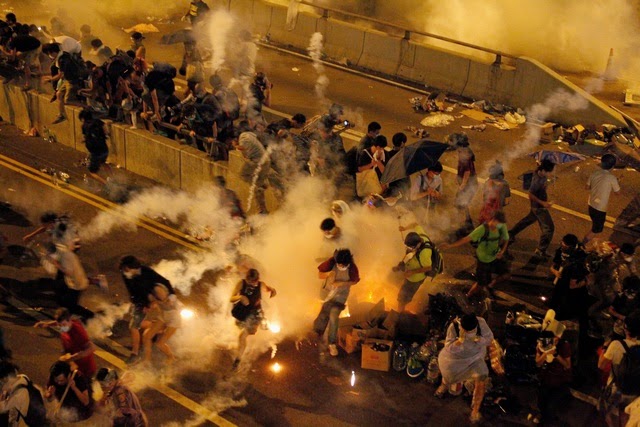
The Umbrella movement was officially launched at 1.45am on Sunday, September 28, 2014 because Mainland China is not honoring its treaty obligations regarding Hong Kong maintaining its democratic system. Police used tear gas and pepper spray on Sunday, September 28th in an attempt to disperse the nonviolent demonstrators which outraged many more Hong Kong residents who then joined the demonstrations. Tens of thousands of protesters have taken to the streets over the past week, paralyzing not just Central Hong Kong but also parts of Causeway Bay, Admiralty and Mong Kok demanding universal suffrage. On October 3, 2014 pro-government thugs, some apparently connected with organized crime (the triads), attacked nonviolent demonstrators while police looked on passively.


Amnesty International and Human Rights Watch have issued statements on events surrounding the protests in Hong Kong over the past week carried out by the Umbrella Movement. On October 3rd Amnesty International denounced the failure of Hong Kong police to protect hundreds of demonstrators, including women and girls targeted for sexual assault and harassment, attacked by pro-government protesters who appeared on the scene. Two days earlier on October 1, 2014 Amnesty reported on arrests in mainland China of Chinese nationals who had demonstrated sympathy or support for the Umbrella Movement in Hong Kong. Human Rights Watch in an open letter expressed its concern for the ultimatum by the Hong Kong executive to use all means to clear the streets on October 6th and outlined three concrete steps the authorities must take to honor international legal obligations and to uphold its reputation as a territory committed to the rule of law.


Hong Kong: Women and girls attacked as police fail to protect peaceful protesters

Hong Kong’s police failed in their duty to protect hundreds of peaceful pro-democracy protesters from attacks by counter demonstrators on Friday evening (October 3, 2014) , Amnesty International said.

Women and girls were among those targeted, including incidents of sexual assault, harassment and intimidation, as counter-demonstrators clashed with pro-democracy protesters in the Mongkok and Causeway Bay areas of Hong Kong on Friday evening.

"The police inaction tonight is shameful. The authorities have failed in their duty to protect peaceful protesters who came under attack," said Mabel Au, Director of Amnesty International Hong Kong.

[Read the rest here]

China: Immediately release supporters of Hong Kong protests

The Chinese authorities must immediately and unconditionally release all those detained for peacefully showing support for pro-democracy protests in Hong Kong, said Amnesty International.
At least 20 people have been detained by police in several cities in mainland China over the past two days for posting pictures online with messages of support for the protesters, shaving their heads in solidarity, or for planning to travel to Hong Kong to participate in the protests.

A further 60 have been called in for questioning by the authorities, known as being 'invited for tea'.
"The rounding up of activists in mainland China only underlines why so many people in Hong Kong fear the growing control Beijing has in their city's affairs," said William Nee, China researcher at Amnesty International.

"The fundamental freedoms being exercised by hundreds of thousands of people in Hong Kong continue to be denied to those in mainland China."

Police are known to have detained people in Beijing, Jiangsu, and the southern cities of Guangzhou and Shenzhen, which are close to Hong Kong.

[Read the rest here]


>Human Rights Watch Letter to Chief Executive Leung on Hong Kong Protests


Human Rights Watch in an open letter to the Hong Kong Chief Executive C.Y. Leung expressed its concern with Leung's insistence that protesters must leave the streets by Monday, October 6th and that "all actions necessary" would be used to achieve that goal and went on to say:  

"These remarks raise serious concerns about whether the government will adhere to international obligations to use force only where necessary and only to the minimum extent needed. The poor performance of some police officers in protecting some protesters from violent counter-demonstrators, as well as the government and the police’s initial failure to condemn that violence, raises questions about whether protesters’ rights and safety will be respected and protected. We believe that such words and actions can only exacerbate tensions, particularly about whether ongoing peaceful protests will be dispersed with force.
In order to comply with Hong Kong’s international legal obligations and to uphold its reputation as a territory committed to the rule of law, we urge that you:
1. Ensure that security forces abide by the United Nations (UN) Basic Principles on the Use of Force and Firearms.
We urge that security forces strictly adhere to these principles. Under the Basic Principles, law enforcement officials shall, as far as possible, “apply non-violent means before resorting to the use of force.” When the lawful use of force is unavoidable, law enforcement officials must “[e]xercise restraint in such use and act in proportion to the seriousness of the offence and the legitimate objective to be achieved.” Police restraint is particularly called for given that the demonstrations in Hong Kong have been overwhelmingly peaceful.
2. Ensure maximum respect for ongoing peaceful demonstrations.
The International Covenant on Civil and Political Rights guarantees the rights to peaceful assembly, association, and expression, and tolerates no restrictions except those necessary for national security, public order, and public safety. The government has failed to offer a justification for the use of tear gas and pepper spray against peaceful protesters on September 28 and 29.
If the government believes that the provision of public order necessitates removing peaceful protesters from particular areas, it must justify its decision in terms of why less restrictive measures would not suffice to protect public order, offer alternative venues for protest that are still central and accessible, and refrain from using excessive force in clearing those areas where the burden to public safety and health require clearance. Moreover, the government cannot prohibit peaceful assembly and expression city-wide.
3. Swiftly investigate and prosecute all those suspected of violence against peaceful protesters.
There can be no impunity for those who have attacked peaceful protesters. Hong Kong’s reputation as a city tolerant of peaceful protest and as the home of a professional police force is deeply tarnished as a result of the October 4 incidents in Mong Kok and Causeway Bay. Peaceful protesters, journalists, and onlookers were kicked, punched, and knocked to the ground by unidentified men. We have received multiple credible reports of female protesters being sexually assaulted. Protesters have also told Human Rights Watch that police officers failed or refused to assist when pro-democracy protesters were beaten or harassed by those who oppose them or that police officers let suspected assailants leave without having taken down their details or arresting them. These attacks took place over several hours, and throughout that time police were few in number and appeared unwilling to protect the protesters, raising concerns about collusion and biased law enforcement.
 [Read the entire letter]

Thursday, October 2, 2014

Mohandas Gandhi born 145 years ago on October 2nd: The International Day of Nonviolence

"You must not lose faith in humanity. Humanity is like an ocean; if a few drops of the ocean are dirty, the ocean does not become dirty." - Mohandas Gandhi 


Mohandas Gandhi
He liberated an entire subcontinent from imperial rule without firing a shot. The United Nations has designated his birthday, October 2nd, as the International Day of Nonviolence. Nevertheless,  he did not win the Nobel Peace Prize and is recognized by the Nobel Committee as the "Missing Laureate."

He wasn't a rich man. He never held formal political office. He wasn't a saint or divine figure. He was just a man. An attorney who had taken a vow of poverty and celibacy. His name was Mohandas Karamchand Gandhi.

How did he do it? Through overcoming his own limitations with meditation, experiments with truth and practicing nonviolence as a way of life and then applying it to his community and country through the tradition he was brought up in. This was done through a constructive program when possible and an obstructive program when necessary. According to Gandhi, "a nonviolent life is an act of self-examination and self-purification, whether by an individual, group or nation."

Today in Hong Kong the nonviolent legacy of Gandhi is seen in action through the Umbrella Movement seeking suffrage and democracy.

Gandhi memorial in Geneva, Switzerland
 Within the Cuba context, the family of Oswaldo José Payá Sardiñas and his friends (who called him Bapu) carry on the struggle for justice and dignity while avoiding the pitfalls of hatred and vengeance in an example of nonviolence within the Gandhian tradition.

Gandhi was assassinated on January 30, 1948 gunned down by a hate filled assassin. Oswaldo was assassinated by agents of the totalitarian dictatorship that rules in Cuba under circumstances that still need to be cleared up on July 22, 2012 along with Harold Cepero.

But more importantly beyond how they died both men shared in life a commitment to principled nonviolence. Mohandas Gandhi explained that "[a] nonviolent revolution is not a programme of 'seizure of power' but it is a programme of transformation of relationships, ending in a peaceful transfer of power."

Oswaldo Payá explained it plainly in December of 2002 while receiving the European Union's Sakharov Prize: 
We have not chosen the path of peace as a tactic, but because it is inseparable from the goal for which our people are striving. Experience teaches us that violence begets more violence and that when political change is brought about by such means, new forms of oppression and injustice arise. It is our wish that violence and force should never be used as ways of overcoming crises or toppling unjust governments.
 These are examples of the nonviolence of the strong not the passivity of the weak or the cowardly. It is also available for you to explore and take up as a practice in your life. If you are attracted to non-violence then you should join the experiment in truth and start a nonviolent study group in your community.