Showing posts with label Václav Havel. Show all posts

Thursday, December 18, 2025

Remembering Václav Havel, Oswaldo Payá Sardiñas and nonviolent action

 "A single idea, if it is right, saves us the labor of an infinity of experiences." - Jacques Maritain

Oswaldo Payá Sardiñas and President Václav Havel in Prague (2002)

Twenty three years ago on December 17, 2002 Oswaldo Paya addressed the European Parliament in Strasbourg at a ceremony awarding him the the Sakharov Prize where he outlined his nonviolent vision for change in Cuba.

"The first victory we can claim is that our hearts are free of hatred. Hence we say to those who persecute us and who try to dominate us: ‘You are my brother. I do not hate you, but you are not going to dominate me by fear. I do not wish to impose my truth, nor do I wish you to impose yours on me. We are going to seek the truth together.’"
 Václav Havel passed away fourteen years ago today, on December 18, 2011. His nonviolent resistance and dedication to truth in successfully resisting totalitarian rule in Czechoslovakia remain powerful legacies and examples that are relevant today. In 2002, President Vaclav Havel addressed the Cuban people and offered words that should be heeded now:
"Our world, as a whole, is not in the best of shape and the direction it is headed in may well be quite ambivalent. But this does not mean that we are permitted to give up on free and cultivated thinking and to replace it with a set of utopian clichés. That would not make the world a better place, it would only make it worse. On the contrary, it means that we must do more for our own freedom, and that of others."
Nonviolence requires recognizing these extreme injustices and the justifiable anger that it generates but at the same time channeling it into creative and productive means to end the injustices. Some would argue that one must remove their anger, as one takes off a back pack, but that is profoundly mistaken. Martin Luther King Jr. offered a different approach that has proven more powerful: 
"The supreme task [of a leader] is to organize and unite people so that their anger becomes a transforming force." 

Mohandas Gandhi spoke in 1920 of learning "through bitter experience the one supreme lesson to conserve my anger, and as heat conserved is transmuted into energy, even so our anger controlled can be transmuted into a power that can move the world."
 

This is not hating but harnessing a powerful spiritual energy and channeling it productively. Blowing up and screaming at someone is a waste of that energy that can be channeled into creative solutions to end the injustice.

Nonviolence theoretician Gene Sharp also recognizes that there is a moral dimension that cannot be ignored without dire consequences (as efforts to normalize relations with the Castro regime in Cuba demonstrated): "It is unreasonable to aim for a 'win- win' resolution. Brutal dictators and perpetrators of genocide do not deserve to win anything."

Nonviolent thought can be divided into two general categories: strategic nonviolence and principled nonviolence but although emphasizing different perspectives they need not be in conflict.
Strategic nonviolence takes a pragmatic approach that is based on being more effective then violence. 

Non-violent resistance is an armed struggle but its weapons are not deployed to do violence or kill. These arms are psychological, social, economic and political weapons. Gene Sharp argues with much evidence "that this is ultimately more powerful against oppression, injustice and tyranny then violence. Historical studies are cited that demonstrate the higher success rates of nonviolent movements when compared against violent ones. 

University Academics Maria J. Stephan and Erica Chenoweth in their 2008 study "Why Civil Resistance Works: The Strategic Logic on Nonviolent Conflict" compared the outcomes of 323 nonviolent and violent resistance campaigns from 1900 to 2006. They found that major nonviolent campaigns have achieved success 53 percent of the time, compared with just under half that at 26 percent for violent resistance campaigns. Finally there study also suggests “that nonviolent campaigns are more likely than violent campaigns to succeed in the face of brutal repression.”
Principled nonviolence looks at the spiritual dimension, and the power of an individual to change and in doing so impact the world. Mohandas Gandhi described it as follows on September 8, 1913 in Indian Opinion:
"We but mirror the world. All the tendencies present in the outer world are to be found in the world of our body. If we could change ourselves, the tendencies in the world would also change. As a man changes his own nature, so does the attitude of the world change towards him. This is the divine mystery supreme. A wonderful thing it is and the source of our happiness. We need not wait to see what others do."
The advantage of principled non-violence and taking it up as a daily practice in ones life is that it gives one the strength to resist provocations and builds up the character of the practitioner that assists in carrying out a strategic nonviolent plan.

Critics of nonviolence often argue that nonviolence works well against democracies but not brutal regimes, often citing the Nazis. Nevertheless in 1943 in Germany on Rosenstrasse street German wives married to Jewish men, who had been taken to concentration camps, organized a series of strikes and protests that forced the Nazis to return their Jewish husbands back from the death camps. Those men survived the Holocaust thanks to their wives courageous and nonviolent action.  

The disturbing questions that should arise are: What would have happened if instead of the violent Antifa movement, that fought the Nazis in street battles throughout the 1930s that escalated violence, opponents of the Nazis had followed Gandhi's advice at the time and resisted them nonviolently? What would have happened if the Weimar Republic instead of attempting to silence the Nazis by repeatedly prosecuting them for violating hate speech laws had challenged their evil ideas in the court of public opinion?

Since the founding of the Cuban Committee for Human Rights in 1976 there has existed in overall terms a general strategy of change that can be summed up as: " Carrying out a nonviolent struggle in defense of human rights for the freedom of Cuba."

Looking at another definition of strategy that divides it into three parts gives a better idea of the challenges facing the democratic opposition in Cuba:

1. Diagnostic: A totalitarian dictatorship with dynastic elements with the political will to hang on to power.
2. Guiding policy: nonviolence
3. Action plan: There exist different areas of emphasis by the opposition and civil society that is also somethin
g found in nonviolent struggles.
Strategic nonviolence takes a pragmatic approach that is based on being more effective then violence: 
Non-violent resistance is an armed struggle but its weapons are not deployed to do violence or kill. These arms are  psychological, social, economic and political weapons. Gene Sharp argues with much evidence "that this is ultimately more powerful against oppression, injustice and tyranny then violence." 

The reason for the greater success rate of nonviolent resistance is that it is easier to mobilize large numbers of people to take nonviolent action than to engage in violent action. Success is not only defined by overthrowing the existing regime, but having a transition that ends in a democratic regime. The methods used in nonviolent struggle translate better to democratic practices then violent resistance because they involve nonviolent discipline, the mobilization of large numbers and the encouragement of civic virtue.  

Furthermore the use of humor is not to be underestimated. Václav Havel in an address to the Central European University on June 24, 1999 at a difficult moment on the international scene made the case for laughter.

"The only thing I can recommend at this stage is a sense of humor, an ability to see things in their ridiculous and absurd dimensions, to laugh at others and at ourselves, a sense of irony regarding everything that calls out for parody in this world."

Following his death in 2011, every year on the anniversary of his passing admirers of Václav Havel the world over wear short trousers in his memory. 

On December 18th roll up your trousers to honor Vaclav Havel

Organizers explained its historic significance along with its particular Czech sensibility.

The “Short Trousers for Václav Havel” initiative started in 2012 to honor the memory of Václav Havel with a gesture that was unique, memorable and easily achieved by supporters of this exceptional person in modern Czech and European history.  Short Trousers is a reference to Havel stepping into political life in 1989 and his inauguration to the presidency in visibly short trousers. He explained vainly that rather than a tailor’s mistake it was his habit to pull his pants up at every dramatic situation. To this, one might say global mythology of his short trousers, he added with a smile: "I must say that I am glad of it, more or less. From my point of view it’s a pretty gentle way of mocking myself."  An effort to honor such a respectable person by a gesture that points to this humorous episode might appear, at first sight, as a contradictory act. But the opposite is true. We believe that rolled up trousers on the anniversary of the death of Václav Havel is a gesture which is Czech, slightly satirical and which can be easily joined by anyone who wants to honor the memory of the last Czechoslovak and the first Czech president Havel in a cheerful way.

This method of spontaneous remembrance contrasts dramatically with how dictators forcibly demand that they be remembered on penalty of imprisonment for dissenting as has been the case following the 2016 death of Fidel Castro.  


Marking Vaclav Havel's 14th death anniversary wearing short trousers.


Monday, December 18, 2023

Remembering Václav Havel, Oswaldo Payá Sardiñas and nonviolent action

 "A single idea, if it is right, saves us the labor of an infinity of experiences." - Jacques Maritain

Oswaldo Payá Sardiñas and President Václav Havel in Prague (2002)

Twenty one years ago on December 17, 2002 Oswaldo Paya addressed the European Parliament in Strasbourg at a ceremony awarding him the the Sakharov Prize where he outlined his nonviolent vision for change in Cuba.

The first victory we can claim is that our hearts are free of hatred. Hence we say to those who persecute us and who try to dominate us: ‘You are my brother. I do not hate you, but you are not going to dominate me by fear. I do not wish to impose my truth, nor do I wish you to impose yours on me. We are going to seek the truth together.’
 Václav Havel passed away twelve years ago today, on December 18, 2011, and his nonviolent resistance and dedication to truth in successfully resisting totalitarian rule in Czechoslovakia remain powerful legacies and examples that are relevant today. In 2002, President Vaclav Havel addressed the Cuban people and offered words that should be heeded now:
"Our world, as a whole, is not in the best of shape and the direction it is headed in may well be quite ambivalent. But this does not mean that we are permitted to give up on free and cultivated thinking and to replace it with a set of utopian clichés. That would not make the world a better place, it would only make it worse. On the contrary, it means that we must do more for our own freedom, and that of others."
Nonviolence requires recognizing these extreme injustices and the justifiable anger that it generates but at the same time channeling it into creative and productive means to end the injustices. Some would argue that one must remove their anger, as one takes off a back pack, but that is profoundly mistaken. Martin Luther King Jr. offered a different approach that has proven far more powerful: 
"The supreme task [of a leader] is to organize and unite people so that their anger becomes a transforming force." 

Mohandas Gandhi spoke in 1920 of learning "through bitter experience the one supreme lesson to conserve my anger, and as heat conserved is transmuted into energy, even so our anger controlled can be transmuted into a power that can move the world."
 

This is not hating but harnessing a powerful spiritual energy and channeling it productively. Blowing up and screaming at someone is a waste of that energy that can be channeled into creative solutions to end the injustice.

Nonviolence theoretician Gene Sharp also recognizes that there is a moral dimension that cannot be ignored without dire consequences (as the recent drive to normalize relations with the Castro regime in Cuba demonstrated): "It is unreasonable to aim for a 'win- win' resolution. Brutal dictators and perpetrators of genocide do not deserve to win anything."

Nonviolent thought can be divided into two general categories: strategic nonviolence and principled nonviolence but although emphasizing different perspectives they need not be in conflict.
Strategic nonviolence takes a pragmatic approach that is based on being more effective then violence. 

Non-violent resistance is an armed struggle but its weapons are not deployed to do violence or kill. These arms are  psychological, social, economic and political weapons. Gene Sharp argues with much evidence "that this is ultimately more powerful against oppression, injustice and tyranny then violence. Historical studies are cited that demonstrate the higher success rates of nonviolent movements when compared against violent ones:

University Academics Maria J. Stephan and Erica Chenoweth in their 2008 study "Why Civil Resistance Works: The Strategic Logic on Nonviolent Conflict" compared the outcomes of 323 nonviolent and violent resistance campaigns from 1900 to 2006. They found that major nonviolent campaigns have achieved success 53 percent of the time, compared with just under half that at 26 percent for violent resistance campaigns. Finally there study also suggests “that nonviolent campaigns are more likely than violent campaigns to succeed in the face of brutal repression.”
Principled nonviolence looks at the spiritual dimension, and the power of an individual to change and in doing so impact the world. Mohandas Gandhi described it as follows on September 8, 1913 in Indian Opinion:
"We but mirror the world. All the tendencies present in the outer world are to be found in the world of our body. If we could change ourselves, the tendencies in the world would also change. As a man changes his own nature, so does the attitude of the world change towards him. This is the divine mystery supreme. A wonderful thing it is and the source of our happiness. We need not wait to see what others do."
The advantage of principled non-violence and taking it up as a daily practice in ones life is that it gives one the strength to resist provocations and builds up the character of the practitioner that assists in carrying out a strategic nonviolent plan.

Critics of nonviolence often argue that nonviolence works well against democracies but not brutal regimes, often citing the Nazis. Nevertheless in 1943 in Germany on Rosenstrasse street German wives married to Jewish men, who had been taken to concentration camps, organized a series of strikes and protests that forced the Nazis to return their Jewish husbands back from the death camps. Those men survived the Holocaust thanks to their wives courageous and nonviolent action.  

The disturbing questions that should arise are: What would have happened if instead of the violent Antifa movement, that fought the Nazis in street battles throughout the 1930s that escalated violence, opponents of the Nazis had followed Gandhi's advice at the time and resisted them nonviolently? What would have happened if the Weimar Republic instead of attempting to silence the Nazis by repeatedly prosecuting them for violating hate speech laws had challenged their evil ideas in the court of public opinion?

Since the founding of the Cuban Committee for Human Rights in 1976 there has existed in overall terms a general strategy of change that can be summed up as: " Carrying out a nonviolent struggle in defense of human rights for the freedom of Cuba."

Looking at another definition of strategy that divides it into three parts gives a better idea of the challenges facing the democratic opposition in Cuba:

1. Diagnostic: A totalitarian dictatorship with dynastic elements with the political will to hang on to power.
2. Guiding policy: nonviolence
3. Action plan: There exist different areas of emphasis by the opposition and civil society that is also somethin
g found in nonviolent struggles.
Strategic nonviolence takes a pragmatic approach that is based on being more effective then violence: 
Non-violent resistance is an armed struggle but its weapons are not deployed to do violence or kill. These arms are  psychological, social, economic and political weapons. Gene Sharp argues with much evidence "that this is ultimately more powerful against oppression, injustice and tyranny then violence." 
The reason for the greater success rate of nonviolent resistance is that it is easier to mobilize large numbers of people to take nonviolent action than to engage in violent action. Success is not only defined by overthrowing the existing regime, but having a transition that ends in a democratic regime. The methods used in nonviolent struggle translate better to democratic practices then violent resistance because they involve nonviolent discipline, the mobilization of large numbers and the encouragement of civic virtue.  

Furthermore the use of humor is not to be underestimated. Václav Havel in an address to the Central European University on June 24, 1999 at a difficult moment on the international scene made the case for laughter.

"The only thing I can recommend at this stage is a sense of humor, an ability to see things in their ridiculous and absurd dimensions, to laugh at others and at ourselves, a sense of irony regarding everything that calls out for parody in this world."

Following his death in 2011, every year on the anniversary of his passing admirers of Václav Havel the world over wear short trousers in his memory. 

On December 18th roll up your trousers to honor Vaclav Havel

Organizers explained its historic significance along with its particular Czech sensibility.

The “Short Trousers for Václav Havel” initiative started in 2012 to honor the memory of Václav Havel with a gesture that was unique, memorable and easily achieved by supporters of this exceptional person in modern Czech and European history.  Short Trousers is a reference to Havel stepping into political life in 1989 and his inauguration to the presidency in visibly short trousers. He explained vainly that rather than a tailor’s mistake it was his habit to pull his pants up at every dramatic situation. To this, one might say global mythology of his short trousers, he added with a smile: "I must say that I am glad of it, more or less. From my point of view it’s a pretty gentle way of mocking myself."  An effort to honor such a respectable person by a gesture that points to this humorous episode might appear, at first sight, as a contradictory act. But the opposite is true. We believe that rolled up trousers on the anniversary of the death of Václav Havel is a gesture which is Czech, slightly satirical and which can be easily joined by anyone who wants to honor the memory of the last Czechoslovak and the first Czech president Havel in a cheerful way.

This method of spontaneous remembrance contrasts dramatically with how dictators forcibly demand that they be remembered on penalty of imprisonment for dissenting as has been the case following the 2016 death of Fidel Castro.  


Marking Vaclav Havel's 12th death anniversary wearing short trousers.

Friday, November 17, 2023

The Velvet Revolution at 34: Václav Havel, The Power of the Powerless, and the hope that it inspires today

 "The salvation of this human world lies nowhere else than in the human heart, in the human power to reflect, in human meekness and human responsibility."- Václav Havel IHT (21 February 1990) 

The Velvet Revolution in Prague on November 17, 1989

What was achieved 34 years ago in Czechoslovakia on November 17, 1989 that makes it a day of celebration around the world? 

It was a rejection of totalitarianism and the system of lies and hatred on which the regime thrived. It was a rebirth of freedom and of normal human relationships. In Vaclav Havel's address to the European Parliament on November 11, 2009 he outlined the daunting challenges faced after the transition:

A democratic political culture cannot be created or renewed overnight. It takes a lot of time and in the meantime there are plenty of unanticipated problems to be solved. Communism ruled just once in modern times (and, hopefully, for the last time), so the phenomenon of post-Communism was also a novelty. We had to confront the consequences of the rule of fear that lasted for so many years, as well as all the dangers related to a redistribution of property without precedent in history. So there were and are lots of obstacles and we are only now acquiring experience of such a state of affairs.
Months earlier in the summer of 1989 Jiří Křižan and Václav Havel had drafted "A Few Sentences" Petition calling for the release of political prisoners and respect for human rights. Tens of thousands of Czechoslovakians signed the petition and it contributed to the Velvet Revolution and the fall of communism in Czechoslovakia.

What took place on November 17, 1989 was the nonviolent triumph of the power of the powerless over a brutal totalitarian regime.This is in profound contrast to the centenary of the start of World War One that was supposed to make the world safe for democracy and instead ushered in two totalitarian systems: Nazism and Communism, a Second World War, a Cold War, and the age of nuclear weapons.

The Velvet Revolution was not inevitable, but a combination of providence, free will, and principled human action. The "Velvet Revolution" achieved profound non-violent change without wholesale slaughter and violence associated historically with revolutions. A cursory look would claim that the "revolution" took 11 days in November for the Communists to relinquish power. 

Some say it began in 1976 after the beating and arrest of the rock band, the Plastic People of the Universe, led to a number of intellectuals, Vaclav Havel, among them drafting and signing Charter 77 challenging the Czech communists to honor the rights outlined in their own constitution, and in the Helsinki accords which the communist government had signed in 1975.

Plastic People of the Universe

However some nonviolent theoreticians place the roots of the 1989 success even further back in the nonviolent response to the Soviet invasion of Czechoslovakia in 1968. After Soviet tanks crushed the Prague Spring, an effort by Czechoslovak communist reformers to build socialism with a human face, Havel wrote the following to the Czechoslovak President Alexander Dubcek who had been one of the reformers later purged: "Even a purely moral act that has no hope of any immediate and visible political effect can gradually and indirectly, over time, gain in political significance." The response by Czechs in what later became known as a civilian based defense, nonviolently bogged down the advancing Soviet army for eight months. The nonviolent lessons learned in 1968 planted seeds that bore fruit in 1989.  

Havel passed away on December 18, 2011 but his legacy endures and his ideas remains relevant raising the call to vigilance at a conference at Charles University titled “Freedom and its Enemies”:

The era of dictatorships and totalitarian systems has not ended at all. It may have ended in a traditional form as we know it from the 20th century, but new, far more sophisticated ways of controlling society are being born. It requires alertness, carefulness, caution, study and a detached view.

I've had the privilege to have walked the streets and breathed the air of Prague in May of 1990, barely five months after Havel went to the Castle in December of 1989, and returned nineteen years later in October of 2009 to participate in Forum 2000 and see the changes that had taken place. 

Although Czechs may no longer look in awe at all that they have accomplished after walking around the center of the city visiting shops and a grocery store, and talking with Czechs over a few beers I left impressed by all that had been accomplished, and with an overwhelming sense of happiness at bearing witness to a flowering of freedom and creativity that continues to endure and thrive. 

Vaclav Havel greets crowds in Wenceslas Square during 'Velvet Revolution'.

Victims of dictatorship the world over have experienced first hand the solidarity of the Czech and Slovak peoples. Further evidence that 34 years later the ideals of the Velvet Revolution endure.

 In Cuba, three years ago the San Isidro Movement, a collective of artists founded in 2018 to resist new restrictions on artistic freedom imposed by Havana's Decree 349 has marked a before and after in Cuban history with their civic protest, and the regime's violent reaction. 

Artists from the San Isidro Movement celebrating Cuban culture

Two years ago members of the San Isidro Movement together with compatriots in the diaspora challenged the dictatorship's culture of death embodied in the phrase "Patria o Muerte" (Homeland or Death) with a song titled "Patria y Vida" (Homeland and Life). Let us pray that soon Cuba will have its nonviolent revolution and its people freed from seven decades of first authoritarian, then totalitarian dictatorship and the old phrase of a democratic Cuba returns "Patria y Libertad" (Homeland and Freedom).

The Velvet Revolution gives us hope that freedom can be achieved in Cuba, and Cuban artists are on the front lines of this effort. Some of them, including Luis Manuel Otero Alcántara and Maykel Castillo Pérez, "El Osorbo" are enduring prison today in Cuba.

Sunday, December 18, 2022

Remembering Václav Havel, Oswaldo Payá Sardiñas and nonviolent action

"A single idea, if it is right, saves us the labor of an infinity of experiences." - Jacques Maritain

Oswaldo Payá Sardiñas and President Václav Havel in Prague (2002)

Twenty years ago on December 17, 2002 Oswaldo Paya addressed the European Parliament in Strasbourg at a ceremony awarding him the the Sakharov Prize where he outlined his nonviolent vision for change in Cuba.

The first victory we can claim is that our hearts are free of hatred. Hence we say to those who persecute us and who try to dominate us: ‘You are my brother. I do not hate you, but you are not going to dominate me by fear. I do not wish to impose my truth, nor do I wish you to impose yours on me. We are going to seek the truth together.’
 Václav Havel passed away eleven years ago today, on December 18, 2011, and his nonviolent resistance and dedication to truth in successfully resisting totalitarian rule in Czechoslovakia remain powerful legacies and examples that remain relevant today. In 2002, President Vaclav Havel addressed the Cuban people and offered words that should be heeded now:
"Our world, as a whole, is not in the best of shape and the direction it is headed in may well be quite ambivalent. But this does not mean that we are permitted to give up on free and cultivated thinking and to replace it with a set of utopian clichés. That would not make the world a better place, it would only make it worse. On the contrary, it means that we must do more for our own freedom, and that of others."
Nonviolence requires recognizing these extreme injustices and the justifiable anger that it generates but at the same time channeling it into creative and productive means to end the injustices. Some would argue that one must remove their anger, as one takes off a back pack, but that is profoundly mistaken. Martin Luther King Jr. offered a different approach that has proven far more powerful: 
"The supreme task [of a leader] is to organize and unite people so that their anger becomes a transforming force." 

Mohandas Gandhi spoke in 1920 of learning "through bitter experience the one supreme lesson to conserve my anger, and as heat conserved is transmuted into energy, even so our anger controlled can be transmuted into a power that can move the world."
 

This is not hating but harnessing a powerful spiritual energy and channeling it productively. Blowing up and screaming at someone is a waste of that energy that can be channeled into creative solutions to end the injustice.

Nonviolence theoretician Gene Sharp also recognizes that there is a moral dimension that cannot be ignored without dire consequences (as the recent drive to normalize relations with the Castro regime in Cuba demonstrated): "It is unreasonable to aim for a 'win- win' resolution. Brutal dictators and perpetrators of genocide do not deserve to win anything."

Nonviolent thought can be divided into two general categories: strategic nonviolence and principled nonviolence but although emphasizing different perspectives they need not be in conflict.
Strategic nonviolence takes a pragmatic approach that is based on being more effective then violence. 

Non-violent resistance is an armed struggle but its weapons are not deployed to do violence or kill. These arms are  psychological, social, economic and political weapons. Gene Sharp argues with much evidence "that this is ultimately more powerful against oppression, injustice and tyranny then violence. Historical studies are cited that demonstrate the higher success rates of nonviolent movements when compared against violent ones:

University Academics Maria J. Stephan and Erica Chenoweth in their 2008 study "Why Civil Resistance Works: The Strategic Logic on Nonviolent Conflict" compared the outcomes of 323 nonviolent and violent resistance campaigns from 1900 to 2006. They found that major nonviolent campaigns have achieved success 53 percent of the time, compared with just under half that at 26 percent for violent resistance campaigns. Finally there study also suggests “that nonviolent campaigns are more likely than violent campaigns to succeed in the face of brutal repression.”
Principled nonviolence looks at the spiritual dimension, and the power of an individual to change and in doing so impact the world. Mohandas Gandhi described it as follows on September 8, 1913 in Indian Opinion:
"We but mirror the world. All the tendencies present in the outer world are to be found in the world of our body. If we could change ourselves, the tendencies in the world would also change. As a man changes his own nature, so does the attitude of the world change towards him. This is the divine mystery supreme. A wonderful thing it is and the source of our happiness. We need not wait to see what others do."
The advantage of principled non-violence and taking it up as a daily practice in ones life is that it gives one the strength to resist provocations and builds up the character of the practitioner that assists in carrying out a strategic nonviolent plan.

Critics of nonviolence often argue that nonviolence works well against democracies but not brutal regimes, often citing the Nazis. Nevertheless in 1943 in Germany on Rosenstrasse street German wives married to Jewish men, who had been taken to concentration camps, organized a series of strikes and protests that forced the Nazis to return their Jewish husbands back from the death camps. Those men survived the Holocaust thanks to their wives courageous and nonviolent action.  

The disturbing questions that should arise are: What would have happened if instead of the violent Antifa movement, that fought the Nazis in street battles throughout the 1930s that escalated violence, opponents of the Nazis had followed Gandhi's advice at the time and resisted them nonviolently? What would have happened if the Weimar Republic instead of attempting to silence the Nazis by repeatedly prosecuting them for violating hate speech laws had challenged their evil ideas in the court of public opinion?

Since the founding of the Cuban Committee for Human Rights in 1976 there has existed in overall terms a general strategy of change that can be summed up as: " Carrying out a nonviolent struggle in defense of human rights for the freedom of Cuba."

Looking at another definition of strategy that divides it into three parts gives a better idea of the challenges facing the democratic opposition in Cuba:

1. Diagnostic: A totalitarian dictatorship with dynastic elements with the political will to hang on to power.
2. Guiding policy: nonviolence
3. Action plan: There exist different areas of emphasis by the opposition and civil society that is also something found in nonviolent struggles.
Strategic nonviolence takes a pragmatic approach that is based on being more effective then violence: 
Non-violent resistance is an armed struggle but its weapons are not deployed to do violence or kill. These arms are  psychological, social, economic and political weapons. Gene Sharp argues with much evidence "that this is ultimately more powerful against oppression, injustice and tyranny then violence." 

The reason for the greater success rate of nonviolent resistance is that it is easier to mobilize large numbers of people to take nonviolent action than to engage in violent action. Success is not only defined by overthrowing the existing regime, but having a transition that ends in a democratic regime. The methods used in nonviolent struggle translate better to democratic practices then violent resistance because they involve nonviolent discipline, the mobilization of large numbers and the encouragement of civic virtue.  

Furthermore the use of humor is not to be underestimated. Václav Havel in an address to the Central European University on June 24, 1999 at a difficult moment on the international scene made the case for laughter.

"The only thing I can recommend at this stage is a sense of humor, an ability to see things in their ridiculous and absurd dimensions, to laugh at others and at ourselves, a sense of irony regarding everything that calls out for parody in this world."
Following his death in 2011, every year on the anniversary of his passing admirers of Václav Havel the world over wear short trousers in his memory. Organizers explained its historic significance along with its particular Czech sensibility.
The “Short Trousers for Václav Havel” initiative started in 2012 to honor the memory of Václav Havel with a gesture that was unique, memorable and easily achieved by supporters of this exceptional person in modern Czech and European history.  Short Trousers is a reference to Havel stepping into political life in 1989 and his inauguration to the presidency in visibly short trousers. He explained vainly that rather than a tailor’s mistake it was his habit to pull his pants up at every dramatic situation. To this, one might say global mythology of his short trousers, he added with a smile: "I must say that I am glad of it, more or less. From my point of view it’s a pretty gentle way of mocking myself."  An effort to honor such a respectable person by a gesture that points to this humorous episode might appear, at first sight, as a contradictory act. But the opposite is true. We believe that rolled up trousers on the anniversary of the death of Václav Havel is a gesture which is Czech, slightly satirical and which can be easily joined by anyone who wants to honor the memory of the last Czechoslovak and the first Czech president Havel in a cheerful way.

This method of spontaneous remembrance contrasts dramatically with how dictators forcibly demand that they be remembered on penalty of imprisonment for dissenting as has been the case following the 2016 death of Fidel Castro. 

Sunday, February 27, 2022

Moral compromises: Cuban national Anamely Ramos again denied the right to return to her homeland by the Castro regime and American Airlines.

"Even a purely moral act that has no hope of any immediate and visible political effect can gradually and indirectly, over time, gain in political significance." - Václav Havel, Letter to the overthrown Czechoslovak Communist Party chairman Alexander Dubček (August 1969)

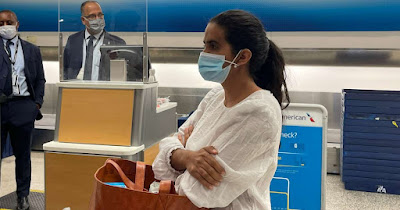
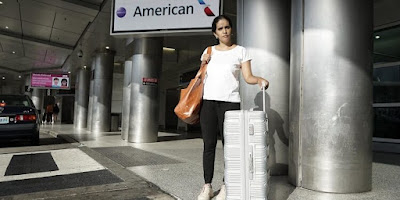
Anamely Ramos González, twice refused her right to return home to Cuba.

Earlier this morning, Anamely Ramos González tried to board a return flight to Cuba, but was told she could not return home. 

This time she received a document from American Airlines that it was the Cuban government that had blocked her from returning.

Eleven days earlier it happened to her for the first time.

On February 16, 2022, Anamely Ramos González, with her documents in order and plane ticket in hand, was told by a representative of American Airlines she could not board the flight home on instructions from the Cuban government. 

Anamely after being told by American Airlines she couldn't board flight home on 2/16/22

Anamely Ramos is an artist and nonviolent Cuban dissident who resides in Cuba.

She traveled abroad in January 2021 to pursue a Ph.D. in Anthropology at the Universidad Iberoamericana de México. 13 months later, in February 2022 she was twice denied entry into Cuba by American Airlines personnel on the instructions of Cuban government officials.

"'Right now I have no country, nowhere to return to, no residence in any other country in the world, no visa to anywhere and here I am,' said [ Anamely Ramos González ] in an interview with the Miami Herald outside Versailles restaurant in Little Havana," reported Nora Gámez Torres after she was turned away on February 16th. 

These were not the first two incidents of a Cuban national being arbitrarily denied the right to return home by the Castro dictatorship.

Estimates range between 70,000 to 300,000 Cubans banned by the Cuban government from returning to their homeland reported The Miami Herald on August 15, 2011 in the article titled "Many Cuban expatriates can't go home again". Despite claims made by both Havana and Washington in 2013 that the Cuban government had liberalized travel to the island, the cases of cruel family separations remain a constant.

223 Cubans have been identified that have been either denied the right to leave or enter Cuba. There are many more, but many are afraid to defy the dictatorship and have their families in the island suffer further reprisals by going public.

Anamely after being told by American Airlines she couldn't board flight home on 2/27/22

This policy of the Castro regime to divide families has a long history, and an ideological foundation. Carlos Eire, a professor at Yale University, a Cuban exile, and former Pedro Pan child in Babalu Blog on January 2, 2020 wrote how he "once had the opportunity of asking one of Fidel’s closest associates, Carlos Franqui, why the top brass of the Castro regime intentionally prevented thousands of Cuban parents from reuniting with their Pedro Pan children in the U.S.. Franqui, who served as a propaganda minister to Fidel before being purged, responded to my question with a huge smile on his face: 'We did it because anything that would destroy the bourgeois family was good for us.'"

These are violations of two fundamental human rights. 

 Article 12 of the Universal Declaration of Human Rights states: 

"No one shall be subjected to arbitrary interference with his privacy, family, home or correspondence, nor to attacks upon his honour and reputation. Everyone has the right to the protection of the law against such interference or attacks."
Article 13 of the Universal Declaration of Human Rights states: 
"Everyone has the right to freedom of movement and residence within the borders of each state.
Everyone has the right to leave any country, including his own, and to return to his
country."

Havana has systematically violated these universal human rights over 60 years. Until 2013, Cubans who stayed abroad over 11 months lost their right to return. 

In 2013 Cuban law increased the amount of time Cubans could spend overseas without losing their residency rights from 11 months to two years, but in the case of Anamely Ramos she is being denied her right to return. She has been out of the country for 13 months.

Anamely Ramos with Sirley Avila Leon

Denying Anamely Ramos her right to return to her home and be reunited with her family is not only a violation of Articles 12 and 13 of the Universal Declaration of Human Rights, but violates existing Cuban law, demonstrating the tyrannical nature of the Cuban government, and the decades long internal blockade erected against Cubans by the Castro regime. 

Until recently, Cubans would fly to Cuba, and be turned around at customs. Now, American Airlines is carrying out the instruction of the Cuban government barring Cuban nationals from boarding their flights home. 

But the dictatorship is not a reliable partner.  

On February16th American Airlines did not provide any documentation indicating why Anamely could not travel, but a verbally told her the Cuban government had denied her right to return.

Two days later on social media Prisoners Defenders released an excerpt from a Cuban government television program called "Al Filo" [ To the point] in which the spokeswoman said it was not Cuba but American Airlines that had barred Anamely from flying.

We (Cuba) know so far the same as she and the journalists, who were apparently waiting for her behind the check in table: that the airline does not allow her to travel because they allege that Cuba prohibits her entry. Just that, without further details. And although until now the most direct and objective refusal was not given by us, the media have a culprit, of course, because as always "Miami confirms it." 
This placed American Airlines in the hot seat. Their "partner government" had thrown them under the bus and claimed it was the U.S. company denying Anamely Ramos the right to travel. They have been a lot of bad press with headlines such as "American Airlines Caves to Authoritarian Communist Regime."

There is a petition underway calling American Airlines to account for this new relationship with the Cuban dictatorship, and its complicity in denying her human right to return home to her country that is found under Article 13 of the Universal Declaration of Human Rights, and calls them out for violating the UN Global Compact on Human Rights, Labor, Environment, and Anti-corruption.

"According to your letter to the United Nations Secretary General, H.E. Antonio Guterres, dated February 15th, 2021, American Airlines adhered to the 10 Principles of the UN Global Compact on human rights, labor, environment and anti-corruption." ...

"By not allowing Ms. Ramos González to go back to her country of residence, your company’s officers violated article 13 of the Universal Declaration of Human Rights, basically the right to freedom of movement. This rights is included in Principle 1 of the Global Compact stating: 'Businesses should support and respect the protection of internationally proclaimed human rights.'"

"At the same time, by following a protocol and orders by the migratory authorities of the totalitarian government of Cuba with no legal standing, you have violated Principle 2 of the Global Compact that states: 'Business should make sure that they are not complicit in human rights abuses.'"

The world is witnessing now the havoc that normalized relations that economically empowered totalitarian dictatorships ( Communist China's role in covering up and contributing to a world wide pandemic), and authoritarian dictatorships (Vladimir Putin invading Ukraine and threatening nuclear war) is threatening tens of millions of lives, but it all began with small moral compromises out of the mistaken belief that the ends justify the means.

The trouble with morally compromising with these regimes is that there is no bottom. Below is a Tweet by a Cuban government agent of influence that has images that border on racism.

Czech dissident, playwright, and president Václav Havel believed that moral actions, no matter how small or futile they may appear at the time can have profound consequences for both freedom and a just society. It is because the world is not a puzzle to be solved but incredibly much more complex that decisions of right and wrong made by each person have such great importance.

The New York Times in their October 13, 2009 issue in an article titled Vaclav Havel, Still a Man of Morals and Mischief: reported that in an interview that was supposed to be about the revolutions that overturned communism 20 years earlier that President Havel raised the question asking if it was true that President Obama had refused to meet the Dalai Lama? Havel replied:

“It is only a minor compromise,” Mr. Havel said of the nonreception of the Tibetan leader. “But exactly with these minor compromises start the big and dangerous ones, the real problems. “This is actually the first time I really do mind something Obama did,” Mr. Havel said. He minded it “much more” than Mr. Obama’s recent decision not to station elements of a missile-defense system in the Czech Republic, a move that several Central European politicians criticized but that Mr. Havel noted was ultimately “an internal American decision.”

These compromises were also seen with regard to normalizing relations with Cuba. 

Carnival Cruise Line signed an agreement with Castro regime officials on March 21, 2016 to sail to Cuba from the United States. In order to conduct their core mission Carnival had to agree to enforce the Castro dictatorship's policy that bans all Cubans from traveling into the island by water. It did not matter if Cubans born on the island were now citizens of another country.  ( Obama's Treasury Department on July 7, 2015 had signed off on the Carnival Cruise Line - Castro regime alliance ignoring that an entire class of Americans would be discriminated against based on their national origin.).

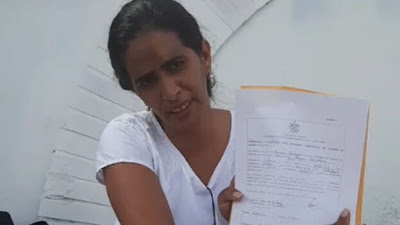
Today, American Airlines provided a Cuban government document identifying the Cuban official, representing the dictatorship in writing that Anamely Ramos would not be allowed to enter Cuba. The document is titled, "Notification to airlines of inadmissible passengers in national territory" and is signed by Lieutenant Colonel Néstor Morera.

Sadly, to obtain this information required eleven days of protests, and demands of transparency combined with the Castro regime denying the verbal statement made by American Airlines, and placing all the blame on the American carrier.

Anamely Ramos, and other Cuban dissidents, are observing that Cuba is not becoming more like the free world with normalization, but the free world is becoming more like Cuba.  Time to end normal relations with abnormal regimes, while we hopefully still can. 

Anamely Ramos shows Cuban government document provided by American Airlines.
 
Below was a live video program Anamely held on Facebook after she left the airport today and returned to the outskirts of Versailles, and further down is an excerpt from a statement she released today exposing the moral compromise made by American Airlines with Havana.

"Today I tried again to board an AA [American Airlines] flight to my country. 

Cuba reissued a notification informing the airline that I am not admitted within the national territory and that, therefore, they "recommend" AA not to board me.

I want to be explicit with this: the decision not to admit is from the Cuban State, the decision to abide by that decision and not let me get on the plane is from American Airlines. They are two different responsibilities and it is Cuba who is most interested in making them one, so as not to have to make an official pronouncement. They act with AA as they do with people who are going to do an act of repudiation of an opponent.

It is not the State Security agents who shout and appear on camera, they are the ones who softly tell people "from the town" to shout and not let other citizens out. The notification received by AA, and which was delivered to me today, is signed by a Lieutenant Colonel, a more than clear sign of who is behind a flagrant violation of human rights.

It was very convenient for Cuba that this whole operation was kept in the shadows. The agreement or protocol that AA cites all the time as the norm that they cannot violate is not public.

 Maybe it doesn't even exist in writing. Maybe it's just an oral agreement. An agreement that collides with the Global Pact that AA signed in 2021 and that speaks of respect for human rights (in this case the right to return) of people - clients."

 #RightToReturn #DerechoARegresar