Saturday, April 17, 2021

Brigade 2506, the Bay of Pigs at sixty and some historical context.

"It doesn't take a hero to order men into battle. It takes a hero to be one of those men who goes into battle." - Norman Schwarzkopf 


Sixty years ago Brigade 2506 members invaded Cuba seeking to end the communist dictatorship then being consolidated by Fidel Castro. Before the world knew what was going on in Cuba, these Cubans tried to prevent these 62 years and counting of horror under the communist dictatorship of the Castro brothers. Outnumbered and outgunned they fought between April 17-19, 1961 and one hundred and four Brigade 2506 members died fighting to liberate Cuba, and eight were executed by firing squad. Most Brigade members were captured and spent 22 months in prison before a ransom was paid for their release.

Cuba's last legitimately elected president, Carlos Prio Socarras, was voted in by Cubans in free and fair elections on July 1, 1948 and assumed office on October 10, 1948. He was a democrat, who respected civil liberties, and presided over years of prosperity and freedom for Cubans. President Prio Socarras belonged to the Autentico Party and succeeded Ramon Grau San Martin, another member of the same political party in the Cuban presidency. On his watch Cuban diplomats played an important role in the drafting of the Universal Declaration of Human Rights. President Carlos Prío Socarras and his wife Mary Tarrero de Prío went into exile in Miami, but his struggle for a democratic Cuba did not end there. He would be arrested on more than one occasion accused of smuggling arms to rebels in Cuba seeking to overthrow Fulgencio Batista.

Cuba's last constitutional president announced his plan to return to the island as early as 1955 and did so during a brief "amnesty" in 1956 only to be expelled at gunpoint a short time later. Prío Socarras would return again in January 1959 when Fulgencio Batista fled power. The Castro brothers and their guerillas promised to restore democracy obtaining the support of the United States. Behind the scenes, despite their public claims, the revolutionaries began immediately consolidating power and marginalizing or disappearing anti-communists from their ranks such as Huber Matos. Publicly, beginning in January 1959 they began broadcasting the public execution of regime opponents by firing squads.


In March 1960 radio stations were seized by the revolutionary government in Cuba, this was followed by the taking of newspapers in May 1960. In July 1960 all U.S. businesses and commercial property in Cuba were nationalized at the direction of the Cuban government. In September 1960 the Committees for the Defense of the Revolution (CDRs) were established throughout Cuba and the close surveillance of all Cubans began. In October 1960 Cuban-owned large and middle sized private enterprises nationalized and all rental properties seized, along with commercial bank accounts. What remained were small and micro enterprises.

President Carlos Prío Socarras departed for exile again in December 1960 as the Castro government turned into a communist military dictatorship. Cuba in the span of two years had transitioned from an authoritarian regime to a totalitarian communist one. It was in this context that Cuban exiles joined Brigade 2506 to overthrow the communist dictatorship in Havana.

Barbara Gutierrez of UNEWS at the University of Miami interviewed Eduardo Zayas Bazán and on April 14th published the article "Cuban exile reminisces about the Bay of Pigs invasion" that described the stakes confronted by these young Cuban exiles in 1961: "When he was 25 years old, Cuban exile Eduardo Zayas Bazán, fearful that his homeland would forever remain under communist rule, made a fateful decision. Leaving behind his young wife and 2-month-old son, he enlisted in a CIA-led mission to secretly invade Cuba and defeat the Castro regime."

They risked life and limb to liberate their homeland, and over a hundred died in the venture, and hundreds more suffered imprisonment as prisoners of war between April 1961 and December 1962.

In the short term the failure of the Bay of Pigs invasion led to Soviets, perceiving American weakness, deploying dozens of medium-range nuclear missiles within striking range of the entire United States, and the subsequent Cuban Missile Crisis that brought the world to the brink of nuclear holocaust egged on by Fidel Castro in October 1962. 


On December 24, 1962, captured prisoners of war of the Brigade 2506 were released from Castro’s prison and flew to Miami. Five days later on December 29, 1962, President John Kennedy and First Lady Jacqueline Kennedy met with the Bay of Pigs veterans, and over 40,000 Cuban exiles at the Orange Bowl. On that day the returning soldiers gave President Kennedy the flag of the Brigade and the President pledged that the Brigade flag was to “fly again in a free Havana.” Less than a year later on November 22, 1963 President John F. Kennedy was assassinated in Dallas, Texas by pro-Castro activist Lee Harvey Oswald

Over the long term the Castro dictatorship has been in power for 62 years and has successfully exported its "model" to Nicaragua and Venezuela spreading misery and terror to millions more while sponsoring revolutionary terror around the globe.

Sixty years after the Bay of Pigs, and the courageous sacrifice of the Brigade 2506 members, and the haunting question remains: "How much better would Cuba and the wider region be today if Castro had been overthrown in 1961?" 

Friday, April 16, 2021

Kabuki theater now underway in Cuba in 2021 is using the same messaging as 2018, and equally as false.

"Falsehood flies, and the Truth comes limping after it; so that when Men come to be undeceiv’d, it is too late; the Jest is over, and the Tale has had its Effect..." - Jonathan Swift, A Letter to a Young Gentleman (1710).

Raul Castro (age 89) said today (April 16, 2021) he is resigning as head of Cuba’s Communist Party, "ending an era of formal leadership by he and his brother Fidel Castro that began with the 1959 revolution," reported the Associated Press. Three years earlier, Raul Castro handed over the office of the presidency to his hand picked successor Miguel Díaz-Canel on April 19, 2018. The dictatorship used this to give the impression that there was a transition underway to a post-Castro era in Cuba back then and many in the press bought the lie.

On April 18, 2018, Ed Augustin writing from Havana for The Guardian began his article, "When Cuba’s president stands down this week, it will mark the first time in nearly six decades that the island will be led by somebody whose last name is not Castro." Five years later and the same claims are now being made again by the experts and journalists, but Cubans in the island know better.

The Castro regime is repeating the same messaging now that is again being echoed by the free press. General Raul Castro remained head of the communist party, the maximum authority, controlled the military, and headed the commission that drafted the new constitution in 2018. Now he is formally ceding the position of the head of the Communist Party, according to press accounts and analysts, to someone not named Castro, but the Castro dynasty remains in control.

Remember when Raul Castro supposedly turned power over to Miguel Díaz-Canel on 4/19/18

This is not a transition but a succession to a new generation of the Castro dynasty led by Alejandro Castro. However, while he lives, Raul Castro will continue to have a veto over what happens in the archipelago. People outside Cuba may not know it, but Cubans on the island already do. Cuban independent journalist Camila Acosta, and member of the 27N intellectual movement explained to Deutsche Welle on April 16, 2021 that "for a long time, it has been the son of Raúl Castro, Alejandro Castro Espín, who moves the strings of the country. Raúl would only officially retire, although he should remain aware of everything perhaps as an authority figure as part of that 'historical elite' of the Revolution."

Raúl Castro Ruz, and his son Alejandro Castro Espín

Raul Castro's son, Colonel Alejandro Castro Espin (age 55), who negotiated the normalization of relations with the Obama Administration is an intelligence officer who also organized the 2014 Vladimir Putin visit to Cuba, regularly visits Russia for high level meetings, and is a hardliner who in 2009 wrote The Price of Power, a harshly critical appraisal of the United States that describes U.S. leaders as “those who seek to subjugate humanity to satisfy their interests and hegemonic goals.” He was also the go to person during the Trump Administration.

Alejandro Castro (shaking hands with President) negotiated normalizing relations with U.S.

According to The Miami Herald in the August 26, 2020 article "Former Trump campaign manager traveled to Cuba to meet ‘Castro’s son,’ Senate report says" in early January 2017, "when the Cuban government was looking for insights into President-elect Donald Trump, his former campaign chief, Paul Manafort, traveled to the island to meet with 'Castro’s son,' according to a U.S. Senate report" and the newspaper identified this "son" as Alejandro Castro.

When Raul Castro dies or becomes incapacitated Alejandro Castro will be the new patriarch of the Castro clan that will seek to hang on to power in Cuba. 

How the press and academia has responded to this recycled propaganda campaign illuminates an important reflection by the Spanish philosopher George Santayana:

"Progress, far from consisting in change, depends on retentiveness. When change is absolute there remains no being to improve and no direction is set for possible improvement: and when experience is not retained, as among savages, infancy is perpetual. Those who cannot remember the past are condemned to repeat it."

Memory, and retentiveness are defenses against political propaganda and the Orwellian rewriting of history. The Czech writer Milan Kundera in his 1999 novel The Book of Laughter and Forgetting observed that "the struggle of man against power is the struggle of memory against forgetting." For too long the Castro regime has relied on others forgetting, it is time that more of us remember.

The Castro family's six-decade grip on power did not end in 2018, and the Kabuki theater underway at the Cuban Communist Party Conference now in 2021 will not change the Castro dynasty's grip on power in Cuba. To change that will necessitate the international community calling out the Castro dictatorship's crimes, recognizing and engaging in meaningful solidarity with Cuba's nonviolent dissidents, and achieving an international consensus on sanctioning this outlaw regime.  

For the U.S. policy makers it means recognizing that since 1974 five American Presidents have tried to normalize relations with unilateral concessions towards Havana only to suffer foreign policy reversals. The alternative to this realistic historical assessment is to continue a relationship with Cuba that can best be summed up as "Groundhog Day."

Tuesday, April 13, 2021

April 13th is the Day of Remembrance for the Victims of the Katyn Massacre.

"To forget would be not only dangerous but offensive; to forget the dead would be akin to killing them a second time.” - Elie Wiesel, Night 

The Soviet Union claimed to enter Poland in September of 1939 to "take care" of the people and seven months later beginning in April 1940 they had executed 22,000 Polish officers and buried them in mass graves in what became known as the Katyn Massacre.

Today is the day of remembrance for the victims. Let us remember and place this crime into its historic context.

On September 17, 1939 with "between 600–650,000 soldiers and over 5,000 thousand Red Army tanks  [of the Soviet Union] invaded the Second Polish Republic, which had been fighting against German aggression since 1 September."

The Soviet Union "invaded Poland on the pretext that ‘the Polish country and its government ceased to exist’. Consequently, ‘the USSR had to take care of the people who lived in Western Ukraine and Western Belarus and their possessions’ as the Soviet propaganda referred to the eastern regions of the Second Polish Republic." ... " About 230,000 [Polish] soldiers and officers and thousands of military service representatives were taken captive by the Bolsheviks."

The reality was that the Soviets had entered into a non-aggression pact with Nazi Germany that included secret protocols dividing up Poland. Nazi and Soviet troops met in the middle of Poland and exchanged pleasantries in September of 1939. 

Nazi and Soviet soldiers salute Nazi flag ceremony on September 22, 1939 in Poland

The Soviet precursor to the KGB was the NKVD. "From October 1939, the delegated NKVD officials from Moscow heard the prisoners, encouraged them to cooperate and collected data. Only a few of the prisoners agreed to collaborate. The commanding officers’ reports included opinions about hostile attitudes of the Poles and a minimal chance of them being useful to the USSR authorities."

The decision to shoot the prisoners was signed on March 5, 1940 by seven members of the All- Union Communist Party (Bolsheviks) authorities: Joseph Stalin, Lavrentiy Beria (proposer), Kliment Voroshilov, Vyacheslav Molotov, Anastas Mikoyan, Mikhail Kalinin and Lazar Kaganovich.

The lists of those sent to death were to be prepared and signed by Piotr Soprunienko, commander-in-chief of the Prisoners of War Board of People’s Commissariat of Internal Affairs, which was created by the order of Beria in September 1939

In the Spring of 1940 the Soviet secret police began to shoot the prisoners in the back of the head or in the neck and burying them in mass graves.

Smolensk–Katyn
On 3 April, the first prisoners from Kozelsk were transported in cattle trucks through Smolensk to Gniezdovo, where smaller groups were transported by prison cars commonly called ‘czornyje worony’ (‘black ravens’) to the wilderness called Kozie Gory in Katyn Forest. The functionaries of the NKVD killed each person by shooting in the back of the head. By 11 May, 1940, 4,421 Polish citizens had been killed and buried in Katyn death pits. There is an assumption that some officers had been killed in Smolensk28.
Kharkov–Piatykhatky
The first group of prisoners from Starobelsk camp was transported to the headquarters of the Board of Kharkov NKVD district on 5 April 1940. Every night in the basement of the building in Dscherschinski Street executioners killed prisoners by shooting in the neck. The trucks carried the bodies to the pits in Forest Park in Kharkov, a kilometer and a half to Piatykhatky village. By 12 May 3,820 Polish citizens had been killed in Kharkov29.
Kalinin (Tver)–Miednoye
On 4 April, 1940, the NKVD started to send prisoners from Ostashkov to the headquarters of the Board of Kalinin NKVD district (today’s Tver) at 6 Soviet Street. The executions took place in the basements. The same method of killing was used: a shot to the neck. In the mornings trucks carried the bodies to the pits in Miednoye village, 30 kilometers further away. By 22 May, 1940, 6,311 Polish citizens had been killed in Kalinin. What is worth mentioning when it comes to the Katyn lie, is that the territory of Miednoye cemetery has never belonged to Germany30.
Polish authorities built war cemeteries at the places where the officers’ bodies had been buried. The cemeteries were officially opened in the year 2000. (in Kharkov on 17 June, in Katyn on 28 July and on 2 September in Miednoye)31.
Survivors
Only 395 people from the three camps survived. Some of them owed their rescue to pure chance. Several people were willing to fight on the Soviet side in case of German invasion. There were also agents among them, the same ones as the NKVD had in the camps. The officers who were arrested in the camps and transported to NKVD Lubyanka prison in Moscow also managed to escape death in the summer of 194032.

The Guardian summed up the crime as follows: "Joseph Stalin ordered his secret police to execute 22,000 Polish army officers and civilians in 1940, in one of the greatest mass murders of the 20th century."


On April 13, 1990 the Soviet Union admitted its guilt in the 1940 Katyn Massacre.


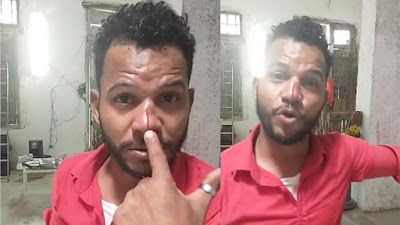
Cuban dissident and artist Maykel Castillo Pérez, "El Osorbo" beaten up while attack was recorded by secret police

"I won again. They beat me and I crossed my arms, I didn't answer you [with violence]. I will continue to tell truths " " - Maykel Castillo "Osorbo", April 12, 2021

On April 12, 2021 two individuals attacked Maykel Castillo and secret police recorded it

On April 9, 2021 Reuters published a profile on Cuban dissidents that highlighted Cuban rapper Maykel Castillo, a member of the San Isidro Movement, and an artist who sang and appeared in the video Patria y Vida that has been a viral sensation in Cuba. Yesterday, Maykel was assaulted in Havana by strangers as state security agents filmed the assault. They were probably recording to see if he hit back to defend himself, and use that as a basis for prosecution, but he took the blows, and remained nonviolent. Maykel Castillo also known as "Osorbo" denounced the incident on a live broadcast through Luis Manuel Otero Alcántara's social networks: "Something happened today, which probably should have happened many days ago." “I knew that something like this could happen to me; you broke my nose."

Over the past three years he has fought against censorship and the dystopian Decree 349, that further restricts artistic freedom in Cuba. He has paid for his defiance with threats, beatings, and prison. This blog has periodically given updates on his plight.

Maykel Castillo Pérez, "El Osorbo"

In September of 2018 Cuban rapper Maykel Castillo Pérez, "El Osorbo" protested against Decree 349/2018 during a show. This is a new law that further outlaws independent art in Cuba. Three days after the concert, he was detained by the Cuban secret police. On November 15th Maykel sewed his mouth shut and began a hunger strike demanding to be freed. An official told him that they would meet his demand, and he ended the strike. But as the days turned into weeks, and the imprisonment continued, the Cuban artist on December 4th re-started the hunger strike. The Cuban Rapper completed a prison sentence of one year one month for protesting Decree 349.

Maykel Castillo Pérez, "El Osorbo"
 
This was not the first time that he had been the victim of a politically motivated prosecution. On January 28, 2015, Maykel Castillo Pérez was sentenced to a year in prison in Havana. He was targeted for having used music to express his dissenting political opinions. He was charged with ‘peligrosidad predelictiva’ (‘pre-crime dangerousness’), which is used to imprison Cubans for what they  may potentially do in the future due to their associations and/or views.. 
 
His defense attorney told a reporter from Diario de Cuba that prosecutors wanted the judge to sentence him to five years. He once described his musical style as that of someone who “doesn’t make concessions with a system full of liars.” 
 
Being locked up for what one may potentially do in the future, as was done to Maykel, is a widely applied charge by the Castro dictatorship.
 
According to a January 13, 2020 report in The New York Times a former high-ranking judge in Cuba provided documents which "showed that approximately 92 percent of those accused in the more than 32,000 cases that go to trial in Cuba every year are found guilty. Nearly 4,000 people every year are accused of being “antisocial” or “dangerous,” terms the Cuban government uses to jail people who pose a risk to the status quo, without having committed a crime." Furthermore, the article says that "records show that Cuba’s prison system holds more than 90,000 prisoners. 

Yesterday, following the attack Maykel declared, "I'm a tough black," he said. "Not even a thousand beatings are going to make me cross my arms and close my mouth," he warned. He underscored the danger facing him, and the possible escalation of violence by the dictatorship, and his commitment to nonviolence. “If you break a bone, it stays broken. If I die for that, the fault will be yours, because you are a murderer, " he said, addressing the government.  

 The attack on April 12, 2021 was an outrage, and we will continue to monitor the situation on the island, and report on acts of violence and repression.

Patria y Vida. Homeland and Life. Estamos conectados. We are connected. 

Thursday, April 8, 2021

Yom Hashoah: Holocaust Martyrs and Heroes Remembrance Day

"It happened, therefore it can happen again: this is the core of what we have to say. It can happen, and it can happen everywhere." - Primo Levi, 1986 The Drowned and the Saved

Never Forget
We must never forget what happened and remain vigilant now and in the future to battle against the mass destruction of innocent human beings.  News today with polls showing that new generations are ignorant of the Holocaust is deeply troubling. As Santayana observed, those who forget history are doomed to repeat it. This is why we must remember and say never again.  


Never Again
Unfortunately the international community has failed more than once since 1945 to prevent another mass slaughter. Cambodia under the Khmer Rouge murdered between one fourth and one third of its population between 1975 and 1979, civil libertarian Nat Hentoff pointed to another genocide that could have been stopped in Rwanda in 1994, and witnessed in Syria in 2016 where religious minorities, including Christians were targeted.


Today it is also important to remember that antisemitism is on the rise world wide and people of the Jewish faith need our solidarity and support in confronting rising hatred and intolerance to ensure that what Nazi Germany did never be repeated, and that there be no more Cambodias, Rwandas, and Syrias.