"The first victory we can claim is that our hearts are free of hatred. Hence we say to those who persecute us and who try to dominate us: ‘You are my brother. I do not hate you, but you are not going to dominate me by fear. I do not wish to impose my truth, nor do I wish you to impose yours on me. We are going to seek the truth together’. THIS IS THE LIBERATION WHICH WE ARE PROCLAIMING."
Oswaldo José Payá Sardiñas (2002)
Showing posts with label San Isidro Movement. Show all posts
Showing posts with label San Isidro Movement. Show all posts
Yesterday marked two years since the start of political show trials against Maykel Castillo Pérez and Luis Manuel Otero Alcántara, two nonviolent and internationally recognized artivists, which resulted in lengthy and unjust prison sentences for both.
Maykel Castillo and Luis Manuel in show trial footage.
Maykel
Castillo Pérez, musician, and
two-time Grammy winner, was imprisoned on May 18, 2021. He was put on "trial" after more than a year in prison, and today, despite
being innocent, has been locked up for over three years.
— Center for a Free Cuba (@cubacenter) June 1, 2024
Luis Manuel Otero Alcántara and Maykel “Osorbo” Castillo Pérez
were unjustly sentenced to five and nine years in
prison, respectively on June 24, 2022. Both had remained jailed following their arrests on the dates mentioned above.
"The salvation of this human world lies nowhere else than in the
human heart, in the human power to reflect, in human meekness and human
responsibility."- Václav Havel IHT (21 February 1990)
The Velvet Revolution in Prague on November 17, 1989
What was
achieved 34 years ago in Czechoslovakia on November 17, 1989 that makes
it a day of celebration around the world?
It was a rejection of
totalitarianism and the system of lies
and hatred on which the regime thrived. It was a rebirth of freedom and
of
normal human relationships. In Vaclav Havel's address to the European Parliament on November 11, 2009 he outlined the daunting challenges faced after the transition:
A
democratic political culture cannot be created or renewed overnight. It
takes a lot of time and in the meantime there are plenty of
unanticipated problems to be solved. Communism ruled just once in modern
times (and, hopefully, for the last time), so the phenomenon of
post-Communism was also a novelty. We had to confront the consequences
of the rule of fear that lasted for so many years, as well as all the
dangers related to a redistribution of property without precedent in
history. So there were and are lots of obstacles and we are only now
acquiring experience of such a state of affairs.
Months earlier in the summer of 1989 Jiří Křižan and Václav Havel had drafted "A Few Sentences" Petition
calling for the release of political prisoners and respect for human
rights. Tens of thousands of Czechoslovakians signed the petition and it
contributed to the Velvet Revolution and the fall of communism in
Czechoslovakia.
What took place on November 17, 1989 was the nonviolent triumph of the power of the powerless over a brutal totalitarian regime.This is in profound contrast to the centenary of the start of World War One
that was supposed to make the world safe for democracy and instead
ushered in two totalitarian systems: Nazism and Communism, a Second
World War, a Cold War, and the age of nuclear weapons.
The Velvet Revolution was not inevitable, but a combination of providence, free will, and principled human action. The "Velvet Revolution"
achieved profound non-violent change without wholesale slaughter and
violence associated historically with revolutions. A cursory look would
claim that the "revolution" took 11 days in November for the Communists to relinquish power.
However some nonviolent theoreticians place the roots of the 1989 success even further back in the nonviolent response to the Soviet invasion of Czechoslovakia in 1968. After Soviet tanks crushed the Prague Spring, an effort by
Czechoslovak communist reformers to build socialism with a human face, Havel wrote the following to the Czechoslovak President Alexander Dubcek who had been one of the reformers later purged:
"Even a purely moral act that has no hope of any immediate and visible
political effect can gradually and indirectly, over time, gain in
political significance." The response by Czechs in what later became known as a civilian based defense,
nonviolently bogged down the advancing Soviet army for eight months.
The nonviolent lessons learned in 1968 planted seeds that bore fruit in
1989.
The
era of dictatorships and totalitarian systems has not ended at all. It
may have ended in a traditional form as we know it from the 20th
century, but new, far more sophisticated ways of controlling society are
being born. It requires alertness, carefulness, caution, study and a
detached view.
I've had the privilege to have walked the streets and breathed the air of Prague in May of 1990, barely five months after Havel went to the Castle in December of 1989, and returned nineteen years later in October of 2009 to participate in Forum 2000
and see the changes that had taken place.
Although Czechs may no
longer look in awe at all that they have accomplished after walking
around the center of the city visiting shops and a grocery store, and
talking with Czechs over a few beers I left impressed by all that had
been accomplished, and with an overwhelming sense of happiness at
bearing witness to a flowering of freedom and creativity that continues
to endure and thrive.
Vaclav Havel greets crowds in Wenceslas Square during 'Velvet Revolution'.
Victims of dictatorship the world over have
experienced first hand the solidarity of the Czech and Slovak peoples.
Further evidence that 34 years later the ideals of the Velvet Revolution
endure.
In Cuba, three years ago the San Isidro Movement,
a collective of artists founded in 2018 to resist new restrictions on
artistic freedom imposed by Havana's Decree 349 has marked a before and
after in Cuban history with their civic protest, and the regime's
violent reaction.
Artists from the San Isidro Movement celebrating Cuban culture
Two years ago members of the San Isidro Movement together with
compatriots in the diaspora challenged the dictatorship's culture of
death embodied in the phrase "Patria o Muerte" (Homeland or Death) with a song titled "Patria y Vida"
(Homeland and Life). Let us pray that soon Cuba will have its
nonviolent revolution and its people freed from seven decades of first
authoritarian, then totalitarian dictatorship and the old phrase of a
democratic Cuba returns "Patria y Libertad" (Homeland and Freedom).
The Velvet Revolution gives us hope that freedom can be achieved in Cuba, and Cuban artists are on the front lines of this effort. Some of them, including Luis Manuel Otero Alcántara and Maykel Castillo Pérez, "El
Osorbo" are enduring prison today in Cuba.
Here is the English translation of their post demanding freedom.
#Cuba: We demand freedom for artists Luis Manuel Otero Alcántara and Maykel Castillo Pérez, also known as “Maykel Osorbo”, prisoners of conscience of the government of Miguel Diaz-Canel. Raise your voice for a Cuba without repression and without censorship. #FreeArtists #InternationalArtistsDay
Luis Manuel Otero Alcántara was arrested when he tried to go out and join nonviolent protesters on July 11, 2021. On July 10, 2023 in the Miami Herald, a letter of his was published as an opinion piece titled 'Cuba’s Authorities Have Stolen My Youth Just For Speaking My Mind’ in which he describes the prison conditions he is enduring.
"I’m imprisoned in Guanajay, a maximum-security penitentiary southwest of Havana. Many of my fellow prisoners are serving life sentences for murder. The authorities have separated me from other political prisoners. I share a cell with three others. I’m allowed to talk to other inmates in the hallway, but I’m only taken out to the yard when other prisoners are gone. I should be allowed to spend an hour outside every day, but I’m only let out occasionally at the whim of the guards. I’ve lost weight because of the scarcity of food and poor quality of meals. I’m often afraid to eat because the food looks rotten. After I was sentenced in June 2022, the rules for visiting me changed. Now my family can only visit me once a month, instead of twice. No one else is allowed. Even my beloved uncle is banned because of his involvement in activism."
Following bios were taken from Amnesty International, and adapted to the present day.
Luis Manuel Otero Alcántara is an artist and member of the San Isidro Movement, a group that mobilized initially in opposition to a law which stands to censor artists. He was detained on 11 July around 3pm in Havana, after posting a video
saying he would join the protests. It is believed he is being held at
Guanajay prison, but the charges against him are unclear. Amnesty
International has named him a prisoner of conscience on three prior occasions.
Maykel Castillo Pérez,known by his stage name Maykel
Osorbo, is a Cuban musician and human rights activist. He is one of the
authors of “Patria y Vida”, a song critical of the Cuban government that
has been adopted as a protest anthem. On 4 April 2021, Maykel was
walking in Havana when police officers questioned him and attempted to
arrest him but desisted in the face of complaints from other passersby
who considered the action unjust. On May 18, 2021, security agents arrived at
his home and arrested him. He was held at the Pinar del Río
Provincial Prison under charges of “assault”, “resistance”, “evasion of
prisoners and detainees” and “public disorder.”
Luis Manuel Otero Alcántara
and Maykel “Osorbo” Castillo Pérez were sentenced to five and nine
years in prison respectively by the Castro regime on June 24, 2022. They are currently serving out their unjust prison sentences.
Maykel “Osorbo” Castillo Pérez and Luis Manuel Otero Alcántara
"I think they kill my child every time they deprive a person of their right to think." - José Martí
28 January 1853 – 19 May 1895
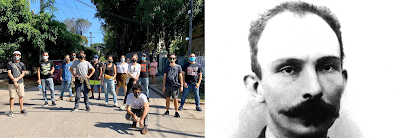
José
Martí was a poet, journalist, and Cuban independence leader. He had also endured prison for writings critical of the Spanish government. He organized a
war of independence, but did so without resorting to dehumanizing his
adversary or appealing to hatred. He was also a fierce advocate for
civil liberties and especially freedom of thought and expression. Today,
January 28 marks 170 years since the day José Julián Martí Pérez was born.
The communist dictatorship in Cuba claimsJosé
Martí as its own, but their ideology and actions are in stark contrast to his values.
Over a thousand sons and daughters of Cuba are arbitrarily and unjustly imprisoned today for exercising their right to free thought and expression in calling for freedom in July 2021. Eleven thousand are jailed for pre-crime in Cuba. The regime jails them for what they might potentially do in the future. Millions of Cubans have gone into exile, and many are barred from returning home by the Castro regime. The Castro regime continues to kill Cubans for standing up for freedom or attempting to flee Cuba to live in freedom. It has criminalized free speech, and jailed artists and independent journalists for exercising their profession.
"Man loves liberty, even if he does not know that he loves it. He is
driven by it and flees from where it does not exist."
"Freedoms, like privileges, prevail or are imperiled together You
cannot harm or strive to achieve one without harming or furthering all."
"Liberty is the right of every man to be honest, to think and to speak
without hypocrisy."
"It is the duty of man to raise up man. One is guilty of all
abjection that one does not help to relieve. Only those who spread
treachery, fire, and death out of hatred for the prosperity of others are
undeserving of pity."
Martí also criticized the writings of Karl Marx, observing they were antithetical to his own values. If one considers that he wrote, "It is the duty of man to raise up man. One is guilty of all abjection that one does not help to relieve. Only those who spread treachery, fire, and death out of hatred for the prosperity of others are undeserving of pity." He was a contemporary of Marx who had written in 1849, "We are ruthless and ask no quarter from you. When our turn comes we shall not disguise our terrorism." Martí recognized the dangers of Socialism and its doctrine of envy, observing:
"Socialist ideology, like so many
others, has two main dangers. One stems from confused and incomplete
readings of foreign texts, and the other from the arrogance and hidden
rage of those who, in order to climb up in the world, pretend to be
frantic defenders of the helpless so as to have shoulders on which to
stand."
The observation of José Martí that “A revolution is still necessary: the one that does not make its caudillo president, the revolution against revolutions, the uprising of all peaceful men, once soldiers, so that neither they nor anyone will ever be so again,”is a damning indictment of the 64 year dictatorship of the Castro brothers, but also relevant to free Cubans.
Martí wrote this before nonviolence was recognized as a powerful force to be used to achieve change. He led the effort to initiate Cuba's second war of independence and was killed in action during an early skirmish in that war in 1895.
However, the idea of an uprising of nonviolent men and women to carry out a "revolution against revolutions" that will usher in a democracy, and not another dictator, is precisely what many Cubans want.
Today also marks five years since nonviolence scholar Gene Sharp died. He taught generations that there was an alternative to bloody conflict
and that it was non-violent armed conflict. Professor Sharp practiced nonviolence as a conscientious objector during the Korean War, and studied the examples of Mohandas Gandhi, the Reverend Martin Luther King Jr., and many other nonviolent practitioners. He demonstrated that nonviolent resistance was anything but passive, and that success in a struggle required strategy as well.
"I say nonviolent struggle is armed struggle. And we have to take back
that term from those advocates of violence who seek to justify with
pretty words that kind of combat. Only with this type of struggle one
fights with psychological weapons, social weapons, economic weapons and
political weapons. And that this is ultimately more powerful against
oppression, injustice and tyranny then violence."
Cubans of all ideological stripes claim him as their own, but
objectively who has maintained the spirit of his words and ideals? Castroism is the antithesis of all that José Martí represented.
There
is a movement that seeks to restore human rights and liberties using
nonviolent means that uphold his values. These are courageous men and women who risk all
standing up to the Cuban dictatorship. Many have been jailed, some have been killed, and their families targeted for reprisals in this struggle for freedom.
Oswaldo Payá Sardiñas addresses the EU parliament (2002)
"The first victory we can claim is that our hearts are free
of hatred. Hence we say to those who persecute us and who try to
dominate us: ‘You are my brother. I do not hate you, but you are not
going to dominate me by fear. I do not wish to impose my truth, nor do I
wish you to impose yours on me. We are going to seek the truth
together.’"
It
also leads to #27N and the San Isidro Movement, and on January 27, 2021, artists,
journalists and intellectuals peacefully gathered in front of the
Ministry of Culture to read the works of José
Martí. They are his descendants.
The San Isidro Movement
Two years ago on the eve of the 168th anniversary of José Martí's birth, approximately 20 artists, journalists and intellectuals gathered mark the two month anniversary of hundreds of artists and intellectuals protesting at the Ministry of Culture
on November 27, 2020 for freedom of expression following the government
raid on the San Isidro Movement's headquarters in Havana hours earlier.
Out of this public demonstration, the Vice Minister of Culture agreed to
meet with 32 representatives and committed to an ongoing dialogue. The
27N movement was formed that same night, but afterwards the regime official reneged on his pledge.
Carolina
Barrero, an art historian, led the group in reading the poem "Dos
Patrias," which translates to "Two Homelands," and posted the video on
Facebook.
27 de enero de 2021.
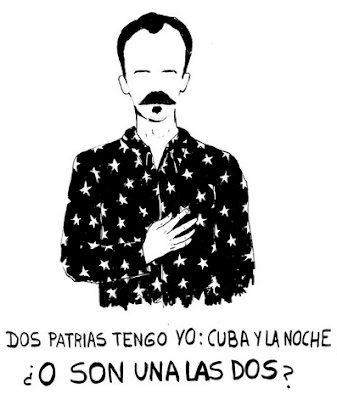
Dos patrias tengo yo: Cuba y la noche. ¿O son una las dos?
On January 27, 2021, Diario de Cuba reported on the preemptive
arrests, an act of repudiation against the gathered artists and
intellectuals, led by the Minister of Culture Alpidio Alonso and his
Vice-Minister Fernando León Jacomino, who were caught on camera
physically assaulting them. Secret police arrested the dissidents and crammed them into a small bus before beating them up while they were already detained.
Carolina
Barrero was charged with "Clandestine Printing," a crime under Article
210 of the Castro regime's penal code, for distributing the above image,
and a case was filed against her.
On March 21, 2021 Cuban artist Camila Ramírez Lobón
identified herself
as the author of the image and challenged regime officials: “The law
that you want to apply against the beauty, in the full sense of the
word, that Carolina embodies, you will
have to use against me, too,” she wrote.
Camila Ramírez Lobón
Other heirs, are to be found in Cuban diaspora, one of
them is Patiño Vázquez, a self described "Cuban-American child of mambo
and rock & roll." He created his own arrangement, a musical setting for this work of poetry.
Two Homelands
By José
Martí
I've got two homelands: Cuba and the night.
Or are both the same? As soon as
the sun withdraws its majesty, with long veils
and holding a carnation, silent,
Cuba, like a sad widow, appears in front of me
I know which bloody carnation trembles in her hand!
My chest is empty, it is torn and empty where the heart used to be.
It's time to start dying. The night is right to say good-bye.
The light disturbs and the human word.
The universe speaks better than (the) man.
Like a flag that invites you to battle, the red flame of the sail flatters.
I open the windows, already tight inside of me.
Muted, breaking the carnation's leaves, like a cloud that blurs the sky,
Cuba, a widow, passes...
In
2023 the heirs of Martí are subjected to political show trials,
beatings, forced exile, and extrajudicial executions by the Castro
dictatorship that has created an even more draconian penal code to punish those that dare exercise their fundamental human rights in expressing their desire for freedom.
Today is the 169th anniversary of the birth of José Julián Martí Pérez, better known as José Martí, and hundreds of sons and daughters of Cuba are being subjected to political show trials for expressing themselves, peacefully assembling, and/or reporting on what happened during the protests in mid-July 2021. The lives of many of these unjustly and arbitrarily imprisoned Cubans hang in the balance.
Luis Manuel Otero Alcántara marks 10 days on hunger and thirst strike today.
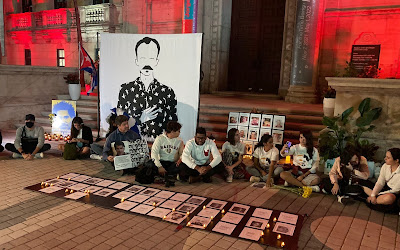
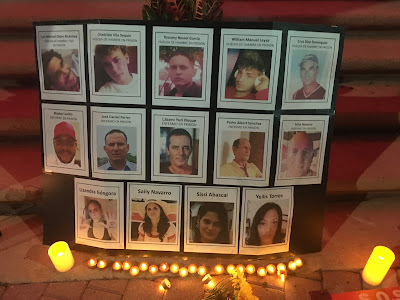
On the evening of January 25, 2022 at the Freedom Tower in a vigil organized and hosted by Anamely Ramos González and Claudia Genlui of the San Isidro Movement for the freedom of Luis Manuel Otero Alcántara, Yosvany Rosell García Caso, William Manuel Leyva, Cruz García Domínguez, and Chadrián Vila Sequín who are on hunger and thirst strike, and the rest of the political prisoners.
January 27, 2021 marked the two month anniversary of hundreds of artists and intellectuals protest at the Ministry of Culture
on November 27, 2020 for freedom of expression following the government
raid on the San Isidro Movement's headquarters in Havana hours earlier.
Out of that gathering, the Vice Minister of Culture agreed to meet with
32 representatives, and out of that encounter committed to an ongoing
dialogue. On that night the 27N movement was formed.
Artists and intellectuals pay homage to Martí at the Ministry of Culture
José
Martí was born on January 28, 1853 and in addition to being a
journalist, poet, and independence leader he was also a fervent defender of
freedom of expression and conscience.
Cubans of all ideological stripes claim him as their own, but
objectively who has maintained the spirit of his words and ideas? There
is a movement
in Cuba and in Exile that seeks to restore human rights and liberties using
nonviolent means. There are courageous men and women who risk everything
standing up to dictatorship. Many have been jailed and some of them have been killed in the process and their families targeted for reprisals.
Some of the political prisoners featured in the vigil at the Freedom Tower
José Martí wrote that "There is no forgiveness for acts of hatred.
Daggers thrust in the name of liberty are thrust into liberty's heart." He also criticized the writings of Karl Marx, observing they were antithetical to his own values. Marx in 1849 had written, "We are ruthless and ask no quarter from you. When our turn comes we shall not disguise our terrorism."
"Socialist ideology, like so many
others, has two main dangers. One stems from confused and incomplete
readings of foreign texts, and the other from the arrogance and hidden
rage of those who, in order to climb up in the world, pretend to be
frantic defenders of the helpless so as to have shoulders on which to
stand."
Following these statements to his modern day counterpart over a
century later leads one toOswaldo Paya, addressing the European Parliament on December 17, 2002:
"The first victory we can claim is that our hearts are free
of hatred. Hence we say to those who persecute us and who try to
dominate us: ‘You are my brother. I do not hate you, but you are not
going to dominate me by fear. I do not wish to impose my truth, nor do I
wish you to impose yours on me. We are going to seek the truth
together.’"
It
also leads to #27N and the San Isidro Movement, and the artists,
journalists and intellectuals peacefully gathered in front of the
Ministry of Culture to read the works of José
Martí on January 27, 2021. They are his heirs.
27 de enero de 2021.
Dos patrias tengo yo: Cuba y la noche. ¿O son una las dos?
One of them Carolina Barrero, an art historian, led the group in the reading of the poem "Dos Patrias" which translates to English to "Two Homelands," and posted the video
on Facebook last year. She also distributed a printed image of José Martí wearing a shirt with stars on it. This year, on the one year anniversary, she Tweeted the same video of herself reading the poem that is embedded above.
On January 27, 2021, Diario de Cuba reported on the preemptive
arrests, an act of repudiation against the gathered artists and
intellectuals, led by the Minister of Culture Alpidio Alonso and his
Vice-Minister Fernando León Jacomino, who were caught on camera
physically assaulting them. The dissidents
were arrested and crammed into a small bus by secret police and beaten up
while already detained.
State Security accused Carolina Barrero of “Clandestine Printing”, a crime under Article 210 of the Castro regime's penal code, for distributing the above image and pursued a case against her.
"They are afraid of nonviolent protests." - Camila Lobón (Periodico Cubano)
On March 21, 2021 Cuban artist Camila Ramírez Lobón
identified herself as the author of the image and challenged regime officials: “The law that you want to apply against the beauty, in the full sense of the word, that Carolina embodies, you will
have to use against me, too,” she wrote.
Other heirs, are to be found in Cuban diaspora, one of
them is Patiño Vázquez, a self described "Cuban-American child of mambo
and rock & roll." He created his own arrangement, a musical setting for this work of poetry.
Two Homelands
By José
Martí
I've got two homelands: Cuba and the night.
Or are both the same? As soon as
the sun withdraws its majesty, with long veils
and holding a carnation, silent,
Cuba, like a sad widow, appears in front of me
I know which bloody carnation trembles in her hand!
My chest is empty, it is torn and empty where the heart used to be.
It's time to start dying. The night is right to say good-bye.
The light disturbs and the human word.
The universe speaks better than (the) man.
Like a flag that invites you to battle, the red flame of the sail flatters.
I open the windows, already tight inside of me.
Muted, breaking the carnation's leaves, like a cloud that blurs the sky,
Cuba, a widow, passes...
In
2022 the heirs of Martí are subjected to political show trials, beatings, forced exile, and extrajudicial executions by the Castro dictatorship that
systematically denies freedom of speech and assembly, but claims the
poet as their own.
Ideas expressed below by José Martí are in conflict with Castroism and
cannot be reconciled. However they are in accord with the democratic
Cuba that helped draft the Universal Declaration of Human Rights in 1948,
and struggled for a more just and democratic order, but was first damaged by Fulgencio Batista on March 10, 1952 then systematically destroyed by
Fidel and Raul Castro beginning on January 1, 1959.
"Man loves liberty, even if he does not know that he loves it. He is
driven by it and flees from where it does not exist."
"Freedoms, like privileges, prevail or are imperiled together You
cannot harm or strive to achieve one without harming or furthering all."
"Liberty is the right of every man to be honest, to think and to speak
without hypocrisy."
"It is the duty of man to raise up man. One is guilty of all
abjection that one does not help to relieve. Only those who spread
treachery, fire, and death out of hatred for the prosperity of others are
undeserving of pity."
These views exist today in Cuba, but not in the regime, but among dissidents, defying the communist dictatorship, who embrace freedom while rejecting hatred. Cuban scientist Oscar Casanella, who took part and was beaten up during the unauthorized 2019 Pride March, went on hunger strike in the San Isidro Movement's headquarter's in November 2020, took part in the January 27, 2021 protest outside the Ministry of Culture, and went into exile earlier this month, was present at the vigil on January 25, 2022.
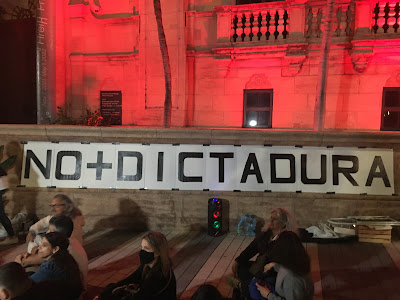
"No+Dictatorship" sign at Freedom Tower vigil in Miami on 1/25/22
The Castro regime and its agents of influence attempt to disqualify those now in the diaspora, but forget that José Martí was a political prisoner, who was forcibly exiled from Cuba by the Spaniards for 24 years, and spent those years in exile advocating for Cuba's independence and Cubans freedom.
Below is a video by Omni Zona Franca of the vigil on January 25, 2022 with organizers and participants interviewed.
These are the top 12 monthly blog entries of the year arranged in chronological
order. George Santayana understood the importance of remembering the
past in order to avoid repeating the same mistakes.
Thursday, January 28, 2021
José Julián Martí Pérez at 168: The heirs of José Martí and those who repress them now
"I think they kill my child every time they deprive a person of their right to think." - José Martí
On 27J, the eve of the 168th anniversary of the birth of José Julián Martí Pérez, better known as José Martí, approximately 20 artists, journalists and intellectuals gathered to read some of his works. [...] Preemptive arrests, an act of repudiation against gathered artists and
intellectuals, the Minister of Culture Alpidio Alonso and his
Vice-Minister Fernando León Jacomino, caught on camera
physically assaulting nonviolent demonstrators, and the dissidents
arrested and crammed into a small bus by secret police and beaten up
while already detained, reported Diario de Cuba. [ Full blog entry]
Wednesday, February 17, 2021
Celebrating real Cuban culture and the artists defying totalitarian efforts to rewrite it
Let us no longer shout "Homeland and Death" but "Homeland and Life"
Artists from the San Isidro Movement celebrating Cuban culture
"Totalitarianism demands, in fact, the continuous alteration of the
past, and in the long run probably demands a disbelief in the very
existence of objective truth," observed George Orwell in his essay, "The Prevention of Literature" in the journal Polemic, published in
January 1946. Writers that refuse to go along with alteration of the
past all too often pay a terrible price. This is also true for artists
in other fields because totalitarians seek to control the culture. [ Full blog entry ]
Tuesday, March 23, 2021
Setting the record straight on Cuito Cuanavale, General Arnaldo Ochoa,
and how South African democrats overcame and defeated Apartheid in 1991
Revisiting the nonviolent victory over Apartheid, Castro's
genocidal crimes in Africa, and the show trial of the Cuban general that
spent months battling the South African Defence forces.
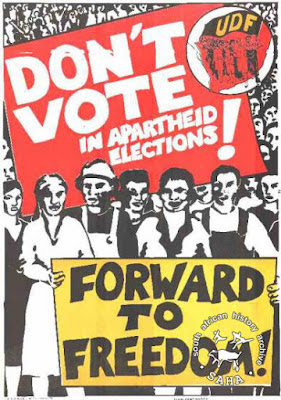
UDF boycotted elections
Communists reject nonviolence as a means to achieve lasting change,
because civil disobedience to them is incompatible with Karl Marx's
theory of class struggle. This is why they demonize and misrepresent Mohandas Gandhi, downplay the real events that brought an end to Apartheid in South Africa, highlight a dubious military victory in 1988 involving Cuban troops and falsely celebrate it as the agent of change. [ Full blog entry ]
Sunday, April 4, 2021
The Radical Left's Contempt for Martin Luther King Jr. in his final years
"But first He must suffer many things and be rejected by this generation." - Luke 17:25
MLK Jr. shot in Memphis, TN at the Lorraine Motel on 4/4/68 at 6:01pm CST
Today is Easter Sunday, but it is also the 53rd observance of the assassination of Reverend Martin Luther King Jr. On Good Friday, I quoted Reverend James Lawson, who like King is an apostle of nonviolence and a Christian pastor, said that “if you want to understand King, you must look at Jesus.” Dr. Martin Luther King Jr., like Jesus, was rejected by all. He was rejected by conservatives, by liberals, by radicals, and by communists. [ Full blog entry ]
Sunday, May 2, 2021
Cuban Dissident Luis Manuel Otero Alcántara on Day 8 of a hunger and
thirst strike: Some context informed by past actions and nonviolence
theory
"I think they kill my child every time they deprive a person of their right to think." - José Martí
Artist and human rights defender Luis Manuel Otero Alcántara
Luis Manuel Otero Alcántara is on the eighth day of a hunger and thirst strike, and in increasingly poor health. He is engaged in a profound dialogue with a regime that for decades has refused to listen,
to really listen, to Cuban citizens petitioning for and demanding
change. This dialogue has been going on for at least three years. He has
tried all types of protests, petitions, performance art pieces, and
music videos in defense of freedom of expression, especially artistic
expression. [ Full blog entry ]
Monday, June 14, 2021
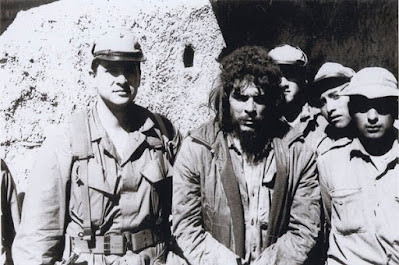
Ernesto "Che" Guevara born on this day in 1928. Nothing to celebrate.
A mass murdering racist, who dined with Mao as millions died of hunger is not someone to celebrate.
"All they that take the sword shall perish with the sword." - Matthew 26, 26:52
Some wish to celebrate Ernesto Guevara's birthday today. If he and his comrades had their way the world would have been subjected to a nuclear holocaust in October 1962, and they were bitterly disappointed that it did not happen.
Thankfully, John F. Kennedy and Nikita Khrushchev reached a peaceful outcome to the Cuban Missile Crisis, but
the Castro regime protested it and was unhappy with their Soviet
allies not launching their nuclear missiles. [ Full blog entry ]
Monday, July 19, 2021
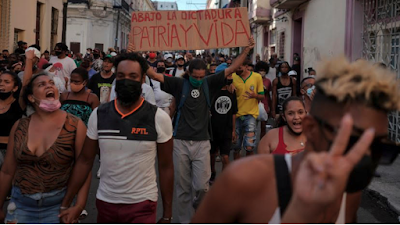
#11July: One week later and nonviolent resistance continues in Cuba
For freedom and justice.
On the streets of Cuba on July 11, 2021
One week later and the protests continue, despite the most brutal
efforts of the Castro regime to silence Cubans on the island. It began
on July 11, 2021 in San Antonio de los Baños, just South East of Havana when Cubans took to the streets in protest.
Others saw it streaming live, and also took to the street in cities and
towns across the country chanting "Freedom" and "Down with the
dictatorship."
President Miguel Diaz-Canel appeared on official television threatening: "They [protesters] would have to pass
over our dead bodies if they want to confront the revolution, and we are
willing to resort to anything." [ Full blog entry ]
Sunday, August 22, 2021
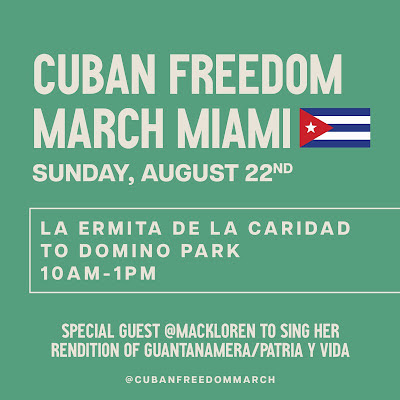
Cuban Freedom March Miami today August 22nd from 10am to 1pm: A reflection on its significance
"If there is to be any chance at all of success, there is only one
way to strive for decency, reason, responsibility, sincerity, civility
and tolerance, and this is decently, reasonably, responsibly, sincerely,
civilly, and tolerantly" - Václav Havel
The Cuban Freedom March
arrives in Miami, Florida today on August 22, 2021 with a march from la
Ermita de la Caridad to Domino Park. The protest starts at 10:00am.
Organizers have carried out successful marches in Washington DC, and Los
Angeles.
On August 11, 2021 the leader of this movement, Alian Collazo, moderated a conversation on "what's really happening in Cuba"
that is necessary viewing to listen to different perspectives, from
young Cuban and Cuban American voices both inside and outside of Cuba.
Twenty years after 9/11: Remembering a horrible day
"Are you ready? Okay. Let's roll."—Todd Morgan Beamer, November 24, 1968–September 11, 2001
2,977 men, women and children
were murdered on September 11, 2001 over the course of a few hours on a
sunny Tuesday morning in three different states. The victims were distributed as follows: 246 on
the four planes
converted into flying missiles. Two of the planes flew into the Twin
Towers which collapsed and led to the deaths of 2,606 human beings in
New York City in the towers and on the ground, and a third struck the
Pentagon taking 125 lives. The fourth plane, heading to Washington D.C.,
never arrived and crashed into an open field near Shanksville,
Pennsylvania as the passengers of the flight fought the terrorists over control of the flight. [ Full blog entry ]
Saturday, October 2, 2021
Join the non-violent movement for democracy and human rights in Cuba
"Use truth as your anvil, nonviolence as your hammer, and anything that
does not stand the test when it is brought to the anvil of truth and
hammered with nonviolence, reject it." - Mohandas Gandhi
Luis Manuel Otero Alcántara on day six of hunger strike in Cuba
July 11, 2021 national nonviolent protests
in Cuba marked a before and after in the history of the island. Tens of
thousands of Cubans across the island demanded an end to the
dictatorship, rejected the official slogan Patria o Muerte (Homeland or Death) and chanted Patria y Vida (Homeland and Life). The reaction of the dictatorship was swift and brutal. Boinas Negras
(black berets) formally known as the National
Special Brigade of the Ministry of the Interior, fired on unarmed
protesters, and were captured on video. The dictatorship handed out
clubs to regime agents to attack protesters. Thousands were detained,
and hundreds remain jailed and face summary trials with prison sentences
in excess of 25 years. [ Full blog entry ]
Tuesday, December 7, 2021
125 years ago today Antonio Maceo Grajales died fighting for Cuban
independence and 31 years ago Reinaldo Arenas died after decades
rebelling against the Castro dictatorship
"My
duties to country and to my own political convictions are above all
human effort; with these I shall reach the pedestal of freedom or I
shall perish fighting for my country's redemption." - Antonio Maceo, November 3, 1890
Today
marks the day 125 years ago on December 7, 1896 when Lieutenant General
Antonio Maceo Grajales died fighting for Cuban independence.
Today, also marks the day 31 years ago on
December 7, 1990 Cuban novelist Reinaldo Arenas killed himself in New
York City, after battling AIDS for several years. He was an important
critic of the Castro regime, and those intellectuals who supported it.
As a Gay man he also suffered discrimination because of the communist dictatorship's hostility to homosexuals. [ Full blog entry ]










 Posts
Posts

