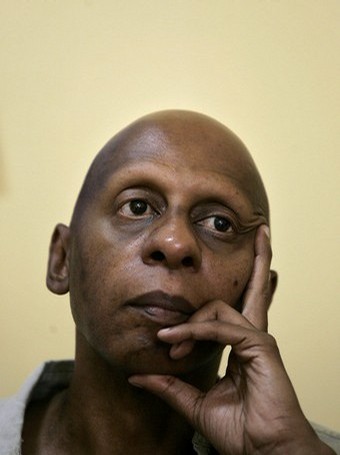
"The first victory we can claim is that our hearts are free of hatred. Hence we say to those who persecute us and who try to dominate us: ‘You are my brother. I do not hate you, but you are not going to dominate me by fear. I do not wish to impose my truth, nor do I wish you to impose yours on me. We are going to seek the truth together’. THIS IS THE LIBERATION WHICH WE ARE PROCLAIMING."
Oswaldo José Payá Sardiñas (2002)
Showing posts with label Guillermo Fariñas Hernández. Show all posts
Over twitter on Sunday Cuban dissidents expressed their condolences, prayers and mourning for Vaclav Havel. At the same time many recognized the solidarity he had demonstrated on their behalf over the years. The English translation is on top and the original Spanish in bold just below.
Guillermo Fariñas Hernández
Independent Journalist and Sakharov prize winner Guillermo Fariñas Hernández tweeted:
An icon of Democracy and liberty has died. God bless the memory of Vaclav Havel. Murio un icono de la Democracia y la Libertad. Dios bendiga la memoria de Vaclav Havel.
Pedro Argüelles Morán
Former prisoner of conscience of the group of the 75 Pedro Argüelles Morán tweeted
Havel is an example for those engaged in civic and pro-democratic struggle. God take him to his bosom. Havel es todo un ejemplo para los luchadores civilistas y pro~democraticos. Dios lo acoja en su seno.
Argüelles Morán further tweeted:
Vaclav Havelis gonephysically,because spiritually, he will always bepresent among those engaged in the civic struggleforfundamental rights and freedoms.
Havel ha desaparecido fisicamente,porque espiritualmente,siempre estara presente entre los luchadores civilista a favor de los derechos y libertades fundamentales.
Yoani Sanchez
Cuban blogger and philologist Yoani Sanchez tweeted that
Vaclav Havel’s book "The power of the powerless" helped me find my voice, to recognize myself as a civic being. Thank you teacher! "El poder de los sin poder" libro de Vaclav Havel que me ayudo a encontrar mi voz, a reconocerme como ente civico. Gracias maestro!
She also tweeted that
Vaclav Havel had passed away and we barely started to walk the path he walked dozens of years ago :-( Vaclav Havel y nosotros apenas hemos comenzado a transitar por un camino que el emprendio hace varias decadas :-(
Oswaldo Payá and Vaclav Havel
Leader of the Christian Liberation Movement and Sakharov prize winner Oswaldo Payá Sardiñas tweeted today that
Havel, precursor and guide to liberation in this new era. God receive you, friend in solidarity with the cause of democracy in Cuba. Havel, un precursor y guía de la liberación en esta nueva era. Dios te reciba, amigo solidario con la causa de la democracia en Cuba.
Oswaldo further tweeted:
Personally I lose an inspiring friend, from whom I received a great education. Always grateful to Havel for the reception he gave me. Personalmente pierdo un amigo ,un inspirador, del cual recibi una gran enseñanza. Siempre agradeceré a Havel la acogida que me dio.
Dagoberto Valdes
Dagoberto Valdes of CoexistenceMagazine tweeted:
Havelhasdied. The world has wona symbolof the "powerof the powerless."CoexistenceMagazineoffers itscondolencesand prayers.
Havel ha muerto.El mundo gana un simbolo del "poder de los sin poder". La revista Convivencia ofrece sus condolencias y oraciones.
Jose Daniel Ferrer Garcia
Former prisoner of conscience of the group of the 75, Jose Daniel Ferrer Garcia tweeted
The deathof formerCzechVaclav Havel, a friend ofCubahascauseddeep sorrow.A great manhas died.
Profundo dolor nos ha causado la noticia del fallecimiento del expresidente Checo Vaclav Havel, gran amigo de Cuba. Ha muerto un gran hombre.
Idania Yanes Contreras had been beaten up and arrested on October 31, 2011 with Antúnez as they visited a hospitalized hunger striker. Released on November 3 she had to go to the hospital to receive treatment. She was suffering from an undetermined infection and the aftermath of the attack by regime agents. She was back home yesterday still suffering the effects from the physical assault by Cuban state security agents: a dilated kidney and bleeding.
On November 11, 2011 at 7:32pm Jorge Luís García Pérez "Antúnez" was released from an arbitrary detention by agents of the Cuban government and tweeted the following:
Just been released after 72 hours, if this is a strategy of attrition as officer Azaharis says, we accept the challenge. As for the Front "the streets belong to the people" is more than a slogan it is a matter of principle.
In less than 30 days suffered 3 arrests of up to 72 hours, this is the repressive balance faced in recent days. If this is not political repression that someone prove otherwise to me.
The minutes of the Central Opposition Coalition (CCO) is concerned with the delicate state of health of our leader Idania, right kidney dilated and bleeding from police beatings.
Idania Yanez, already in her home in Santa Clara. With a dilated right kidney with bleeding from beatings. - Farinas
The Inter-American Commission on Human Rights (IACHR) expressed its concern over recent attacks suffered by Idania Yanes Contreras in Cuba on November 10,2011.
"In the minds of Cuba's current rulers, we Cuban citizens are just like the slaves from whom I am descended, kidnapped in Africa and brought to the Americas by force. For me or any other ordinary citizen to be able to travel abroad, I need a Carta de Libertad, that is a Freedom Card, just as the slaves did:, only today it is called a Carta Blanca, a White Card." - Guillermo Fariñas Hernández.
Dear Mr Jerzy Buzek, President of the European Parliament,
Dear Vice-Presidents and honorable Members of this multi-national democratic forum,
Unfortunately, for want of the tolerance that we so much need on this tormented planet of ours, I cannot be with you as a representative of the Cuban people in rebellion and those Cuban citizens who have lost their dread of the totalitarian government which has been repressing us for a shameful total of 52 years, whose latest victim is the martyr Orlando Zapata Tamayo.
Unluckily for those who misgovern us in our own homeland the fact that I cannot leave and return voluntarily to the island where I was born is, in itself, the most irrefutable witness to the fact that unfortunately, nothing has changed in the autocratic system ruling my country.
In the minds of Cuba's current rulers, we Cuban citizens are just like the slaves from whom I am descended, kidnapped in Africa and brought to the Americas by force. For me or any other ordinary citizen to be able to travel abroad, I need a Carta de Libertad, that is a Freedom Card, just as the slaves did:, only today it is called a Carta Blanca,a White Card.
Original address in Spanish
My deepest hope is that you will not allow yourselves to be deceived by the siren songs of a cruel regime practicing 'wild communism' whose only desire, after pretending to make ostensible economic changes, is that the European Union and the European Parliament will rescind the Common Position, and allow the regime to benefit from the loans and investments used to help Third World countries under the Cotonou Agreements.
Former political prisoners or prisoners of conscience, recently released by 'wild communism', will surely have taken their seats alongside you. It would be a mistake to think that they were set at liberty; they and their families are subject to 'psychological banishment', because their nearest and dearest were blackmailed by the neo-Stalinist Cuban Government.
We, the peaceful opposition within Cuba, take a stoical, rational approach to the material or spiritual difficulties we suffer, as we do to the risk of losing our freedom and even our lives, being as we are part of the least-favored sector of the population. Here, inside Cuba, we are all suffering, but we do not complain, for that reason we hope to be able to rely on your support.
Empty chair at Sakharov Prize Ceremony
Dear Members of the European Parliament, I ask you not to give in to the claims of the Cuban ruling elite, unless the following five demands are met:
First: continue with the release, without banishment, of all political prisoners and prisoners of conscience, and make a public commitment never to imprison non-violent political opponents.
Second: put an immediate end to the violent beating-up and threatening of the peaceful opposition within the country by the regime's military and paramilitary followers.
Third: announce that all Cuban laws which contravene the Universal Declaration of Human Rights are to be examined and repealed.
Four:grant the wherewithal, in daily practice, for establishing opposition parties, mass media not subordinate to the 'State socialism' system, independent trade unions and any other kinds of peaceful social bodies.
Five:publicly accept that all Cubans living in the diaspora have the right to take part in Cuba's cultural, economic, political and social life.
At this crucial juncture in the history of my country, you and all men and women of goodwill throughout the world need to pay close attention to the continual social outbursts and protests within Cuba, caused by frustration in the face of the overweening power of a government capable of issuing the order to murder my compatriots.
I hope to God that there will be no unnecessary civil war between Cubans due to a blind refusal to accept that the political model of 'State socialism' has been and is a failure wherever there has been an attempt to introduce it: something acknowledged by the historic leader of the ill-named Cuban Revolution himself in the foreign press.
The old men who govern Cuba, in their daily contempt for those they govern, do not wish to understand that they should be public servants, and that all genuine public servants give their compatriots the possibility of replacing them or endorsing them. No person in power should seek to be served by those he governs, as is the case in Cuba.
With our sisters and brothers in the struggle who share democratic ideals, with those who are still in prison, those who enjoy ostensible freedom in the streets, and those who have departed into the harshness of exile, we shall continue our unequal non-violent struggle against the Castroite oppressors, and with the help of God, we will win the battle without bloodshed.
If there is one thing that I do in the company of my dissident colleagues, it is to banish any rancor against my political adversaries from my soul. The fact is – and this makes us better human beings to tackle the task of rebuilding our homeland – that in this struggle I have learned to be guided by the words of the first known dissident, Jesus Christ: 'love thine enemies'.
I thank the European Parliament for not abandoning the Cuban people in these more than 50 years of the struggle for democracy. In accepting the 2010 Andrei Sakharov Prize for Freedom of Conscience that has been awarded to me I do so because I feel myself to be a tiny part of the rebellious spirit that nourishes the people I am proud to belong to.
I am extremely grateful to you, ladies and gentlemen, Members of the European Parliament, for this gesture shows that you have not forgotten the sufferings we endure, and thus your gesture brings the light of freedom that much closer to my country.
May God grant that in Cuba we shall shortly see reconciliation amongst His children, and that the country will be blessed with democracy.
Guillermo Fariñas Hernández
Qualified psychologist
Librarian and independent journalist, three times imprisoned on political grounds
Human rights − 15-12-2010 - 13:44 Plenary sessions
Cuban dissident Guillermo Fariñas, this year's winner of the European Parliament's Sakharov Prize for Freedom of Thought, had to be represented by an empty chair at the prize award ceremony on Wednesday as he did not receive permission to leave his country and travel to Strasbourg to receive the prize.
"Even though activists like Guillermo Fariñas are persecuted and are imprisoned, their voice cannot be silenced. The role of the European Parliament is to amplify that voice", said European Parliament president Jerzy Buzek.
"The Sakharov Prize is the trademark of the European Parliament in the fight for human rights all over the world. The empty chair for this year's laureate Guillermo Farinas is the best example of how important this fight is", added the president.
Catherine Ashton, the High Representative of the Union for Foreign Affairs and Security Policy and Vice-President of the Commission, made today the following statement:
"I would like to congratulate Guillermo Farinas on receiving the 2010 Sakharov Prize from the European Parliament in the name of all those who fight in Cuba for greater freedom and human rights. I regret that he has not been able to travel to Strasbourg to receive his prize in person.
The EU will continue to raise human rights in the EU-Cuba political dialogue and in bilateral meetings with the Cuban authorities at every level, including the situation of political prisoners, freedom of expression and ratification of the international bill of human rights. In this context, I welcome the recent release of a number of political prisoners in Cuba and I hope that the process will lead to the unconditional release of all political prisoners."
Addressing MEPs in a recorded message, Mr Fariñas expressed his gratitude to the European Parliament "for not abandoning the Cuban people in these more than 50 years of the struggle for democracy". He explained that he had accepted the Sakharov Prize for the Freedom of Thought "because I feel myself to be a tiny part of the rebellious spirit that nourishes the people I am proud to belong to."
Mr Fariñas criticised the government in Havana, saying "Unluckily for those who misgovern us in our own homeland the fact that I cannot leave and return voluntarily to the island where I was born is, in itself, the most irrefutable witness to the fact that unfortunately, nothing has changed in the autocratic system ruling my country."
He called on MEPs "not allow themselves to be deceived by the siren songs of a cruel regime practising 'wild communism'" when analysing EU policy towards Cuba. According to Mr Fariñas, a change of direction in these relations should only occur if the following five pre-conditions are met:
the release, without banishment, of all political prisoners and prisoners of conscience, with a public commitment never to imprison non-violent political opponents;
an end to the violent beatings of and threats to the peaceful opposition;
an announcement that all Cuban laws that contravene the Universal Declaration of Human Rights will be reviewed and repealed;
granting the means, in daily practice, for establishing opposition parties, mass media not subordinate to the 'State socialism' system, independent trade unions and any other kind of peaceful social bodies;
public acknowledgment that all Cubans living in the diaspora have the right to take part in Cuba's cultural, economic, political and social life.
Guillermo Fariñas
A doctor of psychology and a journalist, 48-year-old Guillermo Fariñas has denounced the Castro regime. He is the founder of "Cubanacán Press," an independent press agency aimed at raising awareness of the fate of political prisoners in Cuba.
Mr Fariñas has spent years in confinement and has gone on hunger strike 23 times so far as a non-violent means of fighting oppression in Cuba. His efforts to secure free internet for all earned him a Reporters Without Borders Cyber-Freedom Prize in 2006.
In July 2010, Mr Fariñas nearly died after a five-month-long hunger strike he began on 24 February, following the death of Orlando Zapata Tamayo, a fellow political activist who passed away after 80 days of hunger strike. He ended the strike after the Cuban government gave in to his plea and released 52 political prisoners.
Empty chair ceremony - not the first time in the European Parliament
This is not the first time that the Sakharov Prize has been awarded in the absence of the laureate. In 2008 China's most prominent human rights activists, Hu Jia, was also not able to take part in the ceremony as he was incarcerated, but a video message from his wife Zeng Jinyan was played to MEPs. For other winners, such as Aung San Suu Kyi in 1990 and Damas de Blanco (Ladies in White) in 2005, close family members or representatives took part in the ceremony but up to now the winners have still not received the prize in person.
The Sakharov Prize
The Sakharov Prize for Freedom of Thought, named in honour of the Soviet physicist and political dissident Andrei Sakharov, has been awarded by the European Parliament every year since 1988 to individuals or organisations who have made an important contribution to the fight for human rights or democracy.
"I am convinced that publicity is the sole effective means of combating the evil and lawlessness which is rampant in my country today." - Anatoli Marchenko
Orlando Zapata Tamayo & Anatoli Marchenko
On the eve of the 8 month anniversary of the death of prisoner of conscience and human rights activist Orlando Zapata Tamayo on February 23, 2010 the impact of his life and death are still reverberating around the world.
When Guillermo Fariñas Hernández learned that the European Parliament had awarded him the Sakharov Prize On October 21, 2010 he announced: “This prize I dedicate in particular to Orlando Zapata Tamayo and Pedro Luis Boitel. These two martyrs died from hunger strikes in protest against the dictatorship of Fidel Castro. I dedicate this prize to all the Cubans who have died for freedom and democracy in Cuba.”
Communism is an international phenomenon that demonstrates common patterns of repression regardless of geography and ethnicity. The tactics used to break down the person are the same whether in the Soviet Union, the People’s Republic of China or the Republic of Cuba under the Castro brothers.
On October 23, 2010 Orlando Zapata's family and friends gathered at his tomb
The patterns of resistance to communist repression share common patterns around the world. Before there was an Orlando Zapata Tamayo there was an Anatoli Marchenko. The parallels between the two are uncanny both were uncompromising human rights defenders who came from working class background. In the Introduction to his book My Testimony written about his time in prison in the 1960s Anatoli described how he survived the brutal conditions:
"When I was locked up in Vladimir Prison I was often seized by despair. Hunger, illness, and above all helplessness, the sheer impossibility of struggling against evil, provoked me to the point where I was ready to hurl myself upon my jailers with the sole purpose of being killed. .. One thing alone prevented me, one thing alone gave me the strength to live through that nightmare; the hope that I would eventually come out and tell the whole world what I had seen and experienced. .. And I gave my word on this to my comrades who were doomed to spend many more years behind bars and barbed wire."
Nevertheless, the commitment to the defense of human rights and not abandoning his homeland when told to by representatives of the Soviet regime would prove fatal. Soviet dissident Anatoli Marchenko was a worker-turned-human rights activist of Ukrainian origin. As a result of his human rights activism he spent 20 years in prisons and labor camps, whose cruel conditions he later described in his books.
One way in which he highlighted human rights problems in the then Soviet Union was through hunger strikes. The last one began on August 4, 1986 when he refused food demanding an end to the torture of political prisoners in the USSR and that they all be released. There was little reaction to his hunger strike from the world press. He died on December 8, 1986 at the age of 48 after being hospitalized the day before. Months later in 1987 Gorbachev announced the liberation of all political prisoners. One year later in 1988 Anatoli Marchenko was awarded the Sakharov Prize along with Nelson Mandela and to date the only one to win the award posthumously. Three years later in 1991 the Soviet Union was dissolved.
The news media that ignored the suffering and torture that Orlando Zapata Tamayo was subjected to and who ignored his hunger strike but reported on his death now recognize its importance. CNN on October 10, 2010 reported the fact that: “International pressure grew when one jailed dissident, Orlando Zapata Tamayo, died earlier this year following a prolonged hunger strike protesting inmate living conditions. The Cuban government responded by promising to free the group by November in the largest release of political prisoners in more than a decade.”
Orlando Zapata Tamayo’s name appears as a symbol of resistance to the systematic denial of human rights in Cuba and the need for all political prisoners to be freed and the laws changed. His sacrifice was not in vain, and the 2010 Sakharov Prize although awarded to Guillermo Fariñas Hernández would not have been awarded to a Cuban if not for the death of Orlando Zapata Tamayo on February 23, 2010. Like Anatoli Marchenko before him, Orlando Zapata Tamayo with his record as a human rights defender and his death on hunger strike denouncing torture and demanding freedom for all political prisoners has shaken the dictatorship and forced it to release the largest number of political prisoners since Pope John Paul II’s 1998 visit.
Now the question remains will the patterns of resistance and regime reactions continue to unfold in a similar pattern? If it does then it means that the dictatorship’s days may be numbered.
Regardless, Orlando Zapata Tamayo is in the thoughts and prayers of many Cubans remembering that 8 months ago today he died to demonstrate the brutal nature of the dictatorship so that others might live.
"I will never abandon the fight for human freedom. Peace depends on the freedom of each and every man." - Andrei Sakharov, 1986
Guillermo Fariñas Hernández was awarded the Sakharov Prize by the European Parliament on October 21, 2010. Who was Andrei Dmitrievich Sakharov, the man the award is named after? A nuclear physicist, he was considered the father of the Soviet hydrogen bomb, and later a human rights activist who won the 1975 Nobel Peace Prize. In his Nobel Lecture on December 11, 1975 (read by his wife Elena Bonner, who also accepted the prize, - he was not allowed to leave the Soviet Union) Sakharov made the case for the linkage between peace, economic development and human rights. Let him tell you in his own words about this remarkable journey.:
I was born on 21 May 1921. My father was a well-known teacher of physics and the author of textbooks, exercise books and works of popular science. I grew up in a large communal apartment where most of the rooms were occupied by my family and relations and only a few by outsiders. The house was pervaded by a strong traditional family spirit - a vital enthusiasm for work and respect for professional competence. Within the family we provided one another with mutual support, just as we shared a love of literature and science.
My father played the piano remarkably well, in particular Chopin, Grieg, Beethoven and Scriabin. During the civil war he earned a living by playing the accompaniment to silent films at the cinema.
I am especially grateful for the memory of my grandmother, Maria Petrovna, who was the family's good spirit. She died before the war at the age of 79. My grandmother brought up six children and when she was around 50 years old she taught herself English all on her own. Right up to the time of her death she read English works of fiction in the original. From when we were quite small she read aloud to us, her grandchildren. I still have the most vivid memory of her reading to us those evenings. It would be Pushkin, Dickens, Marlowe or Beecher-Stowe, and in Holy Week, the Gospel.
The influence of my home has meant a great deal to me, particularly because I had my first lessons at home and later experienced the greatest difficulty in adapting myself to my classmates. I took my final school examination with distinction in 1938 and at once began to study at the Faculty of Physics in Moscow University. Here too I passed my Finals with distinction, in 1942 when because of the war, we had been evacuated to Ashkhabad.
In the summer and autumn of 1942 I lived for some weeks in Kovrov where I had originally been sent to work after my graduation. Later I worked as a lumberjack in a desolate rural settlement near Melekess. My first bitter impressions of the life of the workers and peasants in that very hard time are derived from those days. In September 1942 I was sent to a large munitions factory on the Volga where I worked as an engineer and inventor right until 1945. At the factory I made a number of inventions in the field of production control. But in 1944, while still employed at the factory, I wrote some scientific articles on theoretical physics and sent them to Moscow for appraisal and comment. These first works were never published, but they gave me the self-confidence so essential to every researcher.
In 1945 I began to read for my doctorate at the Lebedev Institute, the department of physics in the Academy of Sciences of the USSR. My teacher there was the great theoretical physicist, Igor Evgenyevich Tamm.
He influenced me enormously and later became a member of the Academy of Sciences of the USSR and a winner of the Nobel Prize for physics. In 1947 I defended my thesis on nuclear physics, and in 1948 I was included in a group of research scientists whose task was to develop nuclear weapons. The leader of this group was I.E. Tamm.
For the next 20 years I worked under conditions of the highest security and under great pressure, first in Moscow and subsequently in a special secret research centre. At the time we were all convinced that this work was of vital significance for the balance of power in the world and we were fascinated by the grandeur of the task. In the foreword to my book Sakharov Speaks, as well as in My Country and the World, I have already described the development of my socio-political views in the period 1953-68 and the dramatic events which contributed to or were the expression of this development. Between 1953 and 1962 much of what happened was connected with the development of nuclear weapons and with the preparations for and realization of the nuclear experiments. At the same time I was becoming ever more conscious of the moral problems inherent in this work. In and after 1964 when I began to concern myself with the biological issues, and particularly from 1967 onwards, the extent of the problems over which I felt uneasy increased to such a point that in 1968 I felt a compelling urge to make my views public.
Thus it was that the article Progress, Peaceful Coexistence and Intellectual Freedom came into being. In reality these are the same themes which seven and a half years later were to become the title of my Nobel Lecture ("Peace, Progress and Human Rights"). I consider these themes to be fundamentally important and closely interconnected. My public stand represented a turning point for me and my entire future. The article very quickly became known throughout the world. For a long time the Soviet press contained no mention of the Progress, and later references were either disapproving in the extreme or else ironic. A great many critics, even if sympathetically disposed towards me, regarded my reflections in this work as exceedingly naive and speculative. Today, however, after eight intervening years, it seems that much of what may be termed important both in Soviet politics and in international politics is connected in one way or another with these thoughts.
From 1970 onwards the defence of human rights and the defence of the victims of political trials became all-important to me. Together with (Valery) Chalidze and Tverdokhlebov, and later with (Igor) Shafarevich and Podyapolski I shared in running the Committee for Human Rights, thus making my position quite clear. I feel bound to recall the fate of two of them. In April 1976 Andrei Tverdokhlebov was sentenced to five years exile for his social work, and in March Grigori Podyapolski was lost to us through his tragic premature death.
As early as 1950, Tamm and I were the joint originators of a Soviet work on controlled thermonuclear reaction (the thermonuclear reaction of hydrogen isotopes either for the production of electrical energy or for the production of fuel for nuclear reactors). Great advances have now been made in this work. A year later, at my initiative, experiments were started on the construction of implosive magnetic generators (devices by which chemical or nuclear reactions are transformed into magnetic field energy). In 1964 we attained a record with a magnetic field of 25 million gauss.
From July 1968, when my article was published abroad, I was removed from top-secret work and "relieved" of my privileges in the Soviet "Nomenclatura" (the privileged class at the top of the system). Since the summer of 1969 I have again been working at the Lebedev Institute where I studied, as an assistant, for my doctorate from 1945 to 1947 and began my scientific work. My present work concerns the problems connected with the theory of elementary particles, the theory of gravitation and cosmology and I shall be glad if I can manage to make some contribution to these important branches of science.
Nevertheless, it is the social issues which unremittingly demand that I make a responsible personal effort and which also lay increasing claims on my physical and mental powers. For me, the moral difficulties lie in the continual pressure brought to bear on my friends and immediate family, pressure which is not directed against me personally but which at the same time is all around me. I have written about this on many occasions but, sad to report, all that I said before applies equally today. I am no professional politician - which is perhaps why I am continually obsessed by the question as to the purpose served by the work done by my friends and myself, as well as its final result. I tend to believe that only moral criteria, coupled with mental objectivity, can serve as a sort of compass in the cross-currents of these complex problems.
I have stated in writing many times already that I intend to refrain from making any concrete political prognoses. There is a large measure of tragedy in my life at present. The sentences lately passed on my close friends - Sergei Kovalev (who just exactly at the time of the Nobel Prize ceremony was sentenced to seven years' imprisonment and three years' exile) and Andrei Tverdokhlebov - represent the clearest and most unequivocal evidence of this. Yet, even so, both now and for always, I intend to hold fast to my belief in the hidden strength of the human spirit.
After receiving the prize, Sakharov continued to work for human rights and to make statements to the West through Western correspondents in Moscow. Early in 1980, after he had denounced the Soviet invasion of Afghanistan, he was exiled to Gorky. In 1984, Elena Bonner joined him, also under sentence of exile. Isolated from family and friends, they continued to be persecuted by the KGB. Sakharov resorted to hunger strikes to secure medical treatment for Bonner, who was finally given permission to leave the Soviet Union for heart surgery in 1985. After Mikhail Gorbachev came to power with a policy of liberalisation, they were freed and allowed to return to Moscow in 1986. Despite the measure of freedom now possible, which enabled him to take up a political role as an elected member of the Congress of the People's Deputies, Sakharov was critical of Gorbachev, insisting that the reforms should go much further. He died in Moscow on December 14, 1989.
