Showing posts with label Jose Marti. Show all posts

Monday, May 20, 2024

Cuba Independence Day 2023: A reflection on the first 467 years [ 1492 - 1959 ]

  Before the arrival of the totalitarian darkness

Independence Day in Havana, Cuba on May 20, 1902

One hundred and twenty two years ago today at noon the flag of the United States was brought down and the Cuban flag raised over Havana as Cuba became an independent republic. However, when looking at Cuba one should look back over the first 467 years [1492 - 1959] and where it is situated today to gain greater understanding of the unfolding tragedy.

Cuba is just 90 miles south of the United States with a population of approximately 11 million people. It is 780 miles long and has a land area of 40,369 square miles and is the largest island in the Caribbean and 17th-largest island in the world by land area.

Cuba seen from space.

Columbus’s second stop in the New World was on October 28, 1492 when he landed in Cuba. (The first place he landed on October 12 was the Bahamas). Cuba was a Spanish colony from Columbus’s landing in 1492 until 1898 when Spain lost Cuba in the Spanish-American War.

President Tomas Estrada de Palma

Cubans engaged in two protracted wars of independence. The first was the 10 Years War that took place between 1868 and 1878 and the second took place between 1895 and 1898 ending with U.S. intervention and a 4-year occupation that ended on May 20, 1902. Cuba's first president was a Cuban exile named Tomas Estrada de Palma.

Future first Cuban president Tomas Estrada de Palma travels to Havana

There are many important figures and entities that emerge in the 19th century but for the sake of brevity will mention Father Felix Varela, Jose Marti, Antonio Maceo, Maximo Gomez and the Bacardi family.

Father Varela was a catholic priest who is said to “have taught the Cubans how to think” and entertained ideas of independence that led to his exile to the United States. 

Antonio Maceo and Maximo Gomez were Cuban generals that played important roles in both wars of independence. Antonio Maceo was of a mixed racial background: part Spanish and part African.

Maximo Gomez, was an experienced military man of Dominican origin who oversaw the overall military campaign in the second war of independence and of the three previously mentioned was the only one who survived the war to see the arrival of the Republic.

José Martí and Antonio Maceo

Jose Marti was a journalist, poet and revolutionary who organized and advocated for the 1895 war of independence and spent most of his adult life exiled in the United States in New York City.

The Bacardi family, began their world famous Rum business in Santiago de Cuba. Don Facundo Bacardí Massó and Don Emilio Bacardi founded Bacardi Limited on February 4, 1862.

Emilio Bacardi Lay, son of one of the two founders of Bacardi, Don Emilio Bacardi, "was a field officer for Gen. Antonio Maceo in 1895 during the invasion of Cuba by independence forces, and reached the rank of colonel by the age of 22," according to his obituary in The New York Times on October 16, 1972 when he died at the age of 95 in exile in Miami. 

Emilio Bacardi Lay

The family would also play an important role in civic life in Cuba, especially Santiago over the 20th century, and were constant opponents of dictatorship, political corruption and remained ardent Cuban nationalists over several generations.

Forced into exile by the Castro regime the Bacardi family has maintained the traditions of the Cuban Republic celebrating independence day, carrying on the family business and continuing the fight for a free Cuba.

The beginning of the Cuban republic on May 20, 1902 had an asterisk – The Platt Amendment: which allowed the United States to intervene in Cuban affairs if U.S. interests were threatened. This Amendment was gotten rid of in 1933 but left a bad taste in the mouth of Cuban nationalists.

Between 1902 and 1952 Cuba progressed socially and economically but faced challenges on the political front. For example in the late 1920s Gerardo Machado, the democratically elected president did not want to leave power becoming a dictator. He was driven from office and into exile in 1933 by a general strike

This was followed by a revolution led by university students and enlisted men in what became known as the sergeants revolt.  

During this period labor unions made great strides for worker's rights in Cuba, especially after the ousting of President Gerardo Machado in 1933.  

Ramon Grau San Martin's provisional government marked a before and after in Cuban history. Between October and December of 1933, it issued a first package of popular and nationalist measures that strengthened labor rights in Cuba.

  1. Created the Ministry of Labor, since there was no body specifically in charge of labor matters.
  2. Established employer liability for accidents; he suspended the evictions of tenants and canceled 50% of the taxes and contributions not paid in due time.
  3. Established the eight-hour work day and the right to unionize. He promulgated the Labor Nationalization Law that established the obligation that 50% of the workers and employees had to be native Cubans.

Labor legislation passed in 1938 guaranteed Cuban workers' additional rights: 

  1.  A minimum wage; 
  2. Pensions that assumed a constitutional character;
  3. Creation of the Central of Workers of Cuba Central de Trabajadores de Cuba (CTC in Spanish) 

In 1940 all the political tendencies in Cuba met to draft what became known as the 1940 Constitution and a presidential election was held and Fulgencio Batista elected. He served out his term as president from 1940 to 1944. Due to a clause in the new Constitution he was unable to run for re-election. Cuba's 1940 Constitution further enshrined workers’ rights into law with 26 articles which included:

A maximum work day of no more than 8 hours and a maximum working week of 44 hours equivalent to 48 in wages (Article 66); The right to paid vacation of one month for each 11 months of work in each calendar year (Article 67); The right of unionization (Article 69); The right to strike (Article 71); The system of collective labor contracts (Article 72); a non-discriminatory practice in the distribution of opportunities to work ( Article 74).

Strong trade unions and labor legislation in the Cuban Republic were a factor in rising living standards, and improved healthcare outcomes.

In the election of 1944 the opposition candidate, Ramon Grau San Martin, won and served a term as president from 1944-1948 and in the election of 1948, Batista’s political party again lost at the general elections and Carlos Prios Socarras was elected president.

Cuba's republic during this democratic period played an important role in the drafting of the Universal Declaration of Human Rights of the United Nations and the establishment of the UN Human Rights Commission.

This democratic renaissance was brought to an end within days of the 1952 presidential elections, when on March 10th Fulgencio Batista organized a coup against the last democratically elected president.

A little over a year later on July 26, 1953, Fidel Castro organized an armed assault on the Moncada Military barracks that was a military disaster but a public relations success. Although most of the men involved with Fidel Castro in the assault were killed, Fidel Castro became a national figure at his trial for organizing the attack. At the trial he portrayed himself as a democrat that wanted to restore the previous democratic order and attacked the Batista dictatorship for its usurpation of the democratic order.


How the totalitarian darkness arrived in Cuba

Upon Batista’s departure from Cuba on January 1, 1959 Fidel Castro began his triumphal trek across Cuba to Havana where he began to consolidate power while continuing publicly to claim that he was a democrat but privately began to infiltrate his movement with communists, alienating many who had fought with him. 

On January 22, 1959 the CTC was replaced by the CTC-Revolucionaria. In the X Congress, held in November 1959, the Secretary General, David Salvador Manso,"said that the workers had not gone to the event to raise economic demands but to support the revolution." And in the XI Congress, November 1961, the delegates renounced almost all the achievements of the labor movement, including  "the nine days of leave for sickness, the supplementary Christmas bonus, the weekly shift of 44 x 48 hours, the right to strike and an increase of 9.09%, among many others. Workers were required to do "voluntary work" that was actually mandatory.

Castro began to approach the mass media threatening them with violence if they reported anything critical. As the months passed all independent media were taken over. Mass televised executions imposed fear in the populace.

 Ramiro Valdez oversaw the installation of the totalitarian communist apparatus in Cuba beginning in 1959. He is now probably doing the same thing in Venezuela.  It was on his watch that the East German Stasi, and KGB created and trained Cuban State Security.

This is how the darkness of totalitarianism took over Cuba and 64 years later remains entrenched there. Cuba gained its independence on May 20, 1902 after centuries of Spanish colonial rule and four years of U.S. occupation following the Spanish American war.

Half of Cuba's post colonial history, thus far, has been under the boot of communist caudillos whose father, ironically, fought for the Spanish crown in the war of independence.

What would José Martí say?

José Julián Martí Pérez: January 28, 1853 - May 19, 1895

José Martí was killed in battle against Spanish troops at the Battle of Dos Ríos, near the confluence of the rivers Contramaestre and Cauto, on May 19, 1895. He is buried in the Santa Efigenia Cemetery in Santiago de Cuba. Cubans the world over honor his memory and Cuban independence follows a day later. Seven years and one day after Martí's death Cuba formally obtained its independence on May 20, 1902.

Cubans across the ideological divide claim José Martí as their own. The claims of the dictatorship led by the Castro brothers that Martí is the intellectual author of their political project is ironic considering that the life and writings of this Cuban patriot is the antithesis of the Castro regime.

José Martí believed that "Peace demands of Nature the recognition of human rights." A 64 year old dictatorship that rejects fundamental human rights is the antithesis of what the Cuban independence leader fought and died for.

Furthermore, José Martí proclaimed the idea that: "One just principle from the depths of a cave is more powerful than an army." 

A principle shared not only by dissidents in Cuba today but also echoed by Vaclav Havel, one of the dissidents who had an important role in ending Communism in Eastern Europe in 1989 said: "I really do inhabit a system in which words are capable of shaking the entire structure of government, where words can prove mightier than ten military divisions."

On this Cuban Independence Day we observe that Cubans have lived without democracy for 72 years, and rededicate ourselves to the struggle for a free Cuba. 


May 20, 1902 the Cuban flag is raised and the Republic born

Sunday, January 28, 2024

Remembering José Martí and his legacy on his 171st birth anniversary

 "Freedom can not be fruitful for the peoples who have their forehead stained in blood." - José Martí*

José Martí, 28 January 1853 – 19 May 1895
 
He re-launched an independence struggle, but he did so without inciting hatred or dehumanizing his opponents. He was a fervent supporter of civil liberties, particularly the freedom of thought and expression. In addition, he worked as a journalist and poet, having previously been imprisoned by the Spanish monarchy for his political views. Today, January 28 marks 171 years since the day José Julián Martí Pérez was born.
 
Cubans of all ideological stripes claim him as their own, but objectively who has maintained the spirit of his words and ideas? There is a movement in Cuba that seeks to restore human rights and liberties using nonviolent means. There are courageous Cubans who risk everything standing up to dictatorship and some of them have been assassinated in the process and their families targeted for reprisals, and forced into exile.

José Martí wrote that "There is no forgiveness for acts of hatred. Daggers thrust in the name of liberty are thrust into liberty's heart." Following this statement to its logical conclusion leads us over a century later to new generations carrying on his legacy.

"The first victory we can claim is that our hearts are free of hatred. Hence we say to those who persecute us and who try to dominate us: ‘You are my brother. I do not hate you, but you are not going to dominate me by fear. I do not wish to impose my truth, nor do I wish you to impose yours on me. We are going to seek the truth together.’" - Oswaldo Payá Sardiñas, December 17, 2002

"Those who steal the rights of others steal from themselves. Those who remove and crush freedom are the true slaves." Harold Cepero Escalante, November 3, 2002  

In their writings and in their lives, Oswaldo and Harold exemplified the best qualities of José Martí, rejecting hatred and continuing to defy injustice while pursuing liberation and national reconciliation. 

Cuban Martyrs: Oswaldo Payá Sardiñas, and Harold Cepero Escalante,

Today in Cuba over a thousand Cubans are jailed for calling for freedom, and an end to dictatorship. They are the direct heirs of José Martí. Let us honor them, and Cuba's apostle in campaigning for their freedom, and for the liberation of Cuba from the present communist dictatorship.  

*"La libertad no puede ser fecunda para los pueblos que tienen la frente manchada de sangre." - Jose Marti  

Saturday, May 20, 2023

Cuba Independence Day 2023: A reflection on the first 467 years

 Before the arrival of the totalitarian darkness


Independence Day in Havana, Cuba on May 20, 1902

One hundred and twenty one years ago today at noon the flag of the United States was brought down and the Cuban flag raised over Havana as Cuba became an independent republic. However, when looking at Cuba one should look back over the first 467 years and where it is situated today to gain greater understanding of the unfolding tragedy.

Cuba is just 90 miles south of the United States with a population of approximately 11 million people. It is 780 miles long and has a land area of 40,369 square miles and is the largest island in the Caribbean and 17th-largest island in the world by land area.

Cuba seen from space.

Columbus’s second stop in the New World was on October 28, 1492 when he landed in Cuba. (The first place he landed on October 12 was the Bahamas). Cuba was a Spanish colony from Columbus’s landing in 1492 until 1898 when Spain lost Cuba in the Spanish-American War.


President Tomas Estrada de Palma

 Cubans engaged in two protracted wars of independence. The first was the 10 Years War that took place between 1868 and 1878 and the second took place between 1895 and 1898 ending with U.S. intervention and a 4-year occupation that ended on May 20, 1902. Cuba's first president was a Cuban exile named Tomas Estrada de Palma.


Future first Cuban president Tomas Estrada de Palma travels to Havana

There are many important figures and entities that emerge in the 19th century but for the sake of brevity will mention Father Felix Varela, Jose Marti, Antonio Maceo, Maximo Gomez and the Bacardi family.

Father Varela was a catholic priest who is said to “have taught the Cubans how to think” and entertained ideas of independence that led to his exile to the United States. 

Antonio Maceo and Maximo Gomez were Cuban generals that played important roles in both wars of independence. Antonio Maceo was of a mixed racial background: part Spanish and part African.

Maximo Gomez, was an experienced military man of Dominican origin who oversaw the overall military campaign in the second war of independence and of the three previously mentioned was the only one who survived the war to see the arrival of the Republic.

José Martí and Antonio Maceo

Jose Marti was a journalist, poet and revolutionary who organized and advocated for the 1895 war of independence and spent most of his adult life exiled in the United States in New York City.

The Bacardi family, began their world famous Rum business in Santiago de Cuba. Don Facundo Bacardí Massó and Don Emilio Bacardi founded Bacardi Limited on February 4, 1862.

Emilio Bacardi Lay, son of one of the two founders of Bacardi, Don Emilio Bacardi, "was a field officer for Gen. Antonio Maceo in 1895 during the invasion of Cuba by independence forces, and reached the rank of colonel by the age of 22," according to his obituary in The New York Times on October 16, 1972 when he died at the age of 95 in exile in Miami.  

Emilio Bacardi Lay

The family would also play an important role in civic life in Cuba, especially Santiago over the 20th century, and were constant opponents of dictatorship, political corruption and remained ardent Cuban nationalists over several generations.

Forced into exile by the Castro regime the Bacardi family has maintained the traditions of the Cuban Republic celebrating independence day, carrying on the family business and continuing the fight for a free Cuba.

The beginning of the Cuban republic on May 20, 1902 had an asterisk – The Platt Amendment: which allowed the United States to intervene in Cuban affairs if U.S. interests were threatened. This Amendment was gotten rid of in 1933 but left a bad taste in the mouth of Cuban nationalists.

Between 1902 and 1952 Cuba progressed socially and economically but faced challenges on the political front. For example in the late 1920s Gerardo Machado, the democratically elected president did not want to leave power becoming a dictator. He was driven from office and into exile in 1933 by a general strike

This was followed by a revolution led by university students and enlisted men in what became known as the sergeants revolt.  


During this period labor unions made great strides for worker's rights in Cuba, especially after the ousting of President Gerardo Machado in 1933.  

Ramon Grau San Martin's provisional government marked a before and after in Cuban history. Between October and December of 1933, it issued a first package of popular and nationalist measures that strengthened labor rights in Cuba.

  1. Created the Ministry of Labor, since there was no body specifically in charge of labor matters.
  2. Established employer liability for accidents; he suspended the evictions of tenants and canceled 50% of the taxes and contributions not paid in due time.
  3. Established the eight-hour work day and the right to unionize. He promulgated the Labor Nationalization Law that established the obligation that 50% of the workers and employees had to be native Cubans.

Labor legislation passed in 1938 guaranteed Cuban workers' additional rights: 

  1.  A minimum wage; 
  2. Pensions that assumed a constitutional character;
  3. Creation of the Central of Workers of Cuba Central de Trabajadores de Cuba (CTC in Spanish) 

In 1940 all the political tendencies in Cuba met to draft what became known as the 1940 Constitution and a presidential election was held and Fulgencio Batista elected. He served out his term as president from 1940 to 1944. Due to a clause in the new Constitution he was unable to run for re-election. Cuba's 1940 Constitution further enshrined workers’ rights into law with 26 articles which included:

A maximum work day of no more than 8 hours and a maximum working week of 44 hours equivalent to 48 in wages (Article 66); The right to paid vacation of one month for each 11 months of work in each calendar year (Article 67); The right of unionization (Article 69); The right to strike (Article 71); The system of collective labor contracts (Article 72); a non-discriminatory practice in the distribution of opportunities to work ( Article 74).

Strong trade unions and labor legislation in the Cuban Republic were a factor in rising living standards, and improved healthcare outcomes.

In the election of 1944 the opposition candidate, Ramon Grau San Martin, won and served a term as president from 1944-1948 and in the election of 1948, Batista’s political party again lost at the general elections and Carlos Prios Socarras was elected president.

Cuba's republic during this democratic period played an important role in the drafting of the Universal Declaration of Human Rights of the United Nations and the establishment of the UN Human Rights Commission.

This democratic renaissance was brought to an end within days of the 1952 presidential elections, when on March 10th Fulgencio Batista organized a coup against the last democratically elected president.

A little over a year later on July 26, 1953, Fidel Castro organized an armed assault on the Moncada Military barracks that was a military disaster but a public relations success. Although most of the men involved with Fidel Castro in the assault were killed, Fidel Castro became a national figure at his trial for organizing the attack. At the trial he portrayed himself as a democrat that wanted to restore the previous democratic order and attacked the Batista dictatorship for its usurpation of the democratic order.


How the totalitarian darkness arrived in Cuba

Upon Batista’s departure from Cuba on January 1, 1959 Fidel Castro began his triumphal trek across Cuba to Havana where he began to consolidate power while continuing publicly to claim that he was a democrat but privately began to infiltrate his movement with communists, alienating many who had fought with him. 

On January 22, 1959 the CTC was replaced by the CTC-Revolucionaria. In the X Congress, held in November 1959, the Secretary General, David Salvador Manso,"said that the workers had not gone to the event to raise economic demands but to support the revolution." And in the XI Congress, November 1961, the delegates renounced almost all the achievements of the labor movement, including  "the nine days of leave for sickness, the supplementary Christmas bonus, the weekly shift of 44 x 48 hours, the right to strike and an increase of 9.09%, among many others. Workers were required to do "voluntary work" that was actually mandatory.

Castro began to approach the mass media threatening them with violence if they reported anything critical. As the months passed all independent media were taken over. Mass televised executions imposed fear in the populace.

 Ramiro Valdez oversaw the installation of the totalitarian communist apparatus in Cuba beginning in 1959. He is now probably doing the same thing in Venezuela.  It was on his watch that the East German Stasi, and KGB created and trained Cuban State Security.

This is how the darkness of totalitarianism took over Cuba and 64 years later remains entrenched there. Cuba gained its independence on May 20, 1902 after centuries of Spanish colonial rule and four years of U.S. occupation following the Spanish American war.

Half of Cuba's post colonial history, thus far, has been under the boot of communist caudillos whose father, ironically, fought for the Spanish crown in the war of independence.

What would José Martí say? 

José Julián Martí Pérez: January 28, 1853 - May 19, 1895


José Martí was killed in battle against Spanish troops at the Battle of Dos Ríos, near the confluence of the rivers Contramaestre and Cauto, on May 19, 1895. He is buried in the Santa Efigenia Cemetery in Santiago de Cuba. Cubans the world over honor his memory and Cuban independence follows a day later. Seven years and one day after Martí's death Cuba formally obtained its independence on May 20, 1902.

Cubans across the ideological divide claim José Martí as their own. The claims of the dictatorship led by the Castro brothers that Martí is the intellectual author of their political project is ironic considering that the life and writings of this Cuban patriot is the antithesis of the Castro regime.

José Martí believed that "Peace demands of Nature the recognition of human rights." A 64 year old dictatorship that rejects fundamental human rights is the antithesis of what the Cuban independence leader fought and died for.

Furthermore, José Martí proclaimed the idea that: "One just principle from the depths of a cave is more powerful than an army." 

A principle shared not only by dissidents in Cuba today but also echoed by Vaclav Havel, one of the dissidents who had an important role in ending Communism in Eastern Europe in 1989 said: "I really do inhabit a system in which words are capable of shaking the entire structure of government, where words can prove mightier than ten military divisions."

On this Cuban Independence Day we observe that Cubans have lived without democracy for 71 years, and rededicate ourselves to the struggle for a free Cuba. 

May 20, 1902 the Cuban flag is raised and the Republic born


Saturday, May 21, 2022

Cuban Freedom March NYC today May 21st starts at 11am: A reflection on its significance

 "If there is to be any chance at all of success, there is only one way to strive for decency, reason, responsibility, sincerity, civility and tolerance, and this is decently, reasonably, responsibly, sincerely, civilly, and tolerantly" - Václav Havel 


The Cuban Freedom March arrives in New York City, New York today on May 21, 2022 with a march from Good Morning America in Times Square to the Jose Marti statue in Central Park. The protest starts at 11:00am. Organizers have carried out successful marches in Washington DC, Los Angeles, and Miami.

This is a freedom movement led by young Cubans and Cuban Americans with a presence on social media on Instagram, Facebook, and Twitter.

This is a means to demonstrate continued support for human rights and freedom in Cuba through the nonviolent exercise of an important and fundamental right: peaceful assembly.

 The values expressed by this youth movement thus far are in agreement with the values expressed by the San Isidro Movement, the Patriotic Union of Cuba, the Ladies in White and the Liberation Christian Movement in Cuba.

 
The pro-democracy movement in Cuba is a nonviolent movement, and within the spectrum of nonviolent actions there are at least 198 identified by the nonviolence theoretician Gene Sharp.
 
These freedom marches fall under the category of processions by Professor Sharp. Marches are identified as the 38th of 198 identified nonviolent actions by Gene Sharp.  
 
Strategic nonviolence takes a pragmatic approach that is based on being more effective then violence, especially when confronting brutal dictatorships, like the Castro regime
 

Non-violent resistance is an armed struggle but its weapons are not deployed to do violence or kill. These arms are  psychological, social, economic and political weapons.  Gene Sharp argues with much evidence "that this is ultimately more powerful against oppression, injustice and tyranny then violence. Historical studies are cited that demonstrate the higher success rates of nonviolent movements when compared against violent ones:
University Academics Maria J. Stephan and Erica Chenoweth in their 2008 study "Why Civil Resistance Works: The Strategic Logic on Nonviolent Conflict" compared the outcomes of 323 nonviolent and violent resistance campaigns from 1900 to 2006. They found that major nonviolent campaigns have achieved success 53 percent of the time, compared with just under half that at 26 percent for violent resistance campaigns. Finally there study also suggests “that nonviolent campaigns are more likely than violent campaigns to succeed in the face of brutal repression.”
Therefore, if you want to help Cubans on the island than you owe it to them and to yourself to listen to them, review what they have done in the past, are doing today, the repression suffered, and learn as much as you can about the philosophy and strategy of nonviolence they have embraced for decades.
 

Beginning in the 1970s a nonviolent human rights movement emerged in the prisons and would win some battles against the dictatorship using grassroots civic resistance tactics and endure to the present day inspiring millions of Cubans on the island and around the world.

Transnational assistance to Cuban nonviolent activists have been measures of concrete solidarity with the Cuban people that draws howls from the dictatorship and their allies, but gratitude from most Cubans. 
 
Below are some presentations, documentaries, and historic clips that can be of use as an introduction to nonviolence. 
 
Many are also available in Spanish to circulate among Cubans on the island that until now have not been directly connected to the national civic resistance movement there.  

Friday, May 20, 2022

Cuba Independence Day 2022: A reflection on the first 530 years

 Before the arrival of the totalitarian darkness

Independence Day in Havana, Cuba on May 20, 1902

One hundred and twenty years ago today at noon the flag of the United States was brought down and the Cuban flag raised over Havana as Cuba became an independent republic. However, when looking at Cuba one should look back over the past 530 years and where it is situated today to gain greater understanding of the unfolding tragedy.

Cuba is just 90 miles south of the United States with a population of approximately 11 million people. It is 780 miles long and has a land area of 40,369 square miles and is the largest island in the Caribbean and 17th-largest island in the world by land area.

Columbus’s second stop in the New World was on October 28, 1492 when he landed in Cuba. (The first place he landed on October 12 was the Bahamas). Cuba was a Spanish colony from Columbus’s landing in 1492 until 1898 when Spain lost Cuba in the Spanish-American War.

Cubans engaged in two protracted wars of independence. The first was the 10 Years War that took place between 1868 and 1878 and the second took place between 1895 and 1898 ending with U.S. intervention and a 4-year occupation that ended on May 20, 1902. Cuba's first president was a Cuban exile named Tomas Estrada de Palma.


Future first Cuban president Tomas Estrada de Palma on way to Havana

There are many important figures and entities that emerge in the 19th century but for the sake of brevity will mention Father Felix Varela, Jose Marti, Antonio Maceo, Maximo Gomez and the Bacardi family.

Father Varela was a catholic priest who is said to “have taught the Cubans how to think” and entertained ideas of independence that led to his exile to the United States. 

Antonio Maceo and Maximo Gomez were Cuban generals that played important roles in both wars of independence. Antonio Maceo was of a mixed racial background: part Spanish and part African.

Maximo Gomez, was an experienced military man of Dominican origin who oversaw the overall military campaign in the second war of independence and of the three previously mentioned was the only one who survived the war to see the arrival of the Republic.

José Martí and Antonio Maceo

Jose Marti was a journalist, poet and revolutionary who organized and advocated for the 1895 war of independence and spent most of his adult life exiled in the United States in New York City.

The Bacardi family, began their world famous Rum business in Santiago de Cuba. Don Facundo Bacardí Massó and Don Emilio Bacardi founded Bacardi Limited on February 4, 1862.

Emilio Bacardi Lay, son of one of the two founders of Bacardi, Don Emilio Bacardi, "was a field officer for Gen. Antonio Maceo in 1895 during the invasion of Cuba by independence forces, and reached the rank of colonel by the age of 22," according to his obituary in The New York Times on October 16, 1972 when he died at the age of 95 in exile in Miami.  

Emilio Bacardi Lay

The family would also play an important role in civic life in Cuba, especially Santiago over the 20th century, and were constant opponents of dictatorship, political corruption and remained ardent Cuban nationalists over several generations. 

Forced into exile by the Castro regime the Bacardi family has maintained the traditions of the Cuban Republic celebrating independence day, carrying on the family business and continuing the fight for a free Cuba.

The beginning of the Cuban republic on May 20, 1902 had an asterisk – The Platt Amendment: which allowed the United States to intervene in Cuban affairs if U.S. interests were threatened. This Amendment was gotten rid of in 1933 but left a bad taste in the mouth of Cuban nationalists.

Between 1902 and 1952 Cuba progressed socially and economically but faced challenges on the political front. For example in the late 1920s Gerardo Machado, the democratically elected president did not want to leave power becoming a dictator. He was driven from office and into exile in 1933 by a general strike

This was followed by a revolution led by university students and enlisted men in what became known as the sergeants revolt. This put Fulgencio Batista into the national spotlight and by 1934 he was the strong man behind the scenes even though democratic formalities were restored.

In 1940 all the political tendencies in Cuba met to draft what became known as the 1940 Constitution and a presidential election was held and Fulgencio Batista elected. He served out his term as president from 1940 to 1944. Due to a clause in the new Constitution he was unable to run for re-election. 

In the election of 1944 the opposition candidate, Ramon Grau San Martin, won and served a term as president from 1944-1948 and in the election of 1948, Batista’s political party again lost at the general elections and Carlos Prios Socarras was elected president.

Cuba's republic during this democratic period played an important role in the drafting of the Universal Declaration of Human Rights of the United Nations and the establishment of the UN Human Rights Commission.

This democratic renaissance was brought to an end within days of the 1952 presidential elections, when on March 10th Fulgencio Batista organized a coup against the last democratically elected president.

A little over a year later on July 26, 1953, Fidel Castro organized an armed assault on the Moncada Military barracks that was a military disaster but a public relations success. Although most of the men involved with Fidel Castro in the assault were killed, Fidel Castro became a national figure at his trial for organizing the attack. At the trial he portrayed himself as a democrat that wanted to restore the previous democratic order and attacked the Batista dictatorship for its usurpation of the democratic order.


How the totalitarian darkness arrived in Cuba

Upon Batista’s departure from Cuba on January 1, 1959 Fidel Castro began his triumphal trek across Cuba to Havana where he began to consolidate power while continuing publicly to claim that he was a democrat but privately began to infiltrate his movement with communists, alienating many who had fought with him, and began to approach the mass media threatening them with violence if they reported anything critical. As the months passed all independent media were taken over. Mass televised executions imposed fear in the populace.

Ramiro Valdez oversaw the installation of the totalitarian communist apparatus in Cuba beginning in 1959. He is now probably doing the same thing in Venezuela.  It was on his watch that the East German Stasi trained Cuban State Security.

This is how the darkness of totalitarianism took over Cuba and 63 years later remains entrenched there. Cuba gained its independence on May 20, 1902 after centuries of Spanish colonial rule and four years of U.S. occupation following the Spanish American war.

Half of Cuba's post colonial history, thus far, has been under the boot of communist caudillos whose father, ironically, fought for the Spanish crown in the war of independence.


José Martí
What would José Martí say? 

José Martí was killed in battle against Spanish troops at the Battle of Dos Ríos, near the confluence of the rivers Contramaestre and Cauto, on May 19, 1895. He is buried in the Santa Efigenia Cemetery in Santiago de Cuba. Cubans the world over honor his memory and Cuban independence follows a day later. Seven years and one day after Martí's death Cuba formally obtained its independence on May 20, 1902.

Cubans across the ideological divide claim José Martí as their own. The claims of the dictatorship led by the Castro brothers that Martí is the intellectual author of their political project is ironic considering that the life and writings of this Cuban patriot is the antithesis of the Castro regime.

José Martí believed that "Peace demands of Nature the recognition of human rights." A 63 year old dictatorship that rejects fundamental human rights is the antithesis of what the Cuban independence leader fought and died for.

Furthermore, José Martí proclaimed the idea that: "One just principle from the depths of a cave is more powerful than an army." 

A principle shared not only by dissidents in Cuba today but also echoed by Vaclav Havel, one of the dissidents who had an important role in ending Communism in Eastern Europe in 1989 said: "I really do inhabit a system in which words are capable of shaking the entire structure of government, where words can prove mightier than ten military divisions."

On this Cuban Independence Day we observe that Cubans have lived without democracy for 70 years, and rededicate ourselves to the struggle for a free Cuba. 

May 20, 1902 the Cuban flag is raised and the Republic born


Saturday, February 1, 2020

Irene in Havana: Cuba under the Castros is a profoundly anti-Marti regime.

Presentation made today at the Christian Democrat Movement's traditional lunch to celebrate the birth of Jose Julian Marti-Perez. The film Irene in Havana was screened during the lunch.


"Irene in Havana," is a short film by Lilo Villaplana that premiered on November 27, 2018 at the Manuel Artime Theater in Miami.

The images in the movie, The Cathedral, the Paseo del Prado, the Malecon and the Cabaña, were filmed clandestinely in the streets of Cuba. There were also some scenes filmed in Miami.

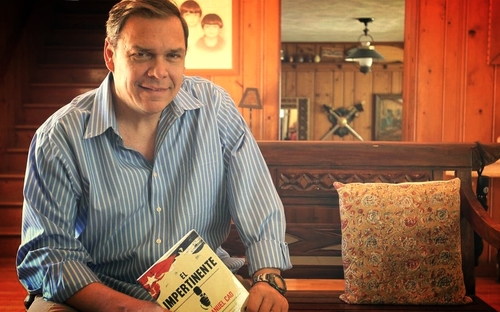
The script is by journalist Juan Manuel Cao, a prisoner of conscience in Cuba who at age 20 was jailed for three years for "enemy propaganda," and tortured. He spent time in the Combinado del Este, La Cabaña and Mazorra, a psychiatric facility were he was tortured.


Screenwriter Juan Manuel Cao
This short film speaks many truths of the first years of the Castro dictatorship.

Truths that continue to be suffered into the present.

24 years ago on February 24, 1996 four young men were killed while searching for rafters in the Florida Straits, in international space when Fidel and Raul Castro gave the orders to launch missiles and destroy two Brothers to the Rescue planes.


Ten years ago on February 23, 2010, the brick layer, human rights defender, and prisoner of conscience Orlando Zapata Tamayo, after seven years of torture, died on hunger strike. It was a death facilitated by regime officials who denied him water as punishment.


Four days ago Rolando Rodriguez Lobaina, a former political prisoner, freelance journalist and human rights defender "was regulated" - that is he was denied his rights to travel freely - despite having all his documents in order. His last message was that they were detaining him.

Rolando Rodriguez Lobaina
Today his family reports that the secret police say they arrested him but released him an hour later. The family knows nothing about Rolando and they fear for his life.

Cuba, under the Castros, is a profoundly anti-Marti regime. Marti believed in freedom, especially freedom of thought and expression.

Under the Castro regime freedom of expression can end in prison for engaging in "enemy propaganda," and freedom of thought can also lead you to prison for the crime of "dangerousness." This is an affront to Jose Marti's belief that "[l]iberty is the right of every man to be honest, to think and to speak without hypocrisy." Hypocrisy, under the Castro regime, is a currency for survival.

This is the Cuba of the Castros that has existed for six decades. This is the Cuba captured in "Irene in Havana."