Showing posts with label Oswaldo Payá. Show all posts

Monday, March 24, 2025

#StandUp4HumanRights: International Day for the Right to Truth about Human Rights Abuses

"As we inaugurate this new international observance, let us recognize the indispensable role of the truth in upholding human rights – and let us pledge to defend the right to the truth as we pursue our global mission of human rights."

Secretary-General Ban Ki-moon 24 March 2011


El Salvador's Msgr Oscar Arnulfo Romero slain 3/24/1980. Poland's Fr Jerzy Popiełuszko murdered 10/19/1984.

 On December 21, 2010, the United Nations General Assembly proclaimed March 24 as the International Day for the Right to the Truth concerning Gross Human Rights Violations and for the Dignity of Victims. According to the proclamation the purpose of this day is to:

  • Honor the memory of victims of gross and systematic human rights violations and promote the importance of the right to truth and justice;
  • Pay tribute to those who have devoted their lives to, and lost their lives in, the struggle to promote and protect human rights for all;
  • Recognize, in particular, the important work and values of Archbishop Oscar Arnulfo Romero, of El Salvador, who was assassinated on 24 March 1980, after denouncing violations of the human rights of the most vulnerable populations and defending the principles of protecting lives, promoting human dignity and opposition to all forms of violence.

It also seems appropriate today to honor and pay tribute to Father Jerzy Popiełuszko, of Poland, who was kidnapped, tortured and assassinated on October 19, 1984 by sharing an excerpt from his February 28, 1982 sermon:

"The church always stands on the side of truth. The church always stands on the side of people who are victimized. Today the church stands on the side of those who have lost their freedom, whose conscience is being broken. Today the church stands on the side of Solidarity, on the side of the working people, who are often placed in one line along with common criminals. Dedication to freedom is tightly knit with human nature and with mature national awareness. This dedication is intertwined with the law and duty. It is intertwined with the law, and thus every man and every nation must experience the suppression of freedom as painful and unjust."

Both Archbishop Romero and Father Popiełuszko were victims of gross and systematic human rights violations and sadly over the past forty five years there have been many more:

15 years, one month and one day ago Cuban prison officials announced the death of prisoner of conscience Orlando Zapata Tamayo at 3:00pm. He had suffered beatings, torture, and years added to his unjust prison sentence because Orlando continued to denounce human rights abuses in prison. He refused to look the other way and remain silent. The secret police and prison guards drove him to the last recourse of a non-violent activist: the hunger strike. Even there the regime sought to torture and humiliate denying him, a man on a water only hunger strike, water. It is believed that act of torture contributed to the failure of his kidneys and to his death. Oswaldo Payá said that Orlando died for the dignity of all Cubans. Following his death the dictatorship and its apologists continued to attack and smear this human rights defender. It is for that reason that especially on this day that Orlando Zapata Tamayo be remembered.


Orlando Zapata Tamayo, tortured and denied water, while on hunger strike murdered on Feb 23, 2010 

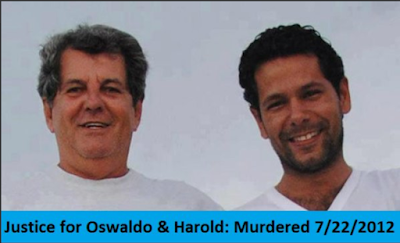
On July 22, 2012, Havana's secret police murdered Oswaldo Payá Sardiñas and Harold Cepero Escalante. In 2023, following a ten year investigation, the Inter-American Commission on Human Rights confirmed that the two human rights defenders were killed by Cuban government agents.

Oswaldo Payá  was sixty years old when he was assassinated. He was a family man and lay Catholic from Havana, an engineer who, in September 1988, founded the Christian Liberation Movement with fellow Catholics in the El Cerro neighborhood, and over the next 23 years would carry out important campaigns to support human rights and a democratic transition in Cuba.  Oswaldo would speak out against human rights breaches and demand victims' dignity, even if it meant denouncing the United States for mistreating Al Qaeda prisoners at the Guantanamo Naval Base prison in 2002. Oswaldo was a consistent defender of human rights, but not the only one.

Harold Cepero  was 32 years old when he was extrajudicially executed alongside Oswaldo. He was from the town of Chambas in Ciego de Ávila.  Harold began studying at the University of Camaguey when he was 18 years old, and in 2002, he and other students signed the Varela Project. It was a legal measure inside the existing Cuban constitution sponsored by the Christian Liberation Movement. Despite this, Harold and other students were expelled from the university for signing it and sharing it with others. The secret police would organize a mob to "judge", scream at, insult, threaten and expel the students who had signed the Varela Project. Following his expulsion on November 13, 2002, Harold wrote a letter warning that "those who steal the rights of others steal from themselves. Those who remove and crush freedom are the true slaves."  Expelled from university for signing the Varela Project with fellow students. He enrolled in a seminary and began studying for the priesthood before leaving to join the Christian Liberation Movement, embracing a new vocation as a human rights defender. 


This is not an exhaustive accounting, there are thousands of Cuban victims alone.

The right to the truth and the defense of the dignity of the victims are crucial elements in the process of obtaining justice. 

There are over 1,100 political prisoners today in Cuba. 

In Miami, on March 28, 2025 starting at 6 p.m., a march will begin at the Brigade 2506 Monument, at the corner of 8th Street and 13th Avenue in Little Havana, and will travel down 13th Avenue to the Museum of the Cuban Diaspora. The idea is to hear the names of all the remaining political prisoners on the island along the trajectory of the march. 

We must remember both the dead and the living, not for revenge, but for truth, memory, and justice.

It is a long known fact recorded in history by the great Roman statesmen Marcus Tullius Cicero that "The hope of impunity is the greatest inducement to do wrong." 

Exposing the truth about these crimes and defending the dignity of the victims while seeking to hold those responsible accountable both under the rule of law and by the judgment of history will provide the greatest amount of justice that humanity can provide limiting impunity and the repetition of these crimes.

Saturday, December 17, 2022

20 years ago today, Oswaldo Paya received the European Parliament's Sakharov Prize


SPEECH DELIVERED BY MR. OSWALDO PAYÁ UPON ACCEPTING THE SAKHAROV PRICE FOR FREEDOM OF THOUGHT


Strasbourg, December 17, 2002

English translation below:

First of all, I should like to express my thanks to Mr. Pat Cox, President, and to this Parliament in which the many peoples of Europe are represented.

You have awarded the Andrei Sakharov Prize to the people of Cuba. I say “the people of Cuba” because they are the ones who so richly deserve such an award. I say it without excluding any of my fellow countrymen, irrespective of their political stance, because rights have no political, racial or cultural hue. Nor have dictatorships any political color: they are neither right-wing nor left-wing, they are merely dictatorships. In my country there are thousands of men and women who are fighting in the midst of persecution for the rights of all Cubans. Hundreds of them have been imprisoned solely for having proclaimed and stood up for those rights, and this is why I am receiving this award on their behalf.

I say that this prize is for all Cubans because I believe that, in awarding it, Europe wishes to say to them: “You too are entitled to rights.”

This is something which we have always firmly believed, but there are times when this truth has seemed to be less than self-evident to many of the world’s people.

I have not come here to ask you to support those who oppose the Cuban Government or to condemn those who persecute us. It is of no help to Cuba that some people in the world side with the country’s government or with the latter’s opponents on the basis of an ideological standpoint. We want others to side with the Cuban people - with all Cubans – and this means upholding all their rights, supporting openness, supporting our demand that our people should be consulted via the ballot box regarding the changes we are calling for. We are asking for solidarity so that our people can be given an opportunity to speak through the ballot box, as proposed in the Varela Project.

Many people have linked this prize to the Varela Project, and rightly so, since the thousands of Cubans who, in the midst of repression, have signed the petition calling for a referendum are making a decisive contribution to bringing about the changes which Cuba needs. Those changes would mean involvement in cultural and economic life, civil and political rights, and national reconciliation. That would constitute a genuine exercise in self-determination by our people. We must reject the myth that we Cubans have to live without rights in order to support our country’s independence and sovereignty.

Father Felix Varela has taught us that independence and national sovereignty are inseparable from the exercise of basic rights. We Cubans – whether we live in Cuba or in the diaspora – are a single people and we have both the determination and the ability to build a just, free and democratic society, without hatred and without the desire for revenge. In the words of José Marti, ‘With everyone and for everyone’s benefit’.

We have not chosen the path of peace as a tactic, but because it is inseparable from the goal for which our people are striving. Experience teaches us that violence begets more violence and that when political change is brought about by such means, new forms of oppression and injustice arise. It is our wish that violence and force should never be used as ways of overcoming crises or toppling unjust governments. This time we shall bring about change by means of this civic movement which is already opening a new chapter in Cuba’s history, in which dialogue, democratic involvement, and solidarity will prevail. In such a way we shall foster genuine peace. Cuba’s civic combatant heroes – the ordinary people who have signed the Varela Project – carry no weapons. Not a single hand is armed. We walk with both arms outstretched, offering our hands to all Cubans as brothers and sisters, and to all peoples of the world.

The first victory we can claim is that our hearts are free of hatred. Hence we say to those who persecute us and who try to dominate us: ‘You are my brother. I do not hate you, but you are not going to dominate me by fear. I do not wish to impose my truth, nor do I wish you to impose yours on me. We are going to seek the truth together’. THIS IS THE LIBERATION WHICH WE ARE PROCLAIMING.

There are still those who perpetuate the myth that the exercising of political and civil rights is an alternative to a society’s ability to achieve social justice and development. They are not mutually exclusive. The absence of any civil and political rights in Cuba has had serious consequences such as inequality, the poverty of the majority and privileges of a minority and the deterioration of certain services, even though these were conceived as a positive system to benefit the people. In this way, although many Cubans have for years worked out of love and in good faith, the situation as regards civil and political rights is now serious, quite apart from a widening inequality and the deterioration in the quality of life of the majority of the population. Among other things, the freedom of action of the citizens of Cuba has been limited, which has neutralized their huge potential for creativity and productiveness and is the main reason for the country’s poverty.

This state of affairs cannot be justified by saying that the Cuban people have adopted this system out of choice. You all know that none of the peoples represented in this Parliament, and no people in the world, would ever give up the right to exercise their fundamental freedoms.

It is becoming increasingly apparent that well-being and economic and social progress are the fruits of being able to exercise one’s rights. In the same way, a democracy is not genuine and complete if it cannot initiate and sustain a process that raises the quality of life of all its citizens, because no people would freely vote for the kind of poverty and inequality that results in the masses becoming disadvantaged and marginalized. The peoples of Latin America are calling for a genuine democracy which will enable justice to be established. It is scandalous that methods intended to overcome a crisis and end poverty can be applied in the name of efficiency when in reality they threaten to obliterate the poor. I cannot claim to herald new positions or propose new models, but the people of Cuba have lived and suffered under various political and economic systems.

We now know that any method or model which purportedly aims to achieve justice, development, and efficiency but takes precedence over the individual or cancels out any of the fundamental rights leads to a form of oppression and to exclusion and is calamitous for the people. We wish to express our solidarity with all those who suffer from any form of oppression and injustice, and with those in the world who have been silenced or marginalized.

The cause of human rights is a single cause, just as the people of the world are a single people. The talk today is of globalization, but we must state that unless there is global solidarity, not only human rights but also the right to remain human will be jeopardized. If there is no solidarity between people we will be unable to preserve a fair world in which it is possible to continue living as human beings. I therefore humbly believe that rather than new models, both for societies and for relations between countries, what we need is a new spirit.

This new spirit, which should find expression in solidarity, cooperation, and justice in the relations between countries, will not impede development, because if policies and models are made secondary to personal realization and the establishment of justice and democracy, and if policies are humanized, we will bridge the gulfs that divide peoples and will become a true human family.

We bring from Cuba a message of peace and solidarity for all peoples. The people of Cuba accept this prize with dignity and in the hope that we can rebuild our society with love for all, as brothers, and as children of God. Cubans are straightforward people and want nothing more than to live in peace and progress in our work, but WE CANNOT, WE DO NOT KNOW HOW TO, AND WE DO NOT WANT TO LIVE WITHOUT FREEDOM.

We dedicate this prize and our hopes to the Lord Jesus, born in a lowly manger.

Thank you and Merry Christmas.

Oswaldo Payá Sardiñas addressed European Parliament  in 2002


Tuesday, April 5, 2022

Fourteen years of the Geneva Summit for Human Rights and Democracy: A look back

"The world is in greater peril from those who tolerate or encourage evil than from those who actually commit it." - Albert Einstein

The 14th Geneva Summit for Human Rights and Democracy convenes in Switzerland on April 6, 2022. Over the past fourteen years this summit has been and continues to be a vital space for dissenting voices to gather and engage in an important conversation: to diagnose the problems challenging human rights and dignity and to do better and be better in order to turn around the 16 year global decline in human rights.  


The first edition was held on April 19, 2009, "one day before the international community gather[ed] in Geneva to address racism, intolerance and persecution in the High-Level Segment of the UN Durban Review Conference (DRC)" and it had a longer title, "Geneva Summit for Human Rights, Tolerance and Democracy" and the tag line, "Stop Discrimination, Go for Human Rights." UN Watch, a Geneva based NGO whose mission is "to monitor the performance of the United Nations by the yardstick of its own Charter", brought together an international coalition of nineteen organizations to co-sponsor the summit. 


Founding members of the Coalition are: The Assistance Association for Political Prisoners (Burma), AVEGA (Rwanda), CADAL (Argentina), Directorio (Cuba), Darfur Peace and Development Center (Sudan), Fondation Généreuse Développement (Cameroon), Freedom House (USA), Freedom Now (USA ), Groupe des Anciens Etudiants Réscapés du Genocide (Rwanda), Global Zimbabwe Forum (Zimbabwe), Human Rights Without Frontiers (Belgium),  International Federation of Liberal Youth, (United Kingdom), Ingenieurs du Monde (Switzerland) LICRA (France), SOS Racisme (France), Stop Child Executions (Canada), Becket Fund for Religious Liberty (USA), East and Horn of Africa Human Rights Defenders Project (Uganda), UN Watch (Switzerland). Fourteen years later the partners coalition has grown to 27.

Arielle Herzog, Leon Saltiel, Hillel C. Neuer and other UN Watch staff were the chief organizers of the first six editions and responsible for their great success and establishing this space for dialogue. UN Watch today continues to lead this coalition and build on this great legacy, but it is important to return to the beginning to see how we arrived were we are today.

The UN Durban Review Conference (DRC) of 2009 was one more example of the ongoing moral bankruptcy of the United Nations. The star speaker, and apparently the only head of state invited to speak, was Iran's notorious president, Mahmoud Ahmadinejad who engages in holocaust denial and has called for the destruction of Israel. This conference, ostensibly to confront the problem of racism, began a gathering point of the worse dictatorships on the planet to legitimize themselves and demonize Israel.

Meanwhile, in marked contrast, the Geneva Summit for Human Rights, Tolerance and Democracy was held at the Centre International de Conférences Genève, just down the street from the Palais des Nations UN compound where the DRC was being held. Human rights defenders, victims of repression and political dissidents gathered to share their experiences, bear witness, and attempt to wield real political force from the power of human conscience. This is what the martyred Czech dissident and philosopher Jan Patočka called the "solidarity of the shaken". This coalition called for an end to discrimination and for human rights promotion.

The first summit's inaugural speech was given by by Iranian Activist and President of Stop Child Executions, Nazanin Afshin Jam, who outlined the human rights situation in Iran. She addressed that under Iranian laws the life of a woman is worth half of a man's and other sexist practices, the execution of homosexuals, and the executions of minors. The Iranian activist also gave an overview of the summit that began at 9:00am and ended at 6:30pm.

The inaugural summit was divided into four sessions that were tied into the Universal Declaration of Human Rights.

Session I was titled "Racism, Genocide, and Crimes Against Humanity: Assessing the Genocide Convention After 60 Years" and the panel was made up by Irwin Cotler, Counsel for genocide victims and dissidents, Canadian MP, Gregory Stanton, President of Genocide Watch and International Association of Genocide Scholars, Ester Murawajo, Tutsi survivor, founder of AVEGA and Dominique Sopo, President of SOS Racisme.  

Session II was titled "Resisting Authoritarianism: Human Rights, Democracy, and the Dissident Movement" with speakers Bo Kyi, Burmese dissident and winner of the Human Rights Prize from Human Rights Watch, Saad Eddin Ibrahim, Egyptian dissident, José Gabriel Ramón Castillo, Cuban dissident and prisoner of conscience, and Esra'a Al Shafei, dissident blogger, Mideast Youth - Thinking Ahead.

Session III was titled "Torture and Cruel and Inhuman Treatment" with speakers Nazanin Afshin-Jam, president of Stop Child Execution,  Parvez Sharma, Producer of the documentary Jihad for Love, and Ahmad Batebi, Iranian dissident.

Session IV was titled "Freedom of Expression and 'Defamation of Religion'" with panelists  Mohamed Sifaoui, Journalist, Algeria, Floyd Abrams, U.S. advocate for First Amendment press freedom,  Patrick Gaubert, President of LICRA and Member of the European Parliament.

The 2nd Geneva Summit was held on March 8-9, 2010, strategically timed to coincide with the main annual session of the U.N. Human Rights Council. The objective of the 2010 Geneva Summit was to give voice to victims of the world’s worst abusers, empowering those who suffer repression under closed systems of government.

The program featured plenary sessions, workshops and training sessions over two days. A large portion of the program was dedicated to presentations—personal and compelling testimony—from victims of the world’s worst abusers.

On March 8, 2010 gave the opening address on behalf of the Geneva Summit Coalition for the second edition of the Geneva Summit. Sadly, these words remain relevant today, but now the global decline in political freedoms and civil liberties has expanded from four to thirteen years in a row.

Regrettably, the chief international body charged with protecting human rights is failing to live up to its mission to stop these and other abuses. The Geneva-based UN Human Rights Council—as acknowledged in a recent report by 17 of its 47 member states, supported by Amnesty International, Human Rights Watch, and the International Commission of Jurists—falls short in its handling of country situations, in the efficiency of the process involved in highlighting violations, and in its reactivity to crisis situations. Strong politicization of the Council, driven by bloc-based voting patterns, has led to inaction in face of atrocity and abuse. We saw this sad spectacle last week within the Council, first with the secretary general of Iran’s High Council for Human Rights denying the documented and rampant instances of torture, executions, and mass detentions of Iranians followed by the Cuban Foreign Minister’s speech who echoing his Iranian colleague also denied Cuba’s horrible human rights record and to add insult to injury went on to blame the United States for the death of Orlando Zapata Tamayo as well as slander the deceased Cuban prisoner of conscience as a criminal.

Little wonder that the March 1st magazine issue of Newsweek contains an article titled “The Downfall of Human Rights.” The article highlights Freedom House's report "Freedom in the World," released in January, and reveals a global decline in political freedoms and civil liberties for the fourth year in a row, the longest drop in the almost 40 years that the survey has been produced.

According to Summit organizers, "[m]ore then 800 people registered to attend the summit and over 1600 watched the live webcast. 35 dissidents and human rights activists took the floor to condemn and testify about some of the worst human rights situations around the world and issued a joint call for Internet Freedom around the world."
Cuban dissident Nestor Rodriguez Lobaina was denied an exit visa by the Castro regime despite being invited to attend the Geneva Summit, but the coalition did not stop there and started a campaign for him to attend.

30 NGOs from this Summit called on the UN High Commissioner for Human Rights to intervene on behalf of Cuban human rights defender Nestor Rodriguez Lobaina barred by the Cuban dictatorship from attending this meeting. The Cuban ambassador protested loudly when Hillel Neuer of UN Watch raised the matter in an interactive dialogue with the High Commissioner, but Nestor on the other hand was grateful that the UN Watch representative spoke up for his human rights.
In the end Nestor addressed the summit by phone, and would attend and address the 2012 Summit in person. Still remember the powerful and haunting testimony of Caspian Makan, human rights activist, and fiancé of Neda Agha-Soltan, who was murdered in Iran by pro-regime agents months earlier on June 20, 2009. Another speaker who made a powerful impression was Yang Jianli, activist in the 1989 Tiananmen Square protest, a former political prisoner, and founder of Initiatives for China and today a friend. The Geneva Summit created network of activists that remain in contact and continue to collaborate.

Cuban human rights defenders and victims of repression have had a voice at this gathering over the past fourteen years to denounce their plight and call for human rights and freedom for Cuba. Former Cuban prisoners of conscience and human rights defenders Jose Gabriel Ramon Castillo (2009, 2010), Luis Enrique Ferrer Garcia (2011), Nestor Rodriguez Lobaina (2012), Regis Iglesias (2013), and Juan Francisco Sigler Amaya (2015), human rights defender and daughter of martyred actvist Rosa Maria Paya (2013, 2016), human rights defender Damarys Moya Portieles (2014), human rights defender and social democrat Manuel Cuesta Morua (2015), former prisoner of conscience, human rights defender and artist Danilo Maldonado El Sexto (2017), Sakharov laureate Guillermo Fariñas Hernández (2018), human rights lawyer Juan Carlos Gutiérrez representing Cuban prisoner of conscience Dr. Eduardo Cardet (2019), Cuban lawyer, journalist, and human rights defender who serves as Executive Director of the nonprofit Cubalex Laritza Diversent (2020), Cuban political performance artist Tania Bruguera (2021), and Cuban visual artist and political activist Hamlet Lavastida (2022).

2013 was the last time I addressed the Geneva Summit for Human Rights and Democracy during the fifth edition of the gathering and less than seven months after Oswaldo Payá Sardiñas and Harold Cepero Escalante had been murdered by State Security on July 22, 2012. Present in the room were Rosa María Payá Acevedo, and Regis Iglesias Ramírez of the Christian Liberation Movement. Both had addressed the meeting.
The 5th Annual Geneva Summit for Human Rights and Democracy today is an opportunity for reflection. Unfortunately, the human rights situation around the world has not improved over the past five years and in many instances worsened. The question is why? Cuban democratic opposition activist, Oswaldo Payá Sardiñas, when awarded the Sakharov prize for Freedom of Thought on December 17, 2002 observed that “The cause of human rights is a single cause, just as the people of the world are a single people. The talk today is of globalization, but we must state that unless there is global solidarity, not only human rights but also the right to remain human will be jeopardized.” The past decade has demonstrated that he was right.

Cuban state security has worked for decades trying to discredit and silence authentic dissident voices and continues to today with their spies and agents of influence.  It is a constant struggle to frustrate their efforts. They are willing to lie, slander, assault and even murder those who have the courage to dissent. The 2012 killings of Oswaldo Payá and Harold Cepero and the firing on unarmed protesters during the 11J protests in Cuba demonstrate this.

For decades Cuban victims of repression said that nobody listened, and in 1987 an award winning documentary titled "Nobody Listened" interviewed Cuban political prisoners and human rights defenders describing the lack of international solidarity.  

Over the past fourteen years thanks to the Geneva Summit for Human Rights and Democracy their voices have been and continue to be heard.  

The next summit begins on Wednesday, April 6, 2022 at 9:00am Central European Time. For more information visit the Geneva Summit website here. Use hashtags #GenevaSummit2022 and #GS22


Wednesday, February 9, 2022

"Extrajudicial killings continue in Cuba" By John Suarez | The Washington Post

Cases of Diubis Laurencio Tejeda (2021), Christian Díaz (2021), Oswaldo Payá (2012) and Harold Cepero (2012) highlighted in The Washington Post.


The Washington Post, January 27, 2022

Opinion: Extrajudicial killings continue in Cuba

Oswaldo Payá, seen here in 2006, was killed in July 2012 while in a car in Cuba. (Javier Galeano/AP)

The Jan. 23 editorial “Cuba’s show trials roll on” was spot on, but it left unsaid that the extrajudicial killings also continue.

Cuban President Miguel Díaz-Canel appeared on state television after the 11J protests started on July 11, stating, “The order of combat is given, revolutionaries take to the streets.” This directive incited government security forces to commit violence against civilians. They shot and killed unarmed demonstrators.

Diubis Laurencio Tejeda and Christian Díaz killed in 2021.

Authorities recognized one death in these protests. Diubis Laurencio Tejeda was a 36-year-old singer who was shot in the back by the National Revolutionary Police (PNR) in Havana on July 12. There are others, but they have not been officially recognized.

Christian Díaz, age 24, disappeared after joining the protests. Relatives on July 12 reported him missing to the PNR in Cárdenas. Police told his father that Christian was jailed in Matanzas. On Aug. 5, officials informed his family he’d drowned in the sea and was buried in a mass grave. His family is convinced he was beaten to death.

This isn’t the first time Havana has covered up state murders. The 2012 killings of Cuban dissident leaders Oswaldo Payá and Harold Cepero by security forces are two high-profile examples.

John Suarez, Washington

The writer is executive director of the Center for a Free Cuba.

https://www.washingtonpost.com/opinions/2022/01/27/extrajudicial-killings-continue-cuba/

Tuesday, July 21, 2020

Oswaldo Payá, Harold Cepero, and America's New Martyrs for Democracy

"The greatest incitement to guilt is the hope of sinning with impunity."- Cicero 
 
https://youtu.be/-UsIz0jIUHg


Castroism has claimed hundreds of thousands of lives in the Americas and Africa over the years, and despite this bloody and dark history there is an amnesia that seems to impact national leaders when dealing with this dictatorship, and in at least two cases, the memory was recovered by both the leadership and the people, but too late to avoid the same tragic fate of the Cubans.

This is why it is important to remember what the true nature of the dictatorship in Cuba is, and that of its blood allies in the region: Venezuela and Nicaragua.

On July 22, 2012 beginning at 9:00am there will be virtual live broadcast of tributes to Cuban martyrs Oswaldo Payá, Harold Cepero, and other new martyrs for democracy from around the Americas. CubaDecide provides the following description for the video:
"Live broadcast of the Tribute to Oswaldo Payá and Harold Cepero on the 8th anniversary of their murder. From various cities around the world we gather to commemorate the Victims of Communism in the Americas, a tribute to the new Martyrs of Democracy."
 Below, in Spanish, is the schedule for the day beginning at 9:00am EST and ending at 9:00pm EST. It is a 12 hour event, and should be widely shared to inform friends of freedom from around the world.


Monday, July 20, 2020

Christian Liberation Movement recalls legacies of Oswaldo Payá and Harold Cepero and organizes masses around the world in their memory

Eight years without Oswaldo and Harold.


Regis Iglesias, spokesperson for the Christian Liberation Movement, on July 19, 2020 spoke in a webinar organized by Christian Democrats on Oswaldo Payá and Harold Cepero on the legacy of these two Cuban martyrs and the ongoing work of the movement in which they had leadership positions.

Conversation with MCL's  Regis Iglesias on anniversry of Oswaldo and Harold's death
Iglesias also published an essay on July 15, 2020 titled Without Oswaldo and Harold where he laid out the case that what happened on July 22, 2012 was an extrajudicial killing by Castro's secret police:
"This July 22, eight years will have passed without the Cuban regime giving answers about the deaths of Oswaldo Payá, leader of the Christian Liberation Movement and Sakharov Prize laureate of the European Parliament 2002 and of the young activist Harold Cepero while traveling by road to the east of the island.

Oswaldo and Harold were accompanied by the then president of New Generations of the Popular Party in Madrid, Ángel Carromero and the Christian Democrat Swede Aron Modig.

From Carromero and other witnesses who could see Cepero alive in the hospital we found out from the first moment that it was an organized crime and executed by the repressive forces of the Cuban regime that had been following them throughout the trip.

Also the sloppy official version itself is a lie due to the irreconcilable technical contradictions with which they tried to make us believe that it had been a traffic accident.

Carromero himself after his return to Spain claimed that Oswaldo and Harold were alive when he was taken from the scene by the forces of the political police.

After a light blow from the car that was following them, Ángel was able to brake and when he was going to complain to his attackers, he received a pistol blow to the temple, losing consciousness until he was introduced to another vehicle that took him to the hospital. This was confirmed with monosyllables from prison and using the consul's cell phone in Kirpatick, who had come to visit the current president of the Popular Party, Pablo Casado.

Carromero told all this to the Spanish and North American press, but no one listened to him, no one has supported him on his return, and the crime has gone unpunished."
The Christian Liberation Movement (MCL) organized a mass for their martyred compatriots on  July 17, 2020 in Havana, and on July 19th in Guanabacoa.
MCL on July 22, 2020 is also organizing masses that are currently scheduled to take place in Madrid, Miami, Berlin, Key West, Hialeah, Rome, Alicante, Paris, Texas, and Mexico.

Eight years have passed, and the memory and legacies of Oswaldo Payá and Harold Cepero remain strong, and so does the demand for truth and justice with over 8,790 signatures gathered demanding an investigation. If you have not yet signed then please do so here.

Sunday, June 23, 2019

Responding to Carlos Gutierrez and Alan Gross on Cuba policy

Question asked and answered

Some of the Cubans killed by the Castro regime during Obama detente
 Secretary Carlos Gutierrez's observation would be more accurately directed at the Obama Administration that legitimized a dictatorship, distanced itself from dissidents, freed terrorists that planned attacks on U.S. soil and killed Americans, and looked the other way while diplomats and their dependents were being harmed in Cuba.

This was not a foreign policy but wishful thinking that was also doing the bidding of the U.S. Chamber of Commerce and the Agriculture lobby to open up credits to the Castro regime that would saddle Americans with the bill, and perpetuate the Castro dictatorship at the expense of the Cuban people.
Victims of state violence in Cuba during Obama detente
Oswaldo Payá, and Laura  Pollán, opposition leaders that would have overseen a democratic transition were killed, and repression exploded without consequences during the Obama years. Extrajudicial killings of fleeing Cubans continued but during the Obama years high profile activists also met untimely deaths that appear to have been carried out by Castro's state security service. The same spy agency that Obama's October 2016 Presidential Directive on Cuba ordered the CIA to share intelligence with.

Explosion in arbitrary detentions during Obama detente with Castro regime
Finally, with regards to the point raised by Alan Gross on agricultural export sales. They collapsed on President Obama's watch because they were no longer politically necessary to purchase leverage in the American political process. The Castro regime was getting everything it wanted through unilateral concessions. 


Tuesday, October 2, 2018

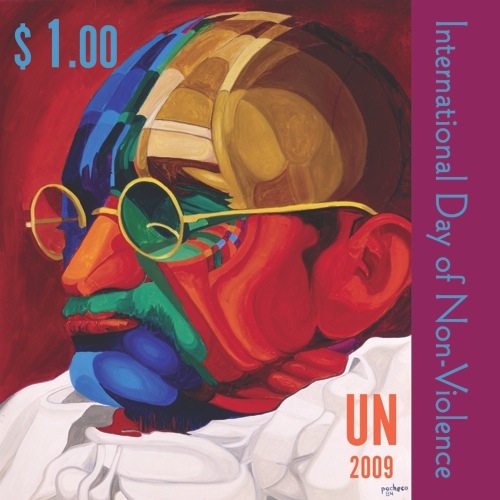
Mohandas Gandhi born 149 years ago on October 2nd: The International Day of Nonviolence

"You must not lose faith in humanity. Humanity is like an ocean; if a few drops of the ocean are dirty, the ocean does not become dirty." - Mohandas Gandhi 

Mohandas Gandhi born 149 years ago today

He liberated an entire subcontinent from imperial rule without firing a shot. The United Nations has designated his birthday, October 2nd, as the International Day of Nonviolence. Nevertheless,  he did not win the Nobel Peace Prize and is recognized by the Nobel Committee as the "Missing Laureate."

He wasn't a rich man. He never held formal political office. He wasn't a saint or divine figure. He was just a man. An attorney who had taken a vow of poverty and celibacy. His name was Mohandas Karamchand Gandhi. 

How did he do it? Through overcoming his own limitations with meditation, experiments with truth and practicing nonviolence as a way of life and then applying it to his community and country through the tradition he was brought up in. This was done through a constructive program when possible and an obstructive program when necessary. According to Gandhi, "a nonviolent life is an act of self-examination and self-purification, whether by an individual, group or nation."

Mohandas Gandhi, who greatly influenced American civil rights leader Martin Luther King Jr., spoke of social responsibility and trusteeship. Gandhi, a self-described socialist, was not an enthusiastic proponent of an expanded social-welfare state as commonly understood arguing:  
"The State represents violence in a concentrated and organized form. The individual has a soul, but as the State is a soulless machine, it can never be weaned from violence to which it owes its very existence. Hence I prefer the doctrine of trusteeship. [...] What I would personally prefer would be not centralization of power in the hands of the State, but an extension of the sense of trusteeship, as, in my opinion, the violence of private ownership is less injurious than the violence of the State. However, if it is unavoidable, I would support a minimum of State-ownership."
Furthermore the critique made by both King and Gandhi of a "thing-oriented" society or the state as a "soulless machine" looks to the person or the individual not an economic mechanism  or economic class. The focus is on the human person and polices that recognize and respect the uniqueness of each human being and their dignity.

Both rejected the doctrine of the ends justifying the means recognizing that means and ends are interrelated and cannot be separated.


Gandhi idea's inspired Martin Luther King Jr in America and Oswaldo Payá in Cuba.
The Soviet press published an article written by S.M. Vakar in 1948 following Gandhi's assassination on January 30, 1948 titled "The Class Nature of the Gandhi Doctrine" subtitled "Gandhi as a Reactionary Utopian" in the Soviet philosophy journal Voprosy filosofii (Questions of Philosophy). The Marxist Leninist argument was outlined as follows:
Although Gandhi regarded the union and independence of the Indian peoples as his goal, his reactionary-Utopian social theory and the reformist methods of struggle connected with it caused his activity to fail in facilitating overthrow of the colonial yoke [...] The social essence of the Gandhi doctrine and its fundamentally reactionary role in the history of India's national liberation movement has hardly been treated in Marxist literature. Yet this doctrine still retards the development of class awareness among the Indian masses.
What was this social essence of Gandhian thought that so troubled the Marxist Leninists in the Soviet Union? First, the reformist methods of struggle referred to in the above quote was nonviolent resistance and secondly his social theory rejected class struggle as another manifestation of destructive violence. On September 11, 1906 a new word came into existence that would give a better understanding of Gandhi's social theory and method of struggle which he described as:
'Satyagraha.' Truth (Satya) implies love, and firmness (agraha) engenders and therefore serves as a synonym for force. I thus began to call the Indian movement 'Satyagraha,' that is to say, the Force which is born of Truth and Love or non-violence, and gave up the use of the phrase 'passive resistance,' in connection with it, so much so that even in English writing we often avoided it and used instead the word 'Satyagraha' itself or some other equivalent English phrase.
The Marxist-Leninists embraced revolutionary violence and a movement led by a small vanguard of intellectuals and professional revolutionaries that would carry out the changes necessary by whatever means necessary and rejected nonviolence as naive. They followed the doctrine of Lenin as presented in his 1902 revolutionary tract What is to be done.

Over a century has passed since both sets of ideas have been set out and applied around the world. An analysis done by Maria J. Stephen and Erica Chenoweth systematically explores the strategic effectiveness of both violent and nonviolent campaigns using data on 323 campaigns carried out between 1900 and 2006.[1] There findings demonstrate that major non-violent campaigns were successful 53% of the time versus only 26% for major violent campaigns and terrorist campaigns had a 7% success rate.

The ideas and legacy of Mohandas Gandhi have remained relevant over the past century and continue to resonate today.


Mohandas Gandhi reading 

"The world of tomorrow will be, must be, a society based on non-violence. That is the first law; out of it all other blessings will flow. It may seem a distant goal, an impractical Utopia. But it is not in the least unobtainable, since it can be worked for here and now."
 - Mohandas Gandhi

"Returning hate for hate multiplies hate, adding deeper darkness to a night already devoid of stars. Darkness cannot drive out darkness; only light can do that. Hate cannot drive out hate, only love can do that."
 - Martin Luther King Jr. 

"The cause of human rights is a single cause, just as the people of the world are a single people. The talk today is of globalization, but we must state that unless there is global solidarity, not only human rights but also the right to remain human will be jeopardized." 
- Oswaldo Payá Sardiñas

Author at the Gandhi memorial in Geneva, Switzerland with Juan Carlos Gonzalez Leiva