Showing posts with label Sebastian Arcos Bergnes. Show all posts

Thursday, August 8, 2024

Remembering Gustavo Arcos: Eighteen Years Later

 The Cuban Revolutionary who broke with Fidel Castro and became a Human Rights Defender


Gustavo Arcos Bergnes (1926- 2006)

On this day eighteen years ago, Gustavo Arcos Bergnes, who was 79 years old, passed away in Havana, Cuba, due to a heart attack. His birthplace was Caibarién, a small village in central Cuba. He studied diplomatic law at the University of Havana when he was a young man. However, on March 10, 1952, Fulgencio Batista's coup interrupted his academic career.

This is where he met Fidel Castro and later joined him on the July 26, 1953 assault on the Moncada military barracks. Gustavo was shot in the back, touching his spine and damaging the sciatic nerve, and left partly paralyzed by the wound suffered in the assault. [ Anita Snow reported in the Associated Press on Wednesday, May. 18, 2005 that "His sciatic nerve was damaged and has deteriorated over the years, making walking difficult, especially up the one flight of stairs from the street."]

Luis Arcos Bergnes killed in 1956

 Brother Luis killed by Fulgencio Batista's forces 
Gustavo was sentenced to ten years in prison but was pardoned and released 22 months later in 1955 and went with the rest of the group to organize a rebel army in Mexico. He traveled through Latin America and the United States gathering money and munitions. His brother Luis Arcos Bergnes was killed when the Granma expedition landed in Cuba in 1956 and were met by Batista's forces.

Gustavo Arcos was appointed Cuba's ambassador to Belgium following Castro's arrival to power in 1959. Wounded in the Moncada assault with a martyred brother, he could have easily remained a privileged member of the revolutionary elite, but that was not why he had taken up arms against Fulgencio Batista. He had fought for an end to dictatorship and the restoration of a democratic Cuba. When he returned to Cuba in 1964 he saw not only that the government had turned communist but that Fidel Castro was another dictator.  At the time Raul Castro personally offered Gustavo a position in the regime leadership. Gustavo rejected the offer. He was already disenchanted and preferred to remain in the diplomatic corps, away from Havana.Gustavo expressed his dissent privately.

"They shot a lot of people," Mr. Arcos told the Associated Press in 2005 during the summary trials held after the revolutionaries took power. "They shot people who could have easily been imprisoned." 

 On March 15, 1966 he was detained and in 1967 he was sentenced to 10 years in prison. for alleged counterrevolutionary activity. He served three years in prison before being released after a long hunger strike in 1969, but was not allowed to leave the country.

Logo of the Cuban Committee for Human Rights

 Joining the Cuban Committee for Human Rights

He and his younger brother, Sebastián Arcos Bergnes, joined the 1976-founded Cuban Committee for Human Rights in 1982 while incarcerated at the Combinado de Este. In 1981, the brothers were imprisoned for attempting to leave the country. Not long after, the Committee started issuing declarations criticizing the deplorable conditions under which political detainees were housed.

In 1986, international pressure compelled the Cuban government to grant a few concessions, including visits from several international human rights organizations and the release of several political prisoners, who subsequently carried out the Committee's activities in Havana's streets. Gustavo Arcos succeeded the committee's exiled executive director, Dr. Ricardo Bofill, shortly after his release from prison in 1988.

In 1990, Gustavo Arcos sent a message to Castro, defying the objections of many Cuban exiles, requesting that he call a "National Dialogue" that would involve all facets of Cuban society, both on the island and in exile. On January 28, 1990, Castro responded by saying that "the Cuban people" will take care of those activists during his speech to the Worker's Congress.

Sebastian Arcos's home was stormed by government-sponsored rioters on March 5, 1990. Gustavo's house was stormed on March 8 by a different mob that was led by future foreign minister Roberto Robaina. Many old acquaintances from exile persuaded Gustavo to dissolve the Committee in order to preserve the lives of the activists. Gustavo stated that "The Cuban Committee for Human Rights will continue its work, even if it costs us our own lives...no terror, nor propaganda will be able to deter the development of humanistic ideas in our country."

On January 13, 1992 the executive board of the Cuban Committee for Human Rights again issued a statement reaffirming their commitment to nonviolence and calling for dialogue:   "Violence is not and cannot be the solution to our problems... We will not tire from insisting that the only possible solution is civilized discussion of our differences. This is an appeal to Cubans for wisdom and common sense... No act of violence is justified... Let us say no to violence and learn to live in peace."

Gustavo Arcos Bergnes, Sebastián Arcos Bergnes and Jesús Yanes Pelletier were arrested at their homes in Havana on the evening of 15 January 1992. Both Gustavo and Yanes Pelletier were released after approximately 24 hours. However, Sebastian Arcos Bergnes was charged with "enemy propaganda" and "inciting rebellion," he was sentenced to four years and eight months in jail. He was transferred to Ariza Prison in  Cienfuegos Province, more than 130 miles from Havana, where Sebastian was imprisoned alongside dangerous criminals and was systematically denied medical attention. In 1993 the regime offered him a deal: Sebastian would be released immediately if he only agreed to leave the island for good. Sebastian rejected the deal, becoming the first documented case of a political prisoner choosing prison in Cuba over freedom in exile.

Brother Sebastian killed by medical neglect while arbitrarily imprisoned

After an international campaign that included his designation as an Amnesty International prisoner of conscience and a request by France Libertés, the organization founded by former French first lady Danielle Mitterrand, Sebastian Arcos was released in 1995. 

A few weeks after his release, Arcos was diagnosed with a malignant tumor in the rectum, for which he had previously been denied medical care in prison. After a Cuban doctor was fired from his post for treating Arcos, he traveled to Miami for further care.

In 1996, Sebastian Arcos Bergnes testified before the UN Human Rights Commission in Geneva, Switzerland. Sebastian Arcos Bergnes died in Miami surrounded by relatives on December 22, 1997.

Due to his worsening health in his last years he lowered his profile and ceded much of the work to exiled members of the Cuban Committee for Human Rights. Nevertheless, he met with US Senators visiting Cuba in 2000, with former President Carter in 2002 and signed a letter in 2003 denouncing the unjust imprisonment of 75 Cuban dissidents imprisoned in the Black Cuban Spring.

As his health deteriorated in his latter years, he reduced his public presence and gave up a large portion of his work to exiled members of the Cuban Committee for Human Rights. Still, in 2000 he met with US senators traveling to Cuba, with former President Carter in 2002, and he signed a letter protesting the unfair detention of seventy-five Cuban dissidents during the March 2003 crackdown.

In the 2005, Associated Press article, Anita Snow reported that he stayed in touch with other dissidents and spoke "frequently with Oswaldo Paya, a devout fellow Roman Catholic who led a signature-gathering effort called the Varela Project, which sought a referendum asking voters if they favored civil liberties such as freedom of speech and the right to business ownership." The article concluded with Gustavo's concern that he would not live to see the return of democracy saying : "I do hope I will see the end of this, but I'm not sure if I will.

In response to a question regarding Gustavo Arcos' legacy that I received from the news agency EFE on August 8, 2006, I said, "It is with great sadness that Arcos will not be able to be there the day that we expect a democratic transition in Cuba. We will always remember that he was one of the founders of the Cuban dissidence, of great courage, coming from a family that sacrificed much and that fought so much against dictatorship both Fulgencio Batista's and Fidel Castro's." Also noted that he left a "strong legacy that will continue to grow" while "in these moments that a giant of the Cuban dissidence has died we have projects that he basically initiated." Compared the call in 1990 by the Arcos brothers to a national dialogue so that "all segments both inside the island and in exile could analyze the Cuban problem and have proposals for the future" with "how presently one sees, 16 years later how  Oswaldo Payá Sardiñas following that example of a national dialogue was able to elaborate a document for transition designed by Cubans in the island and the exiles, in a process of nearly three years."  I also addressed his principled stand and how he entered the dissident movement outlined above and concluded: "We are talking about a man with courage and who is an example of  non-cooperation with the Castro regime."

Michael N. Nagler, an expert in principled non-violence, has noted that nonviolence always bears fruit and leaves seeds for positive outcomes, even when it is not immediately obvious. For instance, pro-democracy activists from around the world continue to be inspired by Gustavo's tenets of nonviolence and have recalled his life and example by posting a remembrance of him on his death anniversary on X today.

Sunday, August 11, 2019

Please Take Urgent Action for Cuban Lady in White and prisoner of conscience Xiomara Cruz

Help save Xiomara de las Mercedes Cruz Miranda's life.

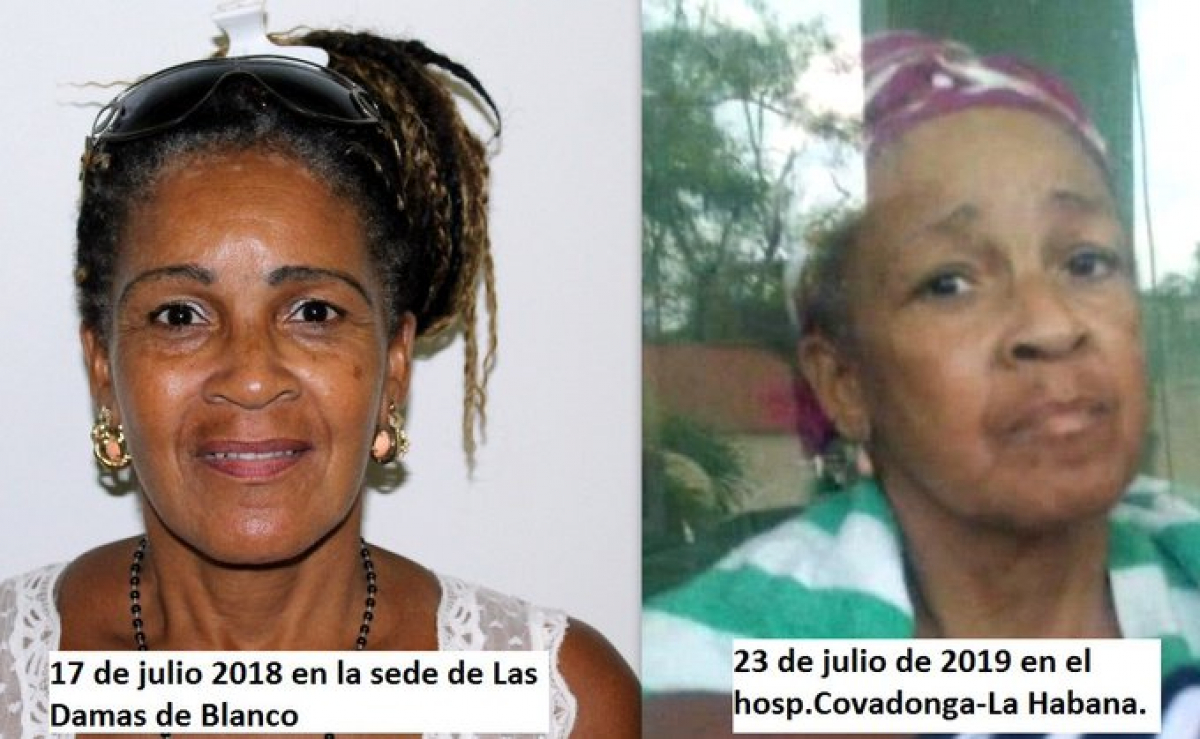
Xiomara de las Mercedes Cruz Miranda before and during her jailing.
Xiomara de las Mercedes Cruz Miranda is a Cuban dissident. member of the Ladies in White, a mother, and a prisoner of conscience. She was arrested on April 16, 2016 for speaking out during a human rights demonstration in Havana's Central park. She was placed on parole in January of 2018. She was re-arrested in mid-September 2018 under the charge of being "threatening." On September 19, 2018 she was tried and sentenced to one year and four months in prison. She was sent to a prison 400 kilometers from her home. This was an added hardship for her family to visit her, and keep an eye on her well being.

Xiomara was sent to a punishment cell for at least 10 days for speaking to her daughter over the phone. Apparently, officials did not like the content of their conversation.

Over the course of one year in custody of the Castro dictatorship her health has radically declined. Above and below are photos of rashes that appeared on her body in June that Cuban medical doctors in Ciego de Ávila claimed to be unable to diagnose. In mid-July she was returned to Havana to La Covadonga hospital.


On August 8, 2019 she was transferred to intensive care. Cuban dissident Angel Juan Moya has posted videos of interviews from August 6th and August 7th with doctors at the hospital. Family members are complaining that they are receiving differing diagnosis and her situation continues to worsen. Xiomara is intensive care and now doctors are saying that it could be lung cancer. A doctor refuses to update the family saying: "that he did not want to see those people."

Their is cause for great concern. Xiomara's condition is deteriorating, and one of the doctors raised the issue of a "political" question.  Healthcare in Cuba has a history of being subordinated to political considerations. The health of the patient is not the top priority.

Laura Pollán February 13, 1948 – October 14, 2011
Xiomara de las Mercedes Cruz Miranda may become the second Lady in White to be a victim of purposeful medical neglect. The first was Laura Inés Pollán Toledo, founding leader of the Ladies in White, who was a victim of a sad, tragic and unnecessary death on October 14, 2011.

This practice of politically motivated medical negligence is not just limited to members of the Ladies in White. Two other examples separated by twenty years demonstrates that this is a long term regime tactic to deal with dissidents in a manner that rises to the level of cruel and unusual punishment.

Sirley Avila Leon was denied adequate medical care in Cuba
On May 24, 2015 Sirley Avila Leon was the victim of a politically motivated machete attack carried out by Osmany Carriòn, with the complicit assistance of his wife, that led to the loss of her left hand, right upper arm nearly severed, and knees slashed into leaving her crippled. Following the attack Sirley did not receive adequate medical care and was told quietly by medical doctors in Cuba that if she wanted to get better that she would need to leave the country. She arrived in Miami on March 8, 2016 in a wheel chair unable to bend her legs, or close her remaining hand.

Sebastián Arcos Bergnes Born: 1931, Died: December 22, 1997
Sebastián Arcos Bergnes, a human rights defender and leader in the Cuban Committee for Human Rights, died from a case of purposeful medical neglect.

On January 13, 1992 the executive board of the Cuban Committee for Human Rights again issued a statement reaffirming their commitment to nonviolence and calling for dialogue with the Cuban government.

Sebastian Arcos Bergnes was detained on January 15, 1992 and charged with "enemy propaganda" and "inciting rebellion," he was sentenced to four years and eight months in prison. Sebastian was transferred to Ariza Prison in  Cienfuegos Province,  more than 130 miles from Havana, where he was imprisoned alongside dangerous criminals and systematically denied medical attention.

In 1993 the regime offered Sebastian a deal: He would be released immediately if he only agreed to leave the island for good. Sebastian rejected the deal, choosing prison in Cuba over freedom in exile.

After an international campaign that included his designation as an Amnesty International prisoner of conscience and a request by France Libertés, the organization founded by former French first lady Danielle Mitterrand, Sebastian Arcos was released in 1995.

A few weeks after his release, Arcos was diagnosed with a malignant tumor in the rectum, for which he had previously been denied medical care in prison. After a Cuban doctor was fired from his post for diagnosing Arcos, he traveled to Miami for further care. In 1996, Sebastián Arcos Bergnes testified before the UN Human Rights Commission in Geneva, Switzerland.


Sebastian died on December 22, 1997 from the cancer that could have been easily diagnosed much earlier, and saved his life.

The fear is that a similar process is being carried out against Xiomara de las Mercedes Cruz Miranda. The international community and people of good will need to make their voices heard.

Xiomara Cruz, prisoner of conscience, Covadonga Hospital intensive care, Aug 8th

Friday, December 28, 2018

#Nonviolence: 20 years after the silent call for justice in Cuba

"What's past is prologue" - William Shakespeare


Below is the OpEd published in the Miami Herald twenty years ago today. It continues to set the context for the present struggle for a free Cuba. Vigil for the victims of the Castro regime are held every year at FIU on February 24th and July 13th.


Published Monday, December 28, 1998, in the Miami Herald

FREE CUBA FOUNDATION

Join our silent call for justice

``Justice does not help those who slumber but helps only those who are vigilant.''-- Mahatma Gandhi

IN A FEW DAYS the world will be marking the 40th anniversary of the systematic denial of human rights and basic human dignity in Cuba. The 50th Anniversary of the Universal Declaration of Human Rights was observed in Cuba by beatings and arrests of dissidents and human-rights activists leading up to and on the anniversary itself.

It is sad to note how far the Cuban government has sunk. It was 50 years ago that the Cuban delegation, representing a democratic and constitutional republic, wrote the first draft of the Universal Declaration of Human Rights. The members recognized that this document would have been ``accepted by that generous spirit who was the apostle of our independence: Jose Marti, the hero who -- as he turned his homeland into a nation -- gave us forever this generous rule: `With everyone, and for the good of everyone.' ''

Last Dec. 10 a spiritual heir of the 1948 Cuban delegation held up copies of the Universal Declaration of Human Rights and of the New Testament and was knocked down and dragged away by Cuban police. Today the mere support of those principles enunciated by the Cuban delegation in 1948 leads to beatings, arrests, and in some cases, deaths.

We shall raise here a silent call for justice. We shall use petitions, silent vigils, and fasts to raise the issue of justice for those who no longer can speak. We will not forget those innocents who died at the hands of the Cuban government such as:

  •  On Dec. 22, 1997, Sebastian Arcos Bergnes died of a cancer that was allowed to spread until terminal while he sat with violent criminals in a Cuban prison cell. His crime was being a human-rights activist and the vice-president of the Cuban Committee for Human Rights.
  •  On March 29, 1997, Joachim Lovschall, a 26-year-old Dane studying Spanish at the University of Havana, was shot to death by Cuban state-security agents while crossing a street in Havana. Nearly two years later no disciplinary or lawful investigation of the guard who killed Lovschall has begun despite Denmark's official protests.
  •  On Feb. 24, 1996, Armando Alejandre Jr., Mario de la Peña, Carlos Costa, and Pablo Morales where blown out of the sky over the Florida Straits while searching for Cuban rafters in international waters. The Cuban pilots responsible for the shootdown have yet to face justice for their actions.
  •  On July 13, 1994, an estimated 41 men, women, and children were drowned by agents of the Cuban government for the sole crime of exercising their right to leave Cuba. The Cuban government has not held a proper investigation, brought those responsible to justice, or recovered the bodies of the victims and returned them to their families.
  • We call on all people of goodwill to join our silent call for justice. Let others know of these travesties.

    We have embraced the principle of nonviolence, and we seek the truth as our ends. Gandhi said:
    ``Use truth as your anvil, nonviolence as your hammer, and anything that does not stand the test when it is brought to the anvil of truth and hammered with nonviolence, reject it.''
    We call on people everywhere who share our passion for justice to join us. Nearly a year ago we signed an Accord for Democracy in which the final line quoted Marti's noble sentiment: ``With everyone, and for the good of everyone.''

    Let us work so that in Cuba once again this will become a reality and not just a noble sentiment.


    Susana Mendiola
    Chairwoman,
    Viviana Mendiola
    Vice President,
    Marco J. Alonso
    Treasurer,
    John Suarez
    Coordinator,
    Free Cuba Foundation
    Florida International University


    Copyright © 1998 The Miami Herald 

    Tuesday, June 26, 2018

    International Day in Support of Victims of Torture: Cuban victims of the Castro regime

    Torture is a mortal sin! Christian communities must commit themselves to helping victims of torture. - Pope Francis

     
    June 26th is the International Day in Support of Victims of Torture and sadly there are many in Cuba who are torture victims. The United Nations Convention against Torture and Other Cruel, Inhuman or Degrading Treatment or Punishment (1984), defines "torture" as "any act by which severe pain or suffering, whether physical or mental, is intentionally inflicted on a person for such purposes as obtaining from him or a third person information or a confession, punishing him for an act he or a third person has committed or is suspected of having committed, or intimidating or coercing him or a third person, or for any reason based on discrimination of any kind, when such pain or suffering is inflicted by or at the instigation of or with the consent or acquiescence of a public official or other person acting in an official capacity. It does not include pain or suffering arising only from, inherent in or incidental to lawful sanctions."  

    The International Center for Transitional Justice explains on its website that "truth can help victims to find closure by revealing the details of the events they suffered, such as the fate of forcibly disappeared loved ones or why certain people were targeted for abuse. Moreover, knowing the truth about past events enables proper mourning practices, essential to most cultures, helping to achieve personal and communal healing."

    Most Cuban victims of torture remain unknown, but there are high profile cases that are the tip of the iceberg. Below is a partial sampling of some of those cases. Others are mentioned in the 1987 documentary Nobody Listened (Nadie Escuchaba).

    This is due in part because prisoners of conscience are denied family visits leaving them at the mercy of prison officials with no one from the outside to be able to vouch for their condition. This leads to extreme cases were family members must demand proof of life, unsure whether their loved one is still alive.  This still goes on today.

    There are other cases that are well documented outside of the prisons.

    In March 2018 mother and son were beaten up by Cuban secret police for exercising their fundamental rights. Asunción Carrillo is a Lady in White who had spent years campaigning for her son's freedom. Trade unionist Iván Hernández Carrillo, a former prisoner of conscience is Asunción's son. When she tried to go to Church she was grabbed and mistreated by the secret police and when her son tried to intervene on her behalf they beat him down, kicked him, dragged him down the street, handcuffed him and continued to beat him in the jeep where he had been thrown like a sack.

    This is Cuba in 2018, but it has been going on for a long time. Other well documented cases hit at the dark underbelly of the dictatorship in Cuba and its intolerance for all kinds of dissent.

    Sirley Avila Leon following May 2015 machete attack ordered by secret police
    Sirley Ávila León was a delegate to the Municipal Assembly of People’s Power in Cuba from June 2005, for the rural area of Limones until 2012 when the regime gerrymandered her district out of existence. The Castro regime removed her from her position because she had fought to reopen a school in her district, but been ignored by official channels and had reached out to international media. Her son, Yoerlis Peña Ávila, who had an 18 year distinguished career in the Cuban military was forced out when he refused to declare his mother insane and have her committed to a psychiatric facility.

    Sirley joined the ranks of the democratic opposition and repression against her increased dramatically. On May 24, 2015 she was the victim of a brutal machete attack carried out by Osmany Carriòn, with the complicit assistance of his wife, that led to the loss of her left hand, right upper arm nearly severed, and knees slashed into leaving her crippled. This attack was done on the orders of the secret police. Following the attack she did not receive adequate medical care and was told quietly by medical doctors in Cuba that if she wanted to get better that she would need to leave the country.

    On March 8, 2016 she arrived in Miami and began a course of treatments over the next six months during which she was able to walk once again although still limited due to her injuries. She returned to Cuba on September 7, 2016 only to find her home occupied by strangers and her attacker free and bragging that he would finish the job. She moved in with her mother and within a short time a camera and microphone were set up across from her mother's home on a post.

    Threats against Sirley's life intensified leading her to flee Cuba to the United States and request political asylum on October 28, 2016. 

    There have been other cases were medical mistreatment was apparently prescribed by the political police.

    Omar Pernet Hernández August 15, 1945 - October 7, 2017
    Cuban dissident and former prisoner of conscience Omar Pernet Hernández passed away in Louisville, Kentucky on October 7, 2017. Beginning in 1965 at age 18 he was imprisoned for the first time in Cuba for political reasons. Years later in an interview he would sum up his life in Cuba: "I was tortured in Castros' jails in four processes since 1965, when I was going to turn 19 years old."
     During his last imprisonment he described how doctors engaged in malpractice against him following a car accident while he was being transferred from one prison to another that left him crippled.
    Omar Pernet: Look, the meaning of this, is that this type of boot that you see here....I will show it to you again. This boot was fitted for me in Cuba and it began to damage my hips because one, the left, is longer than the right. Then, one hip went like this 0:30 (shows the way hip is going up). Then, here in Spain, they said I couldn't go on wearing those boots, and they asked me to cut them down, and told me to make the ones I'm wearing. These I'm wearing now are stabilizing my hips.
    INT: "How is it possible, since the Cuban doctors are so excellent normally, at least that's what the Cubans say, and promote throughout the world. That they should be so wrong? And hurt you so much? How many months did you stay that way in Cuba?"
    OP: Well, in 2005, on the 5th of April, I began to wear these boots until the 17-18. I stayed like that until the 3rd of March of 2008 using those boots. These I'm wearing now are different, from Spain. " Stands up, 2:06, shows. "The only thing they did was to slap a cast on. They had me on a cast from the tips of my toes up to my neck for 18 months. The doctors here [in Spain] say they don't find any logic to it. That it was intolerable, the amount of time I spent in those conditions. The cast was removed twice, and each time it was to break my leg again." 
    Omar Pernet Hernández was 72 years old when he passed away, a victim of cancer. He had spent 22 years in Castro's prisons for defying the communist regime and lived in forced exile for the final nine years of his life. He had been jailed in four different instances beginning with being sent to a forced labor camp for refusing military service, then jailed for trying to first leave Cuba, then jailed again for "enemy propaganda" when he denounced prison conditions, and finally sentenced to 25 years in prison for gathering signatures for Project Varela, a petition drive to reform Cuban laws to bring it in line with international human rights standards.

    Physical and psychological torture and the denial of medical care or even water as punishment has proven fatal in the past.

    Orlando Zapata Tamayo: Victim of prolonged torture
     Cuban prisoner of conscience Orlando Zapata Tamayo died on February 23, 2010 after years of torture, and a prolonged water only hunger strike.Prison authorities, in an effort to break him, denied him water over the course of more than two weeks on and off
     
    On the day Orlando Zapata died, Cuban opposition leader Oswaldo Payá Sardiñas in a heartfelt message explained the circumstances surrounding the Cuban human rights defender's untimely death: 

    Orlando Zapata Tamayo, died on this afternoon, February 23, 2010, after suffering many indignities, racist slights, beatings and abuse by prison guards and State Security. Zapata was killed slowly over many days and many months in every prison in which he was confined. Zapata was imprisoned for denouncing human rights violations and for daring to speak openly of the Varela Project in Havana's Central Park. He was not a terrorist, or conspirator, or used violence. Initially he was sentenced to three years in prison, but after successive provocations and maneuvers staged by his executioners, he was sentenced to more than thirty years in prison.
    He was moved around several prisons, including Quivicán Prison, Guanajay Prison, and Combinado del Este Prison in Havana. Where according to Amnesty International on October 20, 2003 Orlando was dragged along the floor of Combinado del Este Prison by prison officials after requesting medical attention, leaving his back full of lacerations. Orlando managed to smuggle a letter out following a brutal beating it was published in April of 2004:
    My dear brothers in the internal opposition in Cuba. I have many things to say to you, but I did not want to do it with paper and ink, because I hope to go to you one day when our country is free without the Castro dictatorship. Long live human rights, with my blood I wrote to you so that this be saved as evidence of the savagery we are subjected to... 
    There have been other cases were medical treatment was denied as punishment with fatal results.

    Sebastián Arcos Bergnes in front of his home on May 31, 1995 following his release
     In 1992 Sebastian Arcos Bergnes was charged with "enemy propaganda" and "inciting rebellion," he was sentenced to four years and eight months in prison. Amnesty International recognized him as a prisoner of conscience. Sebastian was transferred to Ariza Prison in  Cienfuegos Province,  more than 130 miles from Havana, where he was imprisoned alongside dangerous criminals and systematically denied medical attention. In 1993 the regime offered Sebastian a deal: He would be released immediately if he only agreed to leave the island for good. Sebastian rejected the deal, choosing prison in Cuba over freedom in exile.

    After a prolonged international campaign Sebastian Arcos was released in 1995. A few weeks after his release, Arcos was diagnosed with a malignant tumor in the rectum, for which he had previously been denied medical care in prison. After a Cuban doctor was fired from his post for diagnosing Arcos, he traveled to Miami for further care. In 1996, Sebastián Arcos Bergnes testified before the UN Human Rights Commission in Geneva, Switzerland:

    My name is Sebastián Arcos Bergnes, and I am the Vice-president of the Cuban Committee for Human Rights, a non-governmental organization founded in Cuba in 1976 to observe the respect for the Universal Declaration of Human Rights in the island.
    On the 15 of January 1992 I was arrested in my home by the Cuban political police; the second time in ten years. On October of that year I was sentenced to 4 years and eight months in prison for the sole crime of reporting to this Commission the violations of human rights committed by the government of my country. The labor of those volunteers of this Commission inside of Cuba are considered by the government as "enemy propaganda."
    I will not enter into the details concerning the multiple irregularities of the judicial process always against me, nor about the conditions that I had to tolerate for more than three years. I will refer solely to one aspect of this my last experience in Cuban prisons.
    When I was arrested in January of 1992, I enjoyed excellent general health for a man my age, 60 years then. I weighed around 170 pounds, and ran 5 to 6 kilometers every morning. Eight months later, when after a campaign of denunciations of my family I was transferred finally to a military hospital, I'd lost over 30 pounds and suffered from multiple ailments.
    My stay in the hospital was not long. In December of 1992 I was transferred to the Prison of Ariza in the Province of Cienfuegos, over 300 km from my home and my relatives. All of the medical treatments indicated by specialists of the military hospital were immediately suspended. During the next 30 months that I spent in Ariza my state of health worsened considerably, and I was systematically denied access to the medications that my family sent me.
    During those 30 months only occasionally did I see inexperienced doctors that gave me incomplete medical exams and additionally lacked the medication to prescribe me. I have in my possession a detailed chronology of my repeated denunciations concerning the abandonment of my health by the Cuban authorities.
    In February of 1994, in an attempt to refute my denunciations, the Cuban government presented before this Commission a strip of video filmed without my knowledge, in which I appeared to be undergoing a medical exam. That was the second and last time that I was taken to the hospital, that time for a cardiological exam which had been ordered with urgency on three previous occasions.
    In mid - 1994 I commenced to suffer pains in my left leg, which later spread to the rest of my extremities. After a rapid examination, a doctor in the prison determined that I suffered from polineutritis -a deficiency illness very common in the Cuban jails, and he prescribed treatment with vitamins. The pain continued with me for nearly a year later when I was liberated as a result of a gesture of the humanitarian organization France Liberte.
    A few days after being liberated the pain worsened suddenly. Many weeks later I had to be urgently admitted to the hospital, were a doctor (friend) discovered that I had a malignant tumor in the rectum. Finally I had to leave Cuba to receive medical treatment in Miami, where my children live. The medical team which examined me in Mercy Hospital diagnosed a rectal tumor of 8 cm of diameter, with more than a year and a half of growth, with metastasis in the bones of the pelvis. At only 4 cm from the anal sphincter, the tumor could have been easily detectable with a simple feel of the area which is included in a basic medical exam for any man over 50 years old. Attached here are medical diagnosis which confirm what I've been saying.
    These conclusions put the Cuban government in a difficult juncture. Or the Cuban government didn't know of the existence of the tumor, and in that case they recognize that they did not give me adequate medical assistance; or I'm lying and the Cuban government did know about the tumor and hid that knowledge for more than a year.Or the Cuban government recognizes itself guilty of criminal negligence in my case, or it recognizes itself guilty of an attempted premeditated homicide against my person.
    Mr. President:
    Before I finish, I would like to make clear that mine is not an isolated case, but only an example of the regular practice of Cuban authorities in their treatment of prisoners of conscience. Out of the group of 6 political prisoners liberated by the Cuban government after the requests of France Liberte, only two enjoyed good health. In addition to my own case, Reinaldo Figueredo has cancer in his vocal chords, Luis Enrique Gonzalez Ogra has pancreatic cancer, and Ismael Salvia Ricardo is nearly blind. Terrible nutrition, crowded and unsanitary cells, housing with common violent criminals, violent repression, and reluctant medical assistance - if any- are the norm and not the exception in Cuban prisons.
    Because of all this, Mr. President, it is urgent that this Commission demand of the Cuban government that it permit without restriction the International Red Cross to all the Cuban prisons, and that Cuba comply with the international statutes about prisoners and the treatment of prisoners. This is the least we can do in the short run to avoid that cases like mine be repeated, in which medical assistance came-tragically-when it was already far too late.
     Sebastián Arcos Bergnes died in Miami surrounded by relatives on December 22, 1997.

    Cuban torture survivor Amado Rodriguez
    These practices began in the first years of the Castro regime. The case of Amado Rodriguez who was born in Santiago de Cuba, Cuba in 1943 illustrates this. At 13, he joined the 26th of July Movement against the Batista regime and was later sent into exile to save his life. At the height of the revolution, he returned and became an activist against the Castro regime.

    He was arrested and spent a total of 23 years as a political prisoner during two different terms. He was 18 years old when he was first arrested in 1961 and sentenced to 30 years, of which he served 18. Four years later, Amado was arrested and sentenced to 15 years. He was released in 1989 and sent directly to the United States after serving five years, four of which he spent in solitary confinement.

    Amado Rodriguez was considered a prisoner of conscience by Amnesty International and other human rights organizations. His release was the result of personal visits and petitions to the Cuban government from representatives of Amnesty International, Human Rights Watch, the Red Cross International, the UN High Commissioner for Human Rights and a US Senator.

    Amado described how by June of 1985 he was the only "plantado" prisoner at Boniato prison in jail cell #2 a small sealed punishment cell. He was only in underwear isolated without knowing whether it was day or night. Nine months later he was moved to a sealed cell within the Boniato prison were prison officials placed him on a new minimal caloric consumption diet but by October of 1986 since he refused to break he was subjected to the use of handcuffs and placed in a stress position. 

    Thursday, January 28, 2016

    Cuban Committee for Human Rights founded 40 years ago today in Cuba

     Honor, honor. - Jose Marti

    Logo of the Cuban Committee for Human Rights
    The struggle for a free Cuba has been a long affair with different episodes and different approaches.
    Between 1959 and 1966 there had been a violent resistance to the Castro regime that carried out armed landings (1961); guerilla uprisings (1961 - 1966) that according to Carlos Alberto Montaner "lasted until approximately 1966, when the last foci of peasant guerrillas on the central mountains were exterminated." Many of the participants in the Anti-Castro armed struggle had first been members of Castro's July 26th Movement, who had fought in good faith to rid Cuba of the Batista regime with the aim of a democratic restoration. These Cubans returned to fight in the hills when it became obvious that the Castro brothers were imposing another and more brutal dictatorship.


    On January 28, 1976 a candle was lit in Cuba and a new type of struggle for freedom initiated when Ricardo Bofill together with Marta Frayde at her home in Havana founded the Cuban Committee for Human Rights. Carlos Alberto Montaner described how this movement came into existence during a speech in 2009 in Madrid, Spain:
    Finally, in 1976, half a dozen Cuban opposition actvists with leftist backgrounds were summoned by professor Ricardo Bofill [3] and founded in Havana the Cuban Committee for Human Rights, the first political organization in the nation's history to expressly renounce violence as a method of struggle. The group decided to abide by the rule of law to reclaim the rights quashed by the dictatorship. Meanwhile, in exile in Washington, about the same time, Mrs. Elena Mederos, former minister in the revolutionary government, and activist and political scientist Frank Calzón, founded Of Human Rights with the same objective: to defend, by nonviolent and legal means, persecuted individuals, dissidents and political prisoners in Cuba.

    In 1982 at the Combinado de Este prison Gustavo Arcos Bergnes and his younger brother, Sebastián Arcos Bergnes, joined the Cuban Committee for Human Rights. The brothers had been imprisoned in 1981 for trying to leave the country illegally. Soon thereafter, the Committee began to send out proclamations denouncing the deplorable conditions in which political prisoners were kept. 

    Shortly after his release from prison in 1988, Gustavo Arcos succeeded the committee’s executive director, Dr. Ricardo Bofill, who was forced into exile.

    In 1990, against the protests of many Cuban exiles, Gustavo Arcos issued a statement to Castro asking him to convene a "National Dialogue," which would include all segments of Cuban society, on the island and in exile. During his address to the Worker's Congress on January 28, 1990, Castro issued his response noting that "the Cuban people" will take care of those activists.

    On March 5, 1990 government sponsored mobs attacked Sebastian Arcos's home. On March 8 another mob, led by future Foreign Minister Roberto Robaina, attacked Gustavo's home. From exile, many old friends asked Gustavo to dissolve the Committee to save the activists' lives. Gustavo replied: "The Cuban Committee for Human Rights will continue its work, even if it costs us our own lives...no terror, nor propaganda will be able to deter the development of humanistic ideas in our country."

    On January 13, 1992 the executive board of the Cuban Committee for Human Rights again issued a statement reaffirming their commitment to nonviolence and calling for dialogue:   "Violence is not and cannot be the solution to our problems... We will not tire from insisting that the only possible solution is civilized discussion of our differences. This is an appeal to Cubans for wisdom and common sense... No act of violence is justified... Let us say no to violence and learn to live in peace."

    Gustavo Arcos Bergnes, Sebastián Arcos Bergnes and Jesús Yanes Pelletier were arrested at their homes in Havana on the evening of 15 January 1992. Both Gustavo and Yanes Pelletier were released after approximately 24 hours. However, Sebastian Arcos Bergnes was charged with "enemy propaganda" and "inciting rebellion," he was sentenced to four years and eight months in jail. He was transferred to Ariza Prison in  Cienfuegos Province,  more than 130 miles from Havana, where Sebastian was imprisoned alongside dangerous criminals and was systematically denied medical attention. In 1993 the regime offered him a deal: Sebastian would be released immediately if he only agreed to leave the island for good. Sebastian rejected the deal, becoming the first documented case of a political prisoner choosing prison in Cuba over freedom in exile.

    After an international campaign that included his designation as an Amnesty International prisoner of conscience and a request by France Libertés, the organization founded by former French first lady Danielle Mitterrand, Sebastian Arcos was released in 1995. A few weeks after his release, Arcos was diagnosed with a malignant tumor in the rectum, for which he had previously been denied medical care in prison. After a Cuban doctor was fired from his post for treating Arcos, he traveled to Miami for further care.

    In 1996, Sebastian Arcos Bergnes testified before the UN Human Rights Commission in Geneva, Switzerland. Sebastian Arcos Bergnes died in Miami surrounded by relatives on December 22, 1997.

    Due to his worsening health in his last years Gustavo Arcos lowered his profile and ceded much of the work to exiled members of the Cuban Committee for Human Rights. Nevertheless, he met with US Senators visiting Cuba in 2000, with former President Carter in 2002 and signed a letter in 2003 denouncing the unjust imprisonment of 75 Cuban dissidents imprisoned in the Black Cuban Spring.

    In the 2005, Associated Press article, Anita Snow reported that he stayed in touch with other dissidents and spoke "frequently with Oswaldo Paya, a devout fellow Roman Catholic who led a signature-gathering effort called the Varela Project, which sought a referendum asking voters if they favored civil liberties such as freedom of speech and the right to business ownership." The article concluded with Gustavo's concern that he would not live to see the return of democracy saying : "I do hope I will see the end of this, but I'm not sure if I will.
     
    Gustavo Arcos passed away in Cuba on August 6, 2006. Martha Frayde passed away in Spain on December 4, 2013. Ricardo Bofill remains in exile in Miami, Florida and an active member of the Cuban Committee for Human Rights.

    This nonviolent approach would endure and grow into a nationwide movement across Cuba and write new chapters in Cuba's history of resistance to tyranny. Today we remember the activists who forty years ago initiated this new, and nonviolent struggle for a free Cuba with the Cuban Committee for Human Rights.


    Friday, August 8, 2014

    Remembering Gustavo Arcos: Eight Years Later

    The Cuban Revolutionary who broke with Fidel Castro and became a Human Rights Defender
    Gustavo Arcos Bergnes (1926- 2006)
     Eight years ago today Gustavo Arcos Bergnes passed away in Havana, Cuba at the age of 79 from a heart attack. He was originally from a small town in central Cuba called Caibarién. As a young men he attended the University of Havana and studied diplomatic law. However, his studies were abruptly interrupted by Fulgencio Batista's coup on March 10, 1952. This is where he met Fidel Castro and later joined him on the July 26, 1953 assault on the Moncada military barracks. Gustavo was shot in the back, touching his spine and damaging the sciatic nerve, and left partly paralyzed by the wound suffered in the assault. [ Anita Snow reported in the Associated Press on Wednesday, May. 18, 2005 that "His sciatic nerve was damaged and has deteriorated over the years, making walking difficult, especially up the one flight of stairs from the street."]

    Luis Arcos Bergnes killed in 1956
    Brother Luis killed by Fulgencio Batista's forces 
    Gustavo was sentenced to ten years in prison but was pardoned and released 22 months later in 1955 and went with the rest of the group to organize a rebel army in Mexico. He traveled through Latin America and the United States gathering money and munitions. His brother Luis Arcos Bergnes was killed when the Granma expedition landed in Cuba in 1956 and were met by Batista's forces.

    Gustavo Arcos was appointed Cuba's ambassador to Belgium following Castro's arrival to power in 1959. Wounded in the Moncada assault with a martyred brother, he could have easily remained a privileged member of the revolutionary elite, but that was not why he had taken up arms against Fulgencio Batista. He had fought for an end to dictatorship and the restoration of a democratic Cuba. When he returned to Cuba in 1964 he saw not only that the government had turned communist but that Fidel Castro was another dictator.  At the time Raul Castro personally offered Gustavo a position in the regime leadership. Gustavo rejected the offer. He was already disenchanted and preferred to remain in the diplomatic corps, away from Havana.Gustavo expressed his dissent privately.

    "They shot a lot of people," Mr. Arcos told the Associated Press in 2005 during the summary trials held after the revolutionaries took power. "They shot people who could have easily been imprisoned." 

     On March 15, 1966 he was detained and in 1967 he was sentenced to 10 years in prison. for alleged counterrevolutionary activity. He served three years in prison before being released after a long hunger strike in 1969, but was not allowed to leave the country.

    Logo of the Cuban Committee for Human Rights
     Joining the Cuban Committee for Human Rights
    In 1982 at the Combinado de Este prison he and his younger brother, Sebastián Arcos Bergnes, joined the Cuban Committee for Human Rights, formed in 1976. The brothers had been imprisoned in 1981 for trying to leave the country illegally. Soon thereafter, the Committee began to send out proclamations denouncing the deplorable conditions in which political prisoners were kept. By 1986, due to international pressure, the Cuban government was forced to allow a few concessions such as visits by several international human rights organizations and the release of several prisoners, who then extended the work of the Committee to the streets of Havana. Shortly after his release from prison in 1988, Gustavo Arcos succeeded the committee’s executive director, Dr. Ricardo Bofill, who was forced into exile.


    In 1990, against the protests of many Cuban exiles, Gustavo Arcos issued a statement to Castro asking him to convene a "National Dialogue," which would include all segments of Cuban society, on the island and in exile. During his address to the Worker's Congress on January 28, 1990, Castro issued his response noting that "the Cuban people" will take care of those activists.

    On March 5, 1990 government sponsored mobs attacked Sebastian Arcos's home. On March 8 another mob, led by future Foreign Minister Roberto Robaina, attacked Gustavo's home. From exile, many old friends asked Gustavo to dissolve the Committee to save the activists' lives. Gustavo replied: "The Cuban Committee for Human Rights will continue its work, even if it costs us our own lives...no terror, nor propaganda will be able to deter the development of humanistic ideas in our country."

    On January 13, 1992 the executive board of the Cuban Committee for Human Rights again issued a statement reaffirming their commitment to nonviolence and calling for dialogue:   "Violence is not and cannot be the solution to our problems... We will not tire from insisting that the only possible solution is civilized discussion of our differences. This is an appeal to Cubans for wisdom and common sense... No act of violence is justified... Let us say no to violence and learn to live in peace."

    Gustavo Arcos Bergnes, Sebastián Arcos Bergnes and Jesús Yanes Pelletier were arrested at their homes in Havana on the evening of 15 January 1992. Both Gustavo and Yanes Pelletier were released after approximately 24 hours. However, Sebastian Arcos Bergnes was charged with "enemy propaganda" and "inciting rebellion," he was sentenced to four years and eight months in jail. He was transferred to Ariza Prison in  Cienfuegos Province,  more than 130 miles from Havana, where Sebastian was imprisoned alongside dangerous criminals and was systematically denied medical attention. In 1993 the regime offered him a deal: Sebastian would be released immediately if he only agreed to leave the island for good. Sebastian rejected the deal, becoming the first documented case of a political prisoner choosing prison in Cuba over freedom in exile.


    Sebastian Arcos Bergnes: Death by medical neglect
    Brother Sebastian killed by medical neglect while arbitrarily imprisoned
    After an international campaign that included his designation as an Amnesty International prisoner of conscience and a request by France Libertés, the organization founded by former French first lady Danielle Mitterrand, Sebastian Arcos was released in 1995. A few weeks after his release, Arcos was diagnosed with a malignant tumor in the rectum, for which he had previously been denied medical care in prison. After a Cuban doctor was fired from his post for treating Arcos, he traveled to Miami for further care.


    In 1996, Sebastian Arcos Bergnes testified before the UN Human Rights Commission in Geneva, Switzerland. Sebastian Arcos Bergnes died in Miami surrounded by relatives on December 22, 1997.

    Due to his worsening health in his last years he lowered his profile and ceded much of the work to exiled members of the Cuban Committee for Human Rights. Nevertheless, he met with US Senators visiting Cuba in 2000, with former President Carter in 2002 and signed a letter in 2003 denouncing the unjust imprisonment of 75 Cuban dissidents imprisoned in the Black Cuban Spring.

    In the 2005, Associated Press article, Anita Snow reported that he stayed in touch with other dissidents and spoke "frequently with Oswaldo Paya, a devout fellow Roman Catholic who led a signature-gathering effort called the Varela Project, which sought a referendum asking voters if they favored civil liberties such as freedom of speech and the right to business ownership." The article concluded with Gustavo's concern that he would not live to see the return of democracy saying : "I do hope I will see the end of this, but I'm not sure if I will.

    When the news agency EFE called me on August 8, 2006 and asked me about the legacy of Gustavo Arcos I responded: "It is with great sadness that Arcos will not be able to be there the day that we expect a democratic transition in Cuba. We will always remember that he was one of the founders of the Cuban dissidence, of great courage, coming from a family that sacrificed much and that fought so much against dictatorship both Fulgencio Batista's and Fidel Castro's." Also made the observation that he left a "strong legacy that will continue to grow" while "in these moments that a giant of the Cuban dissidence has died we have projects that he basically initiated." Compared the call in 1990 by the Arcos brothers to a national dialogue so that "all segments both inside the island and in exile could analyze the Cuban problem and have proposals for the future" with "how presently one sees, 16 years later how  Oswaldo Payá Sardiñas following that example of a national dialogue was able to elaborate a document for transition designed by Cubans in the island and the exiles, in a process of nearly three years."  I also addressed his principled stand and how he entered the dissident movement outlined above and concluded: "We are talking about a man with courage and who is an example of  non-cooperation with the Castro regime."

     Michael N. Nagler, an expert in principled non-violence has observed that nonviolence always works because even when it is not immediately self-evident it leaves seeds and fruits that are always positive. For example, today, Cuban dissidents visited Gustavo's widow, Teresa, and Havana, Cuba and remembered his life and example and continue to be inspired by his principled nonviolence.