Showing posts with label civil society. Show all posts

Friday, September 22, 2017

Economist and Founding member of the Center for Coexistence sentenced to three years deprivation of liberty

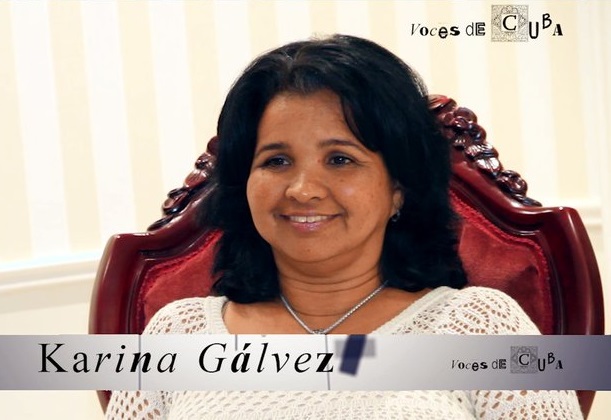
Cuba does not have an independent judiciary and political trials are often covered up with bogus charges to avoid international scrutiny. This appears to be the case with Karina Gálvez Chiu, a founding member of a prestigious civil society group the Center for Coexistence Studies (CEC) and it is the second time that a space where the groups is meeting has been confiscated by the regime.


14ymedio, Havana, 21 September 2017 — Economist Karina Gálvez Chiu was sentenced Thursday by the Municipal Court of the city of Pinar del Rio to three years of deprivation of liberty and the confiscation of her home for the crime of tax evasion, a member of the Center for Coexistence Studies (CEC) confirmed 14ymedio. A court decision that she ensures did not surprise her and that she expected.

“Although after the trial, which was clearly won by the defense lawyers, we had hoped that the penalty would decrease somewhat with respect to the prosecutor’s request,” explained the economist.

Finally, “the court accepted the requests for sanctions proposed by the prosecution,” the CEC said in a statement. This does not mean, however, that the economist must go to prison, since the sentence contemplates that the sentence of deprivation of freedom can be substituted by three years of house arrest.

The trial against Gálvez began on January 11 when she was detained for a week at the province’s Technical Department of Criminal Investigation and her house was sealed.

Karina Gálvez’s house was also the headquarters of the Center for Coexistence studies (CEC) and with its seizure the independent project lost its meeting place for the second time. In 2009, the yard of the home of Galvez’s parents, where their members met, was also confiscated and closed.

The property is now at the disposition of the Municipal Housing Department, subordinate to the Council of the Administration of the Municipality of Pinar del Río.

The court ruling says that the conviction seeks to “make the defendant understand” the seriousness of the crime and also “serve to educate the people in general.”

In addition, Gálvez has been banned from exercising the right to vote and to stand as a candidate in electoral processes, as well as losing “the right to hold management positions in the organs corresponding to the political-administrative activity of the State.”

She is also prohibited “from being issued a passport and leaving from the national territory until the penalties imposed have been completed,” says the document that the court sent to her on Thursday through her defense lawyer.

The sentence states that this type of punishment is applied individually and in “its type and extent” is for the purpose of “repressing, re-educating and preventing the commission of new offenses.”

As of this Thursday Gálvez has ten days to appeal. After that time the sentence will be signed against her and she must wait for the appointment with an implementation judge.

“I still have not decided if I’m going to appeal, I’m thinking about it,” says the economist. “The person who presided over my trial is the president of the Provincial Court, so I would have to appeal to a judge who is subordinate to him,” and that “would be a formality.”

Gálvez has denounced, in recent months, an escalation of pressure by the authorities, which includes numerous interrogations in the provincial Immigration and Aliens Department, where they inquired about the motivations of her trips off the island.

Other members of the CEC have been summoned by the police and have received warnings, including the director of the publication, Dagoberto Valdés, who was told by an official last October that from that moment on his life will be “very difficult.”

The CEC organizes training courses for citizens and civil society and, in a recent public statement, its members assured that they will not leave Cuba or the Church and that they will continue to “work for the country.”

CEC sent out several tweets about Karina Gálvez's plight and the following contained a copy of the legal decision and said that  Karina Galvez, from the Center for Coexistence Studies sentenced to three years prison and the confiscation of her home, that had been the headquarters of CEC.
Thursday, April 9, 2015

The Castro Regime's idea of dialogue: The monologue of the closed fist

If liberty means anything at all, it means the right to tell people what they do not want to hear. - George Orwell
 

Leticia Ramos and Augusto Monge attacked in Panama
Today nonviolent dissidents, representing independent civil society from Cuba, sought to engage in a dialogue with representatives of the dictatorship who claimed to be civil society. The Miami Herald reported that the "Panamanian government extended an invitation to all sectors of Cuba’s civic society to participate in the hopes of an unedited dialogue, in celebration of the resumed relations between the U.S. and Cuba." Panama’s Vice President and chancellor, Isabel Malo de Alvarado, called on all the involved parties to “listen to each other within the frame of respect.” 

 The Herald explained that the response of the Castro regime delegation on Wednesday, was to not attend the inauguration of the Civic Society Forum  stating it: “will not share the same space as mercenaries and terrorists”.  Today "activists Rosa Maria Paya, daughter of murdered opposition leader Oswaldo Paya, and Lillian Tintori, wife of imprisoned Venezuelan opposition leader Leopoldo Lopez were welcomed by screams and insults at the Civic Society Forum. 


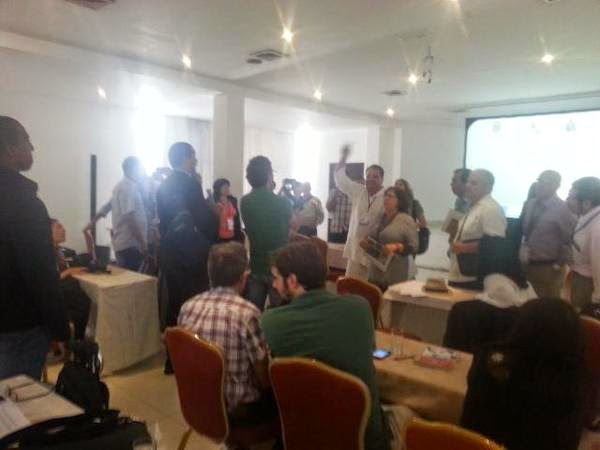
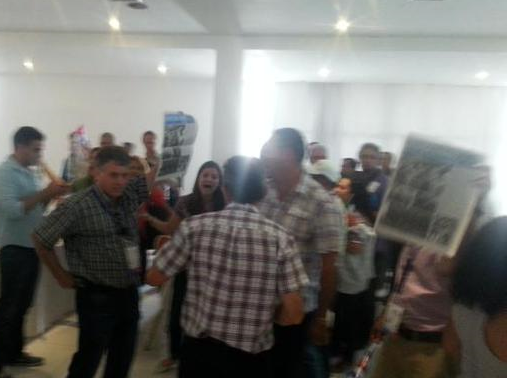
 Over twitter at 11:43am today Rosa María Payá tweeted "Cuban delegation official still impedes initiation of the start of the panel" along with the above photograph. Two minutes later and another tweet: "Cuban officials begin violence and police at the door do not enter." In the next tweet she posted the photo below of Cuban GONGOs holding up a publication slandering dissidents and shouting "mercenaries must get out."


El Nuevo Herald in an exclusive interview with Abel Prieto, Cuba’s former minister of culture and adviser to Raúl Castro, learned that the Castro regime had turned down the opportunity to debate with critics. Prieto, who is the president of the official delegation of the Cuban dictatorship in the VII Summit of the Americas and was also present during the aforementioned acts slandered dissidents who were attending the forum when he stated:
"It’s not possible to ask Cuba to dialogue with puppets of these special services agencies in the U.S. We can’t legitimize that opposition which is absolutely fabricated; it doesn’t have any weight, it doesn’t have any real connection to our society. It’s just people who are seeking a way of life."
 In response to a question from El Nuevo Herald about the acts of repudiation carried out in Panama against dissident activists the former Minister of Culture once again sought to defame those who dissent from the regime line:
"This has nothing to do with acts of repudiation. I mean, I don’t know, for me it has nothing to do with that, and there’s no fanatics here. There’s people who are intelligent, a lot more intelligent…those mercenaries have to be born again to reach the most minimal level of decency and intelligence that is found within the Cuban delegation. They’re not fanatics, or people who yell often: they yell because they feel offended."  
Panamanian President Juan Carlos Varela, in his address following the walk out of Castro regime representatives said that governments "must not fear the empowerment of civil society that is called to play a watchdog role on governance." However for a totalitarian dictatorship such as the one that has ruled in Cuba for 56 years all power is centralized in the Communist party and more specifically in the Castro family. This regime operates with complete impunity and with a monopoly control of the national media and all other political parties outlawed by the imposed communist constitution. It has also sought to crush an manifestations of independent civil society, refusing to legally recognize them and subjecting them to repression.


Beginning in the 1970s the Castro regime has sought to appropriate the word dialogue in what in practice is a regime monologue that is the opposite of what the word means. This has had a negative impact on public discourse. In July of 2004 the late Bishop Agustin Roman wrote about the necessity of rescuing, a word that he described as beautiful, but that had been twisted by the dictatorship in Cuba:
"It's good that to start this effort, the true meaning of the word dialogue be rescued. We have all witnessed the misrepresentation of this beautiful word, thanks to the manipulations of the dictatorship that has wanted to use it for its own purposes, and also thanks to some complying with the Castro lexicon, perhaps without noticing where the misrepresentation comes from, seem content to have them steal the dictionary, the same ones who previously stole our homeland."
The word dialogue has a long history and to have arisen in the West with Plato and the Greeks over 2,400 years ago. The root meaning of the word dialogue is formed by two words dia and logos which literally means  'two way flow/exchange' of meaning.This is precisely what the dictatorship in Cuba fears most because in a two way dialogue where different ideas and opinions can be expressed the edifice of the totalitarian regime begins to dissolve into nothingness as society, long repressed begins to emerge from its long and forced hibernation.

This existential threat to totalitarianism terrifies the Castro clan and their regime agents who benefit from the current status quo. This is why what the regime calls dialogue in reality is the monologue of the closed fist and unfortunately over the past 56 years it has been used to beat down those who peacefully dissent

Yesterday it was seen dramatically at Porra park in Panama City when a group of Cuban dissidents from the diaspora and the island sought to lay flowers before a bust of Jose Marti and were subjected to a violent act of repudiation by Castro regime state security. Carlos Alberto Montaner reported on twitter:  They have identified the ringleader of the attacks on Cuban democrats in Panama. It is Col. Alexis Frutos Weeden, head of Cuban intelligence in Venezuela.

 Sadly, the negation of both dialogue and civil society has now intruded into the Summit of the Americas for the first time since 1994 with the entrance of the Castro regime. This is just a small part of the price to be paid for inviting a totalitarian dictatorship into the fold of democratic states and does not bode well for the future.   

Meanwhile at a parallel forum in Panama City bruised up Cuban activists from the island and exile gathered to discuss the Agreement for Democracy and issued a statement outlining a course of action following the events of the past two days.   

Saturday, September 27, 2014

27th Human Rights Council session ends in victory for civil society

Some good news for a change. 


Ten successive hostile amendments to resolution protecting civil society were defeated by vote on the final day of the 27th Human Rights Council session. During the adoption of the resolution Germany highlighted the right to funding for civil societyThis was a defeat for the dictatorship in Cuba that sought to curtail civil society participation during the 27th session itself with two egregious examples in the general debate on item 3 and later the same day in the general debate on item 4.


Below is the text of the draft resolution protecting civil society that was adopted by consensus.


Human Rights Council
Twenty-seventh session
Agenda item 3
Promotion and protection of all human rights, civil, political, economic, social and cultural rights, including the right to development

Argentina, Australia,* Belgium,* Benin, Botswana, Bulgaria,* Burkina Faso, Canada,* Chile, Costa Rica, Croatia,* Cyprus,* Czech Republic, Denmark,* Estonia, Finland,* France, Georgia,* Germany, Greece,* Guatemala,* Hungary,* Iceland,* Ireland, Israel,* Italy, Japan, Latvia,* Liechtenstein,* Lithuania,* Luxembourg,* Montenegro, Netherlands,* New Zealand,* Nigeria,* Norway,* Peru, Poland,* Portugal,* Romania, Senegal,* Sierra Leone, Slovakia,* Slovenia,* Spain,* Sweden,* Switzerland,* Tunisia,* Turkey,* United Kingdom of Great Britain and Northern Ireland, United States of America, Uruguay,* Yemen:* draft resolution

27/… Civil society space

The Human Rights Council,
Guided by the purposes and principles of the Charter of the United Nations,
Guided also by the Universal Declaration of Human Rights, the Vienna Declaration and Programme of Action, the International Covenants on Human Rights, and all other relevant instruments,

Recalling the Declaration on the Right and Responsibility of Individuals, Groups and Organs of Society to Promote and Protect Universally Recognized Human Rights and Fundamental Freedoms,

Recalling also all Human Rights Council resolutions relevant to creating and maintaining civil society space, inter alia, resolutions 12/16 of 2 October 2009, on freedom of opinion and expression, 21/16 of 27 September 2012, on the rights to freedom of peaceful assembly and of association, 22/6 of 21 March 2013, on protecting human rights defenders, 24/8 of 26 September 2013 on equal political participation, 24/21 of 27 September 2013 on civil society space: creating and maintaining, in law and in practice, a safe and enabling environment, 24/24 of 27 September 2013, on cooperation with the United Nations, its representatives and mechanisms in the field of human rights, 25/38 of 28 March 2014, on the promotion and protection of human rights in the context of peaceful protests, and 26/13 of 26 June 2014 on the promotion, protection and enjoyment of human rights on the Internet,

Recognizing the important role of civil society at the local, national, regional and international levels, and that civil society facilitates the achievement of the purposes and principles of the United Nations,

Reaffirming that special emphasis should be given to measures to assist in the strengthening of a pluralistic civil society, including through the strengthening of the rule of law, social and economic development, the promotion of the right to freedom of expression, online and offline, including artistic expression and creativity, access to information, the rights of peaceful assembly and freedom of association, including the right and ability to solicit, receive and utilize resources, and the administration of justice, and to the real and effective participation of the people in the decision-making processes,

Recognizing the crucial importance of the active involvement of civil society, at all levels, in processes of governance and in promoting good governance, including through transparency and accountability, at all levels, which is indispensable for building peaceful, prosperous and democratic societies,

Recognizing also that creating and maintaining a safe and enabling environment in which civil society can operate free from hindrance and insecurity assists States in fulfilling their existing international human rights obligations and commitments, without which equality, accountability and the rule of law are severely weakened,

Mindful that domestic legal and administrative provisions and their application should facilitate, promote and protect an independent, diverse and pluralistic civil society, and in this regard strongly rejecting all threats, attacks, reprisals and acts of intimidation against civil society actors, and underscoring that States should investigate any such alleged acts, ensure accountability and effective remedies, and take steps to prevent any further such threats, attacks, reprisals or acts of intimidation,

Underscoring that the legal framework within which civil society operates is that of national legislation consistent with the Charter of the United Nations and international human rights law,

Deeply concerned that, in some instances, domestic legal and administrative provisions, such as national security and counter-terrorism legislation, and other measures, such as provisions on funding to civil society, have sought to or have been misused to hinder the work and endanger the safety of civil society in a manner contrary to international law, and recognizing the urgent need to prevent and stop the use of such provisions, and to review and, where necessary, amend any relevant provisions in order to ensure compliance with international human rights law and, as appropriate, international humanitarian law,

Welcoming the recent enactment by some States of national legislation and policies to facilitate, promote and protect civil society space consistent with international human rights law, and looking forward to their effective implementation,

1. Welcomes the holding on 11 March 2014 of the panel discussion on the importance of the promotion and protection of civil society space and the summary report thereof;

2. Reminds States of their obligation to respect and fully protect the civil, political, economic, social and cultural rights of all individuals, inter alia, the rights to freedom of expression and opinion and to assemble peacefully and associate freely, online as well as offline, including for persons espousing minority or dissenting views or beliefs, and that respect for all such rights, in relation to civil society, contributes to addressing and resolving challenges and issues that are important to society, such as addressing financial and economic crises, responding to public health crises, responding to humanitarian crises, including in the context of armed conflict, promoting the rule of law and accountability, achieving transitional justice goals, protecting the environment, realizing the right to development, empowering persons belonging to minorities and vulnerable groups, combating racism and racial discrimination, supporting crime prevention, countering corruption, promoting corporate social responsibility and accountability, combating human trafficking, empowering women and youth, advancing social justice and consumer protection, and the realization of all human rights;

3. Urges States to create and maintain, in law and in practice, a safe and enabling environment in which civil society can operate free from hindrance and insecurity;

4. Emphasizes the importance of civil society space for empowering persons belonging to minorities and vulnerable groups, as well as persons espousing minority or dissenting views or beliefs, and in that regard calls upon States to ensure that legislation, policies and practices do not undermine the enjoyment of their human rights or the activities of civil society in defending their rights;

5. Also emphasizes the important role of artistic expression and creativity in the development of society and, accordingly, the importance of a safe and enabling environment for civil society in that regard, in line with article 19 of the International Covenant on Civil and Political Rights;

6. Urges States to acknowledge publicly the important and legitimate role of civil society in the promotion of human rights, democracy and the rule of law;

7. Also urges States to engage with civil society to enable it to participate in the public debate on decisions that would contribute to the promotion and protection of human rights and the rule of law, and of any other relevant decisions;

8. Stresses in particular the valuable contribution of civil society in providing input to States on the potential implications of legislation, when such legislation is being developed, debated, implemented or reviewed;

9. Urges States to ensure access to justice, accountability and end impunity for human rights violations and abuses against civil society actors, including by putting in place, and where necessary reviewing and amending, relevant laws, policies, institutions and mechanisms to create and maintain a safe and enabling environment in which civil society can operate free from hindrance and insecurity;

10. Calls upon States to ensure that provisions on funding to civil society are in compliance with their international human rights obligations and commitments and are not misused to hinder the work or endanger the safety of civil society actors, and underlines the importance of the right and ability to solicit, receive and utilize resources for its work;

11. Urges all non-State actors to respect all human rights and not to undermine the capacity of civil society to operate free from hindrance and insecurity;

12. Emphasizes the essential role of civil society in subregional, regional and international organizations, including in support of the organizations’ work, and in sharing experience and expertise through effective participation in meetings in accordance with relevant rules and modalities, and in this regard reaffirms the right of everyone, individually and in association with others, to unhindered access to and communication with subregional, regional and international bodies, in particular the United Nations, its representatives and mechanisms;

13. Recognizes the valuable contribution of national, subregional, regional and international human rights mechanisms and bodies, including the universal periodic review and special procedures of the Human Rights Council, the treaty bodies and national human rights institutions, to the promotion and protection of civil society space, and encourages these mechanisms in the framework of their existing mandates to continue to address relevant aspects of civil society space;

14. Welcomes the work of the Office of the United Nations High Commissioner for Human Rights to promote and protect civil society space, including its work on widening the democratic space, and invites it to continue efforts in this regard;

15. Requests the High Commissioner to prepare a compilation of practical recommendations for the creation and maintenance of a safe and enabling environment for civil society, based on good practices and lessons learned, and in this regard to continue to engage with and seek the views of States, the special procedures of the Human Rights Council, the treaty bodies, relevant United Nations bodies and agencies, regional human rights mechanisms, national human rights institutions, civil society and other stakeholders, and to submit the compilation to the Human Rights Council at its thirty-second session;

16. Decides to remain seized of the matter.


A/HRC/27/L.24

Sunday, August 31, 2014

European NGO calls for EU to pressure Cuba on human rights


The EU must put pressure on Cuba to respect human rights

The EU and Cuba held subsequent negotiations concerning the possibility of future political dialogue and assistance between the two sides. To ensure that the agreement will lead to human rights improvements in Cuba, Civil Rights Defenders, together with the Cuban Campaign, Por Otra Cuba, have developed a platform on how these negotiations should be conducted and what should be included in the agreement.

Negotiations between the EU and Cuba, to achieve a bilateral agreement on the subjects of political dialogue and assistance, began in early 2014. Cuba is currently the only country in Latin America the EU has no bilateral agreement with, the reason being the total lack of respect for human rights in the country.

When the Cuban government signed the International Covenant on Civil and Political Rights (ICCPR) and the Convention on Economic, Social and Cultural Rights (CESCR) in 2008 it represented a first step towards change. But since then, no real improvements have followed as far as human rights is concerned.

Civil Rights Defenders calls on the EU to put pressure on Cuba to ratify and implement human rights conventions – before any discussion on an agreement can continue. Prior to any final agreement it is essential that the EU includes civil society in Cuba and the political opposition in the dialogue in order for it to have legitimacy amongst the population.

During the negotiations, it has also emerged, that the EU, in addition to the agreement on political dialogue and assistance, intends to initiate a trade agreement with Cuba. The platform states that no trade agreement should be entered into before Cuba ratifies and implements the two human rights conventions.

Read the full platform here

Visit Por Otra Cubas website: in english / in spanish

Categories: News.

Tags: CESCR, EU, ICCPR, and Por Otra Cuba.
Regions: Cuba.

Saturday, August 4, 2012

International Day of Solidarity with civil society of Belarus

“The solidarity of the shaken can say ‘no’ to the measures of mobilization that make the state of war permanent. … The solidarity of the shaken is built up in persecution and uncertainty: that is its front line, quiet, without fanfare or sensation even there where this aspect of the ruling Force seeks to seize it.” - Jan Patočka

"We wish to express our solidarity with all those who suffer from any form of oppression and injustice, and with those in the world who have been silenced or marginalized." - Oswaldo Paya


In the midst of the pain and sorrow surrounding the untimely deaths of Oswaldo Paya and Harold Cepero it is still necessary to remember those in other parts of the world suffering repression at the hands of tyrants. Today, August 4, 2012 has been set aside as the International Day of Solidarity with Civil Society of Belarus.

This is what Oswaldo would do if he were physically with us today because he believed in the power of human solidarity and the importance to demonstrate it and apply it for the sake of humanity itself. Oswaldo Paya placed solidarity into the modern day context observing: "The talk today is of globalization, but we must state that unless there is global solidarity, not only human rights but also the right to remain human will be jeopardized."

August 4th, 2011 is the day selected because a prominent dissident and human rights defender Ales Bialiatski was arrested on that day. Ales is a leading figure in the defense of human rights as chairman of the Human Rights Center "Viasna", and vice-president of the International Federation for Human Rights. It also important to remember the crucial role played by the arts in civil society to create spaces of freedom.

Furthermore, the tyrant of Belarus visited the tyrant of Cuba in March of 2012 and reached out to cooperate with a fellow repressive dictator. This adds another reason as to why free Cubans and Belarusians need to reach out in solidarity with one another in confronting their shared challenges to obtain freedom.


The organizers of the event published a statement explaining the significance of the day stating that their objective is to attract attention to the human rights situation in Belarus, and to express solidarity with the Belarusian citizens fighting for their civil rights under permanent pressure and harassment. I joined together with other friends in celebrating the 20th anniversary of Belarus's independence from the Soviet Union on August 25, 2011. Today my prayers go out to Belarus's civil society and two Cubans who died under mysterious circumstances on July 22, 2012. At the same time reproducing the important document below released by the organizers of the solidarity day.


Manifest

International Day of Solidarity
with civil society and human rights movements in Belarus

We, the activists of civil and human rights organizations from various countries around the world declare our initiative to establish International Day of Solidarity with the civil society and human rights movement in Belarus on the 4th of August.
Being in the heart of Europe, Belarus is the only country of the continent, where the death penalty is enforced and where the European Convention on Human Rights does not apply.
Even in such conditions, civil society in Belarus is one of the most powerful in the post-Soviet area. Every day, Belarusian human rights defenders provide legal support to dozens of people. The lawyers from Belarus win cases in the Human Rights Committee and other UN bodies. Directors, artists, writers and musicians continue to create. The Belarusian rock-band "Lyapis Trubetskoy" is known all around the world for their songs and civil position, despite the fact that at home they are included in the "black list" of banned artists.
Politicians of our countries criticize the authorities of Belarus, then they sit down to talks; they impose sanctions, but keep on trading; they threaten Belarusian authorities with isolation, at the same time maintaining relations. But leave it to politicians!
In contrast to politicians, we – civil society activists, human rights defenders and simply concerned citizens – consider it important to express our support to the Belarusian civil society, members of which carry on promoting and protecting human rights standards and the rule of law, offering new ideas and initiatives, helping people to meet, talk, write and create. And all of this is taking place in spite of the systematic violations of fundamental human rights: freedom of assembly, association and expression – the foundations, without which civil society can not exist.
We want to draw attention to the situation in Belarus and to show our solidarity with those people who fight for their freedom under constant pressure and persecution. On this day, we’d like the attention of mass media, news agencies and citizens of our countries being as much as possible attracted to what is going on with civil society in this European country, to its problems and difficulties. We want our colleagues in Belarus feel our support to help them go further with strengthening human rights and the rule of law in their country.
On this day - August 4, 2011 - Ales Bialiatski was arrested. He is one of the leading Belarusian human rights defenders, the head of the Human Rights Center "Viasna" and the vice-president of the International Federation for Human Rights. For many people this moment marked a new phase of pressure on human rights defenders and civil activists in Belarus, where massive human rights violations had become common practice.
We have established this day not to support any political opposition. On this day, one should not hear calls to overthrow the existing political regime in Belarus, but calls to comply with international obligations in the area of human rights, undertaken by Belarus.
We believe that freedom has no boundaries. We think that the situation in Belarus should be considered as a challenge for civil society all across Europe and Eurasia. We are convinced that all of this area can not be considered the territory of freedom, as long as there are countries (like Belarus) where freedom is restricted.
We believe that while there is at least one state that easily and with impunity shows disregard for the opinion of its own citizens as well as international norms and principles, such a scenario will be possible in other countries, authorities of which continue seeking new ways of how to silence voices of their critics and opponents, and quickly adopt the "worst practices" of their neighbors. In fact, the only thing we can oppose to it – is our international solidarity.
We will observe this day every year, until the situation of civil society in Belarus changes: until  its authorities put an end to imprisoning people for human rights activities, until there is a guarantee of fundamental human rights: freedom of expression, assembly and association.