Showing posts with label Tony Díaz Sánchez. Show all posts

Saturday, May 7, 2022

Project Varela at 20: Christian Liberation Movement invites us today to West Dade Regional Library to remember when thousands of Cubans risked all for a free Cuba.

We do not forget, we do not betray our principles and values, we are consistent, without fanfare, with serene courage, with generosity, without hatred but without fear: Long live the Varela Project !!! - Regis Iglesias Ramirez, May 10, 2021 over Twitter

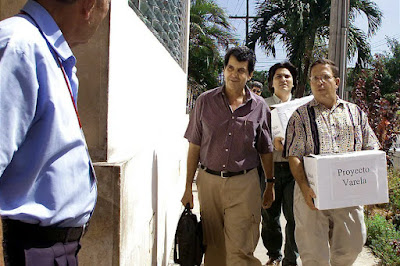
Oswaldo Payá, Antonio Diaz, and Regis Iglesias walk to turn in petitions

Milan Kundera, the Czech writer, in his 1999 novel The Book of Laughter and Forgetting observed that "the struggle of man against power is the struggle of memory against forgetting." Memory provides context to unfolding events today, and helps to render informed judgements.

Twenty years ago on May 10, 2002, carrying 11,020 signed petitions in support of the Varela Project, the Christian Liberation Movement's Oswaldo Payá Sardiñas, Antonio Diaz Sanchez, and Regis Iglesias Ramirez delivered them to the Cuban National Assembly.

The Varela Project, named after the Cuban Catholic Priest Felix Varela, sought to reform the Cuban legal system to bring it in line with international human rights standards. They had followed the letter of the law in organizing the campaign.

The Christian Liberation Movement was founded by Catholic lay people in Havana in September 1988, and is part of a non-violent dissident movement that traces its origins and influences to the Cuban Committee for Human Rights that was founded in 1976.

Former President James Carter visited Cuba in May 2002 and on May 15th gave a speech at the University of Havana, where he advocated for the lifting of economic sanctions on Cuba and "called for the Varela Project petition to be published in the official newspaper so that people could learn about it."

President James Carter at the University of Havana.

Yet the dictatorship's response to the nonviolent citizen's initiative, and to President Carter's request, was to coerce Cubans into signing another petition declaring the Constitution unchangeable and quickly passed it through the rubber stamp legislature. 

The Varela Project was not presented for debate before the National Assembly, which according to then existing law drafted by the Castro dictatorship meant that it should have been debated in that legislative body. 

Today at 3:00pm at the West Dade Regional Library (9445 Coral Way) in Miami, Florida,  the Christian Liberation Movement is extending an invitation to "the struggle of memory against forgetting" and ask the rest of us to join "in this discussion commemorating the 20th anniversary of the Varela project in Cuba, including its legacy and impact."

Sunday, December 12, 2021

Nonviolent resistance has a history of success in combating repression in Cuba by Regis Iglesias and John Suarez

Maria J. Stephan and Erica Chenoweth in their 2008 study "Why Civil Resistance Works: The Strategic Logic on Nonviolent Conflict" compared the outcomes of 323 nonviolent and violent resistance campaigns from 1900 to 2006. They found that major nonviolent campaigns achieved success 53 percent of the time, compared with just under half that at 26 percent for violent resistance campaigns."

Oswaldo Payá Sardiñas, Regis Iglesias, and Tony Diaz Sanchez deliver petitions

Grassroots movements in Cuba have fought for liberty for decades, mobilizing Cubans to defend human rights and freedom. The July 11 nationwide protests marked a historic moment, but they did not arise from nowhere.

In November 2020, hundreds of artists mobilized outside of the Ministry of Culture in a 15-day effort to free political prisoner Denis Solís González. They demanded both his release and greater artistic freedoms.

The San Isidro Movement (MSI), an artists collective formed in 2018 to nonviolently defend artistic freedom, challenged regime officials to free their unjustly jailed compatriot. Solís González was charged with contempt for protesting an illegal search of his home by a policeman, whom he had called a coward.

Rather than accede to MSI’s demands, officials repeatedly and violently escalated repression over 15 days, but they were met with nonviolent responses that inspired hundreds of artists and intellectuals to gather outside the Ministry of Culture, bringing officials to the negotiating table for dialogue.

The San Isidro Movement’s exercise in nonviolent power led to the formation of a new movement, 27N, and increased civic resistance. The pattern continued through 2021, reaching millions of Cubans across the island with the movement's art and music — in particular the song, “Patria y Vida.” The rapper Maykel Castillo Perez (Osorbo), co-author of the song and also a member of MSI, is currently in prison and severely ill.

This is not the first time nonviolent tactics have been carried out successfully in Cuba. The Cuban Committee for Human Rights, founded in 1976, systematically documented human-rights violations, information smuggled out of Cuba to international human rights organizations, which led to the installation of a special rapporteur focused on Cuba’s human-rights situation and the Castro regime’s condemnation over a 15-year period beginning in 1991. Havana’s record was carefully scrutinized, and it was held accountable annually until 2006.

The Christian Liberation Movement (MCL), founded in 1988 to work for Cuba’s democratization, is best known for the Varela Project, a petition signed by 11,020 Cubans in May 2002 calling on the regime to guarantee international human-rights norms in law. Fidel Castro changed his constitution to prevent it from being amended that same year.

The regime responded with violence, not so much because of the number of signatures presented to the National Assembly, but because more than 120 Citizens’ Committees had been created throughout the country in the process and imprisoned most of their leaders. Despite this repression, MCL turned in an additional 14,384 signatures in October 2003.

Castro expected the March 2003 crackdown, dubbed the “Black Cuban Spring,” to be the end of the opposition. Instead, it sparked the emergence of a new movement, the Ladies in White, led by the wives, mothers, sisters and daughters of the men jailed. For eight years, these women lobbied, protested and marched for their loved ones’ freedom. They were successful, and the last of the men were released from prison in 2011, a nonviolent victory over the dictatorship. The Ladies in White continue to the present day, demanding human rights be respected in Cuba.

The price of nonviolent defiance has been high: long prison terms, exile, deportations and extrajudicial killings. Tempted by the understanding that Cubans are exerting power through nonviolent action, some voices have emerged advocating a turn to violence in the belief that it would expedite a democratic transition.

Strategic studies have demonstrated that the more brutal the regime, the less effective and successful violent movements are. Counterintuitively, nonviolent movements have been more successful in overthrowing brutal dictators and transitioning to lasting democracies.

The Castro dictatorship, with decades of experience in terrorism, torture and genocide around the world, is an expert in war, as demonstrated in the 1960s when it efficiently and ruthlessly crushed a violent opposition in Cuba with the aid of Soviet advisors to consolidate power.

Nonviolent resistance is better able to mobilize citizens to demand change and obtain global solidarity and sanctions, creating the political, diplomatic and economic isolation of the regime and punishing the individuals and entities that violate Cubans’ rights. 

Regis Iglesias Ramírez is spokesperson for the Movimiento Cristiano Liberación. 

John Suarez is executive director of Centro por una Cuba Libre.

Note: This article was published in The Miami Herald on Tuesday, November 30, 2021.

Sunday, May 10, 2020

Project Varela: Looking back at the nonviolent campaign 18 years later

The nonviolent campaign that shook up the dictatorship in Cuba, changed the Cuban Communist Constitution and continues to haunt the Castro regime.


Oswaldo Payá Antonio Diaz, and Regis Iglesias after turning in signatures
18 years ago today, carrying 11,020 signed petitions in support of the Varela Project, Oswaldo Payá Sardiñas, Antonio Diaz Sanchez, and  Regis Iglesias Ramírez walked with the bulky card board boxes labeled Project Varela turning them into the Cuban National Assembly. 

The national coordinator of the Christian Liberation Movement, Eduardo Cardet, issued a statement on the 18th anniversary of these petitions being presented.
"On a day like today, 18 years ago the first signatures were delivered in support of the Varela Project (11,020 signatures), which constituted a formidable expression of free adherence to a project that managed to unite diverse people in a common purpose, demanding full rights for all Cubans. The totalitarian state persists, misery as a resource of oppression deepens, repression intensifies; the longing for freedom, justice and prosperity of our people is an old long-delayed longing.
Enough of dictatorship!All rights for the Cuban people!Long live the Varela Project, Long live the MCL!Homeland, Liberty and Life!"
The General Secretary of the Christian Liberation Movement and one of the individuals who turned in the petitions, Tony Diaz Sanchez placed the importance of the Varela project in context stating, "The liberation of a people begins at the ballot box as an invitation to each of the citizens to actively participate in the necessary transformations. This is the essence of the Varela Project, an essence that is also the aim and strategy of the Christian Liberation Movement and that we do not abandon ourselves until we Cubans live in freedom in the land that saw us born."

Regis Iglesias, Tony Diaz, and Eduardo Cardet of the Christian Liberation Movement

The New York Times reported on this historic event at the time and the author of the article understood its importance:
"Two days before a historic visit to Cuba by the former President Jimmy Carter, human rights activists today delivered an extraordinary challenge to the Communist government of President Fidel Castro in the form of petitions signed by more than 11,000 people seeking greater freedom. The petition drive, known as the Varela Project, calls for a referendum under the terms of the Cuban Constitution on whether there should be more freedom of expression, an amnesty for political prisoners and a chance for ordinary citizens to own small businesses. The signed petitions were delivered this morning to the National Assembly, after supporters painstakingly verified each signature, in the most significant peaceful effort to bring reform to Cuba in four decades. ''All of these Cubans, who with great courage and sacrifice have signed Project Varela, are the social vanguard for peaceful change in Cuba,'' said Oswaldo Paya, who led the drive. He said changes in the rights of Cubans could only be achieved peacefully.
The three activists, members of the Christian Liberation Movement, would pay a high price, along with dozens of others, for advocating human rights reforms within the existing legal frame work in Cuba. In March of 2003 both Antonio Diaz Sanchez, and Regis Iglesias were arrested and subjected to political show trials and sentenced to long prison sentences. They would spend years in prison followed by forced exile. Oswaldo Payá was killed on July 22, 2012 under circumstances that point to a state security orchestrated extrajudicial execution. 


The Varela Project, named after the Cuban Catholic Priest Felix Varelasought to reform the Cuban legal system to bring it in line with international human rights standards. They had followed the letter of the law in organizing the campaign and yet the dictatorship's response to a nonviolent citizen's initiative was to first coerce Cubans into signing another petition declaring the Constitution unchangeable and quickly passed it through the rubber stamp legislature without debating the Varela Project, which according to the Cuban law drafted by the dictatorship meant that it should have been debated by the National Assembly.


Ten months later on March 18, 2003 the Black Cuban Spring would begin with a massive crackdown on Cuba's civil society with many of the organizers of Project Varela, imprisoned and summarily sentenced up to 28 years in prison. The 75 activists who had been imprisoned with long prison sentences became known as the "group of the 75."

The dictatorship announced, at the time, that the Cuban dissident movement had been destroyed but the Castro regime was mistaken. First, the remaining activists who were still free continued gathering signatures and would turn in another 14,384 petition signatures on October 5, 2003. Secondly, the wives, sisters and daughters of the activists who had been detained and imprisoned organized themselves into the "Ladies in White." A movement that sought the freedom of their loved ones and organized regular marches through the streets of Cuba, despite regime organized violence visited upon them.


Regis Iglesias with Jose Daniel Ferrer Garcia

The Economist
 in its December 14, 2005 issue published a conversation with Oswaldo Paya titled "An unsilenced voice for change" that outlined what had taken place:

Between 2001 and 2004, Mr Payá's movement gathered 25,000 signatures in a vain attempt to persuade Cuba's National Assembly to change the constitution to allow multi-party democracy. Activists of his Christian Liberation Movement made up more than two-thirds of the 75 dissidents and journalists rounded up and jailed for long terms in April 2003. [...] Spain is “complaisant” with Mr Castro's regime, Mr Payá says. “We need a campaign of support and solidarity with peaceful change in Cuba” of the kind that brought an end to apartheid in South Africa and to the Pinochet dictatorship in Chile.
It took over eight years, but the last of the group of the 75 were eventually released. Many were driven into exile but  a core group remain in Cuba and are still defiant. One  of the Project Varela leaders still active and mobilizing large numbers today is Jose Daniel Ferrer Garcia, but others  lost their lives defending human rights and dignity who had also gathered signatures for the Varela Project, such as Orlando Zapata Tamayo.


Project Varela petitions delivered in 2002, 2003 and 2016
Project Varela lives on and on March 24, 2016 another 10,000 signatures were turned into the National Assembly bringing the total number of petitions signed in Cuba to 35,404.  

However, let us end this entry with a documentary produced at the time followed by a reflection 
on one of the key actors in the Varela Project.  The National Democratic Insitute created a documentary in September 2002 about the Varela Project, entitled "Dissident: Oswaldo Payá and the Varela Project," which premiered in several film festivals.


Regis Iglesias has written a chronology of how he experienced things on May 10, 2002 that has been published at the Christian Liberation Movement's website and below is an excerpt.
... Under this repressive state, hundreds of citizens have been working for Cuba. All of this was on our minds the night of May 9. For these reasons that night, in a small room in a house literally fenced by the most sophisticated espionage techniques and by dozens of repressive agents, we met, Oswaldo Payá, Antonio Díaz, Oswaldo Alfonso, Julio Ruiz Pitaluga, Ernesto Martín Fonseca, José Daniel Ferrer, Efrén Fernández, Jorge Colmenero and I to decide the details of the presentation, the next morning, of the Varela Project at the headquarters of the National Assembly of People's Power. Our will was unwavering because millions of Cubans have placed their hopes for freedom in this Project, even from their silent sympathies. We cannot fail them.
[...]
A wave of journalists rushed at us as he got out of the car. Behind him, Antonio and I went down with the two boxes containing the signature ballots. Oswaldo declared: “We came to present the Varela Project, then we will talk. Now we are going to present the signatures, more than 11,000 ″, and we continued our march towards the side entrance of the building where the population is served. I raised my fist with my index and thumb fingers extended to make the sign of Liberation. Dozens of onlookers, journalists, repressive agents and seven more opposition activists involved in the "operation" watched the scene, some with disbelief, others with hatred, most with hope and happiness. "I have waited 42 years to see this," said Julio Ruiz Pitaluga, who spent 24 years in Castro jails and still lived on the Island. 
The doorman of the legislative offices recognized Antonio and greeted him. Another individual dressed as a custodian asked how many of us were to enter, after Oswaldo informed him of the reason for our presence there. "Three, we are three," replied the Liberation leader. We went up the few steps of the premises and they invited us to go to a small room that was on our left. 
There we waited for an official to arrive, who identified herself as Columbié Lugo, who would attend to us because the Deputy in charge of the Population Services Department was absent at that time. We explained the reason for our presence and delivered the two boxes with the signature forms, a list with the names and general information of each signatory, the Legal Foundation of the Varela Project (with a copy). The lawyer corresponded to our courtesy and we asked her to sign a duplicate of the letter to Mr. Alarcón, she graciously agreed to stamp the official seal of said legislative body on his signature. We said goodbye to Lic. Columbié Lugo, of the people who were in the hall of the building and began to go down the steps of the entrance to the offices amidst the "assault" of questions from the press who anxiously waited on the sidewalk our departure. Several dozen curious onlookers crowded the street. 
I couldn't sort all the images and fleeting thoughts that went through my mind. Now I was trying to take a look at the people on the street. I looked at their amazed faces, their gestures and tried to guess their mimics. I was able to see Ernesto Martín, José Daniel, and Ricardo Montes among the large group, they were part of our support." ...
This courageous act of civic courage is remembered, and continues to impact inside Cuba and marks a historic moment that is shaping the eventual democratic transition that will arrive on the island.

Thursday, May 10, 2018

Project Varela: Looking back at the nonviolent campaign 16 years later

The nonviolent campaign that shook up the dictatorship in Cuba, changed the Cuban Communist Constitution and continues to haunt the Castro regime.

Oswaldo Payá, Tony Diaz Sanchez, and Regis Iglesias 16 years ago.
16 years ago today, carrying 11,020 signed petitions in support of the Varela Project, Oswaldo Payá Sardiñas, Antonio Diaz Sanchez, and  Regis Iglesias Ramírez walked with the bulky card board boxes labeled Project Varela turning them into the Cuban National Assembly. The New York Times reported on this historic event:

"Two days before a historic visit to Cuba by the former President Jimmy Carter, human rights activists today delivered an extraordinary challenge to the Communist government of President Fidel Castro in the form of petitions signed by more than 11,000 people seeking greater freedom. The petition drive, known as the Varela Project, calls for a referendum under the terms of the Cuban Constitution on whether there should be more freedom of expression, an amnesty for political prisoners and a chance for ordinary citizens to own small businesses. The signed petitions were delivered this morning to the National Assembly, after supporters painstakingly verified each signature, in the most significant peaceful effort to bring reform to Cuba in four decades. ''All of these Cubans, who with great courage and sacrifice have signed Project Varela, are the social vanguard for peaceful change in Cuba,'' said Oswaldo Paya, who led the drive. He said changes in the rights of Cubans could only be achieved peacefully.
The three activists, members of the Christian Liberation Movement, would pay a high price, along with dozens of others, for advocating human rights reforms within the existing legal frame work in Cuba. In March of 2003 both Antonio Diaz Sanchez, and Regis Iglesias were arrested and subjected to political show trials and sentenced to long prison sentences. They would spend years in prison followed by forced exile. Oswaldo Payá was killed, together with Harold Cepero, on July 22, 2012 under circumstances that point to a state security orchestrated extrajudicial execution.

Tony Diaz Sanchez and Regis Iglesias, two of the three in the photograph when the signatures were turned in, reflected today on the significance of what took place sixteen years ago.


Regis Iglesias on the 16th anniversary of turning in 11,020 signatures for a democratic change reflected on the importance of the Varela Project in AlgoritmoMag.
It was the first time that Cubans voted or demanded to do so after almost half a century of dictatorship that May 10, 2002, when Oswaldo Paya, Tony Diaz and I crossed the threshold of the offices of the National Assembly of People's Power and presented their officials the signatures that legitimized our demand for a referendum.Eleven thousand twenty Cubans with the right to vote, protected by among other articles 1, 3, and fundamentally 88, paragraph g of the draconian socialist constitution in force, took the step and with their personal data supported the demand for a referendum on the Varela Project, so that the law will guarantee the right to "political freedom", "popular sovereignty", the freedom of political prisoners and the economic freedoms of Cubans.More than a civic and legal exercise the initiative of the Christian Liberation Movement and its founder Oswaldo Paya, finally found a methodology to create the minimum social base in the middle of a totalitarian and repressive state in which the opposition is not recognized and dissidence is considered treason. 
Father Felix Varela
 Regis concludes his essay observing that the work is unfinished. 
Sixteen years later we continue with many Cubans demanding these rights, only when they are recognized and guaranteed can we rest, then we can kneel faceing the tombs of Orlando Zapata, Oswaldo Paya, Harold Cepero, Arturo Pérez de Alejo and many of our brothers who are no longer and tell them, "Friends, we've made it!"
Tony Díaz Sánchez Secretary General of the Christian Liberaton Movement (MCL) over twitter continues the call to free Eduardo Cardet and to promote MCL's proposal over twitter.
"At 16 years from Project Varela, honoring the memory of Oswaldo & Harold, we demand freedom of Eduardo Cardet and reiterate, that the transition begins when the law changes and guarantees free elections. "One Cuban one vote" that is our proposal." 
 A couple of days before the signatures were turned over on May 8, 2002 Oswaldo Payá, coordinator of referendum petition was video recorded by the Associated Press:
"Nobody speaks any longer for the Cubans. The Cuban people should be consulted via a referendum and be given a voice because now we want our rights and the Varela Project is not just a test, or an intellectual exercise. It is not a rehearsal to gain experience. It is an initial step in our determination to acquire these rights. Because four decades is enough and a new generation is being born that has been born without rights".

Monday, April 16, 2018

The Christian Resistance to Communism in Cuba presentation at Hope College in Holland, Michigan

"Any religion that professes to be concerned with the souls of men and is not concerned with the slums that damn them, the economic conditions that strangle them, and the social conditions that cripple them is a dry-as-dust religion." - Dr. Martin Luther King Jr.


Before embarking on a review of the Christian resistance to Communism one should examine the systematic evils inherent to the system. The 2015-2016 case of Sirley Avila Leon exposes on multiple levels the diabolical nature of communism in Cuba.


Religious repression in Cuba: The half century crackdown on Christianity in Cuba

The Cuban dictatorship has had a hostile relationship with religion since the beginning when it officially declared itself an atheist state and expelled scores of priests on September 17, 1961, cancelled Christmas in 1969 under the pretext to prevent work shortages for the 1970 ten million ton sugar harvest but continued the ban until 1997, and sent mobs to intimidate Cubans attending religious services.  

The revolutionaries in Cuba came down from the Sierra Maestra mountains in 1959 wearing rosaries, and the leadership used this image to reject the charge that they were communists. Fidel Castro claimed throughout the 1950s and in the early days of the revolution that their aim was to restore democracy, but the reality was that they had always planned to consolidate their rule and establish a communist regime.  [ Full article

Catholic religious orders expelled at gun point from Cuba in 1961
The Christian Resistance to Communism in Cuba 

Cuban Bishop Agustín Román on December 16, 2006 addressed the origins of the nonviolent Cuban dissident movement in Cuba and its Christian roots. Bishop Román had been forced out of Cuba at gun point with 130 others on September 17, 1961. Here he describes the link between the first prominent and nonviolent dissident group resisting the Castro regime.
Underlining its membership in the historic struggle of the Cuban people for justice, the Cuban Committee for Human Rights comes to light on the anniversary of the birth of Martí and cite Father Varela as one of the inspirations of their founding document. It's the same struggle, but it is boldly different: it seeks justice, but by peaceful means. The concept of nonviolent civil resistance is introduced into the history of Cuba. Take the truth as a weapon, placing it in practice in the civic field, what Scripture proposed in the spiritual realm: "the truth shall make you free". Hence its importance at that time and its transcendence for the future of Cuba.
 The Christian Liberation Movement, led by Oswaldo Payá Sardiñas, was founded on September 8, 1988 on the feast day of Our Lady of Charity of El Cobre.  It was made of a group of  catholic laymen who attended a parish in the El Cerro neighborhood in Havana.

Oswaldo Payá Sardiñas was the chief spokesman of the movement and the chief strategist behind initiatives such as the Varela Project, the Heredia Project and the Peoples Path. [ Full Article]

 Oswaldo Payá, Regis Iglesias, and Tony Díaz Sánchez turn in petitions.

 Markets and Morality and the Saint Benedict Institute co-hosted The Christian Resistance to Communism in Cuba on April 16, 2018 at 7:00 p.m. in Winants Auditorium.


Sunday, May 10, 2015

Project Varela and the price of freedom

Freedom isn't free 

Oswaldo, Regis and Tony turn in petition signatures on May 10, 2002
 May 10 marked the thirteenth anniversary of when Oswaldo Payá Sardiñas along with Christian Liberation Movement activists Regis Iglesias Ramírez and Tony Díaz Sánchez walked together with others to turn in 11,020 signatures to the Assembly of Peoples Power in 2002 supporting the Varela Project.  The Varela Project is a citizen initiative demanding human rights reforms and a referendum in Cuba. The response by the Castro regime was to: violate its own norms ignoring the petition, set up its own petition drive making the constitution "unchangeable" using threats and intimidation to obtain signatures, crack down on the opposition ( sentencing 75 to long prison terms, among them Regis to 18 years in prison and Tony to 20 years in prison ), extrajudicially executing Oswaldo in what appears to have been a state security operation on July 22, 2012 that also claimed the life of youth leader, Harold Cepero.


Saturday, May 10, 2014

Remembering Project Varela's Importance to Cuba 12 years after first signatures turned in

Today is the 12th anniversary of Project Varela an initiative based on respect for the rights of persons. - Sayli Navarro, over twitter May 10, 2014
 
Regis Iglesias, Oswaldo Payá and Tony Díaz on May 10, 2002

 It was twelve years ago today that a small contingent of Cuban activists and human rights defenders marched up to the Assembly of Popular Power in Havana, Cuba to turn in 11,020 signatures of Cuban citizens proposing an initiative for human rights reforms based in existing Cuban law that was and is called Project Varela. Over twitter today Rosa Maria Payá Acevedo wrote: "On 12th anniversary of the first delivery of Project Varela our tribute to the brave Cuban citizens who led the initiative." She also invited in another tweet to use the hashtag #ProyectoVarela today.

Activists on their way to the Assembly of Popular Power with petitions
 On May 9, 2014 Regis Iglesias Ramírez, spokesperson for the Christian Liberation Movement based in Spain, posted a video that outlines the extreme nature of the governing regime in Cuba, and the challenges faced by the Cuban democratic resistance in their nonviolent stand for human rights and democratic reforms titled "The people sooner or later will have to impose their determination":
.


Project Varela was an important step in the auto-liberation of the tens of thousands of Cuban citizens who signed it and that is its most important legacy. However, two other of the many important things that it generated are that:
1) Following decades of successfully muzzling the voices of most Cubans and maintaining a propaganda offensive domestically and internationally that gave the impression of near unanimity with the regime's political project was finally broken. Tens of thousands of Cubans risking everything had said they wanted change.

2) Cuba's dissident movement portrayed as fragmented and ineffectual had managed to do what no other dissident movement had been able to do outside of Poland and that was to create a mass mobilization around clearly defined objectives within the existing constitution under Articles 88 g and 63 that placed the dictatorship on the defensive.
Fidel Castro's response was not only a wave of terror and repression but also of misinformation claiming in an interview with Barbara Walters that "Yes they [Cubans] have the right to petition, but not to change the Constitution." Oswaldo Payá Sardiñas on October 13, 2002 in a formal and public response to Fidel Castro clarified the objectives of Project Varela:
Besides the right to carryout the petition, the current Constitution in Cuba reflects the rights for which Project Varela seeks assurances in law.We publicly clarify to Mr. Fidel Castro that Project Varela does not request a change in the Constitution, but rather carrying out changes in the laws so that such rights that are in the Constitution are complied with and that the decision be taken by the sovereign people consulted in a Referendum.
On March 18, 2003 a large number of Project Varela petition organizers were arrested and sentenced in summary trials to long prison terms. Prior to that in June of 2002 the Castro brothers steamrolled through their own mandatory petition drive making the Cuban Constitution unchangeable with regards to its communist nature.
Oswaldo Payá Sardiñas reviewing petitions
Twelve years later, now in exile in Miami after long years in prison, Tony Díaz Sánchez observes over facebook that: "The only bad thing that Project Varela has is that 12 years after its legal filing, it is totally valid."
Project Varela Activists back in the day
 Eduardo Cardet, member of the Coordinating Council of the Christian Liberation Movement (MCL) in Cuba in an interview with ACI Press that: "There are many people who are still signing it. That is why it remains still valid today because it adjusts to the Cuban reality where nothing has changed."
The regime in Cuba has not changed but Project Varela marks a clear before and after in the will of the Cuban people to express their desires for legal reforms to ensure that human rights are respected at great personal risk to themselves.

Long live Project Varela! Justice for Oswaldo and Harold. The time for the referendum is now.

Friday, February 28, 2014

Remembering Oswaldo on his Birthday and the first step on the path to change

"You are who decides, you have to make the decision to decide. You are the protagonist. The first step is to allow all that is good within you to come out and to rid yourself of grudges, of hubris, or of arrogance if you have abused power, of fears, and of that desperation that paralyzes many." - All Cubans, The Path to Change, last page of printed handout under Orientations

My father should be celebrating his 62nd birthday. Join us tonight, 7:30pm to talk about #SOSVenezuela and Cuba. -  Rosa María Payá Acevedo over twitter

Tony Diaz Sanchez,

Oswaldo Payá should be together with his family tonight in a modest neighborhood in Havana, El Cerro, celebrating his 62nd birthday. However, the totalitarian dictatorship, that tonight is overseeing the murder of students in Venezuela who want to see their homeland freed, nineteen months ago on July 22, 2012 murdered both Oswaldo and Harold Cepero, a Christian Liberation Movement youth leader.

Following these killings, of which the circumstances have not been cleared up, the Payá family saw an intensification of death threats, state security surveillance, and persecution. This led the matriarch of the family, Ofelia Acevedo to decide that before others were murdered that it was time to seek political refuge in exile. Tonight members of the Payá family held a teach-in on the situations in Venezuela and Cuba with Gisela Parra, an exiled magistrate and a member of the opposition as guest speaker.

The question arises: Why do the Castro and Maduro regimes fear those who speak the truth, and peacefully assemble? Neither Oswaldo, Harold or the Venezuelan students, murdered over the past two weeks were violent.  On the contrary they counseled against violence, and hatred. However they also counseled against being afraid, of having hope and living in truth.

This is unacceptable for a totalitarian dictatorship. Because these regime's thrive on fear and distrust which is also related to fear. However, it is difficult for such a regime to instill fear in someone who believes in God, in an afterlife and subsequently, may fear other things greater than death, such as living a lie subjected to the arbitrary whims of a cruel dictator. It is not enough just to be alive going through the motions.

It is telling that Génesis Carmona, the 22 year old student and Miss Tourism shot in the head and murdered by Maduro's agents, was carrying a sign that day that read: "God's time is perfect but if we don't go out into the streets, the time of Maduro will be ETERNAL"

The other factor is that a movement that bases itself in nonviolence and love taps into power, but one different to that wielded by a totalitarian dictatorship. Gandhi offered a reflection on different kinds of power:
"Power is of two kinds. One is obtained by the fear of punishment and the other by acts of love. Power based on love is a thousand times more effective and permanent then the one derived from fear of punishment."
This power does not seek to impose its will on others but to encourage self-expression and personal liberation. This self-liberation as was seen with the more than 25,000 Cubans that signed The Varela Project and the tens of thousands of Venezuelans protesting peacefully in the streets is the stuff that destabilizes regimes. It is the first, and I would dare say the biggest step, on the path to change.
