Showing posts with label Ricardo Bofill. Show all posts

Sunday, July 12, 2026

Dr. Ricardo Bofill, founder of the Cuban human rights movement. Requiescat in Pace

 "I can't understand the hatred towards me. Because, really in the only field I’ve done battle, is the field of ideas." - Dr. Ricardo Bofill, 1987 in "Nobody Listened" documentary 

Dr. Ricardo Bofill in a PBS documentary in 2005

The founder of the human rights movement in Cuba passed away on this day seven years ago in Miami. Ricardo Bofill Pagés co-founded the Cuban Committee for Human Rights in 1976, dedicated his entire life to defending human rights and suffered years in Cuban prisons for it.

This blog has celebrated the work of Dr. Bofill over the years and will do so again today. His story and legacy changed the course of a nation, and the outcome is still playing out today. The 400th blog on this site was dedicated to him.

 On December 10, 2014 Regis Iglesias, spokesperson of the Christian Liberation Movement at 1:40pm posted a picture of Ricardo Bofill over twitter with the text: "Honoring honor. Ricardo Bofill, an essential reference in the defense of Human Rights of Cubans." He was and remains correct in his assessment of this man.

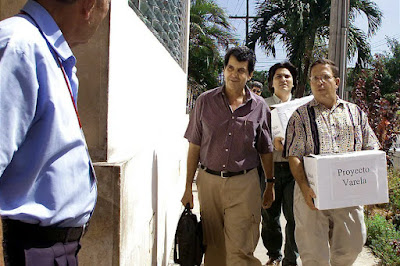
Ricardo Bofill, President of the organization that initiated the civic movement during 
the first exposition of dissident art, shortly before an assault by repressive forces

 In the 1987 documentary Nobody Listened, directed by Néstor Almendros and Jorge Ulla the world was introduced to Ricardo Bofill and the nonviolent human rights movement on the big screen.  Dr. Bofill is interviewed and discusses his circumstances as a dissident in Cuba engaged in the battle of ideas:

"I can't understand the hatred towards me. Because, really in the only field I’ve done battle, is the field of ideas. In this field I’ve had no response just prison and the police. And I don’t know why because the revolution controls all mass media. They have editorials, journalists, even many writers in the world. I don’t know why the response, time and again, has been jail. The response should come in the field I fight in, with ideas. I was arrested again in 1983. On that occasion, I was sentenced to 17 years in jail accused of activities in the Cuban Committee for Human Rights and the last period of prison began. For reasons of health and others I know not of in 1985 I was placed in the status I’m now in which is “conditional liberty with restriction of movement.”

Fidel Castro was asked the name of the human rights defender in another interview. The Cuban dictator dismisses his importance, but it is obvious in the context of his answer that he knows very well who this lone activist is, and views him as a threat.

Dr. Ricardo Bofill in the documentary Nobody Listened in 1987

 Why do they view Bofill's movement as an existential threat? The Castro dictatorship's ideology and revolution are based in violence and blood shed. The July 26, 1953 assault on the Moncada Barracks is a failure not only in the short term defeat suffered by Castro's forces but in the long term degradation of Cuban society and the abandonment of dialogue, moral and ethical restraints in favor of a cult of violence nurtured by a dictatorship now in its 60th year in power. 

Even the men responsible for doing this now complain about the society their revolution has created.They blame Cubans for their poor behavior and customs. Of course men and women with sound moral groundings who speak clearly what they believe and defend human dignity and freedom have an unfortunate tendency to die under suspicious circumstances in Cuba.

There are two traditions battling for control in Cuba. One tradition, embodied by the Castro regime, based on violence and the destruction of the other has dominated Cuba's political discourse for over half a century. It views dissent as treason and demands unanimity; the only acceptable ideas belong to the dictatorship. 

The second, an older tradition that built the institutions of Cuban democracy in the 19th Century using nonviolent means, who founded companies with a social conscience such as Bacardi, that contributed to the common good until forced out of their homeland, and of the democrats who helped draft the Universal Declaration of Human Rights in 1948 are still there in Cuba's nonviolent civic resistance movement.

This is the movement founded by Ricardo Bofill and a handful of activists on January 28, 1976 that today is  a nationwide movement of thousands who are nonviolently engaged in the battle of ideas and the defense of human rights. Today's repression across the island continues to demonstrate that the Castro regime is terrified of what Ricardo Bofill started.

In an open letter written in 1986 Dr. Bofill rejected regime slanders and staked out their position as a movment: "We have nothing to do with the CIA, we do not participate in violent acts, we have no other weapon than the word, and we are going to use it while we have a breath of life left."

In 1988 he was forced out of the country by the dictatorship, but continued his human rights work from exile in Miami, while Gustavo Arcos remained and continued to do the work in Cuba.

Dr. Bofill meets President Reagan in The White House in 1988

 It is a long and frustrating struggle to achieve the freedom of a country in the grip of totalitarian rule. One must neither over estimate or underestimate what has been achieved and what remains to be done. This is a marathon, not a sprint that requires persistence and faith, not despair. 

Dr. Bofill told me that 35 years ago and it still holds true today.

This is what he did, and Dr. Ricardo Bofill's legacy will live on in Cuba and in the end will triumph over the forces of brute force and tyranny.

Requiescat in pace Professor.


Thursday, August 8, 2024

Remembering Gustavo Arcos: Eighteen Years Later

 The Cuban Revolutionary who broke with Fidel Castro and became a Human Rights Defender


Gustavo Arcos Bergnes (1926- 2006)

On this day eighteen years ago, Gustavo Arcos Bergnes, who was 79 years old, passed away in Havana, Cuba, due to a heart attack. His birthplace was Caibarién, a small village in central Cuba. He studied diplomatic law at the University of Havana when he was a young man. However, on March 10, 1952, Fulgencio Batista's coup interrupted his academic career.

This is where he met Fidel Castro and later joined him on the July 26, 1953 assault on the Moncada military barracks. Gustavo was shot in the back, touching his spine and damaging the sciatic nerve, and left partly paralyzed by the wound suffered in the assault. [ Anita Snow reported in the Associated Press on Wednesday, May. 18, 2005 that "His sciatic nerve was damaged and has deteriorated over the years, making walking difficult, especially up the one flight of stairs from the street."]

Luis Arcos Bergnes killed in 1956

 Brother Luis killed by Fulgencio Batista's forces 
Gustavo was sentenced to ten years in prison but was pardoned and released 22 months later in 1955 and went with the rest of the group to organize a rebel army in Mexico. He traveled through Latin America and the United States gathering money and munitions. His brother Luis Arcos Bergnes was killed when the Granma expedition landed in Cuba in 1956 and were met by Batista's forces.

Gustavo Arcos was appointed Cuba's ambassador to Belgium following Castro's arrival to power in 1959. Wounded in the Moncada assault with a martyred brother, he could have easily remained a privileged member of the revolutionary elite, but that was not why he had taken up arms against Fulgencio Batista. He had fought for an end to dictatorship and the restoration of a democratic Cuba. When he returned to Cuba in 1964 he saw not only that the government had turned communist but that Fidel Castro was another dictator.  At the time Raul Castro personally offered Gustavo a position in the regime leadership. Gustavo rejected the offer. He was already disenchanted and preferred to remain in the diplomatic corps, away from Havana.Gustavo expressed his dissent privately.

"They shot a lot of people," Mr. Arcos told the Associated Press in 2005 during the summary trials held after the revolutionaries took power. "They shot people who could have easily been imprisoned." 

 On March 15, 1966 he was detained and in 1967 he was sentenced to 10 years in prison. for alleged counterrevolutionary activity. He served three years in prison before being released after a long hunger strike in 1969, but was not allowed to leave the country.

Logo of the Cuban Committee for Human Rights

 Joining the Cuban Committee for Human Rights

He and his younger brother, Sebastián Arcos Bergnes, joined the 1976-founded Cuban Committee for Human Rights in 1982 while incarcerated at the Combinado de Este. In 1981, the brothers were imprisoned for attempting to leave the country. Not long after, the Committee started issuing declarations criticizing the deplorable conditions under which political detainees were housed.

In 1986, international pressure compelled the Cuban government to grant a few concessions, including visits from several international human rights organizations and the release of several political prisoners, who subsequently carried out the Committee's activities in Havana's streets. Gustavo Arcos succeeded the committee's exiled executive director, Dr. Ricardo Bofill, shortly after his release from prison in 1988.

In 1990, Gustavo Arcos sent a message to Castro, defying the objections of many Cuban exiles, requesting that he call a "National Dialogue" that would involve all facets of Cuban society, both on the island and in exile. On January 28, 1990, Castro responded by saying that "the Cuban people" will take care of those activists during his speech to the Worker's Congress.

Sebastian Arcos's home was stormed by government-sponsored rioters on March 5, 1990. Gustavo's house was stormed on March 8 by a different mob that was led by future foreign minister Roberto Robaina. Many old acquaintances from exile persuaded Gustavo to dissolve the Committee in order to preserve the lives of the activists. Gustavo stated that "The Cuban Committee for Human Rights will continue its work, even if it costs us our own lives...no terror, nor propaganda will be able to deter the development of humanistic ideas in our country."

On January 13, 1992 the executive board of the Cuban Committee for Human Rights again issued a statement reaffirming their commitment to nonviolence and calling for dialogue:   "Violence is not and cannot be the solution to our problems... We will not tire from insisting that the only possible solution is civilized discussion of our differences. This is an appeal to Cubans for wisdom and common sense... No act of violence is justified... Let us say no to violence and learn to live in peace."

Gustavo Arcos Bergnes, Sebastián Arcos Bergnes and Jesús Yanes Pelletier were arrested at their homes in Havana on the evening of 15 January 1992. Both Gustavo and Yanes Pelletier were released after approximately 24 hours. However, Sebastian Arcos Bergnes was charged with "enemy propaganda" and "inciting rebellion," he was sentenced to four years and eight months in jail. He was transferred to Ariza Prison in  Cienfuegos Province, more than 130 miles from Havana, where Sebastian was imprisoned alongside dangerous criminals and was systematically denied medical attention. In 1993 the regime offered him a deal: Sebastian would be released immediately if he only agreed to leave the island for good. Sebastian rejected the deal, becoming the first documented case of a political prisoner choosing prison in Cuba over freedom in exile.

Brother Sebastian killed by medical neglect while arbitrarily imprisoned

After an international campaign that included his designation as an Amnesty International prisoner of conscience and a request by France Libertés, the organization founded by former French first lady Danielle Mitterrand, Sebastian Arcos was released in 1995. 

A few weeks after his release, Arcos was diagnosed with a malignant tumor in the rectum, for which he had previously been denied medical care in prison. After a Cuban doctor was fired from his post for treating Arcos, he traveled to Miami for further care.

In 1996, Sebastian Arcos Bergnes testified before the UN Human Rights Commission in Geneva, Switzerland. Sebastian Arcos Bergnes died in Miami surrounded by relatives on December 22, 1997.

Due to his worsening health in his last years he lowered his profile and ceded much of the work to exiled members of the Cuban Committee for Human Rights. Nevertheless, he met with US Senators visiting Cuba in 2000, with former President Carter in 2002 and signed a letter in 2003 denouncing the unjust imprisonment of 75 Cuban dissidents imprisoned in the Black Cuban Spring.

As his health deteriorated in his latter years, he reduced his public presence and gave up a large portion of his work to exiled members of the Cuban Committee for Human Rights. Still, in 2000 he met with US senators traveling to Cuba, with former President Carter in 2002, and he signed a letter protesting the unfair detention of seventy-five Cuban dissidents during the March 2003 crackdown.

In the 2005, Associated Press article, Anita Snow reported that he stayed in touch with other dissidents and spoke "frequently with Oswaldo Paya, a devout fellow Roman Catholic who led a signature-gathering effort called the Varela Project, which sought a referendum asking voters if they favored civil liberties such as freedom of speech and the right to business ownership." The article concluded with Gustavo's concern that he would not live to see the return of democracy saying : "I do hope I will see the end of this, but I'm not sure if I will.

In response to a question regarding Gustavo Arcos' legacy that I received from the news agency EFE on August 8, 2006, I said, "It is with great sadness that Arcos will not be able to be there the day that we expect a democratic transition in Cuba. We will always remember that he was one of the founders of the Cuban dissidence, of great courage, coming from a family that sacrificed much and that fought so much against dictatorship both Fulgencio Batista's and Fidel Castro's." Also noted that he left a "strong legacy that will continue to grow" while "in these moments that a giant of the Cuban dissidence has died we have projects that he basically initiated." Compared the call in 1990 by the Arcos brothers to a national dialogue so that "all segments both inside the island and in exile could analyze the Cuban problem and have proposals for the future" with "how presently one sees, 16 years later how  Oswaldo Payá Sardiñas following that example of a national dialogue was able to elaborate a document for transition designed by Cubans in the island and the exiles, in a process of nearly three years."  I also addressed his principled stand and how he entered the dissident movement outlined above and concluded: "We are talking about a man with courage and who is an example of  non-cooperation with the Castro regime."

Michael N. Nagler, an expert in principled non-violence, has noted that nonviolence always bears fruit and leaves seeds for positive outcomes, even when it is not immediately obvious. For instance, pro-democracy activists from around the world continue to be inspired by Gustavo's tenets of nonviolence and have recalled his life and example by posting a remembrance of him on his death anniversary on X today.

Sunday, December 12, 2021

Nonviolent resistance has a history of success in combating repression in Cuba by Regis Iglesias and John Suarez

Maria J. Stephan and Erica Chenoweth in their 2008 study "Why Civil Resistance Works: The Strategic Logic on Nonviolent Conflict" compared the outcomes of 323 nonviolent and violent resistance campaigns from 1900 to 2006. They found that major nonviolent campaigns achieved success 53 percent of the time, compared with just under half that at 26 percent for violent resistance campaigns."

Oswaldo Payá Sardiñas, Regis Iglesias, and Tony Diaz Sanchez deliver petitions

Grassroots movements in Cuba have fought for liberty for decades, mobilizing Cubans to defend human rights and freedom. The July 11 nationwide protests marked a historic moment, but they did not arise from nowhere.

In November 2020, hundreds of artists mobilized outside of the Ministry of Culture in a 15-day effort to free political prisoner Denis Solís González. They demanded both his release and greater artistic freedoms.

The San Isidro Movement (MSI), an artists collective formed in 2018 to nonviolently defend artistic freedom, challenged regime officials to free their unjustly jailed compatriot. Solís González was charged with contempt for protesting an illegal search of his home by a policeman, whom he had called a coward.

Rather than accede to MSI’s demands, officials repeatedly and violently escalated repression over 15 days, but they were met with nonviolent responses that inspired hundreds of artists and intellectuals to gather outside the Ministry of Culture, bringing officials to the negotiating table for dialogue.

The San Isidro Movement’s exercise in nonviolent power led to the formation of a new movement, 27N, and increased civic resistance. The pattern continued through 2021, reaching millions of Cubans across the island with the movement's art and music — in particular the song, “Patria y Vida.” The rapper Maykel Castillo Perez (Osorbo), co-author of the song and also a member of MSI, is currently in prison and severely ill.

This is not the first time nonviolent tactics have been carried out successfully in Cuba. The Cuban Committee for Human Rights, founded in 1976, systematically documented human-rights violations, information smuggled out of Cuba to international human rights organizations, which led to the installation of a special rapporteur focused on Cuba’s human-rights situation and the Castro regime’s condemnation over a 15-year period beginning in 1991. Havana’s record was carefully scrutinized, and it was held accountable annually until 2006.

The Christian Liberation Movement (MCL), founded in 1988 to work for Cuba’s democratization, is best known for the Varela Project, a petition signed by 11,020 Cubans in May 2002 calling on the regime to guarantee international human-rights norms in law. Fidel Castro changed his constitution to prevent it from being amended that same year.

The regime responded with violence, not so much because of the number of signatures presented to the National Assembly, but because more than 120 Citizens’ Committees had been created throughout the country in the process and imprisoned most of their leaders. Despite this repression, MCL turned in an additional 14,384 signatures in October 2003.

Castro expected the March 2003 crackdown, dubbed the “Black Cuban Spring,” to be the end of the opposition. Instead, it sparked the emergence of a new movement, the Ladies in White, led by the wives, mothers, sisters and daughters of the men jailed. For eight years, these women lobbied, protested and marched for their loved ones’ freedom. They were successful, and the last of the men were released from prison in 2011, a nonviolent victory over the dictatorship. The Ladies in White continue to the present day, demanding human rights be respected in Cuba.

The price of nonviolent defiance has been high: long prison terms, exile, deportations and extrajudicial killings. Tempted by the understanding that Cubans are exerting power through nonviolent action, some voices have emerged advocating a turn to violence in the belief that it would expedite a democratic transition.

Strategic studies have demonstrated that the more brutal the regime, the less effective and successful violent movements are. Counterintuitively, nonviolent movements have been more successful in overthrowing brutal dictators and transitioning to lasting democracies.

The Castro dictatorship, with decades of experience in terrorism, torture and genocide around the world, is an expert in war, as demonstrated in the 1960s when it efficiently and ruthlessly crushed a violent opposition in Cuba with the aid of Soviet advisors to consolidate power.

Nonviolent resistance is better able to mobilize citizens to demand change and obtain global solidarity and sanctions, creating the political, diplomatic and economic isolation of the regime and punishing the individuals and entities that violate Cubans’ rights. 

Regis Iglesias Ramírez is spokesperson for the Movimiento Cristiano Liberación. 

John Suarez is executive director of Centro por una Cuba Libre.

Note: This article was published in The Miami Herald on Tuesday, November 30, 2021.

Saturday, February 6, 2021

Remembering Reagan on the 71st anniversary of his 39th birthday: What he did to end tyranny in Cuba

Ronald Wilson Reagan born 110 years ago today on February 6, 1911.

Ronald Reagan was born 110 years ago today in Tampico, Illinois on February 6, 1911. Today, at the Reagan Library the Reagan Foundation broadcast an online celebration observing the 40th President's birthday with a wreath laying ceremony at his tomb. Moments like these give one time to reflect.

My earliest political memories dimly recalled Nixon, and Ford but more complete memories began with the Carter Administration, and the dramatic change that occurred with President Reagan's administration from the afternoon of January 20, 1981 to the morning of January 20, 1989.

In my first year at Florida International University, I had joined the College Republicans, and at the age of 19 on June 29, 1988 at the Omni International Hotel to support the Senate candidacy of Connie Mack an event was held were I was able to meet and listen to President Ronald Reagan, and came away deeply impressed. He gave a wide ranging speech that included foreign policy and meeting with Cuban- American leaders, and he spoke truths that still resonate and hold true today. Below is an excerpt from the speech.

"And let's talk for a moment about foreign policy. Let me offer here a simple, straightforward message: No more Vietnams, no more Nicaraguas, no more Bay of Pigs. Never again! Connie Mack and I stand with the Nicaraguan resistance. We will not rest until we've won for them the full support they need and until they've won for themselves the genuine democracy and freedom for which they've so bravely struggled. By supporting courageous freedom fighters around the world, we're shining a light on the path out from Communism, and nowhere has that light shone brighter than in Afghanistan. And isn't it time we apply the lessons of Afghanistan in Nicaragua and show the same commitment to freedom fighters in our own hemisphere as we do to others in distant lands?

I just came from a meeting with Cuban-American leaders, and I want to tell you what I told them. In Communist Cuba, a man like Armando Valladares is considered a criminal. In the United States, we're honored to have him represent our nation before the world. In Communist Cuba, a man like Ramon Puig is labeled an enemy of the Government. In the United States, he's a respected citizen and a hero. And while Havana spreads communism, terror, and death in Central America, many Cuban-Americans like Dr. Manuel Alzugaray are providing food, medicine, and humanitarian assistance to the victims of Communist aggression.

So, yes, there is an unbridgeable gulf between the Governments of the United States and Cuba; it is the gulf between freedom and tyranny. And as far as this administration is concerned, freedom for Cuba, liberty for her people, is a nonnegotiable demand. And so long as Cuba remains an inhuman Communist dungeon, so long as it exports terrorism and revolution in the Western Hemisphere; has some 60,000 military, secret police, and other personnel propping up brutal Communist dictatorships around the world; and, yes, so long as Cuba is used as the personal instrument of Fidel Castro's violent anti-Americanism -- there cannot and must not be any normalization of relations with Cuba."

Critics of Reagan's policy on Cuba have to downplay both its concrete actions and achievements.

Ronald Reagan entered the White House in 1981 and re-imposed the Cuba travel ban, toughened economic sanctions undoing Jimmy Carter's detente with Fidel Castro, in 1982 placed the Castro regime on the list of state sponsors of terrorism, and started Radio Marti to break through the communist monopoly with uncensored information for Cubans on the island. 


President Reagan was an unapologetic anti-communist who empowered dissidents and engaged in acts of solidarity to underscore their importance.

Ronald Reagan backed the creation of a Radio Free Cuba to break Castro regime's information monopoly over Cubans beginning in 1981. In a 1983 address, President Reagan explained the importance of getting the truth to oppressed peoples:

The Soviets are terrified of the truth. They understand well and they dread the meaning of St. John's words: "You will know the truth, and the truth will set you free." The truth is mankind's best hope for a better world. That's why in times like this, few assets are more important than the Voice of America and Radio Liberty, our primary means of getting the truth to the Russian people.[...]  We've repeatedly urged the Congress to support our long-term modernization program and our proposal for a new radio station, Radio Marti, for broadcasting to Cuba. The sums involved are modest, but for whatever reason this critical program has not been enacted. Today I'm appealing to the Congress: Help us get the truth through. Help us strengthen our international broadcasting effort by supporting increased funding for the Voice of America, Radio Free Europe, Radio Liberty, and by authorizing the establishment of Radio Marti.

He signed it into law in October 1983. When it finally went on the air full time in 1985 Radio Free Cuba had come into existence named Radio Marti. This radio station transmitting uncensored information to Cuba marked a before and after inside the island nation. At the time President Reagan hoped that Radio Marti would ''help defuse the war hysteria on which much of current Cuban Government policy is predicated.'' The Hoover Institution in 1989 listed it as one of a 100 conservative victories.

The State Department placed Cuba on the list of state sponsors of terrorism on March 1, 1982 because of the dictatorship's involvement in cocaine trafficking and arms smuggling to communist guerrilla groups in Colombia.

The Reagan Administration pursued engagement both with the Castro regime and the Cuban people, and unlike others, before and after, did not confuse the two. Reagan tasked Ambassador Vernon Walters as his special envoy, sending him in 1982 to meet for six hours with Fidel Castro in Cuba. As was the case with the Soviet Union, the Cuban counterparts took part in a frank discussion that did not sugarcoat the nature of their regime.

25 years after the Castro regime came to power on January 5, 1984 President Reagan addressed the Cuban people over Radio Marti, in its early broadcasts. Below is the message he delivered.

“On behalf of the people of the United States, I would like to extend New Year’s greetings to the people of Cuba.

We know you’re marking a historic anniversary on your island. Twenty-five years ago, during these early January days, you were celebrating what all of us hoped was the dawn of a new era of freedom. Most Cubans welcomed the prospects for democracy and liberty which the leaders of the Cuban revolution had promised.

Such a free and democratic Cuba would have been warmly welcomed by our own people. We’re neighbors in a hemisphere that has been characterized by the quest for human freedom. Government which rests upon the consent of the governed is a cardinal principle that enshrines the dignity of every individual. We share many of the same ideals, especially a common longing for a world of peace and justice. We are both proud peoples, proud of what we’ve achieved through our own efforts.

But tragically, the promises made to you have not been kept. Since 1959 you’ve been called upon to make one sacrifice after another. And for what? Doing without has not brought you a more abundant life. It has not brought you peace… It has not won freedom for your people – freedom to speak your opinions, to travel where and when you wish, to work in independent unions and to openly proclaim your faith in God…

In the meantime, over half a million of your fellow citizens have migrated to the United States, where their talents and hard work have made a major contribution to our society. We welcomed them and we’re proud of their success. But we have to wonder: what would Cuba’s economy be like today if those people had been allowed to use their great talent, drive and energy to help you create prosperity on your island?

The most important question remains: Where is Cuba heading? If it were heading towards greater welfare and freedom for your people, that would be wonderful. But we know prisoners of conscience, convicted for their political activities, have been languishing in Cuban prisons, deprived of all freedom for nearly a quarter of a century…

You may not be aware of some of these things… That’s because you are systematically denied access to facts and opinions which do not agree with your government’s official view. But why are your leaders so unwilling to let you hear what others think and say? If the power of truth is on their side, why should they need to censor anyone’s views? Think about that…

The objective of the Radio Martí program will be simple and straightforward: tell the truth about Cuba to the Cuban people. We want you to know what you haven’t been told…

These are not pleasant questions but they deserve answers. I hope you’ll contemplate them with care. At the beginning of this new year, let us hope that the future will be kinder than the past. And may that better future begin soon for all you in Cuba.

Feliz Año Nuevo y que Dios te bendiga [Happy New Year and God bless you].

The Reagan Administration did not stop there, but named former Cuban prisoner of conscience Armando Valladares Ambassador to the United Nations Human Rights Commission and made human rights in Cuba a priority. Reagan presented an interim report to members of the Cuban American community.

The end result was that for the first and last time Amnesty International, the International Committee of the Red Cross and the UN Human Rights Commission were able to visit Cuban political prisoners, and assess the human rights situation in the country.

In the 1987 documentary Nobody Listened, directed by Néstor Almendros and Jorge Ulla the world was introduced to Ricardo Bofill, one of the founders of the Cuban human rights movement, and the nonviolent human rights movement overall on the big screen. Dr. Bofill is interviewed and discusses his circumstances as a dissident in Cuba engaged in the battle of ideas:

"I can't understand the hatred towards me. Because, really in the only field I’ve done battle, is the field of ideas. In this field I’ve had no response just prison and the police. And I don’t know why because the revolution controls all mass media. They have editorials, journalists, even many writers in the world. I don’t know why the response, time and again, has been jail. The response should come in the field I fight in, with ideas. I was arrested again in 1983. On that occasion, I was sentenced to 17 years in jail accused of activities in the Cuban Committee for Human Rights and the last period of prison began. For reasons of health and others I know not of in 1985 I was placed in the status I’m now in which is “conditional liberty with restriction of movement.”

Fidel Castro was asked the name of the human rights defender in another interview. The Cuban dictator dismissed his importance, but it is obvious in the context of his answer that he knew very well who this lone activist was, and viewed him as a threat.

President Ronald Reagan received Dr. Ricardo Bofill in Nov 1988.

In 1988 Ricardo Bofill was forced out of the country by the dictatorship, but continued his human rights work from exile in Miami, while Gustavo Arcos remained and continued to represent the movement in Cuba. In late November 1988 he was being received by President Ronald Reagan in the White House.

These are a just a few of the reasons that Cuban Americans fondly remember the 40th President of the United States, and continue to honor his memory.


Friday, August 14, 2020

Exiled leader of the Cuban Committee for Human Rights dies of COVID-19 in Miami

 "I am not - nor have I ever been - of the extreme left, nor of the extreme right. I have always been parked in the center - undoubtedly the best place - gathering the good of both parties. I dream of a Cuba in which we all fit." Oscar Peña
Ricardo Bofill and Oscar Peña of the Cuban Committee for Human Rights
Covid-19 claimed the life of Oscar Peña, a leader of the Cuban Committee for Human Rights. Over twitter today Cuban scholar and journalist Carlos Alberto Montaner reported:
"Oscar Peña, one of the heads of the Cuban Committee for Human Rights created by Ricardo Bofill and Gustavo Arcos, has died of Covid in Miami. When he denounced the regime, they mounted several acts of repudiation. In exile he always tried to find peaceful and reasonable solutions."
It is important to revisit the founding of the Committee. On January 28, 1976 a candle was lit in Cuba and a new type of struggle for freedom initiated when Ricardo Bofill together with Marta Frayde at her home in Havana founded the Cuban Committee for Human Rights. Carlos Alberto Montaner described how this movement came into existence during a speech in 2009 in Madrid, Spain:
Finally, in 1976, half a dozen Cuban opposition actvists with leftist backgrounds were summoned by professor Ricardo Bofill [3] and founded in Havana the Cuban Committee for Human Rights, the first political organization in the nation's history to expressly renounce violence as a method of struggle. The group decided to abide by the rule of law to reclaim the rights quashed by the dictatorship. Meanwhile, in exile in Washington, about the same time, Mrs. Elena Mederos, former minister in the revolutionary government, and activist and political scientist Frank Calzón, founded Of Human Rights with the same objective: to defend, by nonviolent and legal means, persecuted individuals, dissidents and political prisoners in Cuba.
In 1982 at the Combinado de Este prison Gustavo Arcos Bergnes and his younger brother, Sebastián Arcos Bergnes, joined the Cuban Committee for Human Rights. The brothers had been imprisoned in 1981 for trying to leave the country illegally. Soon thereafter, the Committee began to send out proclamations denouncing the deplorable conditions in which political prisoners were kept. 

Shortly after his release from prison in 1988, Gustavo Arcos succeeded the committee’s executive director, Dr. Ricardo Bofill, who was forced into exile.


 In 1990, against the protests of many Cuban exiles, Gustavo Arcos issued a statement to Castro asking him to convene a "National Dialogue," which would include all segments of Cuban society, on the island and in exile. During his address to the Worker's Congress on January 28, 1990, Castro issued his response noting that "the Cuban people" will take care of those activists.

On March 5, 1990 government sponsored mobs attacked Sebastian Arcos's home. On March 8 another mob, led by future Foreign Minister Roberto Robaina, attacked Gustavo's home. From exile, many old friends asked Gustavo to dissolve the Committee to save the activists' lives. Gustavo replied: "The Cuban Committee for Human Rights will continue its work, even if it costs us our own lives...no terror, nor propaganda will be able to deter the development of humanistic ideas in our country."

Logo of the Cuban Committee for Human Rights
On January 13, 1992 the executive board of the Cuban Committee for Human Rights again issued a statement reaffirming their commitment to nonviolence and calling for dialogue:   "Violence is not and cannot be the solution to our problems... We will not tire from insisting that the only possible solution is civilized discussion of our differences. This is an appeal to Cubans for wisdom and common sense... No act of violence is justified... Let us say no to violence and learn to live in peace."


Gustavo Arcos Bergnes, Sebastián Arcos Bergnes and Jesús Yanes Pelletier were arrested at their homes in Havana on the evening of 15 January 1992. Both Gustavo and Yanes Pelletier were released after approximately 24 hours. However, Sebastian Arcos Bergnes was charged with "enemy propaganda" and "inciting rebellion," he was sentenced to four years and eight months in jail. He was transferred to Ariza Prison in  Cienfuegos Province,  more than 130 miles from Havana, where Sebastian was imprisoned alongside dangerous criminals and was systematically denied medical attention. In 1993 the regime offered him a deal: Sebastian would be released immediately if he only agreed to leave the island for good. Sebastian rejected the deal, becoming the first documented case of a political prisoner choosing prison in Cuba over freedom in exile.

Martha Frayde
 After an international campaign that included his designation as an Amnesty International prisoner of conscience and a request by France Libertés, the organization founded by former French first lady Danielle Mitterrand, Sebastian Arcos was released in 1995. A few weeks after his release, Arcos was diagnosed with a malignant tumor in the rectum, for which he had previously been denied medical care in prison. After a Cuban doctor was fired from his post for treating Arcos, he traveled to Miami for further care.

Sebastian Arcos Bergnes
In 1996, Sebastian Arcos Bergnes testified before the UN Human Rights Commission in Geneva, Switzerland. Sebastian Arcos Bergnes died in Miami surrounded by relatives on December 22, 1997.

Due to his worsening health in his last years Gustavo Arcos lowered his profile and ceded much of the work to exiled members of the Cuban Committee for Human Rights. Nevertheless, he met with US Senators visiting Cuba in 2000, with former President Carter in 2002 and signed a letter in 2003 denouncing the unjust imprisonment of 75 Cuban dissidents imprisoned in the Black Cuban Spring.

In the 2005, Associated Press article, Anita Snow reported that he stayed in touch with other dissidents and spoke "frequently with Oswaldo Paya, a devout fellow Roman Catholic who led a signature-gathering effort called the Varela Project, which sought a referendum asking voters if they favored civil liberties such as freedom of speech and the right to business ownership." The article concluded with Gustavo's concern that he would not live to see the return of democracy saying : "I do hope I will see the end of this, but I'm not sure if I will.

Gustavo Arcos Bergnes
Gustavo Arcos passed away in Cuba on August 6, 2006. Martha Frayde passed away in Spain on December 4, 2013. Ricardo Bofill remained in exile in Miami, Florida and an active member of the Cuban Committee for Human Rights until his death on July 12, 2019.

This nonviolent approach would endure and grow into a nationwide movement across Cuba and write new chapters in Cuba's history of resistance to tyranny.

The struggle for a free Cuba has been a long affair with different episodes and different approaches.
Between 1959 and 1966 there had been a violent resistance to the Castro regime that carried out armed landings (1961); guerilla uprisings (1961 - 1966) that according to Carlos Alberto Montaner "lasted until approximately 1966, when the last foci of peasant guerrillas on the central mountains were exterminated." 

Many of the participants in the Anti-Castro armed struggle had first been members of Castro's July 26th Movement, who had fought in good faith to rid Cuba of the Batista regime with the aim of a democratic restoration. 

These Cubans returned to fight in the hills when it became obvious that the Castro brothers were imposing another and more brutal dictatorship.

Some of them ended up joining the Cuban Committee for Human Rights and continued the struggle using nonviolent means.

Oscar Peña
 Others like Oscar had believed, but grown disillusioned with the crude brutality of the regime.

Sebastián Arcos Cazabón considers that Oscar Peña was "another of the good guys who didn't make it to see a free Cuba." Speaking to Martí Noticias, Arcos described his colleague as someone with a constant imagination. "He represented a generation that initially got on the bandwagon of the Revolution and then realized that it was a trap."

Ricardo Bofill, President of the organization that initiated the civic movement during 
the first exposition of dissident art, shortly before an assault by repressive forces


Friday, July 12, 2019

Dr. Ricardo Bofill, founder of the Cuban human rights movement. Requiescat in Pace

"I can't understand the hatred towards me. Because, really in the only field I’ve done battle, is the field of ideas." - Dr. Ricardo Bofill, 1987 in "Nobody Listened" documentary
Dr. Ricardo Bofill in a PBS documentary in 2005
The founder of the human rights movement in Cuba just passed away in Miami. Ricardo Bofill co-founded the Cuban Committee for Human Rights in 1976, dedicated his entire life to and suffered years in Cuban prisons for defending human rights.


This blog has celebrated the work of Dr. Bofill over the years and will do so again today. His story and legacy changed the course of a nation, and the outcome is still playing out today. The 400th blog on this site was dedicated to him.

On December 10, 2014 Regis Regis Iglesias, spokesperson of the Christian Liberation Movement at 1:40pm posted a picture of Ricardo Bofill over twitter with the text: "Honoring honor. Ricardo Bofill, an essential reference in the defense of Human Rights of Cubans." He was and remains correct in his assessment of this man.


Ricardo Bofill, President of the organization that initiated the civic movement during 
the first exposition of dissident art, shortly before an assault by repressive forces
In the 1987 documentary Nobody Listened, directed by Néstor Almendros and Jorge Ulla the world was introduced to Ricardo Bofill and the nonviolent human rights movement on the big screen.  Dr. Bofill is interviewed and discusses his circumstances as a dissident in Cuba engaged in the battle of ideas:
"I can't understand the hatred towards me. Because, really in the only field I’ve done battle, is the field of ideas. In this field I’ve had no response just prison and the police. And I don’t know why because the revolution controls all mass media. They have editorials, journalists, even many writers in the world. I don’t know why the response, time and again, has been jail. The response should come in the field I fight in, with ideas. I was arrested again in 1983. On that occasion, I was sentenced to 17 years in jail accused of activities in the Cuban Committee for Human Rights and the last period of prison began. For reasons of health and others I know not of in 1985 I was placed in the status I’m now in which is “conditional liberty with restriction of movement.”
Fidel Castro was asked the name of the human rights defender in another interview. The Cuban dictator dismisses his importance, but it is obvious in the context of his answer that he knows very well who this lone activist is, and views him as a threat.


Dr. Ricardo Bofill in the documentary Nobody Listened in 1987
Why do they view Bofill's movement as an existential threat? The Castro dictatorship's ideology and revolution are based in violence and blood shed. The July 26, 1953 assault on the Moncada Barracks is a failure not only in the short term defeat suffered by Castro's forces but in the long term degradation of Cuban society and the abandonment of dialogue, moral and ethical restraints in favor of a cult of violence nurtured by a dictatorship now in its 60th year in power. 

Even the men responsible for doing this now complain about the society their revolution has created.They blame Cubans for their poor behavior and customs. Of course men and women with sound moral groundings who speak clearly what they believe and defend human dignity and freedom have an unfortunate tendency to die under suspicious circumstances in Cuba.

There are two traditions battling for control in Cuba. One tradition, embodied by the Castro regime, based on violence and the destruction of the other has dominated Cuba's political discourse for over half a century. It views dissent as treason and demands unanimity; the only acceptable ideas belong to the dictatorship. 

The second, an older tradition that built the institutions of Cuban democracy in the 19th Century using nonviolent means, who founded companies with a social conscience such as Bacardi, that contributed to the common good until forced out of their homeland, and of the democrats who helped draft the Universal Declaration of Human Rights in 1948 are still there in Cuba's nonviolent civic resistance movement.

This is the movement founded by Ricardo Bofill and a handful of activists on January 28, 1976 that today is  a nationwide movement of thousands who are nonviolently engaged in the battle of ideas and the defense of human rights. Today's repression across the island continues to demonstrate that the Castro regime is terrified of what Ricardo Bofill started.

In an open letter written in 1986 Dr. Bofill rejected regime slanders and staked out their position as a movment: "We have nothing to do with the CIA, we do not participate in violent acts, we have no other weapon than the word, and we are going to use it while we have a breath of life left."

In 1988 he was forced out of the country by the dictatorship, but continued his human rights work from exile in Miami, while Gustavo Arcos remained and continued to do the work in Cuba.


Dr. Bofill meets President Reagan in The White House in 1988
It is a long and frustrating struggle to achieve the freedom of a country in the grip of totalitarian rule. One must neither over estimate or underestimate what has been achieved and what remains to be done. This is a marathon, not a sprint that requires persistence and faith, not despair. Dr. Bofill told me that 28 years ago and it still holds true today.

This is what he did, and Dr. Ricardo Bofill's legacy will live on in Cuba and in the end will triumph over the forces of brute force and tyranny.

Requiescat in pace.