Friday, August 3, 2012

Another voice joins the call for truth and transparency on Oswaldo Paya's death

In the video below Senator Bob Menendez speaks out on the death of Oswaldo José Payá Sardiñas, Cuban Dissidents arrested at Paya's funeral and calls for an international and transparent investigation while explaining the reasons why.


Take action and sign the petition demanding a transparent investigation in pursuit of the truth by an international organization.

Thursday, August 2, 2012

Patterns of Repression and Human Rights Violations in Cuba

“It's up to all of us to try - and those that say that individuals are not capable of changing anything are only looking for excuses.” - Vaclav Havel, on Amnesty International's 50th Anniversary in 2011


Remarks on Capitol Hill today August 2, 2012

Alex  Sutton is right when he says that there is no free speech in Cuba and this also applies to the international press based there that know if they reported the news accurately they would be kicked out  of the country by the regime as many international reporters have already been. If you want to have an idea of what is actually going on you are better off reading the tweets of independent journalists and human rights defenders on the island.

There are two constants in the patterns of repression and human rights violations in Cuba over the past 53 years and they are the rising body count of victims and the use of fear as a tool of political control to maintain power over the Cuban populace.Underestimating the Castro regime has been a great mistake made by numerous policy makers and analysts. The Cuban intelligence service (known as G2) was formed and trained by the East German intelligence service known as the Stasi.  Like their East German counterparts the Cubans have not only infiltrated dissident groups on the island but the highest levels of the United States intelligence services and State Department. The case of Ana Belen Montes should serve as a warning to those that underestimate this dictatorship. The poisoning of dissidents and staged car accidents were standard tactics of the Stasi that the Cuban intelligence service adopted.
 
Rudolph Joseph Rummel, a political science professor at the University of Hawaii and an expert in Democide (murder by government) estimates 73,000 Cubans were killed between 1959 and 1987. Pascal Fontaine in chapter 25 of The Black Book of Communism  states that in Cuba between 1959 through the late 1990s between 15,000 and 17,000 Cubans were executed by firing squad. The Cuban Archives place the number at 100,000 killed.

Remember that freedom of expression and a free press are non-existent in Cuba. Amnesty International on June 30, 2010 reported on how “Cuba's repressive legal system has created a climate of fear among journalists, dissidents and activists, putting them at risk of arbitrary arrest and harassment by the authorities.” The activists suffering the imprisonment, in many cases, have overcome their fear. The repression they suffer is to make them an example to others in the populace. Human Rights Watch first described the Cuban regime of having a "repressive machinery" in 1999. Twenty years later when Fidel Castro the human rights group reaffirmed in a new report "New Castro Same Cuba" that the repressive machinery remained intact.

The United Nations Committee against Torture on June 25, 2012 delivered a scathing report on torture in Cuba and the lack of legal safe guards. The Cuban constitution and the criminal code explicitly deny Cubans their right to their own opinions that are contrary to the interests of the regime to preserve and promote communism. The lack of a free and independent media that is systematically persecuted and censored means that little information gets out of Cuba and even less gets to the population on the island. In addition to these laws the proclivity to dissent is also prohibited. The possibility that you may have opinions counter to the regime in the future or may associate with people hostile to the regime can lead you to imprisonment for the Orwellian crime of "predilection to social dangerousness."

Despite the "legal" apparatus the dictatorship uses "extra-legal" measures organizing mobs to assault non-violent activists peacefully exercising their rights. In recent years women have been brutally targeted by these regime agents. Afterwards adequate medical care has been sketchy at best.

Extrajudicial killings were a common practice beginning in 1959. Brutal examples continue to the present day such as the July 13, 1994 "13 de Marzo" tugboat massacre that claimed the lives of scores of men, women and children and the February 24, 1996 Brothers to the Rescue shoot down that murdered four human rights defenders.  ( Also bears mentioning that on the eve and day of this attack the American diplomat Robin Meyers was sideswiped by cars driven by Cuban state security agents on a number of occasion over February 23 and 24th.)

Since 2006 when Fidel Castro became sick and turned power over to his brother Raul, a new and disturbing pattern emerged. In the past activists would occasionally disappear or their bodies would appear under mysterious circumstances.  Manuel Acosta Larena, an activist in the Democracy Movement, died under suspicious circumstances while in detention on June 24, 2007 and appears to have been a victim of police brutality. Miguel Valdés Tamayo was part of the group of the 75 arrested in March of 2003 released in 2004 for health reasons Cuban State Security began a campaign of harassment that led to his premature death on January 10, 2007. October 7, 2006, independent journalist and librarian Hector Riverón Gonzalez, 48, found dead near a taxi at the taxi stand in the City of Las Tunas. His body was found dead under a tree, with his shoes clean and dry although it had rained all night, and handcuff marks. The journalist had been threatened with death several times by State Security. Other cases involving suspicious deaths are those of Omar Darío Pérez Hernández, of Camagüey, Cuba and Idania García Quesada, a dentist from Las Tunas, Cuba. Forced to flee the country it is believed that they were killed by State Security in 2003 and 2004 respectively.

This leads to the question: Why does the Castro regime hate and fear opposition and dissident leaders such as Oswaldo Payá Sardiñas and Laura Inés Pollán Toledo? Both were nonviolent and advocated political dialogue


Oswaldo Payá Sardiñas interview in January of 2003 (in Spanish)

Oswaldo Payá left Cuba in late 2002 to collect the Sakharov Prize awarded to him by the European Union where he gave an important speech on December 17, 2002 in which he outlined an important first victory of the opposition:
“The first victory we can claim is that our hearts are free of hatred. Hence we say to those who persecute us and who try to dominate us: ‘You are my brother. I do not hate you, but you are not going to dominate me by fear. I do not wish to impose my truth, nor do I wish you to impose yours on me. We are going to seek the truth together.’”
Laura Pollán became a dissident when her husband was imprisoned during the Black Cuban Spring of 2003 along with more than 75 others. She was one of the founders of the Ladies in White and challenged the dictatorship on the streets of Cuba. Following brutal repression in an effort to prevent them from marching through the streets of Havana Laura Pollan demonstrated states: "We will never give up our protest. The authorities have three options — free our husbands, imprison us or kill us. 

Laura Pollán wearing a cast product of attacks received by regime agents
 Refusing to be afraid and refusing to hate one's adversaries creates a dynamic of liberation that is a mortal threat to these type of totalitarian regimes. It leads others to lose their fear and those who have aided the regime in the past are more likely to join opposition ranks knowing that they will be treated in a just not vengeful manner. This is why the dictatorship, even in death, hates them and tries to destroy their memory.

This combined with a reduction in concerted international solidarity efforts over the past four years has led to a new and disturbing pattern. The regime is now able to act on its hatred of high profile activists.

Beginning on February 23, 2010 higher profile figures such as prisoner of conscience Orlando Zapata Tamayo tortured and denied water while on hunger strike died. On January 31, 2011 Mercedez Talavera López died after being run over by a car in the city of Cárdenas in Matanzas. This was followed by the death of  human rights defender Juan Wilfredo Soto Garcia on May 8, 2011 just three days after a brutal beating by regime agents. The suspicious deaths of Laura Pollan on October 14, 2011 by a mysterious illness combined with what an independent doctor described as "purposeful medical neglect", of prisoner of conscience Wilman Villar Mendoza on January 20, 2012 while on hunger strike and now Oswaldo Payá on July 22, 2012 in a "car accident" less than two weeks after another car was launched at him points to a new and troubling trend of high profile victims.

The nonviolent end of communism in Eastern Europe and the Soviet Union was carefully studied by the Castro regime. It appears that their strategy is to eliminate the Cuban Vaclav Havel's and Aung San Suu Kyi's in order to preserve power or guarantee a bloody finish to their system.

Laura and Oswaldo were both inspired by Mohandas Gandhi who advocated using truth as an anvil and nonviolence as a hammer to see if it stands the test. Ofelia Acevedo, the widow of Oswaldo Payá, founder and new leader of the Christian Liberation Movement demands the opening of a transparent investigation conducted by an international organization whose sole purpose is the pursuit of truth.

Achieving this objective and getting at the truth of what happened will break the culture of impunity practiced by the Castro regime that has all too often gotten away with murder in Cuba. This will also hasten the establishment of a new pattern of liberation and the respect for human rights that both Laura Pollan, Oswaldo Payá and these other activists struggled and died for.




Wednesday, August 1, 2012

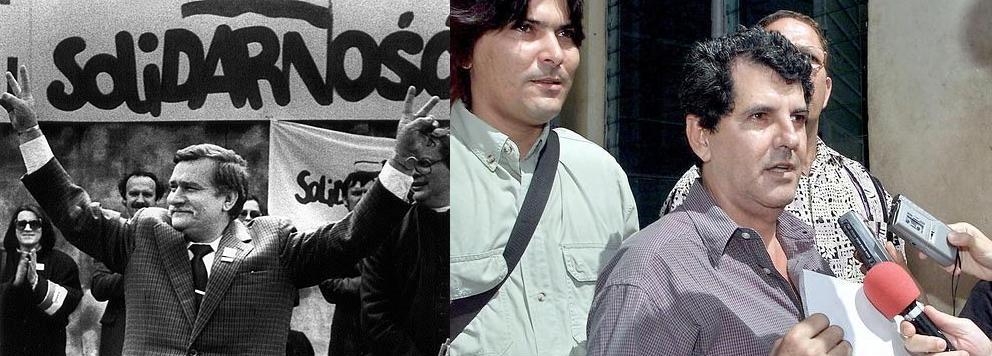
Lech Walesa calls for an international investigation into Oswaldo Paya's death

In a letter to Oswaldo Paya's widow backs the demand for an international and transparent investigation into the human rights defender's death.
Lech Walesa in a letter to Oswaldo Paya's widow calls for international investigation


Lech Wałęsa 
The city of Gdańsk, July 31, 2012 

Lady Ofelia Acevedo 
Christian Liberation Movement
Havana, Cuba 

Dear Madam: 

Once again please accept my condolences on the occasion of the sudden death of Oswaldo. Before this tragedy, I feel that all that we have been moved, we are one family - we are united by faith in the ideas and values, whose propagator was Oswaldo. We share a concern about the works created by him, we are also joined together in the hope of that new Cuba, for which Oswaldo was struggling, to finally become a reality.

Oswaldo has done something exceptional - he has not only integrate the divided opposition, but also has convinced the public that changes are possible. I know how hard it is to overcome fear, to break the stagnation and apathy of the people living in a totalitarian country where there is no freedom. I know how hard it is to fight for ideals when in everyday life you face misunderstanding, hostility, and aggression. How easy it is to renounce one's goals when the regime proposes privileges and a comfortable life. Oswaldo never chose the easy way. Stubbornly and against the difficulties, often finding rejection and hatred, he was realizing his most cherished and only goal: a free and just Cuba, to which he wanted to arrive through nonviolent means. 

I regret that I never had the opportunity to meet with Oswaldo and personally express my admiration for his courage and his extraordinary spiritual strength. But Oswaldo, although he died, in my memory he will remain alive forever. I am confident he will stay alive in the memory of all, for whom freedom and human rights are a fundamental value. 

It's hard to calm the pain and be resigned to the loss of a loved one. It is difficult to understand the meaning of this suffering, when the family is denied the truth about the circumstances of the death of someone close. The lack of official information, the denial of contact with the participants of the accident, raises questions about the version of events presented in the mass media in Cuba. That is why I am supporting your efforts and those of the MCL for an open transparent investigation and to convene an international commission to investigate the circumstances of the accident.

I assure you of my prayers also. 

Lech Walesa

Original in Spanish taken from the MCL website:

Lech Wałęsa
La ciudad de Gdańsk, el 31 de Julio del 2012
Señora Ofelia Acevedo
Movimiento Cristiano Liberación
La Habana, Cuba
Estimada Señora:
Otra vez más le ruego acepte mis condolencias con motivo de la muerte repentina de Oswaldo. Ante la tragedia, siento que todos los que hemos sido conmovidos, somos una familia – nos une la fe en las ideas y valores, cuyo propagador fue Oswaldo; nos une la preocupación por la obra creada por él; nos une también la esperanza sobre que nueva Cuba, por la cual estuvo luchando Oswaldo, finalmente va a ser la realidad.
Oswaldo ha hecho algo excepcional – ha logrado no sólo integrar a la oposición dividida, sinó también ha convencido a la sociedad de que los cambios son posibles. Yo se qué difícil es superar al miedo, romper al marasmo y la apatía de la gente que vive en un país totalitario, donde no existe la libertad. Yo se qué difícil es luchar por los ideales, cuando en la vida cotidiana uno enfrenta la incomprensión, la enemistad, la agresión. Qué fácil es renunciar a los objetivos de uno cuando el régimen propone privilegios y una vida cómoda. Oswaldo jamás ha escogido el camino más fácil. Con obstinación y en contra a las dificultades, frecuentemente encontrando al rechazo y al odio, estaba realizando su objetivo más querido, único: Cuba libre y justa, hacia a la cual quería llegar por la vía pacífica.
Lamento que nunca he tenido la oportunidad de encontrarme con Oswaldo y personalmente expresarle mi admiración por su valentía y su extraordinaria fuerza espiritual. Pero Oswaldo, aunque ha fallecido, en mi memoria se queda vivo para siempre. Confío que va a quedar vivo en la memoria de todos, para los cuales la libertad y los derechos humanos son un valor fundamental.
Es dificil calmar al dolor y resignarse a la perdida de un ser querido. Es difícil comprender el sentido de este sufrimiento, cuando a la familia se le niega conocer la verdad sobre las circunstancias de la muerte del cercano. La falta de las informaciones oficiales, el negar el contacto con los participantes del accidente, despierta dudas sobre la versión de los acontecimientos, presentada en los medios de difusión masiva en Cuba. Es por esto que yo estoy apoyando los esfuerzos Suyos y los del MCL por abrir la investigación transparente y por convocar a una comisión internacional que investigue las circunstancias del accidente
Les aseguro también sobre mí oración.
Lech Walesa

Monday, July 30, 2012

Petition Demanding International and Transparent Investigation into the deaths of Paya and Cepero

"I'm not going to accept the version the government's giving. In no way do I accept it." - Ofelia Acevedo, Oswaldo Paya's widow

On July 22, 2012 Oswaldo Payá Sardiñas, founder and leader of the Christian Liberation Movement and Harold Cepero Escalante, member of the cited movement, lost their lives on the Las Tunas-Bayamo highway, in the island of Cuba. In the wrecked car traveled together with them, Ángel Francisco Carromero and Jens Aron Modig, Spanish and Swedish citizens respectively.

In the absence of official information to clarify to the families of the deceased the truth of the accident that killed Oswaldo Payá and Harold Cepero, we ask, as required by respect for truth and the duty of care to the pain of the victims of this tragic event, to proceed in the shortest possible to make known the truth of what happened.

In the words of Ofelia Acevedo, widow of Oswaldo Payá, founder and new leader of the Christian Liberation Movement, the families of the two dead dissidents do not look for the guilty, but for the truth. We join this claim and demand the opening of a transparent investigation conducted by an international organization whose sole purpose is the pursuit of truth.

Only in this manner can the contradictions that from the outset have surrounded the deaths of Payá Sardiñas and Cepero Escalante dissipate. We also ask, according to international law and the most basic duties of justice to be met by any government in the world that the process of inquiry into the truth of the death of Payá Sardiñas and Cepero Escalante, guarantee the Spanish and Swedish citizens that traveled aboard the wrecked car, care and fair legal defense and according to law.

Original Spanish text of the petition and form to add your name available here.

Thursday, July 26, 2012

Oswaldo José Payá Sardiñas in his own words

"They have told me that they will kill me before this regime ends, but I will not flee." - Oswaldo Paya

Oswaldo José Payá Sardiñas

The first victory we can claim is that our hearts are free of hatred. Hence we say to those who persecute us and who try to dominate us: ‘You are my brother. I do not hate you, but you are not going to dominate me by fear. I do not wish to impose my truth, nor do I wish you to impose yours on me. We are going to seek the truth together’. - Oswaldo Paya, December 17, 2002

We now know that any method or model which purportedly aims to achieve justice, development, and efficiency but takes precedence over the individual or cancels out any of the fundamental rights leads to a form of oppression and to exclusion and is calamitous for the people. - Oswaldo Paya, December 17, 2002

We wish to express our solidarity with all those who suffer from any form of oppression and injustice, and with those in the world who have been silenced or marginalized. - Oswaldo Paya, December 17, 2002

The cause of human rights is a single cause, just as the people of the world are a single people. The talk today is of globalization, but we must state that unless there is global solidarity, not only human rights but also the right to remain human will be jeopardized. - Oswaldo Paya, December 17, 2002

It's obviously a matter of shame that our land is being used for that purpose, having foreign prisoners brought to Cuba. Even if they are terrorists they deserve respect. Their human rights should be respected. - Oswaldo Paya, December 18, 2002 (on arrival of Taliban prisoners to Guantanamo )

There is a real “moral inversion,” in what the foreign media, intellectual circles, ecclesiastical circles, diplomats and politicians are doing against the people of Cuba and against the dissident right now. They judge the persecuted, the poor, those who are silenced, but they do not dare to judge the government. - Oswaldo Paya, October 3, 2011

As a Cuban, I am not a tourist or someone who is living in a glass case, I eat in a workers’ canteen, I relate to doctors, nurses, patients. My coworkers, whom I love and I’m proud to work with, despite having the state security watching me. I walk down these streets with my colleagues and friends, my neighbors. I know how Cubans feel, and they want a new life, they want freedom, they want rights.  - Oswaldo Paya, October 3, 2011

We thank all those heroes who on one day were abducted from their homes unjustly imprisoned solely for defending human rights. The people of Cuba and all who love justice must be grateful to those Cubans who have been symbols of dignity and hope shining from the shadows.  - Oswaldo Paya, October 7, 2010

As John Paul II said: we have to be the protagonists of our history. Liberation is a task for the Cuban people – now with greater hope because we are definitely on the verge, on the threshold of truth and liberation. That is our hope." - Oswaldo Paya, March 29, 2012

We denounce all those governments and states in this continent and in the world together with the many institutions and persons that prefer a harmonious relationship with lies and oppression than  open solidarity with the Cuban people. All are complicit with what is happening and what will happen. - Oswaldo Paya, March 2, 2010


"It is not up to the U.S. to bring about changes in Cuba. Nor is it up to the U.S. businessmen who say that by doing business here they will bring change. Nor is it up to U.S. tourists. And I say this to those who say that U.S. tourists will bring changes to Cuba. The Spaniards and Canadians haven't done so. Moreover, that's an insult to the Cuban people. Changes will not be made by tourists drinking daiquiris and mojitos, strolling through our beaches and staying in hotels that Cubans can't stay in." - Oswaldo Paya
