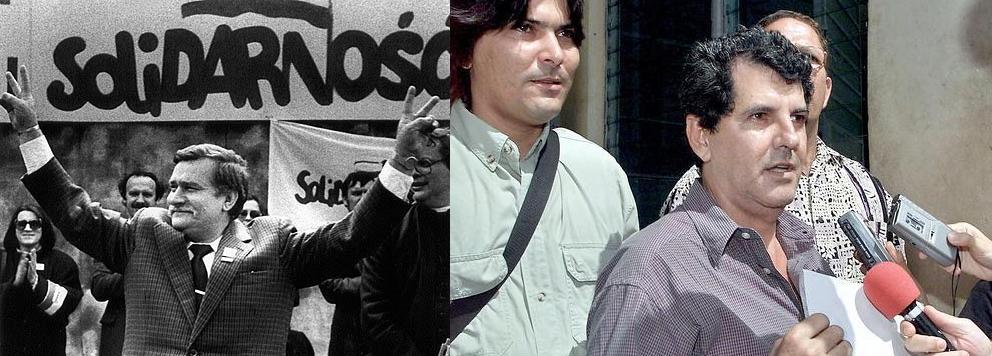
Showing posts with label Lech Walesa. Show all posts

Friday, November 15, 2019

Honoring Lech Walesa: Freedom's champion who led the Solidarity Movement and helped free Poland

"We hold our heads high, despite the price we have paid, because freedom is priceless." - Lech Walesa, August 30, 2009.


Meeting Lech Walesa at a NED event honoring him.
Met one of my hero's a couple nights ago. Lech Walesa, the electrician who started a labor union that overthrew a dictatorship in Poland and opened the path to the liberation of Eastern Europe in 1989.

Earlier this week, he spoke before a congressional committee on Capitol Hill and was honored at a National Endowment for Democracy event where he also spoke.

Lech Walesa, the 1983 Nobel Peace Laureate, who thirty years ago on November 15, 1989 addressed a joint session of the United States Congress.

Six months earlier on June 4, 1989 Poland had its first free elections in over half a century following round table talks earlier that year. This would not have happened if not for Lech Walesa and the Polish Solidarity Movement that had obtained guarantees for workers following a strike in the Gdansk ship yards in 1980. With Poland's freedom, the rest of Eastern and Central Europe followed and the Berlin Wall was torn down after dividing Berliners and killing scores of Germans for 38 years.

It could have all ended badly. In China, the Tiananmen Square massacre took place on the same day as the Polish elections that ushered in thirty years of freedom and prosperity.

In Latin America, despots returned in Nicaragua and sprung up in Venezuela. Fidel Castro died of old age never having to face justice and the regime founded by him and his brother continues to wreak havoc in Cuba and in Latin America.

In February 2009 Lech Walesa was barred from entering Venezuela by Hugo Chavez, and ten years later under the regime of Nicolas Maduro ones is seeing the results of Chavismo.

Throughout these years, Lech Walesa would remain a friend of the Cuban dissident movement. He joined the call for an international investigation into the death of Oswaldo Payá Sardiñas in July of 2012.

Today, we remember his speech from thirty years ago, celebrate his legacy, and strive to continue his struggle for freedom.


We the people 
Lech Wałęsa addresses joint session of the United States Congress November 15, 1989

Mr. Speaker, Mr. President, members of the Cabinet, distinguished members of the House and Senate.

“We the People”. With these words I wish to begin my address. I do not need to remind anyone here where these words come from. And I do not need to explain that I – an electrician from Gdansk – am also entitled to invoke them.

I stand before you as the third foreign non-head of state invited to address the joint Houses of Congress of the United States. This Congress, which, for many people in the world, oppressed and stripped of their rights, is a beacon of freedom and a bulwark of human rights. And here, I stand before you, to speak to America in the name of my nation. To speak to citizens of the country and the continent whose threshold is guarded by the famous Statue of Liberty. It is for me an honor so great, a moment so solemn, that I cannot find anything to compare it with.

People in Poland link the name of the United States with freedom and democracy, with generosity and high mindedness, with human friendship and friendly humanity. I realize that not everywhere is America so perceived. I speak of her image in Poland. This image has been strengthened by numerous favorable historical experiences, and it is very well known that Poles repay warm heartedness in kind.

The world remembers the wonderful principle of American democracy: “Government of the people, by the people, for the people.”

I do remember these words. I, a shipyard worker from Gdańsk, have devoted my entire life, along with other members of the Solidarity movement, to the service of this idea: “Government of the people, by the people, for the people”. Against privilege and monopoly. Against violations of the law. Against the trampling of human dignity. Against contempt and injustice.

Such, in fact, are the principles and values reminiscent of Abraham Lincoln and the founding fathers of the American Republic, as well as the principles and ideas of the American Declaration of Independence and the American Constitution. These principles are pursued by the great Polish Solidarity movement; a movement that is effective.

I know that Americans are idealistic, but at the same time, practical people, endowed with common sense and capable of logical action. They combine these features with belief in the ultimate victory of right over wrong. But they prefer effective work to making speeches, and I understand them very well. I am not a fan of speeches. I prefer facts and work. I treasure effectiveness.

Ladies and gentleman, the fundamental and most important thing that I would like to tell you about is that the social movement bearing the beautiful name “Solidarity”, born of the Polish nation, is an effective movement. After many long years of struggle, it bore fruit and the results are there for all to see today. It set the direction and developed a way of action that has affected the lives of millions of people speaking different languages. It has swayed monopolies,

And the struggle was conducted without resorting to violence of any kind, a point that cannot be stressed too much. We were being locked up in prisons, deprived of our jobs, beaten, and sometimes killed. And we did not so much as strike a single person. We did not destroy anything. We did not smash a single window pane. But we were stubborn. Very stubborn. Ready to suffer, to make sacrifices. We knew what we wanted, and our power prevailed in the end.

It was a consistent and persistent movement, never giving up. And that is why after all these hard years, marked by so many tragic moments, Solidarity is today succeeding and showing the way to millions of people in Poland and other countries.

Ladies and gentleman, it was ten years ago, in August 1980, that the famous strike began in the Gdansk shipyards that led to the emergence of the first independent trade union in communist countries, and soon became a vast social movement, supported by the Polish nation. I was ten years younger then, unknown to anybody but my friends in the shipyard, and somewhat slimmer. And I must frankly say that it was important. I was an unemployed man at that time, fired from my job for earlier attempts to organize workers in the fight for their rights. I jumped over the shipyard wall and rejoined my former colleagues, who promptly appointed me leader of the strike. This is how it all began.

When I recall the road we travelled, I often think of that jump over the fence. Now others jump fences and tear down walls. They do it because freedom is a human right. But there is also another reflection that comes to mind when I think of the road behind us. In those days, at the beginning, many warnings, admonitions, and even condemnations reached us from many parts of the world.

“What are those Poles up to?” we heard. “They are mad!” “They are jeopardizing world peace and European stabilit!” “They ought to stay quiet and not get on anybody’s nerves”. From those voices we gathered that other nations have the right to live in comfort and prosperity, they have the right to democracy and freedom, and it is only Poles who should give up these rights so as not to disturb the peace of others.

In the days before the Second World War there were many people who asked: “Why should we die for Gdańsk, isn’t it better to stay home?” But war soon paid them a visit. And they had to start dying, for Paris, for London, for Hawaii. This time, too, there were many who complained: “There is that Gdansk again, disturbing our peace!”

But the recent developments in Gdańsk carried a different message. This is not the beginning, but the true end of that war. That was the beginning of a new, better, democratic, and safe era in the history of our world. It is no longer a question of “dying for Gdańsk”, but of “living for it”.

Looking at what is happening around us today, we may affirm that the path of struggle followed by Poland in quest of human rights, a struggle without violence and characterized by typical Polish stubbornness and firmness in the quest for pluralism and democracy, shows many people today, and even nations, how to avoid the greatest dangers of conflict.

If there is something threatening European stability today it is certainly not Poland. Poland is driving towards its own profound transformation; transformation achieved through peaceful means, through evolution, negotiated with all the parties concerned, which makes it possible to avoid the worst. And perhaps is held up as a model for many other regions. For, as we know, changes elsewhere are not so peaceful. Peacefully and prudently, with their eyes open to danger but not giving up what is right and necessary, the Poles gradually paved a way for historic transformations.

We are joined along this way, to various extents, by others: Hungarians and Russians, Ukrainians and the people from the Baltic states, Armenians and Georgians, and in recent days East Germans. We wish them luck and rejoice each success they achieve. We are certain that others will also take road we have followed, as there is no other choice!

So now I ask, is there is any sensible man understanding the world around him who could justifiably say today that it would be better for the Poles to keep quiet, because what they are doing is jeopardizing world peace? Could we even dare say that Poles are doing more to preserve and consolidate peace than many of their frightened advisors? Could we not say that stability and peace is under greater threat from countries which have not yet brought themselves to carry out far-reaching and comprehensive reforms, which do their utmost to preserve the old and disgraced ways of government, contrary to the wishes of their societies?

Things are different in Poland. And I must say that our task is viewed with understanding by our Eastern neighbors and their leader Mikhail Gorbachev. This understanding lays the foundation for new relations between Poland and the Soviet Union, relations which are much better than before. These improved mutual relations will also contribute to stabilization and peace in Europe, removing useless tensions.

The Poles have a long and difficult history, and no one wants more than we do peaceful coexistence and friendship with all nations and countries, and particularly with the Soviet Union. We believe that it is only now that the right and favorable conditions for such coexistence and friendship are emerging. Poland is making an important contribution to a better future for Europe, to European reconciliation. And also to the vast and important Polish-German reconciliation. To overcoming all the divisions and the strengthening of human rights on our continent. But it does not come easily for Poland.

In the Second World War, Poland was the first country to fall victim to aggression. Her losses in terms of human life and national property were the heaviest. Her fight was the longest; she was always a dedicated member of the victorious alliance and her soldiers fought in all the world theatres. In 1945 Poland was, theoretically speaking, one of the victors. Theory, however, had little in common with practice.

In practice, as her allies looked on in passive consent, an alien system of government was imposed in Poland, without a president in the Polish tradition, unaccepted by the nation, together with an alien economy, an alien law, and an alien philosophy of social relations. The legal Polish government, recognized by the nation, and leading the struggle of all Poles throughout the war was condemned, and those who remained faithful to it were subjected to the most ruthless persecution. Many were murdered. Thousands vanished somewhere into Russia’s East and North. Civilian repression without soldiers of the underground army that fought the Nazis. And it is only now that we are discovering their bones in unmarked graves scattered among the forests.

This was followed by persecutions of all those who dared to think independently. All the solemn pledges about free elections in Poland that were made in Yalta were broken. It was the second great national catastrophe following the catastrophe of 1939. When other nations were joyously celebrating victory, Poland was again sinking into mourning.

The awareness of this tragedy was doubly bitter, as the Poles realized that they had been abandoned by their allies. The memory of this is still strong in the minds of many. Nevertheless, the Poles took to rebuilding their devastated country, and in the first years following the war they were highly successful. But soon a new economic system was introduced, in which individual entrepreneurship ceased to exist, and the entire economy ended up in the hands of the state, run by people who were not elected by the nation.

Stalin forbade Poland to use aid provided by the Marshall Plan; aid that was used by everyone in Western Europe, including countries which lost the war. It is worth recalling now that great American plan which helped Western Europe to protect its freedom and peaceful order. And now is the moment when Eastern Europe awaits an investment of this kind, an investment in freedom, democracy, and peace. An investment adequate to the greatness of the American nation.

The Poles have travelled a long way. It would be worthwhile for all those commenting on Poland, often criticizing Poland, to bear in mind that, whatever Poland has achieved, she achieved through her own effort, through her own stubbornness, her own relentlessness. Everything was achieved thanks to the unflinching faith of our nation in human dignity, and in what is described as the values of Western culture and civilization. Our nation well knows the price of all this.

Ladies and gentleman, for the past fifty years, the Polish nation has been engaged in a difficult and exhausting battle. First to preserve its very biological existence. Later to save its national identity. In both instances, Polish determination was there. Today, Poland is rejoining the family of democratic and pluralistic countries, returning to the tradition of religious and European values. For the first time in half a century, Poland has a non-communist and independent government supported by the nation.

But in our past there looms a serious obstacle. A great danger. Our long subjection to a political system incompatible with national traditions, to an economic system incompatible with rationality and common sense, coupled with a stifling of independent thought and disregard for national interest has led the Polish economy to ruin, to the verge of utter catastrophe. The first government in fifty years elected by the people and serving the people has inherited from the previous rulers of the country the burden of an economy organized in a manner which prevents it from satisfying even the basic needs of its people.

The economy we inherited after almost five decades of communist rule is in need of overhaul. This will require patience and great sacrifice. This will require time and means. The present condition of the Polish economy is not due to change, as it is not specifically a Polish predicament. All the countries of the Eastern Bloc are bankrupt today. The communist economy has failed in every part of the world. One result of this is the exile of citizens of those countries, by land and by sea, by boat and by plane, swimming and walking across borders. This is a mass scale phenomenon, well known in Europe, Asia, and Central America.

But Poland has taken its new road and will never be turned back. The sense of our work and struggle in Poland lies in our creating situations and prospects that would hold Poles back from seeking a place for themselves abroad; that would encourage them to seek meaning in their work and hope for a better future in their own country, their own home. One sometimes hears that people in Poland do not care to work well. But even those who say this know that Poles work well and effectively, if only they see the sense and usefulness of their work. The working people know their arithmetic too. They are working much harder and in worse conditions than their opposite numbers abroad, and on top of that, they are paid much lower wages. The economic system around them is absurd. To make matters worse, every several or dozen years, the country suffered a new crisis, a new crunch, and time and time again it has turned out that past efforts went to waste. Show me the people who would have worked well stuck for decades under such a system. Wouldn’t they too have succumbed to pessimism?

The system has to be changed and the Poles have taken it upon themselves to change it. I know that America has her own problems and difficulties, some of them very serious. We are not asking for charity, we are not expecting philanthropy. But we would like to see our country treated as a partner and a friend. We would like cooperation under decent and favorable conditions. We would like Americans to come to us with proposals of cooperation, bringing benefits to both sides. We believe that assistance, extended to democracy and freedom in Poland and all of Eastern Europe, is the best investment in the future and in peace, better than tanks, warships, and warplanes; an investment leading to greater security.

Poland has already done much to patch up the divisions existing in Europe, to create better and more optimistic prospects. Poland’s efforts are viewed with sympathetic interest by the West; and for this thanks are in order. We believe that the West’s contribution to the process will now grow. We have heard many beautiful words of encouragement. These are appreciated, but being a worker and a man of concrete work I must tell you that the supply of words on the world market is plentiful, but the demand is falling. Let deeds follow words now.

The decision by the Congress of the United States about granting economic aid to my country opens a new road. For this wonderful decision, I thank you warmly. And I promise you that “this” aid will not be wasted and will never be forgotten.

Ladies and gentleman, from this podium I am expressing words of gratitude to the American people. It is they who supported us in the difficult days of Martial Law and persecution. It is they who sent us aid. They protested against violence. Today, when I am able to freely address the whole world from this elevated spot, I would like to thank them with special words. It is thanks to them that the world “Solidarity” soared across borders and has reached every corner of the world, and thanks to them the people of Solidarity were never alone.

In this chain of people linked to Solidarity there were many, many Americans. I wish to mention here with warm gratitude our friends from the United States Congress, the AFL-CIO trade unions, from the institutions and foundations supporting freedom and democracy, and all those who lent us support in our most difficult moments. They live in all states, in large and small communities of your vast country.

I thank all those who through the airwaves or printed word “spread the truth”. I also wish to say thank you and to greet all Polish-Americans who maintained warm contact with their old fatherland. Their support was always priceless for us.

I wholeheartedly thank the President of the United States and his administration for its involvement in my country’s affairs. I will never forget the then Vice-President, George Bush, speaking over the tomb of the reverent Jerzy Popiełuszko, the martyr of Poland. And I will never forget President George Bush speaking in Gdansk, in front of the monument of the falling shipyard workers. It is from there that the President of the United States was sending a message of freedom to Poland, to Europe, to the world.

Pope John Paul II once said: “Freedom is not just something to have and to use, it is something to be fought for; one must use freedom to build one’s personal life as well as the life of the nation.” I think this weighted thought can equally well be applied to Poland and America. I wish all of you to know and to keep in mind that the ideals which underline this glorious American Republic, and which are still alive here, are also alive and well in faraway Poland. And although for many long years efforts were made to cut Poland off from these ideals, she held her ground and is now reaching for the freedom to which she is justly entitled.

Together with Poland, other nations of Eastern Europe are following this path. The wall that separated people from freedom has collapsed.

Saturday, October 19, 2019

Democracy and Human Rights in Crisis: Lessons from the UN General Assembly and Forum 2000

"Each time the West made the wrong decision of support [for] what they call stability, instead of supporting the peoples right to be free they end up with the situation as the one we are facing today in our hemisphere, Latin America." - Rosa María Payá, Opening Panel of Forum 2000


Challenges and opportunities for Cuban democrats at the UN General Assembly and Forum 2000

Source: CubaBrief

There is an international crisis that finds both human rights and democracy in retreat around the globe. The roots of this crisis are found externally, with the rise of communist China as a great power, and internally with a crisis of values in established democracies.

On October 17th at the United Nations the 193-member General Assembly, elected Brazil and Venezuela to the region’s two vacant spots. Brazil obtained 153 votes, followed by Venezuela with 105 votes both beating Costa Rica, that obtained only 96 votes. The two countries will each serve three-year terms on the UN Human Rights Council beginning January 1, 2020. Costa Rica has the best human rights records of the three candidates, but did not garner enough votes to get elected.

The Washington Post reported on the consequences of this vote and quoted U.N. director at Human Rights Watch, Louis Charbonneau, who observed that “with the seat, Venezuela will try to undermine scrutiny of its abuses and the abuses of its allies,” and that in "votes on some issues can be close, so we don’t need countries like Venezuela who try to undermine the good work.” This vote is an insult to international human rights standards.

Meanwhile in Cuba, U.S. economic sanctions are impacting the Castro regime and forcing it to open up the economy to obtain more hard currency for the dictatorship. The prices of household appliances and other items have been lowered, but Cubans will have to purchase them in dollars.This is part of an effort to limit US economic leverage. The United States has tightened sanctions over the Cuban dictatorship to push for the Castro regime to end its bad actions in Venezuela. Paradoxically it is forcing the regime to open up economically to its own population.

Oved Lobel, a policy analyst at the Australia/Israel & Jewish Affairs Council, outlined the Cuban role in Venezuela in his June 6, 2019 article "What are Russia, Iran and Cuba doing in Venezuela?" in the publication The Strategist.
"Amid the continuing political, economic and humanitarian meltdown of Venezuela, an anti-American alliance consisting of Russia, Cuba and Iran is coalescing to counter US economic and diplomatic pressure on embattled President Nicolas Maduro. The anchor of the alliance is Cuba, which colonised Venezuela through its security services when Fidel Castro’s protege Hugo Chavez came to power in 1998. Castro then began shipping tens of thousands of barrels of oil a day back to Cuba, while Venezuela became what is widely considered a ‘mafia state’. He also expanded his relationships with the narco-terrorist insurgencies plaguing the region, most famously FARC and the National Liberation Army in Colombia. Cuba’s security services helped stand up loyalist paramilitary organisations called colectivos to terrorise opponents of the Maduro regime. More recently, Cuba assisted in creating the Special Actions Force, or FAES, which strikes at opposition figures."
Despite Cuba's role as a bad actor in Venezuela, and the unfolding crisis there, the European Union has pursued an engagement policy with the Castro regime while marginalizing the role of the Cuban opposition both at diplomatic gatherings in Cuba and international meetings in Europe. Leaders of the European Union have forgotten the lessons of 1989 and statues of Karl Marx are being erected in Europe once again.

In contrast to the European Union, much of European civil society has maintained its commitment to Cuban democrats and independent civil society.

Opening Panel of Forum 2000
Earlier this week, over two days on October 15th and 16th in Prague, the capital of the Czech Republic, Forum 2000 gathered to analyze the challenges to a democratic world order that defends human rights. Forum 2000 is a joint initiative of the late Czech President Václav Havel, Japanese philanthropist Yohei Sasakawa, and the late Nobel Peace Prize Laureate Elie Wiesel that was founded in 1996.

Over the past 23 years beginning in 1997, Forum 2000 has organized an annual gathering to focus on pressing international issues. This year's Forum 2000 Conference theme was "Recovering the Promise of 1989" and looked back at the optimism of thirty years ago and the pessimism and challenges of today:
"Thirty years ago, the world was full of hope that, finally, democracy, freedom, and a global order based on peace and responsibility would prevail. In the tumultuous year 1989, people rallied against governments with a dismal human rights record and a lack of respect for the rule of law. Protests in Beijing, Berlin, or Prague coincided with ongoing or looming democratic transitions in Chile, Nicaragua, South Africa and elsewhere. Citizens globally asked for more freedom and democracy and hoped for a just society. Western democracies served as a model to which many looked up to.
Since then, the spirit of freedom and civic responsibility in new democracies, as well as in the more established ones, has faced many difficult tests and today, we are at perhaps one of liberal democracy's most demanding moments."
Cuban dissidents were prominently featured during this edition of the Forum 2000 Conference.

Lech Walesa and Rosa María Payá at Forum 2000
Cuban dissident Rosa María Payá took part in the opening panel, "Ambitions of 1989? Ambitions of Today?" at Žofín Palace, Forum Hall together with Nobel Peace Prize Laureate Tawakkol Karman, Mikuláš Minář, Šimon Pánek, Maia Sandu and moderator Jacques Rupnik. Nobel Peace Prize Laureate Karman addressed how "bad choices are made between tyranny and terrorism," and she declared that "we will fight both. Any war against terrorism is also a war against dictatorship. Every dictator is a terrorist and every terrorist is a dictator."


Rosa María Payá warned of the dangers of ignoring the Castro regime in Latin America, citing her martyred father Oswaldo Payá who said "the cause of freedom is the cause of peace" and no strategy that ignores the authoritarian presence and interference of Castroism in Latin America will be successful in obtaining and maintaining either."

Manuel Cuesta Morúa responds to a question on the Forum 2000 anniversary panel
Cuban dissident Manuel Cuesta Morúa spoke on the anniversary panel, "30 Years of Czech Human Rights Policy Abroad: Achievements and New Challenges" in the Žofín Palace, Forum Hall with speakers Arzu Gebullayeva, Carl Gershman, and Alexandr Vondra.


During the panel discussion Carl Gershman highlighted the criminal nature of the Castro regime and the fact that Cuba's secret police had murdered Oswaldo Payá in 2012.

Tania Bruguera addresses Forum 2000 panel
Cuban artist Tania Bruguera took part in the panel discussion, "60 Years of Communism in Cuba" at Žofín Palace in the Conference Hall along with Wilhelm Hofmeister, Miriam Kornblith, and Danae Vilchez. According to the event description: "Cuba is one of the five remaining modern-day communist countries in the world along with China, Laos, North Korea, and Vietnam. Its communist regime, established in 1959, survived even the collapse of its one-time supporter, the Soviet Union. Despite the new constitution and the so-called 'transition of power' to the new President Miguel Díaz-Canel in 2018, Cuba remains a country ruled by a communist government. What lessons can Cuba learn from the countries that successfully overthrew their communist regimes in 1989? Is there a role for the international community and regional actors in supporting Cuba's eventual transition to democracy?"


This past week demonstrated both the challenges and opportunities for Cuban democrats.

International institutions such as the UN General Assembly are dominated by anti-democratic actors. The election of Venezuela to the UN Human Rights Council adds to the roster of the world's worst human rights offenders sitting on that body with the objective of neutralizing it.

This is due in part to the West's failure of prioritizing human rights over economic interests. The rise of China as an international power aggravates this negative trend.

On the other hand Forum 2000 continues its work of bringing together people of good will from around the world to engage in a democratic conversation on the pressing matters of the day. It also serves as a platform for democrats to network and coordinate their efforts.

This is of great importance to counter the coordination and networking of authoritarians and totalitarians to undermine democracies and international human rights standards.

Nobel Peace Prize Laureate and President of Poland Lech Walesa in the concluding panel of Forum 2000 explained the concept of solidarity. He described it as follows: "If you can't lift heavy weights, you need to ask somebody for help. The Soviet Union was such a weight. We asked Europe, the United States, and Canada for help and together we got rid of the system. Now we need the same spirit of global solidarity in the world."

The rest of the panels are available here.

Friday, June 30, 2017

Forget Castro: Next month we observe five years since two were killed that would've led a free Cuba transition

The talk today is of globalization, but we must state that unless there is global solidarity, not only human rights but also the right to remain human will be jeopardized. - Oswaldo Paya, December 17, 2002


History knows the names Lech Walesa, Vaclav Havel, Mart Laar, and Vytautas Landsbergis all of whom presided over the liberation of their countries: Poland, Czechoslovakia, Estonia, and Lithuania respectively. These movements had the solidarity of the free world and the Catholic Church which offered a measure of protection and moral support that made a difference.

Sadly others have not had such support. This is the case with dissidents in China and the moral failing of the West to back Chinese democrats in 1989 in order to pursue commercial interests with their communist oppressors. The consequences are seen today with an aggressive communist regime in China with a modern military that backs rogue regimes such as North Korea. The political show trial of Chinese scholar, dissident and Nobel Laureate Liu Xiaobo in 2009 who has spent the past eight years unjustly imprisoned and today faces terminal liver cancer and the specter of medical neglect while in the custody of the Chinese communists.

The same holds true in Cuba where the embrace of commercial priorities, especially during the previous Administration coincided with the deaths of many high profile dissident leaders. Next month on July 22nd friends, family and human rights activists the world over will remember Oswaldo Payá Sardiñas and Harold Cepero Escalante two who were killed for dedicating their lives to a nonviolent transition to democracy and freedom in Cuba.

Harold Cepero (age 32) was a youth leader in the Christian Liberation Movement of which Oswaldo Payá was a founder. In 2002 he was expelled from the university for his role in a petition drive to reform Cuban laws to bring them in line with international human rights standards. At the time he wrote a statement on the injustice of what was taking place not only for him, but Cuban society as a whole:
"They are wanting to perpetuate something that it is not even known if it is fair, and in this manner they are denying the progress of a society that wants something new, something that really guarantees a dignified place for every Cuban. They are pressuring people or preventing them from expressing their true feelings, they are cultivating fear in the nation."

Vaclav Havel and Oswaldo Payá meet in Prague (2002)
 Oswaldo Payá Sardiñas (age 60) spent his entire life advocating for Cuban freedom and consequently in opposition to the Castro regime's tyranny. He exchanged letters communicating with Lech Walesa and Vaclav Havel. When Havel passed away in December 2011 Oswaldo Payá remembered his friend stating:
Havel, precursor and guide to liberation in this new era. God receive you, friend in solidarity with the cause of democracy in Cuba. Personally I lose an inspiring friend, from whom I received a great education. Always grateful to Havel for the reception he gave me.
Havel met Oswaldo in Prague in 2002 but Lech Walesa never did and following the Cuban dissident's death observed:
I regret that I never had the opportunity to meet with Oswaldo and personally express my admiration for his courage and his extraordinary spiritual strength. But Oswaldo, although he died, in my memory he will remain alive forever. I am confident he will stay alive in the memory of all, for whom freedom and human rights are a fundamental value. 
We owe it not only to these two Cuban martyrs but all Cubans to remember and place their struggle into the Cuban historical context. Furthermore all people of good will should continue to demand an international investigation into the suspicious circumstances surrounding the deaths of Oswaldo and Harold.

Polish solidarity leader, Lech Walesa sent his condolences to the Payá family on July 23, 2012 and eight days later on July 31, 2012 in a second communication called for an international investigation:
 It's hard to calm the pain and be resigned to the loss of a loved one. It is difficult to understand the meaning of this suffering, when the family is denied the truth about the circumstances of the death of someone close. The lack of official information, the denial of contact with the participants of the accident, raises questions about the version of events presented in the mass media in Cuba. That is why I am supporting your efforts and those of the MCL for an open transparent investigation and to convene an international commission
Five years have passed and both the demand and need for justice continue to be called for around the world. How do you plan to remember and honor Oswaldo Payá and Harold Cepero?


Friday, October 9, 2015

Note to UNESCO: Comandante Ernesto "Che" Guevara is Still Dead

Unfortunately, the United Nations is trying to promote his ideology using U.S. tax dollars


Ideas have consequences and those ideas are sometimes represented by iconic images. This is the case with the image of Ernesto "Che" Guevara and the philosophy of political action that he advocated and that others seek to emulate.  His claim to fame was the role he played along with Fidel and Raul Castro in installing a totalitarian communist regime in Cuba and attempting to spread this model using violent means in Africa and Latin America. Guevara was executed  summarily on October 9, 1967 in La Higuera, Bolivia after he and his band of guerrillas were captured trying to overthrow the government there and install a Castro style regime. His is a legacy of blood and terror that should be lamented not celebrated.

However the United Nations Educational Scientific and Cultural Organization (UNESCO) doesn't see it that way and decided on June 18, 2013 to add “The Life and Works of Che Guevara” to the World Registrar. UNESCO is providing funds to preserve Che Guevara’s papers. Guevara in addition to promoting communist ideology, is best known as an advocate for guerrilla warfare who viewed terrorism as a legitimate method of struggle against an enemy. U.S. tax dollars are paying for some of this. As the world threatens to spiral down into more extreme violence, perhaps one should consider some of the messages UNESCO and U.S. tax dollars are paying for in promoting the writings of Mr. Guevara. The website I Hate the Media compiled ten quotes that reflect the overall thinking and legacy of the Argentine communist revolutionary.
1. “Crazy with fury I will stain my rifle red while slaughtering any enemy that falls in my hands! My nostrils dilate while savoring the acrid odor of gunpowder and blood. With the deaths of my enemies I prepare my being for the sacred fight and join the triumphant proletariat with a bestial howl!” (1953)
2. “Blind hate against the enemy creates a forceful impulse that cracks the boundaries of natural human limitations, transforming the soldier in an effective, selective and cold killing machine. A people without hate cannot triumph against the adversary.” (1967)

3. “To send men to the firing squad, judicial proof is unnecessary … These procedures are an archaic bourgeois detail. This is a revolution!” (1959)

4. “A revolutionary must become a cold killing machine motivated by pure hate. We must create the pedagogy of the The Wall!” The Wall is a reference to the wall where Che’s enemies stood before his firing squads.

5. “I am not Christ or a philanthropist, old lady, I am all the contrary of a Christ … I fight for the things I believe in, with all the weapons at my disposal and try to leave the other man dead so that I don’t get nailed to a cross or any other place.” (1956)

6. “If any person has a good word for the previous government that is good enough for me to have him shot.” (1967)

7. Che wanted the result of the Cuban missile crisis to be an atomic war. “What we affirm is that we must proceed along the path of liberation even if this costs millions of atomic victims.”

8. “In fact, if Christ himself stood in my way, I, like Nietzsche, would not hesitate to squish him like a worm.”

9. “Let me say, at the risk of seeming ridiculous, that the true revolutionary is guided by great feelings of love.”

10. “It’s a sad thing not to have friends, but it is even sadder not to have enemies.”
Guevara's legacy and philosophy of hatred, war and death is a recipe for violent failure. Even if the Guevarist disciple is successful on the battlefield the so called victory will be a dystopian nightmare for all. In 2011 events in Libya were still unfolding but the images of Che Guevara on both sides indicated that regardless the outcome the end result would a bloody and violent disaster. Here is what I wrote at the time:
Australia's News Limited reported on March 28, 2011 that jubilant rebels had set eyes on Qaddafi's home town. At one time Qaddafi himself was viewed as an "African Che." This meant that Qaddafi's rule was brutal, bloody and short for dissenters. At the same time the rebels, also embracing Guevara's bloody political code, have in their uprising against a tyrant also engaged in war crimes and despicable behavior. This does not bode well for what ever emerges out of the conflict in Libya.
The fact that UNESCO is now promoting these writings internationally will lead to more unnecessary bloodshed and conflict. Instead of embracing this icon of violence, and others, the world needs to learn from and emulate non violent icons such as Oswaldo Payá Sardiñas, Aung San Suu Kyi, Corazon Aquino, Vaclav Havel, Lech Walesa, and Desmond Tutu.

Thankfully, the Nobel Peace Prize has a better tradition of this and has demonstrated it once more in 2015 with awarding it to the National Dialogue Quartet that brought a nonviolent and democratic outcome to the Jasmine Revolution in Tunisia.

Che Guevara died violently after spending a good chunk of his life arranging executions and using unconventional and violent means to overthrow governments. Sadly, the UN is promoting ideas and philosophies that will turn young people wanting "to be like Che" into becoming cold killing machines and meeting his same fate. This cycle of glorifying violence needs to end. Guevara's ideas like Hitler's and Mao's need to be recognized for the failure that they are.


Wednesday, February 20, 2013

Geneva Summit for Human Rights and Democracy: What remained unsaid…

If one is the last speaker at the end of a long day of panels, and speeches followed by question and answer sessions then the need to balance the desire to relay information with that of not exhausting the patience of the audience becomes a challenge. In this exercise painful sacrifices of content are made but with the world of blogging it is no longer lost on a note pad. 


Below are some observations that were not included in the closing statement of the Geneva Summit. Their omission is due solely to the desire to keep the remarks at less than eight minutes. To achieve this half the original content was cut. Otherwise it would have been a 20-minute long presentation. The odds and ends have been refashioned into the essay below. 


One objective of the Geneva Summit over the past five years has been to give voice to victims of the world’s worst human rights abuses and in bearing witness hold the perpetrators of such atrocities accountable. If not today in a court of justice then tomorrow in the court of history with the facts and evidence documented for posterity. The program throughout the day has made its contribution to this ambitious and just goal.

It seems providential that Rosa Maria Payá and Regis Iglesias Ramirez would be addressing a gathering that in the recent past had been co-chaired by both Vaclav Havel and Lech Walesa. Two men that had a profound influence on the life of Oswaldo Payá Sardiñas and who considered the Cuban human rights defender a friend.

Lech Walesa had been exchanging letters with Oswaldo since the late 1980s and the Christian Liberation Movement was greatly influenced by the Polish Solidarity movement. Vaclav Havel, the Czech playwright and dissident who helped usher in the Velvet Revolution in his country engaged Oswaldo in a dialogue of letters and along with Lech Walesa and others had a role in seeing that the Cuban dissident leader win the European Union’s Sakharov Freedom of Thought Prize in 2002 and his later nomination for the Nobel Peace Prize. Thanks to the solidarity and pressure of world leaders, such as Vaclav Havel and Jose Maria Aznar, that Oswaldo Payá Sardiñas was able to travel to Strasbourg to receive the Sakharov Prize in December of 2002.

Sadly, Vaclav Havel is no longer with us. He passed away on December 18, 2011, but his contributions and good works live on. Today in the Czech Republic activists, intellectuals and politicians still gather to reflect on and discuss challenges facing humanity today seeking solutions at the Forum 2000. His physical presence may be gone but his words live on. For example in his 1978 essay The Power of the Powerless he made the following observation that was being echoed today by many gathered here: 
"When I speak of living within the truth, I naturally do not have in mind only products of conceptual thought, such as a protest or a letter written by a group of intellectuals. It can be any means by which a person or a group revolts against manipulation: anything from a letter by intellectuals to a workers' strike, from a rock concert to a student demonstration, from refusing to vote in the farcical elections to making an open speech at some official congress, or even a hunger strike, for instance." 
The exercise of moral conscience in the sphere of concrete action or inaction as circumstances may demand is a necessary good in scarce supply in today’s world. That today, here at the Geneva Summit for Human Rights and Democracy, Oswaldo’s daughter, Rosa Maria, and his right hand man Regis Iglesias are demanding justice and concrete solidarity for this martyred Cuban human rights defender is Havel’s Power of the Powerless in action.

Lech Walesa, who thankfully is still with us, has spoken out on the death of his comrade in nonviolence:
“No words can express the pain I felt when I learned of the sudden death of one of the leading democratic activists, the founder of the Christian Liberation Movement, Oswaldo Payá Sardiñas - my friend. … “Oswaldo Payá will remain in my memory as a man of courage, determination and extraordinary fighting spirit. He was one of the most important voices of freedom in Cuba - and therefore incessantly spoke of the need to initiate political and economic reforms and to recognize the general human rights of every person.”
The Solidarity leader and former president of Poland on July 31, 2012 joined the cause of learning the truth about what happened in Bayamo, Cuba when Oswaldo Payá and Harold Cepero were taken from this world in a letter in which he stated:
 “It's hard to calm the pain and be resigned to the loss of a loved one. It is difficult to understand the meaning of this suffering, when the family is denied the truth about the circumstances of the death of someone close. The lack of official information, the denial of contact with the participants of the accident, raises questions about the version of events presented in the mass media in Cuba. That is why I am supporting your efforts and those of the MCL for an open transparent investigation and to convene an international commission to investigate the circumstances of the accident.”
The past three years have been difficult ones for human rights defenders in Cuba. We heard today about Oswaldo Payá and Harold Cepero but also in 2012 there was Wilman Villar Mendoza, and in 2011 Laura Pollan and Juan Wilfredo Soto Garcia, and in 2010 Orlando Zapata Tamayo. Hopefully the human rights bureaucracy at the United Nations and the countries involved in this year’s peer review of Cuba will ask the regime’s representatives about these victims. Unfortunately, all too often even people of good will in order to avoid an inconvenient situation avoid asking the tough questions.

Vaclav Havel on October 12, 2009 at the Forum 2000 Conference he had organized spoke out on the dangers of small lapses of principle and cited President Obama as an example
 I believe that when the new Laureate of the Nobel Peace Prize postpones receiving the Dalai Lama until after he has accomplished his visit to China, he makes a small compromise, a compromise which actually has some logic to it. However, there arises a question as to whether those large, serious compromises do not have their origin and roots in precisely these tiny and very often more or less logical compromises. 
The choice that each and every one of us faces today is the choice of living an integrated life within the truth backing it up with action or passively accepting the lie propagated by those in power. It may not serve one’s self-interest and it may not seem logical in the world of Machiavellian political power calculations, but it is necessary if human civilization is not only to survive but thrive.

 “We wish to express our solidarity with all those who suffer from any form of oppression and injustice, and with those in the world who have been silenced or marginalized.” - Oswaldo Payá, December 17, 2002

Tuesday, August 14, 2012

Oswaldo Payá's letter to Polish Solidarity leader Lech Walesa in 1990

Oswaldo Payá sent a letter to Polish Solidarity leader Lech Walesa in 1990


Eng. Oswaldo José Payá Sardiñas
Peñón 276 e/ Ayuntamiento y Márquez
Cerro, Ciudad de la Habana, Cuba

October 1, 1990

 To Mr. Lech Walesa,

Dear Brother:

How close you and "Solidarity" have been to us in these years. Receive our fraternal greetings.

I write on behalf of the Christian "Liberation" Movement. We are a Christian and patriotic movement that by peaceful means are working for freedom and democracy in our nation.

We have no legal status, rather we are persecuted and harassed and we have no voice.

Senator Zbigniew Romaszewski sent me the form of participation in the 2nd. International Conference of Human Rights, but the Cuban mail only gave it to me on September 18. I don't think further explanations are needed.

Enclosed is our proclamation and Proposition of National Dialogue that we have made to the Cuban government. It is very difficult for us to disclose our objectives due to difficulties well known to you. I hope this gets to you and that the Poles might know of our struggle inspired by the Gospel.

I cannot conclude without expressing our gratitude to you, the Movement "Solidarity" and all the Polish people that knew how to open the path of freedom for subject peoples.

As Catholics we feel that we are in communion with you and that overcomes the difficulties of communication.

God bless you, your family and all the Polish People.

Fraternally in Christ, 

Oswaldo José Payá Sardiñas  Coordinator of the Christian Movement "Liberation"


 Ing. Oswaldo José Payá Sardiñas
Peñón 276 e/ Ayuntamiento y Márquez Cerro,
Ciudad de la Habana, Cuba La Habana,

1 de Octubre de 1990

 Al Señor Lech Walesa

Querido Hermano:

Cuán cercano nos ha sido Ud. Y “Solidaridad” en estos años. Reciban nuestro saludo fraternal.

Escribo a nombre del Movimiento Cristiano “Liberación”. Somos un movimiento cristiano y patriótico que por vías pacíficas trabajamos por la libertad y la democracia en nuestra Nación.

No tenemos status legal, mas bien somos perseguidos y hostigados y no tenemos voz.

El Senador Zbigniew Romaszewski me envió planilla de participación en la 2da. Conferencia Internacional de Derechos Humanos, pero el correo cubano solo me entregó el 18 de septiembre. Creo que no es necesario más explicaciones.

Le adjunto nuestra proclamación y la Proposición de Diálogo Nacional que hemos hecho al Gobierno cubano. Nos es muy difícil divulgar nuestros objetivos por dificultades que Usted bien conoce, espero que ésta llegue a sus manos y que los polacos puedan conocer de nuestra lucha que se inspira en el Evangelio.

No quiero terminar sin expresar nuestra gratitud a Ud., al Movimiento “Solidaridad” y a todo el pueblo polaco que supo abrir el sendero de libertad para los pueblos sometidos.

Como católicos nos sentimos en comunión con ustedes y eso supera las dificultades de comunicación.

Dios le bendiga a Usted, a su familia y a todo el Pueblo Polaco.

Fraternalmente en Cristo,

Oswaldo José Payá Sardiñas
Coordinador del Movimiento Cristiano “Liberación”

Wednesday, August 1, 2012

Lech Walesa calls for an international investigation into Oswaldo Paya's death

In a letter to Oswaldo Paya's widow backs the demand for an international and transparent investigation into the human rights defender's death.
Lech Walesa in a letter to Oswaldo Paya's widow calls for international investigation


Lech Wałęsa 
The city of Gdańsk, July 31, 2012 

Lady Ofelia Acevedo 
Christian Liberation Movement
Havana, Cuba 

Dear Madam: 

Once again please accept my condolences on the occasion of the sudden death of Oswaldo. Before this tragedy, I feel that all that we have been moved, we are one family - we are united by faith in the ideas and values, whose propagator was Oswaldo. We share a concern about the works created by him, we are also joined together in the hope of that new Cuba, for which Oswaldo was struggling, to finally become a reality.

Oswaldo has done something exceptional - he has not only integrate the divided opposition, but also has convinced the public that changes are possible. I know how hard it is to overcome fear, to break the stagnation and apathy of the people living in a totalitarian country where there is no freedom. I know how hard it is to fight for ideals when in everyday life you face misunderstanding, hostility, and aggression. How easy it is to renounce one's goals when the regime proposes privileges and a comfortable life. Oswaldo never chose the easy way. Stubbornly and against the difficulties, often finding rejection and hatred, he was realizing his most cherished and only goal: a free and just Cuba, to which he wanted to arrive through nonviolent means. 

I regret that I never had the opportunity to meet with Oswaldo and personally express my admiration for his courage and his extraordinary spiritual strength. But Oswaldo, although he died, in my memory he will remain alive forever. I am confident he will stay alive in the memory of all, for whom freedom and human rights are a fundamental value. 

It's hard to calm the pain and be resigned to the loss of a loved one. It is difficult to understand the meaning of this suffering, when the family is denied the truth about the circumstances of the death of someone close. The lack of official information, the denial of contact with the participants of the accident, raises questions about the version of events presented in the mass media in Cuba. That is why I am supporting your efforts and those of the MCL for an open transparent investigation and to convene an international commission to investigate the circumstances of the accident.

I assure you of my prayers also. 

Lech Walesa

Original in Spanish taken from the MCL website:

Lech Wałęsa
La ciudad de Gdańsk, el 31 de Julio del 2012
Señora Ofelia Acevedo
Movimiento Cristiano Liberación
La Habana, Cuba
Estimada Señora:
Otra vez más le ruego acepte mis condolencias con motivo de la muerte repentina de Oswaldo. Ante la tragedia, siento que todos los que hemos sido conmovidos, somos una familia – nos une la fe en las ideas y valores, cuyo propagador fue Oswaldo; nos une la preocupación por la obra creada por él; nos une también la esperanza sobre que nueva Cuba, por la cual estuvo luchando Oswaldo, finalmente va a ser la realidad.
Oswaldo ha hecho algo excepcional – ha logrado no sólo integrar a la oposición dividida, sinó también ha convencido a la sociedad de que los cambios son posibles. Yo se qué difícil es superar al miedo, romper al marasmo y la apatía de la gente que vive en un país totalitario, donde no existe la libertad. Yo se qué difícil es luchar por los ideales, cuando en la vida cotidiana uno enfrenta la incomprensión, la enemistad, la agresión. Qué fácil es renunciar a los objetivos de uno cuando el régimen propone privilegios y una vida cómoda. Oswaldo jamás ha escogido el camino más fácil. Con obstinación y en contra a las dificultades, frecuentemente encontrando al rechazo y al odio, estaba realizando su objetivo más querido, único: Cuba libre y justa, hacia a la cual quería llegar por la vía pacífica.
Lamento que nunca he tenido la oportunidad de encontrarme con Oswaldo y personalmente expresarle mi admiración por su valentía y su extraordinaria fuerza espiritual. Pero Oswaldo, aunque ha fallecido, en mi memoria se queda vivo para siempre. Confío que va a quedar vivo en la memoria de todos, para los cuales la libertad y los derechos humanos son un valor fundamental.
Es dificil calmar al dolor y resignarse a la perdida de un ser querido. Es difícil comprender el sentido de este sufrimiento, cuando a la familia se le niega conocer la verdad sobre las circunstancias de la muerte del cercano. La falta de las informaciones oficiales, el negar el contacto con los participantes del accidente, despierta dudas sobre la versión de los acontecimientos, presentada en los medios de difusión masiva en Cuba. Es por esto que yo estoy apoyando los esfuerzos Suyos y los del MCL por abrir la investigación transparente y por convocar a una comisión internacional que investigue las circunstancias del accidente
Les aseguro también sobre mí oración.
Lech Walesa

Monday, July 23, 2012

Letter from Lech Wałęsa on death of Oswaldo Paya

Lech Walesa sends letter of condolence for Oswaldo Paya


Lech Wałęsa

The city of Gdansk, the July 23, 2012

Christian Liberation Movement
Havana, Cuba

Dear Friends:

No words can express the pain I felt when I learned of the sudden death of one of the leading democratic activists, the founder of the Christian Liberation Movement, Oswaldo Payá Sardiñas - my friend.

Oswaldo Paya will remain in my memory as a man of courage, determination and extraordinary fighting spirit. He was one of the most important voices of freedom in Cuba - and therefore incessantly spoke of the need to initiate political and economic reforms and to recognize the general human rights of every person. Oswaldo was confident that these changes may arise in a peaceful way and demanded that the entire Cuban nation participate in this process. On more than one occasion he made ​​reference in his letters that Solidarity and Poland's history as an indicator for him. I wrote that in the difficult path towards democracy faith is very important, it is almost the certainty that the struggle that one is developing, will bring success. The harsh experiences - repression, harassment, humiliations, and misunderstandings often faced by Oswaldo, have failed to kill in him this belief in the victory.

We have never had the opportunity to meet personally, but every time I exchanged correspondence, I expressed my hope that the moment would arrive when we shake hands in his homeland. Unfortunately this day is not going to arrive, I, however, have the hope that I will be able to stand in the cemetery in Cuba, saying goodbye to my friend and pay him the honor of a great and wise man who has been Oswaldo Paya.

I join in sorrow with His Family and those close to him and with my constant prayer in these difficult days.


Original letter in Spanish sent to the Christian Liberation Movement.

Lech Wałęsa

La ciudad de Gdańsk, el 23 de Julio de 2012

Movimiento Cristiano de Liberación
Habana, Cuba

Queridos Amigos:

No encuentro palabras para expresar el dolor que he sentido al enterarme de la repentina muerte de uno de los más importantes activistas democráticos, el fundador del Movimiento Cristiano de Liberación, Oswaldo Payá Sardiñas – mi Amigo.

Oswaldo Payá va a quedar en mi memoria como un hombre de valentía, determinación y espíritu de lucha extraordinarios. Fue una de las voces de libertad más importantes en Cuba – incesablemente y consecuentemente hablaba de la necesidad de iniciar las reformas políticas y económicas y de reconocer los derechos humanos generales de cada persona. Oswaldo confiaba en que estos cambios pueden surgir en vía pacífica y reclamaba a que en este proceso participe toda la Nación Cubana. No una vez hacia referencia en sus cartas que la Solidaridad y la historia de Polonia son un indicador para él. Yo escribía que en el difícil camino hacia la democracia la fe es de suma importancia, casi es la certeza sobre que la lucha que uno está desarrollando, va a traer éxito. Las experiencias duras - las represiones, los acosos, las vejaciones, frecuentemente la incomprensión que enfrentaba Oswaldo, no han logrado matar en él a esta convicción sobre la victoria.

Nunca hemos tenido la ocasión de conocernos personalmente, aunque cada vez que intercambiabamos la correspondencia, yo expresaba mi esperanza sobre que va a llegar el momento cuando nos estrechemos las manos en su Tierra Patria. Lamentablemente este día ya no va a llegar; yo, sin embargo, tengo la esperanza de que voy a tener la posibilidad de pararme en el cementerio en Cuba, despedirme de mi Amigo y rendirle el honor a un hombre grande y sabio que ha sido Oswaldo Payá.

Me uno en el dolor con Su Familia y Sus cercanos y aseguro de mi oración incesante en estos días tan difíciles.

Thursday, December 16, 2010

Gorki Aguila joined with Lech Walesa, Stephen Stills & Sharon Stone in celebrating Solidarity founding in Gdansk shipyards in 1980

30th Anniversary celebration of Founding of Polish Solidarity Union with Former President Lech Walesa at the Museum Of Tolerance in Los Angeles

Cuban punk musician Gorki Aguila attends the 30th Anniversary of Solidarity celebration in Los Angeles with Former President Lech Walesa at the Museum Of Tolerance on December 15, 2010 in Los Angeles, California.*


What are these artists, activists and political leaders celebrating? After decades of brutal repression and horrible labor conditions Polish workers were able to finally organize a labor union in 1980 and forced the communist regime to recognize it following a prolonged labor strike. This labor union, Solidarity, is still active today in a free and democratic Poland that it made possible with its courageous actions 30 years ago.

Taken from the Solidarity website is a brief breakdown of what took place in 1980:

1980

  • July 1st - The Government introduces so called "commercial prices" (market prices) for meat products in factory eateries. This minor decision provokes an increasing wave of workers' protests.
  • July/August - A wave of strikes is running through the country. Jacek Kuroń says: "Do not burn the committees! Establish your own ones!"
  • August 14th - The strike in Gdansk Shipyard starts, after two days it becomes a general strike of all companies in Region, then in all of the country. This is the beginning of "the Polish August".
  • August 17th - The Inter-Enterprise Strike Committee (MKS), led by an electrician Lech Wałęsa, announces 21 postulates (including e.g. the right to establish free trade unions, freedom of speech and the right to strike)
  • August 24th - The Plenary of the Central Committee of Polish United Workers Party (PZPR) dismisses eight close associates of Edward Gierek (PZPR General Secretary), including the Prime Minister Edward Babiuch.
  • August 30th - The Governmental commission ratifies the agreement with the MKS in Szczecin.
  • August 31st - The agreement is ratified in Gdańsk. At the gate of the shipyard Lech Wałęsa says: "We have free and independent trade unions!".
  • September 17th - The representatives of over 30 regional founding committees adopt the resolution establishing the Independent and Self-governing Trade Union (NSZZ) "Solidarność".
  • November 10th - The Supreme Court acknowledges the Constitution of NSZZ " Solidarność". In 1981 about 9.5 million people were members of the union.
Cuban punk rocker Gorki Aguila speaks at 30th Anniversary of Solidarity celebration in L.A. on December 15, 2010*

Now you might ask yourself what is a Cuban punk rocker doing in the middle of all this? How did he wind up speaking at the Museum of Tolerance in Los Angeles?


Porno para Ricardo's take on a Polish Punk song from the film "All that I love"

It wasn't easy, in terms of getting out of Cuba [in fact the rest of the "Porno para Ricardo bandmates had planned to play the above song in Los Angeles but were unable to travel ] but as to participating in this gathering Gorki's presence makes perfect sense. It turns out that at the same time Solidarity was taking off in Poland so was Punk Rock.


Director Jacek Borcuch (L) & Cuban punk rocker Gorki Aguila attend 30th Anniversary Solidarity celebrations in L.A.*

Thenews.pl places it all in context:
The event was organized by the Adam Mickiewicz Institute and the Polish Film Institute to mark the 30th anniversary of Solidarity and takes its motto – ‘How to overthrow a totalitarian regime using a home-made amplifier’ – from the subtitle to the documentary film Beats of Freedom, which shows the history of Polish rock music under communism and its role in the struggle for freedom.


Beats of Freedom trailer

The screening of the film’s abbreviated version will be followed by a panel with the participation of Jacek Borcuch, the director of All That I Love, the Polish candidate for an Oscar nomination in the Best Foreign Film category.


Beats of Freedom Part 1/8

Its promotional campaign is in the hands of the Los Angeles-based company Block Korenbrot and is held under the motto ‘Poland 1981. Solidarity is on the move. Every movement begins with its own sound’.

Jacek Borcuch's All That I Love also deals with the impact of punk rock music and Solidarity in the 1980s but is a fictional account with a Romeo and Juliet romantic subplot.

Wszystko, co kocham - zwiastun (All that I love - trailer)

According to youtube site with an interview of the "Polish actor-turned-director Jacek Borbuch dove into his own memories to write his second feature, All That I Love, shown in competition at the Brussels Film Festival. The film follows the life of a teenage punk musician in Poland in the early 1980s, when Martial Law was imposed by the government and social rebellion against the communist regime was beginning to rise."


Jacek Borcuch, director of “All that I love” interviewed about his film.

Gorki Aguila, of the Cuban punk rock group 'Porno para Ricardo' was the perfect choice to attend and demonstrates the relevance and similarity between the punk music scene in Poland 1980 and Cuba 2010.

(L-R) Musician Stephen Stills, former Polish President Lech Walesa and actress Sharon Stone attend the 30th Anniversary of Solidarity celebration in Los Angeles at the Museum Of Tolerance on December 15, 2010*

Thanks to international solidarity and no doubt a lot of arm twisting the front man of 'Porno para Ricardo' was able to travel outside of Cuba. Now the question remains: "Will he be able to return to the island?" As was the case the last time it all depends on all of us remaining vigilant and assisting Gorki Aguila the next time he asks us for help to the best of our ability.

Actress Sharon Stone makes a peace sign at the 30th Anniversary of Solidarity celebration*

Thank you to whomever thought up of the idea to invite Gorki to celebrate the founding of Solidarity with an act of solidarity with the Cuban people.


*(All photos were taken in L.A. by Charley Gallay/Getty Images North America)