Showing posts with label José Julián Martí Pérez. Show all posts

Wednesday, January 28, 2026

Remembering José Martí and his legacy on his 173rd birth anniversary both in Cuba and in exile

 "Freedom can not be fruitful for the peoples who have their forehead stained in blood." - José Martí*

José Martí, 28 January 1853 – 19 May 1895

 
He re-launched an independence struggle, but he did so without inciting hatred or dehumanizing his opponents. He was a fervent supporter of civil liberties, particularly the freedom of thought and expression. 

Additionally, he worked as a journalist and poet, having previously been imprisoned by the Spanish monarchy for his political views. 

 On this day in 1853 José Julián Martí Pérez was born.
 
Cubans of all ideological stripes claim him as their own, but objectively who has maintained the spirit of his words and ideas?

Not the Cuban dictatorship.

Falsifying Martí 

Sadly, the Castro brothers over the past 67 years has been misrepresenting his writings with the assistance of international institutions such as the United Nations Educational, Scientific and Cultural Organization (UNESCO). They have re-written the real Jose Marti in an Orwellian fashion to advance their totalitarian narrative.

This is not unique to the Marxist-Leninist regime in Cuba but a common practice among other totalitarian regimes to legitimize their rule.

Carlos Ripoll, an expert on the life and thought of Jose Marti in 1994 wrote in the journal Cuban Studies published by the University of Pittsburgh Press the article titled, "The Falsification of José Martí in Cuba" and provided an abstract of his argument:

"Marxist-Leninist governments have traditionally falsified history to justify their rise to power and the political systems they have imposed. In response to the worldwide collapse of Communism, Cuban authorities have intensified their adulteration of history so as to offer a nationalistic rationale for their continuation in power. The highest exponent of the revolutionary tradition in Cuba is José Marti and, therefore, the falsification of his thought and doctrines is the first priority of many historians and critics. They concentrate, in particular, on the Cuban Revolutionary party founded by Marti, which they misrepresent as a forerunner of the Cuban Communist party, the basic institution that holds the monopoly of power and consequently is responsible for all the misfortunes and injustices that afflict the country. This study shows some of the forms this falsification takes in Cuba, its objectives, and attempts to disprove the inconsistent and false arguments of those who purport to find similarities or coincidences between the free, democratic republic that Marti wished for his country and the totalitarian state there in existence." 
In a letter in 1988 to The New York Review of Books, Professor Ripoll revealed how José Martí in a letter to his friend, Valdes Dominguez, written just a year before Martí’s death, criticized the “arrogance and hidden rage” of “socialist ideology” whose adherents, “in order to climb up in the world, pretend to be frantic defenders of the helpless.”

Seven months after the 100th anniversary of the birth of the Cuban independence leader, in 1953, a failed armed attack on the Moncada barracks by Fidel Castro and a group of revolutionaries, led the future Cuban dictator,  during his trial to declare José Martí the "intellectual author" of the attack.

Castro was lying.

In 1972, the Cuban dictatorship created the "Order of Jose Marti" and over the next  54 years awarded it to dictators and war criminals such as: Alexander Lukashenko, Jiang Zemin, Xi Jinping, Kim Il-sung, Nicolae Ceaușescu, Hugo Chávez, Mengistu Haile Mariam, Robert Mugabe, Erich Honecker, Vladimir Putin, Saddam Hussein, and Nicolas Maduro.


The modern counterparts of Martí 

There is a movement in Cuba that seeks to restore human rights and liberties using nonviolent means. 

There are courageous Cubans who risk everything standing up to dictatorship and some of them have been assassinated in the process and their families targeted for reprisals, and forced into exile.

They embrace the principle expressed by José Martí that "There is no forgiveness for acts of hatred. Daggers thrust in the name of liberty are thrust into liberty's heart." 

Following this statement to its logical conclusion leads us over a century later to new generations carrying on his legacy.

"The first victory we can claim is that our hearts are free of hatred. Hence we say to those who persecute us and who try to dominate us: ‘You are my brother. I do not hate you, but you are not going to dominate me by fear. I do not wish to impose my truth, nor do I wish you to impose yours on me. We are going to seek the truth together.’" - Oswaldo Payá Sardiñas, December 17, 2002

"Those who steal the rights of others steal from themselves. Those who remove and crush freedom are the true slaves." Harold Cepero Escalante, November 3, 2002  

In their writings and in their lives, Oswaldo and Harold exemplified the best qualities of José Martí, rejecting hatred and continuing to defy injustice while pursuing liberation and national reconciliation. 

Cuban Martyrs: Oswaldo Payá Sardiñas, and Harold Cepero Escalante,

 Oswaldo and Harold were leaders in the Christian Liberation Movement. They sought freedom for their fellow Cubans.

One of their most important efforts was the Varela  Project. 

The Varela Project, named after the Cuban Catholic Priest Felix Varelasought to reform the Cuban legal system to bring it in line with international human rights standards. They had followed the letter of the law in organizing the campaign and yet the dictatorship's response to a nonviolent citizen's initiative was to first coerce Cubans into signing another petition declaring the Constitution unchangeable and quickly passed it through the rubber stamp legislature without debating the Varela Project, which according to the Cuban law drafted by the dictatorship meant that it should have been debated by the National Assembly. 


The Economist in its December 14, 2005 issue published a conversation with Oswaldo Paya titled "An unsilenced voice for change" that outlined what the Christian Liberation Movement had accomplished.

Between 2001 and 2004, Mr Payá's movement gathered 25,000 signatures in a vain attempt to persuade Cuba's National Assembly to change the constitution to allow multi-party democracy. Activists of his Christian Liberation Movement made up more than two-thirds of the 75 dissidents and journalists rounded up and jailed for long terms in April 2003. [...] Spain is “complaisant” with Mr Castro's regime, Mr Payá says. “We need a campaign of support and solidarity with peaceful change in Cuba” of the kind that brought an end to apartheid in South Africa and to the Pinochet dictatorship in Chile.

 Oswaldo and Harold were assassinated by Cuban government agents on July 22, 2012.

Today in Cuba over a thousand Cubans are jailed for calling for freedom, and an end to dictatorship. 

This tradition also exists in exile, and was best reflected by Brothers to the Rescue.

How and why Brothers to the Rescue formed
In February of 1991 news accounts of the death by dehydration of 15-year-old Gregorio Perez Ricardo, a rafter fleeing Cuba, as U.S. Coast Guard officials tried to save his life shocked the moral imagination of several pilots. 

This was not an isolated event. Academics Holly Ackerman and Juan Clark, in the 1995 monograph The Cuban Balseros: Voyage of Uncertainty reported that “as many as 100,000 Cuban rafters may have perished trying to leave Cuba.” Anecdotal evidence documents that some of them were victims of the Cuban border patrol using sand bags and snipers against defenseless rafters.

Gregorio Perez Ricardo

It was within this context that on May 13, 1991 Brothers to the Rescue was founded with the aim of searching for rafters in the Florida Straits, getting them water, food, and rescued. In December of 1993 Brothers to the Rescue inaugurated their permanent hangar naming it after Gregorio.

Brothers to the Rescue by November of 1995 was collaborating with the Florida Martin Luther King Institute for Non-violence and took part in the King Day parade in 1996. On February 8, 1996 The Miami Times reported “that this group has come around to the belief that change can be brought about in Cuba in the same way that it was brought about by Dr. King in the United States.” The Miami Times concluded in the editorial “Spreading King’s Message” that “In throwing Dr. King's principle into the volatile mix of Cuban exile politics, Brothers to the Rescue is showing a willingness to be creative.”
 

Brothers to the Rescue logo


They risked their lives in the Florida Straits to rescue Cuban rafters and at the same time Brothers to the Rescue challenged the Cuban exile community to abandon both the failed violent resistance and appeasement approaches in order to embrace strategic nonviolence.  This path followed the way of Martin Luther King Jr. with both civil disobedience and a constructive program. What was the end result? Brothers to the Rescue saved more than 4,200 men, women, and children ranging from a five-day old infant to a 79 year old man, and rescued thousands more during the 1994 refugee crisis.

One year after the July 13, 1994 tugboat massacre in which 37 men, women and children were killed Cuban exiles organized a flotilla to travel in a civic non-violent manner to the spot six miles off the Havana coastline where the "13 de Marzo" tugboat had been attacked and sunk to hold a religious service for the victims. The Brothers to the Rescue overflight of Havana, where they dropped bumper stickers in Spanish that read "Comrades No. Brothers" was in response to Cuban gunboats ramming the lead boat of the flotilla.

Brothers to the Rescue also served as a bridge between a nonviolent civic movement inside of Cuba and an exile community seeking a different approach. Cuban dissidents announced on October 10, 1995 the intention to hold a national gathering of the opposition in Cuba on February 24, 1996. The coalition of over a 160 groups named themselves the Cuban Council. Brothers to the Rescue in an open and transparent manner sent $2,000 of privately raised assistance to this coalition on February 13, 1996. In the days leading up to February 24 over a 180 dissidents were imprisoned in a nationwide crackdown. 
 
Coretta Scott King and Jose Basulto of Brothers to the Rescue

 
They risked their lives to serve a great idea, and paid the ultimate price thirty years ago on February 24, 1996.
 
 
On February 24, 1996 at 3:21pm and 3:27pm two Brothers to the Rescue planes were shot down by two Cuban MiGs over international airspace killing four. Two more MIG’s chased a third plane to within three minutes of downtown Key West, but that plane made it back and provided critical information on what had occurred.
 
  
The four men who were killed represented all aspects of the Cuban diaspora: Armando Alejandre Jr, a child who arrived with his parents from Cuba in 1960, Carlos Costa, born in Miami Beach in 1966 and Mario Manuel de la Peña, born in New Jersey in 1971 the children of Cuban exiles. Pablo Morales was born in Cuba in 1966, raised there and was saved by Brothers to the Rescue when he was 26 years old while fleeing the island on a raft. Two were from Havana, one was from New Jersey and the other from Miami Beach. 
These four men, and many other members of Brothers to the Rescue who volunteered their time to save lives, were living out the values and example of Jose Marti in exile. 
"Just as he who gives his life to serve a great idea is admirable, he who avails himself of a great idea to serve his personal hopes of glory and power is abominable, even if he too risks his life, observed Marti." 
 They, both inside and outside of Cuba, are the direct heirs of José Martí. Let us continue to honor and remember them, and Cuba's apostle in campaigning for their freedom, and for the liberation of Cuba from the present communist dictatorship.

*"La libertad no puede ser fecunda para los pueblos que tienen la frente manchada de sangre." - Jose Marti  

Friday, December 31, 2021

Top 12 Notes from the Cuban Exile Quarter 2021 blog entries

Year of pandemic and protest


These are the top 12 monthly blog entries of the year arranged in chronological order. George Santayana understood the importance of remembering the past in order to avoid repeating the same mistakes.


Thursday, January 28, 2021

José Julián Martí Pérez at 168: The heirs of José Martí and those who repress them now

"I think they kill my child every time they deprive a person of their right to think." - José Martí


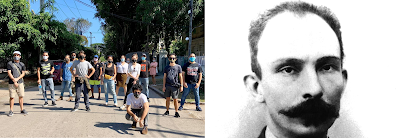
On 27J, the eve of the 168th anniversary of the birth of José Julián Martí Pérez, better known as José Martí, approximately 20 artists, journalists and intellectuals gathered to read some of his works. [...]  Preemptive arrests, an act of repudiation against gathered artists and intellectuals, the Minister of Culture Alpidio Alonso and his Vice-Minister Fernando León Jacomino, caught on camera physically assaulting nonviolent demonstrators, and the dissidents arrested and crammed into a small bus by secret police and beaten up while already detained, reported Diario de Cuba.  [ Full blog entry]


Wednesday, February 17, 2021

Celebrating real Cuban culture and the artists defying totalitarian efforts to rewrite it

Let us no longer shout "Homeland and Death" but "Homeland and Life"
 
Artists from the San Isidro Movement celebrating Cuban culture
 
 
"Totalitarianism demands, in fact, the continuous alteration of the past, and in the long run probably demands a disbelief in the very existence of objective truth," observed George Orwell in his essay, "The Prevention of Literature" in the journal Polemic, published in January 1946. Writers that refuse to go along with alteration of the past all too often pay a terrible price. This is also true for artists in other fields because totalitarians seek to control the culture. [ Full blog entry ]
 

Tuesday, March 23, 2021

Setting the record straight on Cuito Cuanavale, General Arnaldo Ochoa, and how South African democrats overcame and defeated Apartheid in 1991

Revisiting the nonviolent victory over Apartheid, Castro's genocidal crimes in Africa, and the show trial of the Cuban general that spent months battling the South African Defence forces. 

 
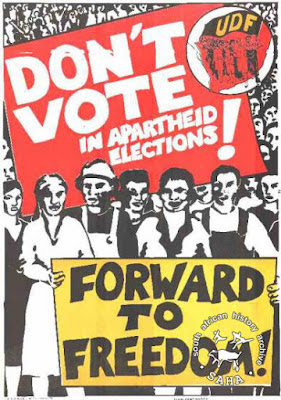
UDF boycotted elections

Communists reject nonviolence as a means to achieve lasting change, because civil disobedience to them is incompatible with Karl Marx's theory of class struggle. This is why they demonize and misrepresent Mohandas Gandhi, downplay the real events that brought an end to Apartheid in South Africa, highlight a dubious military victory in 1988 involving Cuban troops and falsely celebrate it as the agent of change. [ Full blog entry
 

Sunday, April 4, 2021

The Radical Left's Contempt for Martin Luther King Jr. in his final years

"But first He must suffer many things and be rejected by this generation." - Luke 17:25
 
MLK Jr. shot in Memphis, TN at the Lorraine Motel on 4/4/68 at 6:01pm CST

Today is Easter Sunday, but it is also the 53rd observance of the assassination of Reverend Martin Luther King Jr. On Good Friday, I quoted Reverend James Lawson, who like King is an apostle of nonviolence and a Christian pastor, said that “if you want to understand King, you must look at Jesus.” Dr. Martin Luther King Jr., like Jesus, was rejected by all.  He was rejected by conservatives, by liberals, by radicals, and by communists.  [ Full blog entry ]
 

Sunday, May 2, 2021

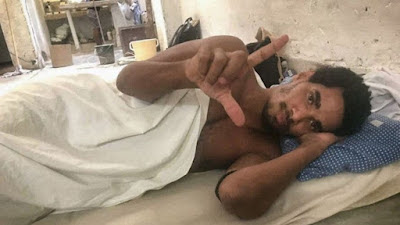
Cuban Dissident Luis Manuel Otero Alcántara on Day 8 of a hunger and thirst strike: Some context informed by past actions and nonviolence theory

"I think they kill my child every time they deprive a person of their right to think." - José Martí

 
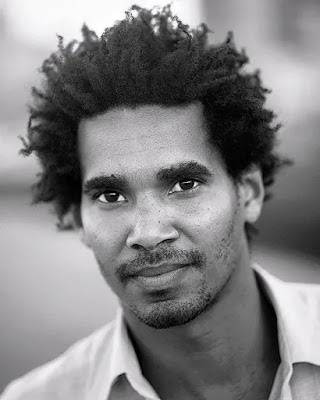
Artist and human rights defender Luis Manuel Otero Alcántara
 
Luis Manuel Otero Alcántara is on the eighth day of a hunger and thirst strike, and in increasingly poor health. He is engaged in a profound dialogue with a regime that for decades has refused to listen, to really listen, to Cuban citizens petitioning for and demanding change. This dialogue has been going on for at least three years. He has tried all types of protests, petitions, performance art pieces, and music videos in defense of freedom of expression, especially artistic expression. [ Full blog entry ]
 

Monday, June 14, 2021

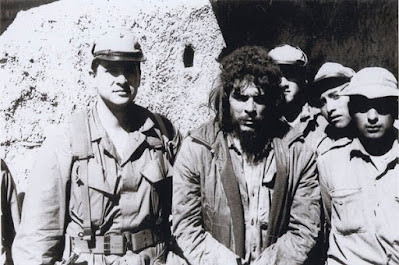
Ernesto "Che" Guevara born on this day in 1928. Nothing to celebrate.

A mass murdering racist, who dined with Mao as millions died of hunger is not someone to celebrate.

"All they that take the sword shall perish with the sword." - Matthew 26, 26:52
 
Some wish to celebrate Ernesto Guevara's birthday today. If he and his comrades had their way the world would have been subjected to a nuclear holocaust in October 1962, and they were bitterly disappointed that it did not happen.

Thankfully, John F. Kennedy and Nikita Khrushchev reached a peaceful outcome to the Cuban Missile Crisis, but the Castro regime protested it and was unhappy with their Soviet allies not launching their nuclear missiles. [ Full blog entry ]

 
Monday, July 19, 2021

#11July: One week later and nonviolent resistance continues in Cuba

For freedom and justice.

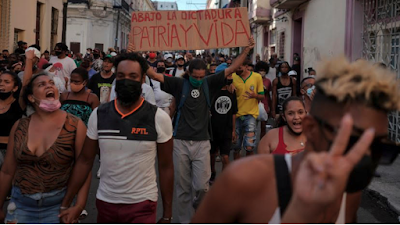
On the streets of Cuba on July 11, 2021

One week later and the protests continue, despite the most brutal efforts of the Castro regime to silence Cubans on the island. It began on July 11, 2021 in San Antonio de los Baños, just South East of Havana when Cubans took to the streets in protest. Others saw it streaming live, and also took to the street in cities and towns across the country chanting "Freedom" and "Down with the dictatorship." 

President Miguel Diaz-Canel appeared on official television threatening: "They [protesters] would have to pass over our dead bodies if they want to confront the revolution, and we are willing to resort to anything."  [ Full blog entry


Sunday, August 22, 2021

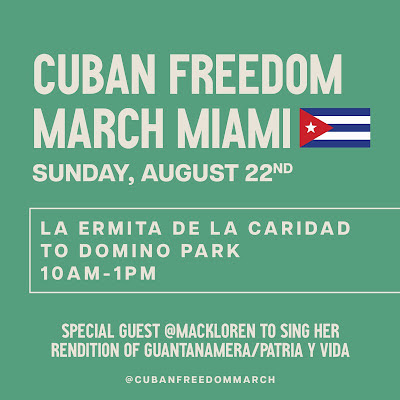
Cuban Freedom March Miami today August 22nd from 10am to 1pm: A reflection on its significance

"If there is to be any chance at all of success, there is only one way to strive for decency, reason, responsibility, sincerity, civility and tolerance, and this is decently, reasonably, responsibly, sincerely, civilly, and tolerantly" - Václav Havel 

 
The Cuban Freedom March arrives in Miami, Florida today on August 22, 2021 with a march from la Ermita de la Caridad to Domino Park. The protest starts at 10:00am. Organizers have carried out successful marches in Washington DC, and Los Angeles.

On August 11, 2021 the leader of this movement, Alian Collazo, moderated a conversation on "what's really happening in Cuba" that is necessary viewing to listen to different perspectives, from young Cuban and Cuban American voices both inside and outside of Cuba.

This is a freedom movement led by young Cubans and Cuban Americans with a presence on social media on Instagram, Facebook, and Twitter. [ Full blog entry ]

Saturday, September 11, 2021

Twenty years after 9/11: Remembering a horrible day

"Are you ready? Okay. Let's roll."—Todd Morgan Beamer, November 24, 1968–September 11, 2001


2,977 men, women and children were murdered on September 11, 2001 over the course of a few hours on a sunny Tuesday morning in three different states. The victims were distributed as follows: 246 on the four planes converted into flying missiles. Two of the planes flew into the Twin Towers which collapsed and led to the deaths of 2,606 human beings in New York City in the towers and on the ground, and a third struck the Pentagon taking 125 lives. The fourth plane, heading to Washington D.C., never arrived and crashed into an open field near Shanksville, Pennsylvania as the passengers of the flight fought the terrorists over control of the flight.  [ Full blog entry ]
 

Saturday, October 2, 2021

Join the non-violent movement for democracy and human rights in Cuba

"Use truth as your anvil, nonviolence as your hammer, and anything that does not stand the test when it is brought to the anvil of truth and hammered with nonviolence, reject it." - Mohandas Gandhi

Luis Manuel Otero Alcántara on day six of hunger strike in Cuba
 
Today in Cuba there are thousands of Cubans jailed for their nonviolent demand for an end to the Castro dictatorship expressed during the mid July 2021 protests. Hundreds have been identified that were jailed or disappeared. It is known that some have resorted to going on hunger strike to protest their unjust imprisonment. Luis Manuel Otero Alcántara is on a hunger strike that he began on September 27, 2021 and is still weak from a bout of COVID-19, and prior hunger strikes. This is part of the movement's repertoire of nonviolent tactics to resist the Castro regime. [ Full blog entry ]
 

Sunday, November 21, 2021

Testimony by John Suarez at the Transatlantic Parliamentary Forum on November 20, 2021

Transatlantic Parliamentary Forum testimony: November 20, 2021
 
Miami City Hall 
 
July 11, 2021 national nonviolent protests in Cuba marked a before and after in the history of the island. Tens of thousands of Cubans across the island demanded an end to the dictatorship, rejected the official slogan Patria o Muerte (Homeland or Death) and chanted Patria y Vida (Homeland and Life). The reaction of the dictatorship was swift and brutal. Boinas Negras (black berets) formally known as the National Special Brigade of the Ministry of the Interior, fired on unarmed protesters, and were captured on video. The dictatorship handed out clubs to regime agents to attack protesters. Thousands were detained, and hundreds remain jailed and face summary trials with prison sentences in excess of 25 years. [ Full blog entry ]
 

Tuesday, December 7, 2021

125 years ago today Antonio Maceo Grajales died fighting for Cuban independence and 31 years ago Reinaldo Arenas died after decades rebelling against the Castro dictatorship

 "My duties to country and to my own political convictions are above all human effort; with these I shall reach the pedestal of freedom or I shall perish fighting for my country's redemption." -  Antonio Maceo, November 3, 1890


Today marks the day 125 years ago on December 7, 1896 when Lieutenant General Antonio Maceo Grajales died fighting for Cuban independence.  

Today, also marks the day 31 years ago on December 7, 1990 Cuban novelist Reinaldo Arenas killed himself in New York City, after battling AIDS for several years. He was an important critic of the Castro regime, and those intellectuals who supported it. As a Gay man he also suffered discrimination because of the communist dictatorship's hostility to homosexuals. [ Full blog entry ]


Monday, May 18, 2020

Rescuing José Martí 125 years after he was shot and killed in the second war of Cuban independence

"I think they kill my child every time they deprive a person of their right to think." - José Martí 
 
Writings of José Martí twisted and distorted by Castroism since 1953.
José Julián Martí Pérez was shot and killed 125 years ago shortly after landing in Cuba at Dos Rios in the early days of the second war of Cuban independence on May 19, 1895. Both his writings and actions taking in life point to a man who prized liberty, independence based in popular sovereignty, and freedom of speech, thought and association as fundamental to his sense of being.

Martí rejected hatred as a animating emotion in the struggle for independence writing, "There is no forgiveness for acts of hatred. Daggers thrust in the name of liberty are thrust into liberty's heart." He also criticized the writings of Karl Marx, and with reason, they were antithetical to his own values. Marx in 1849 had written, "We are ruthless and ask no quarter from you. When our turn comes we shall not disguise our terrorism."

It is not a surprise that Martí saw the dangers inherent in Socialism and its doctrine of envy observing: "Socialist ideology, like so many others, has two main dangers. One stems from confused and incomplete readings of foreign texts, and the other from the arrogance and hidden rage of those who, in order to climb up in the world, pretend to be frantic defenders of the helpless so as to have shoulders on which to stand." 

José Julián Martí Pérez: 1853-1895
Sadly, the Castro regime over the past 67 years has been slowly murdering his legacy with the assistance of international institutions such as the United Nations Educational, Scientific and Cultural Organization (UNESCO). They have re-written the real Jose Marti in an Orwellian fashion to advance the communist narrative.

This is not unique to the Marxist-Leninist regime in Cuba but a common practice among communist regimes to legitimize their rule. Carlos Ripoll, an expert on the life and thought of Jose Marti in 1994 wrote in the journal Cuban Studies published by the University of Pittsburgh Press the article titled, "The Falsification of José Martí in Cuba" and provided an abstract of his argument:
"Marxist-Leninist governments have traditionally falsified history to justify their rise to power and the political systems they have imposed. In response to the worldwide collapse of Communism, Cuban authorities have intensified their adulteration of history so as to offer a nationalistic rationale for their continuation in power. The highest exponent of the revolutionary tradition in Cuba is José Marti and, therefore, the falsification of his thought and doctrines is the first priority of many historians and critics. They concentrate, in particular, on the Cuban Revolutionary party founded by Marti, which they misrepresent as a forerunner of the Cuban Communist party, the basic institution that holds the monopoly of power and consequently is responsible for all the misfortunes and injustices that afflict the country. This study shows some of the forms this falsification takes in Cuba, its objectives, and attempts to disprove the inconsistent and false arguments of those who purport to find similarities or coincidences between the free, democratic republic that Marti wished for his country and the totalitarian state there in existence." 
In a letter in 1988 to The New York Review of Books, Professor Ripoll revealed how José Martí in a letter to his friend, Valdes Dominguez, written just a year before Martí’s death, criticized the “arrogance and hidden rage” of “socialist ideology” whose adherents, “in order to climb up in the world, pretend to be frantic defenders of the helpless.”

Seven months after the 100th anniversary of the birth of the Cuban independence leader, in 1953, a failed armed attack on the Moncada barracks by Fidel Castro and a group of revolutionaries, led the future Cuban dictator,  during his trial to declare José Martí the "intellectual author" of the attack.


In 1972, the Castro regime created the "Order of Jose Marti" and over the next  48 years awarded it to dictators and war criminals such as: Alexander Lukashenko, Jiang Zemin, Xi Jinping, Kim Il-sung, Nicolae Ceaușescu, Hugo Chávez, Mengistu Haile Mariam, Robert Mugabe, Erich Honecker, Vladimir Putin, and Saddam Hussein.

The International UNESCO/José Martí Prize was instituted in November 1994 under the claim that it sought "to promote and reward an activity of outstanding merit in accordance with the ideals and spirit of José Martí." This was done with the active support of the Castro regime, and turned upside down the values of Martí.

Roberto Fernández Retamar, signed death warrant for 3 young black men in 2003.
Consider that the 2019 winner of the José Martí Prize was Roberto Fernández Retamar, Cuban poet, essayist, literary critic and President of the Castro regime's Casa de las Américas.  Mr. Fernández Retamar was also a member of the Council of State, and in 2003 he signed the death sentence that led to the execution by firing squad of three men, who had hijacked a ferry to flee Cuba.

Lorenzo Enrique Copello, Bárbaro Leodán Sevilla and Jorge Luis Martínez
The three men, Lorenzo Enrique Copello Castillo, Bárbaro Leodán Sevilla García and Jorge Luis Martínez Isaac, were part of a group that hijacked a Cuban ferry with passengers on board on April 2, 2003 and tried to force it to the United States. The incident ended without bloodshed, after a standoff with Cuban security forces. They were executed nine days later, following a summary trial, by firing squad.

They did not have a political agenda. Their only goal was fleeing Cuba to the United States.  Questions were raised at the time that if they had been white and not black they would not have been executed.

Retamar also served the agenda of the regime to distort the views of the Cuban independence leader who advocated freedom of speech and conscience, trying to turn him into a censor to fit Castroism's repressive communist ideology. An ideology that is incompatible with Martí.

Standing, left to right: Manuel de la Cruz, Jose Maceo, Guillermo Moncada.
Seated: Juan Gualberto Gomez, Jose Marti, Jose D. Poyo. Key West, Florida.

José Martí not only proclaimed racial equality but practiced it, and would have been horrified to see three young black men executed, who had not physically harmed anyone, through a summary trial and rushed execution.

Ironically, Fidel Castro, although claiming José Martí as an intellectual author of his communist revolution, is not a descendant of those who fought for Cuban independence. Castro's father, Ángel María Bautista Castro Argiz, fought for the Spanish crown and against José Martí in Cuba to preserve the empire. This reality is reflected in how he acted in Cuba once achieving power, along with his strange friendship with Francisco Franco. Both Franco, and Castro's father had fought in Cuba for Spain, and Angel, according to a 2016 Spanish documentary, had a photo of Francisco Franco on his nightstand.
Ángel Castro Argiz
Raymond Carr, one of Britain's greatest historians, found that Castroism had more in common with Francisco Franco and Primo de Rivera than with José Martí, in a 1988 letter to The New York Review of Books exposed the source of Castro's approach to the "public square."
"Having witnessed Castro’s performance at the Second Declaration of Havana I compared Castro’s use of mass meetings as a source of democratic legitimacy with the manipulation of “the constant plebiscite of public opinion” by the Spanish dictator Primo de Rivera. In the 1970s I argued that Castro, like Franco, believed in “the democracy of the public square—the endorsement of mass audiences felt directly by the dictator.” In both these cases the “democracy of the public square” was a bogus democracy since it was a rejection of any form of representative government, of the freedoms of which Martí was a passionate advocate."
 On Franco's death in 1975, Fidel Castro decreed three days of mourning in Cuba, although he made sure that it went unnoticed by the press, it was an official decree signed by Cuban president Oswaldo Dorticós. This ideological flexibility with non-communist dictatorships and their agents should not have been a surprise, Castro in the 1960s had contracted former high ranking Nazis to train his repressive forces.

Fidel Castro and Francisco Franco were close allies.
Many claims can be made about the Castro regime, but one that does not past muster is that it, in any way, embodies the values and spirit of José Julián Martí Pérez. The man who died at Dos Rios on May 19, 1895 was guided by a profound love of freedom that included the right to think, speak and associate freely.

Things that have been denied Cubans for 68 years.

These ideas expressed below by José Martí are in conflict with Castroism and cannot be reconciled. However they are in accord with the democratic Cuba that helped draft the Universal Declaration of Human Rights in 1948, and struggled for a more just and democratic order, but was overthrown by Fulgencio Batista on March 10, 1952 then destroyed systematically by Fidel and Raul Castro beginning on January 1, 1959. 
"Man loves liberty, even if he does not know that he loves it. He is driven by it and flees from where it does not exist."

"Freedoms, like privileges, prevail or are imperiled together You cannot harm or strive to achieve one without harming or furthering all."

"Liberty is the right of every man to be honest, to think and to speak without hypocrisy."

"It is the duty of man to raise up man. One is guilty of all abjection that one does not help to relieve. Only those who spread treachery, fire, and death out of hatred for the prosperity of others are undeserving of pity."  
These views exist today in Cuba, but not in the regime oppressing Cubans, but among the dissidents and the resistance defying the communist regime and embracing freedom of speech, thought and association, while rejecting hatred.

Oswaldo Paya on December 17, 2002, addressing the European Parliament in Strasbourg, declared:
"The first victory we can claim is that our hearts are free of hatred. Hence we say to those who persecute us and who try to dominate us: ‘You are my brother. I do not hate you, but you are not going to dominate me by fear. I do not wish to impose my truth, nor do I wish you to impose yours on me. We are going to seek the truth together.’" 
Less than ten years later, Oswaldo was extrajudicially executed by the Castro regime. Nevertheless this sentiment embodies the living legacy of José Martí that endures in Cuba today in the actions of the non-violent Cuban civic movement.