One resisted the Nazi occupation, the other the Fascist occupation, and two others nonviolently resisted communism. All were killed by communist regimes for not following the Party line.
 |
| Milada Horakova at her show trial in 1950 |
Milada Horáková of Czechoslovakia
Milada Horakova was hanged with three others in Prague’s Pankrac Prison
as a spy and traitor to the Communist Czechoslovakian government on June
27, 1950. She was a lawyer, social democrat, and a prominent feminist
in the interwar and postwar periods. She had been a member of the Czech
resistance to the Nazi occupation of her homeland and survived a Nazi
prison. After Czechoslovakia was liberated from the Nazis in 1945 by the
Soviets she
became a member of parliament in 1946 but resigned her seat after the
Communist coup of 1948. However she refused to abandon her country. She was arrested at her office
on September 27, 1949 "on charges of conspiracy and espionage against the state."
Totalitarian regimes are designed to crush the spirit of the individual
along with the machinery to kill large numbers of people for the sake of
some revolutionary objective. Arthur Koestler
dramatized how this machinery operates on the individual level with the show trial in the novel
Darkness at Noon.
In the typical Stalinist show trial the accused pleads guilty to all
the crimes he or she did not commit then is sentenced to some sort of
draconian punishment and gives thanks to the regime for its generosity. Torture and breaking one's spirit is common practice in these circumstances.
Even when one is able to resist and remain defiant in the face of the
physical and psychological torture the totalitarians will also rewrite
what happened and claim that they also broke you. This is what was done
to Milada Horakova. According
to Radio Prague, "For decades the communist orthodoxy maintained she had been broken by
interrogators and had renounced her beliefs."
It is important to remember that this was not a meaningless exercise in
sadism by the communists, but as in the case of Ochoa in 1989 served
what these totalitarians viewed as a necessary objective to
consolidating and maintaining power. Adam D. E. Watkins in
his 2010 paper "The Show Trial of J U Dr. Milada Horáková: The Catalyst for Social Revolution in Communist Czechoslovakia, 1950"
explains the importance of the show trial in gutting democratic traditions and replacing them with Stalinism:
The study deconstructs the show trial’s influence on inducing a country
to foster the Communist movement against decades of democratic
traditions. The research reveals the impact of the show trial of Dr.
Milada Horáková in 1950 and how it was instrumental in reforming a
society, marked the beginning of Stalinism, and ushered forth a
perverted system of justice leading to a cultural transformation after
the Communist putsch. Furthermore, the revolution truncated intellectual
thought and signified the end of many social movements – including the
women’s rights movement
According to D. E. Watkings Horáková was seen by the public as a symbol
of the First Republic and of democracy. Unlike others who did break
under the relentless psychological and physical torture she never did.
The communists tried to edit her testimony for propaganda purposes but
as Radio Prague in their
2005 report on the discovery of the unedited tapes of her trial:
[S]he faced her show trial with calm and defiance,
refusing to be broken. Audio recordings - intended to be used by the
Communists for propaganda purposes - were mostly never aired, for the
large
part because for the Party's purposes, they were unusable.
Because she refused to cooperate with the Stalinists her punishment was
particularly severe, even for the death penalty. In 2007 her prosecutor
Ludmila
Brozova-Polednova
who in 1950 had helped to condemn Horakova to death, now 86,
was tried as an accomplice to murder. During the trial
Radio Prague reported that a note written by an anonymous eye-witness to Milada Horakova's
execution quoted the young prosecutor recommending:
"Don't break her neck on the noose, Suffocate the bitch - and the
others
too." Milada Horáková was executed in
Pankrác Prison
on 27 June 1950 by a particularly torturous method: "intentionally slow
strangulation, which according to historians took 15 minutes
. She was 48 years old." The urn with her ashes was
never given to her family
nor is it known what became of them.
 |
| Milada Horáková: 25 December 1901, Prague – 27 June 1950, Prague |
In a
letter to her 16 year old teenage daughter
Milada explained why she had refused to compromise with evil. Her
daughter received the letter 40 years later after the end of communist
rule:
The reason was not that I loved you little; I love you just as purely
and fervently as other mothers love their children. But I understood
that my task here in the world was to do you good … by seeing to it that
life becomes better, and that all children can live well. … Don’t be
frightened and sad because I am not coming back any more. Learn, my
child, to look at life early as a serious matter. Life is hard, it does
not pamper anybody, and for every time it strokes you it gives you ten
blows. Become accustomed to that soon, but don’t let it defeat you.
Decide to fight.
Hours prior to her execution
she reaffirmed her position to her family:
I go with my head held high. One also has to know how to lose. That is
no disgrace. An enemy also does not lose honor if he is truthful and
honorable. One falls in battle; what is life other than struggle? (Both
quotes excerpts taken from here)
Ms. Brožová-Polednová, the prosecutor,
was found guilty
and sentenced to six years in prison in 2008 but was given a
presidential pardon by Vaclav Klaus on humanitarian grounds one year and
six months into her sentence and released in 2010. The former
prosecutor defended her actions claiming that what she did was legal and
that she was "following orders." She tried to
appeal her conviction at the Strasbourg Court in 2011 and lost.
June 27th, the day of
Milada Horakova's execution is now recognized
in the Czech Republic as “Commemoration day for the victims of the
Communist regime.”
 |
| Emperor of Ethiopia Haile Selassie I |
Haile Selassie of Ethiopia
Emperor of Ethiopia Haile Selassie I was
believed to be the reincarnation of Jesus Christ.
Selassie had served first as regent of Ethiopia from 1916 to 1930 and
was emperor from 1930 to 1974. He was the heir to a dynasty that traced
its origins to the 13th century, and from there by tradition back to
King Solomon and the Queen of Sheba. At the
League of Nations in 1936,
Emperor Selassie condemned the use of
chemical weapons by Fascist Italy against the people of Ethiopia. Ethiopia was the one independent African state during a time when the rest of the continent was under colonial rule. H.I.M. Haile Selassie , the lion of Judah, resisted the Fascist invasion of
his homeland Ethiopia and warned the world of its threat when he
addressed the League of Nations. He would go into exile in Great Britain but returned home after the defeat of the fascists.
Emperor Haile Selassie's
internationalist views led to Ethiopia becoming a charter member of
the United Nations, and his political thought and experience in
promoting multilateralism and collective security are still viewed as
part of his enduring legacy. Despite inspiring the
founding of a religion that today has up to 800,000 followers he remained an Ethiopian Orthodox Christian until his death.
 |
| Raul Castro & Fidel Castro with close ally Mengistu Haile Mariam |
Emperor Haile Selassie was deposed in a
communist military coup and it is believed that the officers smothered him and that Mengistu Haile Mariam:
"ordered the emperor's body to be buried head down in the palace and
had a lavatory erected over the grave so that he could express daily
his contempt for the monarch."
Winston Churchill had described
Emperor of Ethiopia Haile Selassie I as "the only enlightened Abyssinian prince." In December 1994
The New York Times reported that
an Ethiopian court described "how Emperor Haile
Selassie was 'strangled in his bed most cruelly' in 1975 by order of
the leaders of a Marxist military coup."
Less than a decade after
Mengistu fled into exile on November 5, 2000, Haile Selassie was given an
Imperial funeral by the Ethiopian Orthodox church. Bob Marley's widow,
Rita Marley, participated in the funeral.
 |
| Laura Pollán, founding leader of the Ladies in White |
Laura Inés Pollán of Cuba
Laura Inés Pollán Toledo was a courageous woman who spoke truth
to power and protested in the streets of Cuba demanding an amnesty for
Cuban political prisoners. A woman
who had been a school teacher, before her husband was jailed for his independent journalism in 2003.
Laura Pollán became a dissident when her husband Hector Maseda was imprisoned during
the Black Cuban Spring of 2003 along with more than 75 other activists and civil society members. She was
one of the founders of the Ladies in White and challenged the
Castro regime on the streets of Cuba. Following brutal repression in an
effort to prevent them from marching through the streets of Havana Laura
Pollan directly and nonviolently challenged the regime:
"We will never give up our protest. The authorities have three options — free our husbands, imprison us or kill us.
Despite all the efforts of the Cuban communist dictatorship that
has a monopoly over force and the mass media in Cuba, Laura was able
with a
small group of courageous women
to take to the streets and demonstrate. Not once or twice but on a
weekly basis since her husband was unjustly imprisoned in March of 2003.
The dictatorship did everything they could to stop them, including
brute violence. Bruises and broken bones did not deter these ladies and
they continued marching with casts and slings.
Over a 100,000 people dressed in white took
to the streets in Miami in the spring of 2010 to protest the violence against these women led by Gloria Estefan,
who had organized the demonstration in solidarity with this movement.
 |
| Laura's husband marches with Ladies in White carrying image of his murdered wife |
In the
summer of 2010 the dictatorship finally began the process of releasing the bulk of the remaining prisoners of conscience from the group of the 75 and the last of them were released in the spring of 2011. Unfortunately, there were
new prisoners of conscience whose release the Ladies in White would continue to demand. Laura
recognized that
"[a]s long as this government is around there will be prisoners because
while they've let some go, they've put others in jail. It is a
never-ending story."
Five days before she became suddenly deathly ill,
as the violence and threats escalated, she let the dictatorship know
that: "We are not going to stop. If they have imprisoned our sisters
thinking that we would give up, they are mistaken. We are very united
(...) all the women's movements are very close."
On October 14, 2011, Laura Pollan, one of the founders of the human
rights movement the Ladies in White died after years of suffering
physical and psychological assaults
against her person. Finally, she would become a victim of the Cuban
healthcare system that following the Castroite dictum of inside the
revolution everything outside of it nothing - would suffer and die in a
matter of days while under the supervision of doctors who were
revolutionaries first and doctors second. A Cuban doctor, who reviewed her case file, described it as a
death by purposeful medical neglect
 |
| Nobel Laureate Liu Xiaobo who died imprisoned in China in 2017 |
Liu Xiaobo of China
Nonviolent dissident, scholar and
Nobel Peace Prize Laureate Liu Xiaobo was sentenced to 11 years in prison
for the crime of speaking. He had already been jailed
for more than a year for being one of the authors of Charter 08 that sought to gather signatures in a petition calling on the Chinese regime
to gradually shift toward democracy.
Liu Xiaobo had played a prominent role in the June 1989 protests in
Tiananmen Square engaging in a hunger strike that he mentioned in a
statement he made on December 23, 2009 during the political show trial
he was being subjected to:
But I still
want to say to this regime, which is depriving me of my freedom, that I
stand by the convictions I expressed in my "June Second Hunger Strike Declaration" twenty years ago ‑ I have no enemies and no hatred. None of
the police who monitored, arrested, and interrogated me, none of the
prosecutors who indicted me, and none of the judges who judged me are my
enemies. Although there is no way I can accept your monitoring,
arrests, indictments, and verdicts, I respect your professions and your
integrity, including those of the two prosecutors, Zhang Rongge and Pan
Xueqing, who are now bringing charges against me on behalf of the
prosecution. During interrogation on December 3, I could sense your
respect and your good faith.
Hatred can rot away at a person's intelligence and conscience. Enemy
mentality will poison the spirit of a nation, incite cruel mortal
struggles, destroy a society's tolerance and humanity, and hinder a
nation's progress toward freedom and democracy. That is why I hope to be
able to transcend my personal experiences as I look upon our nation's
development and social change, to counter the regime's hostility with
utmost goodwill, and to dispel hatred with love.
Chinese Dissident Liu Xiaobo was arrested on June 23, 2009 and charged
with “inciting subversion of state power” for co-authoring
Charter 08, a
declaration calling for political reform, greater human rights, and an
end to one-party rule in China that has been signed by hundreds of
individuals from all walks of life throughout the country. On December
25, 2009 Liu Xiaobo was sentenced to 11 years in prison and two years'
deprivation of political rights. The Beijing High Court rejected his
appeal on February 11, 2010."
 |
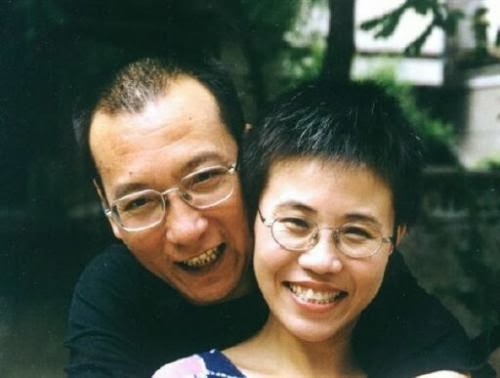
| Liu Xiaobo with his wife, Liu Xia |
On January 19, 2010 Havel met with the Executive Director of Human Rights in China, Sharon Hom, and
engaged her in a dialogue/interview about Liu Xiaobo, Charter 08 and the struggle for democratic reform in China. When asked about the similarities between China today and Czechloslovakia in 1977
explained that:
The
similarities, I would say, are in the basic structure of human rights
reflected in a democratic system, which of course the regime doesn’t
want. The regime wishes for the dictatorship of one party. I think this
is where Charter 08 and Charter 77 are similar: they have similar targets and similar messages to deliver to the [respective] regimes.
On February 3, 2010 both
Czech and Slovak members of parliament nominated Liu Xiaobo for the Nobel Peace Prize. The nomination was also
endorsed by Vaclav Havel and many of the former spokespersons of Charter 77. The 2009
Nobel Prize in Literature laureate,
Herta Müller, in a letter to the Nobel Foundation on behalf of Liu Xiaobo wrote:
I
have urgent request to make to you today. As you know, Vaclav Havel
nominated the Chinese writer Liu Xiaobo for the Nobel Peace Prize
2010.[...]I, too, believe that Liu Xiaobo deserves the Nobel Peace Prize
because in the face of countless threats from the Chinese regime and
great risk to his life, he has fought unerringly for the freedom of the
individual.
Eight months after the rejection of his appeal on October 8, 2010 the
Nobel Committee in Norway awarded this Chinese dissident and Amnesty International prisoner of conscience the
Nobel Peace Prize despite
threats from the Chinese regime.
As December 10th, the day for the ceremony to recognize the 2010 Nobel
Peace Prize Laureate Liu Xiaobo, approached the Chinese regime engaged
in a
human rights crackdown
in Mainland China. Neither he or his wife, Liu Xia, who has been kept
under house arrest, were allowed to attend. The actress Liv Ullman
read the final statement that Liu Xiaobo read out at his December 2009 trial titled: "
I Have No Enemies: My Final Statement" already mentioned and cited above.
Unjustly imprisoned for over eight years China's Nobel Peace Prize Laureate Liu Xiabo was seriously ill in mid 2017 and
although granted medical parole continued to be arbitrarily detained, although in a hospital diagnosed
with terminal liver cancer his access and movement continued to be restricted. His wife, Liu Xia said that her husband, according to
The Guardian,
"cannot be given surgery, radiotherapy or chemotherapy," allegedly
"because the cancer is so advanced." Chinese Human Rights Defenders
reports that individuals in custody, like Liu Xiaobo, had been denied
medical treatment in what is a
life threatening form of torture.
Liu Xiaobo died on July 13, 2017. Four days later on July 17, 2017 the man who had received the Nobel Prize on Xiaobo's behalf in Oslo, Dr. Yang Jianli in Washington, DC, at the monument to the Victims of Communism in an
act of remembrance, spoke of his friend and the culpability of the Chinese communist regime.
In April 1989, when the Tiananmen democracy movement
just broke out, he returned to Beijing from New York and became the most
important intellectual leader of the movement. After the Tiananmen
Massacre, he shouldered both moral and political responsibilities and
continued to fight from inside China while many others left the country
and even abandoned the movement. He was in and out prison and spent half
of the past 28 years after the Tiananmen Massacre in incarceration.
Never wavering in spirit, he shared the sufferings of his compatriots
and gave his life for them. He is a martyr and saint. Yes. Liu Xiaobo is a martyr and saint who possesses a moral authority
that his persecutors can only envy. His legacy of love, justice, peace
and sacrifice will surely far outlive the deeds of those who persecuted
him. That is exactly why the leaders of China are so afraid of him, so
afraid of his words and deeds, and so afraid of his legacy. They are
afraid of the inevitable comparison between Liu Xiaobo’s Chinese dream
and Xi Jinping’s; they are afraid of the unavoidable likening of the
Chinese Communist regime to the Nazis regime because Liu Xiaobo has been
the first Nobel Peace Prize winner who died under confinement since
Carl von Ossietzky, a German pacifist and an opponent of the Nazis, who
died in 1938.
Milada Horakova, a feminist, was a member of the Czech resistance to Nazism. H.I.M. Haile Selassie , the lion of Judah, resisted the Fascist invasion of
his homeland Ethiopia and warned the world of its threat. Laura Inés Pollán Toledo was a school teacher, turned human rights activist, to free her husband, a journalist jailed for his writings. Liu Xiaobo was a literary critic, poet and human rights activist who advocated for nonviolent change in his homeland. He was also a Nobel Peace Prize laureate. They were all murdered by communist regimes.through explicit executions or purposeful medical neglect.
We must not forget them or stop demanding justice for them and their cause.








 Posts
Posts

